
Life, 1890-09-25 · page 6 of 14
Life — September 25, 1890 — page 6: what you’re looking at
What you’re looking at
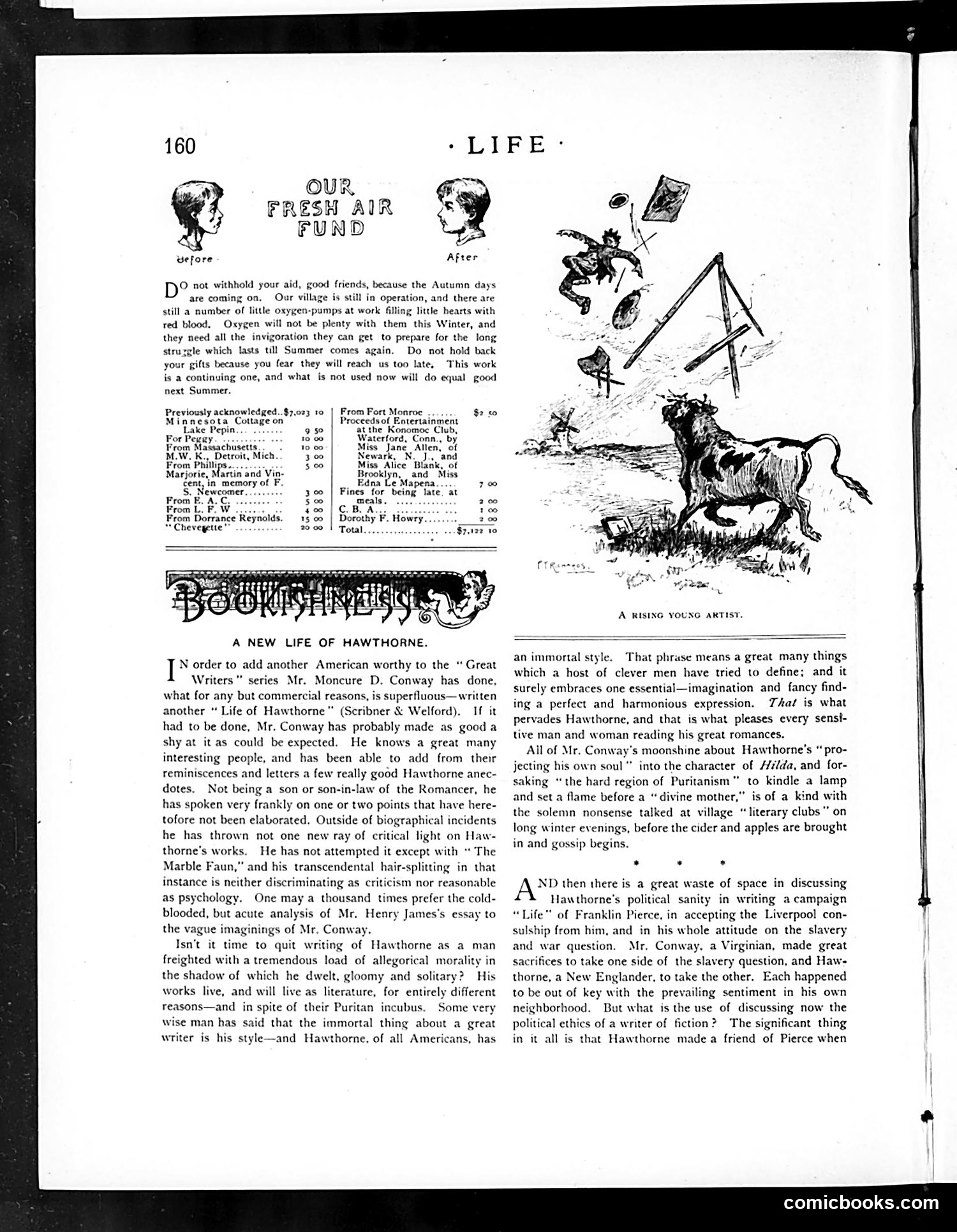
The page contains two distinct elements: **Upper left:** A fundraising appeal for a Fresh Air Fund, showing a boy "before" and "after" receiving outdoor air exposure. The text urges donations to send children to camps, noting these efforts are "continuing one, and what is not used now will do equal good next Summer." This reflects Progressive-era charitable concerns about urban children's health. **Right side:** "A Rising Young Artist" depicts a young person sketching outdoors with insects and animals, satirizing artistic pretension or perhaps the romanticization of nature study among aspiring artists. **Lower section:** A lengthy essay about Nathaniel Hawthorne's literary legacy, discussing Moneure D. Conway's new biography. The piece analyzes Hawthorne's style and political views, particularly regarding slavery and Franklin Pierce.
📄 Transcribed text from this page (OCR, searchable)
Machine-transcribed from the original scan — historical spelling and the odd misread are preserved.
FRESH AIR FUND Before DO net withhold your aid, good friends, because the Autumn days are coming on, Our village is still in operation, and there are still a number of little oxygen-pumps at work filling little hearts with red blood. Oxygen will not be plenty with them this Winter, and they need all the invigoration they can get to prepare for the long struggle which lasts till Summer comes again. Do not hold back your gifts because you fear they will reach us too late, This work is a continuing one, and what is not used now will do equal good next Summer. Previously acknowledged..$7,023 10 | From Fort Monroe Minnesota Cottage on Proceedsof Entertainment Lake Pepin. | atthe Konomoe Club, For Peggy. v.esc.s Waterford, Conn., by From Massachusetts... Miss Jane Allen, of M.W. K., Detroit, Mich. Newark, N. J., ‘and From Phillips. Miss Alice Blank, of Marjorie, Martin and Vin- Brooklyn, and Miss in memory of F. Edna Le Mapena.... S. Newcomer, 2 Fines for being late. at From E. A.C, meals. .... From L. F. W i COBB AGS sss coleves From Dorrance Reynolds. Dorothy F. Howry... * Chevegette” A NEW LIFE OF HAWTHORNE. N order to add another American worthy to the “ Great Writers” series Mr. Moncure D. Conway has done, what for any but commercial reasons, is superfluous—written another “ Life of Hawthorne” (Scribner & Welford), If it had to be done, Mr. Conway has probably made as good a shy at itas could be expected. He knows a great many interesting people, and has been able to add from their reminiscences and letters a few really good Hawthorne anec- dotes. Not being a son or son-in-law of the Romancer, he has spoken very frankly on one or two points that have here- tofore not been elaborated. Outside of biographical incidents he has thrown not one new ray of critical light on Haw- thorne’s works. He has not attempted it except with “ The Marble Faun,” and his transcendental hair-splitting in that instance is neither discriminating as criticism nor reasonable as psychology. One may a thousand times prefer the cold- blooded, but acute analysis of Mr. Henry James's essay to the vague imaginings of Mr. Conway. Isn't it time to quit writing of Hawthorne as a man freighted with a tremendous load of allegorical morality in the shadow of which he dwelt, gloomy and solitary? His works live, and will live as literature, for entirely different reasons—and in spite of their Puritan incubus. Some very ¢ man has said that the immortal thing about a great writer is his style—and Hawthorne, of all Americans, has A RISING YOUNG ARTIST. an immortal style. That phrase means a great many things which a host of clever men have tried to define; and it surely embraces one essential—imagination and fancy find- ing a perfect and harmonious expression, That is what pervades Hawthorne, and that is what pleases every sensi- tive man and woman reading his great romances. All of Mr. Conway's moonshine about Hawthorne's “ pro- jecting his own soul” into the character of A/#/da, and for- saking “the hard region of Puritanism" to kindle a lamp and set a flame before a “divine mother,” is of a kind with the solemn nonsense talked at village “literary clubs” on long winter evenings, before the cider and apples are brought in and gossip begins. . . . ND then there is a great waste of space in discussing Hawthorne's political sanity in writing a campaign “Life” of Franklin Pie! in accepting the Liverpool con- sulship from him, and in his whole attitude on the slavery and war question. Mr. Conway, a Virginian, made great sacrifices to take one side of the slavery question, and Haw- thorne, a New Englander, to take the other, Each happened to be out of key with the prevailing sentiment in his own neighborhood. But what is the use of discussing now the political ethics of a writer of fiction? The significant thing in it all is that Hawthorne made a friend of Pierce when comicbooks.com