
A complete issue · 14 pages · 1890
Life — July 10, 1890
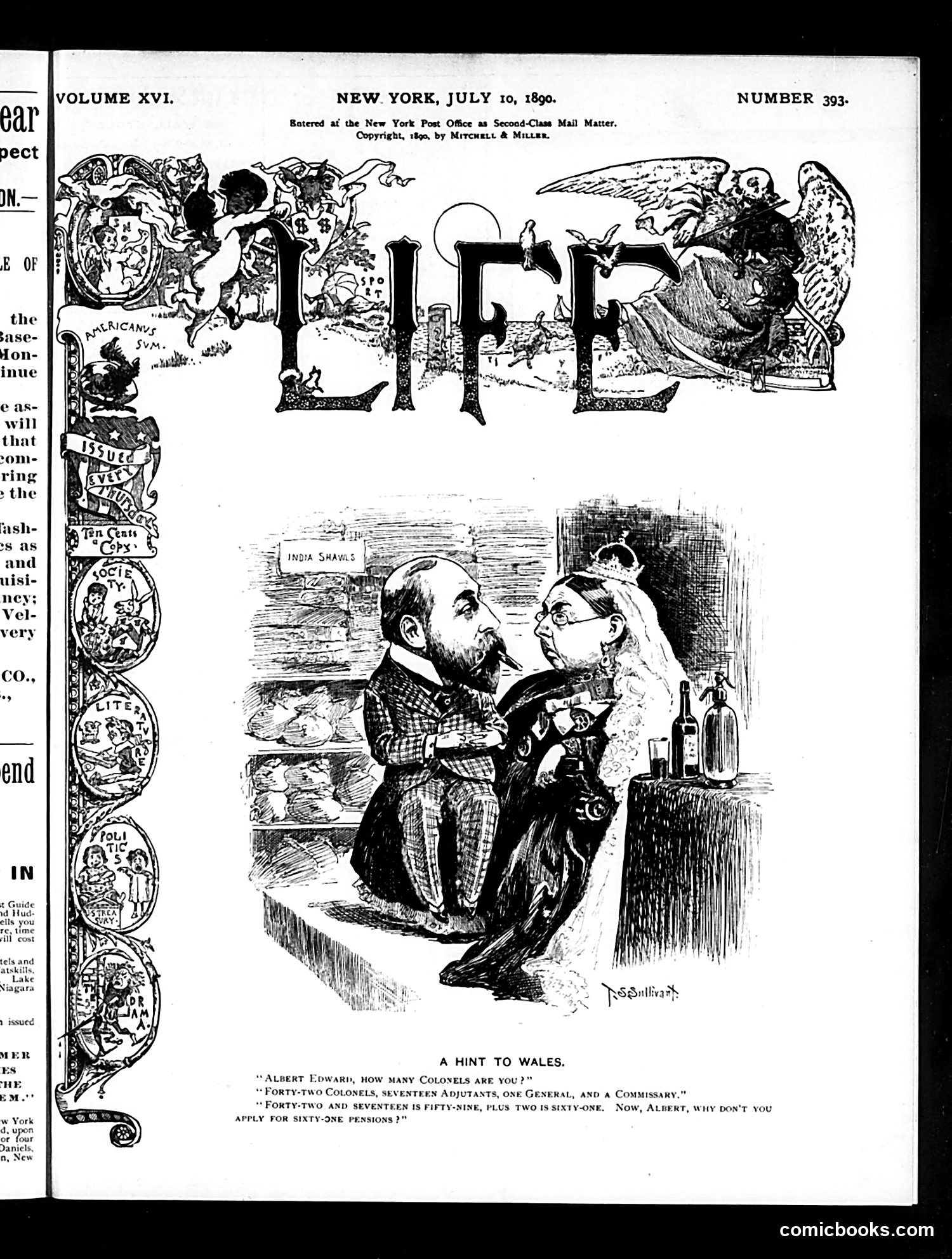
**"A Hint to Wales"** depicts a domestic quarrel between two men in what appears to be a bedroom or private quarters, with bottles visible, suggesting drunkenness or excess. The caption references "Albert Edward" (the Prince of Wales, later Edward VII) and poses a mathematical riddle about colonels, adjutants, a general, and a commissary—asking why he doesn't "apply for sixty-one pensions." This is political satire attacking the Prince of Wales for perceived profligacy and financial irresponsibility. The "hint" sarcastically suggests he accumulate multiple military pensions. The domestic scene likely alludes to scandalous personal behavior. The specific riddle structure and "sixty-one" reference suggest a particular contemporary controversy, though the exact incident remains unclear without additional context.
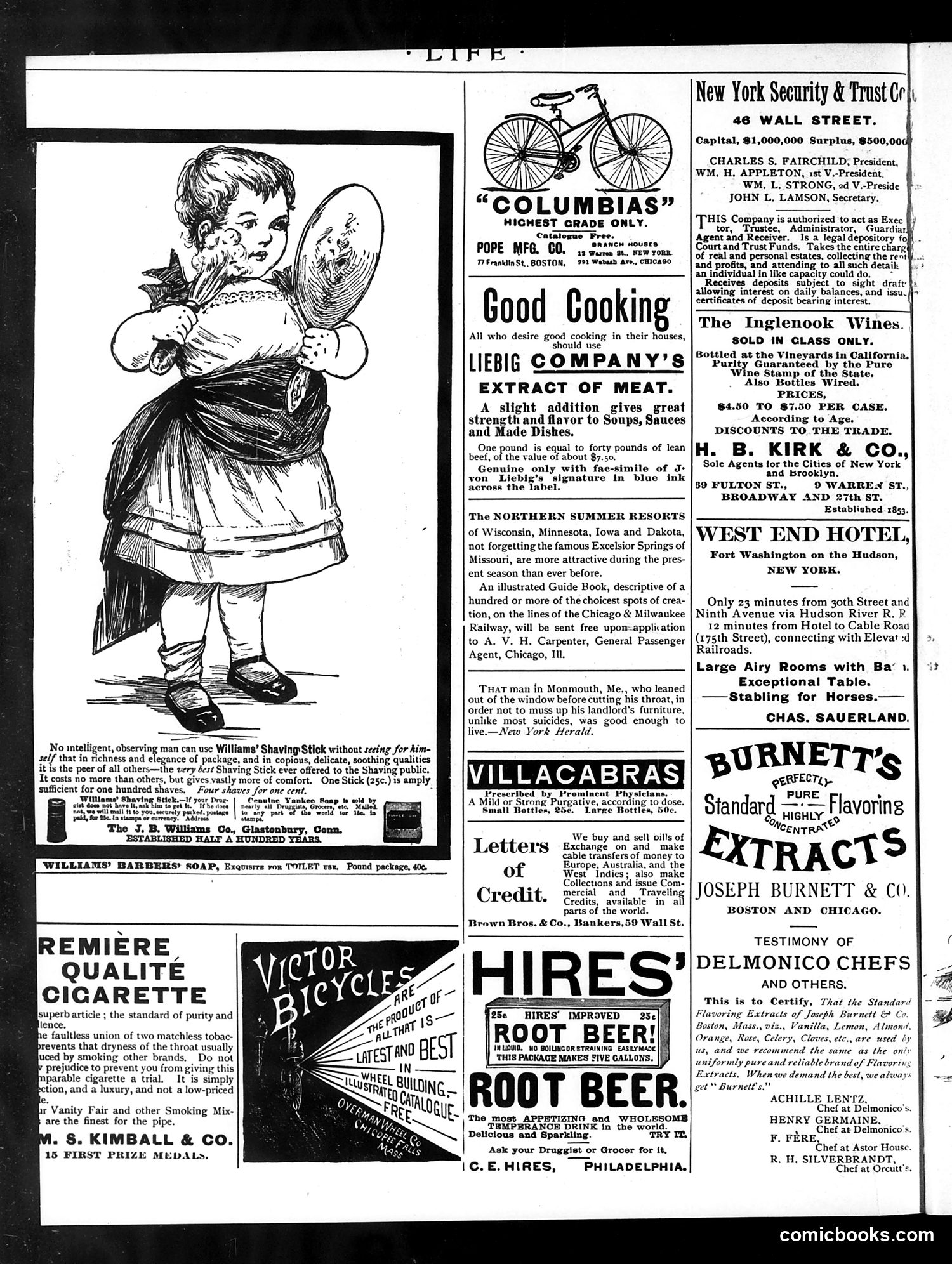
This page is **primarily advertising** with one prominent illustration on the left side. The main cartoon shows a **baby or cherub in classical style**, depicted with exaggerated musculature holding what appears to be a shaving stick. The accompanying text emphasizes "Williams' Shaving Stick" as a product combining "richness and elegance of package" with practical grooming benefits. The satire appears mild—using an idealized infant figure to humorously endorse a men's grooming product, playing on the contrast between childlike innocence and masculine vanity. The remaining page contains advertisements for bicycles (Columbias), wines, hotels, food extracts, and root beer—typical turn-of-the-century commercial content with no apparent political messaging or social commentary beyond standard product promotion.
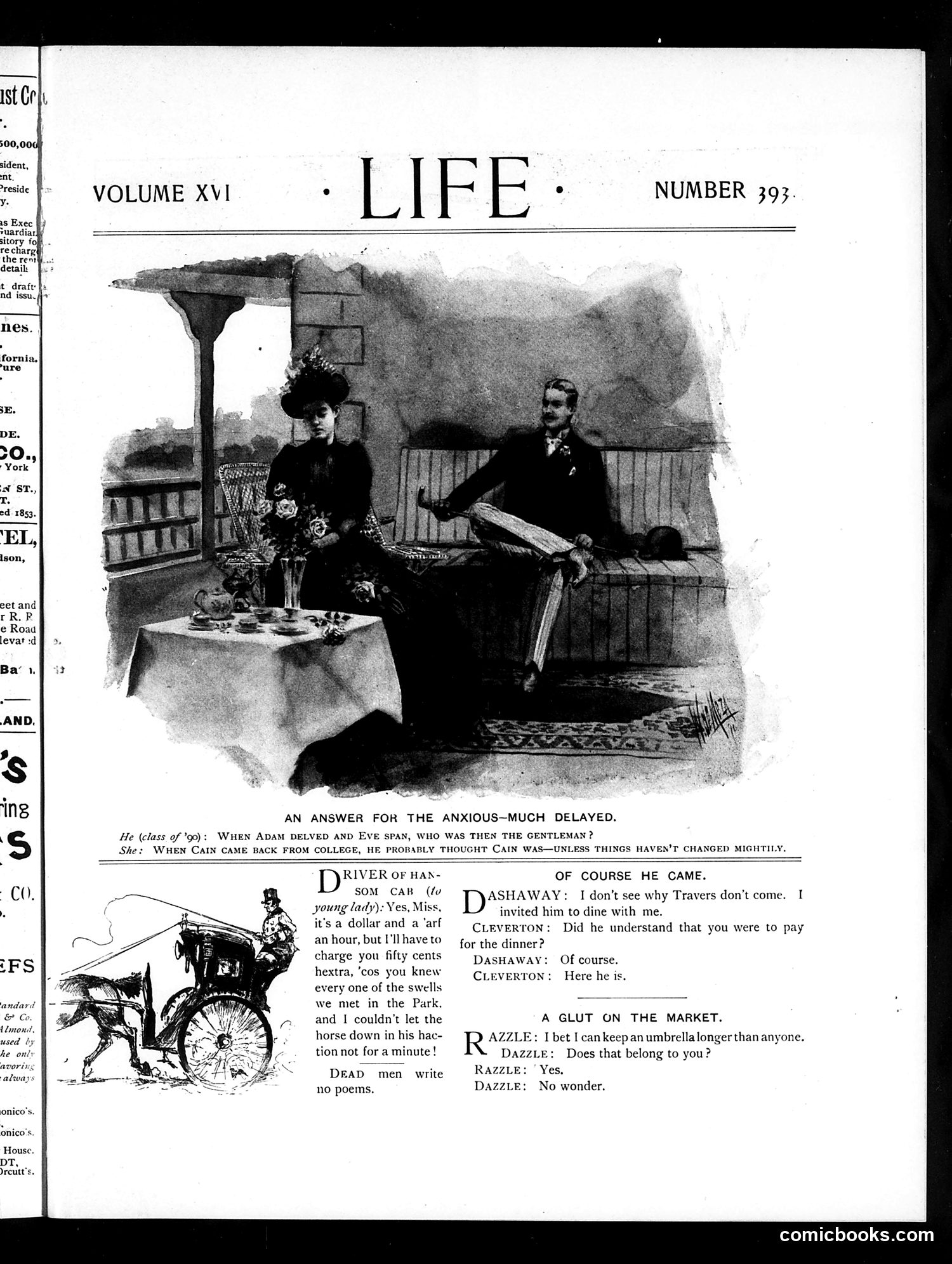
This page contains humorous dialogue pieces rather than political cartoons. The main illustration shows two figures on a terrace discussing delayed social visits—likely referencing common excuses for avoiding social obligations. The dialogues below address mundane social situations: a hansom cab driver's complaint about fare collection, and a dispute over umbrella ownership. The text jokes reference "River of Hansom Cab" (a contemporary serial novel), "Adam and Eve," and "Cain"—creating wordplay about familiar cultural references. The illustration of a man with a horse-drawn cab represents working-class humor about urban transportation economics. Overall, this appears to be a humor/advice column page rather than political satire, focused on relatable domestic and social inconveniences of the era.
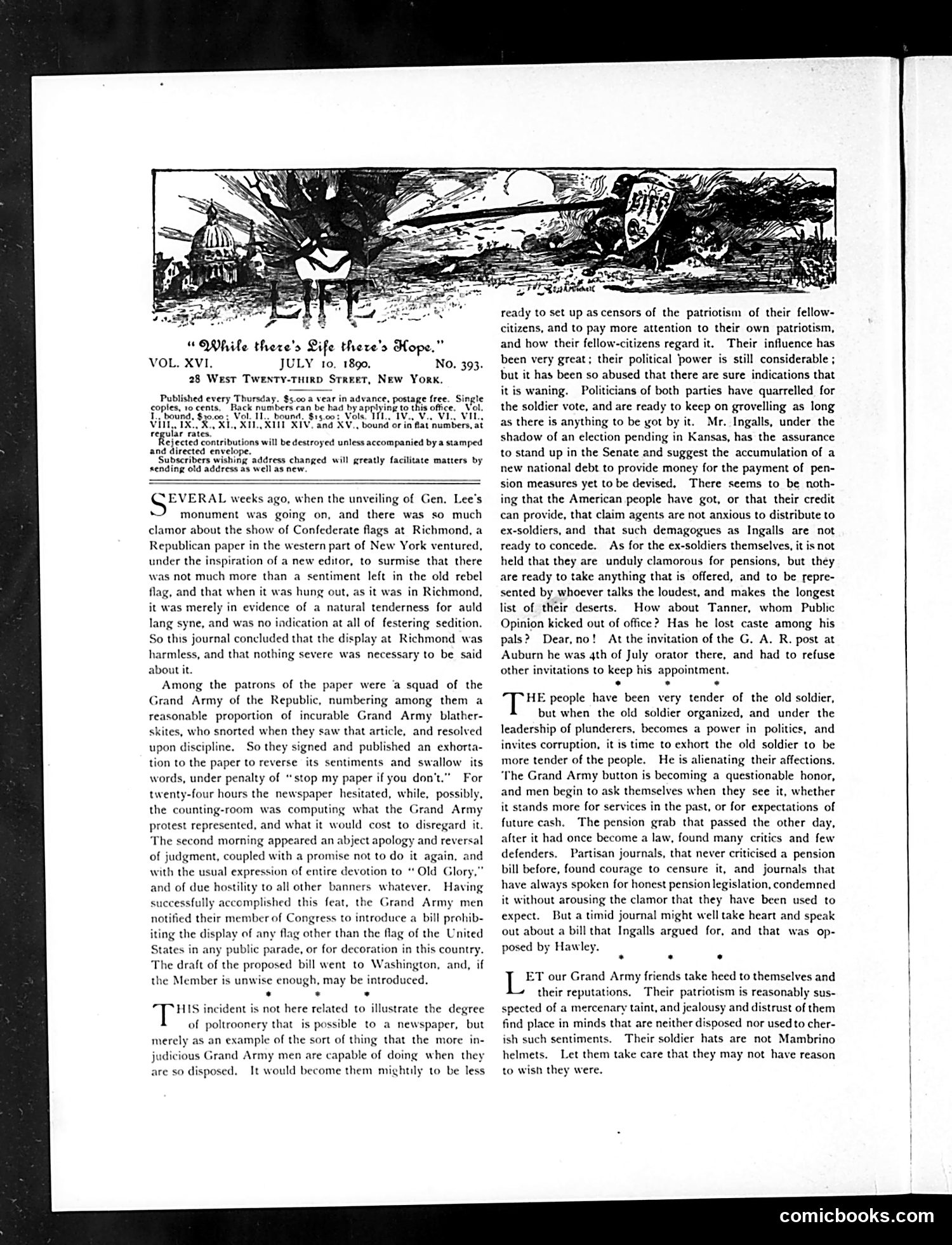
The page features editorial commentary on the recent unveiling of a General Lee monument in Richmond and controversies surrounding Confederate flag displays. The cartoon at the top (title: "While there's Life there's Hope") appears to depict allegorical figures in a landscape, though specific identities are unclear from the image alone. The text discusses Republican concerns about Civil War veteran organizations becoming political instruments. It criticizes the "Grand Army of the Republic" for alleged politicization and references debates over pension bills and monument displays. The piece warns that honoring veterans risks corruption when veterans' groups gain political power, particularly regarding flag displays and public commemorations in post-Reconstruction America. The satire targets both the militarization of politics and veterans' organizations' expanding influence on national policy.
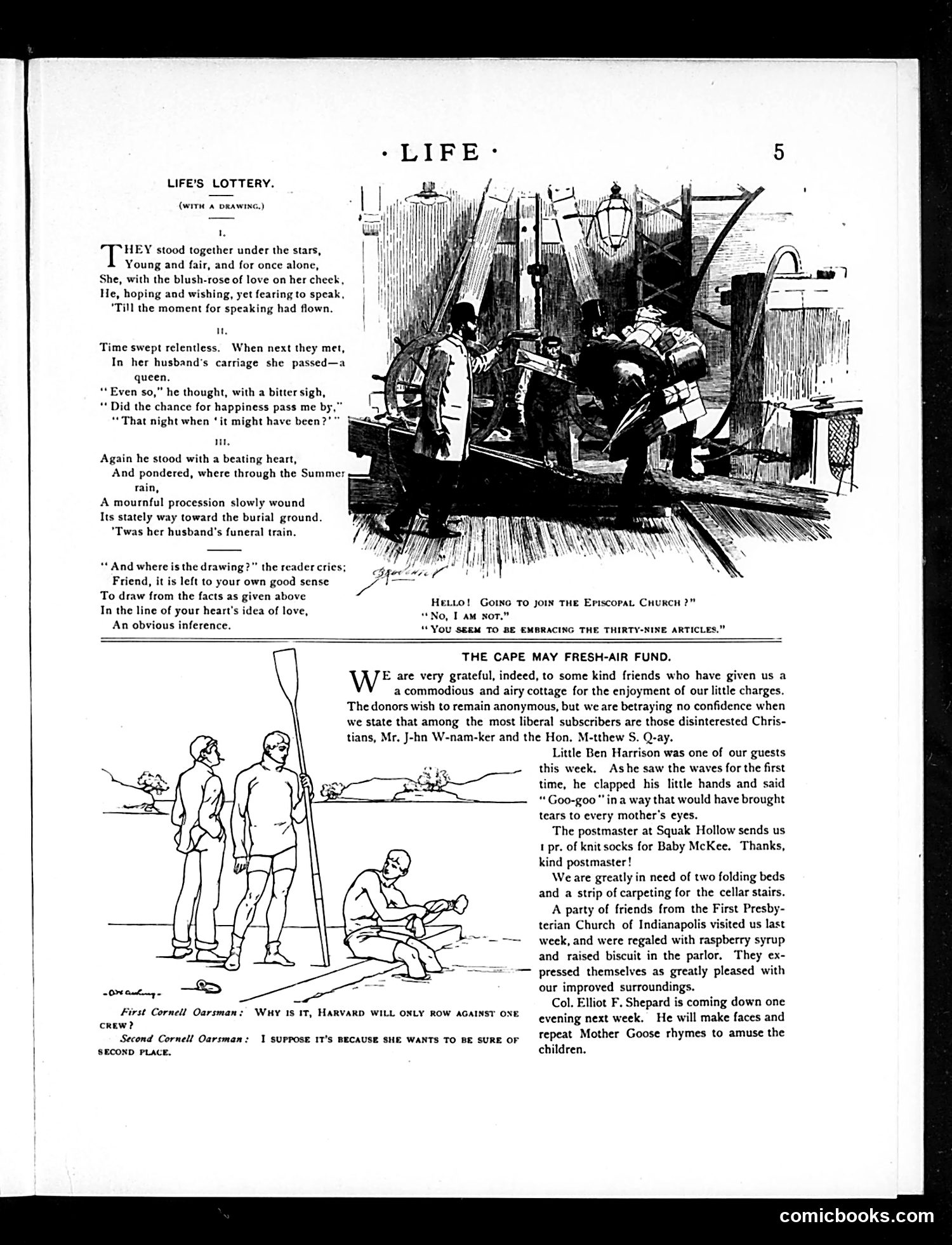
**"Life's Lottery" (Poem with Drawing)** A sentimental narrative poem about a young couple's brief romantic encounter, followed by the man's death. The accompanying sketch depicts a funeral procession, illustrating the poem's tragic arc. This is straightforward Victorian-era sentimentality rather than satire. **Rowing Cartoon** Two men discuss why "Harvard will only row against one crew." The punchline—that she wants to ensure second place—appears to mock either women's athletic participation or a specific women's crew team's competitive record. The humor relies on assumptions about female athletic inferiority typical of early 20th-century attitudes. **"The Cape May Fresh-Air Fund"** This section announces charitable donations for a children's summer cottage, listing donor names and describing children's activities.
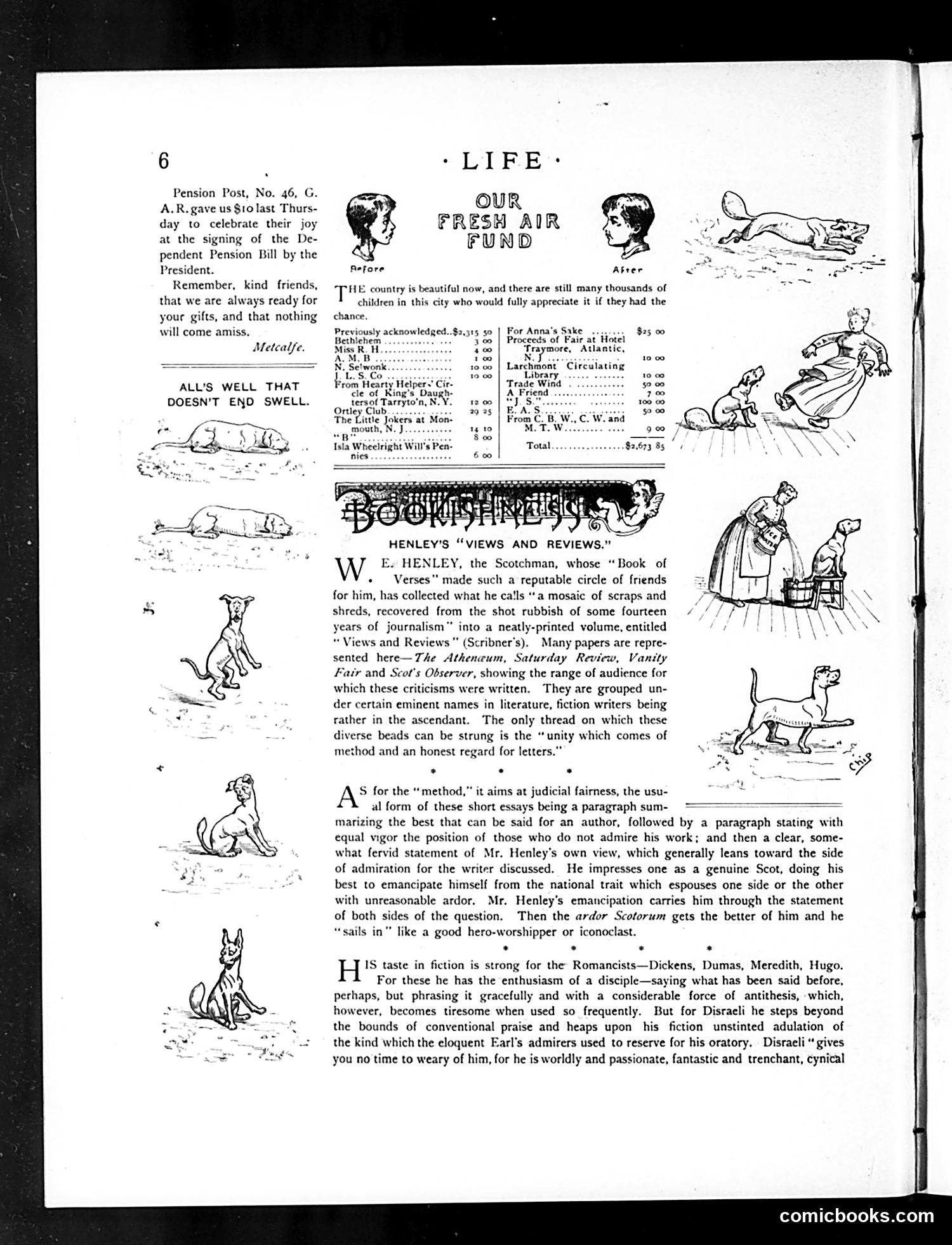
This page contains primarily **literary criticism** rather than political cartoons. The main article is "Henley's 'Views and Reviews,'" discussing Scottish writer W.E. Henley's collected critical essays from various publications. The **small cartoon illustrations** on the left show **dogs in various poses and situations**—sleeping, jumping, standing. These appear to be humorous filler illustrations rather than satirical commentary, likely accompanying a section titled "All's Well That Doesn't End Swell" (a play on the Shakespeare title). The right side features "Our Fresh Air Fund," a charitable fundraising appeal listing donations for children's outdoor recreation, with illustrated children enjoying outdoor activities. This is primarily a **content/literary page** rather than political satire.
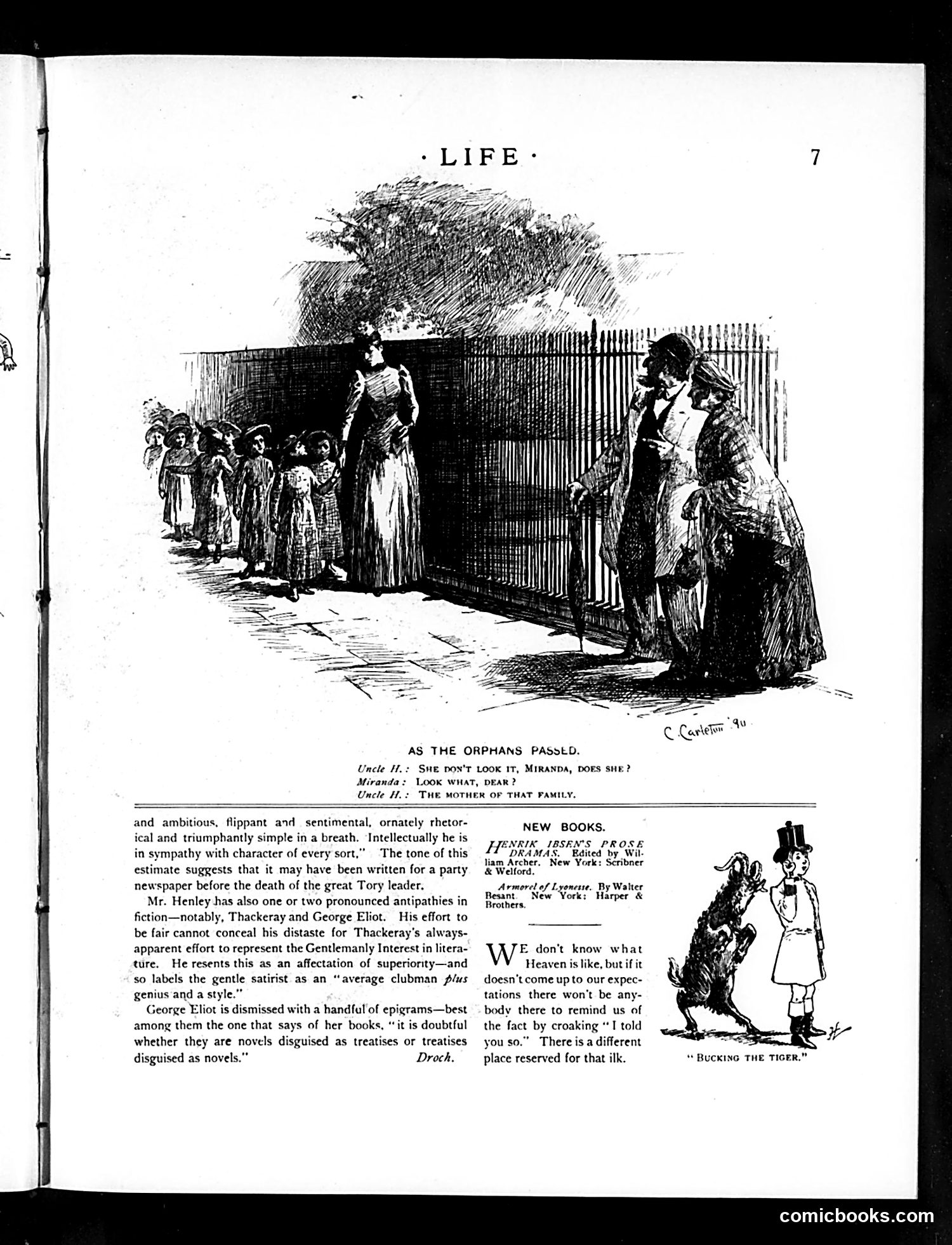
**Main Cartoon: "As the Orphans Passed"** This illustration depicts a wealthy woman and gentleman observing a line of poor children passing by a fence. The dialogue reveals the satirical point: Uncle H. asks if Miranda is looking at them, and she responds dismissively that she's looking at "what, dear?"—implying the orphans are beneath her notice. Uncle H. then identifies them as "the mother of that family," suggesting these are destitute children. The satire targets upper-class indifference to poverty and orphaned children during this era. The well-dressed figures' casual disregard for visible human suffering exemplifies Gilded Age social callousness that Life magazine frequently criticized. The cartoon mocks both the wealthy's obliviousness and their defensive rationalization of inequality.
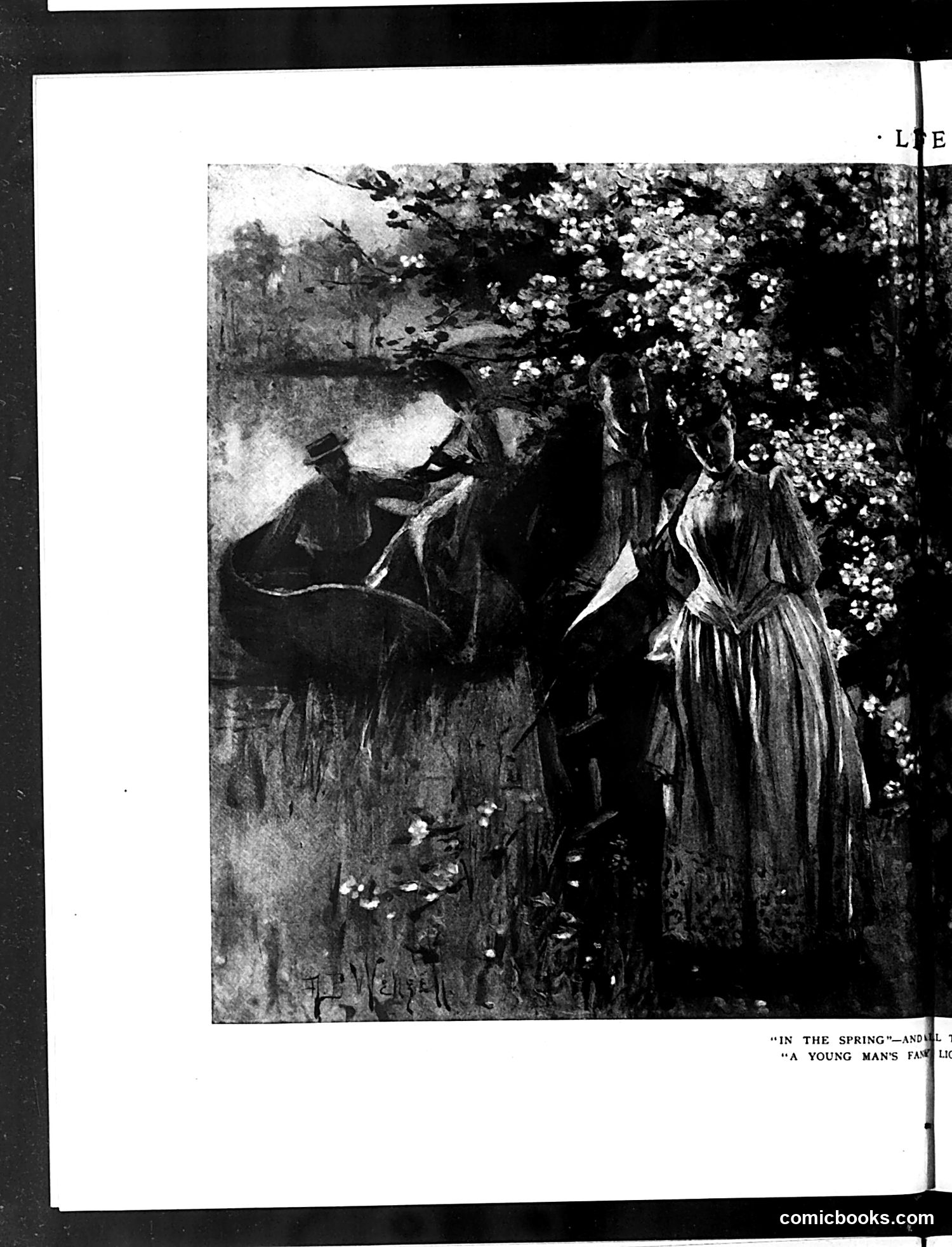
This appears to be a romantic illustration rather than political satire. The image shows two figures in a pastoral spring setting by water, surrounded by flowering branches. The woman wears a long dress typical of early 20th-century fashion, while the man is dressed formally. The caption reads "IN THE SPRING"—AND... "A YOUNG MAN'S FANCI..." (text cut off, likely "A Young Man's Fancy"), referencing the old saying "A young man's fancy lightly turns to thoughts of love" in springtime. This is sentimental, romantic content rather than social or political commentary. *Life* magazine included such illustrations alongside its satirical cartoons. The specific artist and any deeper meaning remain unclear from the visible page.
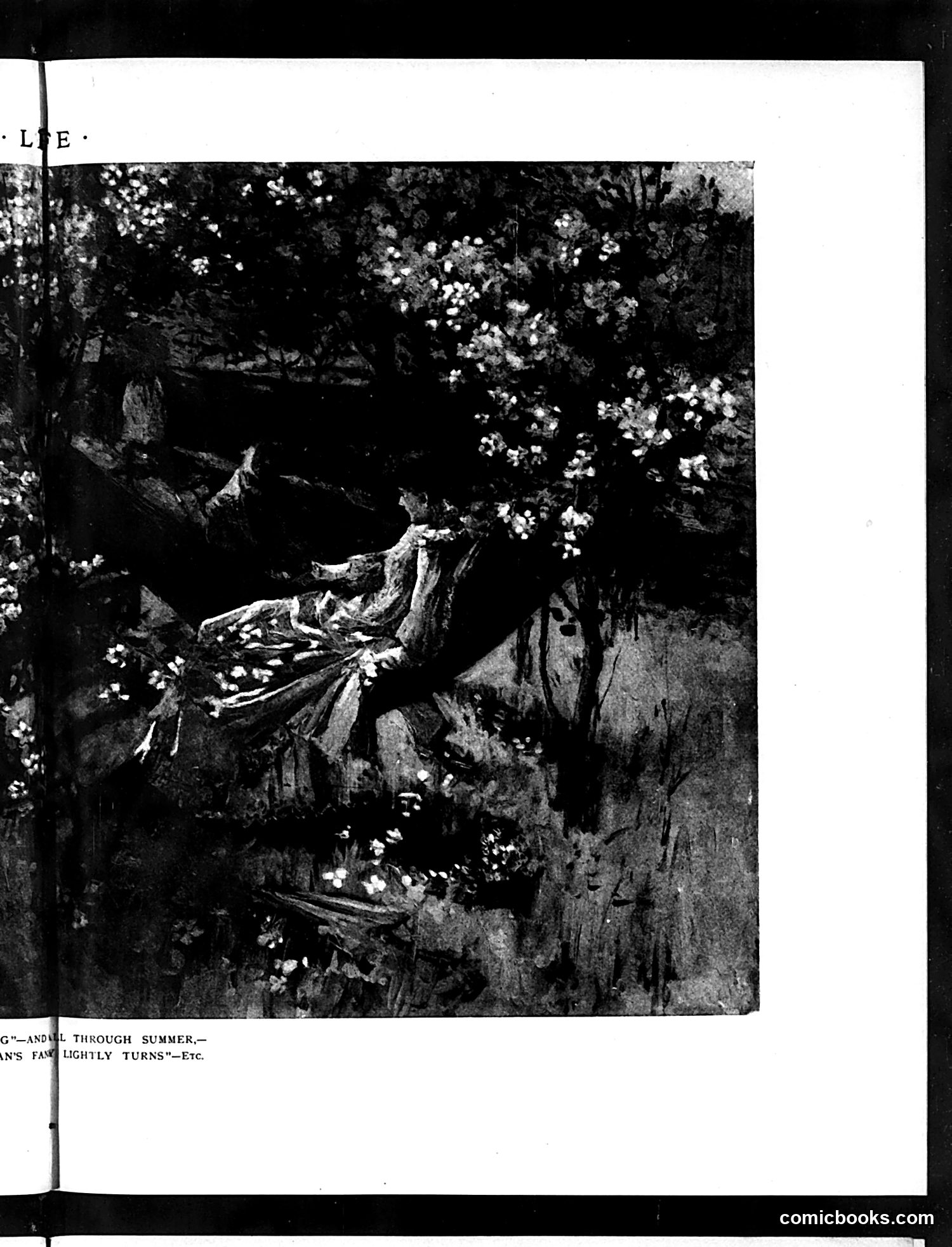
This appears to be a illustration from *Life* magazine showing a romantic or literary scene among flowering vines and foliage. The image depicts what seems to be a reclining figure in classical or romantic dress surrounded by blooming flowers. The partial OCR text mentions "through summer" and "lightly turns," suggesting this may accompany poetry or literature—possibly a Romantic-era poem about nature and love. However, **I cannot definitively identify the specific cartoon's subject, the figures depicted, or the satirical point** from the image alone. The text is too fragmentary to confirm whether this is political satire, literary criticism, or illustration. To accurately explain the joke or reference for a modern reader, I would need either clearer text or additional context about the publication date and surrounding articles.
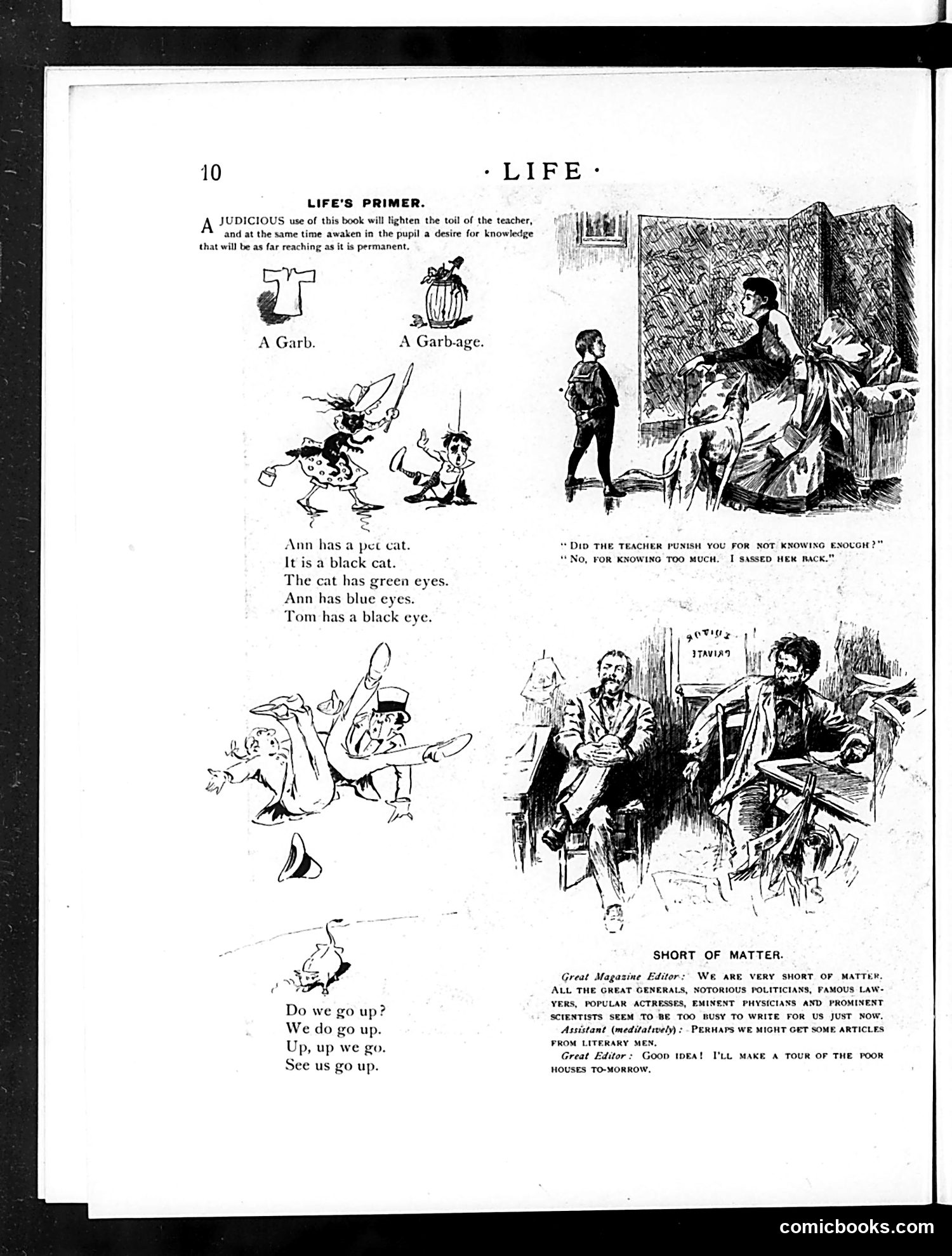
This page contains educational primers and satirical commentary typical of Life magazine's format. **Top Section ("Life's Primer"):** A children's educational rhyme with puns—"A Garb" and "A Garb-age"—teaching basic vocabulary alongside whimsical illustrations. **Right Cartoons:** Two satirical scenes: The first depicts a teacher punishing a student, with dialogue suggesting the student was beaten for "knowing too much"—commentary on restrictive education. The second shows what appears to be editors or politicians in discussion, possibly mocking their avoidance of serious writing. **Bottom Section ("Short of Matter"):** An editor laments that famous generals, politicians, lawyers, and scientists are "too busy" to contribute articles, so they'll instead solicit pieces from "literary men"—satire on how prestigious figures avoid serious journalism while lesser-known writers fill publications. The page mockingly critiques both education systems and the magazine industry's struggles to secure quality content.
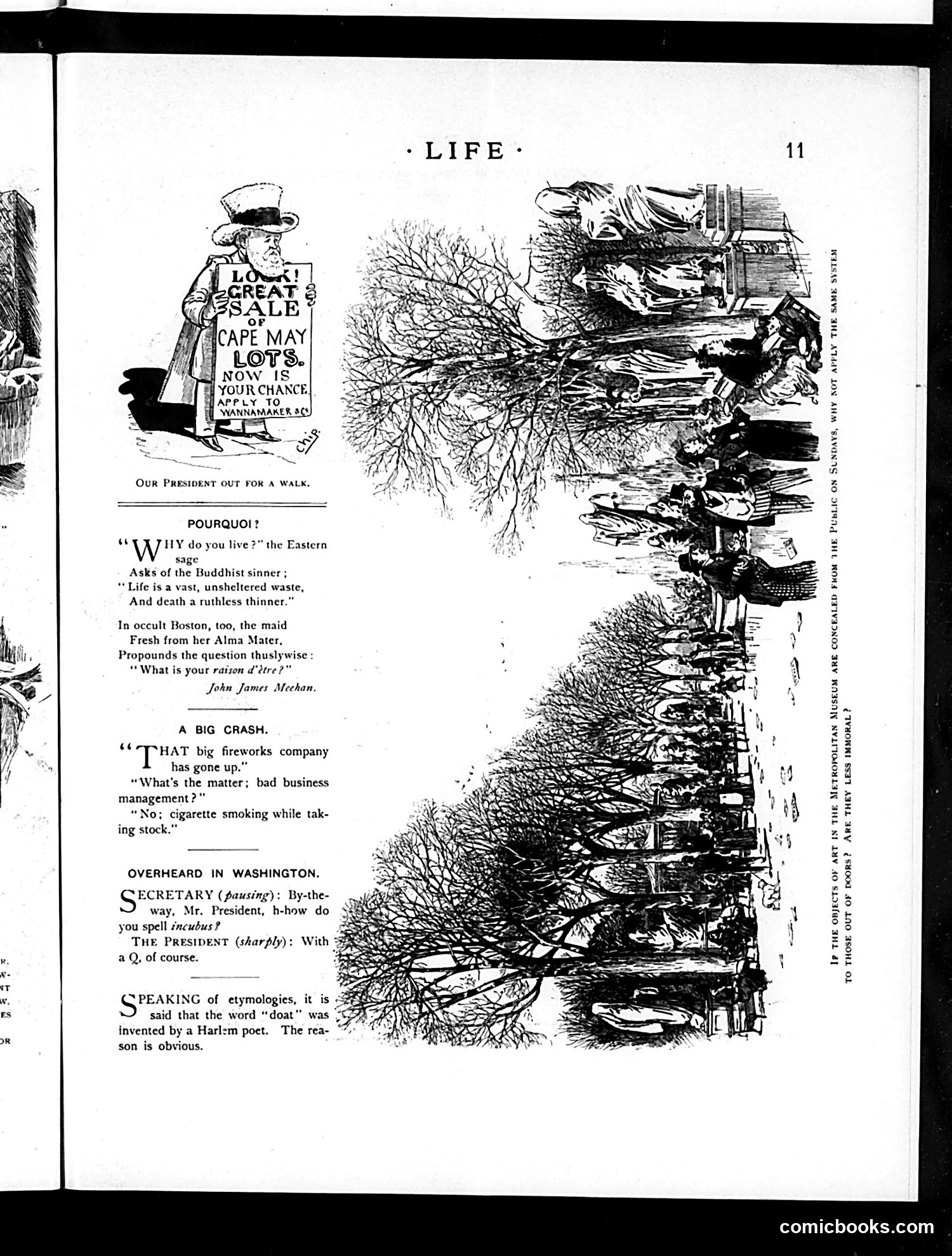
**Top Cartoon ("Our President Out for a Walk"):** Shows a figure in a coat and hat holding a sign advertising "Great Sale of Cape May Lots" with "Now is the time to Apply to Wanamaker & Co." This appears to satirize a sitting president (identity unclear from image alone) conducting commercial real estate promotion, possibly critiquing the mixing of political office with private business interests or endorsements. **Lower Content:** The page includes brief humor pieces mocking various targets: Eastern philosophy ("Why do you live?"), Boston society, a fireworks company business failure blamed on cigarette smoking, and a Washington joke about presidential spelling of "incubus." The overall tone is light political and social satire typical of Life's satirical approach.
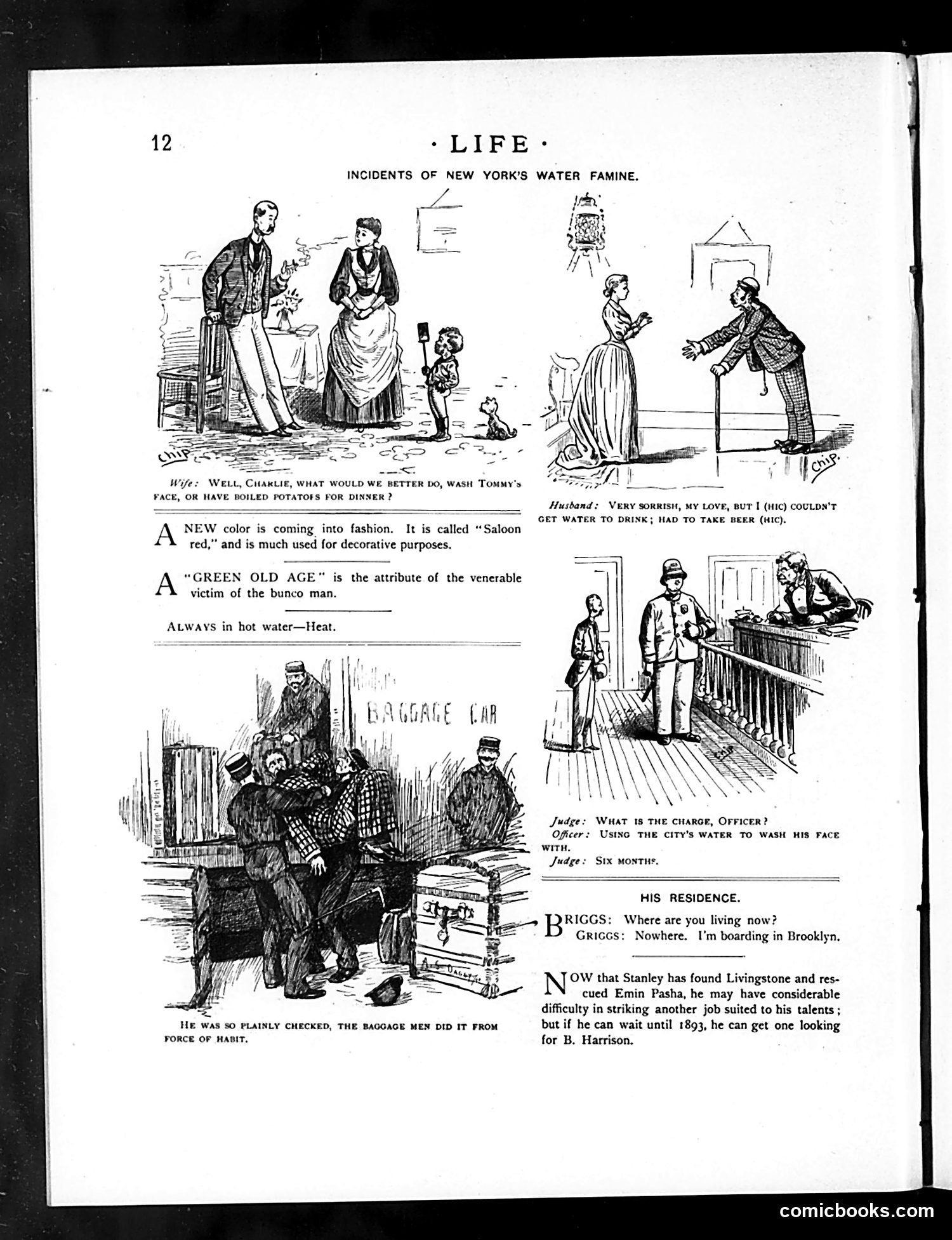
This satirical page documents a severe water shortage affecting New York City. The cartoons mock the crisis through exaggerated scenarios: **The situations depicted:** - A family debating whether to wash their child's face or cook potatoes, given water scarcity - A drunk man who substituted beer for water (the "saloon red" reference) - A man arrested and sentenced to six months for the "crime" of using city water to wash his face - Vagrants with no fixed residence, forced to board in Brooklyn **The satire's point:** The cartoons expose the absurdity and desperation of the water shortage by showing its ridiculous consequences—rationing basic hygiene, criminalizing normal washing, and driving people from the city. The page also includes unrelated gossip about explorers Livingstone and Stanley, and a quip about Benjamin Harrison's 1893 administration, suggesting this appeared around 1892.
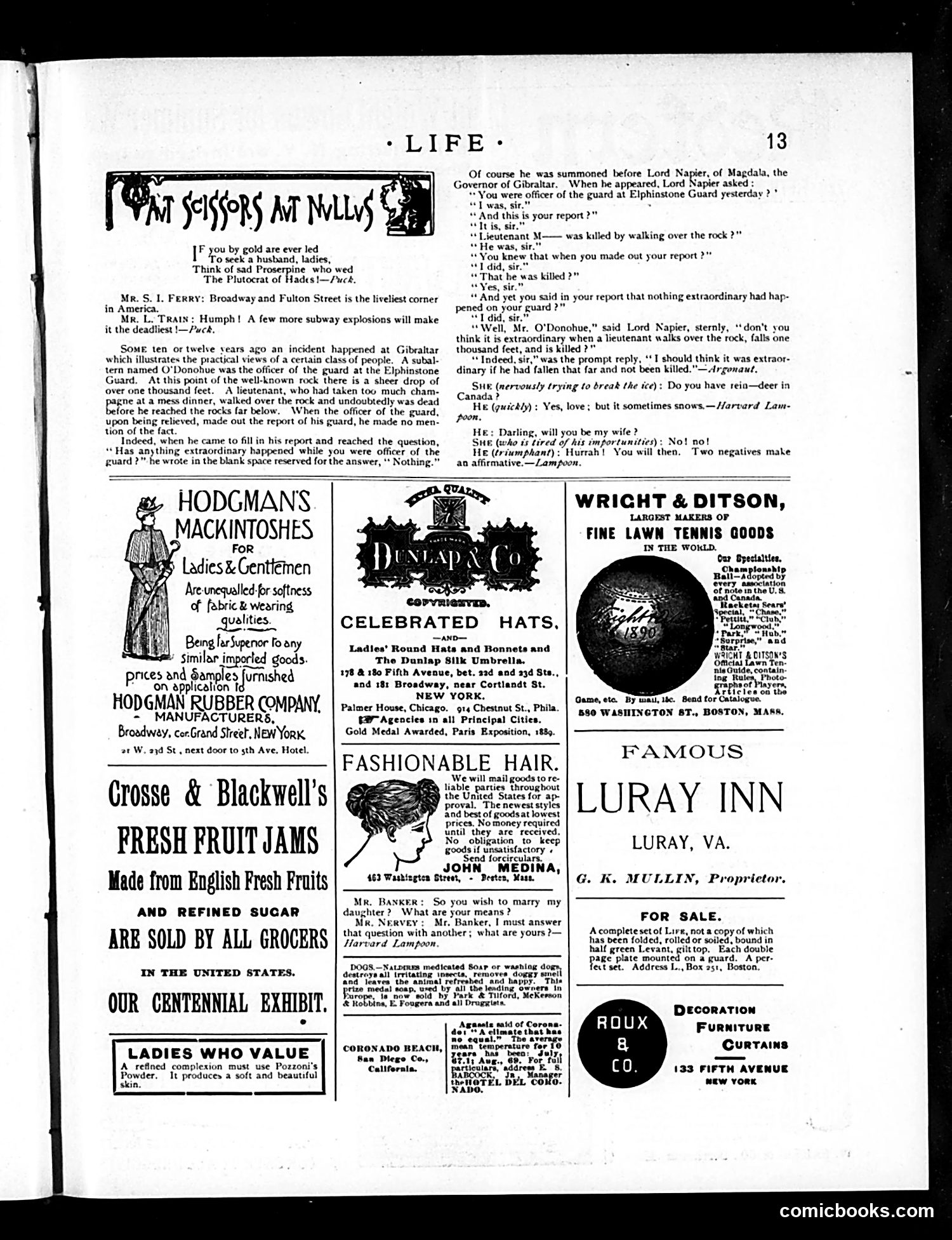
This page features three separate comic anecdotes mocking rigid British military bureaucracy and social pretension: **The Gibraltar Story**: A subaltern officer witnesses a drunk lieutenant fall to his death over a 1,000-foot cliff but reports "nothing extraordinary happened." When confronted by the governor, the officer defends his report with absurd logic: he'd find it extraordinary only if the lieutenant *survived* such a fall. The satire targets military mindset that prioritizes form and procedure over obvious reality. **The Canada Proposal**: A woman rejects a suitor's marriage proposal, then he claims "two negatives make an affirmative"—implying her "no, no" equals yes. The joke mocks pedantic misapplication of logic to social situations. **The Banker Exchange**: A suitor asks a banker's permission to marry his daughter. When asked about his means, he deflects by asking the banker about *his* means—a cheeky riposte to materialistic matchmaking. All three target Victorian society's hollow formality, illogical conventions, and mercenary attitudes toward relationships and status.
This is primarily an **advertising page** with no political cartoons or satirical content. The page consists entirely of commercial advertisements typical of the late 19th century, including: **Products advertised:** Ladies' tailoring services (Redfern, Feeley & Lollinger), summer hotels and resorts, typewriters, patent medicines (Mrs. Winslow's Soothing Syrup, Armour's Beef Extract), cocoa, perfume, trunks and luggage, and linen collars. **Notable element:** A brief humorous observation from the *Philadelphia Press* contrasts a man's patience before and after marriage—tolerating a girlfriend's weight but complaining about holding a baby. This is social commentary on marriage expectations rather than political satire. The page reflects consumer culture of the Gilded Age, targeting affluent readers with leisure time and disposable income for summer travel and luxury goods.