
Life, 1890-07-10 · page 4 of 14
Life — July 10, 1890 — page 4: what you’re looking at
What you’re looking at
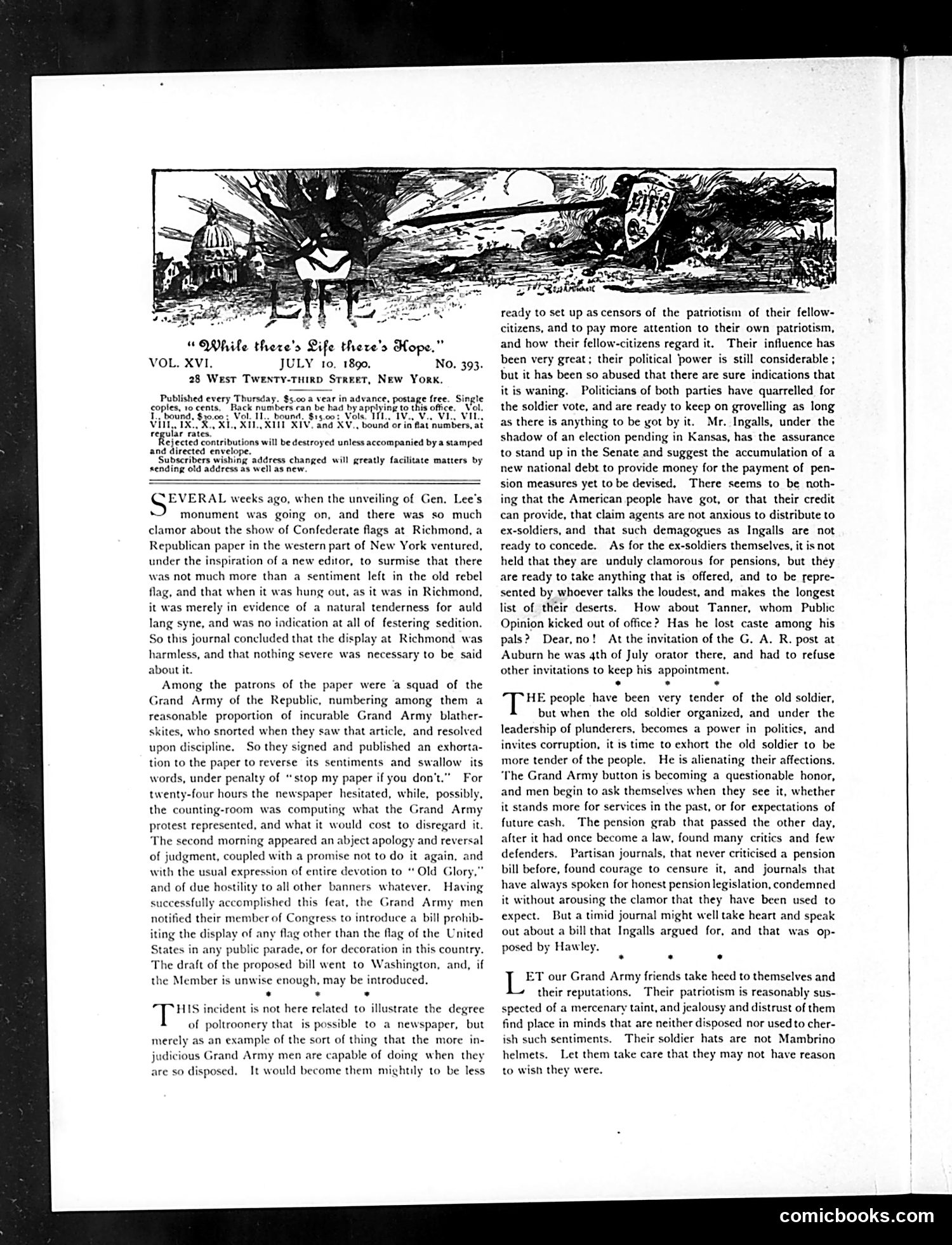
The page features editorial commentary on the recent unveiling of a General Lee monument in Richmond and controversies surrounding Confederate flag displays. The cartoon at the top (title: "While there's Life there's Hope") appears to depict allegorical figures in a landscape, though specific identities are unclear from the image alone. The text discusses Republican concerns about Civil War veteran organizations becoming political instruments. It criticizes the "Grand Army of the Republic" for alleged politicization and references debates over pension bills and monument displays. The piece warns that honoring veterans risks corruption when veterans' groups gain political power, particularly regarding flag displays and public commemorations in post-Reconstruction America. The satire targets both the militarization of politics and veterans' organizations' expanding influence on national policy.
📄 Transcribed text from this page (OCR, searchable)
Machine-transcribed from the original scan — historical spelling and the odd misread are preserved.
“Mhile there's Life there's Hope.” VOL. XVI. JULY 10. 1890. No. 393. 28 West Twenty-THIRD Street, New York. Published every Thursday. $s.co a vear in advance, postage free. Single copies, 10 cents, Rack numbers can be had by applying to this office. Vol. T., bound, $30.00; Vol. II. bound. $15.00; Vols. II1.. IV. . Vi. VIL, Vill IT XIV. and XV., bound or in fat numbers, at regular rates. ‘ejected contributions will be destroyed unless accompanied by a stamped and directed envelope. Subscribers wishing address changed will greatly facilitate matters by sending old address as well as new. ~ EVERAL weeks ago, when the unveiling of Gen. Lee's monument was going on, and there was so much clamor about the show of Confederate flags at Richmond, a Republican paper in the western part of New York ventured, under the inspiration of a new editor, to surmise that there was not much more than a sentiment left in the old rebel flag, and that when it was hung out, as it was in Richmond, it was merely in evidence of a natural tenderness for auld lang syne, and was no indication at all of festering sedition. So this journal concluded that the display at Richmond was harmless, and that nothing severe was necessary to be said about it. Among the patrons of the paper were ‘a squad of the Grand Army of the Republic, numbering among them a reasonable proportion of incurable Grand Army. blather- skites, who snorted when they saw that article, and resolved upon discipline. So they signed and published an exhorta- tion to the paper to reverse its sentiments and swallow its words, under penalty of p my paper if you don’t.” For twenty-four hours the newspaper hesitated, while, possibly, the counting-room was computing what the Grand Army protest represented, and what it would cost to disregard it. he second morning appeared an abject apology and reversal of judgment, coupled with a promise not to do it again, and with the usual expression of entire devotion to ‘Old Glory,” and of due hostility to all other banners whatever. Having successfully accomplished this feat, the Grand Army men notified their member of Congress to introduce a bill prohib- iting the display of any flag other than the flag of the United States in any public parade, or for decoration in this country. The draft of the proposed bill went to Washington, and, if the Member is unwise enough, may be introduced. . . . HIS incident is not here related to illustrate the degree of poltroonery that is possible to a newspaper, but merely as an example of the sort of thing that the more in- judicious Grand Army men are capable of doing when they are so disposed. It would become them mightily to be less ready to set up as censors of the patriotism of their fellow- citizens, and to pay more attention to their own patriotism, and how their fellow-citizens regard it. Their influence has been very great; their political power is still considerable ; but it has been so abused that there are sure indications that it is waning. Politicians of both parties have quarrelled for the soldier vote, and are ready to keep on grovelling as long as there is anything to be got by it. Mr. Ingalls, under the shadow of an election pending in Kansas, has the assurance to stand up in the Senate and suggest the accumulation of a new national debt to provide money for the payment of pen- sion measures yet to be devised. There seems to be noth- ing that the American people have got, or that their credit can provide, that claim agents are not anxious to distribute to ex-soldiers, and that such demagogues as Ingalls are not ready to concede. As for the ex-soldiers themselves, it is not held that they are unduly clamorous for pensions, but they are ready to take anything that is offered, and to be repre- sented by whoever talks the loudest, and makes the longest list of their deserts. How about Tanner, whom Public Opinion kicked out of office? Has he lost caste among his pals? Dear,no! At the invitation of the G. A. R. post at Auburn he was 4th of July orator there, and had to refuse other invitations to keep his appointment. . ° * HE people have been very tender of the old soldier, but when the old soldier organized, and under the leadership of plunderers, becomes a power in politics, and invites corruption, it is time to exhort the old soldier to be more tender of the people. He is alienating their affections. ‘The Grand Army button is becoming a questionable honor, and men begin to ask themselves when they see it, whether it stands more for services in the past, or for expectations of future cash. The pension grab that passed the other day, after it had once become a law, found many critics and few defenders. Partisan journals, that never criticised a pension bill before, found courage to censure it, and journals that have always spoken for honest pension legislation, condemned it without arousing the clamor that they have been used to expect. But a timid journal might well take heart and speak out about a bill that Ingalls argued for, and that w op- posed by Hawley. L ! our Grand Army friends take heed to themselves and their reputations, Their patriotism is reasonably sus- spected of a mercenary taint, and jealousy and distrust of them find place in minds that are neither disposed nor used to cher- ish such sentiments. Their soldier hats are not Mambrino helmets. Let them take care that they may not have reason to wish they were. comicbooks.com