
A complete issue · 18 pages · 1890
Life — May 22, 1890
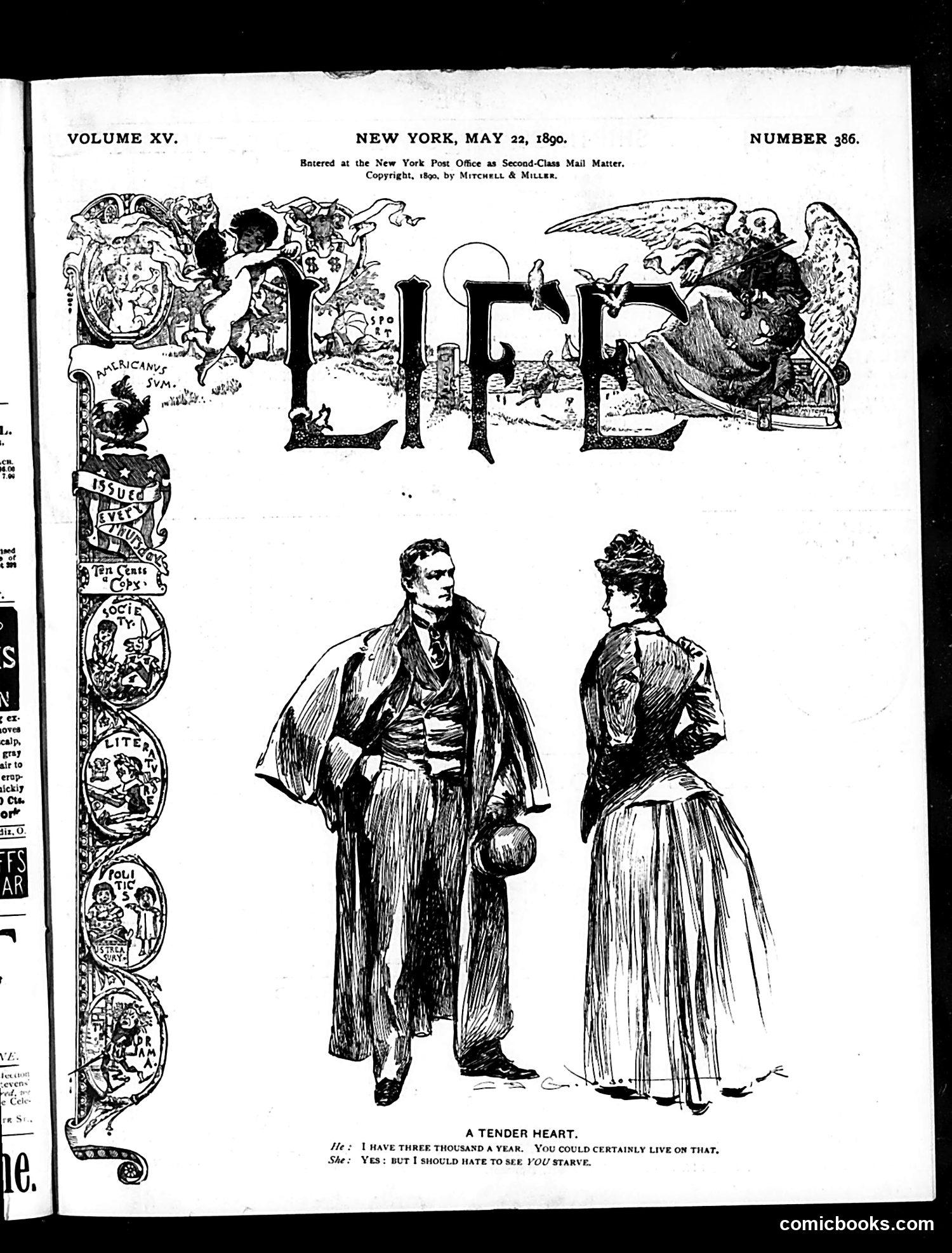
This cartoon from *Life* magazine (May 22, 1890) depicts a dialogue between a well-dressed man and woman about financial support. The man claims to have "three thousand a year" and suggests she could "certainly live on that," while the woman responds she would "hate to see you starve"—implying the income is insufficient for her lifestyle. The satire targets wealthy men's anxieties about marrying women who are financially demanding or materialistic. The woman's concern for his welfare is presented as transparently insincere—she's clearly focused on maintaining her own comfort rather than his wellbeing. This reflects period anxieties about gold-digging wives and the financial burdens of marriage among the upper classes.
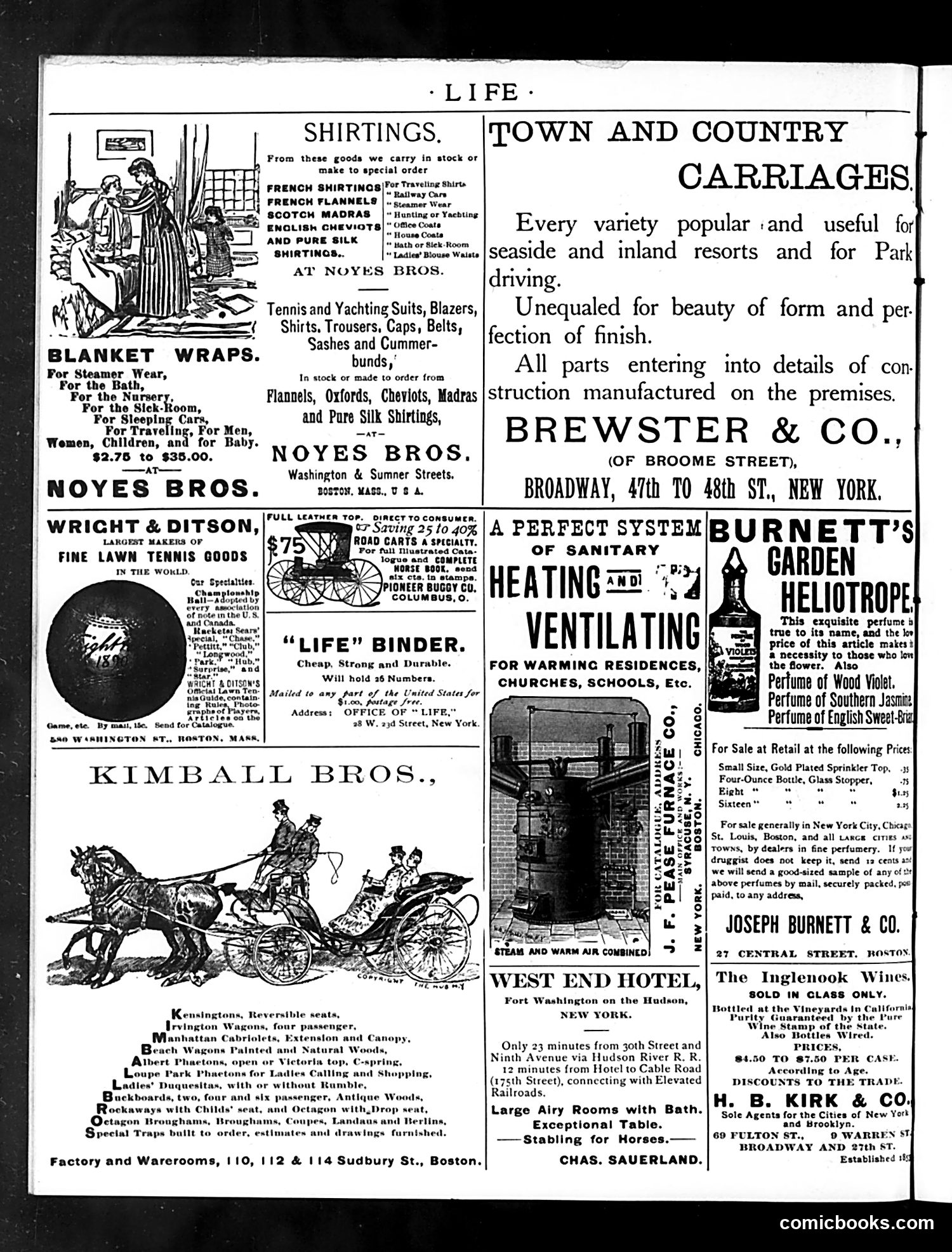
This page is **primarily advertising** with no political cartoons or satirical content requiring historical explanation. The layout features commercial advertisements for period goods: shirtings and blanket wraps (Noyes Bros.), fine lawn tennis goods (Wright & Ditson), carriages (Brewster & Co.), heating and ventilation systems, and perfumes (Burnett's Garden Heliotrope). The only illustrated content shows **Kimball Bros. carriages** with horses and passengers—a straightforward product advertisement depicting various carriage styles available for purchase. The "LIFE" masthead indicates this is from *Life* magazine's advertising section, focused on late 19th or early 20th-century consumer goods rather than satire or political commentary.
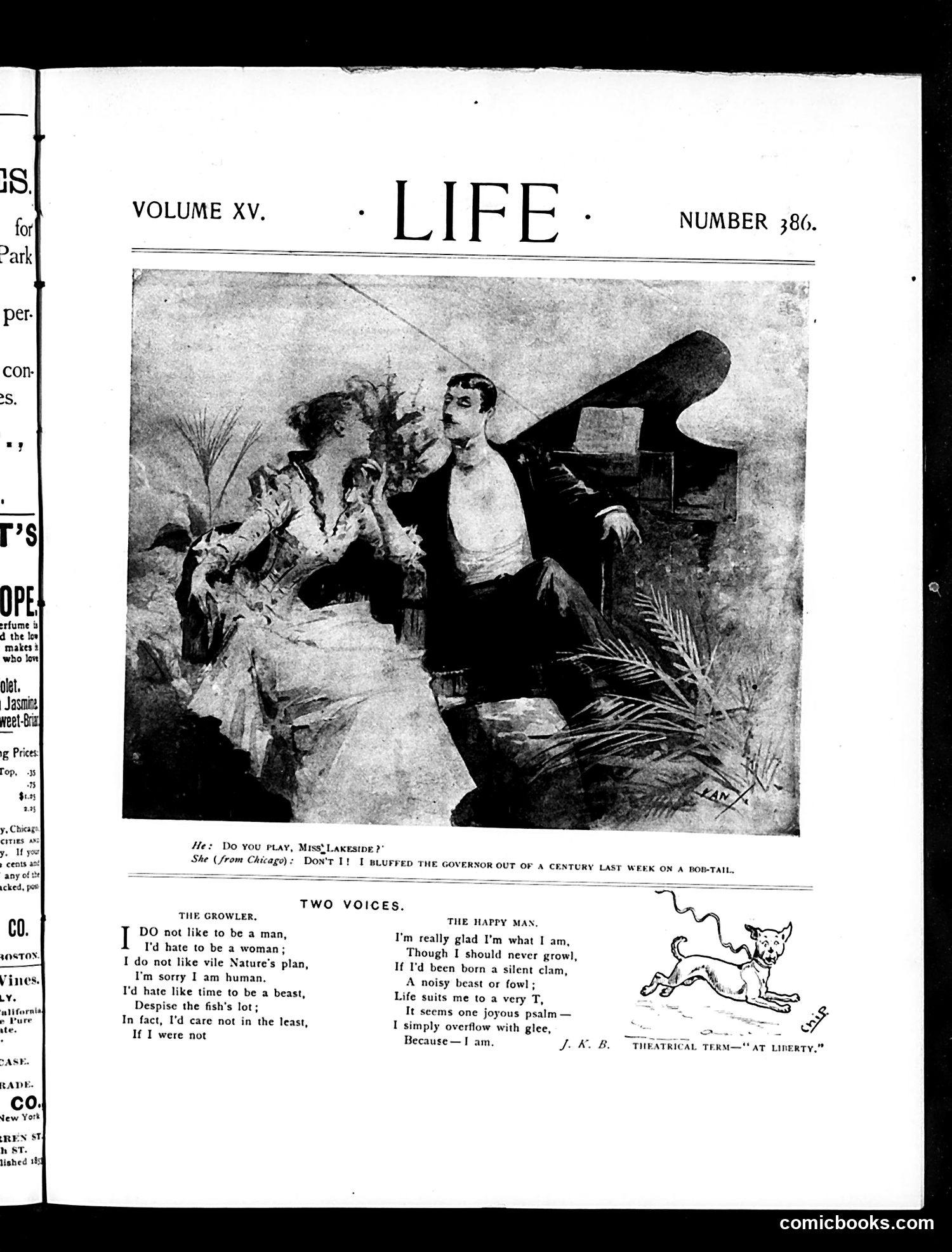
The main illustration depicts a flirtation scene labeled "Do you play, Miss Lakeside?" with a woman from Chicago responding "Don't! I bluffed the governor out of a century last week on a bob-tail." This references card-playing, suggesting the woman is a skilled gambler who recently won substantial money from a state governor. Below are two contrasting poems: "The Growler" (pessimistic about human nature) and "The Happy Man" (content with existence). A small theatrical cartoon labeled "At Liberty" shows a cat, likely punning on an actor being unemployed. The overall page mixes romantic comedy with satirical commentary on gambling, female independence, and social attitudes. The specific governor referenced is unclear without additional context.
The masthead cartoon depicts a rural landscape with classical and American architectural elements, illustrating the magazine's satirical focus on American culture and society. The main editorial content addresses a controversy involving **Mr. Culbertson of Texas**, who protested against American authors, demanding exclusive rights to their writings for nearly fifty years and proposing to artificially inflate prices of foreign literature. The editors mock this protectionist stance, using it to satirize economic nationalism. They argue that American authors seek fair competition, not monopolistic protection, and that forcing higher prices on readers serves no legitimate purpose. The piece also criticizes the copyright bill's failure and mentions **Uncle Dana**'s public statements about "ordinary fools" in newspapers—likely a contemporary political figure, though identity remains unclear from context.
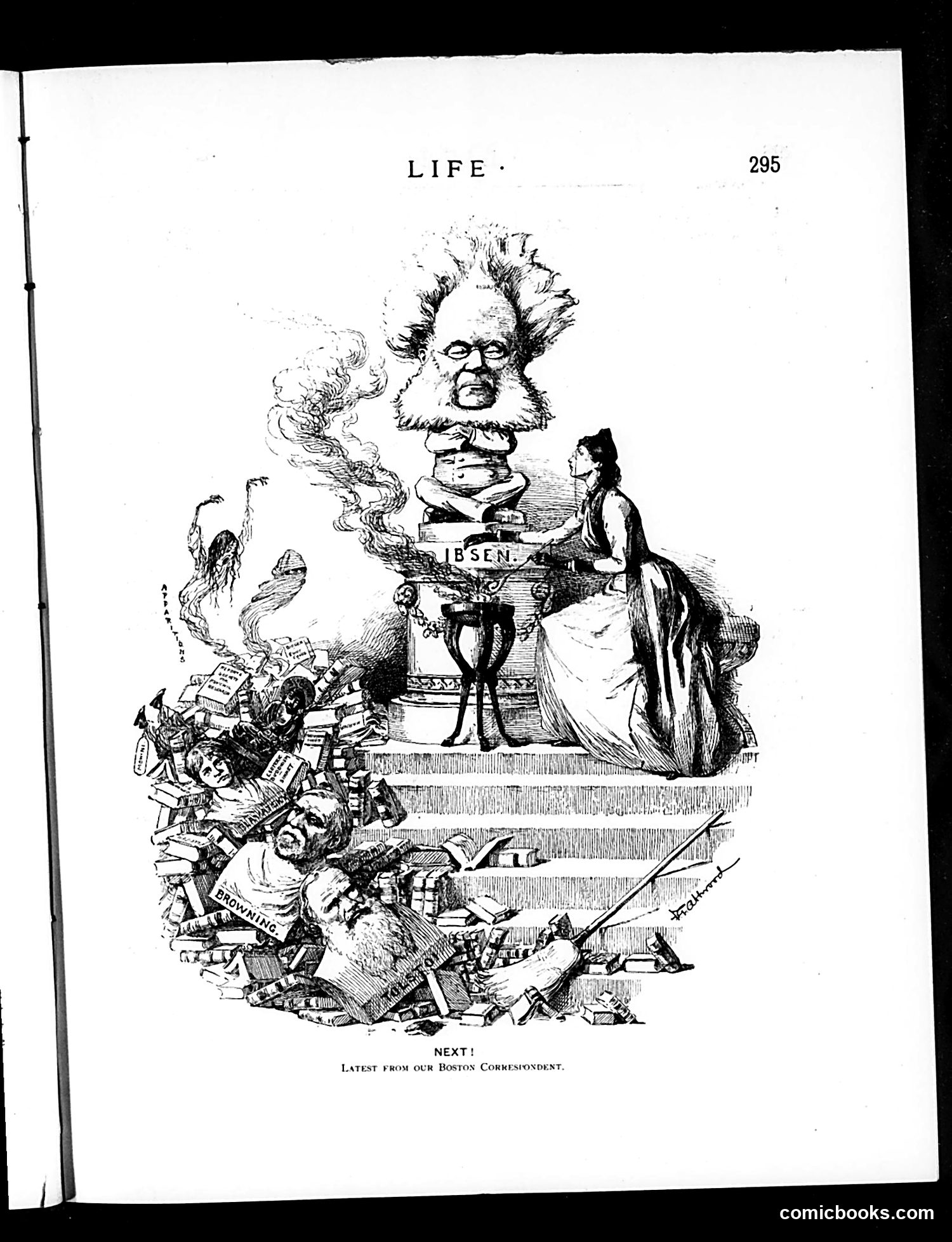
This is a satirical political cartoon from *Life* magazine (page 295) depicting Henrik Ibsen, the Norwegian playwright, as a towering bust monument. The inscription reads "IBSEN" on the pedestal. The satire appears to mock Ibsen's cultural elevation and influence. Below the monument, chaotic figures—labeled "BROWNING" (likely referring to Robert Browning or his literary circle)—are depicted in disarray among scattered books and debris, suggesting intellectual chaos or the tumultuous nature of literary movements. A woman figure stands to the right, possibly representing the arts or literature personified. The caption "NEXT! LATEST FROM OUR BOSTON CORRESPONDENT" suggests this is commentary on Boston's literary tastes and fashions—implying that Ibsen worship represents the latest pretentious trend among American intellectuals, worthy of ridicule.
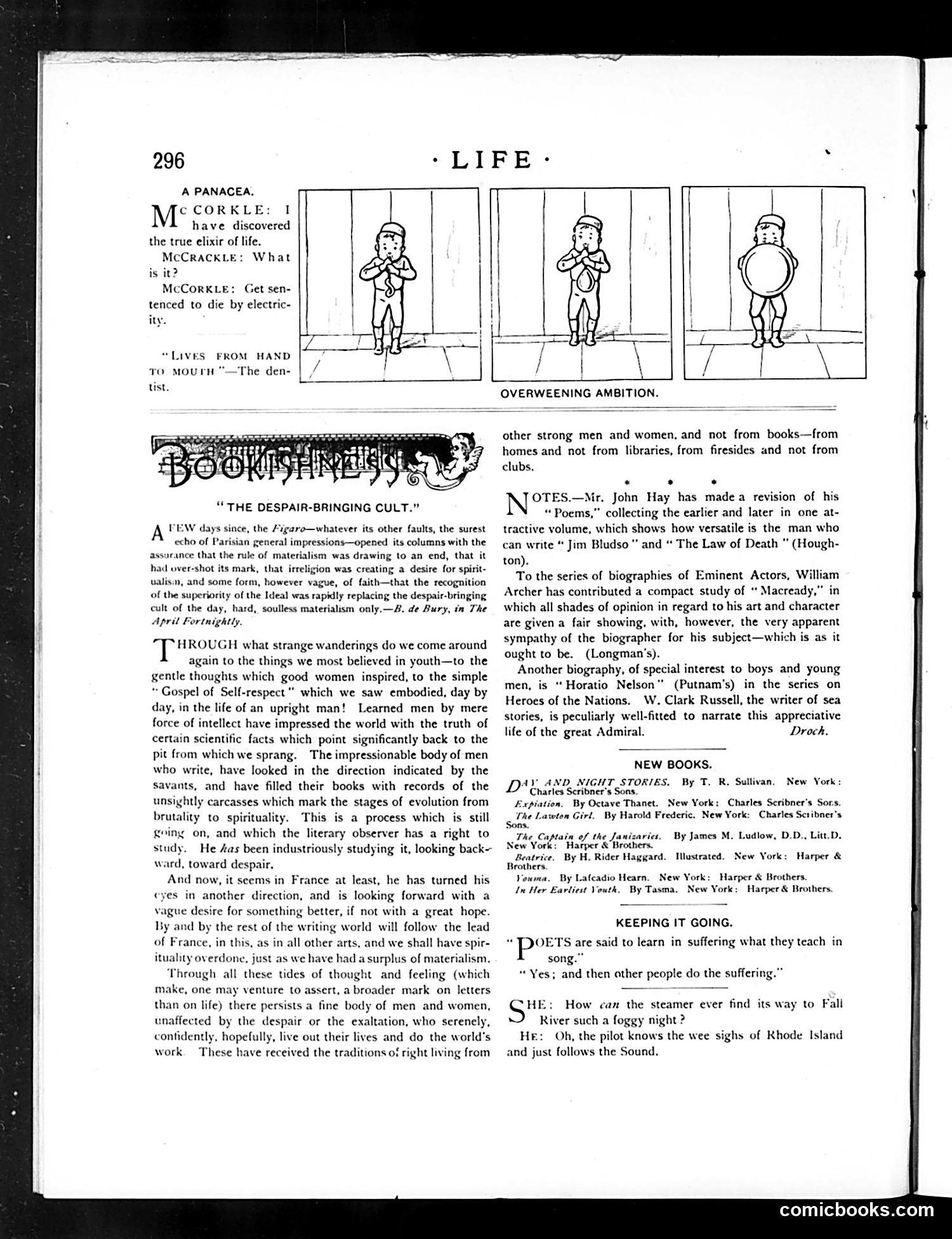
This three-panel cartoon satirizes excessive personal ambition. Each panel shows the same figure progressing through stages: first holding something small to his chest, then a medium object, finally a large sphere so enormous he can barely contain it. The title "Overweening Ambition" suggests the joke is about how ambition grows disproportionately—the figure becomes increasingly burdened by his own desires for advancement or acquisition. The satire targets the human tendency toward unchecked aspiration, where wanting more becomes absurdly self-defeating. The visual progression from manageable to ridiculous illustrates how ambition, left unchecked, consumes and overwhelms the ambitious person rather than fulfilling them. This was a common Life magazine theme critiquing American materialism and social climbing.
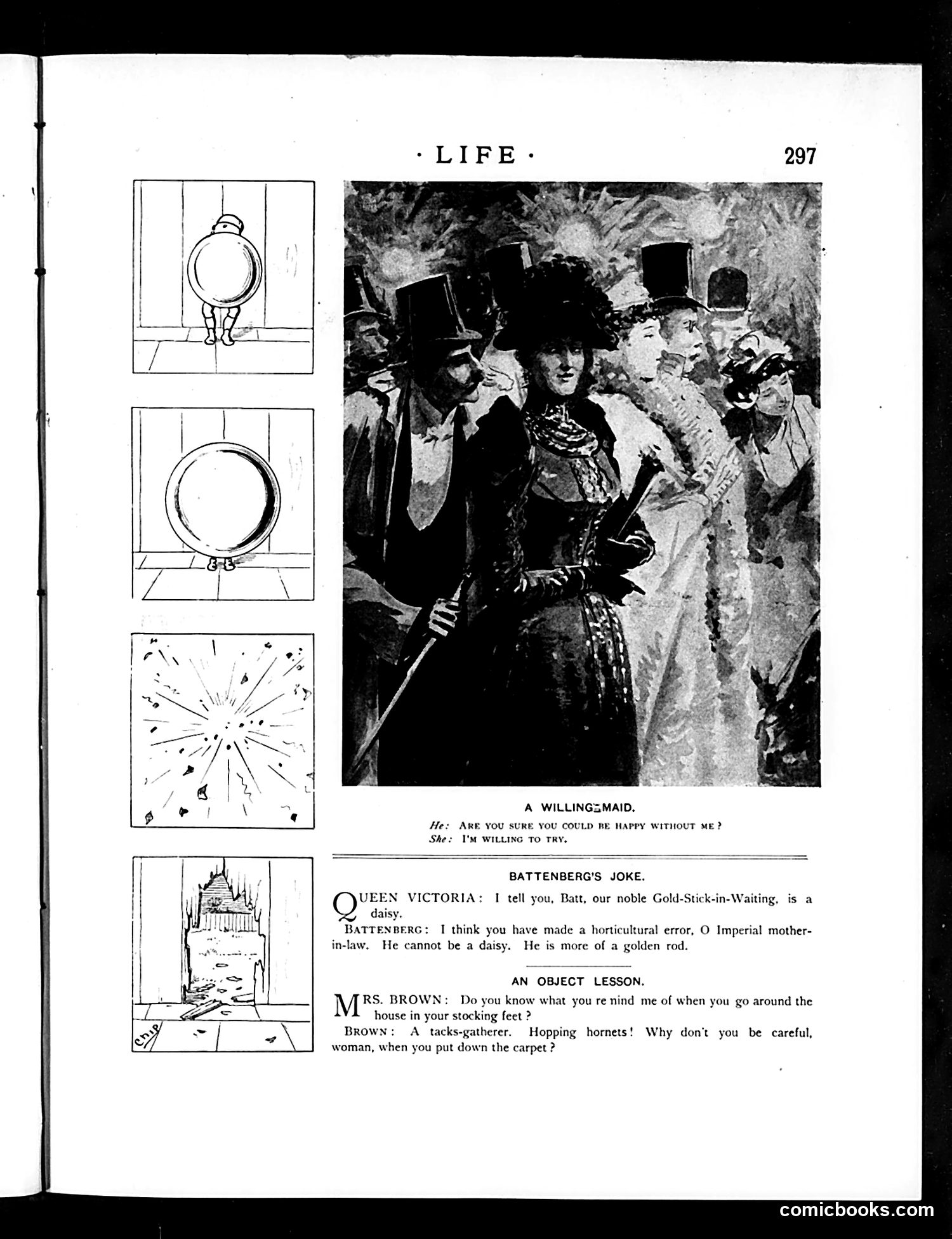
**Top Image: "A Willing Maid"** A photograph (likely from a theatrical production) shows a woman in period costume surrounded by men in top hats. The caption reads: "He: Are you sure you could be happy without me? / She: I'm willing to try." This appears to be a comedic commentary on romantic relationships or marriage, using a theatrical scene to satirize male assumptions about female dependency. **Text Jokes Below:** Two brief humor pieces follow: "Battenberg's Joke" (a pun about Queen Victoria calling something a "daisy" when it's actually a "golden rod"), and "An Object Lesson" (about Mrs. Brown stepping on carpet tacks while wearing stockings). These are simple wordplay and domestic humor typical of early 20th-century magazine filler.
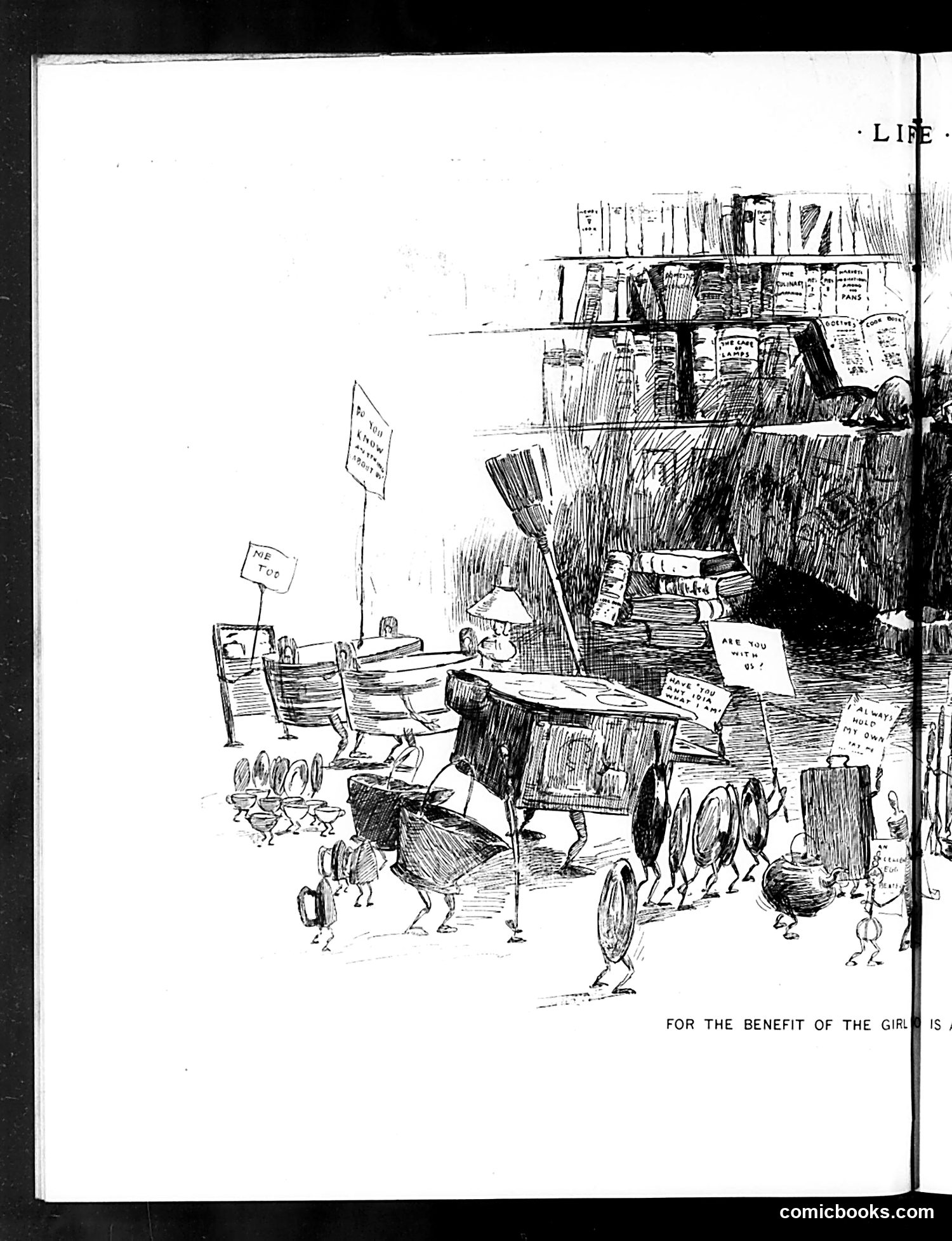
This appears to be a satirical illustration showing a street market or fair scene populated by anthropomorphized objects—wheels, household items, and tools depicted as small figures conducting business or commerce. The drawing style uses hatching and line work typical of early-to-mid 20th century magazine illustration. The partial caption at bottom reads "FOR THE BENEFIT OF THE GIRL IS..." suggesting social commentary, though the complete text is cut off. The signs visible in the marketplace are illegible in this reproduction. Without the full caption and clearer text on the signs, I cannot definitively identify the specific political or social critique intended. The overall concept appears to satirize consumerism, marketplace chaos, or perhaps gender-related social commentary, but the exact target remains unclear from this page alone.
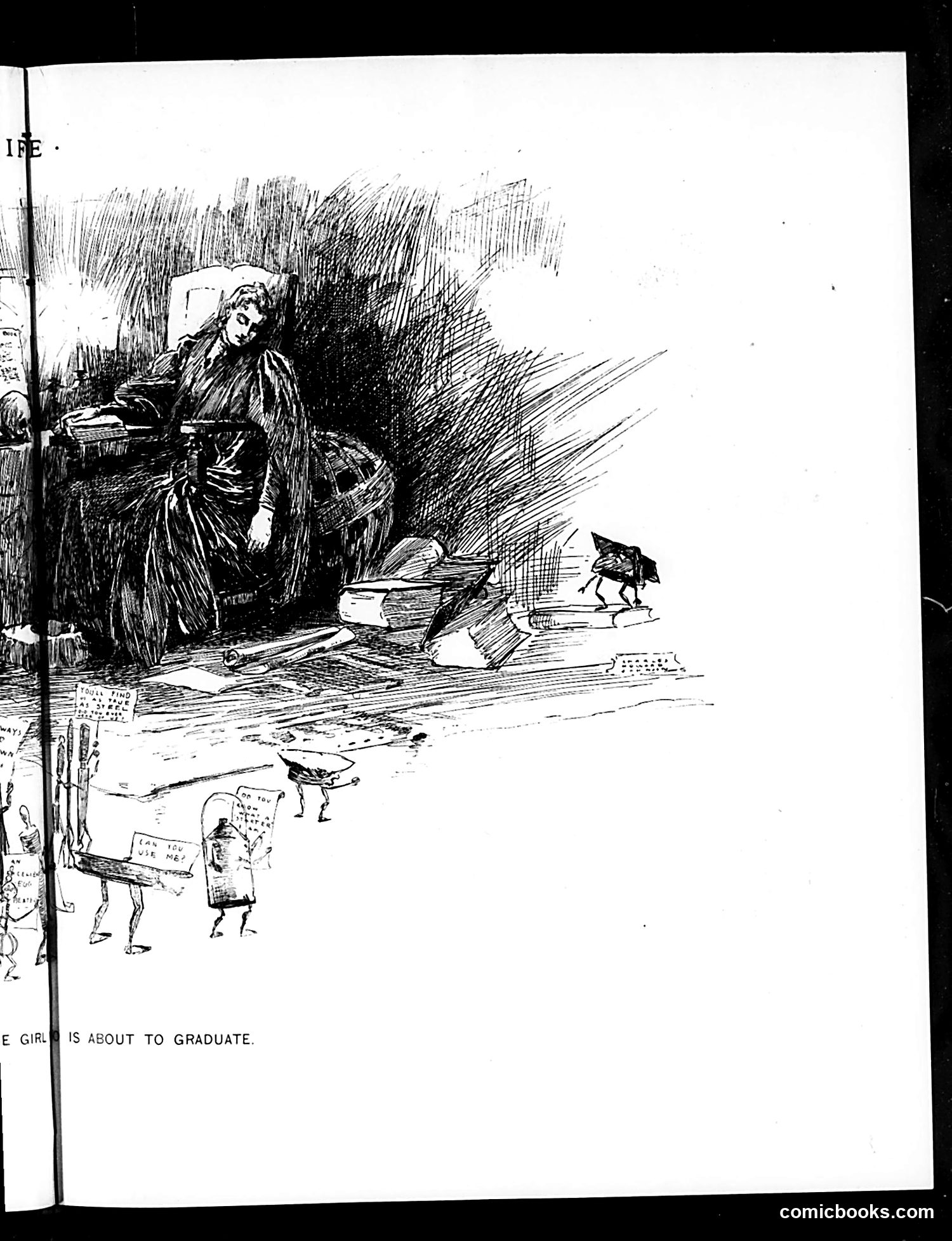
This sketch depicts a woman in Victorian-era dress standing at what appears to be a doorway or threshold, with several small figures below her carrying papers or documents. The caption reads "E GIRL IS ABOUT TO GRADUATE." The satire appears to mock the ambitions or circumstances of a young woman on the eve of completing her education. The small figures below—possibly representing suitors, servants, or social hangers-on—seem to be scrambling or competing for her attention, suggested by their animated poses and the papers they carry. The cartoon likely satirizes either the social fanfare surrounding a privileged girl's graduation, or perhaps critiques expectations about what comes next for educated women of that era. The scale difference and frantic energy of the lower figures emphasizes the social machinery surrounding this milestone moment.
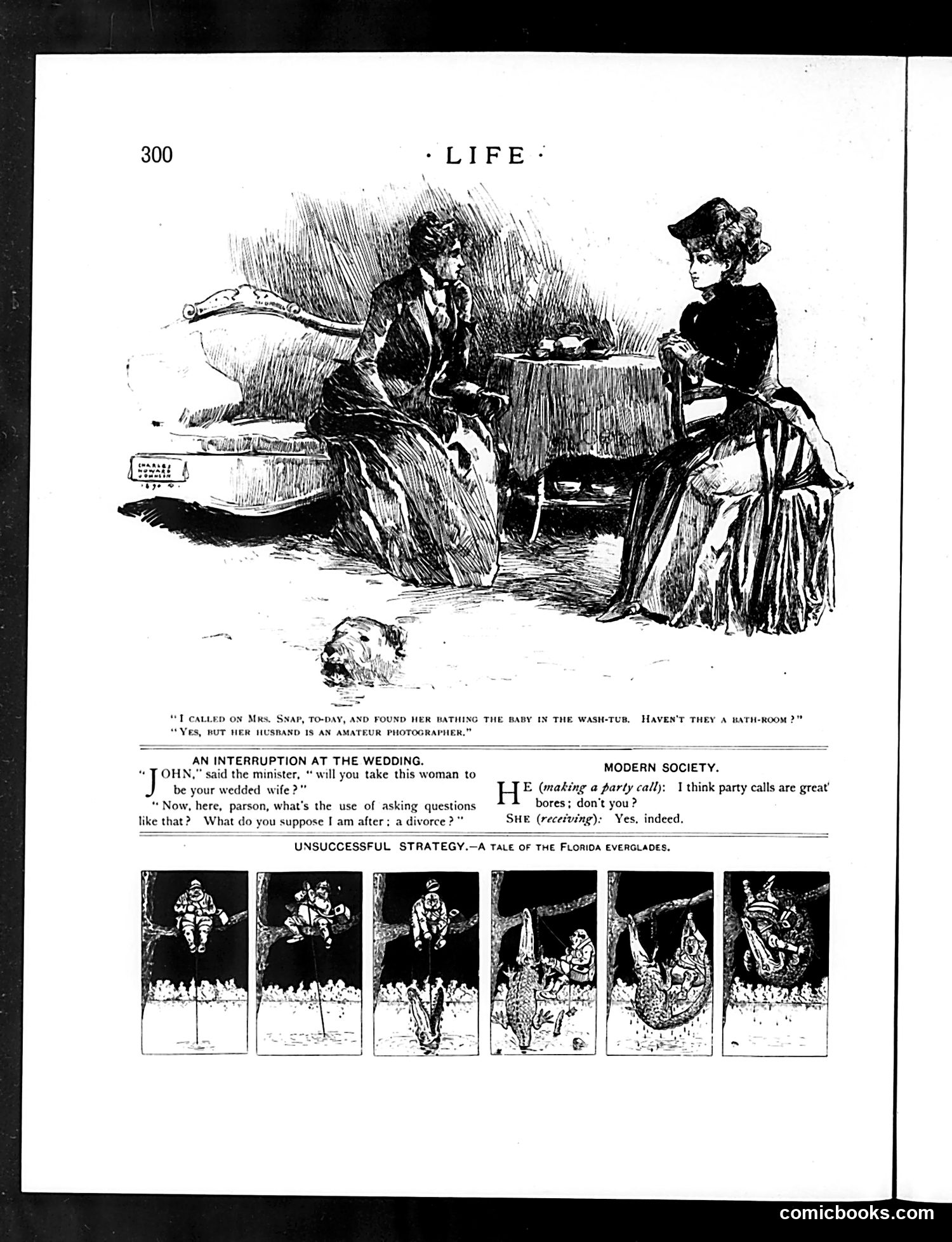
This page contains three distinct satirical pieces from Life magazine: **Top illustration**: Shows two women in conversation, with a small dog nearby. The caption mocks amateur photography—a man's excuse for finding his wife bathing the baby is that he's an "amateur photographer." **"An Interruption at the Wedding"**: A minister asks a groom uncomfortable questions about divorce, satirizing how social conventions allow intrusive questions under the guise of tradition. **"Modern Society"**: A brief dialogue mocking dinner parties, with a woman calling them "great bores" and another agreeing. **Bottom comic strip** ("Unsuccessful Strategy—A Tale of the Florida Everglades"): A six-panel sequence showing someone attempting to catch an alligator, apparently failing as the creature attacks. It's humorous commentary on humans versus nature. The page represents Life's blend of social satire and comedic storytelling targeting upper-class American manners and contemporary situations.
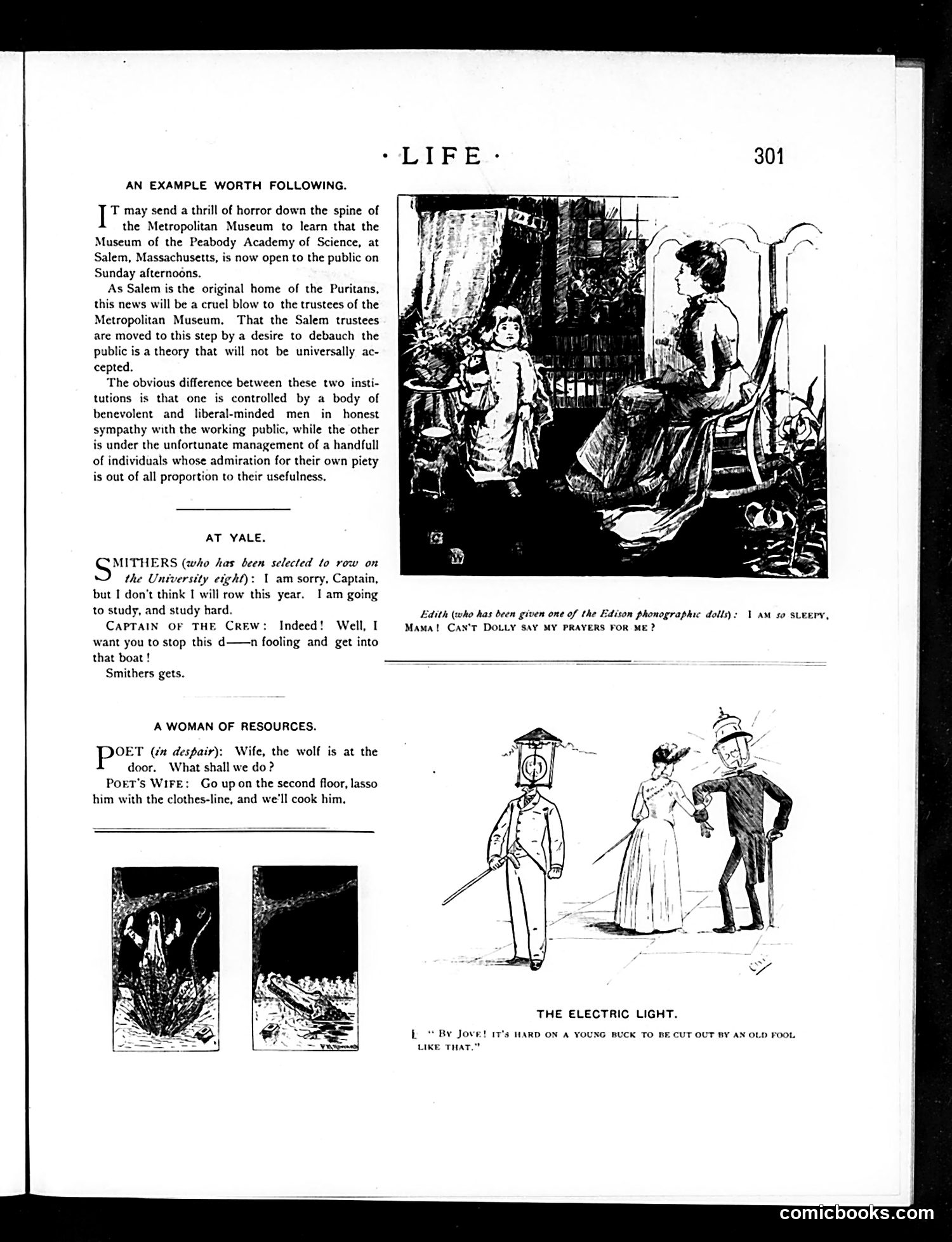
This page contains three distinct satirical pieces: 1. **"An Example Worth Following"**: Critiques the Metropolitan Museum versus the Peabody Academy of Science in Salem, Massachusetts. The text argues the Metropolitan Museum is better managed by "broad-minded" professionals, while Salem's museum suffers from mismanagement by individuals focused on self-promotion rather than public service. 2. **"At Yale"**: A brief dialogue where Smithers declines rowing to study, and the Crew Captain dismisses him as a fool. 3. **"A Woman of Resources"** and **"The Electric Light"**: Comic dialogues with accompanying illustrations satirizing domestic situations and emerging technology (electric lighting), poking fun at social pretensions and generational conflict. The cartoons employ period-typical visual humor and social commentary typical of early 20th-century American satire.
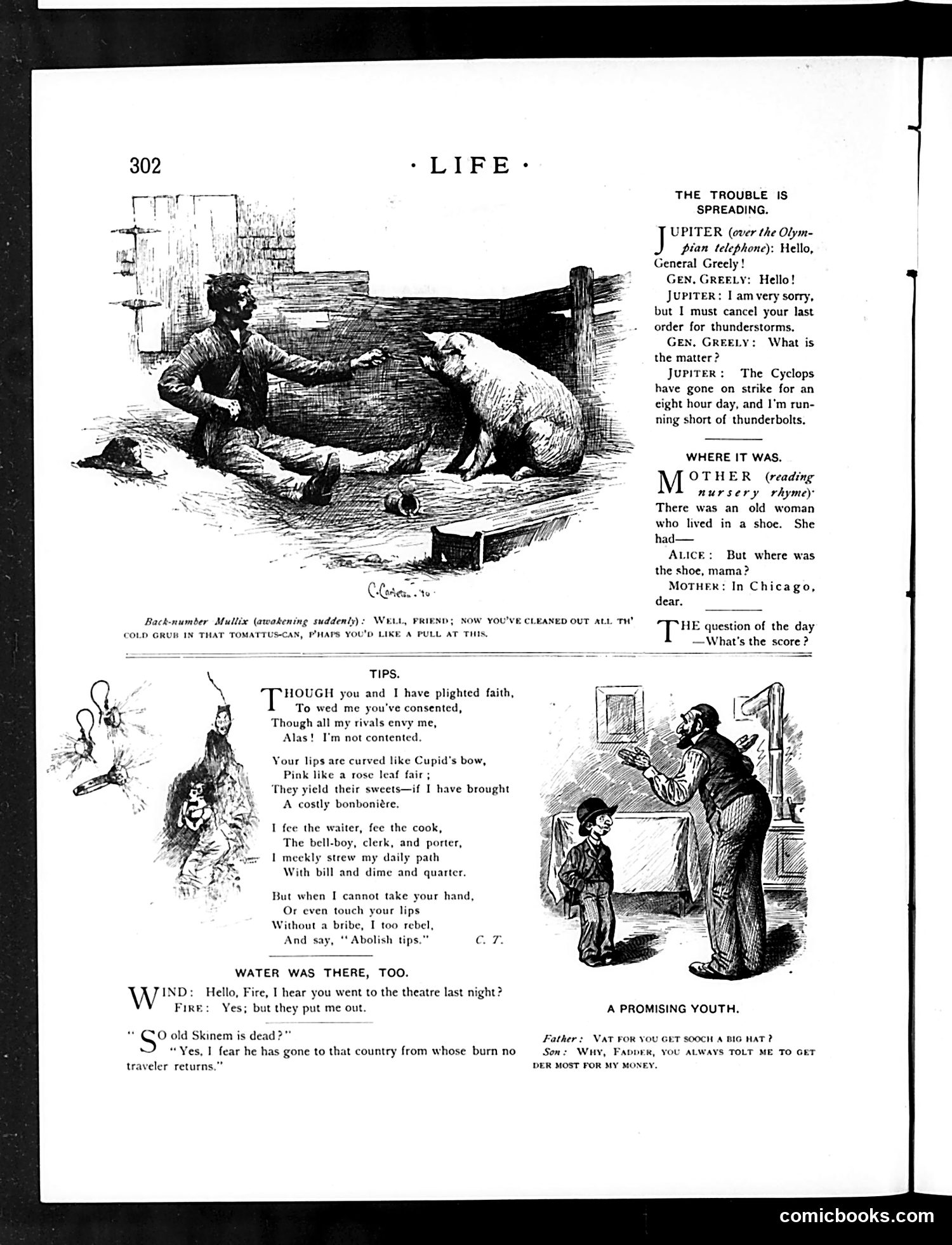
This page contains multiple humorous sketches satirizing early 20th-century American life: **"The Trouble is Spreading"** depicts a labor strike reaching even the gods—the Cyclops (mythological workers who forge Jupiter's thunderbolts) demand an eight-hour workday, leaving Jupiter unable to fulfill weather orders. This mocks contemporary labor strikes and worker organizing movements as spreading beyond reasonable bounds. **"Where It Was"** jokes about Chicago's poverty and homelessness—a child asks where the shoe from the nursery rhyme actually was, and the mother grimly replies "Chicago," implying homelessness was endemic there. **"Tips"** satirizes the widespread custom of tipping waiters, cooks, and porters as an exploitative system where workers depend on bribes rather than wages—a genuine complaint about American service-industry practices. Other sketches mock theatrical censorship ("Water Was There, Too") and immigrant accents and materialism ("A Promising Youth"). The overall theme: contemporary social problems presented as absurd comedies.
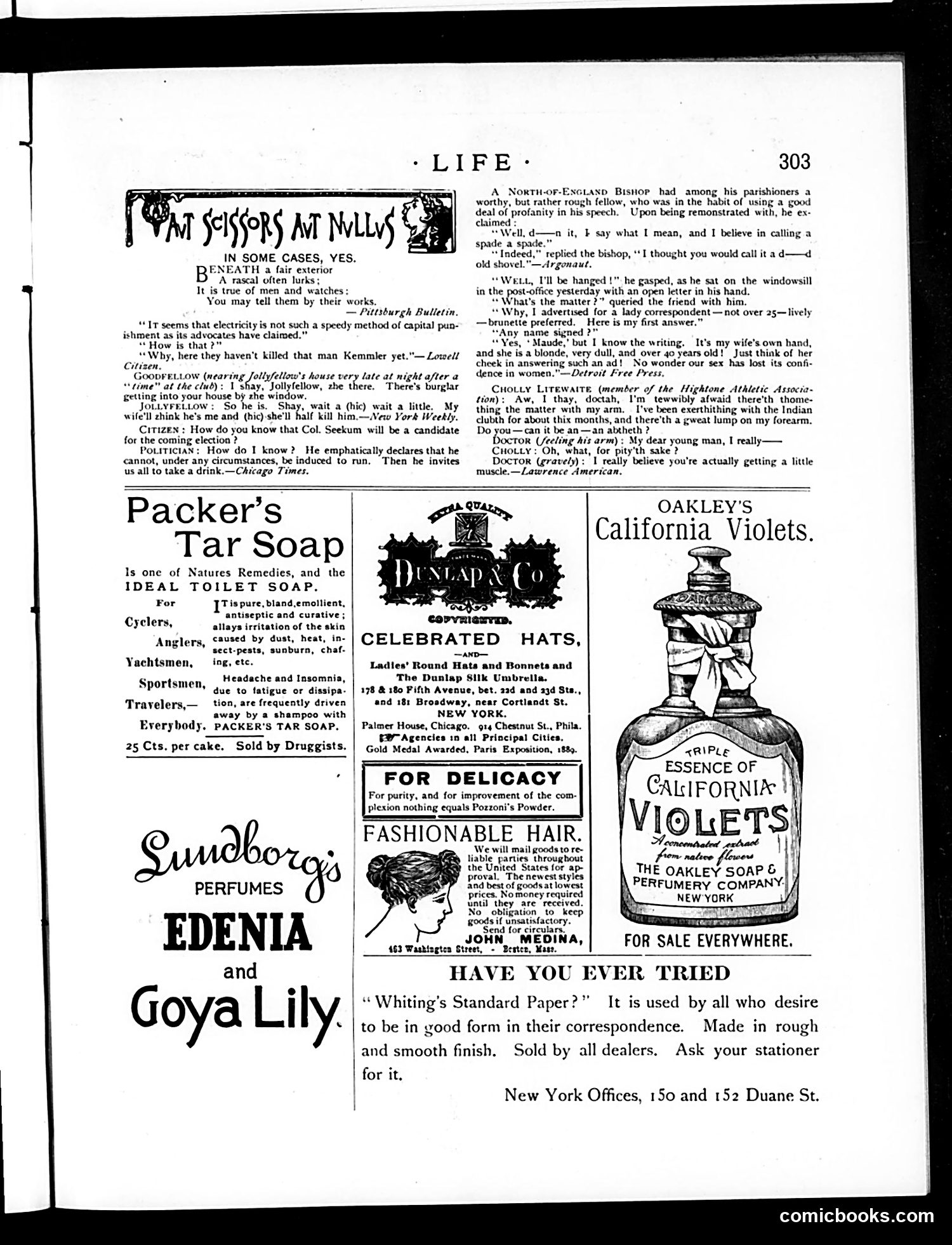
This page contains no single coherent cartoon but rather a collection of satirical jokes and brief humorous anecdotes typical of *Life* magazine's format. Topics include: **Notable references:** - A jab at execution technology: mocking the delayed execution of someone named Kemmler (likely William Kemmler, first person executed by electric chair in 1890), suggesting electricity wasn't the "speedy" capital punishment method advocates claimed - A marital joke where a wife's infidelity goes undetected because the husband assumes an intruder is himself - A political quip: a candidate emphatically denies running while inviting supporters to drinks—exposing his hypocrisy - A personal ad prank: a man's wife answers his advertisement for a young brunette correspondent with her own details deliberately wrong, mocking his naivety The remainder is advertising for period products (tar soap, perfume, hats, hair goods). The humor targets human folly, marital discord, and political deception.
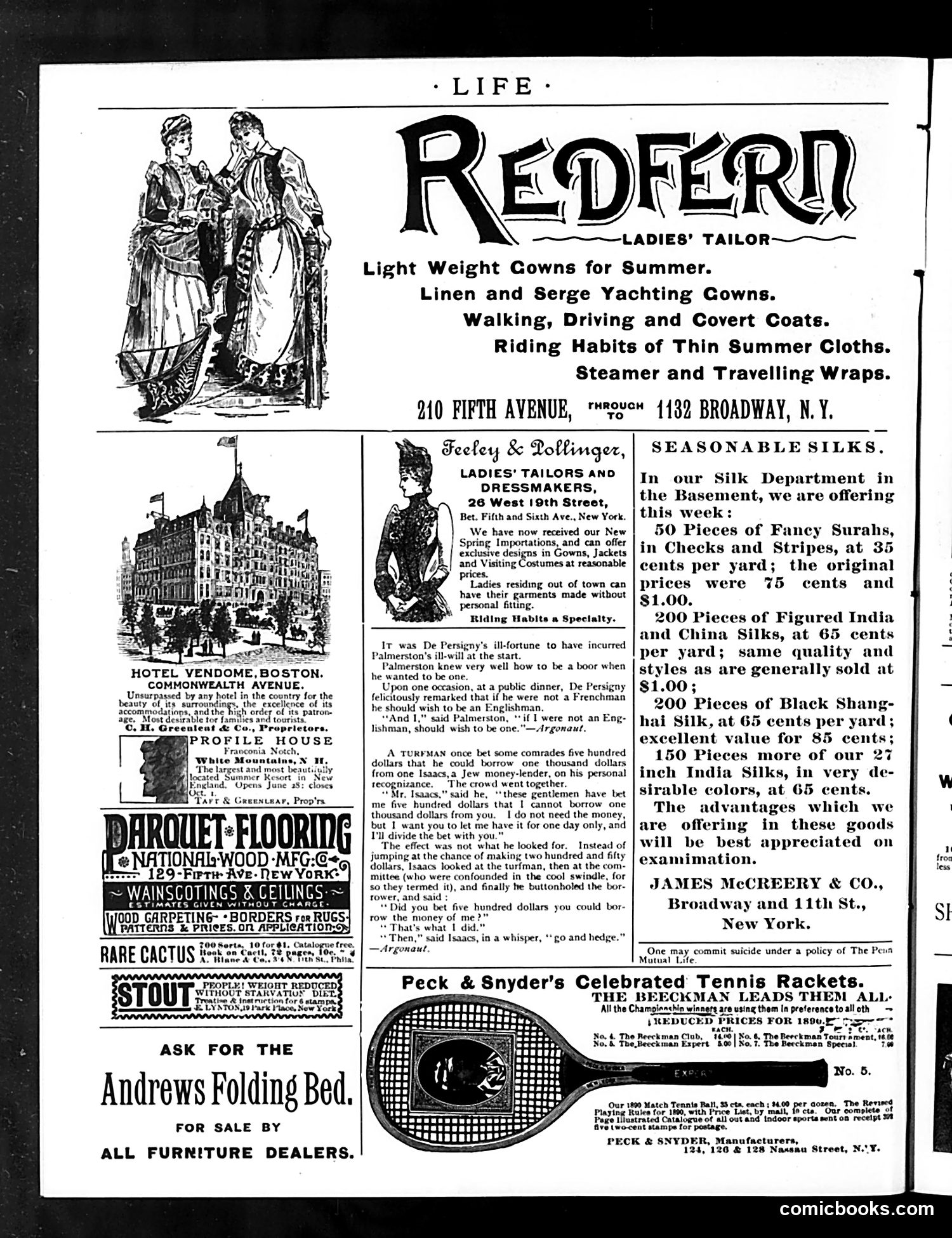
This is primarily **an advertising page** with minimal satirical content. The page features numerous commercial advertisements for ladies' fashion, furniture, and sporting goods typical of 1890s America. The only narrative humor appears in two brief **anecdotes** in the middle section: 1. **De Persigny and Palmerston story**: A French diplomat's attempt to compliment England backfires when British statesman Palmerston delivers a cutting retort, suggesting diplomatic friction between nations. 2. **The Money-Lender anecdote**: A gambler tries to win a bet by borrowing from Jewish money-lender Isaacs, who wisely refuses to participate in what he recognizes as a scheme. The joke plays on stereotypes of Jewish financial shrewdness. Both anecdotes rely on period attitudes about nationality and ethnicity for their humor. The page is dominated by ads for Redfern tailoring, silk sales, hotels, and sporting equipment—reflecting the commercial focus of Life magazine during this era.
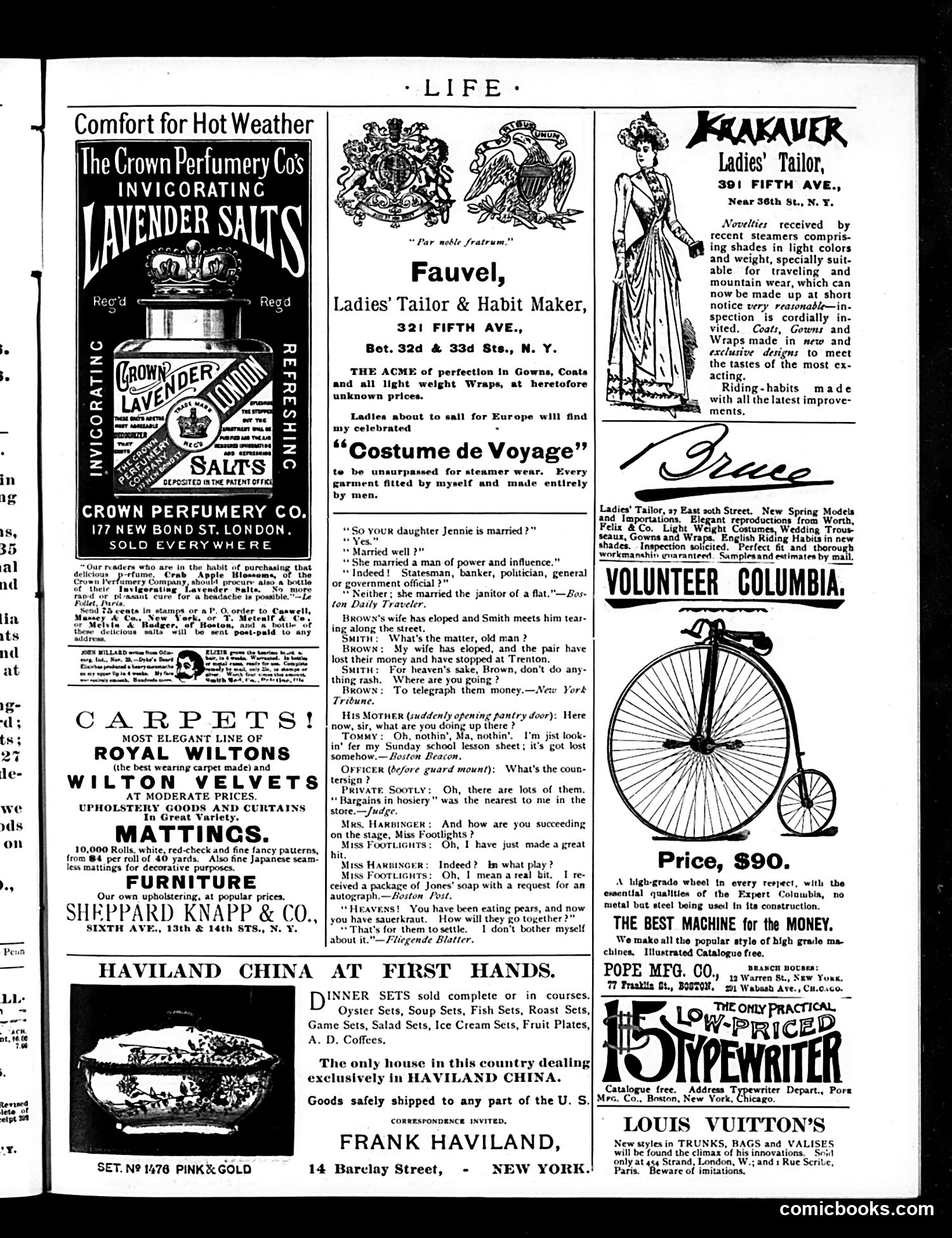
This page is primarily **advertising with embedded comic vignettes** rather than political cartoons. The humor consists of brief, unrelated jokes typical of *Life* magazine's format. The comic snippets include: - A joke about a woman marrying "the janitor of a flat" (satirizing social pretension—marrying for perceived "power and influence") - Brown's wife eloping to Trenton; he plans to send them money (ironic commentary on foolish husbands) - A soldier unable to remember the password (military satire) - An actress claiming success because she received a soap company's autograph request (mocking theatrical delusion) - A man eating pears then sauerkraut without concern (absurdist humor) These are **topical social satire** rather than political commentary—poking fun at vanity, marriage, military life, and theatrical pretension through brief anecdotes. The jokes reflect turn-of-the-century American middle-class anxieties and behavior. No specific historical figures or events are referenced; the humor relies on recognizable social types.
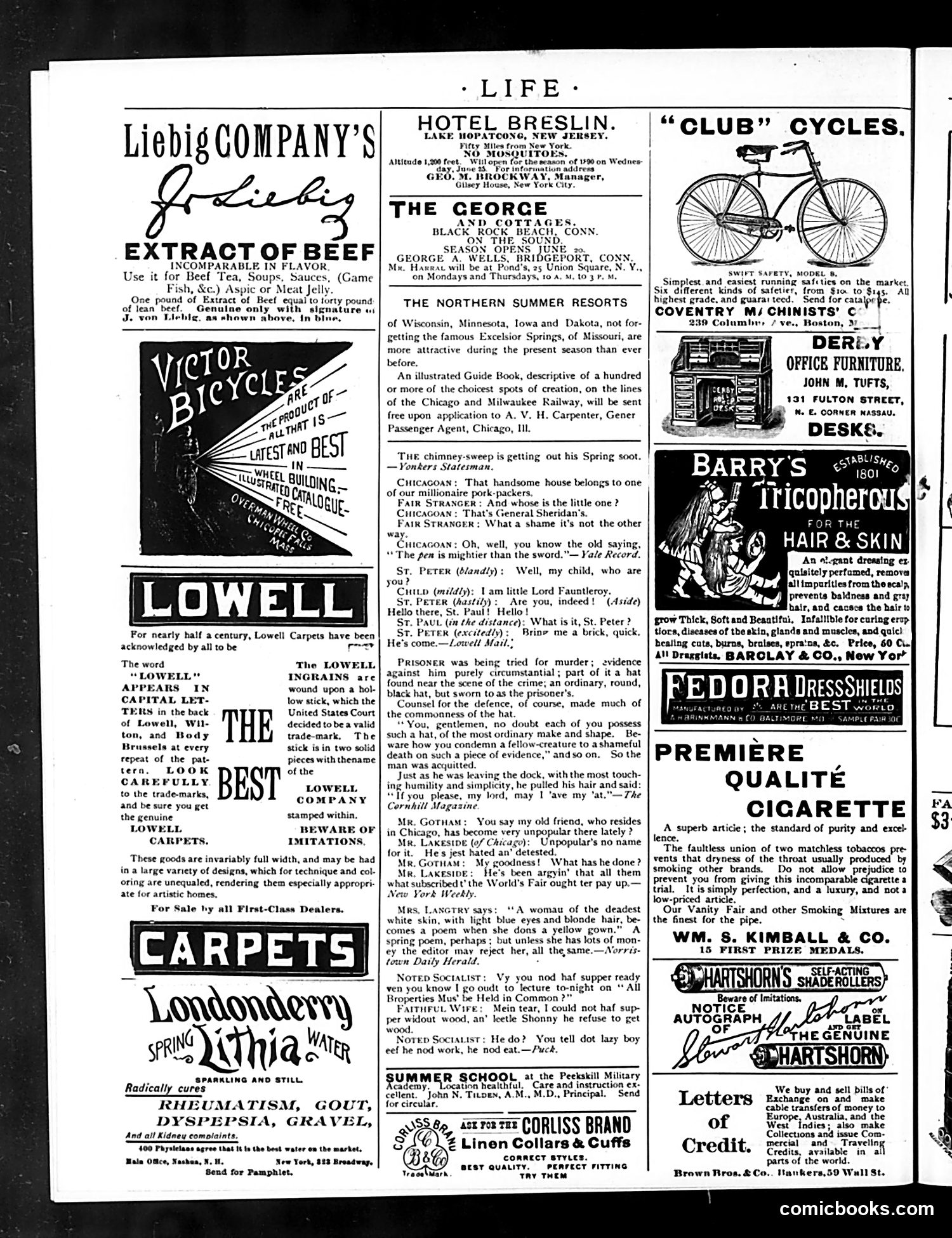
This is primarily an **advertising page** from Life magazine, not a political cartoon or satirical content page. The page consists almost entirely of commercial advertisements for products like Liebig's Extract of Beef, Lowell Carpets, Victor Bicycles, and various hotels and services. The only **satirical content** appears in brief joke vignettes scattered among the ads: - A joke contrasting a wealthy Chicago pork-packer's mansion with General Sheridan's small house, playing on the saying "the pen is mightier than the sword" - A joke about Saint Peter rejecting "Little Lord Fauntleroy" (a reference to the contemporary children's book character known for pretentiousness) - A legal anecdote about a prisoner acquitted due to insufficient evidence regarding a common hat These are **light humor pieces**, not pointed political satire. The page reflects Life's mixed format: serious satirical magazine content alongside commercial sponsorships—a common publishing model of this era.
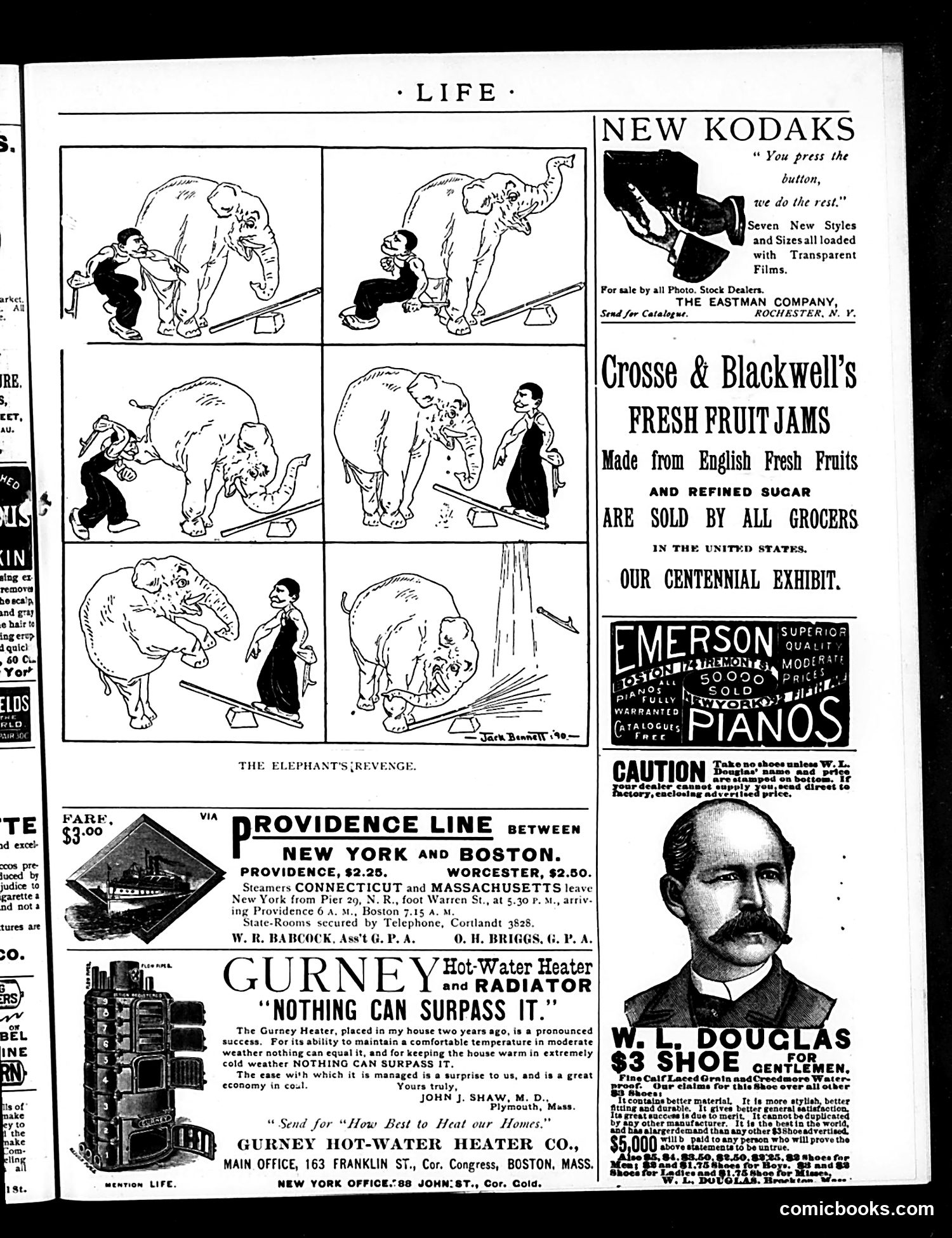
This cartoon depicts a man being repeatedly attacked by an elephant across six panels. The title suggests *retaliation*—the elephant is getting even. The elephant likely represents the **Republican Party** (the GOP's official symbol), while the man represents a political opponent, probably a Democrat or critic of Republican policies. The cartoon satirizes how Republicans "strike back" against their political enemies through various means—each panel shows a new form of assault. Without knowing the specific date and context, the exact political dispute is unclear, but the joke relies on readers understanding contemporary political rivalries. The humor comes from the exaggerated violence and the elephant's persistent, escalating revenge—suggesting Republicans were particularly aggressive in their counterattacks during this era. The cartoonist is credited as "Jack Bennett" (visible at bottom).
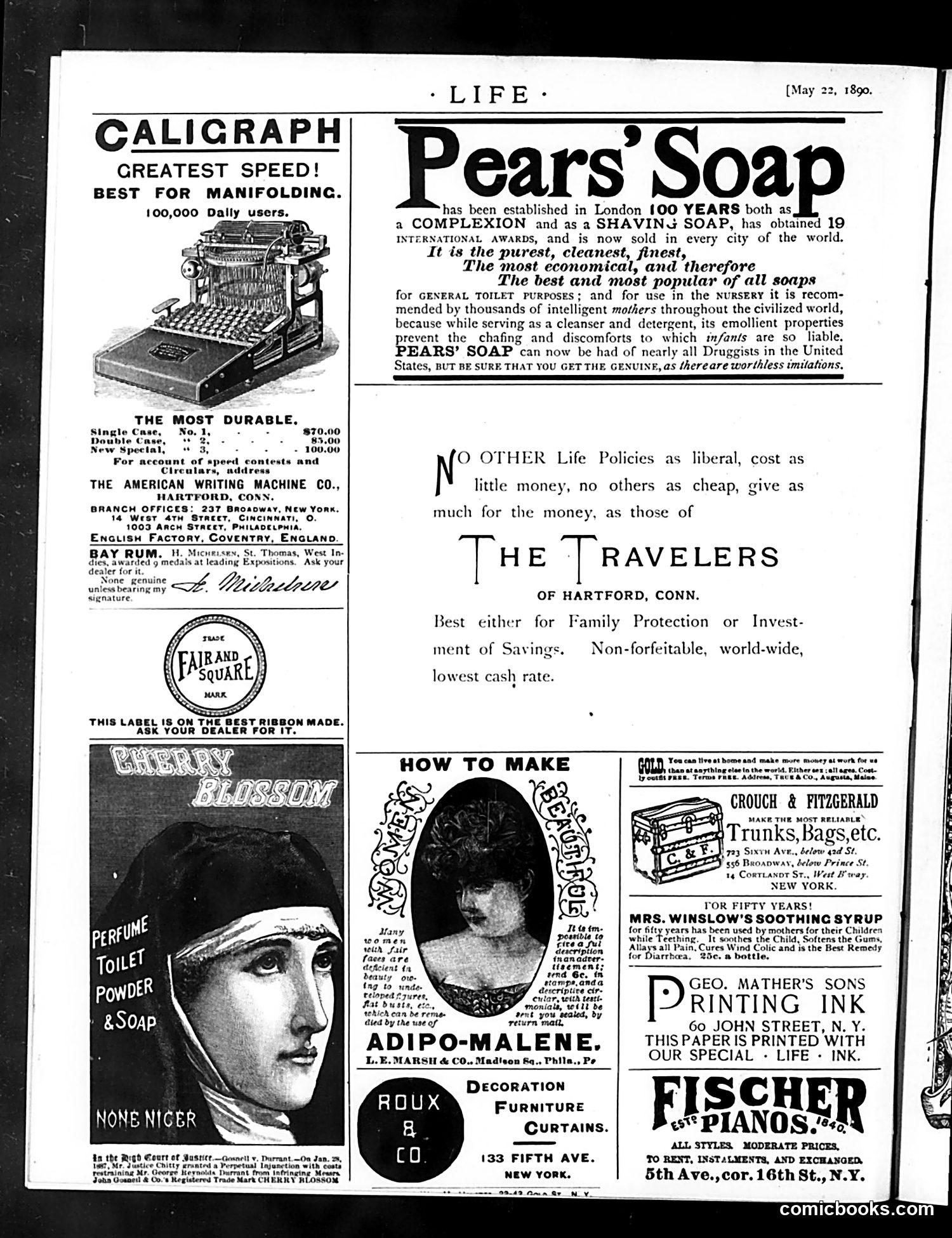
This page is primarily **advertising**, not political satire or editorial cartoon. It contains commercial ads for products typical of the 1890s: Caligraph typewriters, Pears' Soap, Bay Rum, The Travelers Insurance Company, Mrs. Winslow's Soothing Syrup, and pianos. The only image with figurative content is an **"Adipo-Malene"** advertisement featuring a woman's face, promoting a beauty product. This reflects period beauty standards and marketing practices targeting women concerned with facial complexion. A small **Cherry Blossom perfume ad** also appears with minimal imagery. There is **no political cartoon or satire** on this page. Life magazine did publish satirical content, but this particular page functions as a commercial section, reflecting how 19th-century magazines financed themselves through extensive advertising.