
Life, 1890-05-22 · page 4 of 18
Life — May 22, 1890 — page 4: what you’re looking at
What you’re looking at
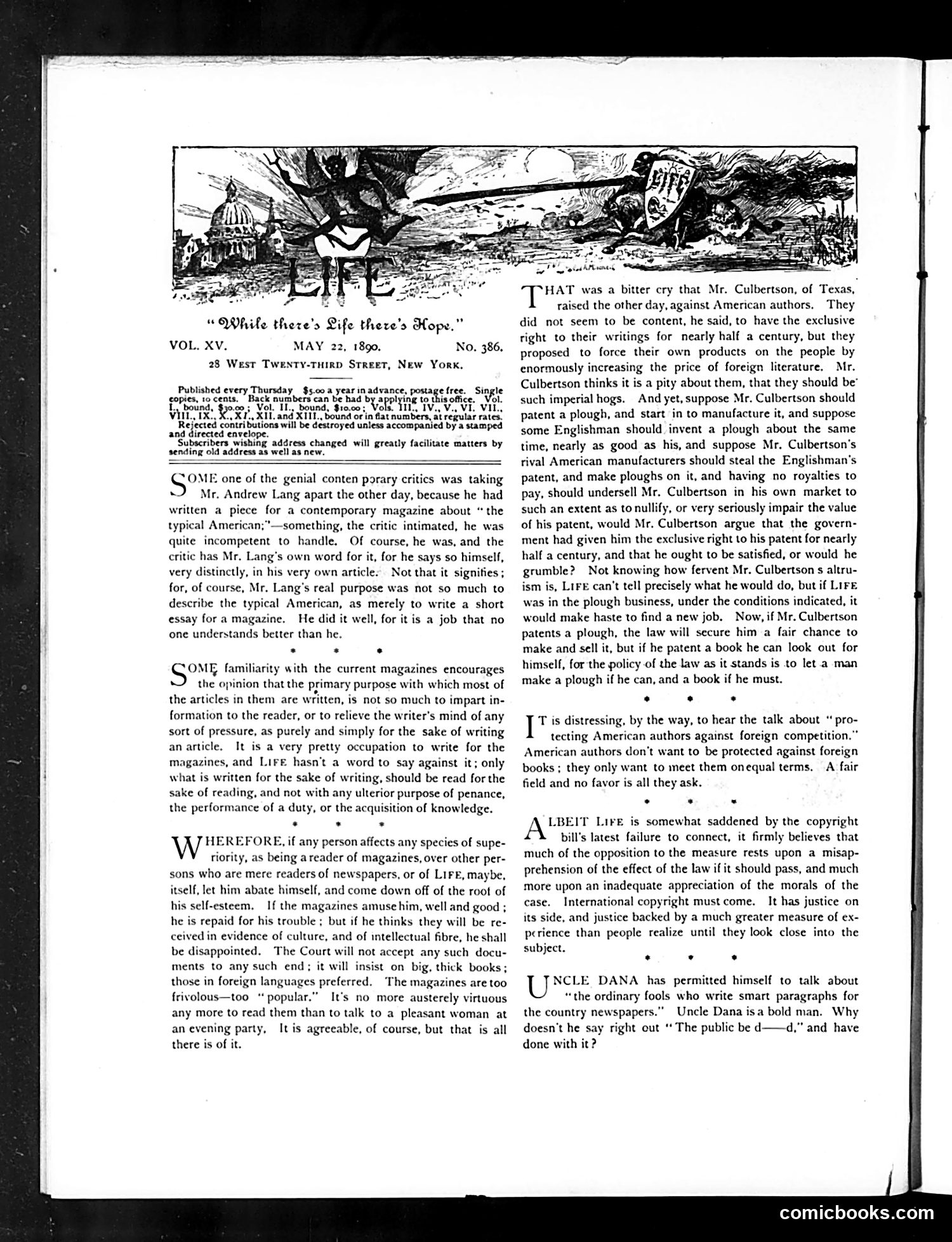
The masthead cartoon depicts a rural landscape with classical and American architectural elements, illustrating the magazine's satirical focus on American culture and society. The main editorial content addresses a controversy involving **Mr. Culbertson of Texas**, who protested against American authors, demanding exclusive rights to their writings for nearly fifty years and proposing to artificially inflate prices of foreign literature. The editors mock this protectionist stance, using it to satirize economic nationalism. They argue that American authors seek fair competition, not monopolistic protection, and that forcing higher prices on readers serves no legitimate purpose. The piece also criticizes the copyright bill's failure and mentions **Uncle Dana**'s public statements about "ordinary fools" in newspapers—likely a contemporary political figure, though identity remains unclear from context.
📄 Transcribed text from this page (OCR, searchable)
Machine-transcribed from the original scan — historical spelling and the odd misread are preserved.
“Mile there's ife there's Hope.” VOL. XV. MAY 22, 1890, No. 386, 28 West Twenty-Tuirp Street, New York, Published every Thursday, $5.00 year in advance, postage free. Single copies, 19 cents. Back numbers can be had b ing to thig office, Vol. mind Voit pound. $ioco: Vole tt . VI, Vil, vir x Xiit bound ocin fat numbers a regular rates, Rejected contri butions will be destroyed unless accompanied by a stamped and directed envelope. Subscribers wishing address changed will greatly facilitate matters by sending ol ew. ome one of the genial conten porary critics was taking Mr. Andrew Lang apart the other day, because he had written a piece for a contemporary magazine about “the typical American;’—something, the critic intimated, he was quite incompetent to handle. Of course, he was, and the for he says so himself, Not that it signifies ; for, of course, Mr. Lang's real purpose was not so much to describe the typical American, as merely to write a short essay for a magazine. He did it well, for it is a job that no one understands better than he. critic has Mr. Lang's own word for very distinctly, in his very own article. Some familiarity with the current magazines encourages the opinion that the primary purpose with which most of the articles in them are written, is not so much to impart in- formation to the reader, or to relieve the writer’s mind of any sort of pressure, as purely and simply for the sake of writing an article, It is a very pretty occupation to write for the magazines, and LIFE hasn't a word to say against it; only what is written for the sake of writing, should be read for the sake of reading, and not with any ulterior purpose of penance, the performance of a duty, or the acquisition of knowledge. . . . HEREFORE, if any person affects any species of supe- riority, as being a reader of magazines, over other per- sons who are mere readers of newspapers, or of LIFE, maybe, itself, let him abate himself, and come down off of the root of his self-esteem. If the magazines amuse him, well and good ; he is repaid for his trouble ; but if he thinks they will be re- ceived in evidence of culture, and of intellectual fibre, he shall be disappointed. The Court will not accept any such docu- ments to any such end; it will insist. on big, thick books ; those in foreign languages preferred. ‘The magazines are too frivolous—too “popular.” It’s no more austerely virtuous any more to read them than to talk to a pleasant woman at an evening party, It is agreeable, of course, but that is all there is of it. HAT was a bitter cry that Mr. Culbertson, of Texas, raised the other day, against American authors. They did not seem to be content, he said, to have the exclusive right to their writings for nearly half a century, but they proposed to force their own products on the people by enormously increasing the price of foreign literature. Mr. Culbertson thinks it is a pity about them, that they should be’ such imperial hogs. And yet, suppose Mr. Culbertson should patent a plough, and start in to manufacture it, and suppose some Englishman should invent a plough about the same time, nearly as good as his, and suppose Mr. Culbertson’s rival American manufacturers should steal the Englishman's patent, and make ploughs on it, and having no royalties to pay, should undersell Mr. Culbertson in his own market to such an extent as to nullify, or very seriously impair the value of his patent, would Mr. Culbertson argue that the govern- ment had given him the exclusive right to his patent for nearly half a century, and that he ought to be satisfied, or would he grumble? Not knowing how fervent Mr. Culbertson s altru- ism is, LIFE can’t tell precisely what he would do, but if LiFe was in the plough business, under the conditions indicated, it would make haste to find a new job. Now, if Mr. Culbertson patents a plough, the law will secure him a fair chance to make and sell it, but if he patent a book he can look out for himself, for the policy of the law as it stands is to let.a man make a plough if he can, and a book if he must. * . . T is distressing, by the way, to hear the talk about “‘ pro- tecting American authors against foreign competition.” American authors don’t want to be protected against foreign books ; they only want to meet them onequal terms. A fair field and no favor is all they ask. LBEIT Lire is somewhat saddened by the copyright bill's latest failure to connect, it firmly believes that much of the opposition to the measure rests upon a misap- prehension of the effect of the law if it should pass, and much more upon an inadequate appreciation of the morals of the case. International copyright must come. It has justice on its side, and justice backed by a much greater measure of ex- perience than people realize until they look close into the subject. . . . NCLE DANA has permitted himself to talk about “the ordinary fools who write smart paragraphs for the country newspapers.” Uncle Dana isa bold man. Why doesn’t he say right out ‘ The public be d——d,” and have done with it? comicbooks.com