
Life, 1890-05-22 · page 6 of 18
Life — May 22, 1890 — page 6: what you’re looking at
What you’re looking at
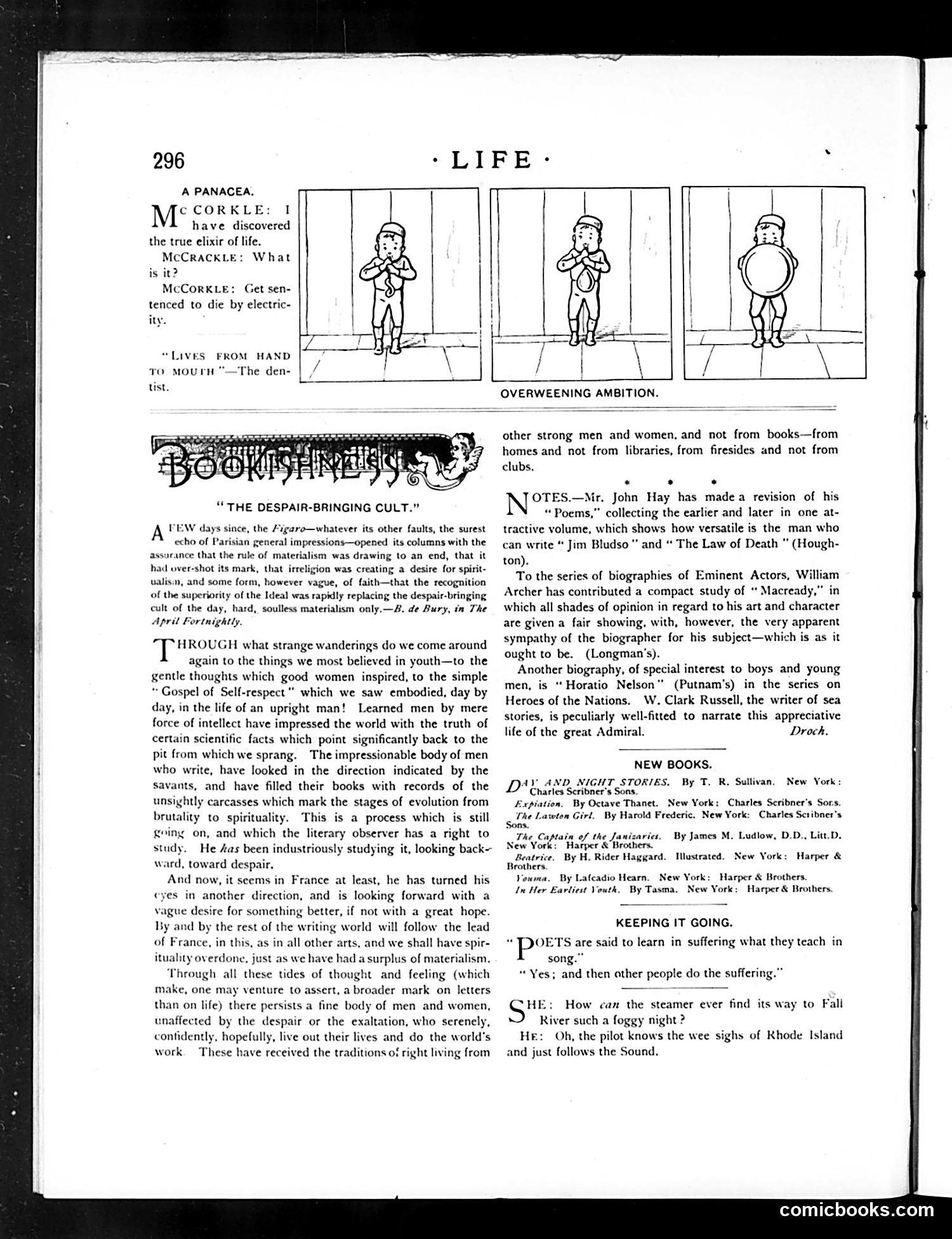
This three-panel cartoon satirizes excessive personal ambition. Each panel shows the same figure progressing through stages: first holding something small to his chest, then a medium object, finally a large sphere so enormous he can barely contain it. The title "Overweening Ambition" suggests the joke is about how ambition grows disproportionately—the figure becomes increasingly burdened by his own desires for advancement or acquisition. The satire targets the human tendency toward unchecked aspiration, where wanting more becomes absurdly self-defeating. The visual progression from manageable to ridiculous illustrates how ambition, left unchecked, consumes and overwhelms the ambitious person rather than fulfilling them. This was a common Life magazine theme critiquing American materialism and social climbing.
📄 Transcribed text from this page (OCR, searchable)
Machine-transcribed from the original scan — historical spelling and the odd misread are preserved.
A PANACEA, MS CORKLE: I have discovered the true elixir of life. McCRackLe: What is it? McCorKLe: Get sen- tenced to die by electric- ity. “LIVES FROM To MOUTH ™ HAND ‘The den- | tist. “THE DESPAIR-BRINGING CULT.” EW days since, the Figaro—whatever its other faults, the surest echo of Parisian general impressions—opened its columns with the assurance that the rule of materialism was drawing to an end, that it had over-shot its mark, that irreligion was creating a desire for spirit- ualisin, and some form, however vague, of faith—that the recognition of the superiority of the Ideal was rapidly replacing the despair-bringing cult of the day, hard, soulless materialism only.—&. de Bury, in The April Fortnightly. HROUGH what strange wanderings do we come around again to the things we most believed in youth—to the gentle thoughts which good women inspired, to the simple “ Gospel of Self-respect " which we saw embodied, day by day, in the life of an upright man! Learned men by mere force of intellect have impressed the world with the truth of certain scientific facts which point significantly back to the pit from which we sprang. The impressionable body of men who write, have looked in the direction indicated by the savants, and have filled their books with records of the unsightly carcasses which mark the stages of evolution from brutality to spirituality. This is a process which is still going on, and which the literary observer has a right to study. He das been industriously studying it, looking back ward, toward despair, And now, it seems in France at least, he has turned his s in another direction, and is looking forward with a gue desire for something better, if not with a great hope. nd by the rest of the writing world will follow the lead of France, in this, as in all other arts, and we shall have spir- ituality overdone, just as we have had a surplus of materialism. Through all these tides of thought and feeling (which make, one may venture to assert, a broader mark on letters than on life) there persists a fine body of men and women, unaffected by the despair or the exaltation, who serenely, contidently, hopefully, live out their lives and do the world’s work. These have received the traditions of right living from by other strong men and women, and not from books—from homes and not from libraries, from firesides and not from clubs, . . . OTES.—Mr. John Hay has madea revision of his “Poems,” collecting the earlier and later in one at- tractive volume, which shows how versatile is the man who can write “ Jim Bludso " and “ The Law of Death " (Hough- ton). To the series of biographies of Eminent Actors, William Archer has contributed a compact study of “ Macready,” in which all shades of opinion in regard to his art and character are given a fair showing, with, however, the very apparent sympathy of the biographer for his subject—which is as it ought to be. (Longman’s). Another biography, of special interest to boys and young men, is “Horatio Nelson” (Putnam's) in the series on Heroes of the Nations. W. Clark Russell, the writer of sea stories, is peculiarly well-fitted to narrate this appreciative life of the great Admiral. Droch. NEW BOOKS. AV AND NIGHT STORIES. By T. R. Sullivan Charles Scribner's Sons. Expiation. By Octave Thanet. The Lawton Girl. Sons. The Captain of the Janizaries. New York: Harper & Brothers. Beatrice. By H. Rider Haggard. Brothers. Youma. By Lafcadio Hearn. In Her Earliest Youth, By Tasma, New York: New York: Charles Scribner's Sors. By Harold Frederic. New York: Charles Scribner's By James M. Ludlow, D.D., Litt.D. Mlustrated. New York: Harper & New York: Harper & Brothers. New York: Harper & Brothers, KEEPING IT GOING. “ PDOETS are said to learn in suffering what they teach in song.” ‘es; and then other people do the suffering.” HE: How can the steamer ever find its way to Fall River such a foggy night ? HE: Oh, the pilot knows the wee sighs of Khode Island and just follows the Sound, comicbooks.com