
A complete issue · 18 pages · 1890
Life — April 17, 1890
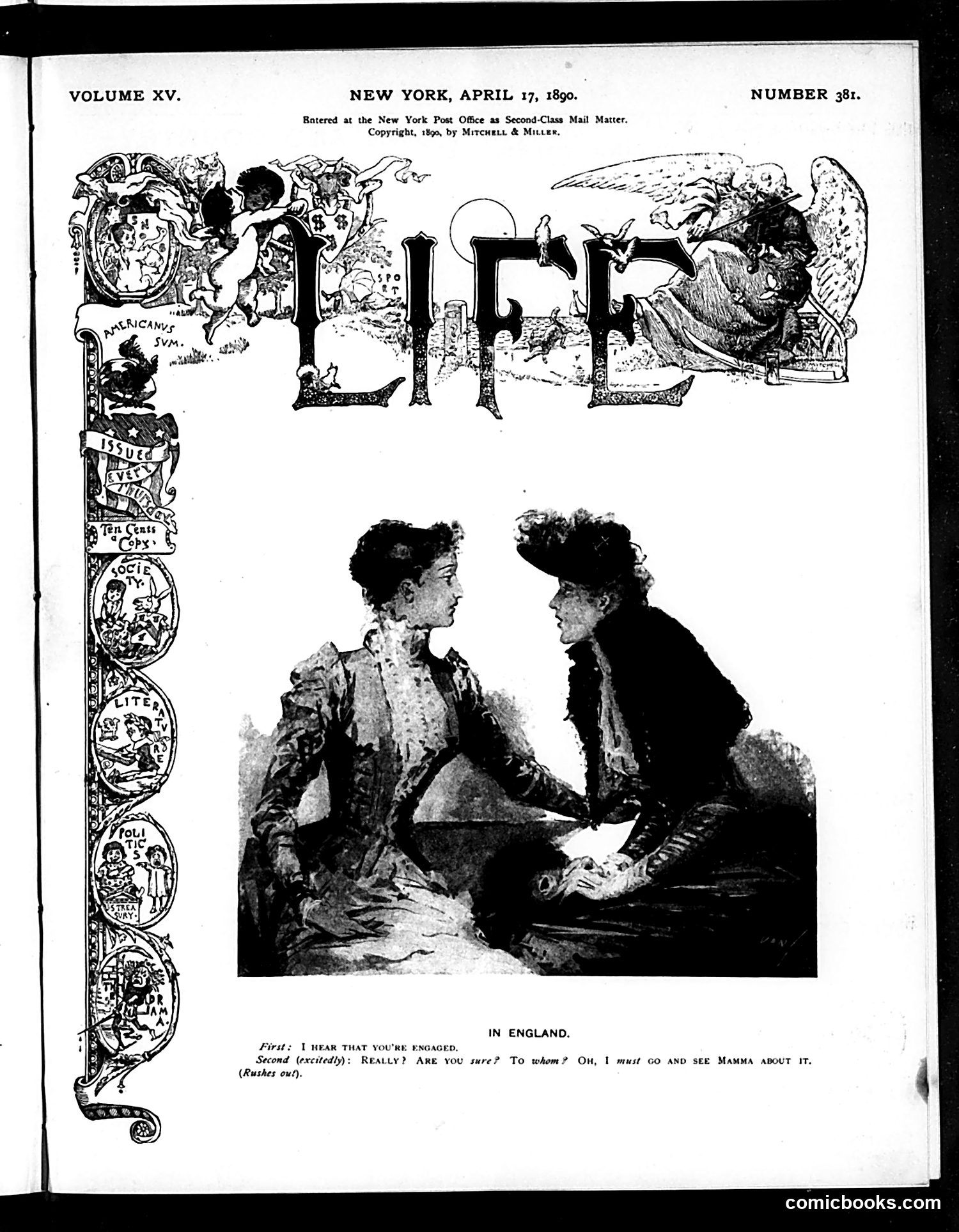
This page features a satirical illustration titled "In England" depicting two women in conversation. The dialogue reads: "First: I hear that you're engaged. Second (excitedly): Really? Are you sure? To whom? Oh, I must go and see Mamma about it." The joke satirizes the social conventions of upper-class English courtship, mocking the seemingly absurd priority of reporting an engagement to one's mother before even confirming details with the fiancé. It highlights Victorian-era attitudes where parental approval and propriety were paramount in matrimonial matters—so much so that a woman might rush to inform her mother of an engagement before fully discussing it with her betrothed. The ornate decorative border is characteristic of *Life* magazine's design aesthetic of this period.
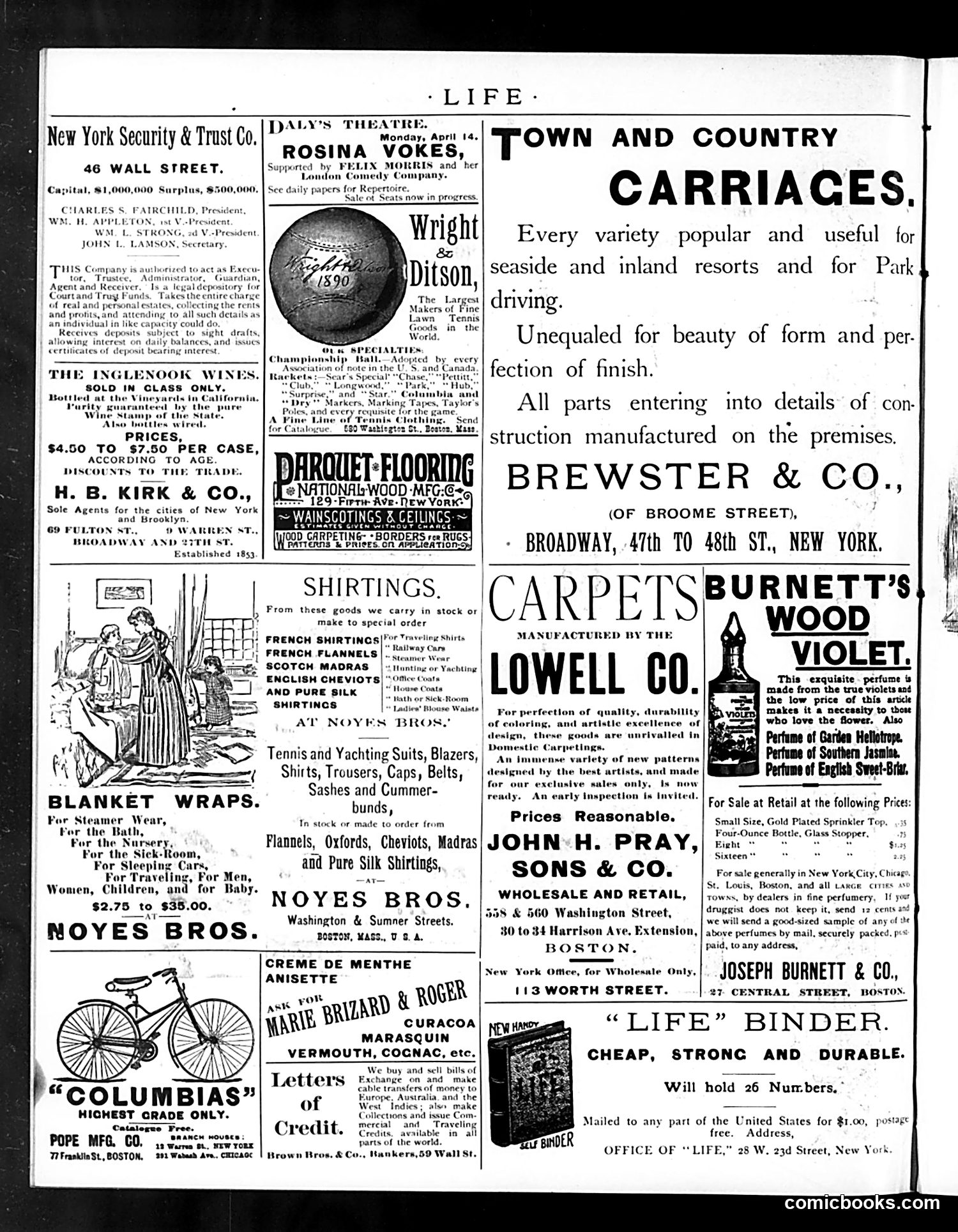
This page is primarily **advertising**, not editorial or satirical content. The layout contains numerous commercial advertisements from the late 19th/early 20th century, including: - Financial services (New York Security & Trust Co.) - Theater promotion (Daly's Theatre featuring "Rosina Vokes") - Carriages and vehicles (Brewster & Co., Columbia bicycles) - Textiles and clothing (Noyes Bros. blanket wraps and shirtings) - Home goods (Lowell carpets, Burnett's perfume) There is a small **illustration** on the left showing figures in period dress examining fabrics or textiles, likely promoting Noyes Bros.' products, but it's commercial art rather than political satire. The page demonstrates Life magazine's business model: satirical editorial content subsidized by paid advertisements from established manufacturers and retailers.
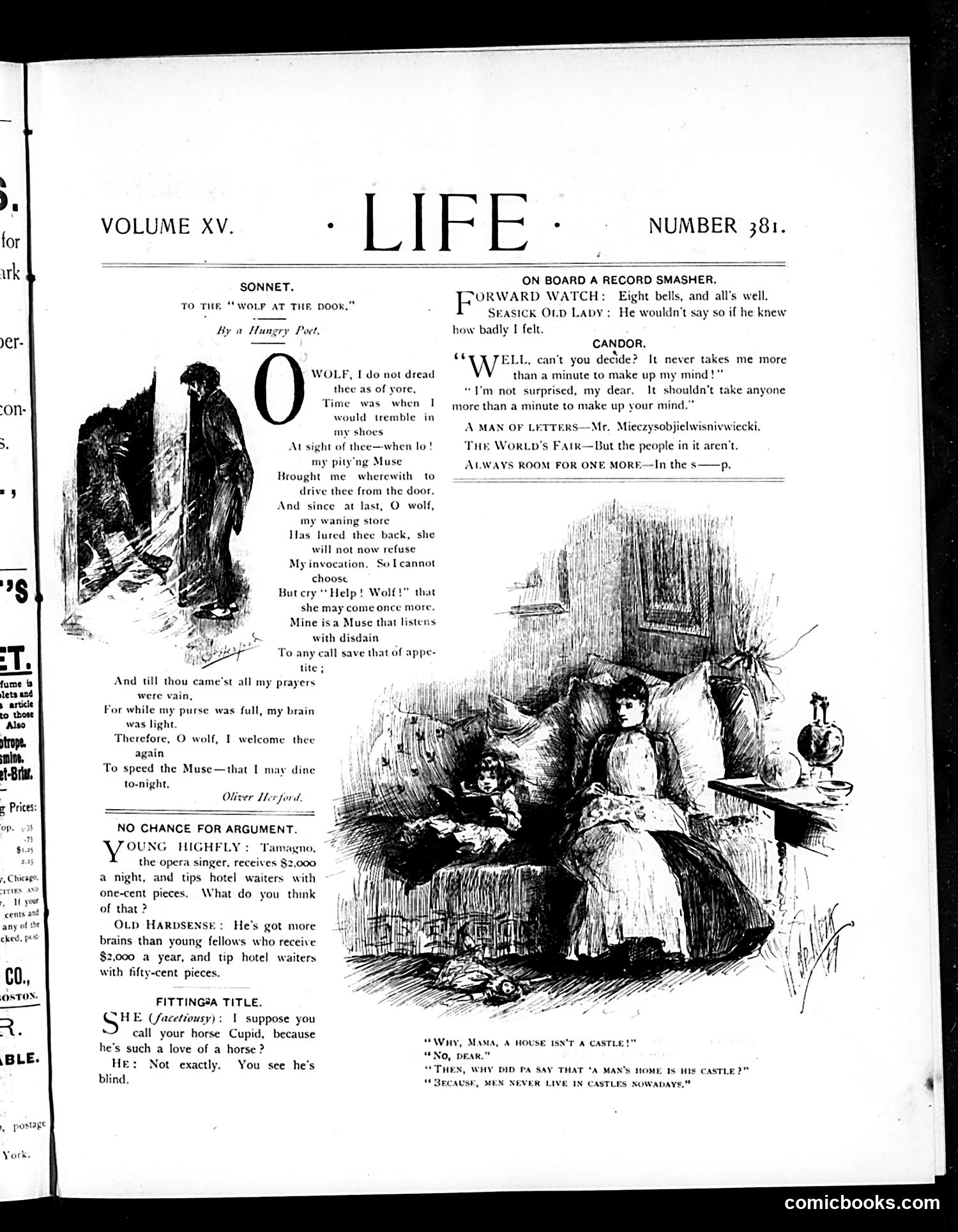
This page from *Life* magazine (Volume XV, Number 381) contains primarily **humorous literary and social content** rather than political cartoons. The main items are: 1. **"Wolf at the Door" Sonnet** by Oliver Herford—a romantic poem about invoking a muse, using the wolf as metaphor for artistic inspiration. 2. **"No Chance for Argument"**—a brief comic exchange between "Young Highly" (an opera singer) and "Old Hardense" debating tips and wages, satirizing wealth disparities in Gilded Age service industries. 3. **"Fitting a Title"**—a short joke about a nearsighted horse named Cupid. 4. **Large illustration** showing a domestic scene with a woman, child, and furniture, captioned with wordplay about "a man's home is his castle." The page reflects *Life's* characteristic blend of literary satire, social humor, and domestic comedy targeting middle-class readers.
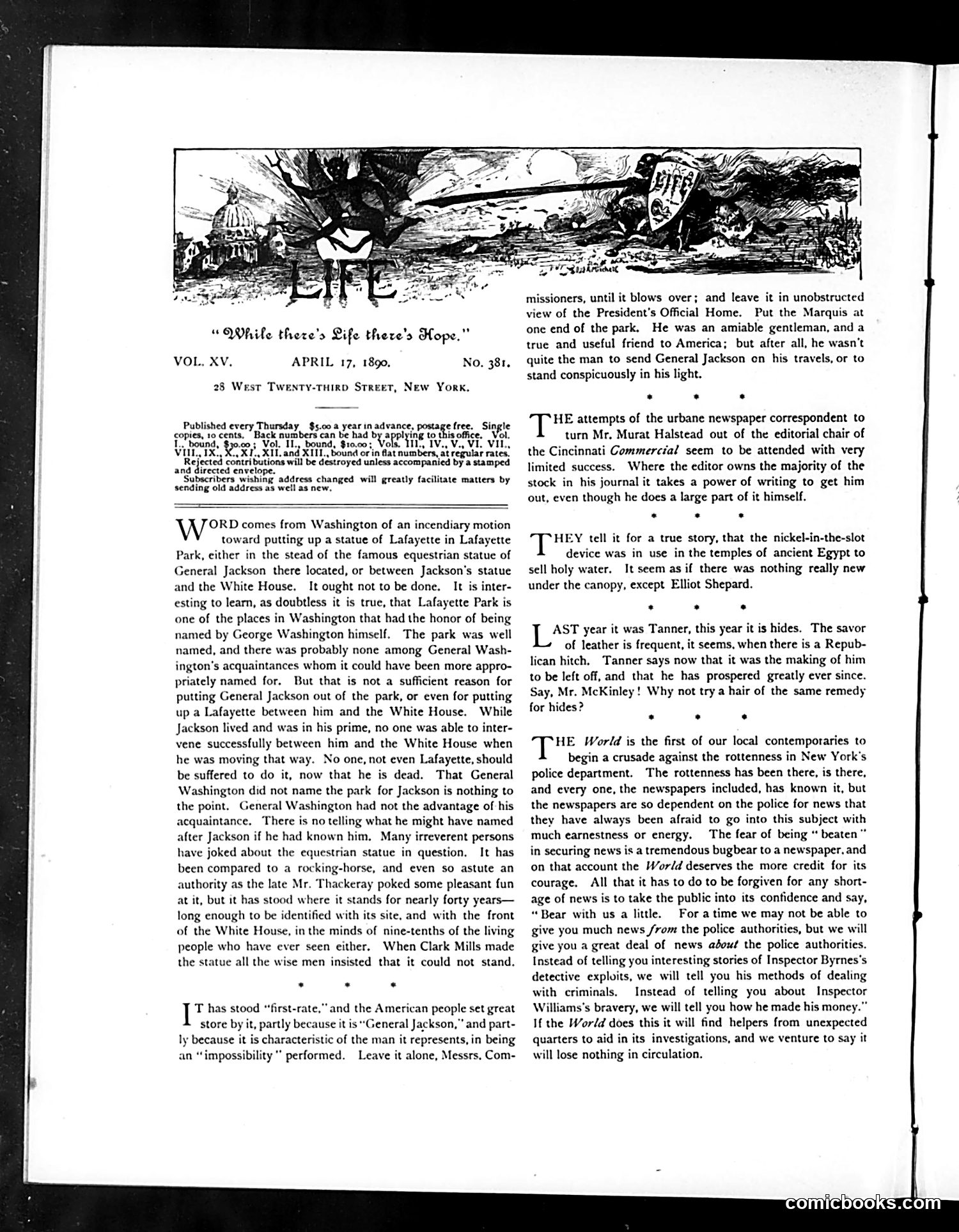
The cartoon at top depicts a debate over a proposed Lafayette statue in Lafayette Park, Washington D.C. The text explains that some wanted the statue positioned near General Jackson's monument, between it and the White House—but this was deemed inappropriate. The satire mocks this controversy as absurd. The author argues that while Jackson's equestrian statue has stood "first-rate" for nearly forty years, placing Lafayette nearby would be ridiculous positioning. The joke lies in treating this minor urban planning dispute with mock-serious analysis, suggesting the public debate reveals how Americans obsess over trivial details of civic monuments and their symbolic placement relative to presidential spaces.
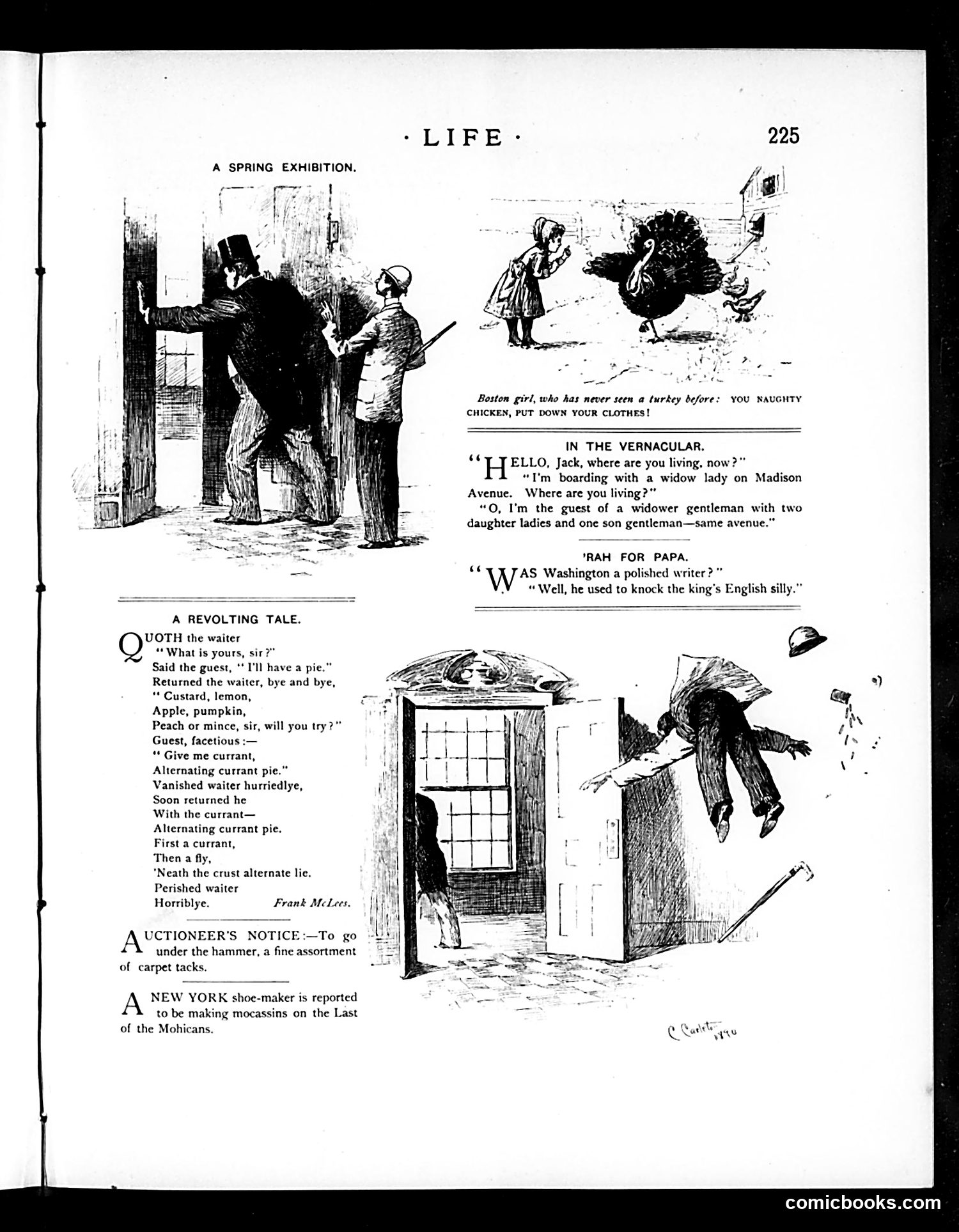
**"A Spring Exhibition"** (top left): Shows a man in formal dress examining artwork at what appears to be a gallery opening, with a young boy watching. The humor likely derives from contrasting sophisticated art appreciation with childlike perspective. **"A Revolting Tale"** (left): A humorous poem about a waiter offering various pie fillings to a guest, who requests "currant pie." The waiter keeps returning with alternating currant and other pies—a play on words ("alternating currant pie / 'Neath the crust alternate lie"). **"Boston girl, who has never seen a turkey before"** (top right): Satirizes urban unfamiliarity with rural life, showing a fashionable city woman encountering a turkey. **Other items**: Brief social commentary and notices typical of Life's satirical format.
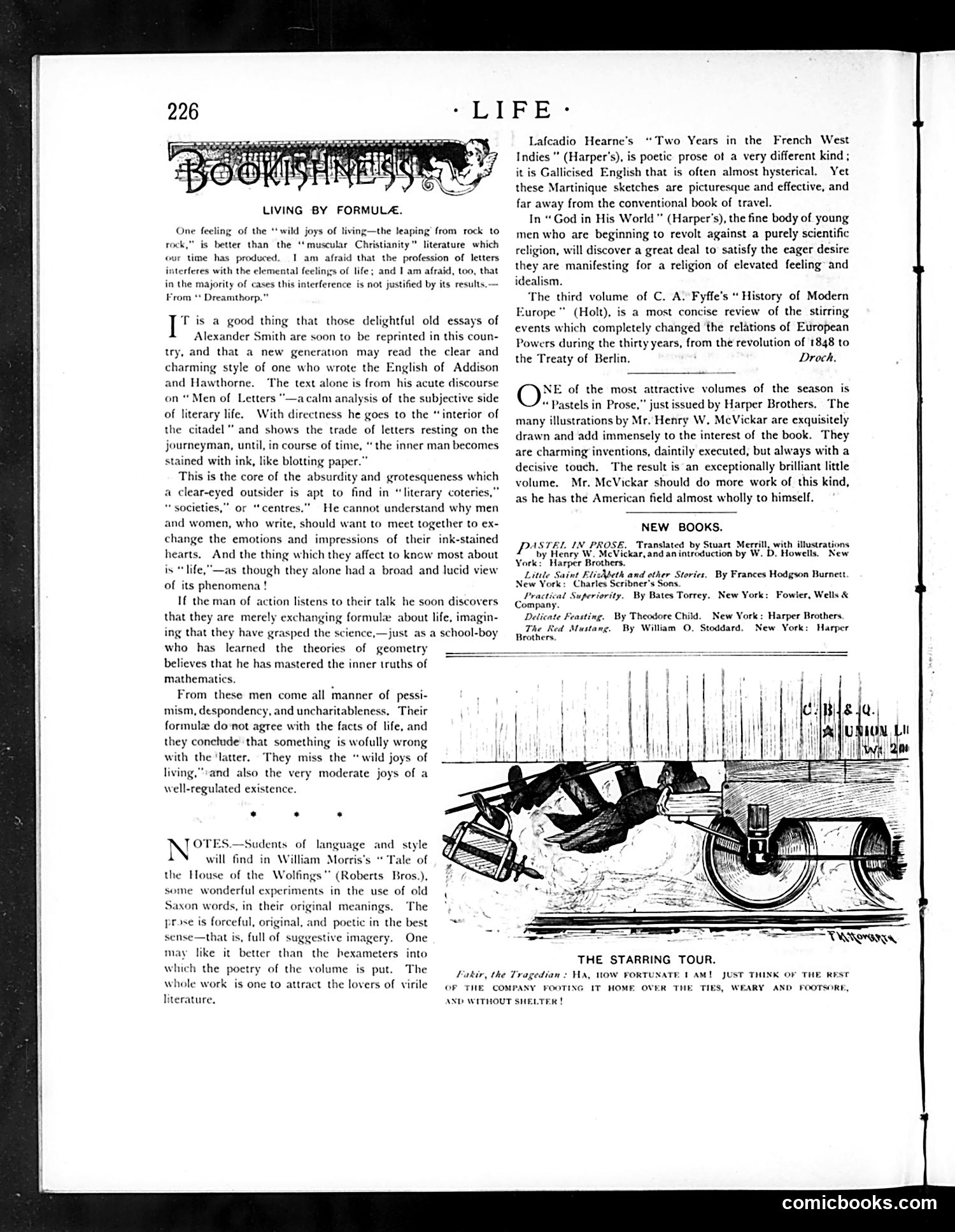
This cartoon depicts an automobile accident or breakdown during what appears to be an early 1900s motorcar journey. The caption reads: "Father, the Tragedian: 'Ha, how fortunate I am! Just think of the rest of the company footing it home over the tires, weary and footsore, and without shelter!'" The humor relies on ironic dramatic timing—the father, a professional actor ("tragedian"), finds opportunity for theatrical expression even in automotive misfortune. While his traveling companions face genuine hardship (walking home on bad roads without shelter), he performs mock gratitude for his predicament. This satirizes both the pretentiousness of theater professionals and early automobiles' notorious unreliability, which frequently stranded travelers.
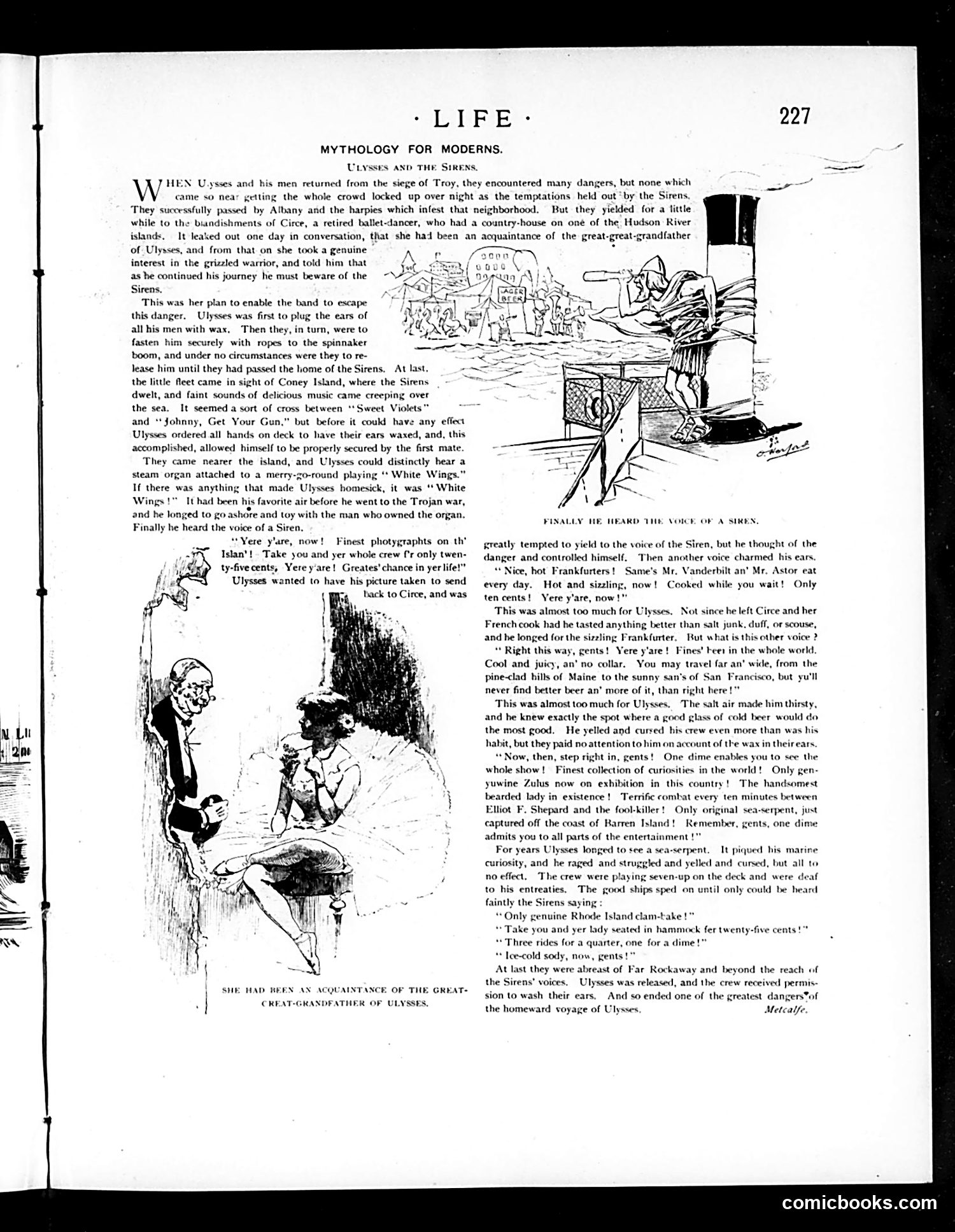
This page presents a modernized retelling of Homer's *Odyssey*, specifically Ulysses' encounter with the Sirens. The text humorously updates classical mythology for contemporary readers by replacing mythological temptations with early 20th-century American urban pleasures—references to "Sweet Violets," vaudeville performances ("White Wings"), and Coney Island attractions. The illustrations show Ulysses resisting these temptations through various methods, with crew members plugging their ears. The satire's point appears to be social commentary on modern vice and distraction: the Sirens become metaphors for contemporary urban temptations (entertainment venues, commercial pleasures) that threaten to derail respectable society—much as they once threatened ancient sailors. The humor lies in applying classical literature to mundane modern life.
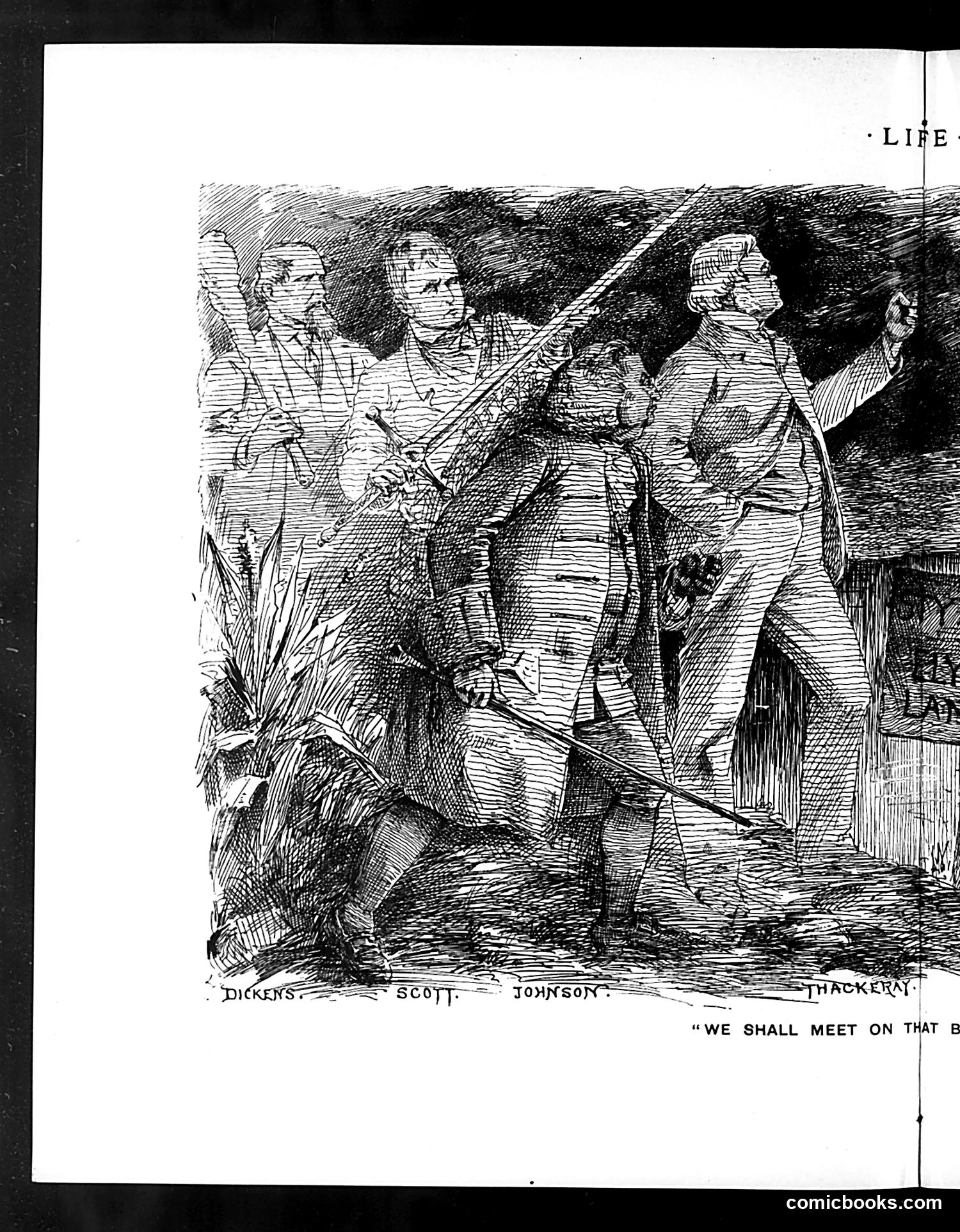
This Life magazine illustration depicts four literary figures identified by name at the bottom: Dickens, Scott, Johnson, and Thackeray. The caption reads "We Shall Meet on That B[ank]" (text appears cut off). The cartoon appears to satirize these famous British authors, showing them as ghost-like or spectral figures in a somewhat murky, outdoor setting with vegetation. The satire likely references a literary meeting or reunion, possibly playing on themes of death, the afterlife, or literary legacy—common subjects for Victorian-era satirical magazines. Without the complete caption, the specific political or social point remains unclear, though it may mock literary pretensions or debate among these canonical authors' reputations.
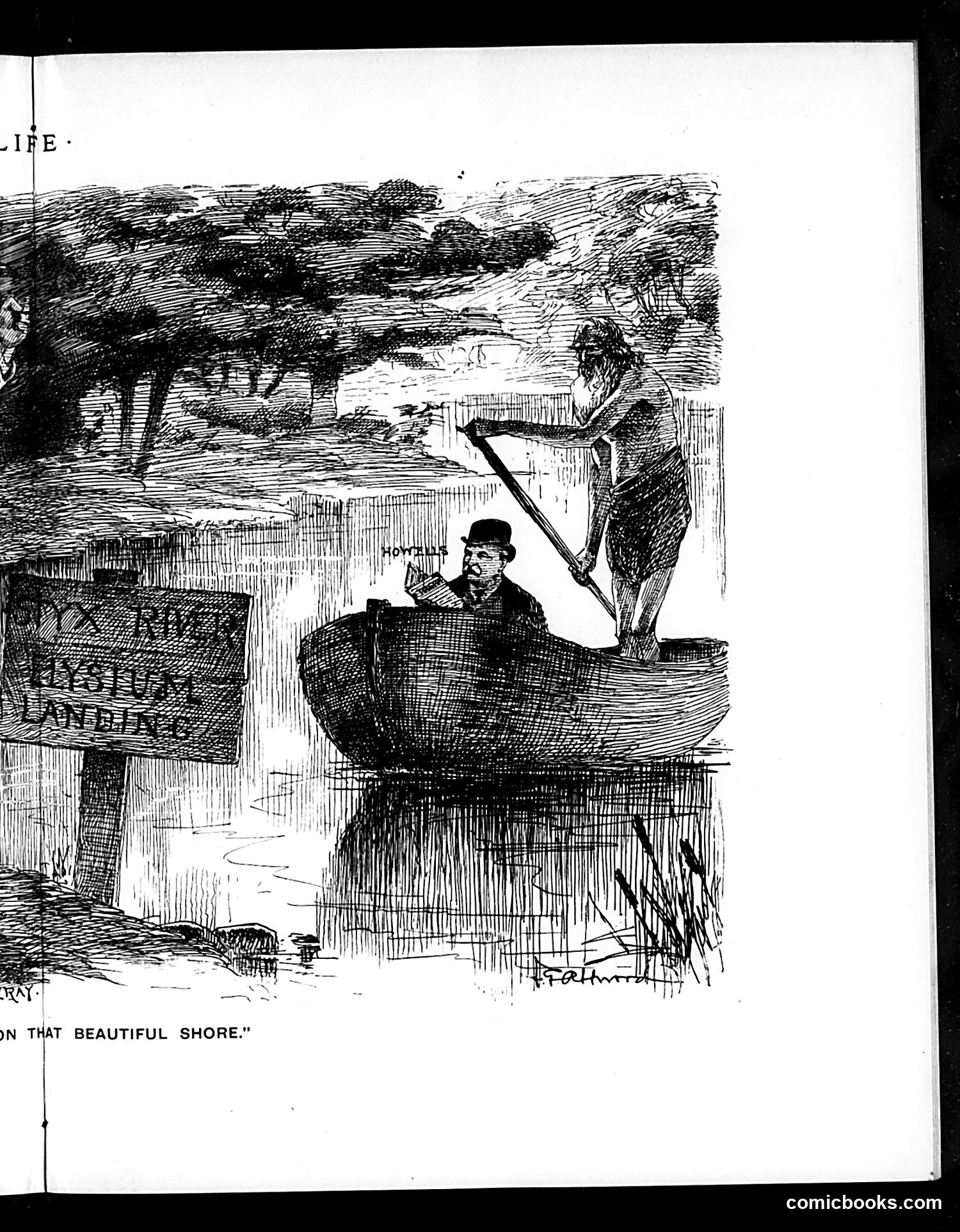
This etching shows two figures by a boat on a riverbank. A man in a bowler hat sits in the vessel while another figure stands beside it, pointing toward the distant landscape with a long pole or oar. The caption "On That Beautiful Shore" appears to reference a spiritual or afterlife concept—likely evoking the hymn "On Jordan's Stormy Bank I Stand" or similar religious imagery about crossing to heaven. The satire likely concerns mortality, death, or a journey toward the afterlife. Without additional context from the magazine's date and political climate, the specific target remains unclear—it could satirize someone's political demise, the end of an era, or metaphorically comment on a contemporary figure's fate. The formal dress and composition suggest commentary on a notable person or event.
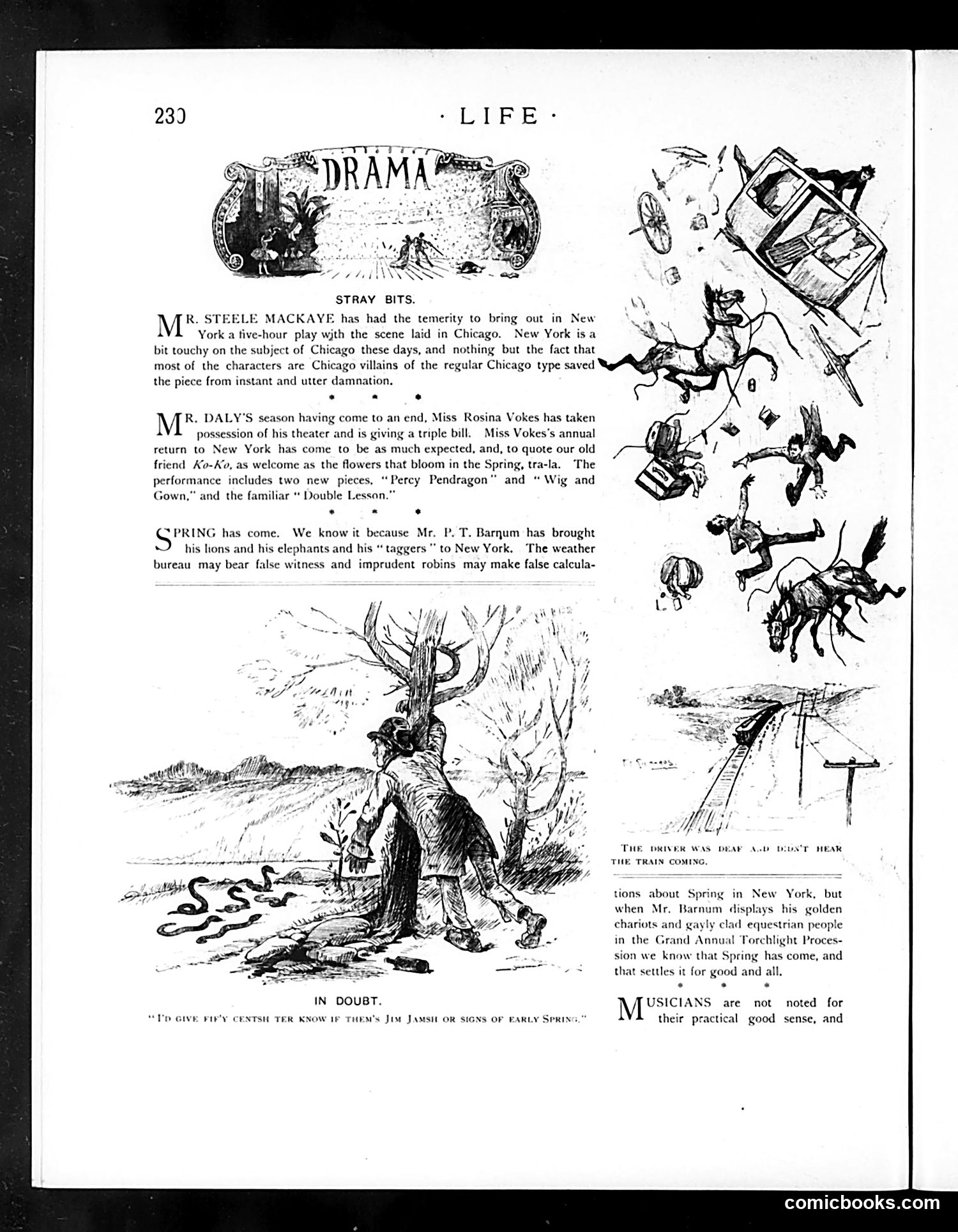
This page from *Life* magazine contains theatrical gossip under the "Drama" section. The text discusses: 1. **Steele MacKaye's play**: A New York production set in Chicago, featuring Chicago-type villains 2. **Miss Rosina Vokes's season**: Her return to New York with a triple bill including "Percy Pendragon," "Wig and Gown," and "Double Lesson" 3. **P.T. Barnum's arrival**: Noted as a sign of spring, bringing his lions and "tigers" to New York for an equestrian Grand Annual Torchlight Procession The cartoons illustrate theatrical chaos—animals and chaos falling from an overturned wagon (top right), and a figure in doubt about spring (bottom left). The satire mocks theater's melodrama and Barnum's sensationalism as unreliable indicators of actual seasonal change.
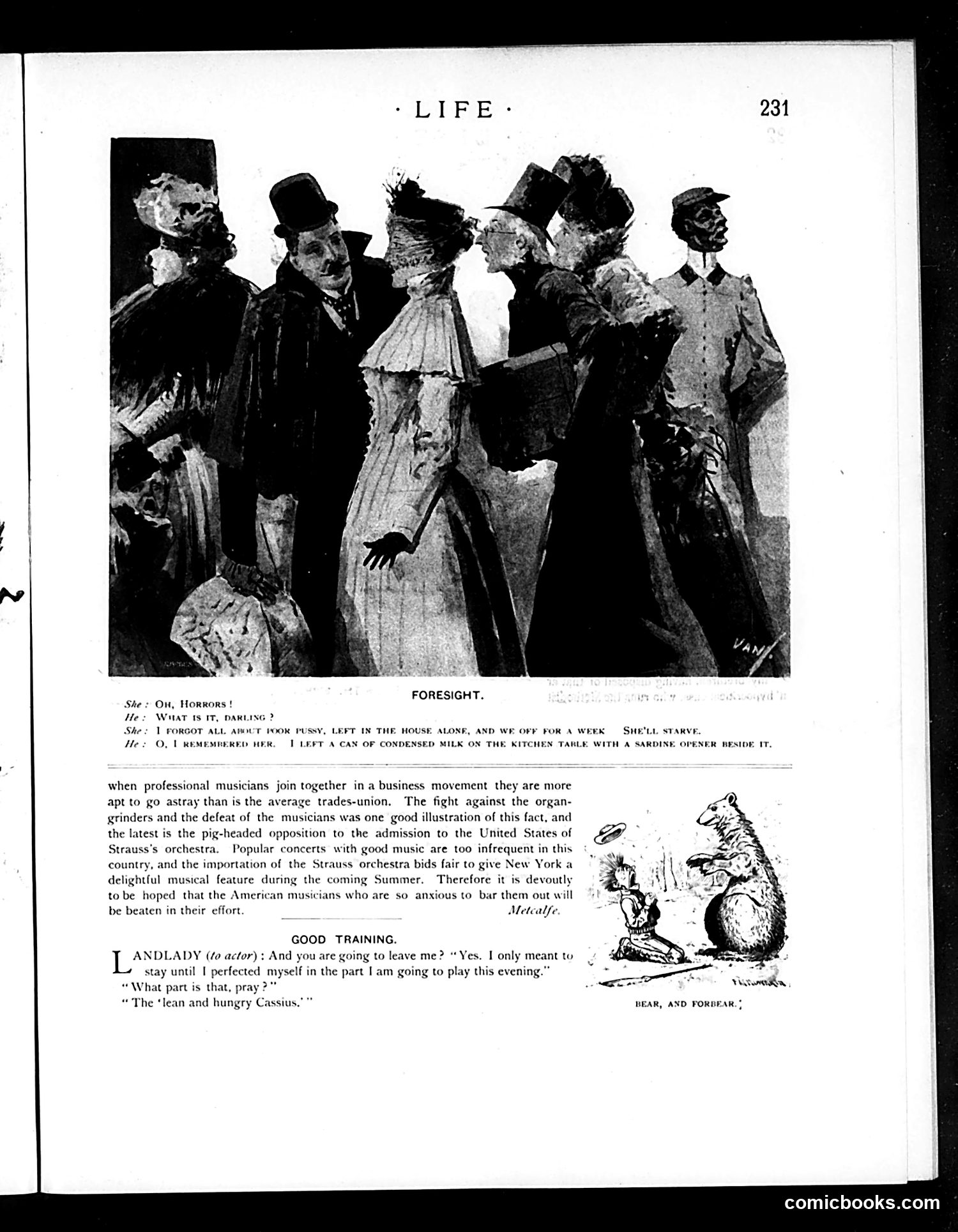
**Top Cartoon ("Foresight"):** A social scene depicting a woman who has forgotten her housemaid at home alone. The joke centers on Victorian-era anxieties about domestic servants: the woman worries the maid will starve, but more importantly, she left a can of condensed milk on the kitchen table—implying the servant might consume it, a perceived threat to household provisions and class boundaries. **Bottom Section ("Good Training"):** Features dialogue between a landlady and actor. The actress claims she stayed late perfecting her role as the "lean and hungry Cassius" (referencing Shakespeare's *Julius Caesar*). The humor suggests she's actually been unable to afford proper meals, conflating theatrical character preparation with genuine poverty—satirizing struggling actors' precarious economic circumstances.
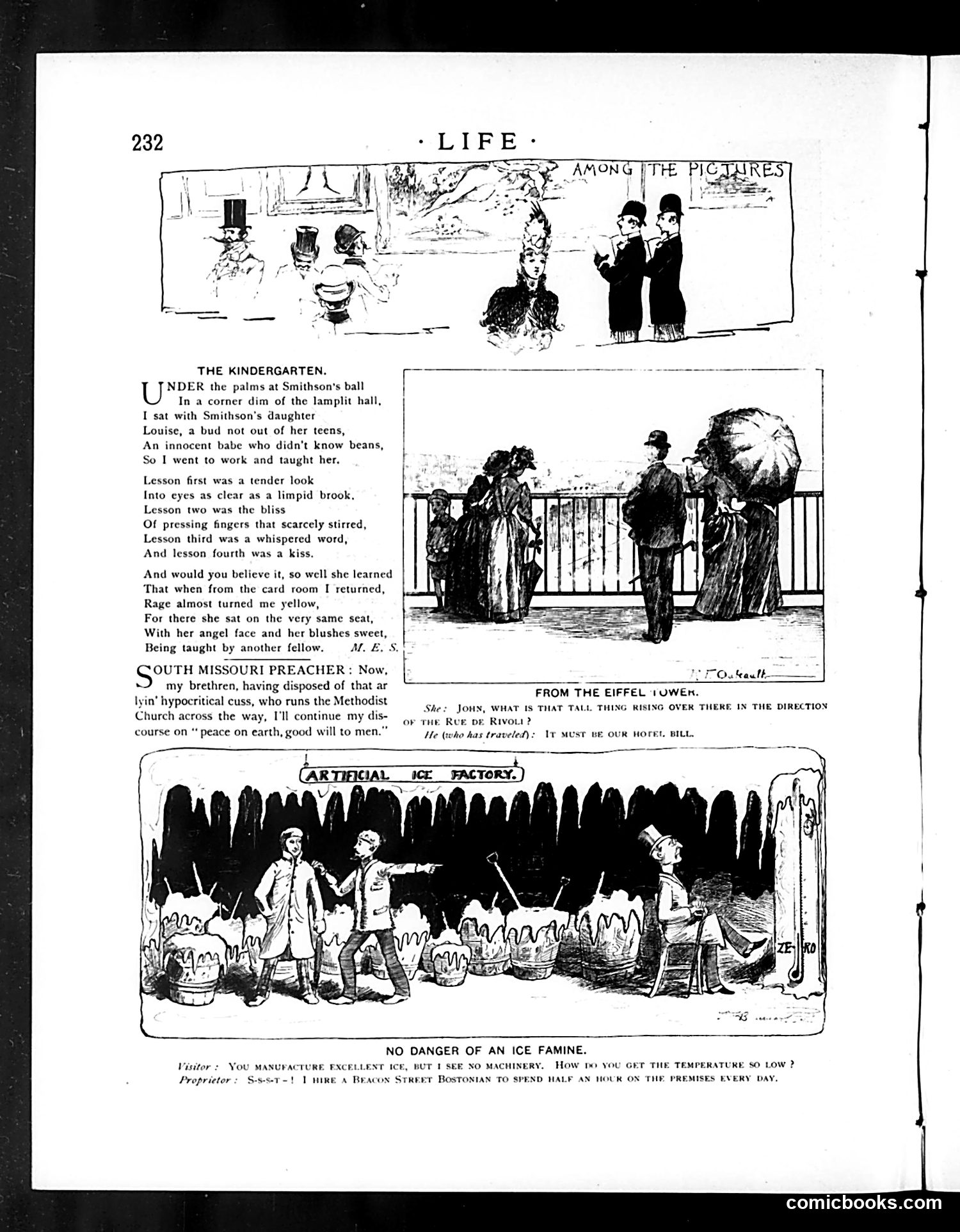
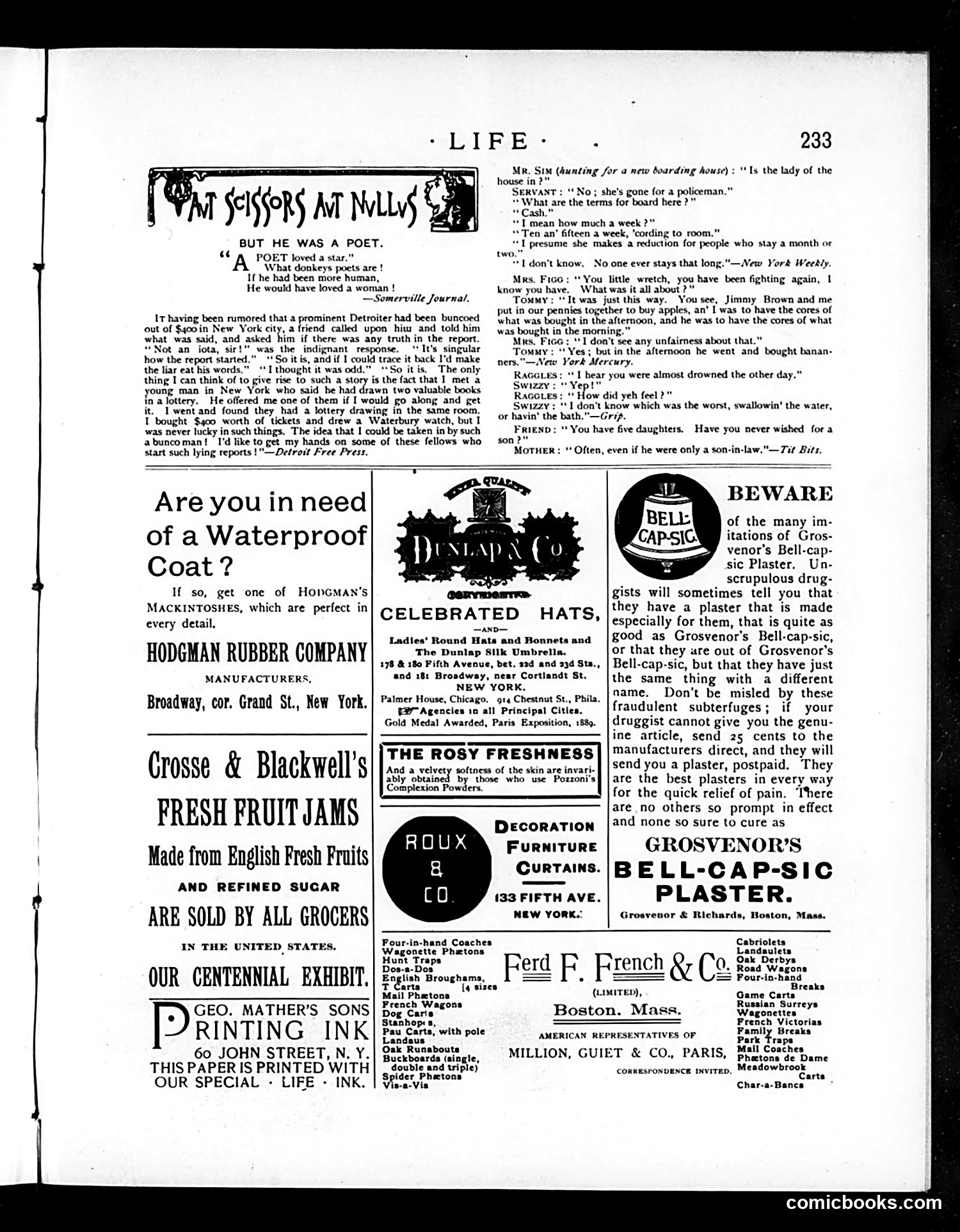
This page contains several short humorous anecdotes typical of *Life* magazine's satirical format, plus period advertisements. **The cartoons/jokes mock human folly:** 1. **"I'm Scissors at Wully"** — A poet who loves a star is ridiculed as impractical; the joke suggests poets are foolish for not loving women instead. 2. **The Detroit bunco story** — A man denies being swindled by a lottery scam, then admits he nearly fell for the exact same scheme, revealing his hypocrisy and gullibility. 3. **Boarding house anecdote** — Dark humor: a landlady calls police on prospective tenants, and no one stays because conditions are dreadful. 4. **Children's disputes** — Tommy and Jimmy argue over apple cores; a girl's complaint about bananas reveals petty childhood squabbles. 5. **The drowning joke** — Swizzy nearly drowned but complains the forced bath was worse than the water itself. **Context**: These reflect Victorian-era concerns with propriety, class, and domestic life. The advertisements (waterproof coats, jams, printing ink) represent late 19th-century consumer goods marketed in such magazines.
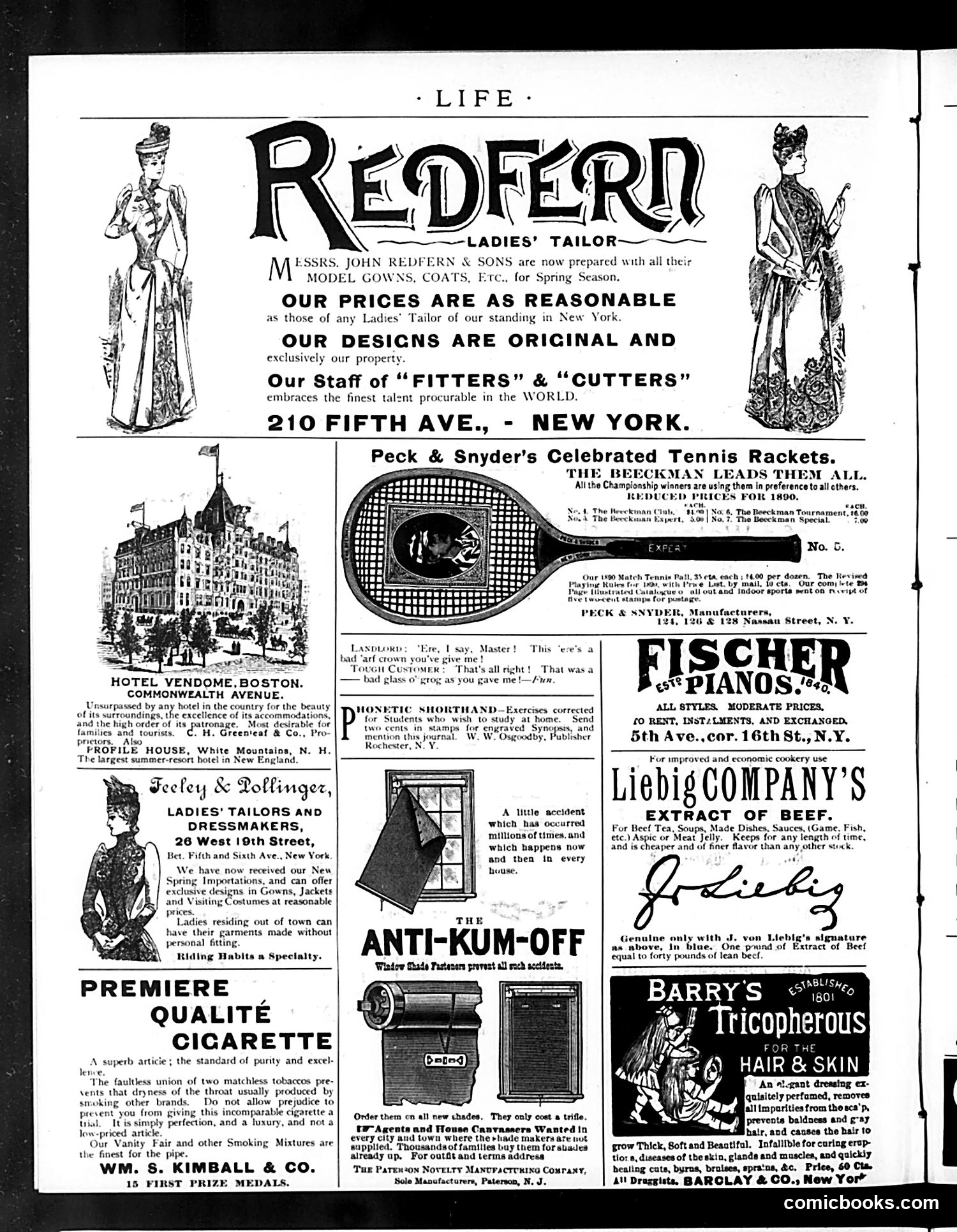
This is primarily an **advertisement page** from Life magazine, not a satirical cartoon. It features luxury goods and services targeted at wealthy, fashionable Americans of the era. The page advertises: - **High-end ladies' tailoring** (Redfern, Feeley & Poblinger) emphasizing exclusive designs and skilled craftspeople - **Luxury hotels** (Hotel Vendome, Boston; Profile House, White Mountains) - **Sporting goods** (Peck & Snyder tennis rackets—"used by championship winners") - **Consumer products**: cigarettes, shorthand courses, pianos, beef extract, hair tonic, window shade fasteners One small **comic vignette** appears: a customer complaining to a bartender ("This 'ere's a bad glass o' grog as you gave me!"), illustrating why "Anti-Kum-Off" window shade fasteners prevent accidents. The page reflects **late-19th-century consumer culture**—advertising aspirational goods to an educated, affluent readership. The typography, illustrations, and product emphasis reveal what wealthy Americans valued: fashion, leisure activities, and modern conveniences.
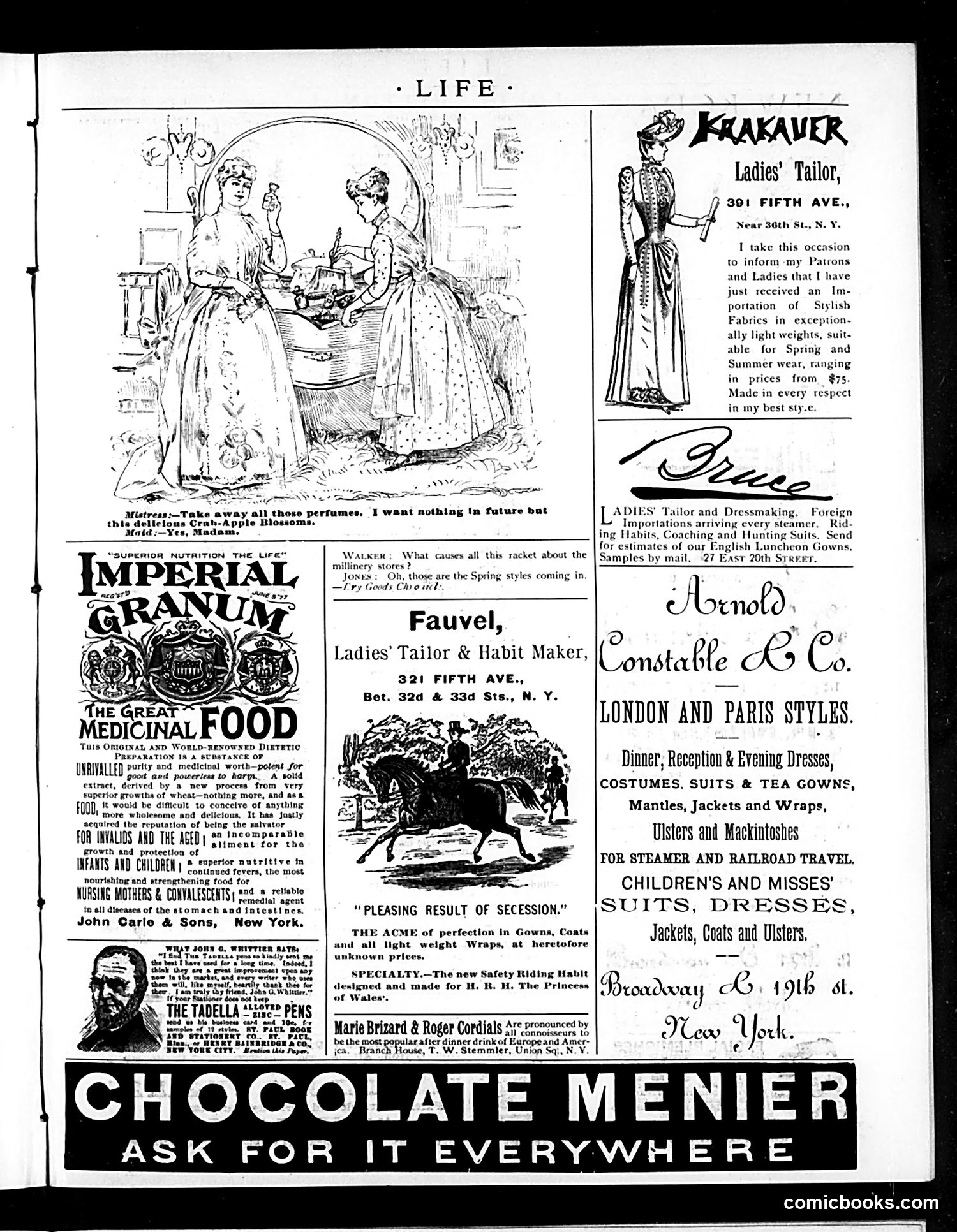
This page is primarily **advertising with minimal editorial content**. The main cartoon (top left) shows a domestic scene where a mistress demands her maid remove all "crab-apple blossom" perfumes, wanting "nothing in future but this delightful odour." It's a light satirical advertisement for a perfume product. Below is a brief joke about spring millinery fashions causing a "racket" in stores—mild social commentary on women's shopping habits and the seasonal fashion industry. The page is otherwise dominated by advertisements for ladies' tailors, medicinal food products (Imperial Granum), cordials, and luxury clothing services catering to wealthy New York women. The reference to "Safety Riding Habit...for H.R.H. The Princess of Wales" suggests these were upscale establishments serving elite clientele. The overall content reflects early 20th-century American consumer culture and women's fashion commerce, with minimal political satire.
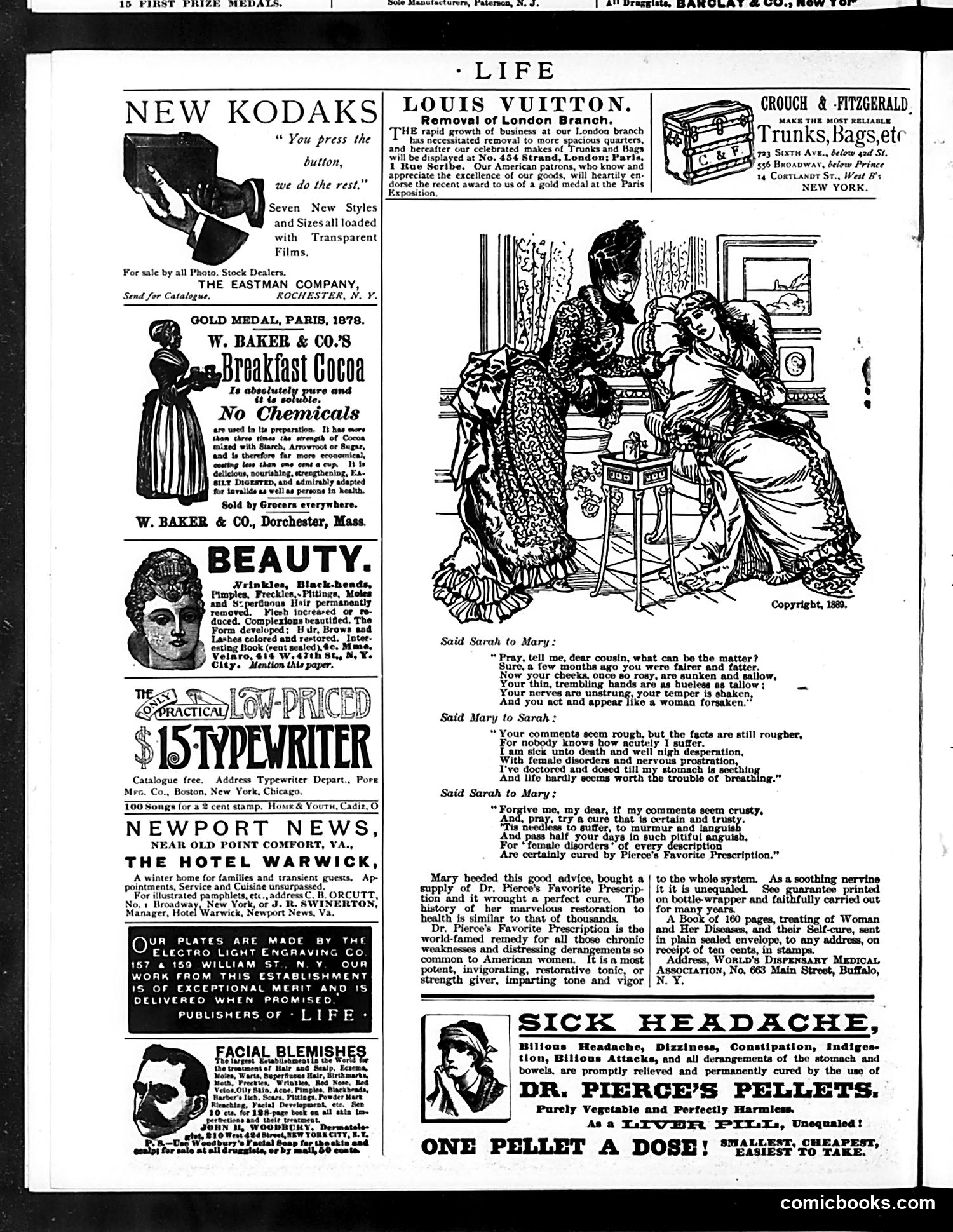
This page is primarily **advertisements** with one central cartoon illustration titled "Said Sarah to Mary" (dated Copyright 1889). The cartoon depicts a social conversation between two women about health. Sarah observes that Mary has become pale, thin, and trembling—appearing "like a woman forsaken." Mary responds that she suffers from "female disorders and nervous prostration," having exhausted herself with doctors and medicines. **The satire:** This is a **patent medicine advertisement** disguised as a moral tale. Sarah's implied solution (completed on the next page) likely recommends "Dr. Pierce's Favorite Prescription"—a widely-marketed nostrum claiming to cure "female disorders." **Historical context:** In the 1880s-90s, such advertisements exploited women's genuine health problems (menstrual issues, nervousness) by promoting dubious remedies as cure-alls. The cartoon uses dramatic imagery of female suffering to sell the product, while framing it as friendly, practical advice between women—a common marketing strategy of the era.
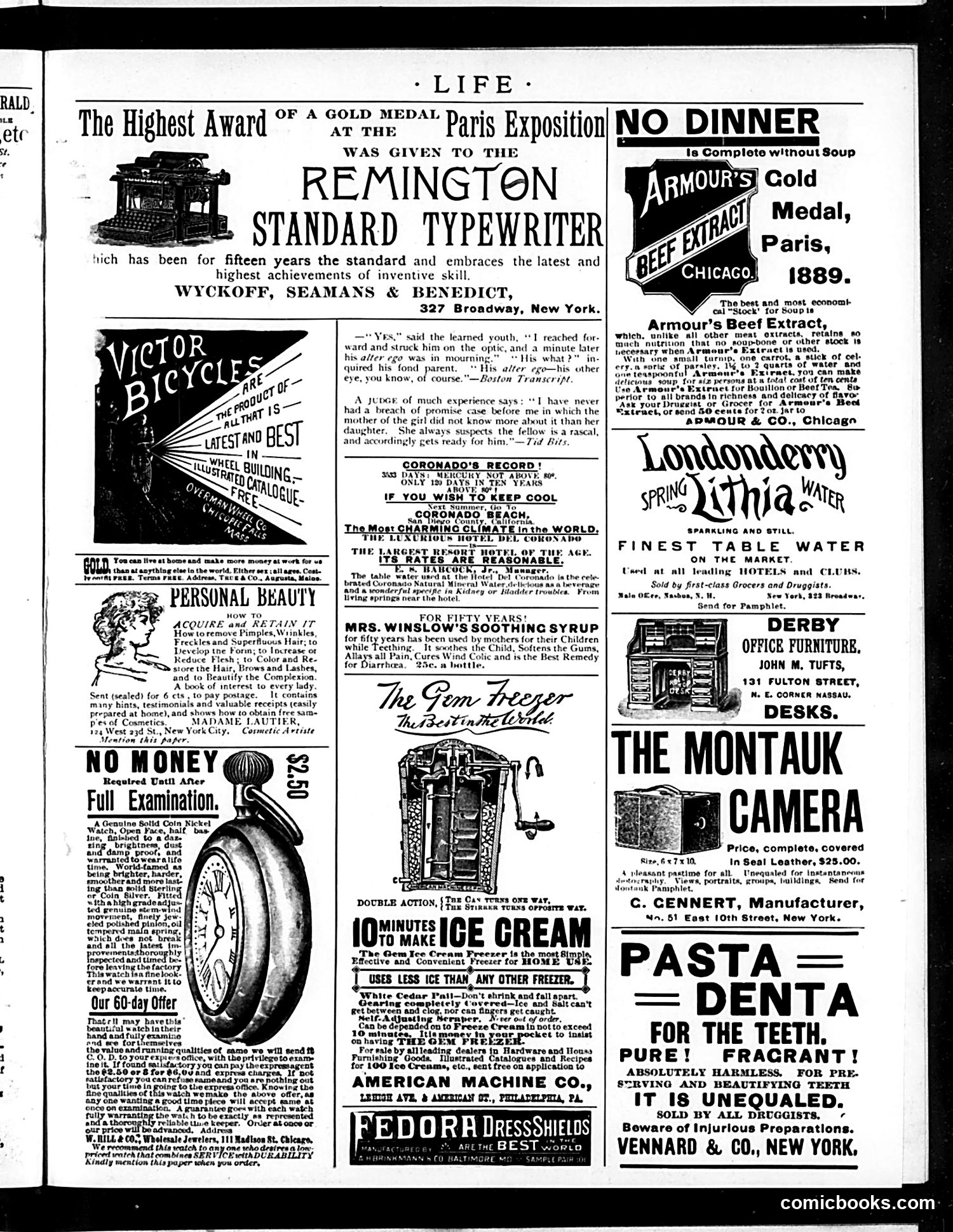
This page is **primarily advertising**, not political satire. It showcases late-19th-century consumer products with minimal editorial content. The notable elements: **Main Advertisement**: The Remington Standard Typewriter claims the highest award at the Paris Exposition—a commercial boast typical of the era's competitive industrial marketing. **Scattered Jokes**: Brief humorous filler pieces appear (the "alter ego"/eye pun, the breach-of-promise anecdote), but these are generic humor, not political commentary. **Product Ads**: The page heavily promotes everyday items—Armour's Beef Extract, Mrs. Winslow's Soothing Syrup (a teething remedy), the Gem ice cream freezer, Derby office furniture, and beauty products. These reflect contemporary consumer culture and available technologies. **Cultural Note**: Some ads (like beauty treatments promising to remove "superfluous hair") reveal period attitudes toward appearance; Mrs. Winslow's Syrup was a widely-used (and now-infamous) product containing opiates. This is a typical commercial page from Life's advertising-heavy era, not a satirical or political commentary piece.
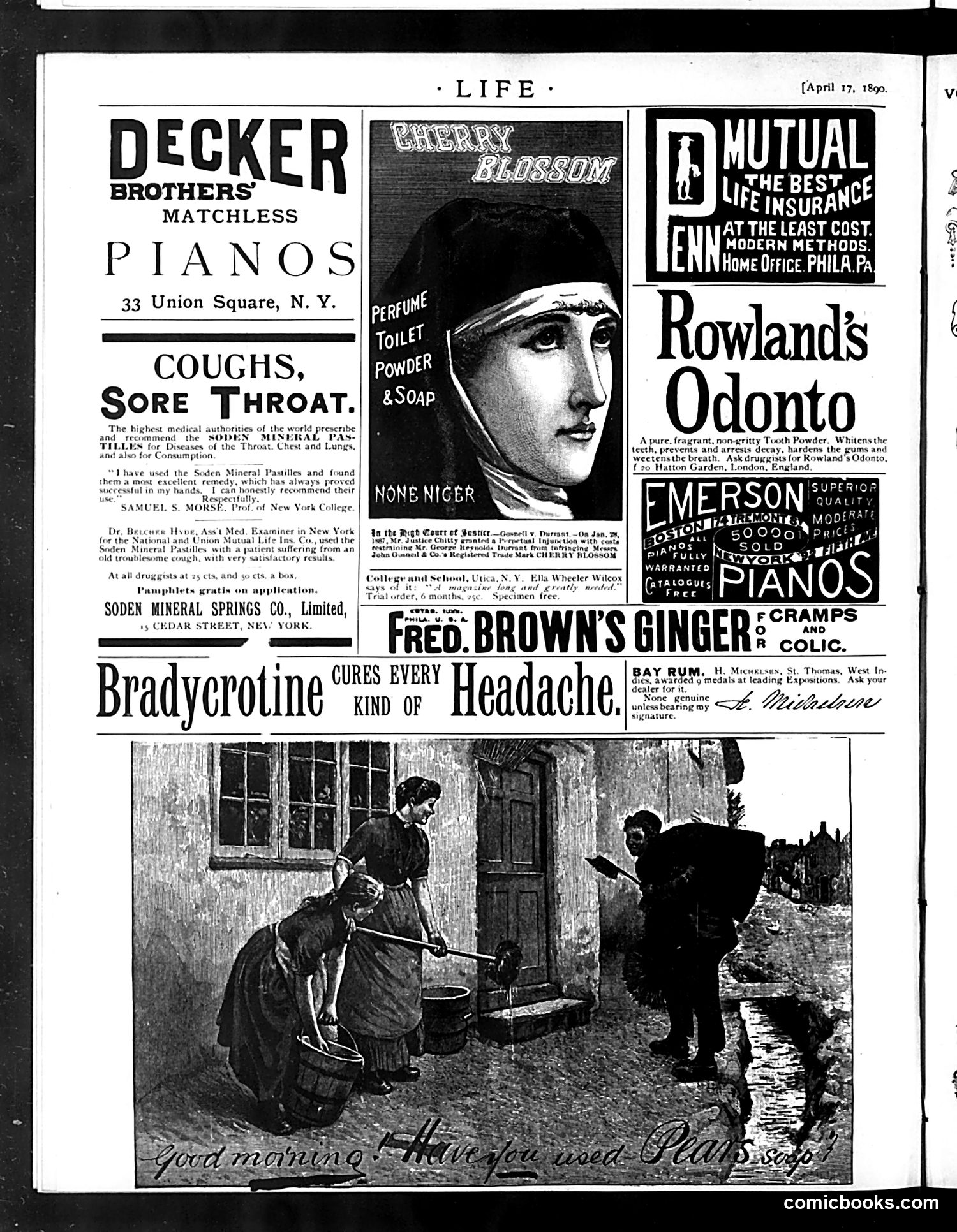
This page is **primarily an advertising spread** with no coherent political cartoon or satirical commentary. It consists of various commercial advertisements typical of 1890s America: - **Decker Brothers pianos** and other musical instruments - **Patent medicines** for common ailments (Soden Mineral Springs for coughs/sore throat, Bradycrotine for headaches, Fred. Brown's Ginger for cramps) - **Hygiene products** (Rowland's Odonto tooth powder, Cherry Blossom perfume) - **Insurance and financial services** (Mutual Life Insurance) The **single illustrative element**—a photograph showing a woman with a child at a doorway—appears to advertise **Pears' soap**, with the caption "Good morning—Have you used Pears soap?" There is **no discernible political satire or social commentary** on this page. It represents straightforward late-19th-century consumer advertising, reflecting the health concerns and product market of that era. The "Life" magazine masthead indicates this was a satirical publication, but this particular page is devoted entirely to commercial content rather than editorial cartoons.