
Life, 1890-04-17 · page 4 of 18
Life — April 17, 1890 — page 4: what you’re looking at
What you’re looking at
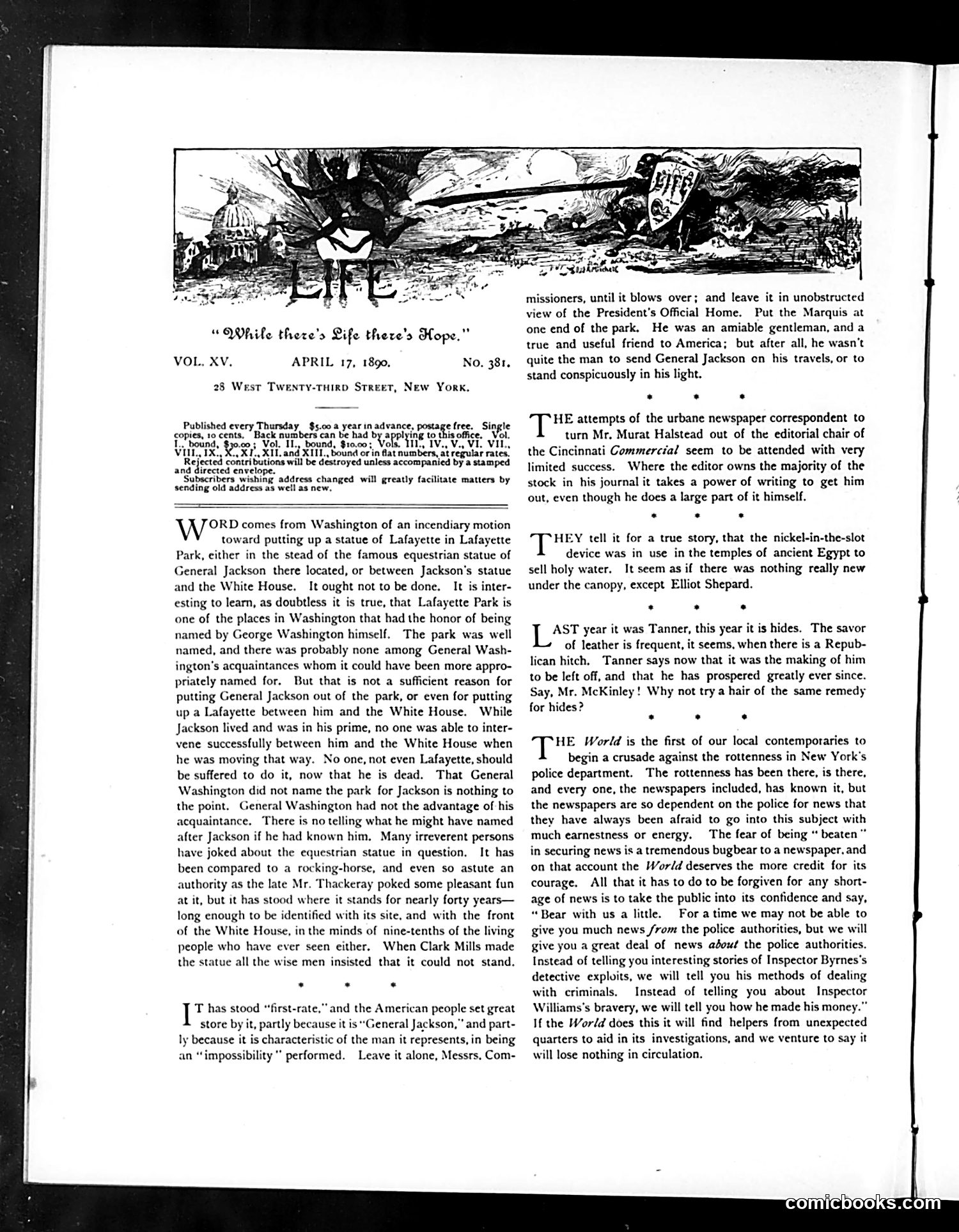
The cartoon at top depicts a debate over a proposed Lafayette statue in Lafayette Park, Washington D.C. The text explains that some wanted the statue positioned near General Jackson's monument, between it and the White House—but this was deemed inappropriate. The satire mocks this controversy as absurd. The author argues that while Jackson's equestrian statue has stood "first-rate" for nearly forty years, placing Lafayette nearby would be ridiculous positioning. The joke lies in treating this minor urban planning dispute with mock-serious analysis, suggesting the public debate reveals how Americans obsess over trivial details of civic monuments and their symbolic placement relative to presidential spaces.
📄 Transcribed text from this page (OCR, searchable)
Machine-transcribed from the original scan — historical spelling and the odd misread are preserved.
“While there's Life there's Hope.” VOL. XV. APRIL 17, 1890, No. 381. 238 West Twenty-THirp Street, New York, Published every Thursday $5.00 a year in advance, postage free. Single copies, so cents. Back numbers can be had by applying to this office, Vol. J, hotind, $y0-90,; Vol. Il bound, $io.c0:, Vols. ye TV., Vey VE. VIL, VIII., IX:, X..X1., XII and XIII, bound orin fat numbers, at regular rates. Rejected contributions will be destroyed unless accompanied by a stamped and directed envelope. Subscribers wishing address changed will greatly facilitate matters by sending old address as well as new. ORD comes from Washington of an incendiary motion toward putting up a statue of Lafayette in Lafayette Park, either in the stead of the famous equestrian statue of General Jackson there located, or between Jackson's statue and the White House, It ought not to be done. It is inter- esting to learn, as doubtless it is true, that Lafayette Park is one of the places in Washington that had the honor of being named by George Washington himself. The park was well named, and there was probably none among General Wash- ington’s acquaintances whom it could have been more appro- priately named for. But that is not a sufficient reason for putting General Jackson out of the park, or even for putting up a Lafayette between him and the White House. While Jackson lived and was in his prime, no one was able to inter- vene successfully between him and the White House when he was moving that way. No one, not even Lafayette, should be suffered to do it, now that he is dead. That General Washington did not name the park for Jackson is nothing to the point. General Washington had not the advantage of his acquaintance. There is no telling what he might have named after Jackson if he had known him, Many irreverent persons have joked about the equestrian statue in question. It has been compared to a rocking-horse, and even so astute an authority as the late Mr. Thackeray poked some pleasant fun at it, but it has stood where it stands for nearly forty years— long enough to be identified with its site, and with the front of the White House, in the minds of nine-tenths of the living people who have ever seen either. When Clark Mills made the statue all the wise men insisted that it could not stand. T has stood “first-rate,” and the American people set great store by it, partly because it is “General Jackson,” and part- ly because it is characteristic of the man it represents, in being an “impossibility performed. Leave it alone, Messrs, Com- missioners, until it blows over; and leave it in unobstructed view of the President's Official Home. Put the Marquis at one end of the park, He was an amiable gentleman, and a true and useful friend to America; but after all, he wasn’t quite the man to send General Jackson on his travels, or to stand conspicuously in his light. * * . HE attempts of the urbane newspaper correspondent to turn Mr. Murat Halstead out of the editorial chair of the Cincinnati Commercial seem to be attended with very limited success. Where the editor owns the majority of the stock in his journal it takes a power of writing to get him out, even though he does a large part of it himself. . . . HEY tell it for a true story, that the nickel-in-the-slot device was in use in the temples of ancient Egypt to sell holy water, It seem as if there was nothing really new under the canopy, except Elliot Shepard. * . . L‘t year it was Tanner, this year it is hides. The savor of leather is frequent, it seems, when there is a Repub- lican hitch, Tanner says now that it was the making of him to be left off, and that he has prospered greatly ever since. Say, Mr. McKinley! Why not try a hair of the same remedy for hides? * . ° Tt World is the first of our local contemporaries to begin a crusade against the rottenness in New York's police department. The rottenness has been there, is there, and every one, the newspapers included, has known it, but the newspapers are so dependent on the police for news that they have always been afraid to go into this subject with much earnestness or energy. The fear of being “ beaten” in securing news is a tremendous bugbear to a newspaper, and on that account the Wor/d deserves the more credit for its courage. All that it has to do to be forgiven for any short- age of news is to take the public into its contidence and say, “Bear with us a little. For a time we may not be able to give you much news from the police authorities, but we will give you a great deal of news adout the police authorities. Instead of telling you interesting stories of Inspector Byrnes’s detective exploits, we will tell you his methods of dealing with criminals, Instead of telling you about Inspector Williams's bravery, we will tell you how he made his money.” If the World does this it will find helpers from unexpected quarters to aid in its investigations, and we venture to say it will lose nothing in circulation.