
Life, 1890-04-17 · page 6 of 18
Life — April 17, 1890 — page 6: what you’re looking at
What you’re looking at
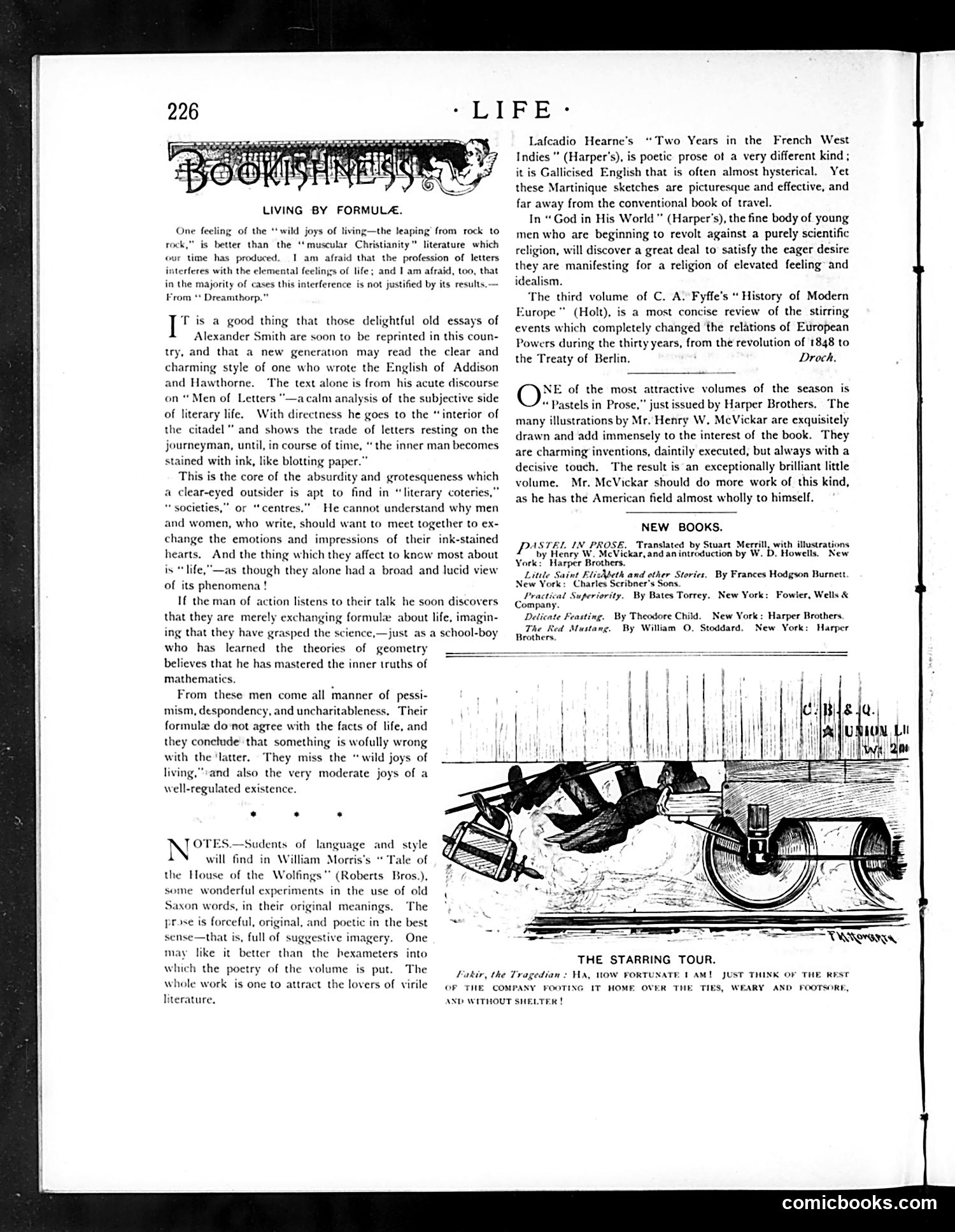
This cartoon depicts an automobile accident or breakdown during what appears to be an early 1900s motorcar journey. The caption reads: "Father, the Tragedian: 'Ha, how fortunate I am! Just think of the rest of the company footing it home over the tires, weary and footsore, and without shelter!'" The humor relies on ironic dramatic timing—the father, a professional actor ("tragedian"), finds opportunity for theatrical expression even in automotive misfortune. While his traveling companions face genuine hardship (walking home on bad roads without shelter), he performs mock gratitude for his predicament. This satirizes both the pretentiousness of theater professionals and early automobiles' notorious unreliability, which frequently stranded travelers.
📄 Transcribed text from this page (OCR, searchable)
Machine-transcribed from the original scan — historical spelling and the odd misread are preserved.
“LIFE: LIVING BY FORMULA. One feeling of the ‘wild joys of living—the leaping’ from rock to rock," is better than the “muscular Christianity” literature which our time has produced, I am afraid that the profession of letters interferes with the elemental feelings of life; and I am afraid, too, that in the majority of cases this interference is not justified by its results. — From ** Dreamthorp.” T is a good thing that those delightful old essays of Alexander Smith are soon to be reprinted in this coun- try, and that a new generation may read the clear and charming style of one who wrote the English of Addison and Hawthorne. ‘The text alone is from his acute discourse on “ Men of Letters "—acalm analysis of the subjective side of literary life. With directness he goes to the “interior of the citadel" and shows the trade of letters resting on the journeyman, until, in course of time, “the inner man becomes stained with ink, like blotting paper.” This is the core of the absurdity and grotesqueness which a clear-eyed outsider is apt to find in “literary coteries,” “ societies,” or “centres.” He cannot understand why men and women, who write, should want to meet together to ex- change the emotions and impressions of their ink-stained hearts. And the thing which they affect to know most about is “life,"—as though they alone had a broad and lucid view of its phenomena ! If the man of action listens to their talk he soon discovers that they are merely exchanging formula about life, imagin- ing that they have grasped the science,—just as a school-boy who has learned the theories of geometry believes that he has mastered the inner truths of mathematics. From these men come all manner of pessi- mism, despondency, and uncharitableness, Their formula do not agree with the facts of life, and they conclude that something is wofully wrong with the ‘latter. They miss the “wild joys of living,"vand also the very moderate joys of a ulated existence. . . N° 2$.—Sudents of language and style i will find in William Morris's “ Tale of the House of the Wolfings” (Roberts Bros.), some wonderful experiments in the use of old The prose is forceful, original, and poetic in the best sense—that is, full of suggestive imagery. One like it better than the bexameters into which the poetry of the volume is put. The whole work is one to attract the lovers of virile o¢ literature, Saxon words, in their original meanings. may THe Fakir, the Tragedian : COMPANY AND WITHOUT SHELTER ! Lafeadio Hearne’s “Two Years in the French West Indies " (Harper's), is poetic prose of a very different kind ; it is Gallicised English that is often almost hysterical. Yet these Martinique sketches are picturesque and effective, and far away from the conventional book of travel. In “God in His World " (Harper's), the fine body of young men who are beginning to revolt against a purely scientific religion, will discover a great deal to satisfy the eager desire they are manifesting for a religion of clevated feeling and idealism. The third volume of C. A. Fyffe’s “ History of Modern Europe” (Holt), is a most concise review of the stirring events which completely changed the relations of European Powers during the thirty years, from the revolution of 1848 to the Treaty of Berlin. Droch. O © of the most attractive volumes of the season is * Pastels in Prose,” just issued by Harper Brothers. The many illustrations by Mr. Henry W. McVickar are exquisitely drawn and add immensely to the interest of the book. They are charming inventions, daintily executed, but always with a decisive touch. The result is an exceptionally brilliant little volume. Mr. McVickar should do more work of this kind, as he has the American field almost wholly to himself. NEW BOOKS. PASTEL IN PROSE. Translated by Stuart Merrill. with illustrations by Henry W. McVickar, and an introduction by W. D, Howells. New York: Harper Brothers. Little Saint FlizAbeth and other Stories, By Frances Hodgson Burnett New York: Charles Scribner's Sons. Practical Superiority. By Bates Torrey, New York: Fowler, Wells & Company. Delicate Feasting. By Theodore Child. New York : Harper Brothers. The Red Mustang, By William OQ. Stoddard. New York: Harper Brothers, THE STARRING TOUR. Ha, NOW FORTUNATE 1 AM! FOOTING IT HOME OVER THE TIES, JUST THINK WEARY Y THE REST 1D FOOTSORE, comicbooks.com