
A complete issue · 18 pages · 1890
Life — April 10, 1890
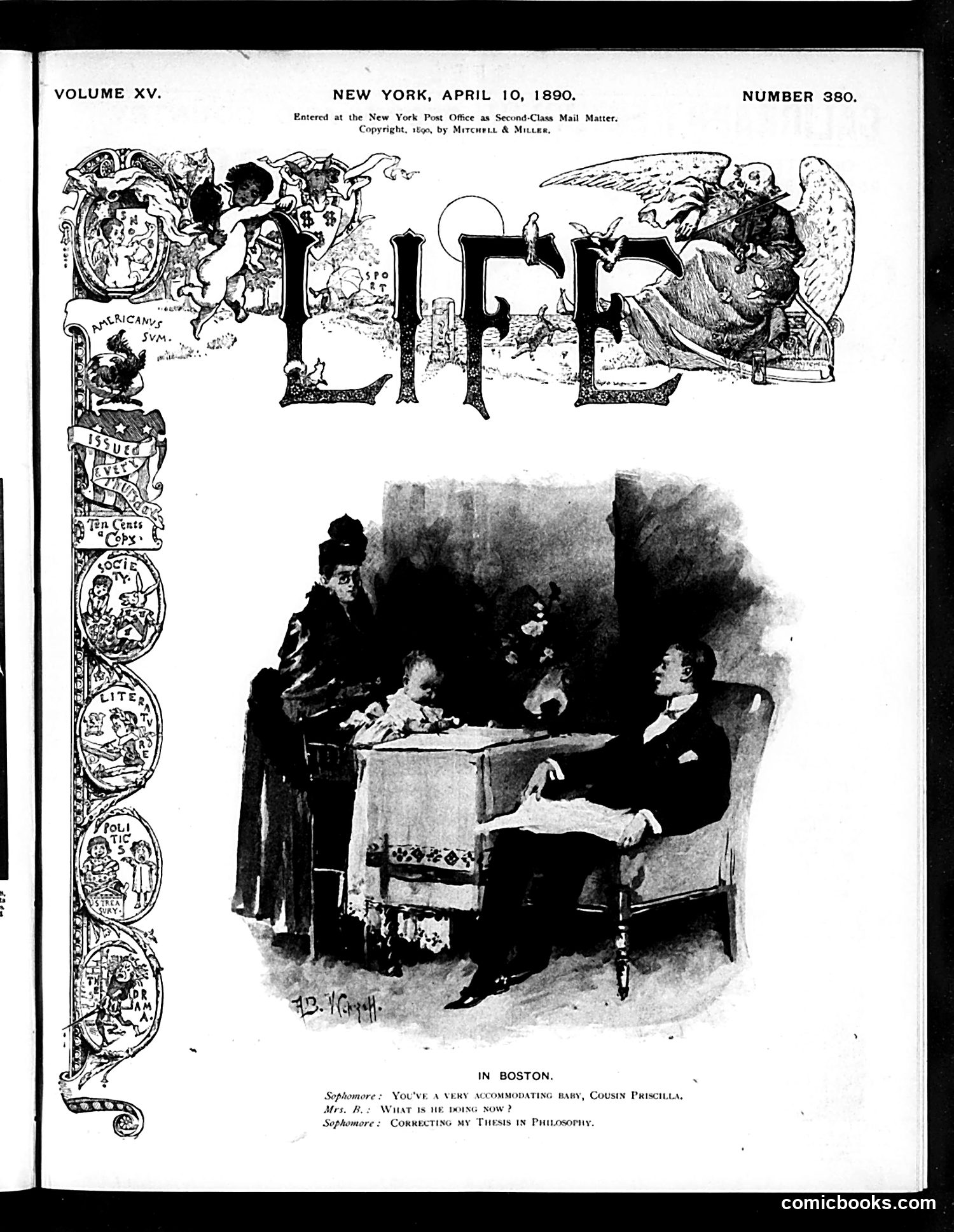
This page contains a single cartoon titled "In Boston" depicting a social scene. A well-dressed man sits conversing with a woman holding a baby, while another woman stands nearby. The humor relies on a class-based joke about intellectual pretension. The sophomore (young man) compliments the baby as "very accommodating," then asks what it's doing. The woman responds that she's "correcting my theses in philosophy"—meaning the baby is serving as a writing surface or desk. The satire mocks Boston's reputation as a center of intellectual and philosophical culture, suggesting that even casual domestic moments involve philosophical discourse. The joke implies both the absurdity of constant intellectualism and perhaps gentle mockery of Boston society's affected sophistication during this era.
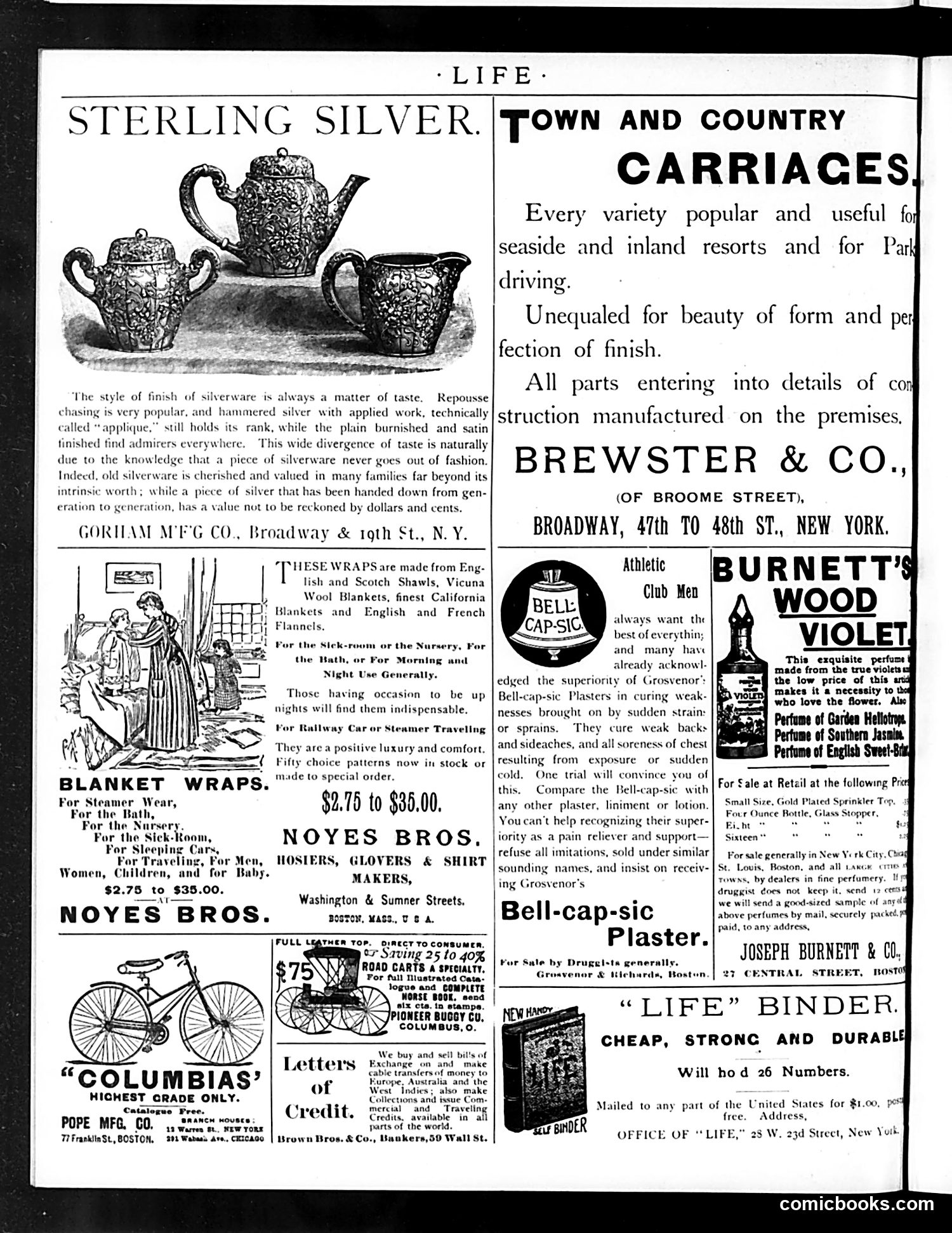
This page is **primarily advertising**, not political satire. It features vintage product advertisements from what appears to be the early 1900s, including: - Sterling silver serving sets (Gorham Mfg Co.) - Blanket wraps for travel and infants (Noyes Bros.) - "Columbias" bicycles (Pope Mfg Co.) - Town and country carriages (Brewster & Co.) - Bell-cap-sic plaster for pain relief - Burnett's Wood Violet perfume - A "Life" binder for magazine subscribers The only illustration with potential social commentary is a small sketch accompanying the blanket wraps advertisement, showing figures in domestic/nursery settings, but it's primarily promotional rather than satirical. The page reflects consumer culture and product marketing of the era.
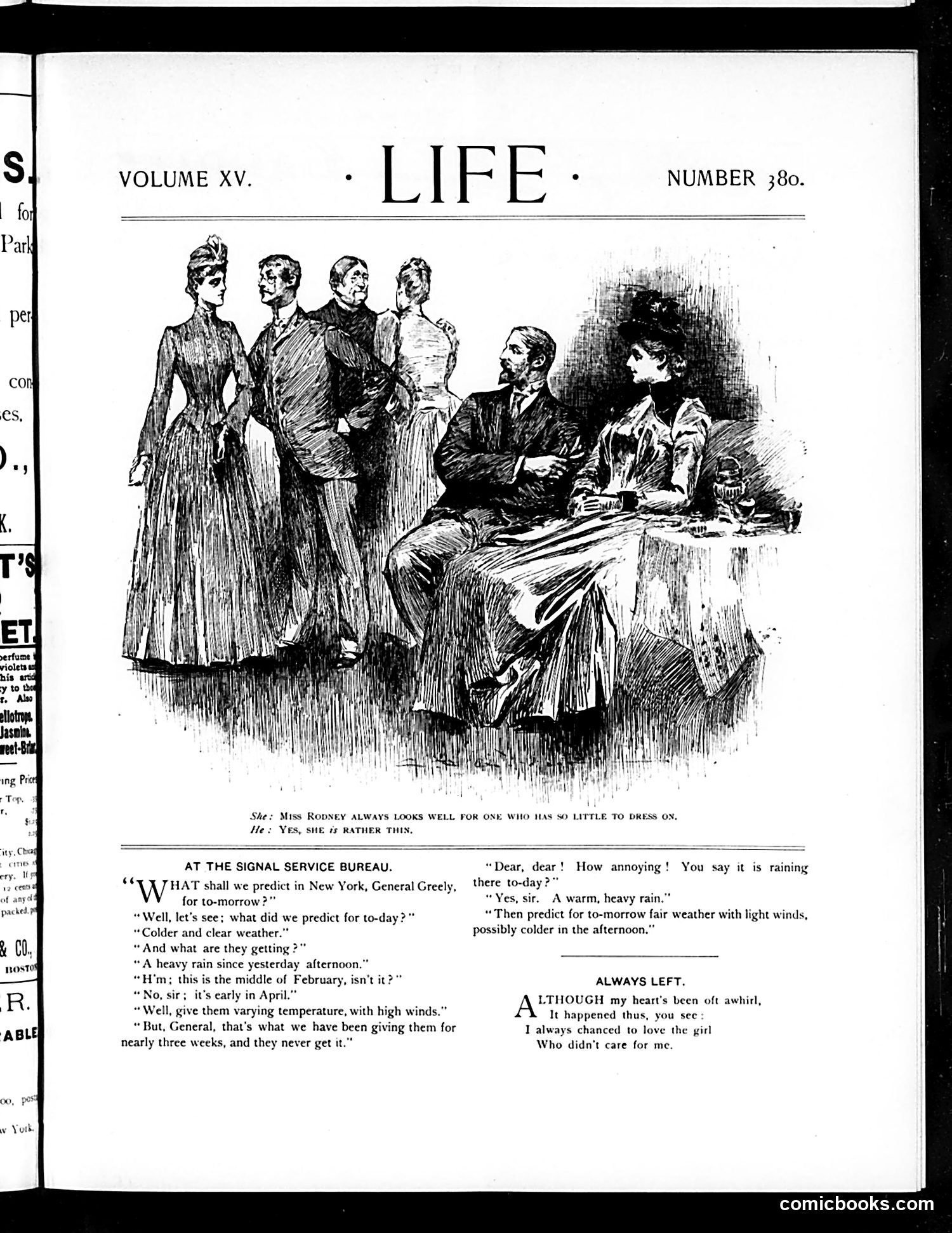
This page from *Life* magazine (Volume XV, Number 380) contains two separate pieces of social satire. The main illustration depicts a scene at "The Signal Service Bureau" where a man sits at a desk consulting with visitors about weather forecasting. The caption notes "Miss Rooney always looks well for one who has so little to dress on"—a joke about modest means. The dialogue satirizes the unreliability of weather predictions. A General Greely is asked about tomorrow's forecast, and the conversation reveals contradictory predictions (rain, then clear weather, then varying temperatures) issued over nearly three weeks. The joke targets the Signal Service Bureau's inability to provide accurate, consistent forecasts—a common source of public frustration in the late 19th/early 20th century. The second item, "Always Left," appears to be unrelated verse about romantic disappointment.
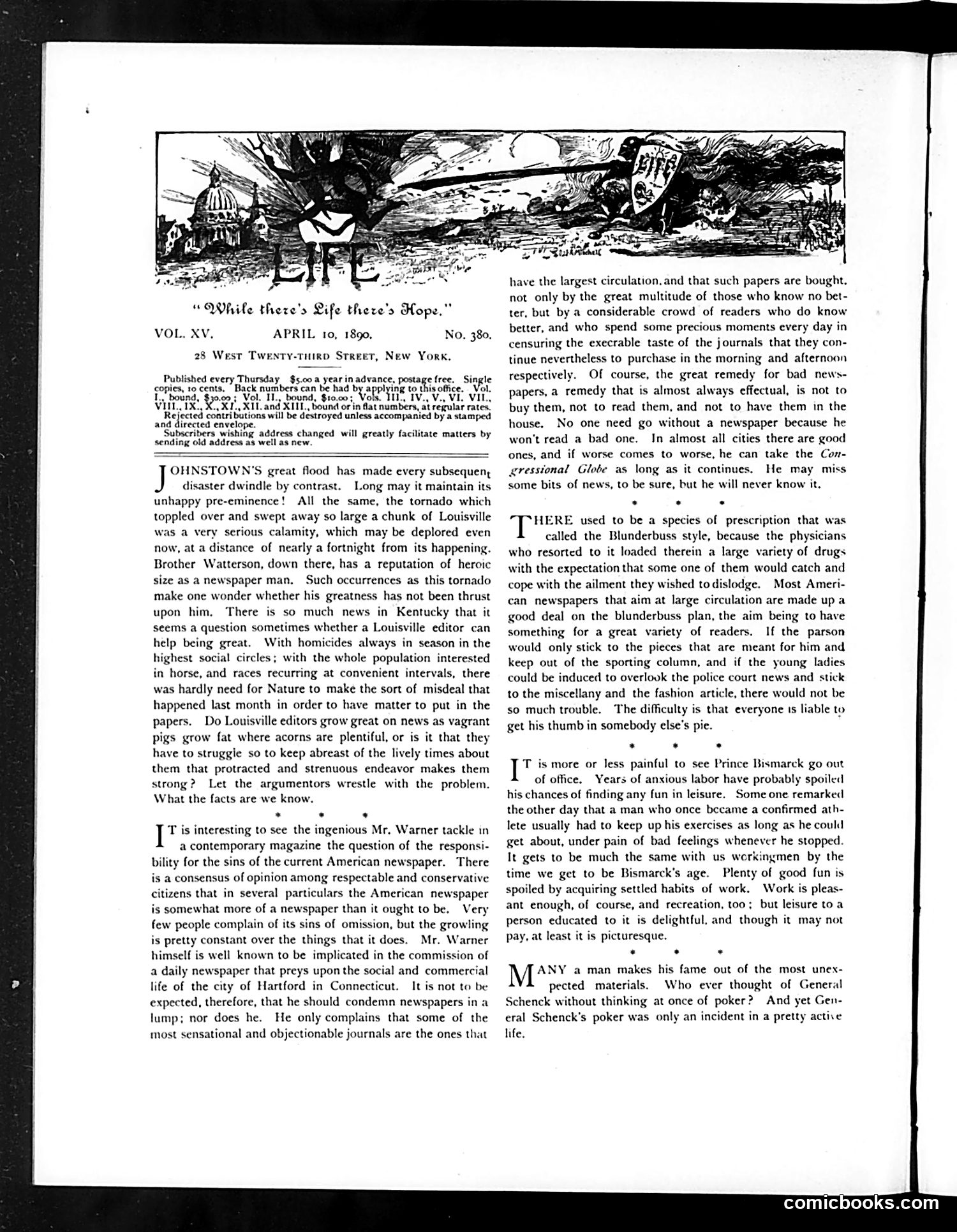
The page's header cartoon depicts a tornado destroying a landscape with a Capitol building visible, illustrating Johnstown's recent catastrophic flood. The accompanying article discusses how this disaster briefly overshadowed other news, questioning whether a Louisville editor could gain fame from such tragedies. The main text addresses American newspaper sensationalism—specifically the "blunderbuss style" of medicine-show advertising where papers would publish diverse remedies hoping something would appeal to readers. The author argues this shotgun approach to content is problematic because readers want tailored news, not miscellaneous articles. Additional sections discuss Prince Bismarck's retirement and General Schenck's poker playing becoming unexpectedly famous—illustrating how people gain unexpected notoriety from unlikely sources.
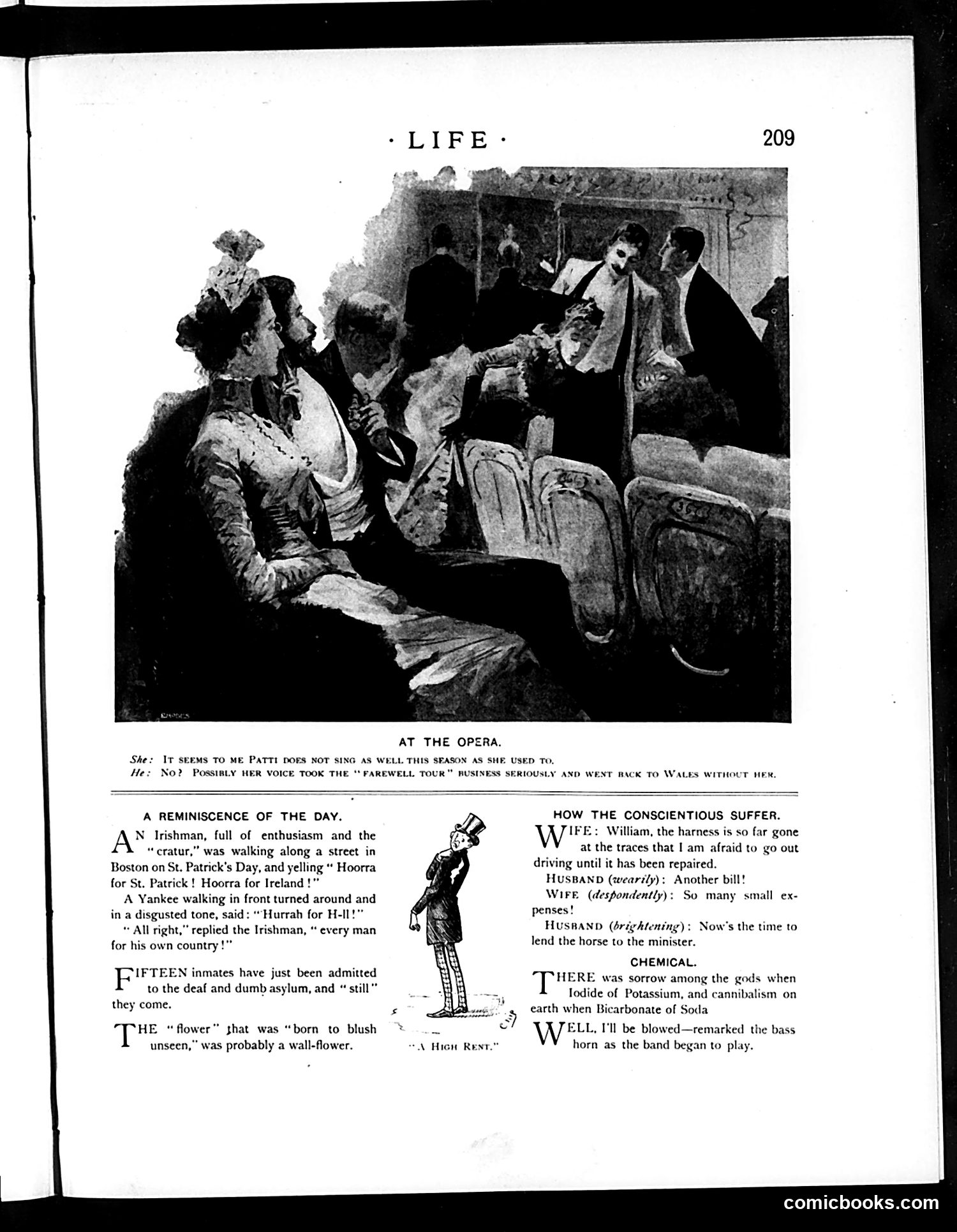
**Main Image Caption: "AT THE OPERA"** The illustration depicts wealthy opera patrons in formal attire. The dialogue suggests social commentary: one character notes that "Patti does not sing as well this season as she used to," and another mentions her voice deteriorated after a "Farewell Tour" to Wales without her husband. This appears to reference the opera singer Adelina Patti, a famous prima donna whose vocal decline was apparently notable to contemporary audiences. **Lower Sections:** The page contains brief humorous anecdotes ("A Reminiscence of the Day," "How the Conscientious Suffer") and a joke about chemistry involving chemical elements. These represent typical Life magazine filler content—light social satire targeting middle-class pretensions and domestic situations common to the era.
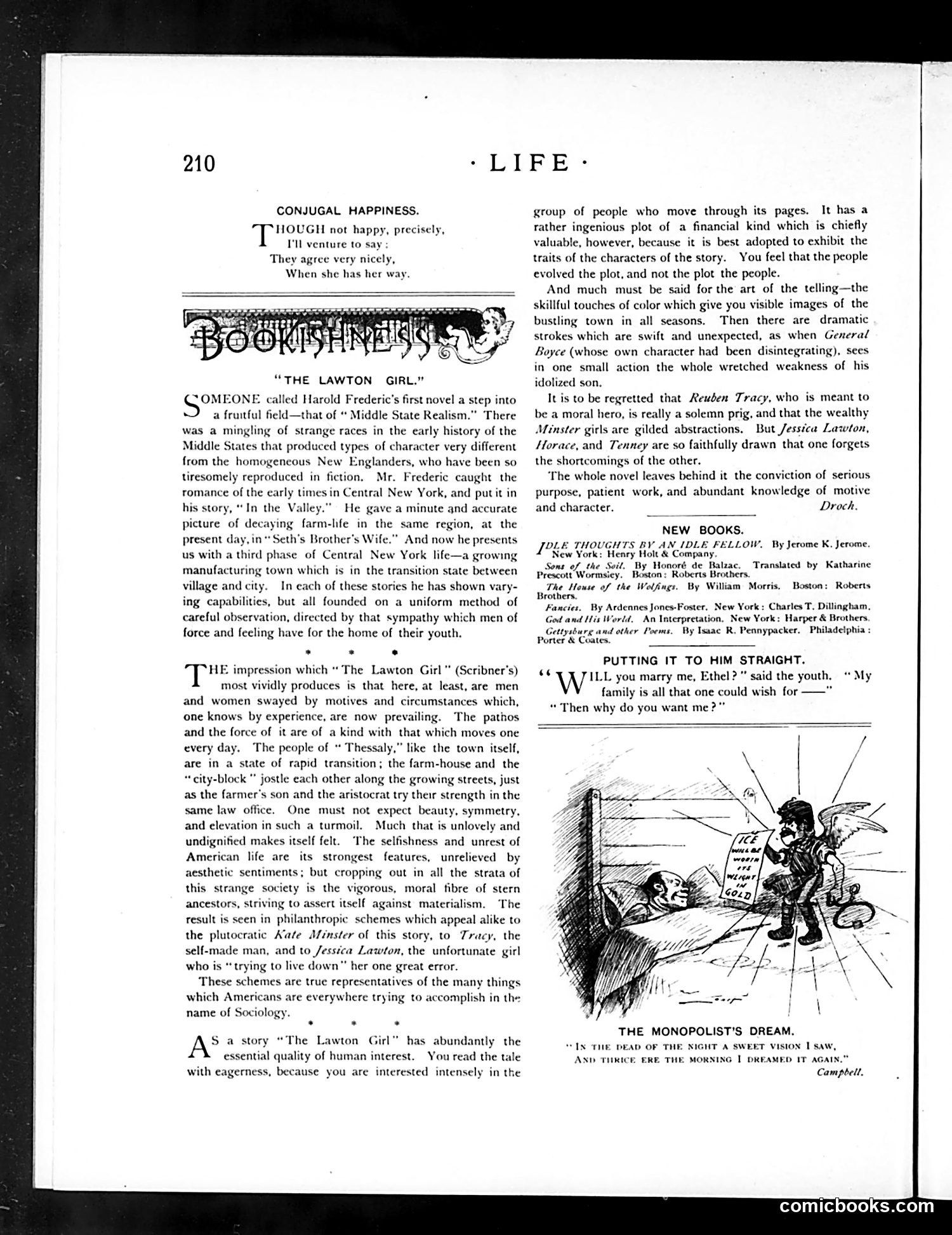
This page contains book reviews and literary criticism rather than political cartoons. The main content discusses Harold Frederic's novel "The Lawton Girl," praising its realistic portrayal of characters in a transitional American manufacturing town. The single illustration, titled "The Monopolist's Dream," shows a figure dreaming or fantasizing, accompanied by a Campbell quote. Without additional context, the specific satirical target isn't entirely clear from the image alone, though the title suggests commentary on industrial monopolies—a significant Progressive Era concern. The page primarily serves as a book review section rather than political satire, focusing on literary merit and character development in contemporary fiction.
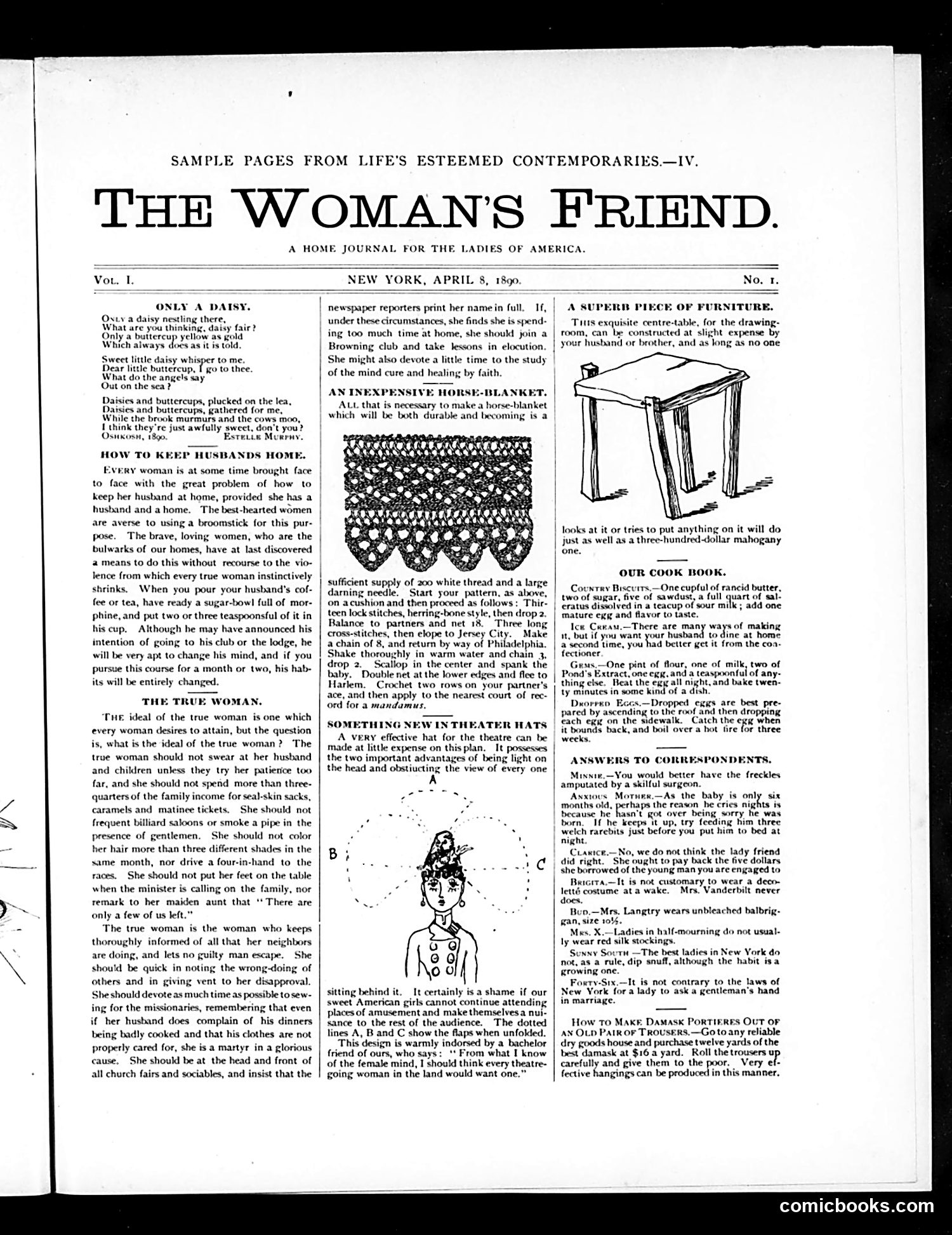
This page from *Life's* April 8, 1890 inaugural issue is primarily **instructional/advice content** rather than political satire. The main illustrated section shows a woman's fashion design—a theatrical hat featuring a dotted pattern with feathers or plumes, positioned behind the head. The accompanying text describes this as "a very effective hat for the theatre" that is "light on the head and obstructing the view of only one person"—a **satirical jab** at the era's fashionable large hats that notoriously blocked other theater-goers' sightlines. The joke is that this design supposedly solves that problem by only obstructing *one* person's view (presumably the wearer's own). The remainder features domestic advice articles on housekeeping, cooking, and social etiquette for women.
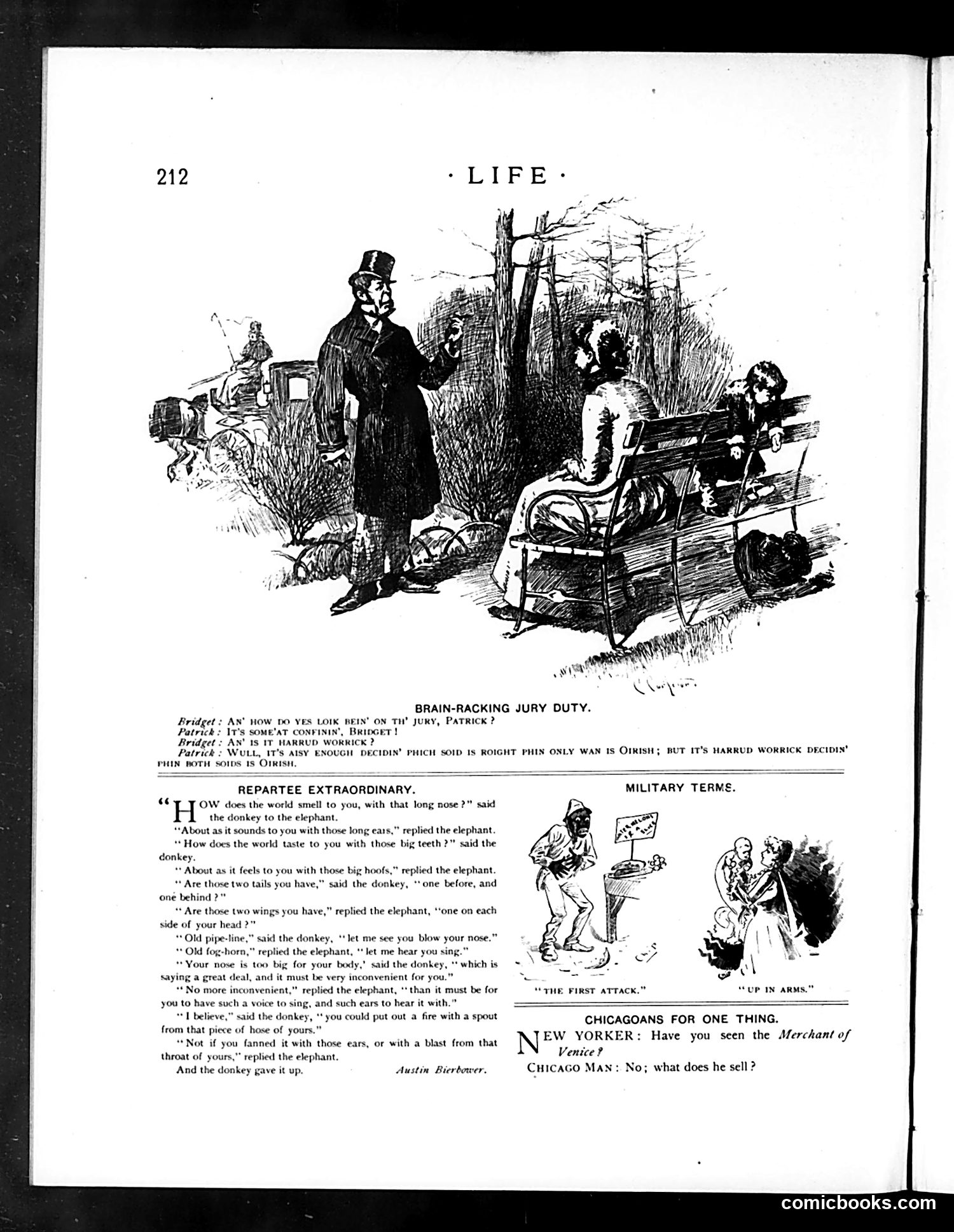
This page contains three separate comic pieces: 1. **"Brain-Racking Jury Duty"**: A sketch mocking jurors' confusion about legal procedure. Bridget questions Patrick about jury service, with Patrick humorously misunderstanding what jurors must decide—confusing the legal merits with whether "both soils is Oirish." 2. **"Repartee Extraordinary"**: A dialogue between a donkey and elephant about sensory perceptions, likely satirizing political opponents (donkey/Democrat, elephant/Republican) through absurdist humor about their differences. 3. **"Military Terms"** and **"Chicagoans for One Thing"**: Brief illustrated jokes—one about military positions ("The First Attack," "Up in Arms"), the other a joke about Chicago merchants and the *Merchant of Venice*. The page reflects early 20th-century American satirical humor targeting Irish immigrants, political parties, and urban culture.
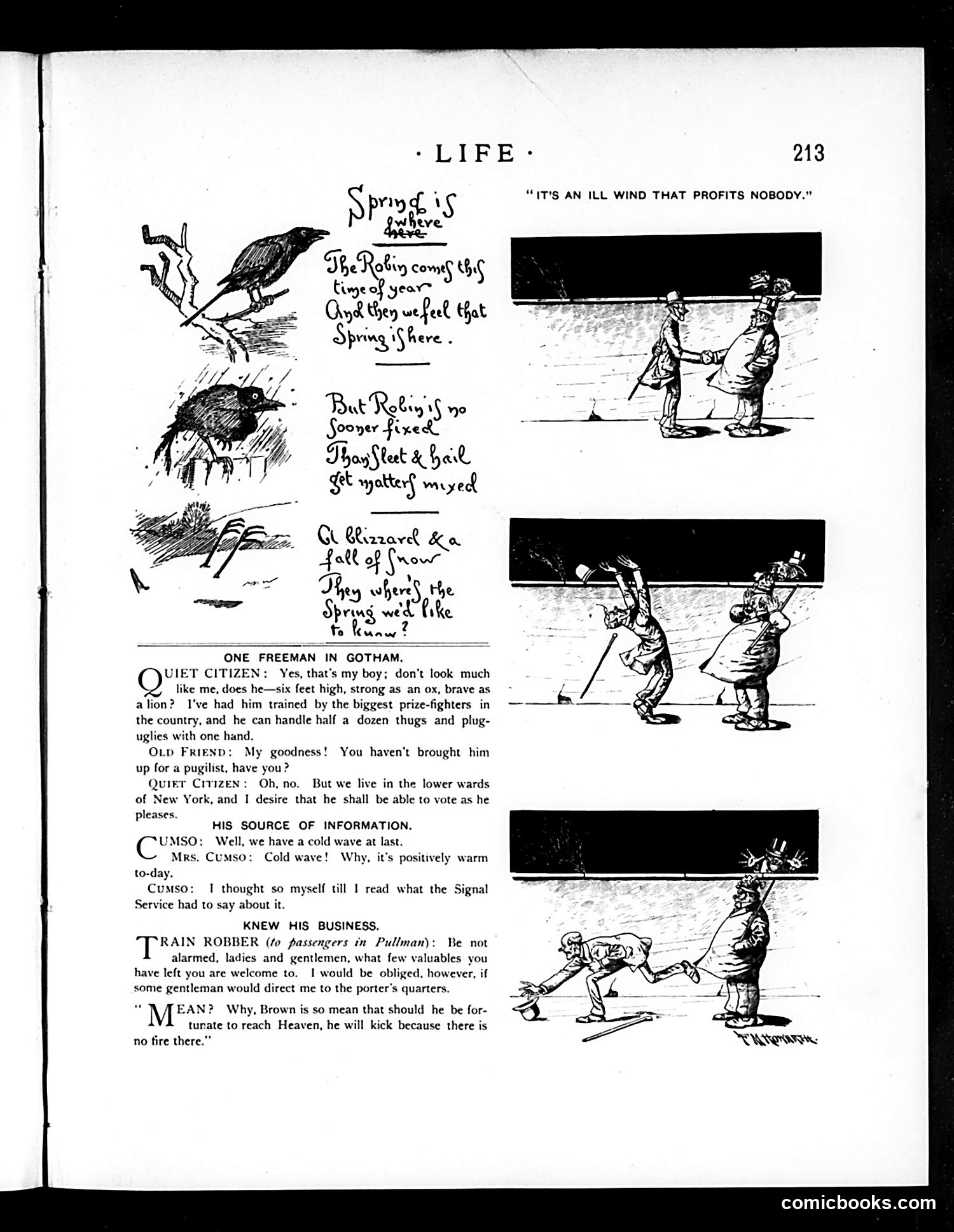
This Life magazine page (page 213) contains humorous sketches and dialogues satirizing everyday life and social pretension. **Top section:** A poem about spring with illustrations of birds and weather, establishing seasonal themes. **"One Freeman in Gotham":** A dialogue mocking class consciousness in New York. A proud parent brags about his boxer son's fighting abilities, while an "Old Friend" suggests he should train him as a pugilist instead. The satire targets working-class aspirations and social mobility anxieties. **Lower sections:** Brief comic vignettes about misinformation sources ("His Source of Information"), weather gossip, and train robbery etiquette—poking fun at how ordinary people spread rumors and misunderstand current events. The overall point: satirizing common urban foibles, class pretension, and the gap between people's actual knowledge and their confident assertions about public matters.
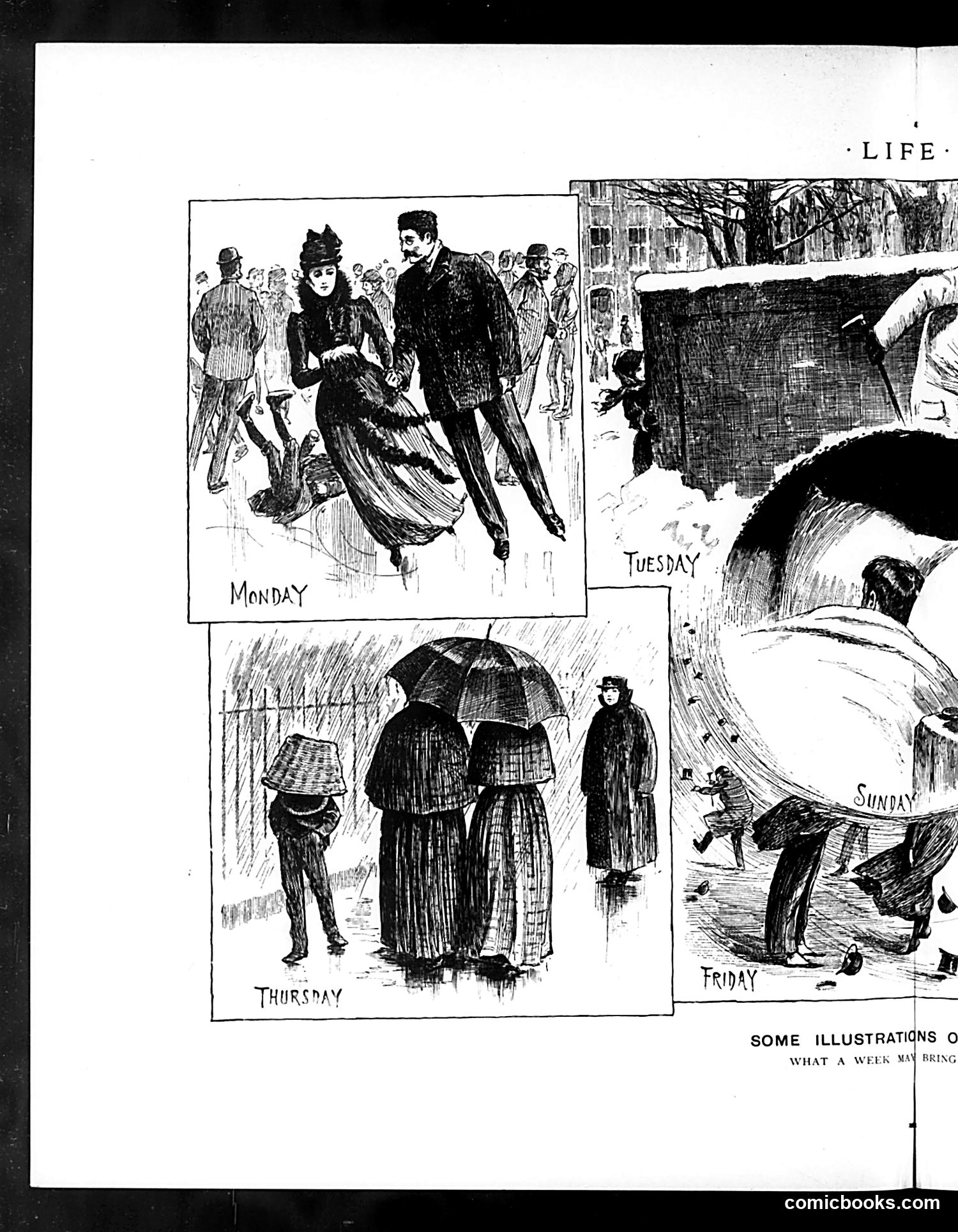
This is a satirical seven-panel comic titled "Some Illustrations of What a Week May Bring," showing the contrasting experiences of what appears to be a wealthy couple versus working-class people across different weekdays. **The satire:** Monday through Friday depict leisure activities—the well-dressed couple socializing in public, shopping, staying indoors during rain—while Thursday shows poor people huddled in harsh weather with umbrellas. Sunday contrasts sharply: the wealthy relax indoors while a child plays outside in what appears to be poverty. **The point:** This is social commentary on class inequality and how the same week brings vastly different experiences based on economic status. The wealthy enjoy protection from elements and social activities, while the poor endure harsh weather and outdoor conditions, with their only leisure time spent in deprivation.
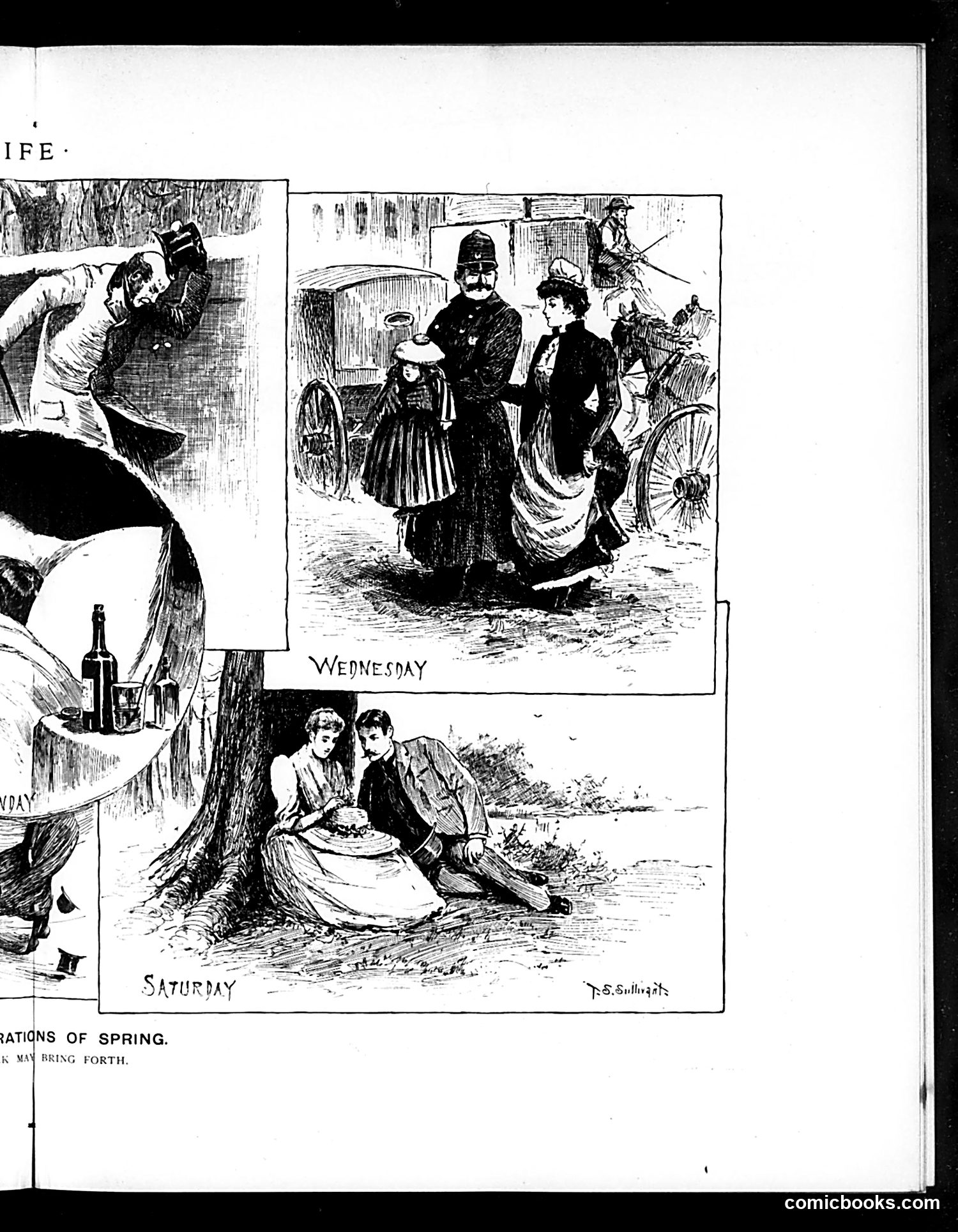
This page appears to show three sequential satirical sketches depicting different days (Wednesday and Saturday are labeled), illustrating the "Temptations of Spring" based on partial visible text. The Wednesday panel shows well-dressed figures with a carriage and bicycles in an urban setting, likely satirizing spring social activities and courtship rituals of the upper classes. The Saturday panel depicts a romantic couple beneath a tree, suggesting how spring inspires amorous behavior. The left panel (partially visible) shows drinking vessels, possibly commenting on spring indulgences or revelry. The overall theme appears to be how spring weather awakens various human desires and social behaviors—romantic, recreational, and perhaps intemperate. The satirical tone typical of *Life* magazine mocks Victorian-era spring social conventions and their consequences.
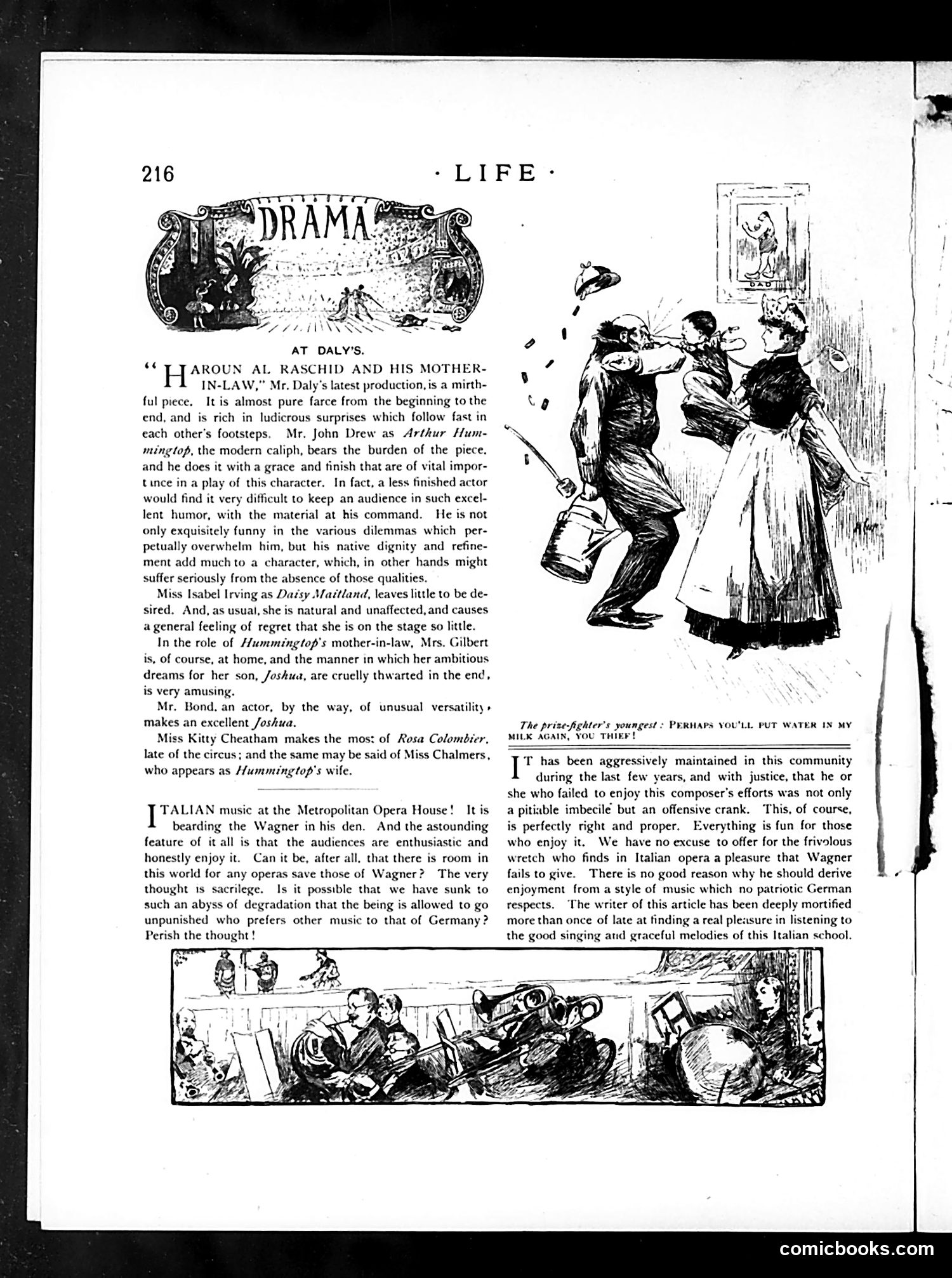
This page contains two distinct pieces of theatrical criticism from what appears to be the late 19th century. **"Haroun Al Raschid and His Mother-in-Law" at Daly's Theatre**: A favorable review of a farce starring John Drew as "Arthur Hummintop," with supporting cast including Isabel Irving and Mrs. Gilbert. The reviewer praises Drew's comedic timing and the play's "ludicrous surprises." **The Italian Opera Satire**: A sarcastic commentary on Wagner's dominance in American musical taste. The writer mocks the prevailing snobbery that considered preferring Italian opera to Wagner's work as philistine or unpatriotic—"a pitiable imbecile" viewpoint. The satire suggests German cultural nationalism had made Wagner's music sacrosanct, making the writer's actual enjoyment of Italian opera's "good singing and graceful melodies" something to hide. The small illustration shows a domestic quarrel over milk, likely comic relief accompanying the reviews.
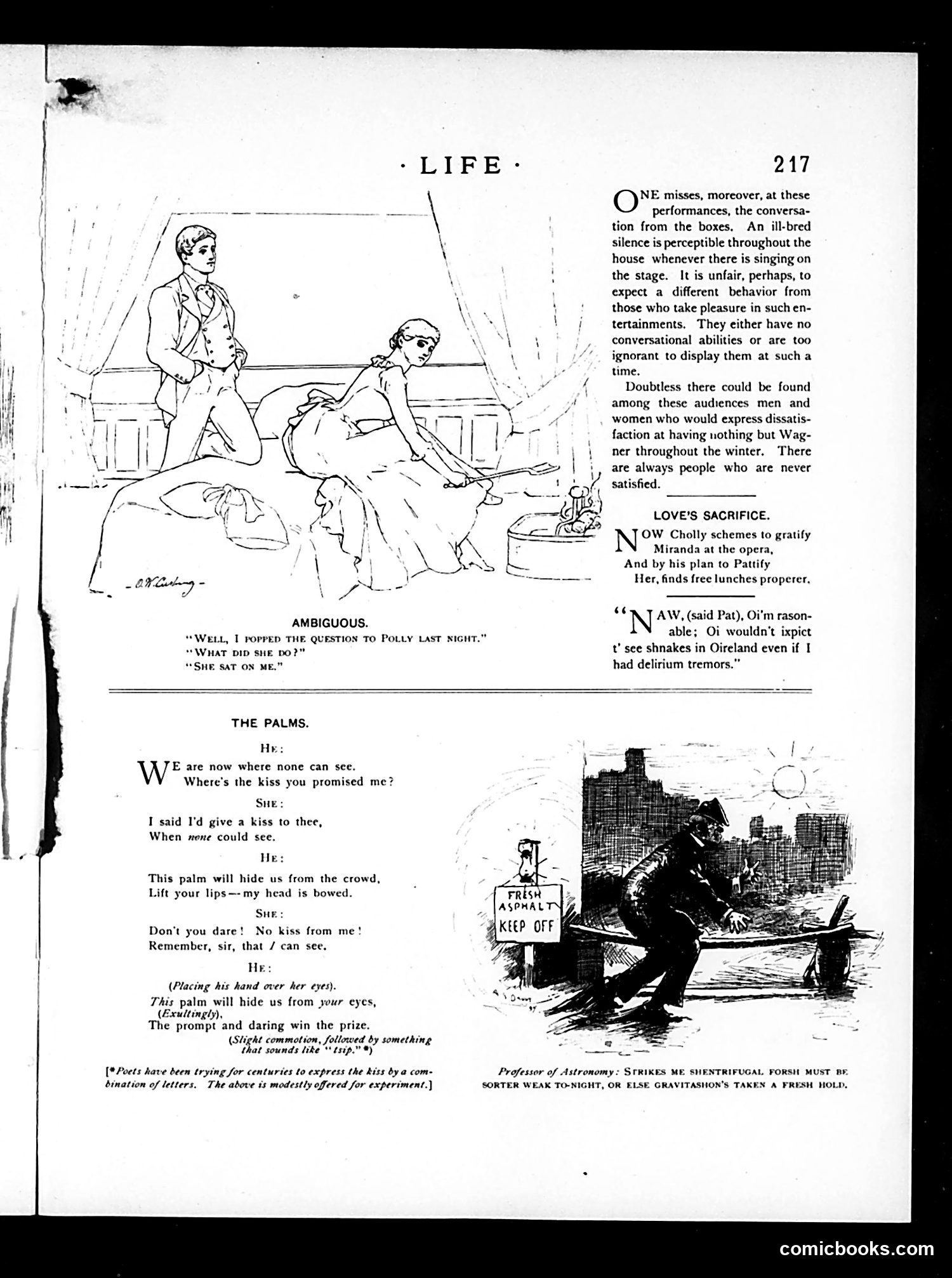
This *Life* magazine page contains multiple satirical pieces about social behavior and courtship: **"Ambiguous"** jokes about a proposal's unclear outcome—the phrase "she sat on me" is deliberately ambiguous (did she reject him physically or accept him?). **"The Palms"** is a flirtation dialogue where a man tries to kiss a woman by covering her eyes with his hand, thinking she won't see him. She reveals she can still see, subverting his trick. The asterisk notes humorously that poets have struggled for centuries to represent kissing sounds in writing. **"Love's Sacrifice"** and the astronomy professor's caption are separate gag items about romance and relationships. The top section critiques opera-goers—specifically wealthy patrons in theater boxes who chat during performances, displaying poor manners and cultural ignorance. The piece sarcastically suggests such people lack conversational ability or education. All pieces reflect early 20th-century concerns about manners, courtship conventions, and class distinctions in entertainment venues.
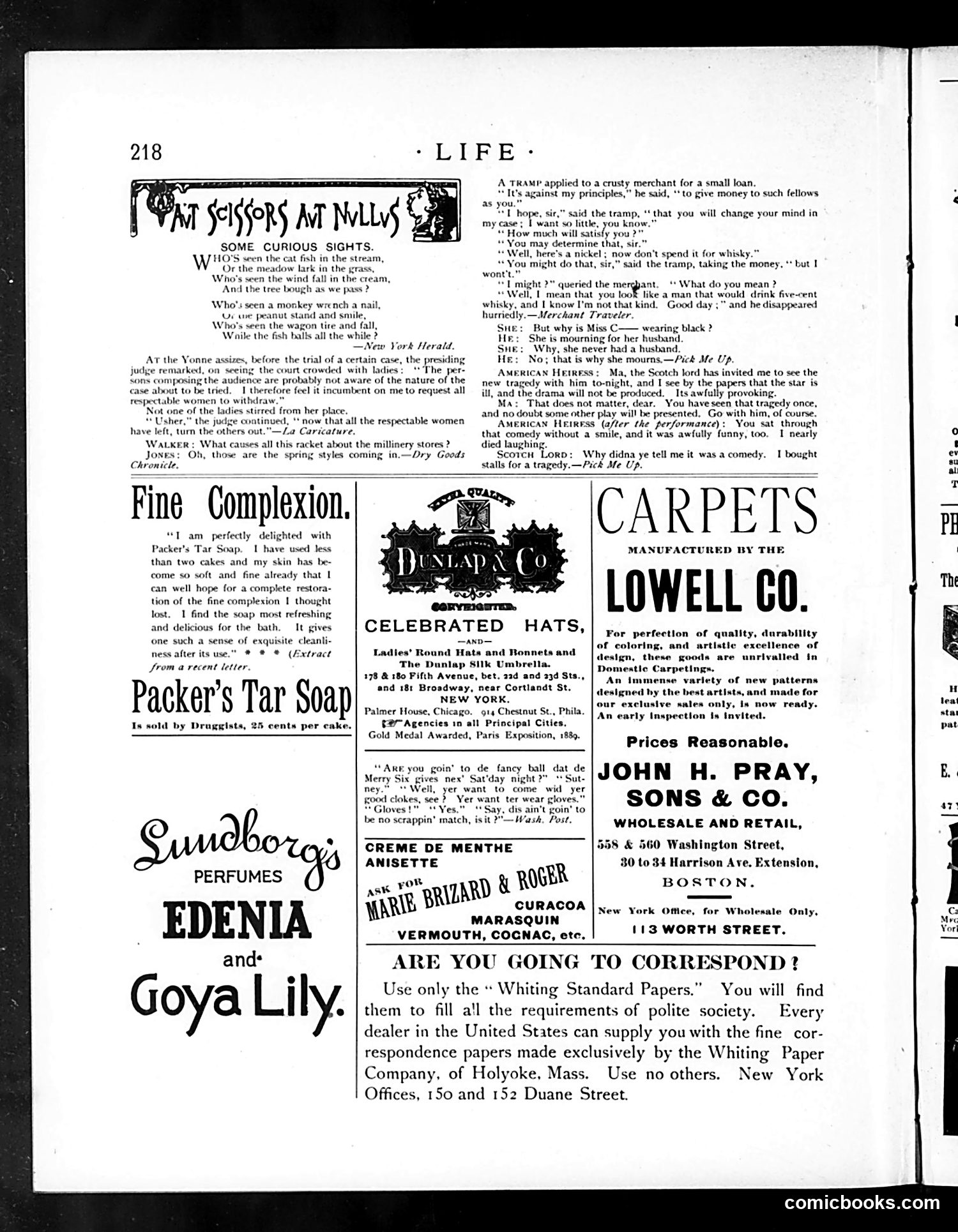
This page contains several brief humorous anecdotes rather than political cartoons. The main content includes: **"At Sissers at Nully's"**: A wordplay joke playing on homophones (cat fish/catfish, meadow lark, monkey wrench) and puns (wind fall, tree bough). It's lightweight absurdist humor. **The Judge's Dilemma**: A courtroom anecdote where a judge asks "respectable women" to leave before a scandalous trial, but none do—satirizing the hypocrisy of women claiming respectability while eager to hear salacious details. **The Tramp and Merchant**: A brief dialogue where a merchant loans money to a tramp despite claiming principles against it—mocking moral inconsistency. **Additional short jokes** about mourning clothes, theater attendance, and an ethnic dialect joke about a fancy ball. The rest is advertising for consumer goods (soap, perfume, hats, carpets). This appears to be a filler page mixing short jokes with advertisements—typical of Life magazine's format. No significant political or social satire is present.
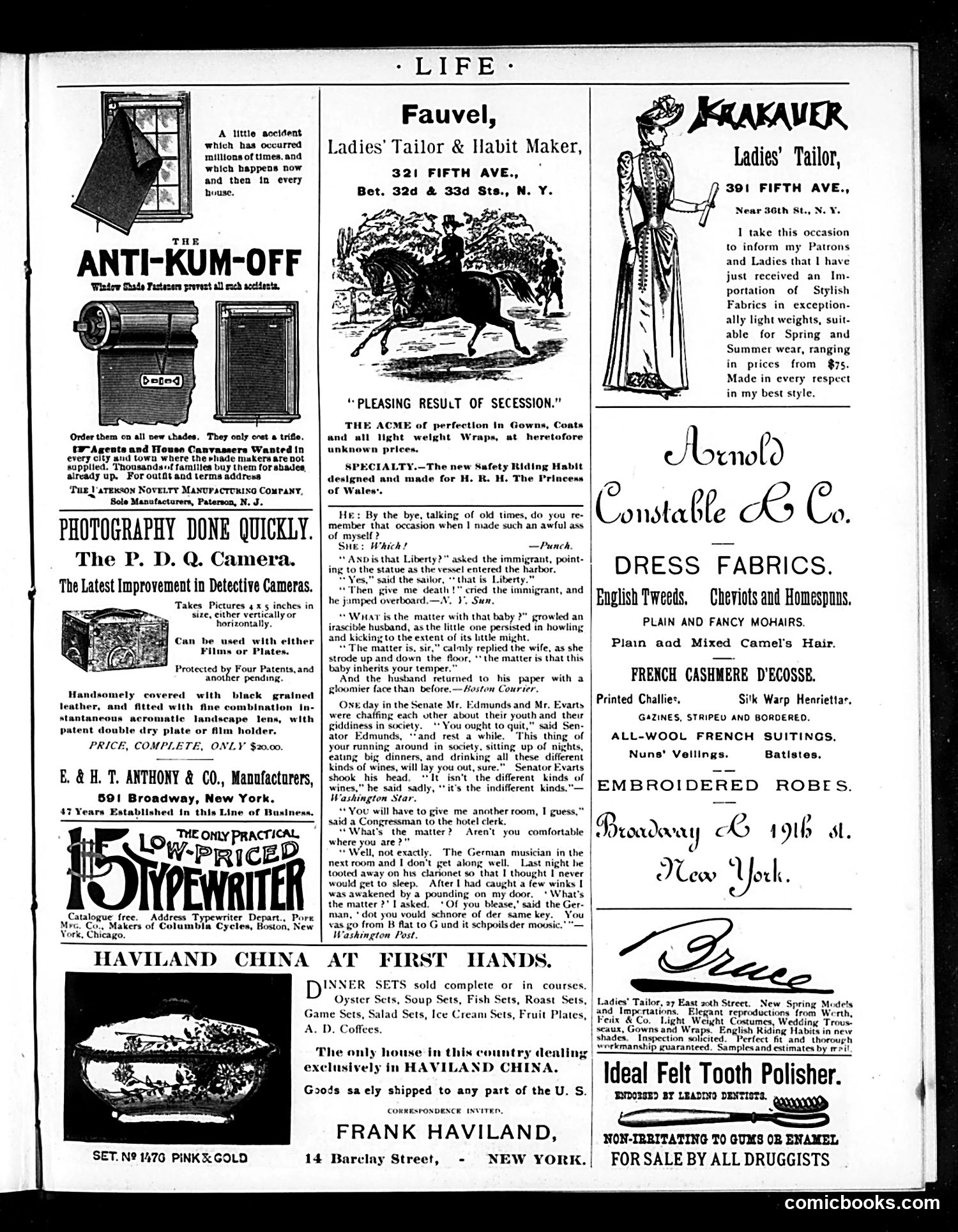
This page is primarily **advertisements with minimal political content**. The main cartoon, titled "Pleasing Result of Secession," shows a horse and rider—likely referencing the Civil War's aftermath rather than current politics. The accompanying text jokes about an immigrant's disillusionment upon seeing the Statue of Liberty, suggesting satire about immigration and American promises versus reality. The remainder consists of humorous anecdotes featuring U.S. senators (Edmunds and Evarts) making witty remarks about wine and indulgence, a congressman's hotel complaint about a German musician, and scattered product advertisements for cameras, typewriters, and ladies' clothing. **The satire is gentle and social rather than sharply political**—poking fun at immigrant expectations, congressional vanity, and domestic absurdities. The page reflects Life magazine's role as a venue for light humor and commercial advertising aimed at affluent readers.
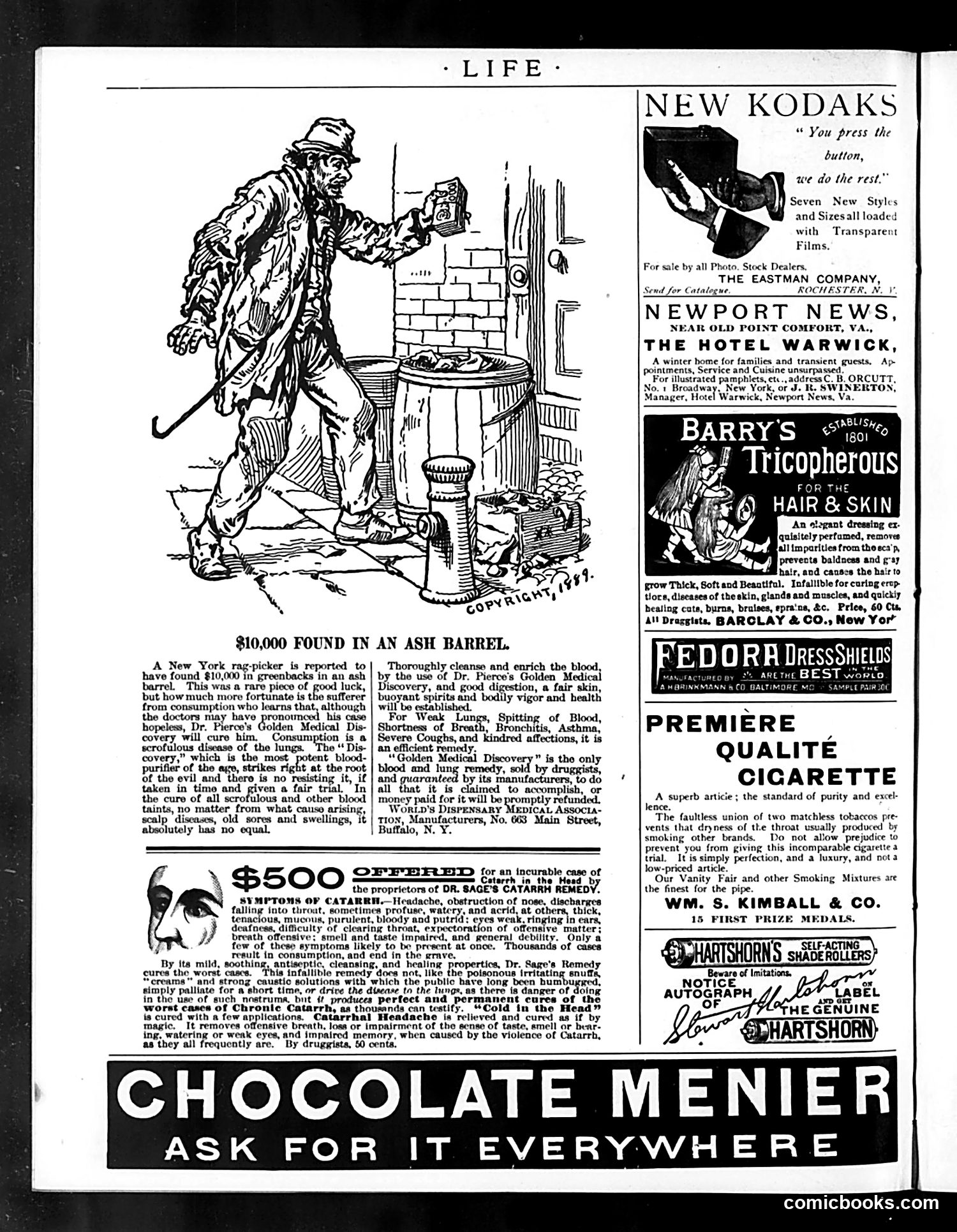
This page is primarily **advertising**, not political satire. The main illustration shows a ragged man (likely a tramp or vagrant) who has discovered money in an ash barrel—accompanying a news story about a New York rag-picker finding $10,000 in greenbacks. The cartoon illustrates a common theme of the era: the possibility of sudden fortune through chance discovery. The sketch's exaggerated, comedic style of the disheveled figure emphasizes the absurdity and luck involved. The remainder of the page consists entirely of **patent medicine and consumer product advertisements** typical of late 19th-century publications: Kodak cameras, hotel services, hair tonics (Tricopherous), Dr. Pierce's Golden Medical Discovery (for consumption/tuberculosis), catarrh remedies, cigarettes, and shade rollers. These ads reflect contemporary medical quackery and early consumer capitalism, offering dubious health claims. There is no political content or sophisticated satire on this particular page.
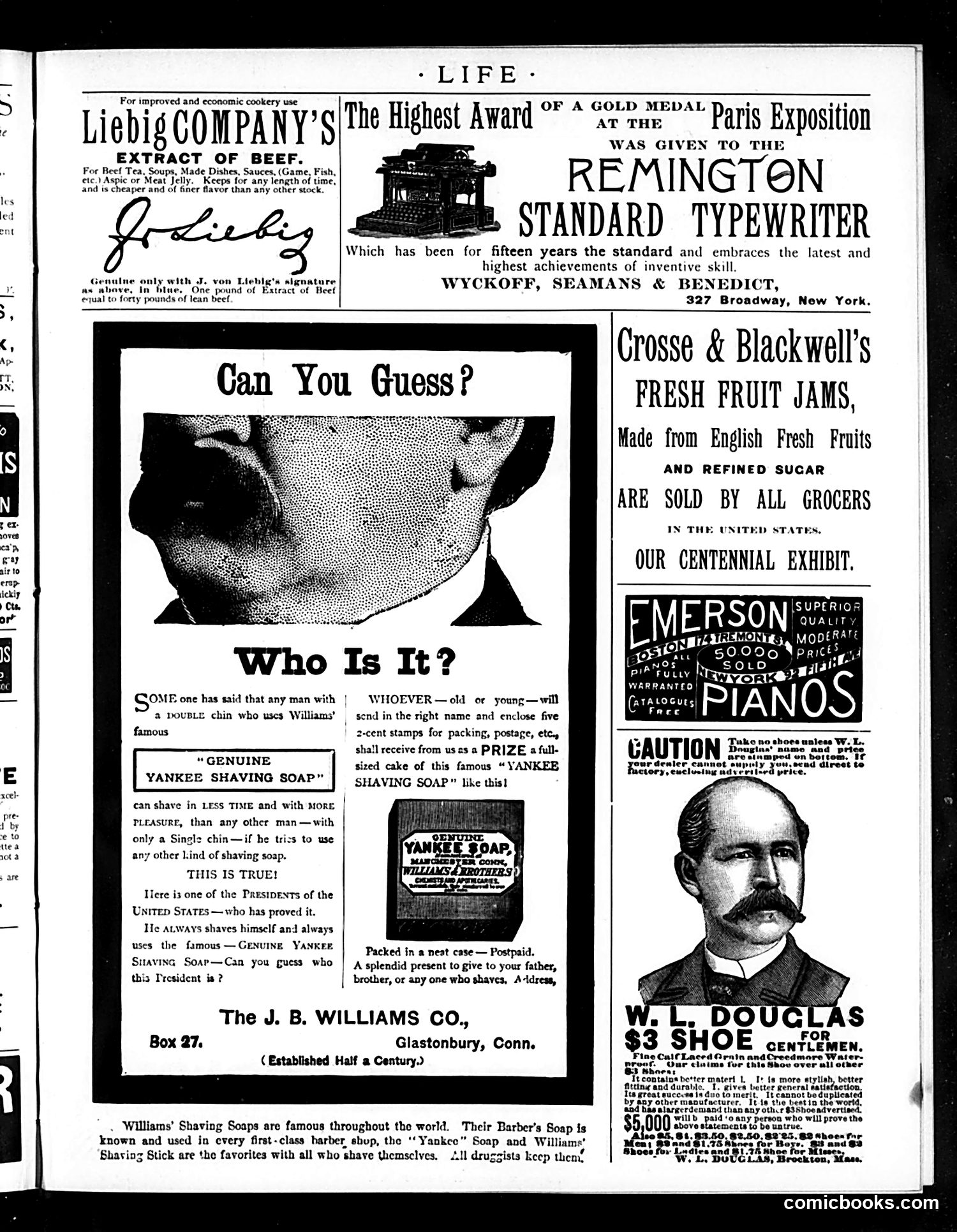
This page is primarily **advertising**, not political satire. The main cartoon is a guessing game for Williams' Shaving Soap. It shows a close-up of a chin and asks readers to identify which U.S. President uses this brand. The joke plays on a claim that any man with a double chin can shave better with Williams' soap than other men using inferior products. The advertisement asserts that one unnamed President "always shaves himself" and uses "genuine Yankee shaving soap," challenging readers to guess his identity in exchange for a free cake of soap (for 5 two-cent stamps). This is straightforward commercial marketing dressed as a game—no sophisticated political commentary. The surrounding page contains additional product advertisements (Liebig's beef extract, Remington typewriters, Crosse & Blackwell jams, Emerson pianos, W.L. Douglas shoes), typical of Life magazine's revenue model.
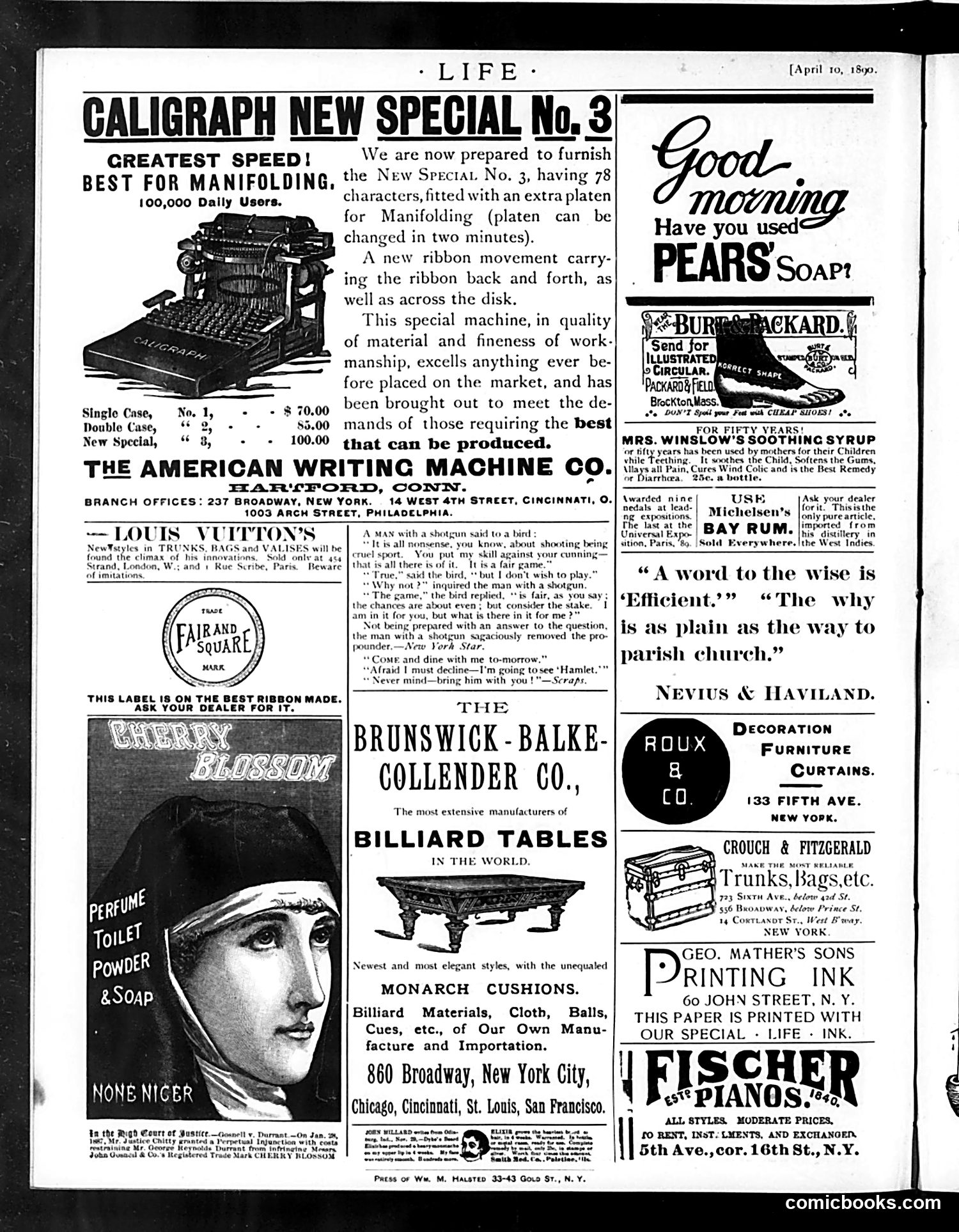
This page is primarily **advertising**, not editorial cartoon content. It showcases various consumer products typical of the 1890s: typewriters, perfume, billiard tables, trunks, printing ink, and pianos. The only narrative content is a brief humorous anecdote about a man with a shotgun confronting a bird. The bird questions why it should allow itself to be shot, arguing there's nothing in it for the bird. The man, unable to respond logically to this self-interested argument, simply shoots the bird anyway. The joke satirizes human illogic and violence disguised as sport—the man cannot justify the "game" rationally but proceeds anyway. It's mild social commentary on hunting culture. The page reflects 1890s consumer culture and advertising dominance in magazines like *Life*, which balanced satirical editorial content with commercial promotion to fund publication.