
Life, 1890-04-10 · page 4 of 18
Life — April 10, 1890 — page 4: what you’re looking at
What you’re looking at
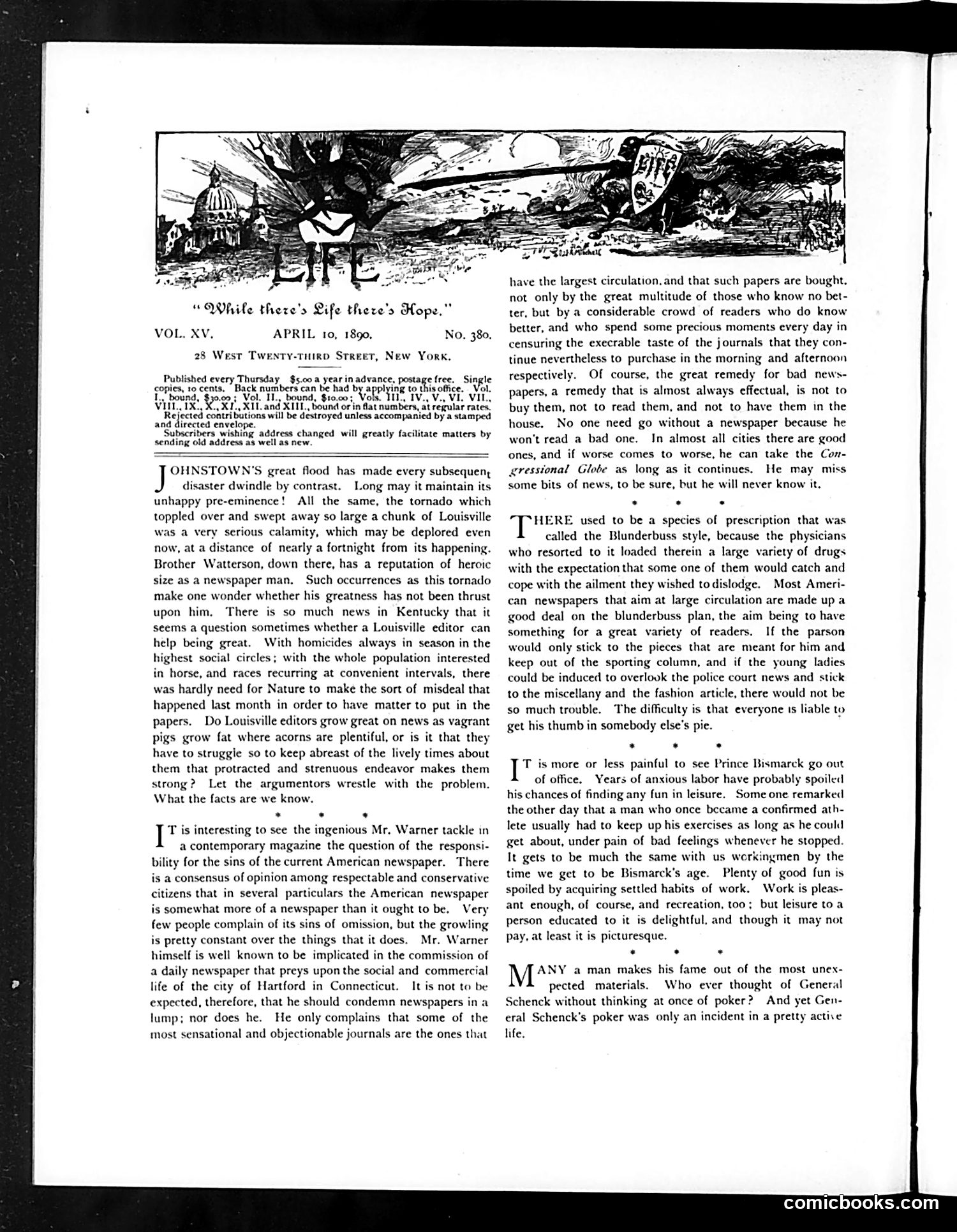
The page's header cartoon depicts a tornado destroying a landscape with a Capitol building visible, illustrating Johnstown's recent catastrophic flood. The accompanying article discusses how this disaster briefly overshadowed other news, questioning whether a Louisville editor could gain fame from such tragedies. The main text addresses American newspaper sensationalism—specifically the "blunderbuss style" of medicine-show advertising where papers would publish diverse remedies hoping something would appeal to readers. The author argues this shotgun approach to content is problematic because readers want tailored news, not miscellaneous articles. Additional sections discuss Prince Bismarck's retirement and General Schenck's poker playing becoming unexpectedly famous—illustrating how people gain unexpected notoriety from unlikely sources.
📄 Transcribed text from this page (OCR, searchable)
Machine-transcribed from the original scan — historical spelling and the odd misread are preserved.
“While there's Life there's Hope.” VOL, XV. APRIL 10, 1890, No. 380. 23 West Twexty-tTiiro Street, New York. Published every Thursday $5.00 a year in advance, postage free. Single copies, to cents, "Back numbers can be had by applying to thisofice. Vol. 1. hound, $9009; Vol. Il. bound, $10.00; Vols II. 1V., V., VI. VIL. VUI., IX!, X., X10, X11. and XIIL, bound or in fat numbers, at regular rates. Rejected contri butions will be destroyed unless accompanied by a stamped and directed envelope. Subscribers wishing address changed will greatly facilitate matters by sending old address as well as new. Jaane great flood has made every subsequen; disaster dwindle by contrast. Long may it maintain its unhappy pre-eminence! All the same, the tornado which toppled over and swept away so large a chunk of Louisville was a very serious calamity, which may be deplored even now, at a distance of nearly a fortnight from its happening. Brother Watterson, down there, has a reputation of heroic size as a newspaper man, Such occurrences as this tornado make one wonder whether his greatness has not been thrust upon him. There is so much news in Kentucky that it seems a question sometimes whether a Louisville editor can help being great. With homicides always in season in the highest social circles; with the whole population interested in horse, and races recurring at convenient intervals, there was hardly need for Nature to make the sort of misdeal that happened last month in order to have matter to put in the papers. Do Louisville editors grow great on news as vagrant pigs grow fat where acorns are plentiful, or is it that they have to struggie so to keep abreast of the lively times about them that protracted and strenuous endeavor makes them strong? Let the argumentors wrestle with the problem, What the facts are we know. . . . T is interesting to see the ingenious Mr, Warner tackle in a contemporary magazine the question of the responsi- bility for the sins of the current American newspaper. There is a consensus of opinion among respectable and conservative citizens that in several particulars the American newspaper is somewhat more of a newspaper than it ought to be. Very few people complain of its sins of omission, but the growling is pretty constant over the things that it does. Mr. Warner himself is well known to be implicated in the commission of a daily newspaper that preys upon the social and commercial life of the city of Hartford in Connecticut. It is not to be expected, therefore, that he should condemn newspapers in a lump; nor does he. He only complains that some of the most sensational and objectionable journals are the ones that have the largest circulation, and that such papers are bought. not only by the great multitude of those who know no bet- ter, but by a considerable crowd of readers who do know better, and who spend some precious moments every day in censuring the execrable taste of the journals that they con- tinue nevertheless to purchase in the morning and afternoon respectively. Of course, the great remedy for bad news- papers, a remedy that is almost always effectual, is not to buy them, not to read them, and not to have them in the house. No one need go without a newspaper because he won't read a bad one. Jn almost all cities there are good ones, and if worse comes to worse, he can take the Con- gressional Globe as long as it continues. He may miss some bits of news, to be sure, but he will never know it. . . . HERE used to be a species of prescription that was called the Blunderbuss style, because the physicians who resorted to it loaded therein a large variety of drugs with the expectation that some one of them would catch and cope with the ailment they wished to dislodge. Most Ameri- can newspapers that aim at large circulation are made up a good deal on the blunderbuss plan, the aim being to have something for a great variety of readers. If the parson would only stick to the pieces that are meant for him and keep out of the sporting column, and if the young ladies could be induced to overlook the police court news and stick to the miscellany and the fashion article, there would not be so much trouble. The difficulty is that everyone ts liable to get his thumb in somebody else’s pie. . . . I" is more or less painful to see Prince Bismarck go out of office. Years of anxious labor have probably spoiled his chances of finding any fun in leisure. Some one remarked the other day that a man who once became a confirmed ath- lete usually had to keep up his exercises as long as he could get about, under pain of bad feelings whenever he stopped. It gets to be much the same with us workingmen by the time we get to be Bismarck’s age. Plenty of good fun is spoiled by acquiring settled habits of work. Work is pleas- ant enough, of course, and recreation, too; but leisure to a person educated to it is delightful, and though it may not pay, at least it is picturesque. . . . Ms’ a man makes his fame out of the most unex- pected materials. Who ever thought of General Schenck without thinking at once of poker? And yet Gen- eral Schenck’s poker was only an incident in a pretty active life. comicbooks.com