
Life, 1890-04-10 · page 6 of 18
Life — April 10, 1890 — page 6: what you’re looking at
What you’re looking at
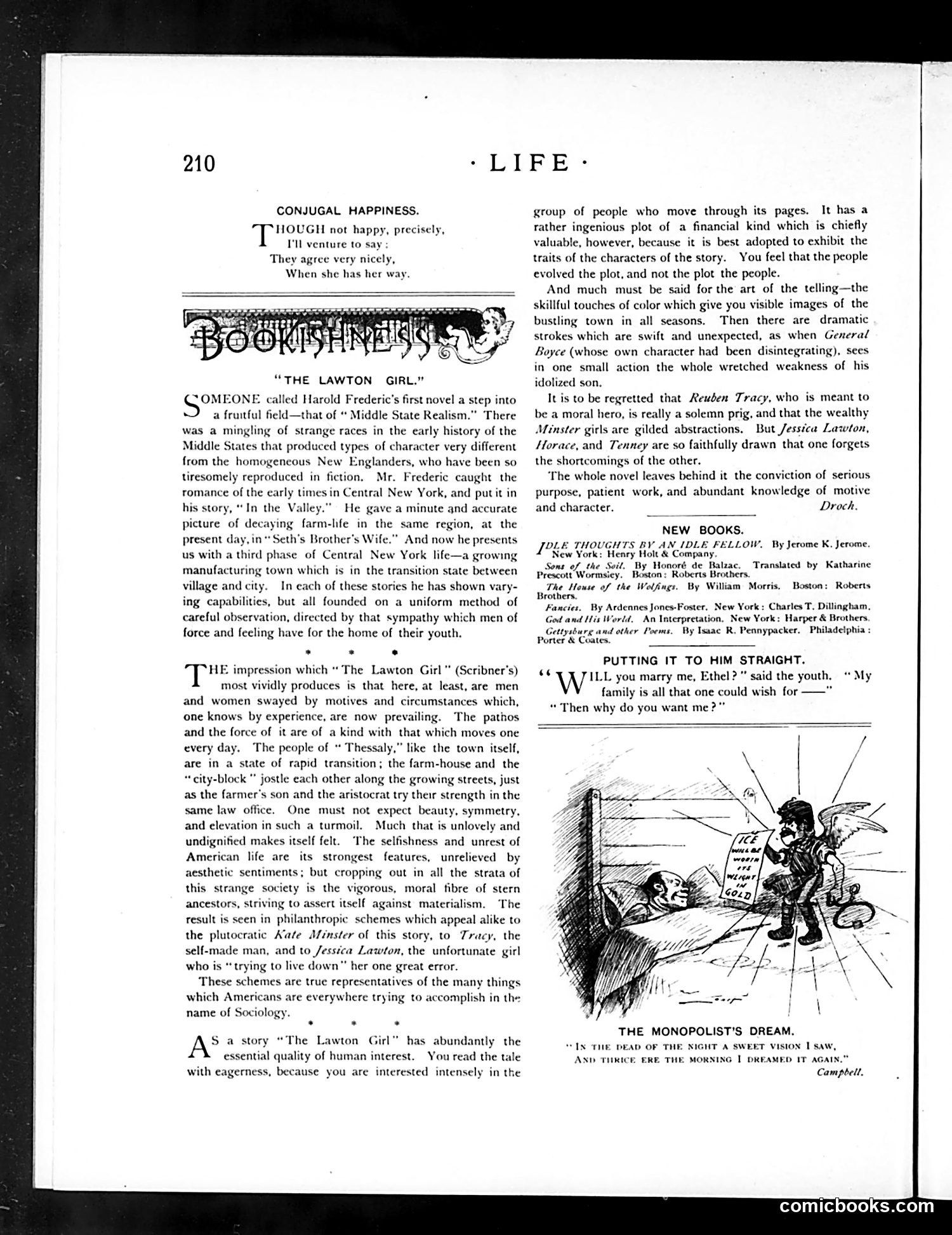
This page contains book reviews and literary criticism rather than political cartoons. The main content discusses Harold Frederic's novel "The Lawton Girl," praising its realistic portrayal of characters in a transitional American manufacturing town. The single illustration, titled "The Monopolist's Dream," shows a figure dreaming or fantasizing, accompanied by a Campbell quote. Without additional context, the specific satirical target isn't entirely clear from the image alone, though the title suggests commentary on industrial monopolies—a significant Progressive Era concern. The page primarily serves as a book review section rather than political satire, focusing on literary merit and character development in contemporary fiction.
📄 Transcribed text from this page (OCR, searchable)
Machine-transcribed from the original scan — historical spelling and the odd misread are preserved.
- LIFE: CONJUGAL HAPPINESS. HOUGH not happy, precisely, I'll venture to say ; They agree very nicely, When she has her way. “THE LAWTON GIRL.” ~OMEONE called Harold Frederic’s first novel a step into a fruitful field—that of * Middle State Realism.” There was a mingling of strange races in the early history of the Middle States that produced types of character very different from the homogeneous New Englanders, who have been so tiresomely reproduced in fiction, Mr. Frederic caught the romance of the early times in Central New York, and putit in his story, “In the Valley.” He gave a minute and accurate picture of decaying farm-hfe in the same region, at the present da‘ Seth's Brother's Wife.” And now he presents us with a third phase of Central New York life—a growing manufacturing town which is in the transition state between village and city. In each of these stories he has shown vary- ing capabilities, but all founded on a uniform method of careful observation, directed by that sympathy w force and feeling have for the home of their youth. . . . ion which * The Lawton Girl” (Scribner's) most vividly produces is that here, at least, are men and women swayed by motives and circumstances which, one knows by experience, are now prevailing. The pathos and the force of it are of a kind with that which moves one every day. The people of “ Thessaly,” like the town itself, are in a state of rapid transition; the farm-house and the “city-block " jostle cach other along the growing streets, just as the farmer's son and the aristocrat try their strength in the same law office. One must not expect beauty, symmetry, and elevation in such a turmoil. Much that is unlovely and undignified makes itself felt. The selfishness and unrest of American life are its strongest features, unrelieved by aesthetic sentiments; but cropping out in all the strata of this strange society is the vigorous, moral fibre of stern ancestors, striving to assert itself against materialism. The result is seen in philanthropic schemes which appeal alike to the plutocratic Aafe Afinster of this story, to Tracy, the self-made man, and to Jessica Lawton, the unfortunate girl who is “trying to live down” her one great error. These schemes are true representatives of the many things which American: HE impr re everywhere trying to accomplish in the name of Sociology. Sa story “The Lawton Girl” has abundantly the essential quality of human interest. You read the tale with eagerness, because you are interested intensely in the group of people who move through its pages. It has a rather ingenious plot of a financial kind which is chiefly valuable, however, because it is best adopted to exhibit the traits of the characters of the story. You feel that the people evolved the plot, and not the plot the people. And much must be said for the art of the telling—the skillful touches of color which give you visible images of the bustling town in all seasons. Then there are dramatic strokes which are swift and unexpected, as when General Boyce (whose own cl ter had been disintegrating), sees in one small action the whole wretched weakness of his idolized son. It is to be regretted that Reuben Tracy, who is meant to be a moral hero, is really a solemn prig, and that the wealthy Minster gitls are gilded abstractions. But Jessica Lawton, Horace, and Tenney are so faithfully drawn that one forgets the shortcomings of the other. ‘The whole novel leaves behind it the conviction of serious purpose, patient work, and abundant knowledge of motive and character. Droch. NEW BOOKS. [PLE THOUGHTS BY AN IDLE FELLOW, By Jerome K. Jerome. New York: Henry Holt & Compan: Sons of the Soil, By Honoré de Balzac. Prescott Wormsicy. Boston: Roberts Brothers. The House of the Wolfings. By William Morris, Brothers. Fanciex.. By Ardennes Jones-Foster. New York: Charles T. Dillingham, God and His World, An Interpretation. New York: Harper & Brothers, Gettysburg and other Poems, By Isaac R. Pennypacker. Philadelphia : Porter & Coates. PUTTING IT TO HIM STRAIGHT. ILL you marry me, Ethel?” said the youth, “ My family is all that one could wish for ——" hen why do you want me?” Translated by Katharine Boston: Roberts “ THE MONOPOLIST'S DREAM. “LN THE DEAD OF THE NIGHT A SWEET VISION T saw, AND THRICE ERE THE MORNING I DREAMED IT AGAIN Campbell. comicbooks.com