
A complete issue · 18 pages · 1890
Life — March 20, 1890
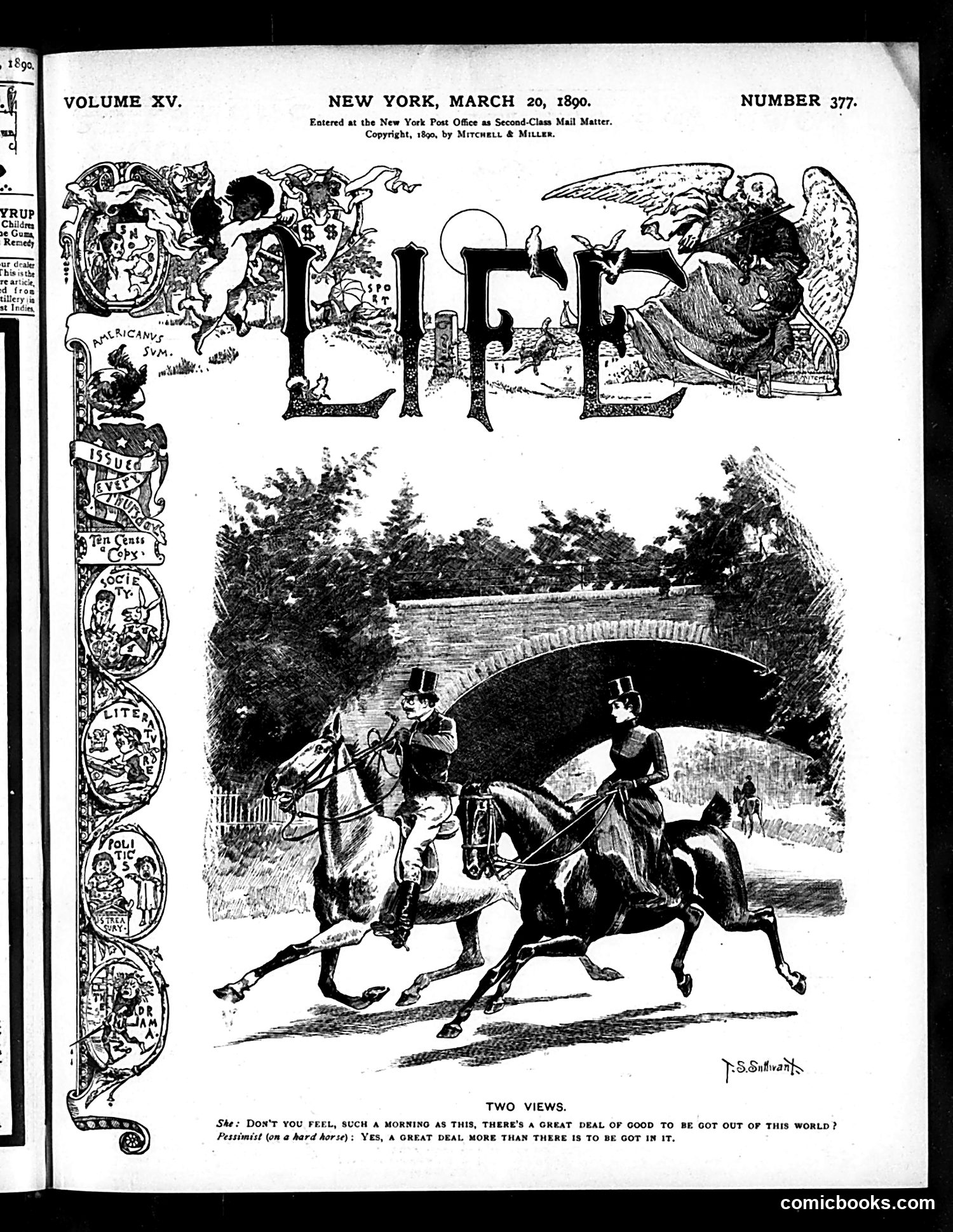
This cartoon satirizes contrasting attitudes about horseback riding. The illustration shows two riders on horses beneath an arched bridge, with dialogue at the bottom: **She** (on the harder horse): "Don't you feel, such a morning as this, there's a great deal of good to be got out of this world?" **Pessimist** (on a hard horse): "Yes, a great deal more than there is to be got in it." The joke plays on the physical discomfort of riding—the euphemistic phrase "good to be got out of this world" is answered literally about the bodily pain of horseback riding. It's a gentle satire on philosophical pessimism, suggesting that discomfort paradoxically makes one appreciate escaping worldly troubles. The cartoon mocks both romantic idealization of outdoor activities and existential pessimism through physical humor.
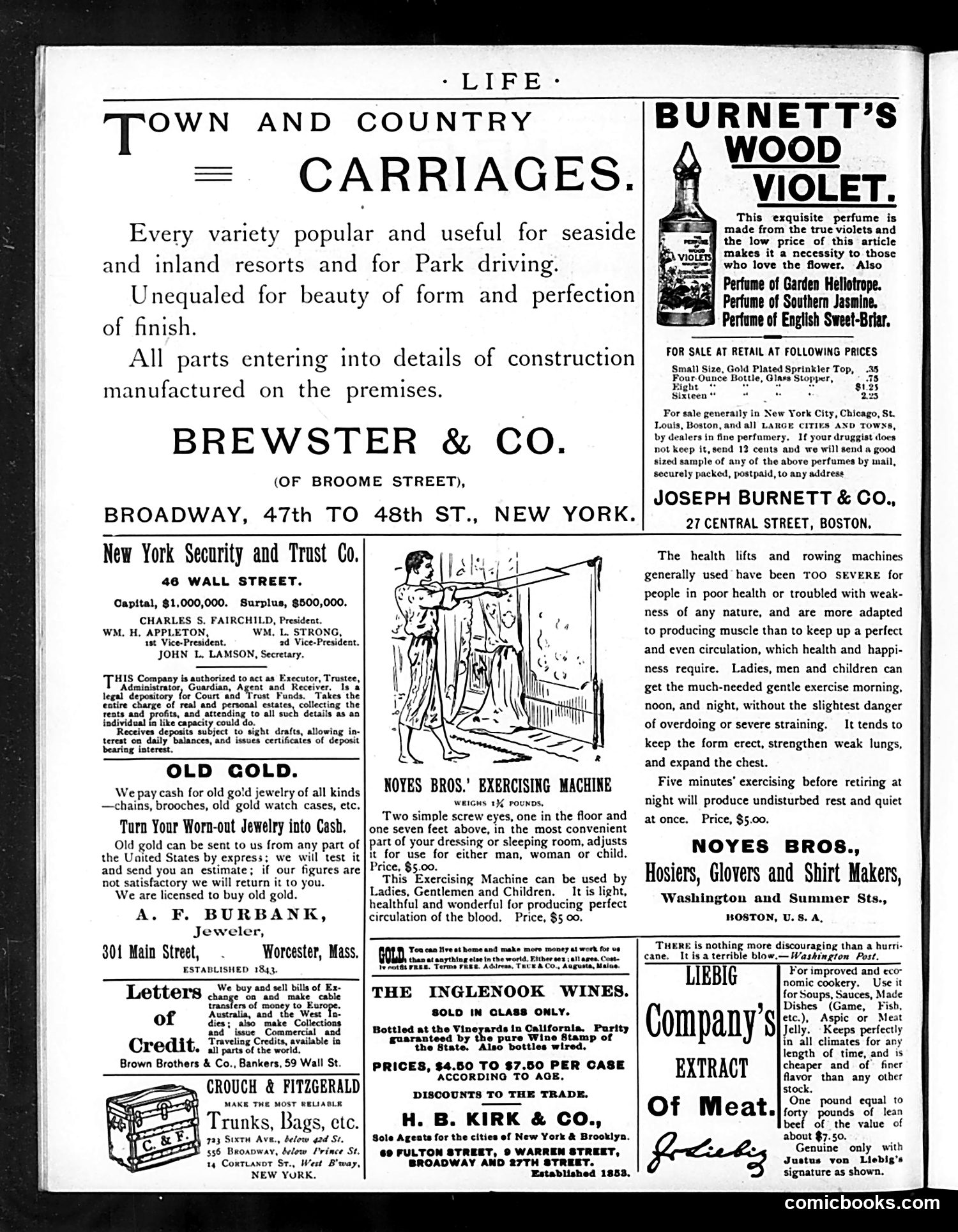
This page is **primarily advertisements** with one small cartoon illustration. The ads promote various products (carriages, perfume, jewelry, wine, exercise machines, and meat extract) typical of late 19th or early 20th-century commerce. The cartoon accompanying the **Noyes Bros. Exercising Machine** ad shows a figure using the device. The accompanying text humorously suggests the machine is gentler than typical severe exercise equipment of the era, safe enough for "ladies, men and children" to use without risk of overexertion. The joke appears to mock the period's obsession with mechanical exercise contraptions as a supposedly safe but still-effective fitness solution—appealing to Victorian sensibilities about proper, controlled exertion. The illustration itself is modest and the satire relatively mild.
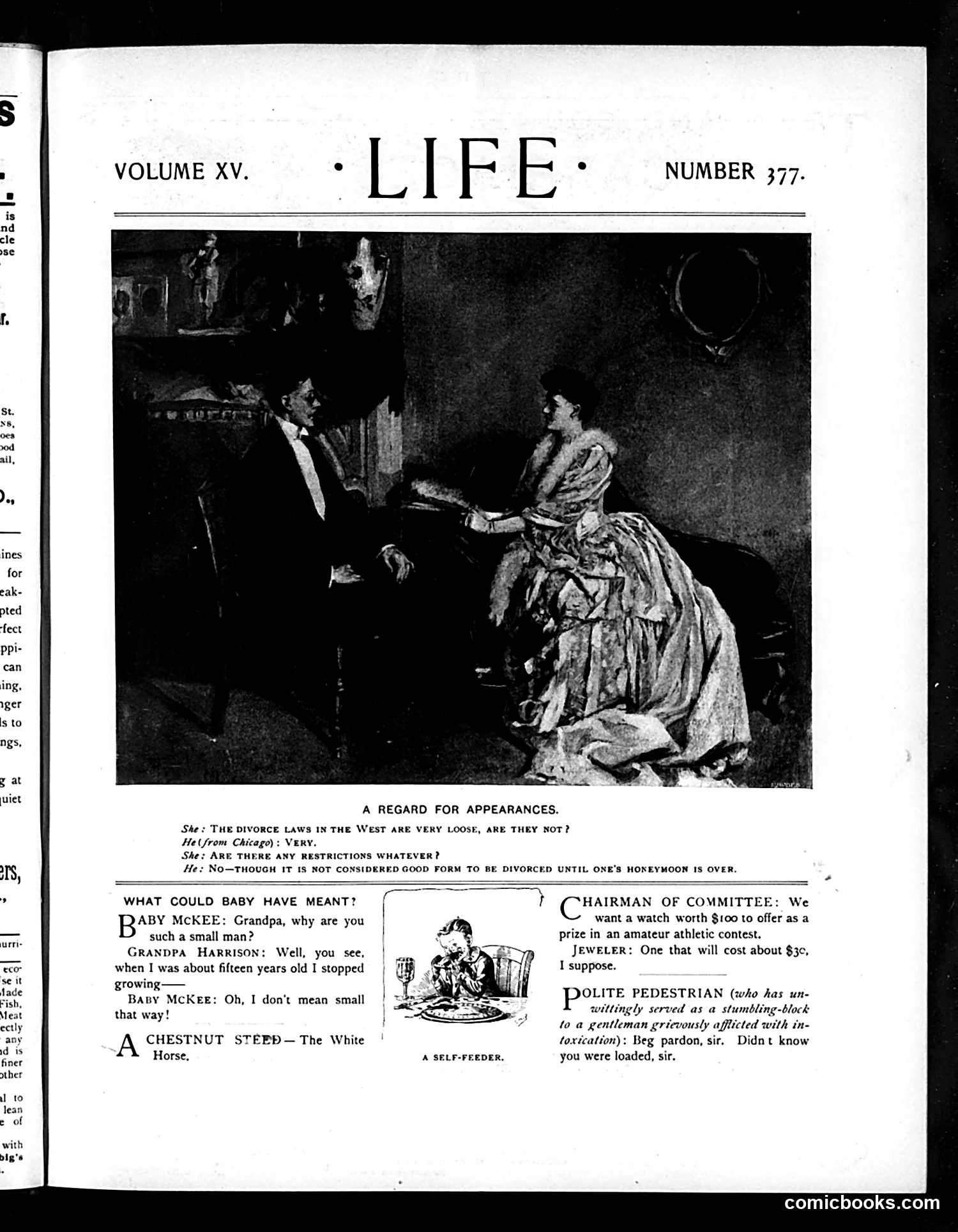
This page contains several brief satirical items typical of Life's humor format: **Main image**: "A Regard for Appearances" depicts a conversation between a man and woman about divorce laws. The joke suggests that while Western divorce laws are loose, there's an unspoken social expectation that couples maintain appearances until their honeymoon ends—implying newlyweds shouldn't divorce too quickly, regardless of legal permission. **Minor items** include: - "Baby McKee" joke: A grandfather explains his small stature by referencing his late growth - "A Chestnut Steed": A brief quip about a white horse - "Self-Feeder" and "Polite Pedestrian": Short humorous anecdotes about everyday situations The overall tone reflects early-20th-century American middle-class social anxieties about propriety, divorce, and public conduct.
This page contains editorial commentary rather than a political cartoon. The masthead quote—"While there's Life there's Hope"—introduces discussions of contemporary social issues. The main content critiques **divorce law and remarriage practices**. The editors argue that contemporary society treats divorce too casually, allowing easily-divorced persons to remarry without sufficient social stigma. They propose a solution: **tiered marriage licenses based on character assessment**, with stricter requirements for those with "doubtful stability." The page also references a controversy involving **Colonel Ibsen** and a "Vassar girl" case (likely referring to Henrik Ibsen's influence on contemporary scandals), and discusses wealth's corrupting influence on character through literary references. The satirical point: American society's increasing permissiveness toward divorce reflects declining moral standards.
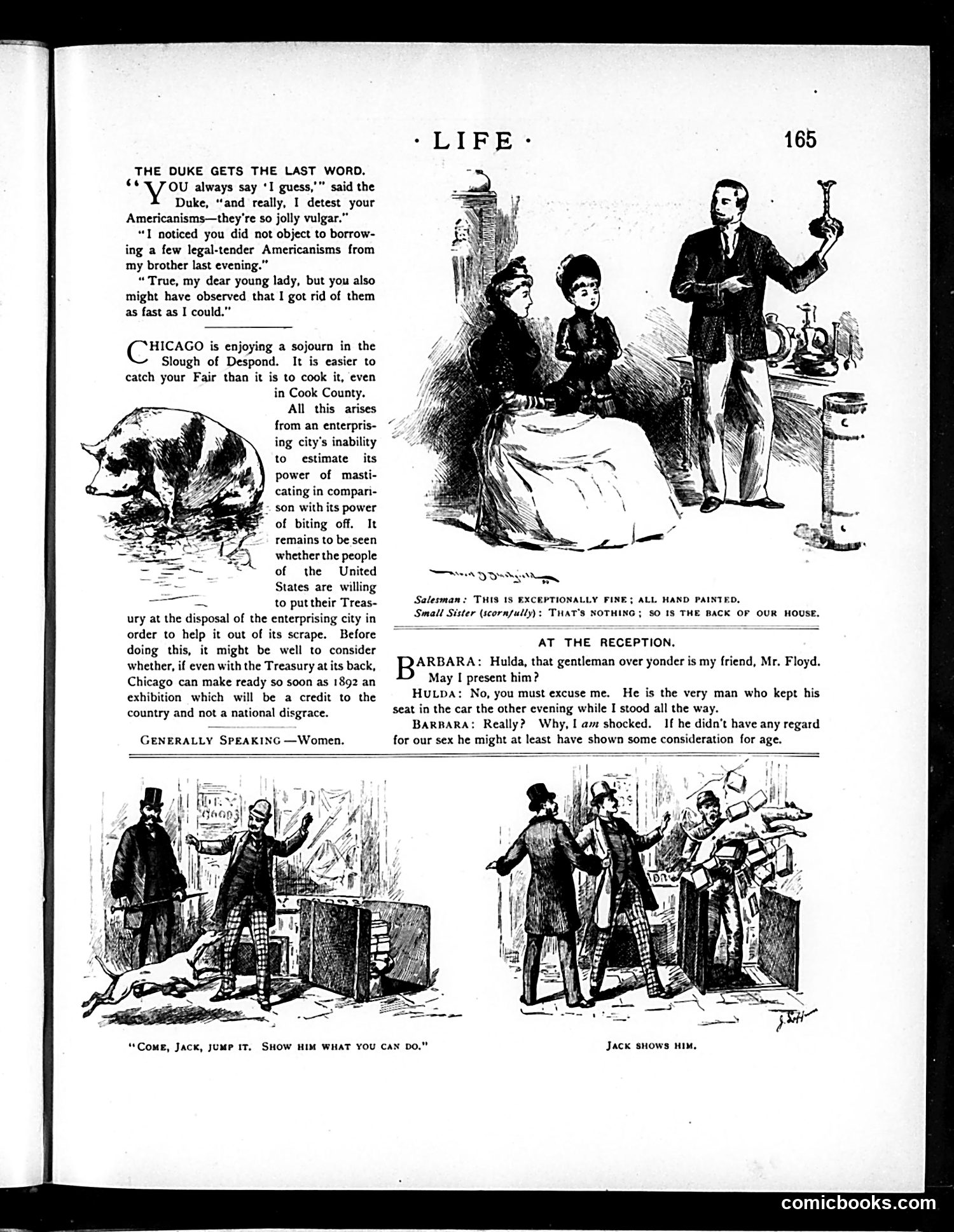
This page contains two distinct pieces of satirical content: **"The Duke Gets the Last Word"** (top): A dialogue satirizing British-American relations, where a British Duke defends his borrowing of "legal-tender Americans" from the narrator's brother. The satire targets American social climbing and the British aristocracy's casual appropriation of American wealth and citizens. **"Generally Speaking—Women"** and "At the Reception" (bottom): A multi-panel cartoon sequence mocking social etiquette and gender relations. The scenario involves a woman (Barbara) introducing a gentleman (Mr. Floyd) at a reception, then complaining that he monopolized her car seat without courtesy. The humor centers on satirizing both male rudeness and female social complaints about propriety and age-related respect. The overall page satirizes class pretension and social hypocrisy in Gilded Age America.
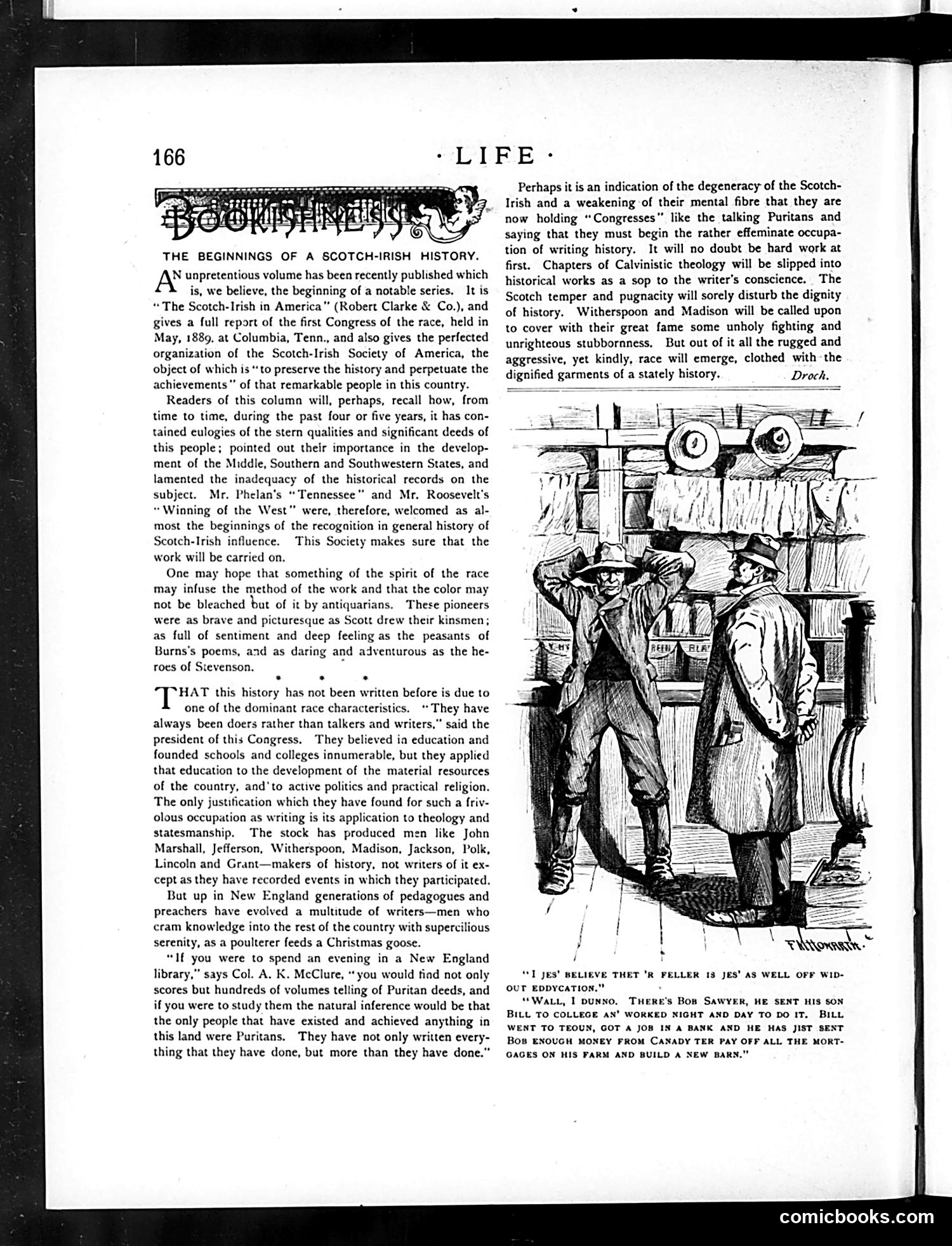
The page features an article titled "The Beginnings of a Scotch-Irish History" discussing a new publication by the Scotch-Irish Society of America, established at an 1889 Columbia, Tennessee congress. The accompanying illustration depicts a humorous scene of Scottish-Irish immigrants or their descendants, with one figure pointing upward (likely indicating aspiration or education) while others appear to be in modest circumstances, possibly workers or laborers. The caption below the cartoon contains dialect humor: "I jes' believe that 'B Feller is jes' as well off wid-out edducation" followed by a story about Bob Sawyer, a farmer's son who worked his way through school and later became successful, acquiring property through hard work and education. The satire critiques anti-education attitudes while celebrating Scotch-Irish industriousness and upward mobility through education.
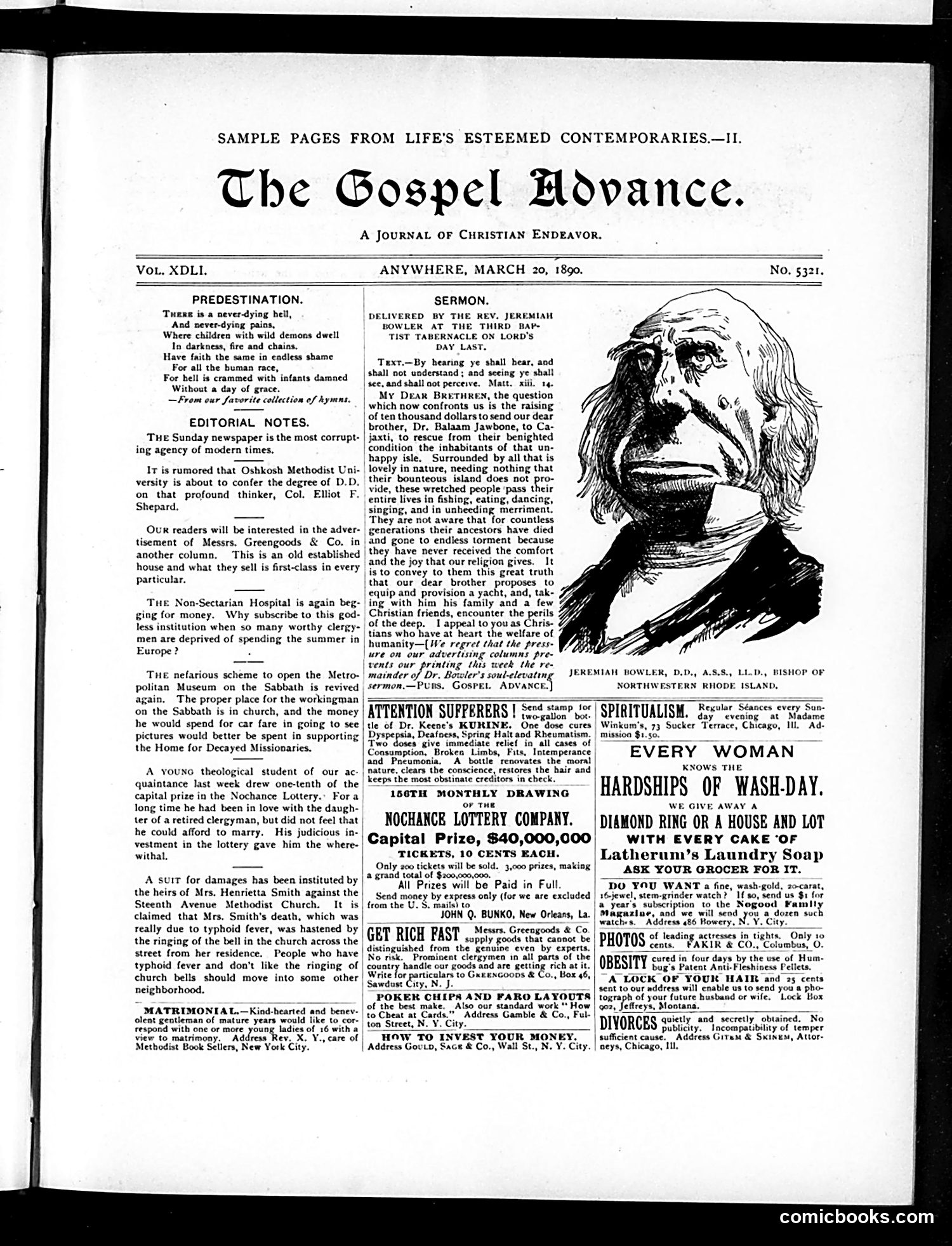
The page is primarily **editorial content and advertisements** rather than political satire. The main visual element is a portrait of **Jeremiah Bowler, D.D., A.S.S., LL.D., Bishop of North Easter Ridge Island**, identified in the caption below the sketch. The editorial notes discuss theological and institutional matters (Methodist University, hospitals, museum policies) typical of a Christian-focused publication. The advertisements are characteristic of 1890s commercial pitches: lottery schemes, medical remedies, matrimonial services, and dubious investment opportunities. This appears to be from *The Gospel Advance*, a Christian endeavor journal, not Life's main satirical section. The content reflects late-19th-century American religious publishing rather than political commentary.
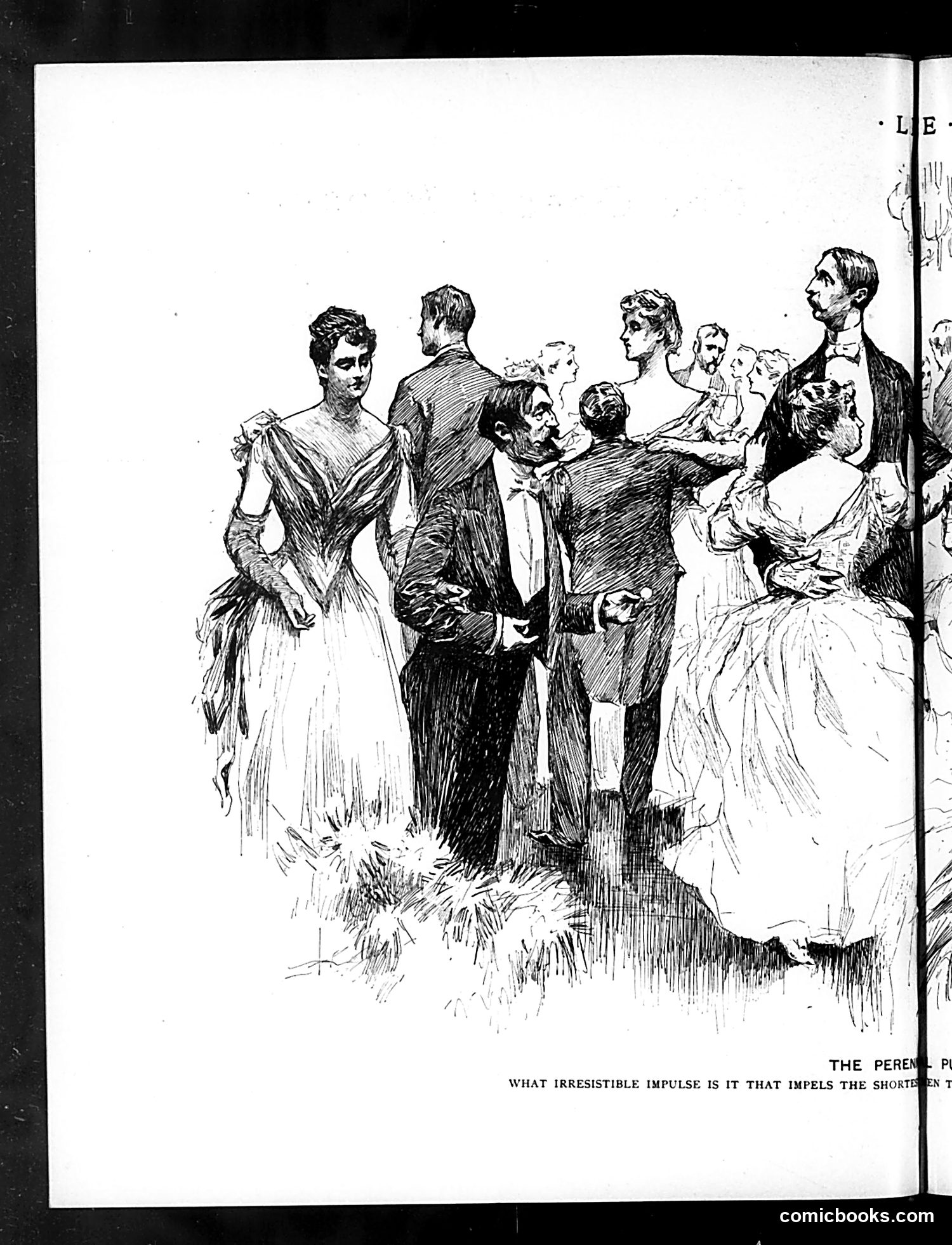
This illustration depicts a formal social gathering—likely a ball or high-society event—showing elegantly dressed men and women in late 19th or early 20th-century attire. The caption reads: "What irresistible impulse is it that impels the shorter men..." (text cuts off). The satire appears to target social dynamics at formal events, specifically the behavior of shorter men in relation to taller women or prominent figures. The joke likely concerns how certain men are drawn to or compelled toward particular social interactions despite physical disparities or social positioning. The title "The Perennial" suggests this is a recurring, timeless social phenomenon being mocked. Without the complete caption, the specific critique remains partially unclear, but it's satirizing predictable behavioral patterns in upper-class social situations.
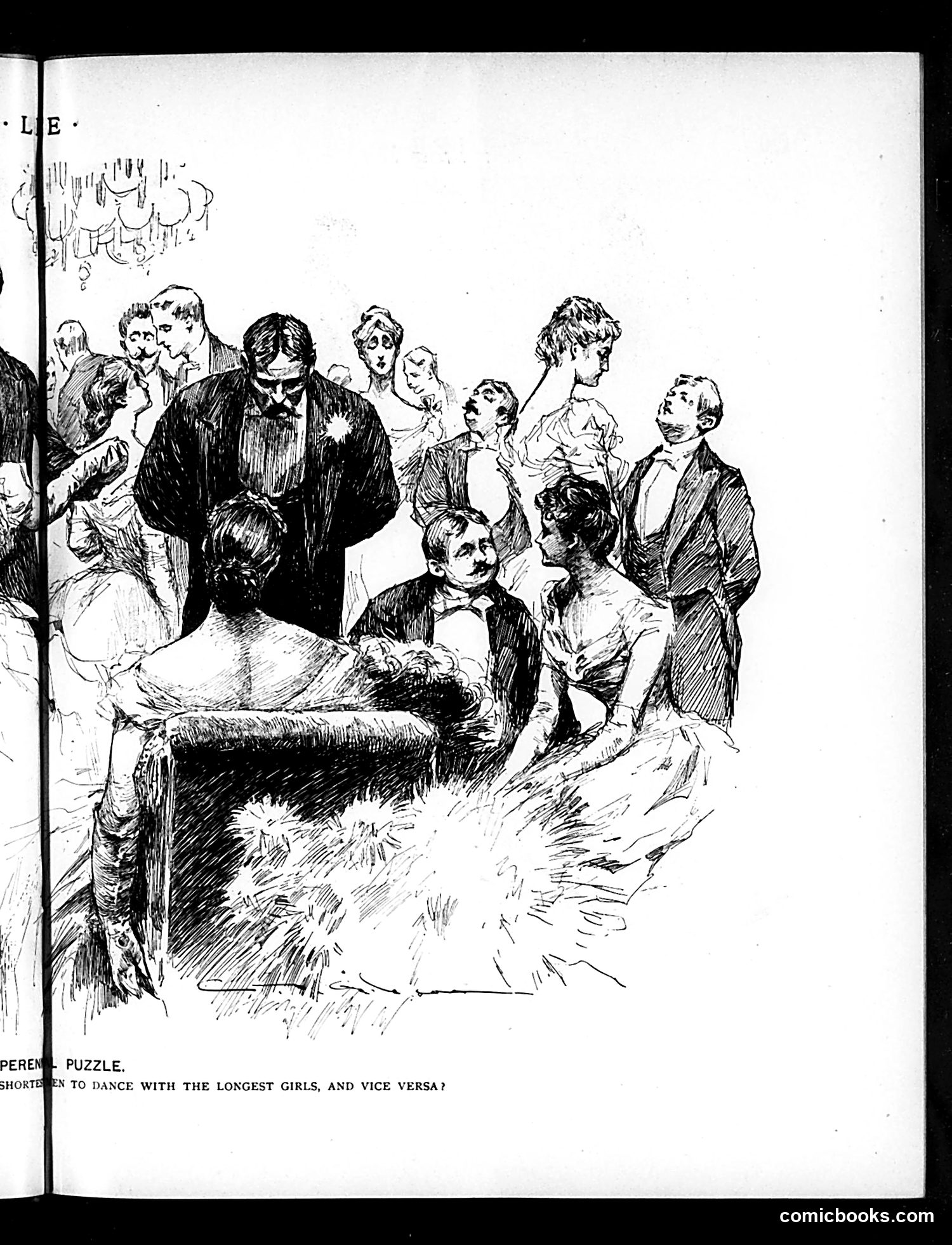
This cartoon illustrates "A Perplexing Puzzle" about social dancing etiquette. The caption asks: "Shorter men to dance with the longest girls, and vice versa?" The sketch depicts a formal dance or social gathering where men and women of notably different heights are paired together awkwardly. The central figure shows a short man with a taller woman, while other couples display similar mismatches, creating visual comedy. The satire mocks Victorian-era social conventions around proper dance partnering. The "puzzle" questions whether height-matching or height-contrast pairings were more appropriate—reflecting genuine anxieties about social protocol in genteel society. The exaggerated height disparities emphasize the absurdity of rigid etiquette rules governing even intimate social interactions like dancing.
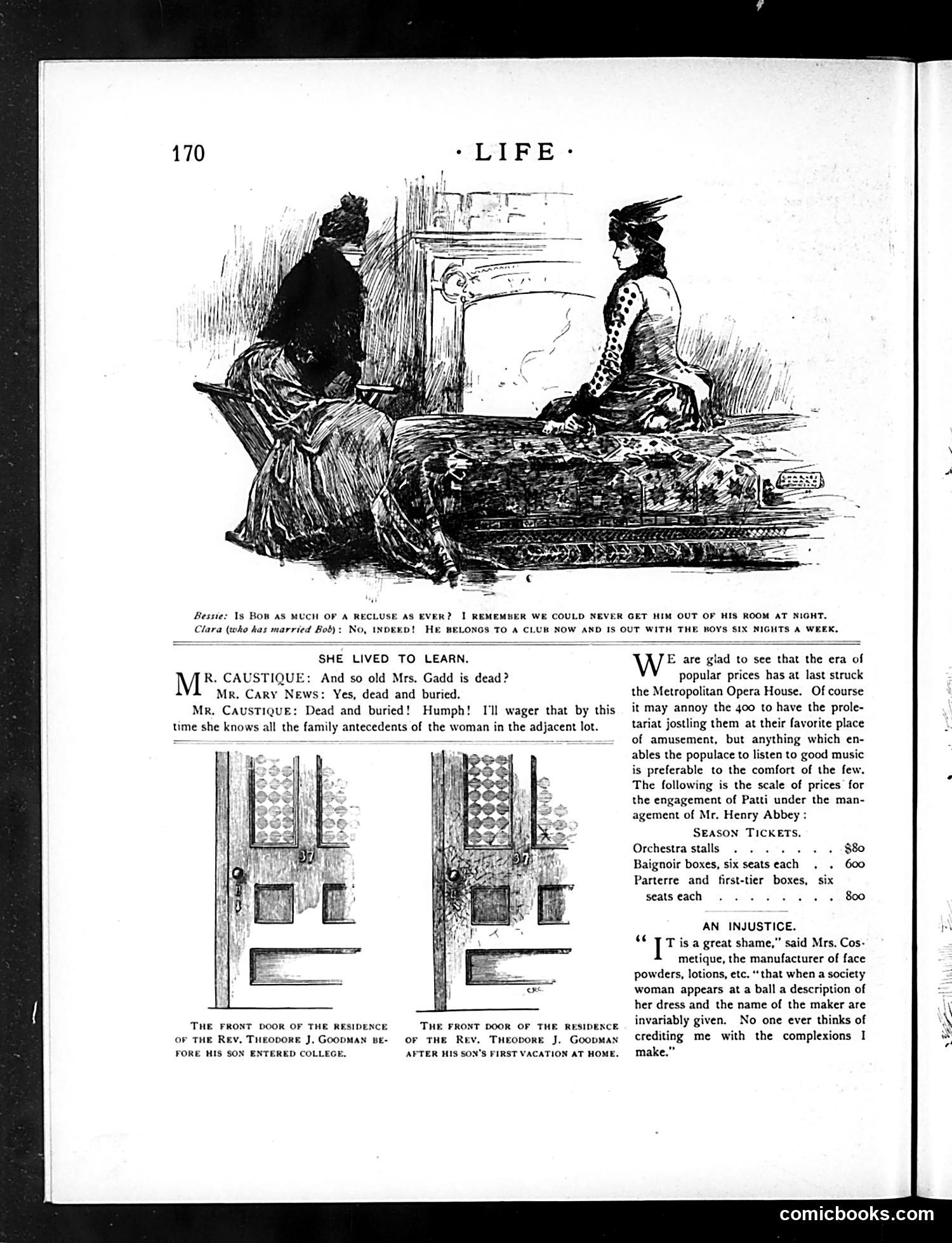
This page contains two distinct satirical pieces: **Top Cartoon ("She Lived to Learn"):** Two women sit conversing. The dialogue mocks gossip culture—Mr. Caustique jokes that Mrs. Gadd, having died, now knows all the neighborhood scandals she couldn't extract while living. The satire targets how death is treated as an afterlife opportunity to finally obtain social gossip, poking fun at both women's obsession with neighbors' secrets and the assumption that even death won't end curiosity about others' private affairs. **Bottom Section:** Includes a small architectural comparison showing a reverend's residence before/after his son entered college, followed by brief social commentary about opera ticket prices and complaints from Mrs. Cosmetique about dress descriptions at society events never crediting makeup manufacturers. The humor targets vanity and commercial self-interest.
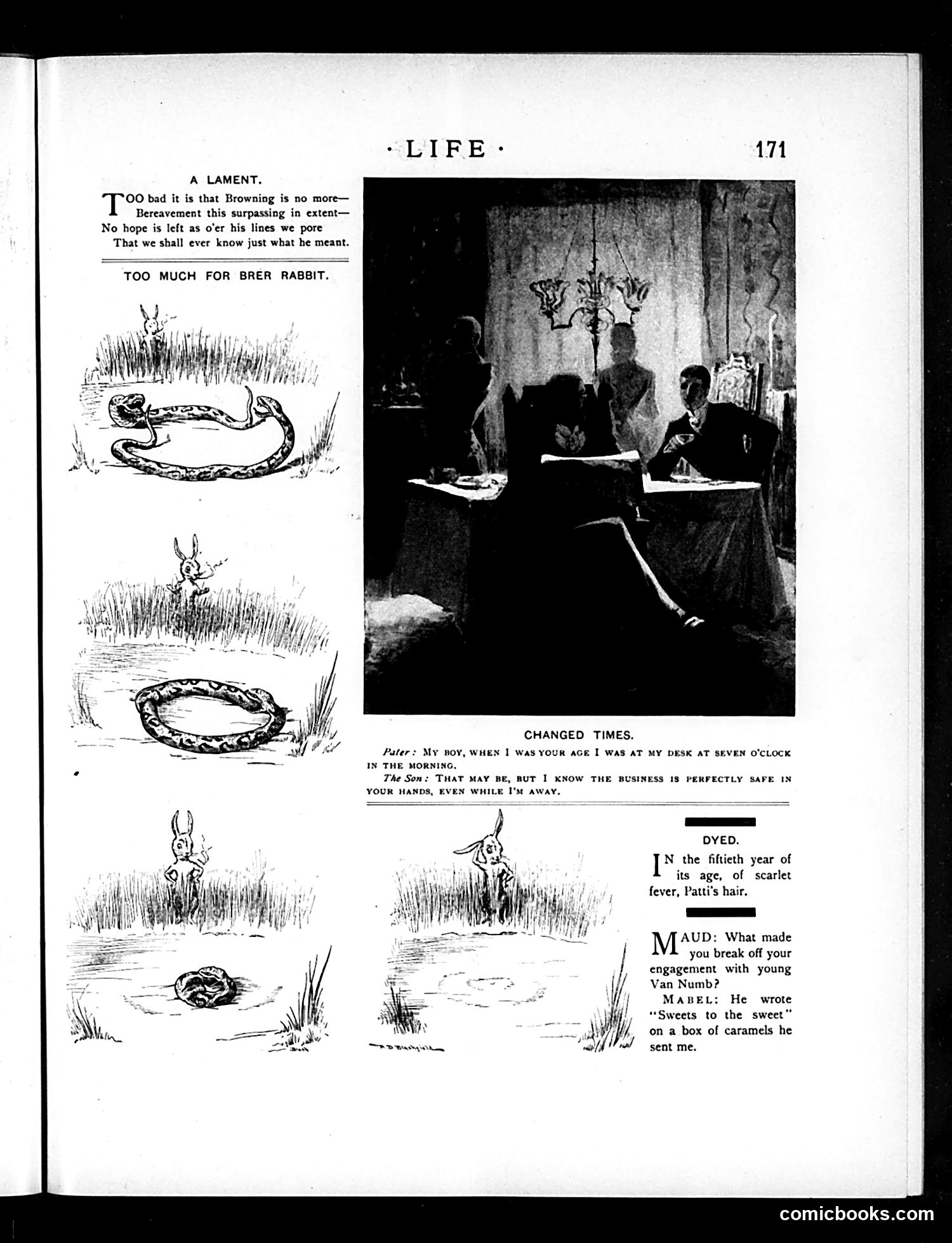
**Left side - "Too Much for Brer Rabbit":** A sequential comic strip showing a rabbit encountering a snake. The rabbit appears increasingly distressed across panels, suggesting the snake (likely representing a threat or predator) overwhelms even the clever rabbit character from African-American folklore. This satirizes situations where cunning alone cannot overcome superior force. **Right side - "Changed Times" photograph:** Shows a domestic scene with a father and son at a desk. The caption presents dialogue about business safety, suggesting changed social dynamics—the father trusts his young son with important matters during his absence, reflecting evolving parent-child relationships or generational shifts in responsibility. **Bottom - "Dyed" dialogue:** A brief exchange about a broken engagement, with a woman (Mabel) mentioning receiving romantic caramels—likely satirizing shallow romantic gestures.
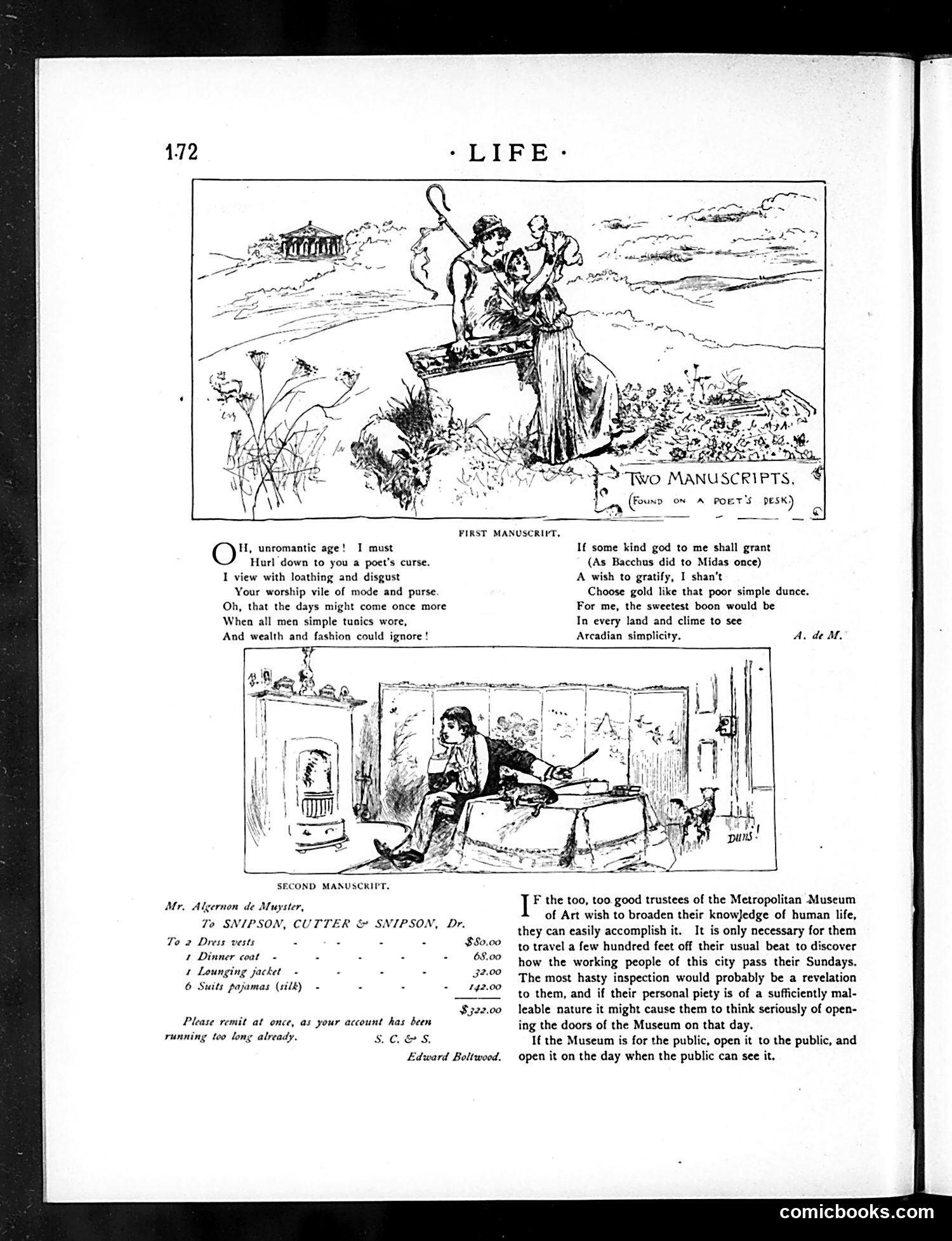
This page satirizes **romantic poetry and pretentious poets**. The two manuscript comparison exposes hypocrisy: The **First Manuscript** presents a poet railing against modern materialism and fashion, praising simple "Arcadian" living and claiming he wouldn't choose gold even if offered. The **Second Manuscript** immediately undercuts this—it's a bill from a tailor showing the same poet owes significant money ($322 total) for expensive clothing: dress vests, dinner coat, lounging jacket, and silk pajamas. The tailor demands immediate payment, noting the account "has been running too long already." The joke: the poet condemns wealth and fashion while spending lavishly on fine garments. His lofty ideals about simplicity clash hilariously with his actual consumer habits. The accompanying editorial about the Metropolitan Museum advocates opening it on Sundays so working-class New Yorkers can visit—a separate social critique about public access and class.
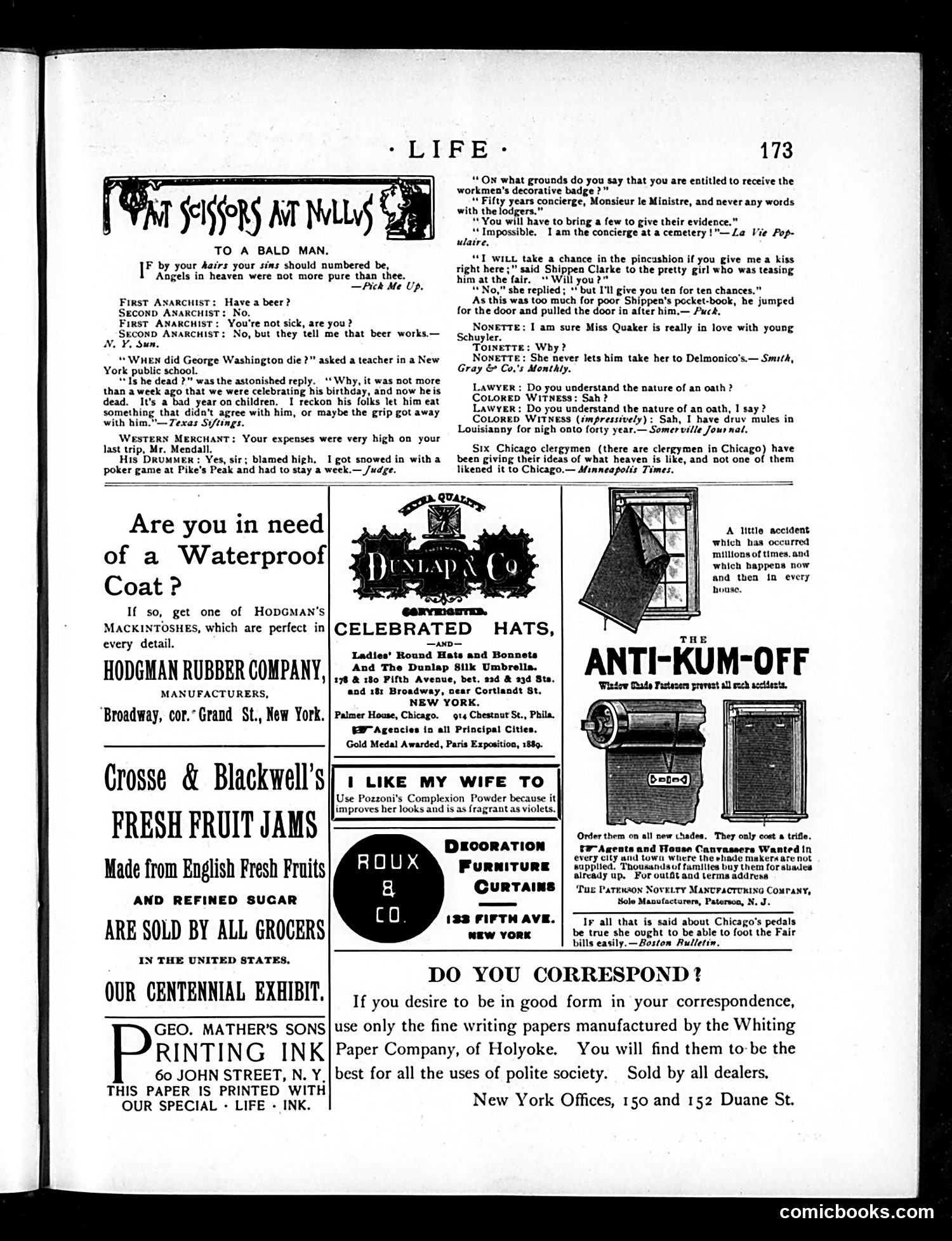
This page contains multiple brief satirical items typical of Life's format, plus period advertisements. **The cartoons/jokes:** The item "To a Bald Man" is a pun: it suggests that a bald man's lack of hair indicates moral purity (few "hairs" = few sins). The anarchist exchange jokes that beer is a cure-all, even for anarchists. The schoolchild's confusion about George Washington satirizes American education—the child thinks Washington recently died rather than understanding he's a historical figure. The Shippen Clarke joke plays on "pincushion" as flirtation, with the girl turning his offer around. The "Miss Quaker" item satirizes wealthy courting customs: that she avoids Delmonico's (an exclusive restaurant) suggests she dislikes spending money—a dig at "Quaker" frugality or the suitor's stinginess. The witness exchange mocks either dialect humor or the absurdity of asking an uneducated man about oaths. The final item sarcastically notes Chicago clergymen's visions of heaven conspicuously omit mentioning Chicago itself—a jab at the city. **The rest is advertising.**
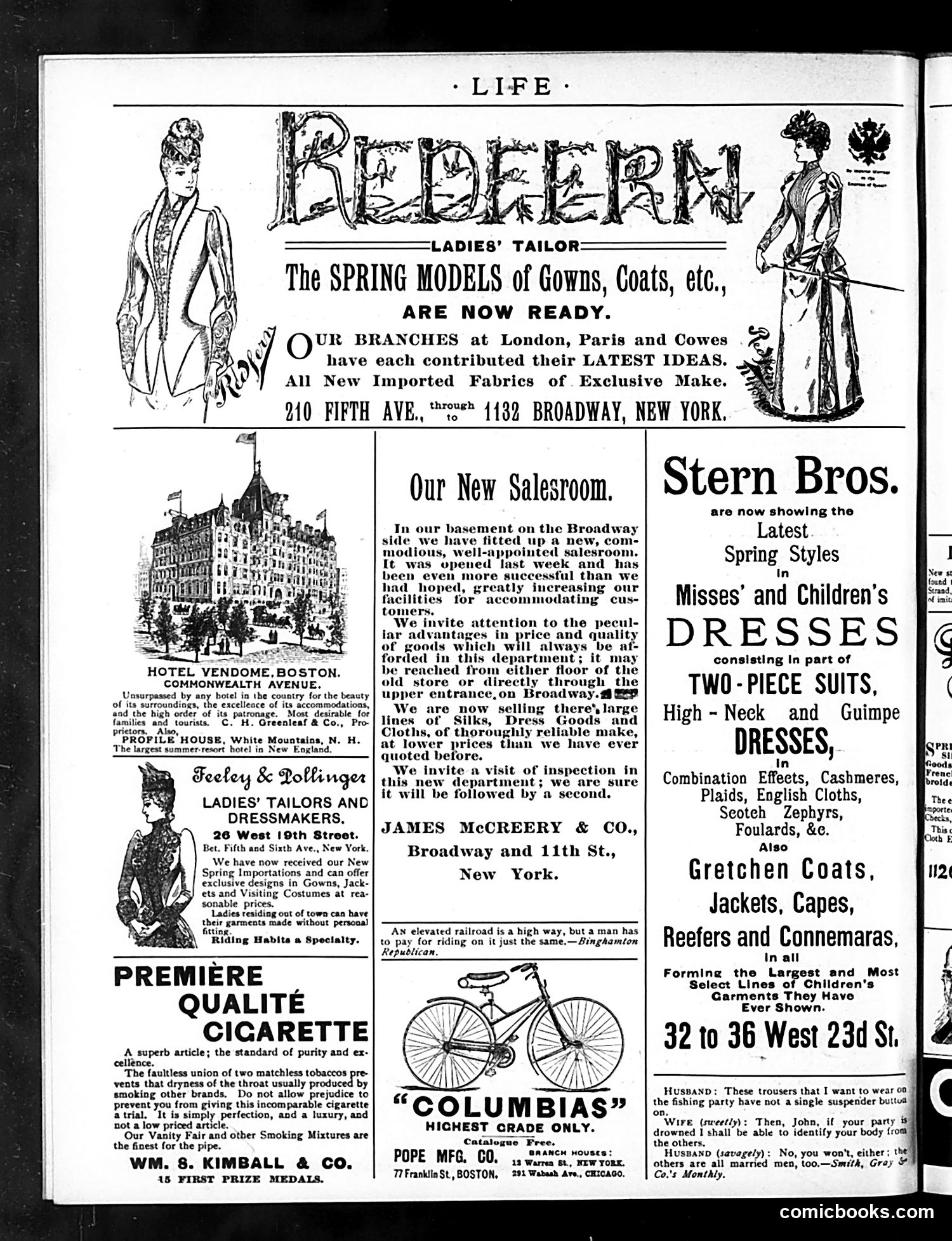
This page is **primarily advertising**, with one small cartoon joke at the bottom. The advertisements showcase spring 1890s fashions for women and children—reflecting the era's elaborate clothing with terms like "Guimpe Dresses," "Gretchen Coats," and "Riding Habits." Multiple New York department stores (Stern Bros., James McCreery & Co.) and tailors compete for wealthy customers. The **single cartoon** is a marital joke: A husband complains his fishing trousers lack suspender buttons. His wife sweetly replies that if the party drowns, she can identify his body because the *other* men will still be wearing married men's clothes (implying suspenders). The husband, outraged, notes the other men are all married too—so his wife's insult backfires. This exemplifies *Life* magazine's humor: domestic squabbles played for laughs, with gender dynamics and class assumptions (only married men wore proper suspenders) as the punchline. The joke appears in "Smith, Grey & Co.'s Monthly"—likely a reprint from another publication.
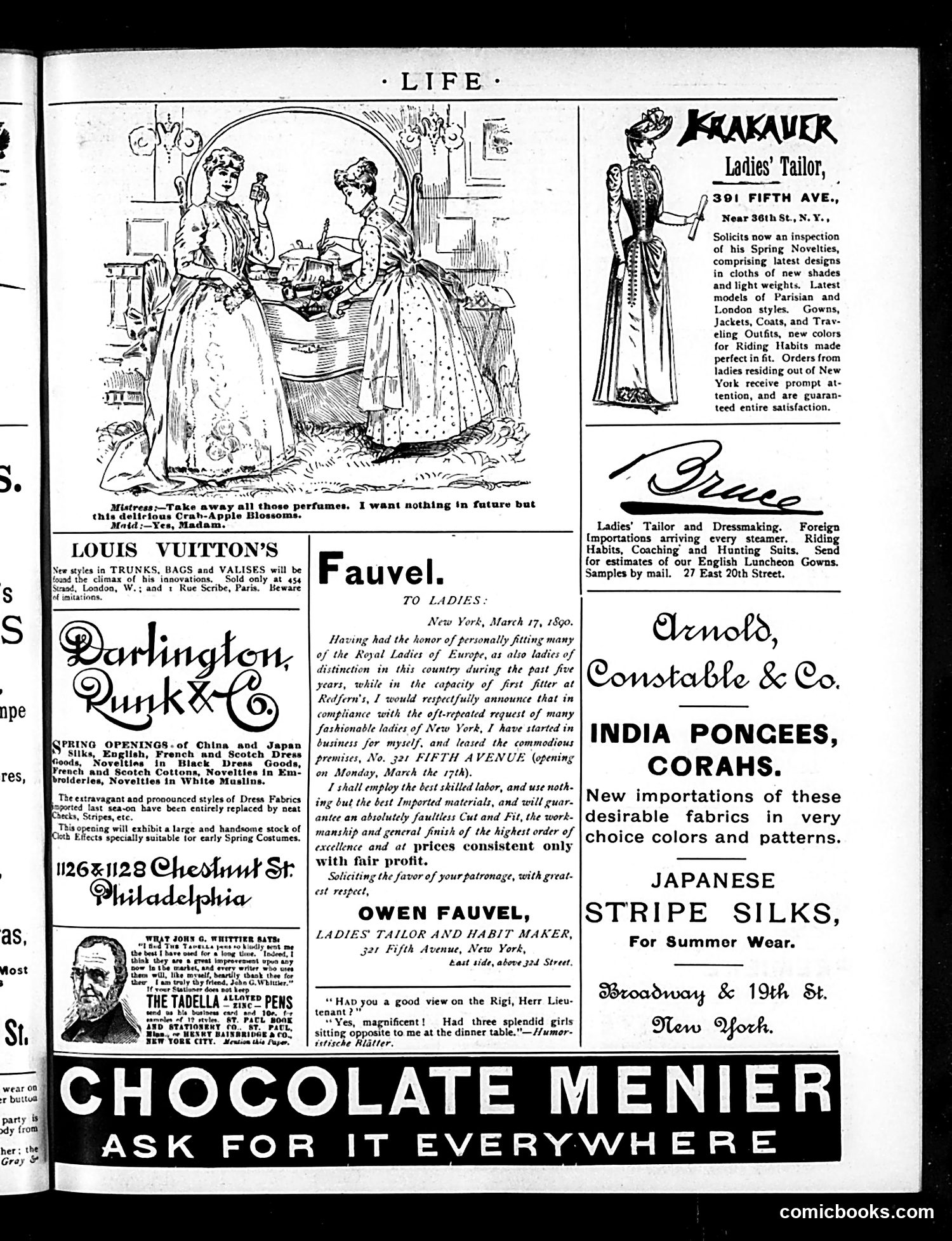
This is primarily an **advertising page** with one small cartoon at the top. ## The Cartoon The illustration shows two women in a parlor discussing perfumes. The caption reads: "Mistress—Take away all those perfumes. I want nothing in future but a delicious Eau de Cologne." This is a **product endorsement joke**—a common advertising format of the era. The humor is mild: a fashionable woman dismisses expensive imported perfumes in favor of simple eau de cologne, which was apparently a competitor's product being advertised elsewhere. ## The Advertisements The page features luxury goods targeting wealthy women: tailoring services (Fauvel, Kakauer), imported fabrics (Indian poncees, Japanese silks), trunks and bags (Louis Vuitton), and dress goods from Darlington Runk & Co. ## Historical Context This reflects 1890s upper-class fashion culture where imported European goods and custom tailoring were status symbols. The advertisements emphasize "Paris and London styles" and foreign importations—markers of wealth and sophistication for Gilded Age American society. The small humor piece is incidental to the commercial purpose.
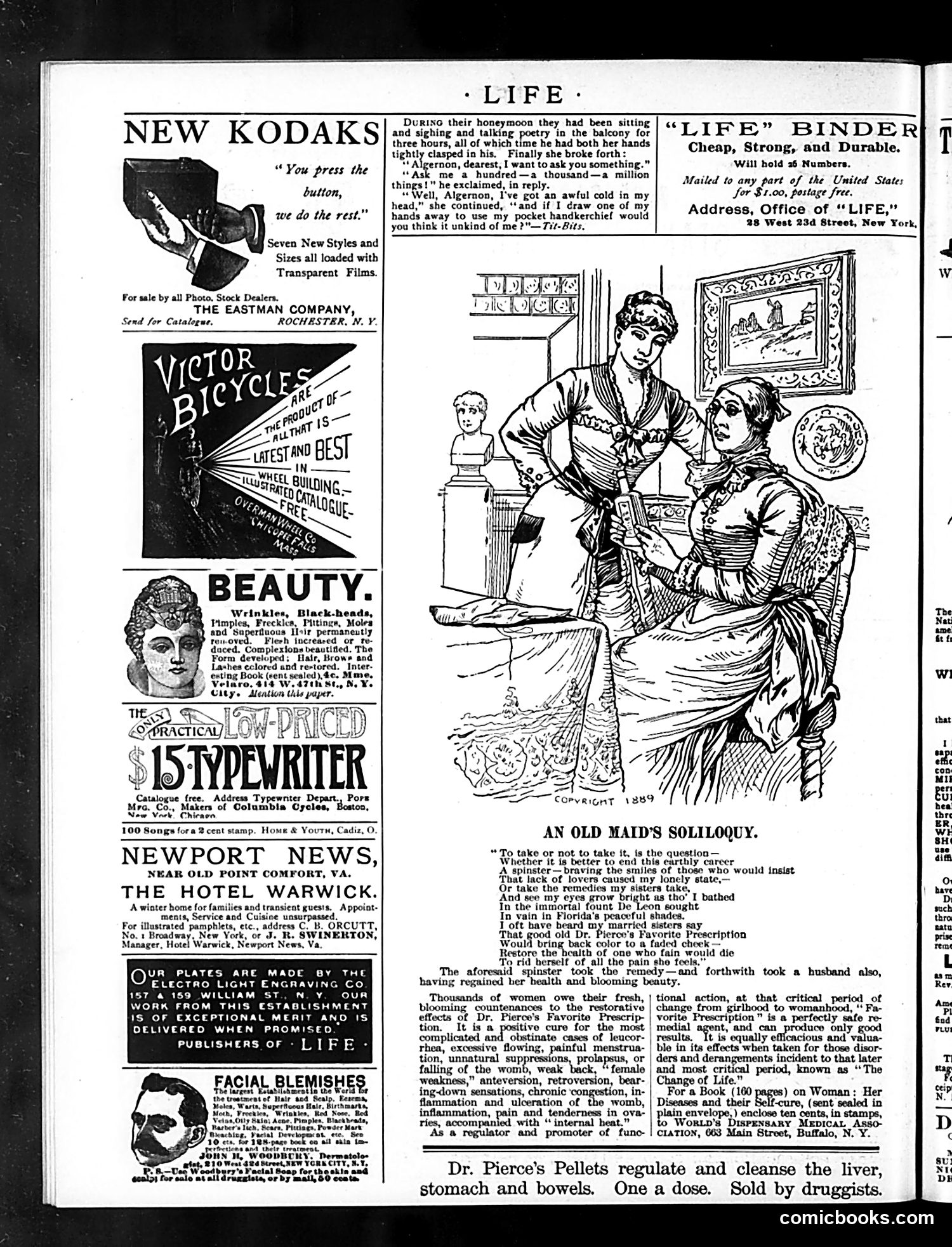
This page mixes advertisements with satirical content typical of *Life* magazine's format. The main cartoon, "An Old Maid's Soliloquy," satirizes both romantic sentimentality and patent medicine marketing. **The Cartoon's Satire:** The illustration depicts three women—likely representing different life stages—discussing remedies. The accompanying text parodies Hamlet's existential monologue ("To be or not to be"), but redirects it toward a spinster's desperation. She considers whether to remain unmarried or use Dr. Pierce's "Favorite Prescription" to restore her health and attractiveness to catch a husband. **The Point:** The satire mocks the desperation society imposed on unmarried women and the aggressive marketing of dubious patent medicines as solutions to female "ailments." Dr. Pierce's Prescription was a real product heavily advertised in this era, often containing questionable ingredients. The surrounding advertisements (typewriters, bicycles, beauty treatments) reinforce the era's consumer culture exploiting insecurity, particularly targeting women's appearance and marriageability anxieties.
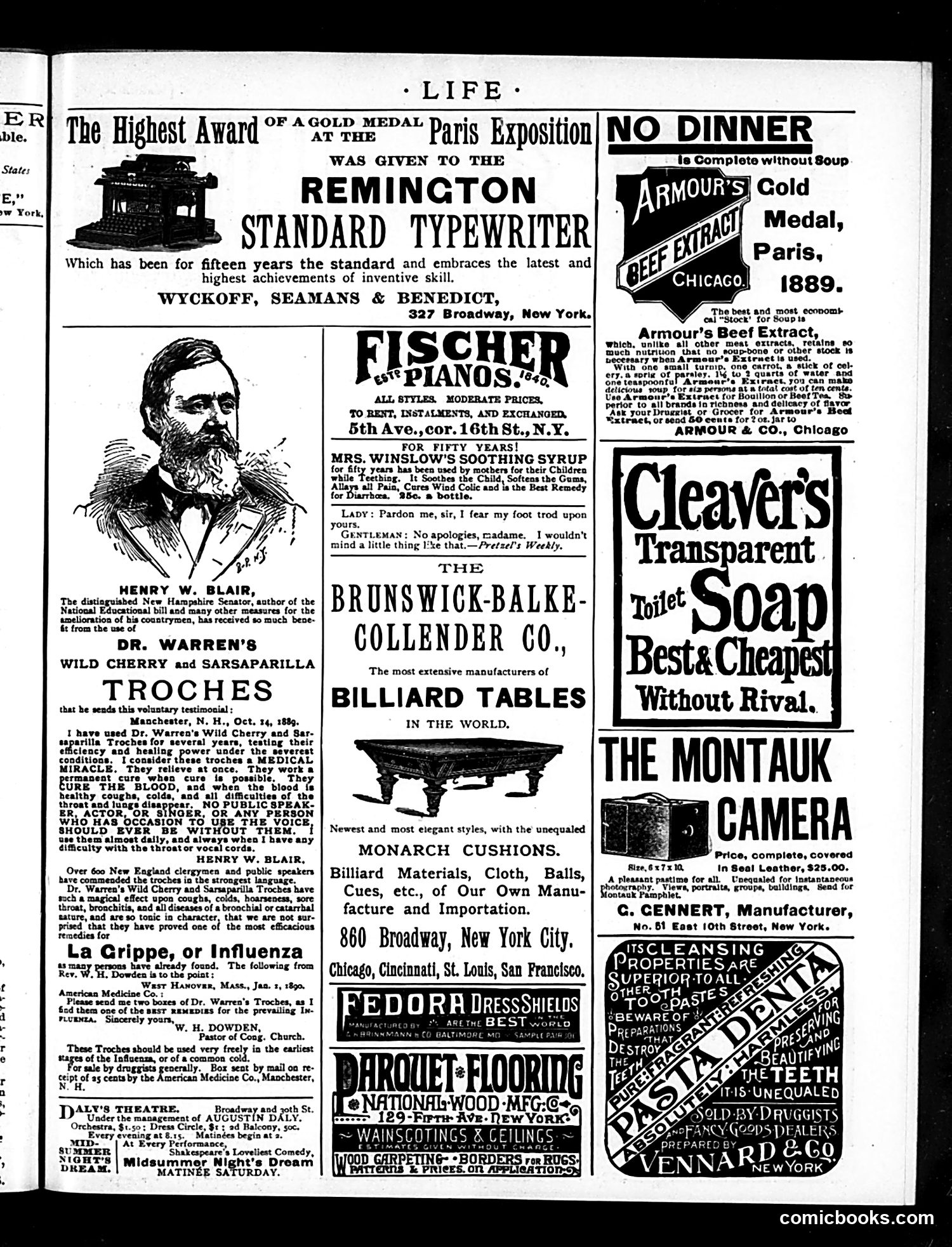
This is primarily an **advertising page** from Life magazine (circa 1889-1890), with minimal editorial content. The only cartoon element is a small joke at the bottom: A lady apologizes to a gentleman for stepping on his foot. He responds gallantly that he wouldn't mind "a little thing like that"—the humor playing on Victorian politeness and the gentleman's willingness to endure minor discomfort to avoid embarrassing a lady. The page is dominated by product advertisements: Remington typewriters, Dr. Warren's medicinal troches (lozenges), Fischer pianos, Mrs. Winslow's Soothing Syrup, billiard tables, and Armour's Beef Extract. Several ads include endorsements from notable figures like New Hampshire Senator Henry W. Blair, lending credibility to patent medicines. The ads reflect late-19th-century consumer culture and the prevalence of largely unregulated medicinal products marketed with quasi-scientific claims.
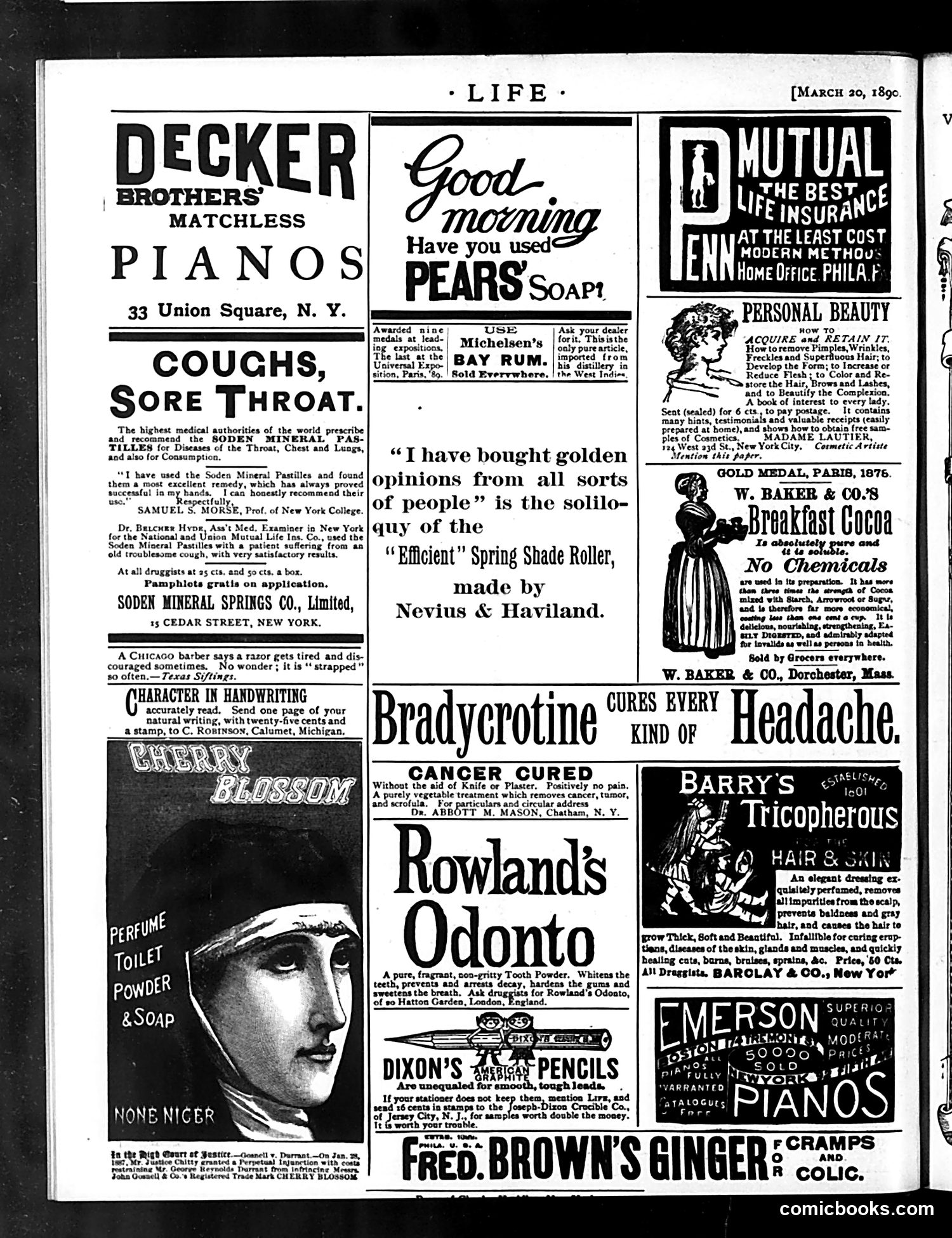
This is primarily an **advertising page** with no political cartoons or satire. The content consists entirely of patent medicine and consumer product advertisements typical of the 1890s. Notable are the **medical claims** that modern readers would find shocking: Soden Mineral Pastilles for consumption (tuberculosis), "Cancer Cured" without knife or plaster, Bradycrotine for headaches, and Barry's Tricopherous for hair growth. These represent the era before FDA regulation, when such products made unsubstantiated health claims. The page reflects **late Victorian consumer culture**, advertising pianos, cocoa, tooth powder, perfume, and beauty products alongside dubious remedies. The "Personal Beauty" book advertisement promising to remove "superfluous hair" and develop form reveals period beauty standards. One small item references a **court case involving George Hernolds Durrant** (likely related to a contemporaneous legal matter), but lacks satirical context here. This is a straightforward historical document of 1890s advertising practices, not editorial commentary.