
Life, 1890-03-20 · page 4 of 18
Life — March 20, 1890 — page 4: what you’re looking at
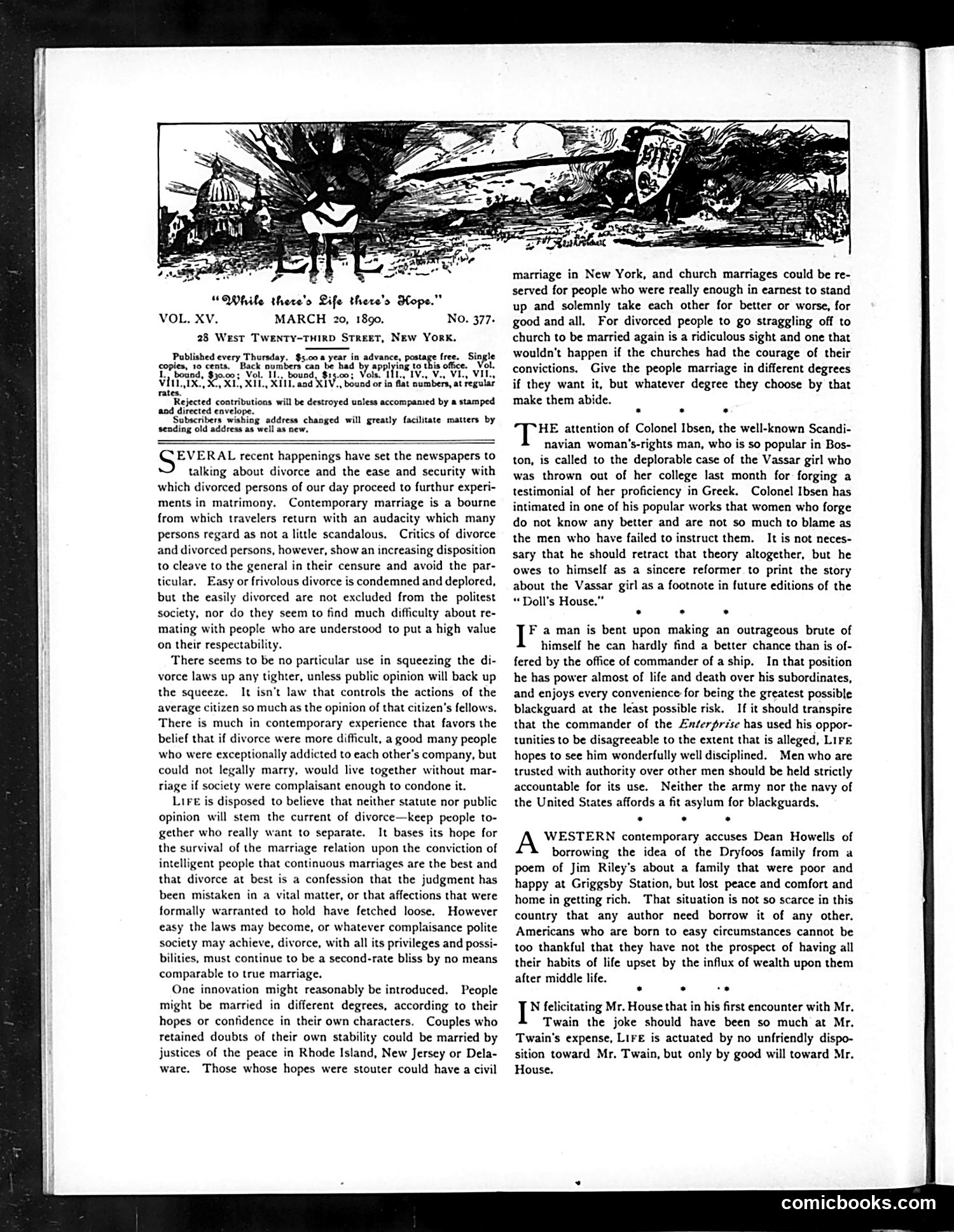
What you’re looking at
This page contains editorial commentary rather than a political cartoon. The masthead quote—"While there's Life there's Hope"—introduces discussions of contemporary social issues. The main content critiques **divorce law and remarriage practices**. The editors argue that contemporary society treats divorce too casually, allowing easily-divorced persons to remarry without sufficient social stigma. They propose a solution: **tiered marriage licenses based on character assessment**, with stricter requirements for those with "doubtful stability." The page also references a controversy involving **Colonel Ibsen** and a "Vassar girl" case (likely referring to Henrik Ibsen's influence on contemporary scandals), and discusses wealth's corrupting influence on character through literary references. The satirical point: American society's increasing permissiveness toward divorce reflects declining moral standards.
📄 Transcribed text from this page (OCR, searchable)
Machine-transcribed from the original scan — historical spelling and the odd misread are preserved.
“While there's Life there's Hope.” VOL. XV. MARCH 20, 1890, No. 377- 28 West Twenty-THIRD Street, New York. Published every Thursday. $3.00 year in advance, postage free, Single goPies, 19 cents. "Back ourters can be had by applying te thi oftce. Vol 1. bound, $: ; Vol. 1I., bound, $15.00; Vols. IIL, IV., V., VI. L, VIUTAX., Xe, ly XIL, XI Teand XIV, bound or in flat numbers, at regula? rates. Rejected contributions will be destroyed unless accompanied by a stamped and directed envelope. Subscribers wishing address changed will greatly facilitate matters by sending old address as well as new, EVERAL recent happenings have set the newspapers to talking about divorce and the ease and security with which divorced persons of our day proceed to furthur experi- ments in matrimony. Contemporary marriage is a bourne from which travelers return with an audacity which many persons regard as not a little scandalous. Critics of divorce and divorced persons, however, show an increasing disposition to cleave to the general in their censure and avoid the par- ticular. Easy or frivolous divorce is condemned and deplored, but the easily divorced are not excluded from the politest society, nor do they seem to find much difficulty about re- mating with people who are understood to put a high value on their respectability. There seems to be no particular use in squeezing the di- vorce laws up any tighter, unless public opinion will back up the squeeze. It isn’t law that controls the actions of the average citizen so much as the opinion of that citizen's fellows. There is much in contemporary experience that favors the belief that if divorce were more difficult, a good many people who were exceptionally addicted to each other's company, but could not legally marry, would live together without mar- riage if society were complaisant enough to condone it. Lire is disposed to believe that neither statute nor public opinion will stem the current of divorce—keep people to- gether who really want to separate. It bases its hope for the survival of the marriage relation upon the conviction of intelligent people that continuous marriages are the best and that divorce at best is a confession that the judgment has been mistaken in a vital matter, or that affections that were formally warranted to hold have fetched loose. However easy the laws may become, or whatever complaisance polite society may achieve, divorce, with all its privileges and possi- bilities, must continue to be a second-rate bliss by no means comparable to true marriage. One innovation might reasonably be introduced. People might be married in different degrees, according to their hopes or confidence in their own characters. Couples who retained doubts of their own stability could be married by justices of the peace in Rhode Island, New Jersey or Dela- ware. Those whose hopes were stouter could have a civil marriage in New York, and church marriages could be re- served for people who were really enough in earnest to stand up and solemnly take each other for better or worse, for good and all. For divorced people to go straggling off to church to be married again is a ridiculous sight and one that wouldn't happen if the churches had the courage of their convictions. Give the people marriage in different degrees if they want it, but whatever degree they choose by that make them abide. . . HE attention of Colonel Ibsen, the well-known Scandi- navian woman's-rights man, who is so popular in Bos- ton, is called to the deplorable case of the Vassar girl who was thrown out of her college last month for forging a testimonial of her proficiency in Greek. Colonel Ibsen has intimated in one of his popular works that women who forge do not know any better and are not so much to blame as the men who have failed to instruct them. It is not neces- sary that he should retract that theory altogether, but he owes to himself as a sincere reformer to print the story about the Vassar girl as a footnote in future editions of the “Doll's House.” . . . IF a man is bent upon making an outrageous brute of himself he can hardly find a better chance than is of- fered by the office of commander of a ship. In that position he has power almost of life and death over his subordinates, and enjoys every convenience for being the greatest possible blackguard at the least possible risk. If it should transpire that the commander of the Enterprise has used his oppor- tunities to be disagreeable to the extent that is alleged, Lire hopes to see him wonderfully well disciplined. Men who are trusted with authority over other men should be held strictly accountable for its use. Neither the army nor the navy of the United States affords a fit asylum for blackguards, . . . WESTERN contemporary accuses Dean Howells of borrowing the idea of the Dryfoos family from a poem of Jim Riley's about a family that were poor and happy at Griggsby Station, but lost peace and comfort and home in getting rich. That situation is not so scarce in this country that any author need borrow it of any other. Americans who are born to easy circumstances cannot be too thankful that they have not the prospect of having all their habits of life upset by the influx of wealth upon them after middle life. . 1. N felicitating Mr. House that in his first encounter with Mr. Twain the joke should have been so much at Mr. Twain's expense, Lire is actuated by no unfriendly dispo- sition toward Mr. Twain, but only by good will toward Mr. House. comicbooks.com