
Life, 1890-03-20 · page 6 of 18
Life — March 20, 1890 — page 6: what you’re looking at
What you’re looking at
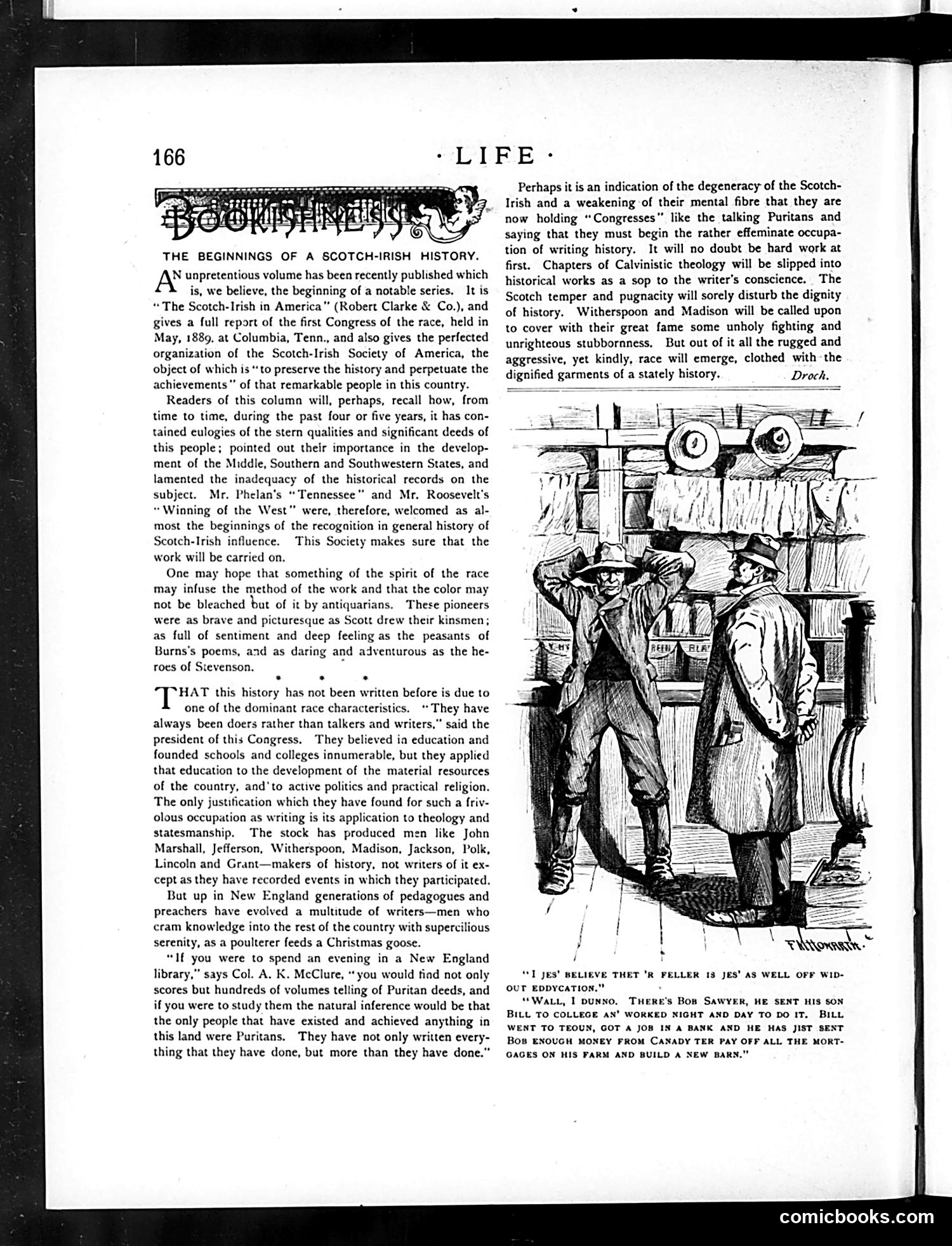
The page features an article titled "The Beginnings of a Scotch-Irish History" discussing a new publication by the Scotch-Irish Society of America, established at an 1889 Columbia, Tennessee congress. The accompanying illustration depicts a humorous scene of Scottish-Irish immigrants or their descendants, with one figure pointing upward (likely indicating aspiration or education) while others appear to be in modest circumstances, possibly workers or laborers. The caption below the cartoon contains dialect humor: "I jes' believe that 'B Feller is jes' as well off wid-out edducation" followed by a story about Bob Sawyer, a farmer's son who worked his way through school and later became successful, acquiring property through hard work and education. The satire critiques anti-education attitudes while celebrating Scotch-Irish industriousness and upward mobility through education.
📄 Transcribed text from this page (OCR, searchable)
Machine-transcribed from the original scan — historical spelling and the odd misread are preserved.
“DITLEE - THE BEGINNINGS OF A SCOTCH-IRISH HISTORY. A unpretentious volume has been recently published which is, we believe, the beginning of a notable series. It is “The Scotch-Irish in America” (Robert Clarke & Co.), and gives a full report of the first Congress of the race, held in May, 1889, at Columbia, Tenn., and also gives the perfected organization of the Scotch-Irish Society of America, the object of which is “to preserve the history and perpetuate the achievements” of that remarkable people in this country. Readers of this column will, perhaps, recall how, from time to time, during the past four or five years, it has con- tained culogies of the stern qualities and significant deeds of this people; pointed out their importance in the develop- ment of the Middle, Southern and Southwestern States, and lamented the inadequacy of the historical records on the subject. Mr. Phelan’ Tennessee" and Mr. Roosevelt's “Winning of the West” were, therefore, welcomed as al- most the beginnings of the recognition in general history of Scotch-Irish influence. This Society makes sure that the work will be carried on. One may hope that something of the spirit of the race may infuse the method of the work and that the color may not be bleached but of it by antiquarians. These pioneers were as brave and picturesque as Scott drew their kinsmen; as full of sentiment and deep feeling as the peasants of Burns's poems, and as daring and adventurous as the he- roes of Stevenson. . HAT this history has not been written before is due to one of the dominant race characteristics. ‘They have always been doers rather than talkers and writers,” said the president of this Congress. They believed ia education and founded schools and colleges innumerable, but they applied that education to the development of the material resources of the country, and'‘to active politics and practical religion. The only justification which they have found for such a friv- olous occupation as writing is its application to theology and statesmanship. The stock has produced men like John Marshall, Jefferson, Witherspoon, Madison, Jackson, Polk, Lincoln and Grant—makers of history, not writers of it ex- cept as they have recorded events in which they participated. But up in New England generations of pedagogues and preachers have evolved a multitude of writers—men who cram knowledge into the rest of the country with supercilious serenity, as a poulterer feeds a Christmas goose. “If you were to spend an evening in a New England library,” says Col. A. K. McClure, “you would tind not only scores but hundreds of volumes telling of Puritan deeds, and if you were to study them the natural inference would be that the only people that have existed and achieved anything in this land were Puritans. They have not only written every- thing that they have done, but more than they have done.” Perhaps it is an indication of the degeneracy of the Scotch- Irish and a weakening of their mental fibre that they are now holding “Congresses” like the talking Puritans and saying that they must begin the rather effeminate occupa- tion of writing history. It will no doubt be hard work at first. Chapters of Calvinistic theology will be slipped into historical works as a sop to the writer's conscience. The Scotch temper and pugnacity will sorely disturb the dignity of history. Witherspoon and Madison will be called upon to cover with their great fame some unholy fighting and unrighteous stubbornness. But out of it all the rugged and aggressive, yet kindly, race will emerge, clothed with the dignified garments of a stately history. Droch. Thtorente” “1 jes’ BELIEVE THET 'R FELLER 13 JES’ AS WELL OFF WID- OUT EDpycaTion, : “Watt, I puNNo, THERE'S Bos SAWYER, HE SENT HIS SON BILL TO COLLEGE AN’ WORKED NIGHT AND DAY TO DO IT, BILL WENT TO TEOUN, GOT A JOB IN A BANK AND HE HAS JIST SENT BoB ENOUGH MONEY FROM CANADY TER PAY OFF ALL THE MORT- GAGES ON HIS FARM AND BUILD A NEW BARN.” comicbooks.com