
A complete issue · 18 pages · 1890
Life — February 20, 1890
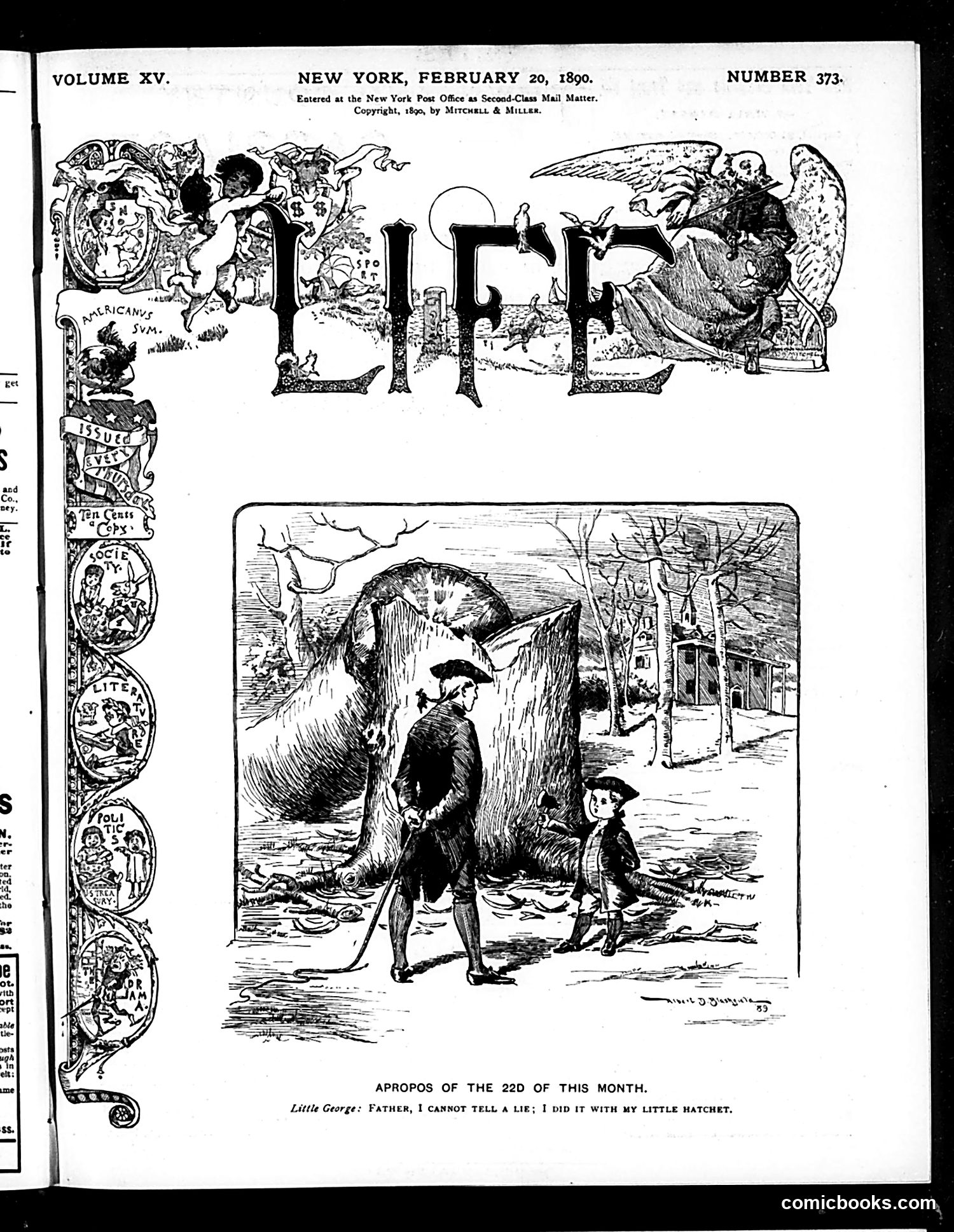
**Main Cartoon: "Apropos of the 22d of This Month"** The illustration depicts two figures examining a large hollow tree trunk. The caption reads: "Little George: 'Father, I cannot tell a lie; I did it with my little hatchet.'" This references the famous apocryphal story of young George Washington and the cherry tree—a myth about childhood honesty that was widely taught in American schools. The cartoon appears to satirize this legend on or near Washington's birthday (February 22). The ornate decorative border on the left contains various emblems and symbols typical of Life magazine's design aesthetic. Without additional context visible on this page, the specific satirical point—whether mocking the myth itself, American patriotism, or contemporary politics—remains unclear from the image alone.
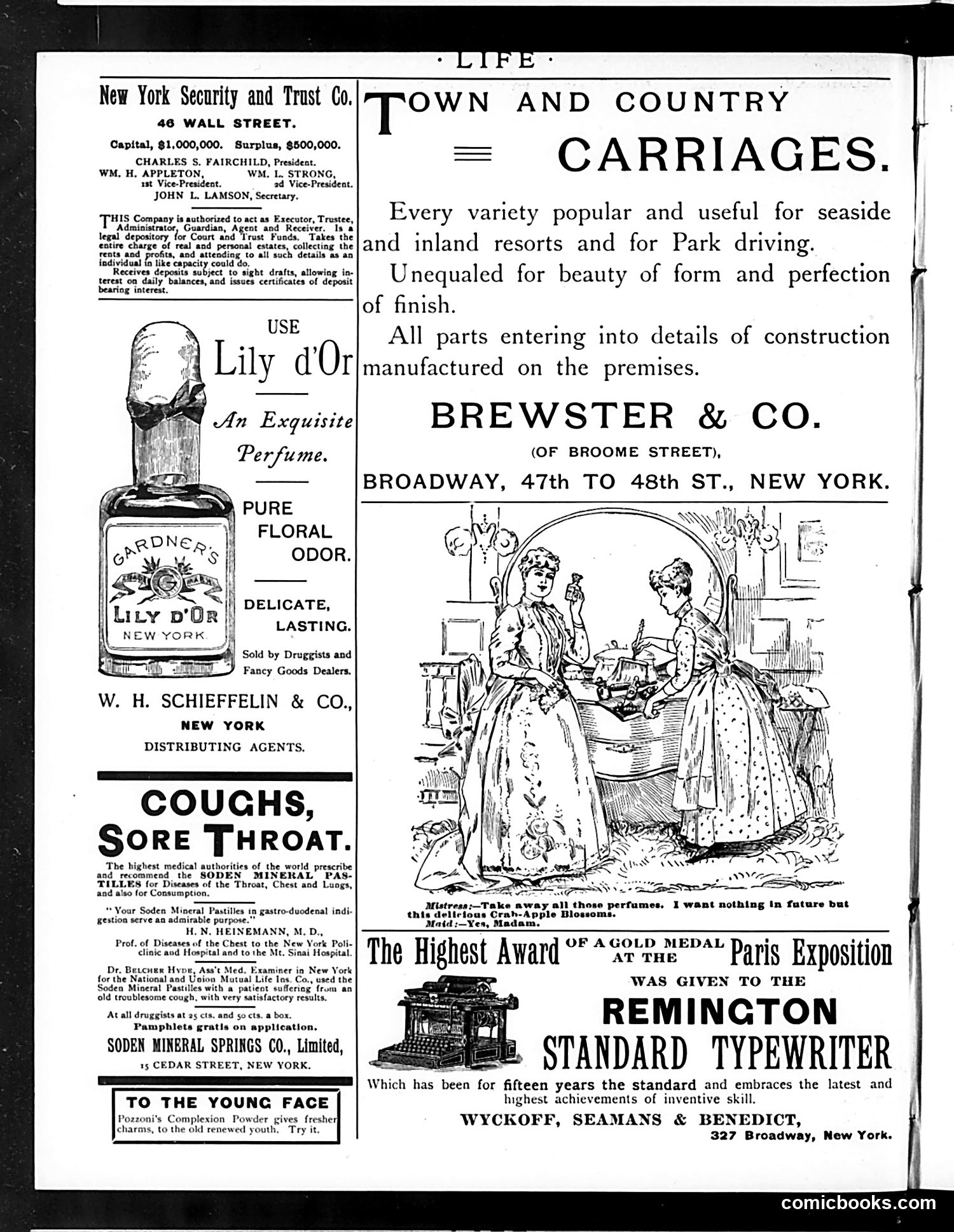
This page is primarily **advertisements** rather than political satire or editorial cartooning. The main content includes ads for: - Brewster & Co. carriages (with a Victorian-era illustration of two women in a carriage) - Lily d'Or perfume - Soden Mineral Springs for throat ailments - Remington Standard Typewriter (claiming a Paris Exposition gold medal) - New York Security and Trust Co. The single illustration—two fashionable women in a horse-drawn carriage—is **commercial artwork** promoting luxury vehicles, not satire. The women's dialogue appears to joke about perfume preferences rather than make social commentary. This appears to be a typical Life magazine page from the late 19th or early 20th century, when such publications mixed editorial content with substantial advertising revenue.
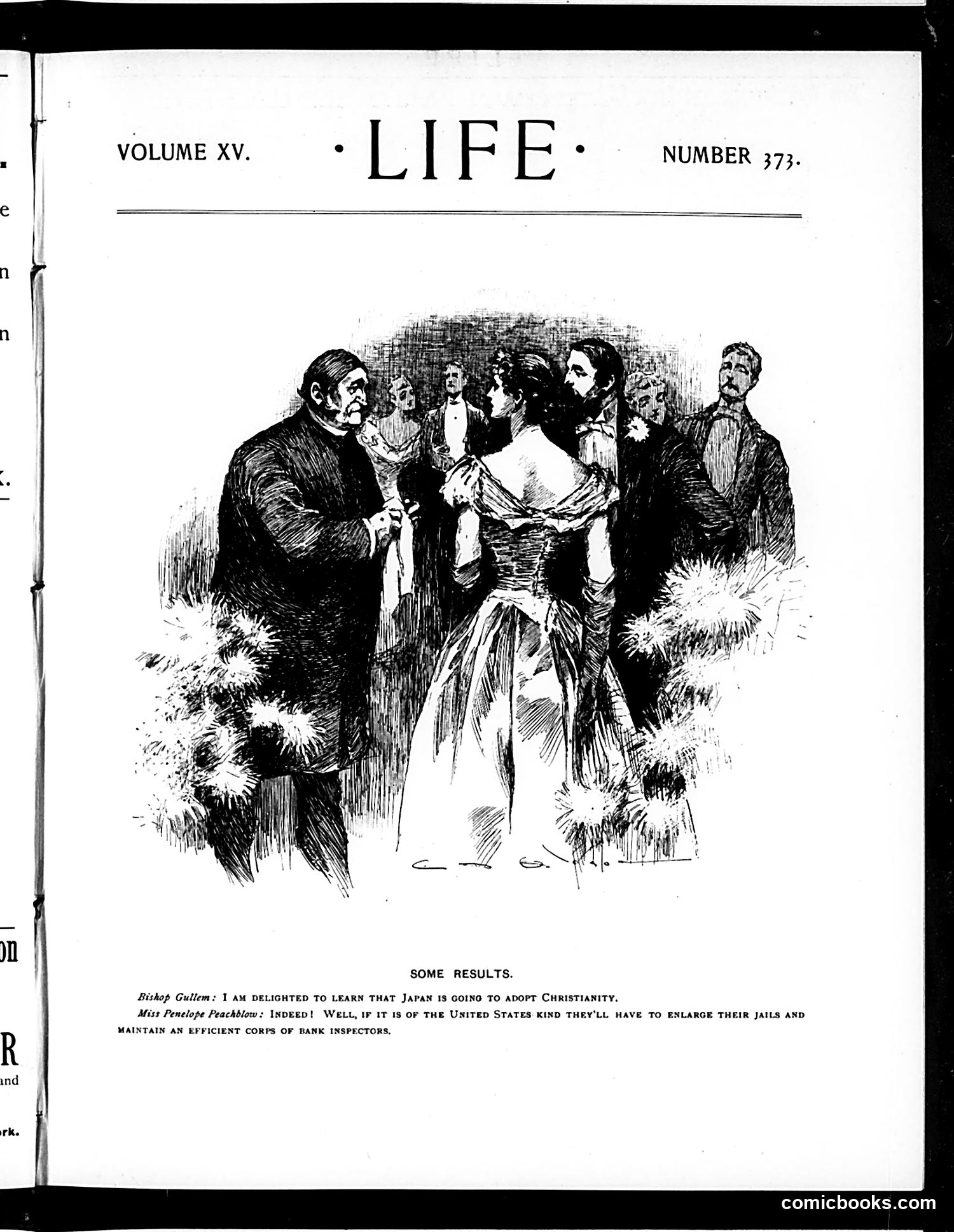
This satirical cartoon depicts a social gathering where Bishop Cullen expresses delight that Japan is adopting Christianity. Miss Penelope Patchbottom responds with sharp irony: if Japan adopts American Christianity, they'll need to "enlarge their jails and maintain an efficient corps of bank inspectors." The joke critiques American Christianity and capitalism circa the early 1900s. Patchbottom's barb suggests that American Christian society is actually characterized by widespread crime and financial fraud requiring large prisons and banking oversight. The cartoon mocks the hypocrisy of promoting American Christian values while acknowledging that American Christianity correlates with corruption, crime, and the need for law enforcement. It's satirical commentary on American moral authority and exceptionalism.
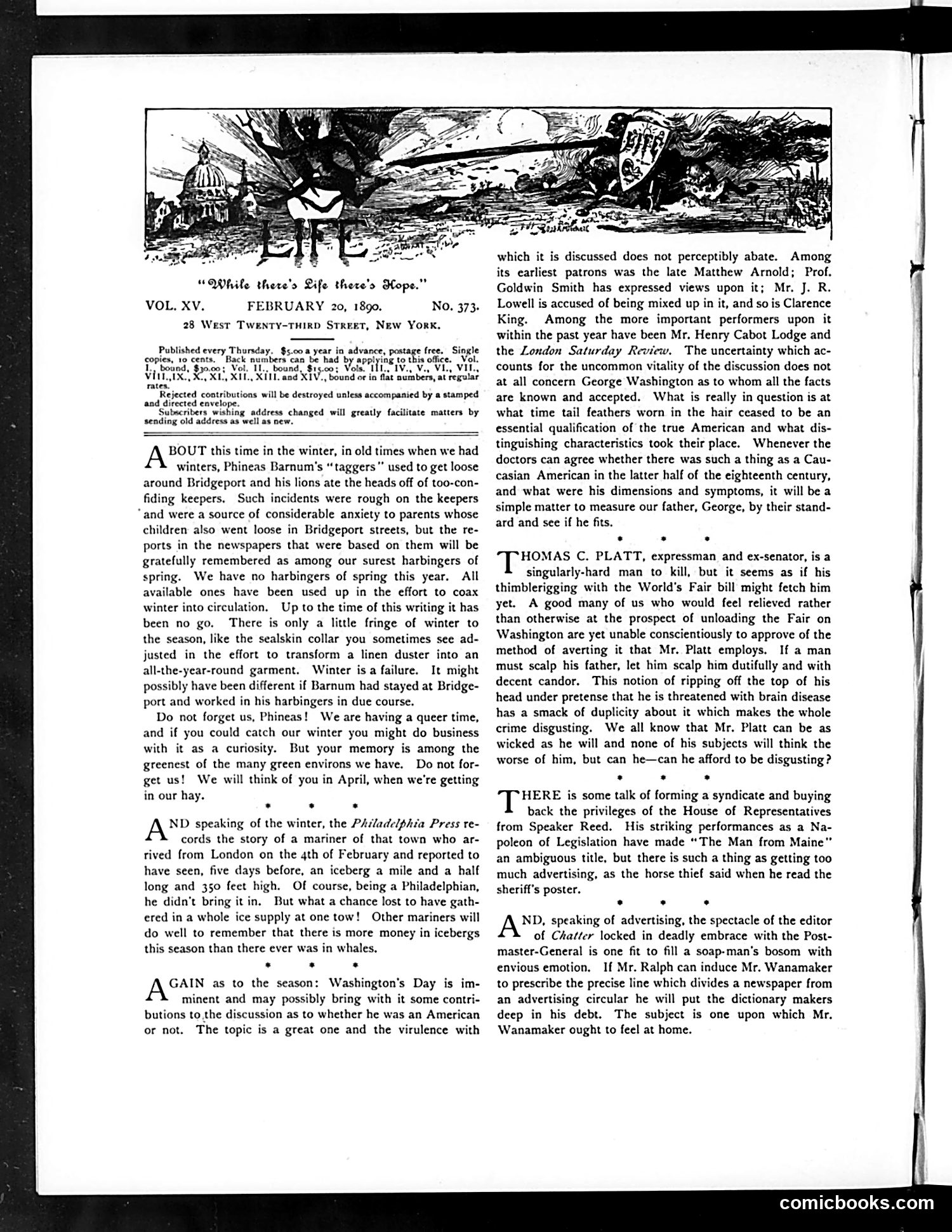
The header cartoon "Where there's Life there's Hope" depicts a skeletal Death figure alongside a living person, likely commenting on winter mortality or seasonal hardship. The accompanying text discusses Bridgeport's winter "raggedy" children and harsh conditions. The page's main content addresses Washington's birthday and whether George Washington was truly "American"—debating what defined an "American" in the late 18th century, particularly regarding ancestry and characteristics. Additional satirical sections target: - **Thomas C. Platt**, a congressman and ex-senator, regarding World's Fair appropriations - **Speaker Reed** and legislative corruption - **The editor of Chatter** magazine and disputes with the Postmaster-General over advertising standards The satire reflects 1890s political scandals and social anxieties about immigration, leadership integrity, and governmental propriety.
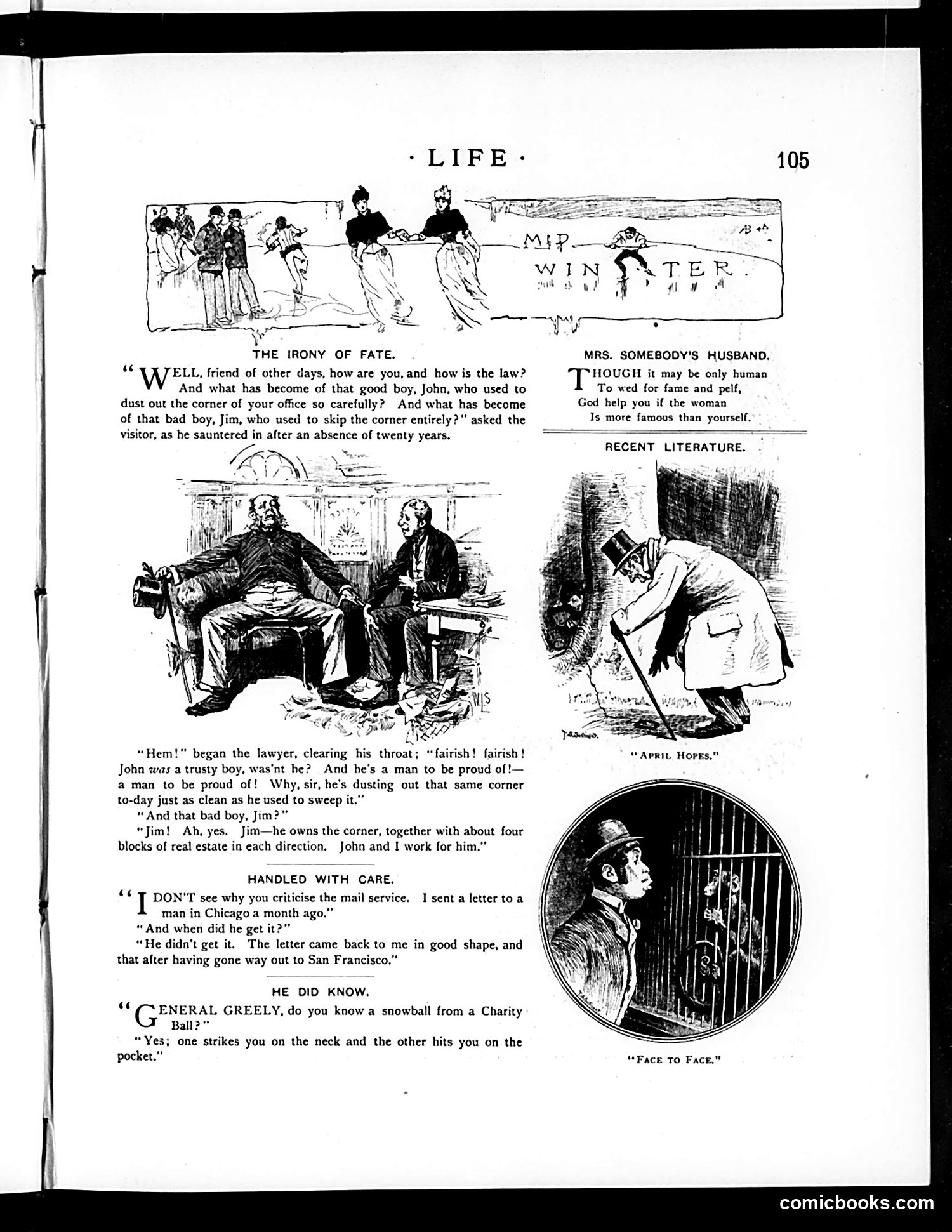
This page contains several unrelated humorous anecdotes and illustrations typical of Life's satirical format: **"The Irony of Fate"** presents a lawyer's story about a successful boy (John) who now owns real estate, contrasted with a "bad boy" (Jim) who merely dusts office corners—yet Jim has become the more prosperous man owning multiple city blocks. The joke satirizes unpredictable life outcomes and social mobility. **"Mrs. Somebody's Husband"** is a brief, cynical quip about spousal fame dynamics. **"Recent Literature"** section includes three unrelated cartoon vignettes with captions like "April Hopes," "Face to Face," and "He Did Know"—featuring a snowball fight reference and general domestic humor. The page reflects early 20th-century American humor emphasizing irony, class commentary, and domestic situations rather than specific political events.
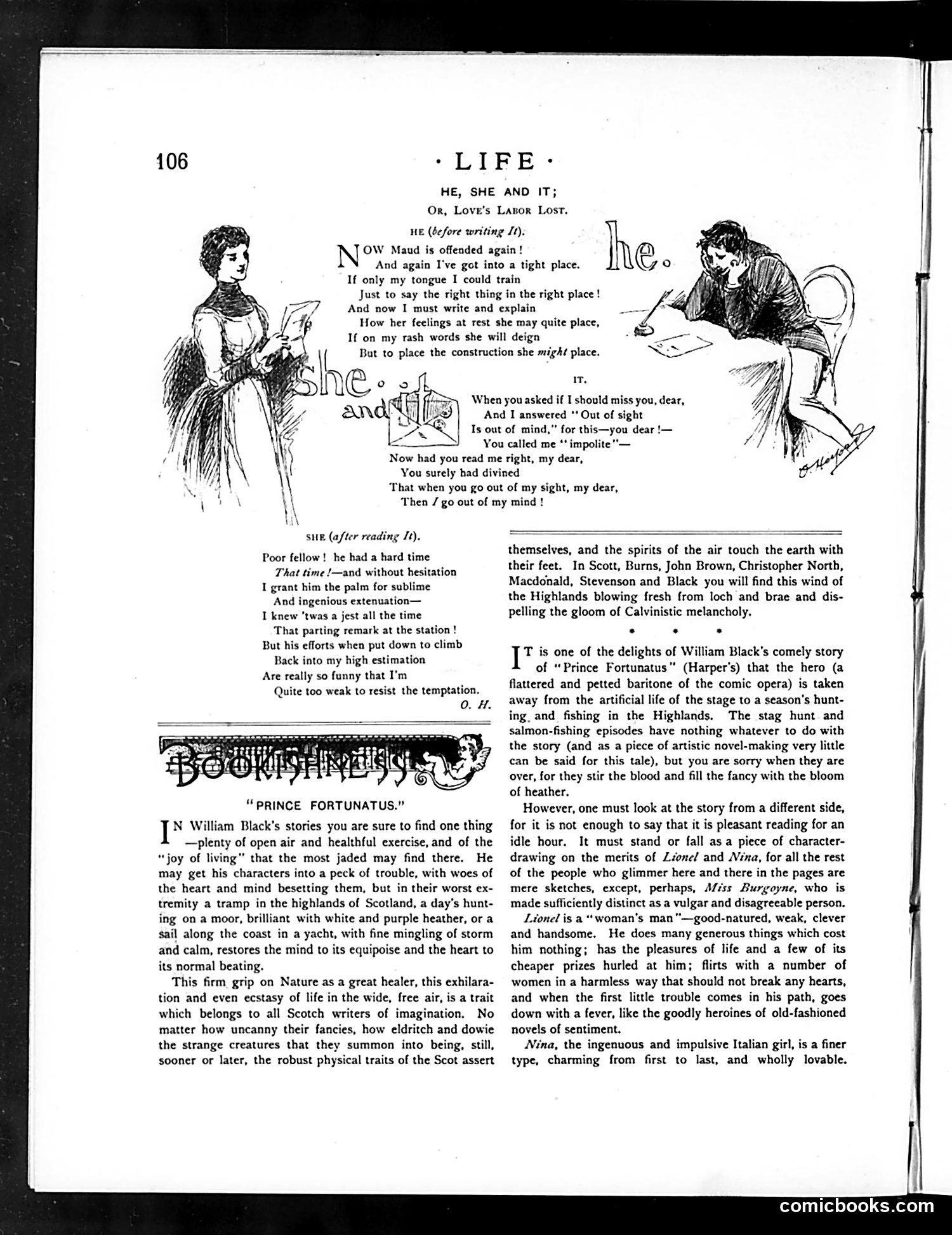
This page from *Life* magazine contains a humorous poem titled "HE, SHE AND IT; Or, LOVE'S LABOR LOST." The illustrations show two figures—a woman reading a letter on the left, and a man writing at a desk on the right—enacting a romantic miscommunication. The poem presents their competing perspectives: he struggles to express his feelings properly, while she interprets his absence literally ("out of sight, out of mind"). The satire targets the awkwardness of romantic correspondence and the gap between intention and reception in love letters. The man's self-conscious worry about saying the "right thing" and the woman's dismissive reading of his explanation create comedy from relatable domestic/romantic tension rather than political commentary. The remaining text discusses William Black's stories and literary characters, unrelated to the cartoon.
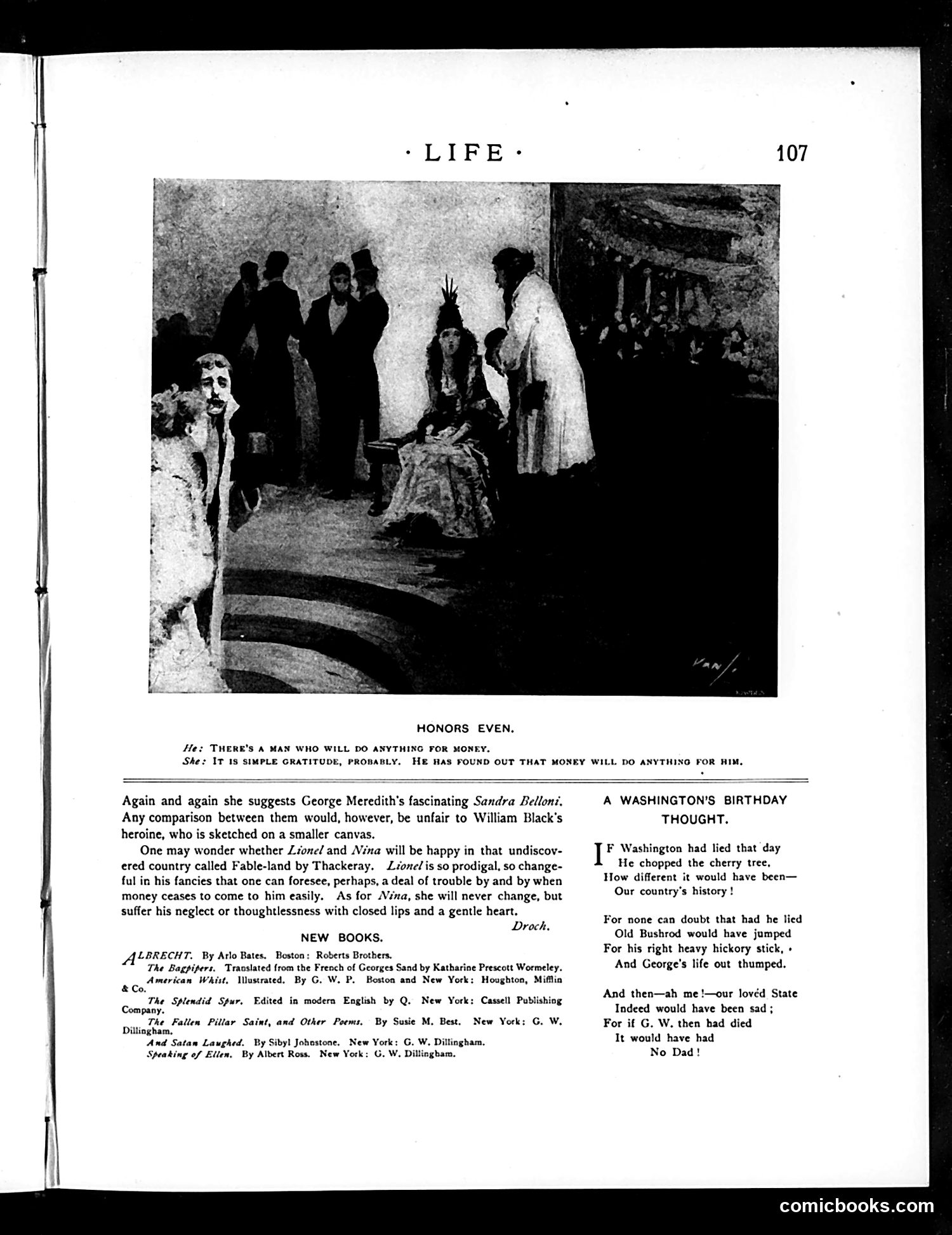
The main illustration, titled "HONORS EVEN," depicts a social scene where a man and woman exchange bitter observations about money and relationships. The dialogue suggests mutual disillusionment: he notes there exists "a man who will do anything for money," while she counters that money itself "will do anything" for him—implying both parties recognize money's corrupting influence on human behavior and romance. This appears to be satirizing early 20th-century attitudes toward marriage, wealth, and social climbing. The formal dress and interior setting suggest upper-class society, where financial considerations often motivated romantic unions. The cartoon's point is that money, rather than love or genuine feeling, drives human relationships—a common theme in period satire critiquing capitalist materialism.
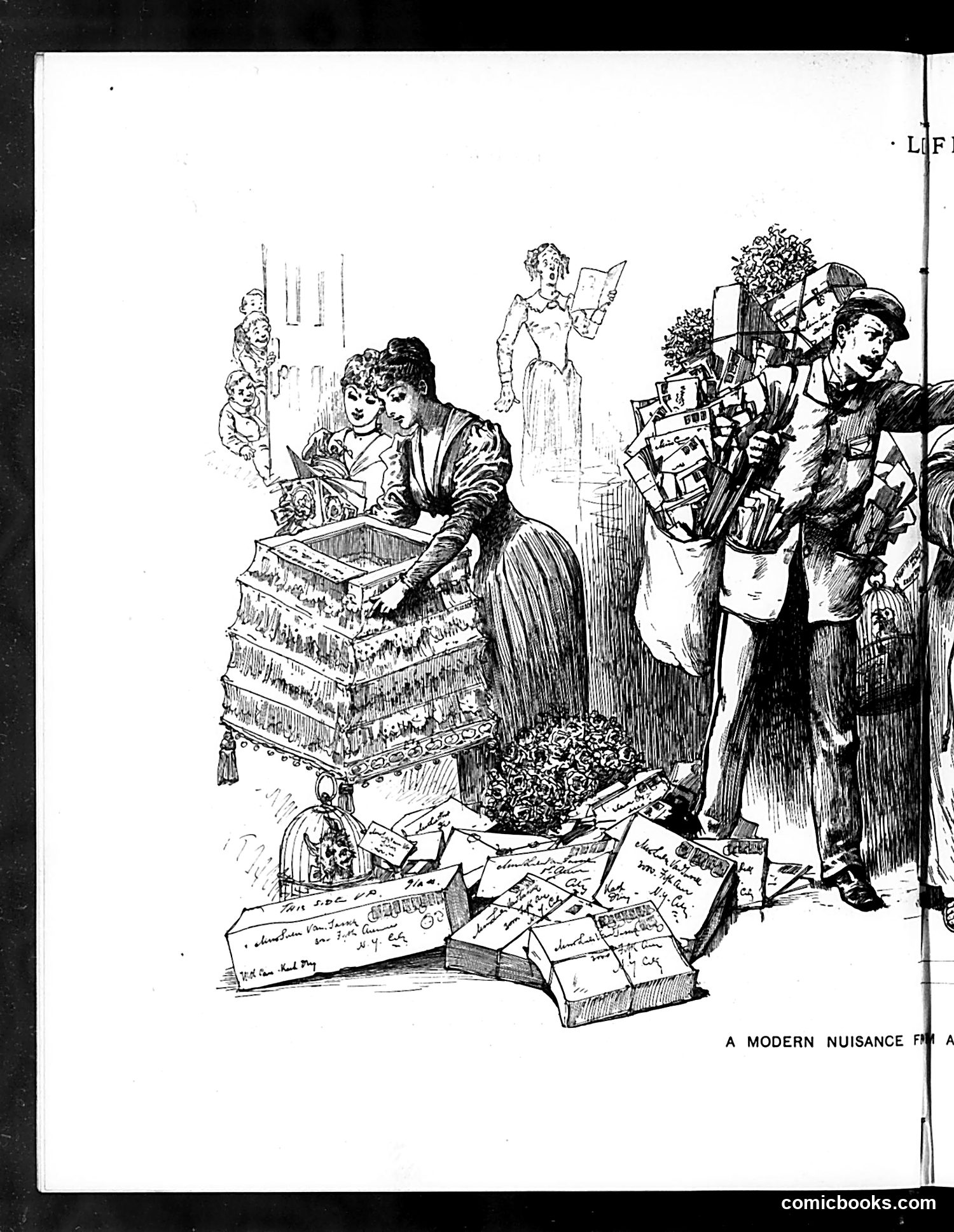
This satirical cartoon depicts the problem of **unsolicited mail and advertising**, a growing annoyance in the late 19th or early 20th century. A well-dressed woman and man stand overwhelmed by piles of addressed envelopes and packages scattered on the ground. Additional figures in the background appear frustrated by similar clutter. The satire targets the explosion of direct mail—promotional materials, circulars, and solicitations flooding households. The neatly dressed couple's dismay and the sheer volume of discarded mail emphasize how this modern commercial practice had become intrusive and burdensome to daily life. This reflects Life magazine's tradition of mocking contemporary social problems and consumer culture. The "nuisance" refers to junk mail as an unwelcome consequence of mass marketing and industrialization.
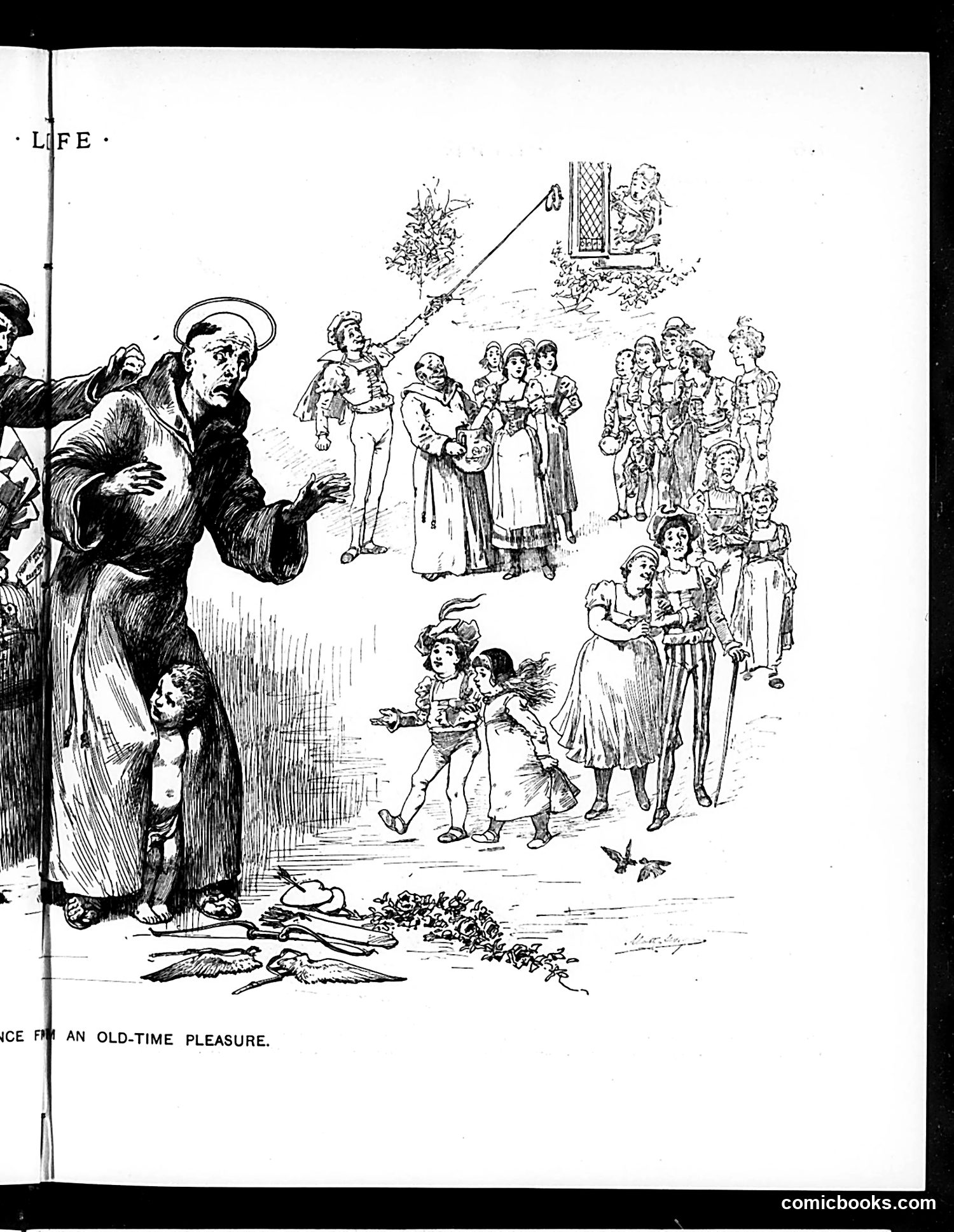
This satirical illustration from *Life* magazine depicts a scene of charitable distribution, likely commentary on public welfare or religious charity. On the left, an elderly figure in religious attire (possibly a priest or charity administrator) dispenses goods to a gathered crowd of women and children. The scattered items at bottom—vegetables, produce, and other goods—suggest food or aid distribution. The caption reads "...NCE FROM AN OLD-TIME PLEASURE," though the full text is cut off. The satire appears to critique either the inadequacy of charitable giving, the paternalistic nature of such assistance, or possibly the decline of traditional community charity. The crowded, somewhat desperate gathering of recipients suggests the cartoonist questions whether such distributions truly address need effectively.
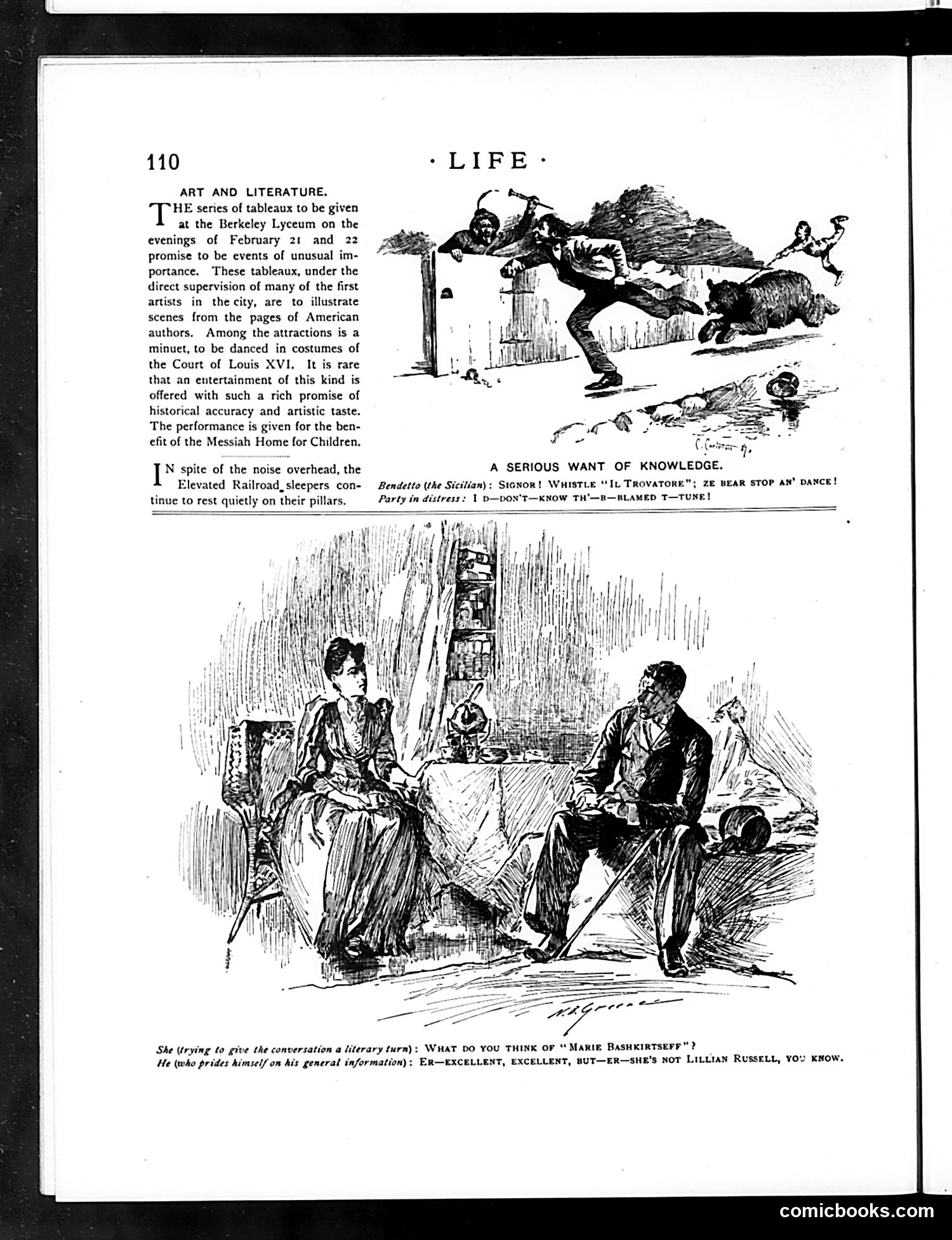
This page contains two distinct satirical illustrations from *Life* magazine. **Top cartoon ("A Serious Want of Knowledge"):** Shows a man being chased by an ostrich while fleeing from what appears to be a building. The caption references Italian opera (*Brandello*), with dialogue about "Il Trovatore" and a "trombone." The satire mocks someone's ignorance of high culture—they've confused an operatic reference with something mundane, exposing their pretension or lack of education. **Bottom cartoon ("She trying to give the conversation a literary turn"):** Depicts a domestic scene where a woman attempts literary discussion by mentioning "Marie Bashkirtseff" (a real 19th-century Russian artist/diarist). The man dismissively responds she's "not Lillian Russell"—a famous actress of the era. The joke: the woman's attempt at intellectual sophistication fails because her companion only recognizes entertainers, not serious artists. It satirizes both feminine intellectual pretension and masculine philistinism.
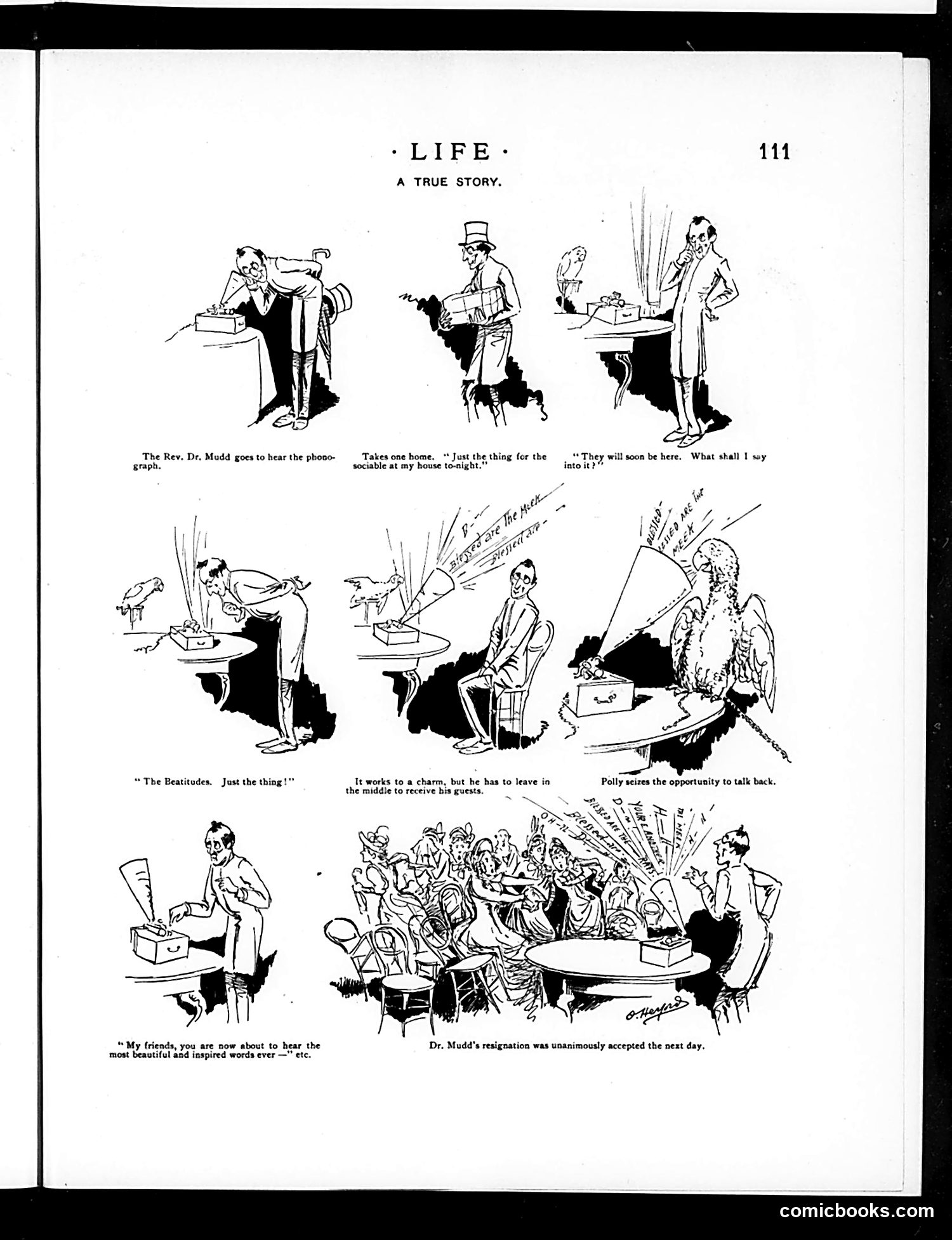
This is a satirical comic strip about **Rev. Dr. Mudd** (likely a fictional clergyman character). The narrative follows his misadventure hosting a dinner party: 1. He obtains a phonograph (early recording device) 2. He takes home a dog, planning to use it as entertainment 3. During the dinner, the dog disrupts the gathering while he attempts his prepared speech 4. The parrot he brings seizes the chance to speak instead 5. His grand oratorical moment is undermined by animal chaos 6. His resignation is "unanimously accepted the next day" The satire mocks pompous clergy members whose pretensions are deflated by circumstances beyond their control—a common theme in early 20th-century American humor.
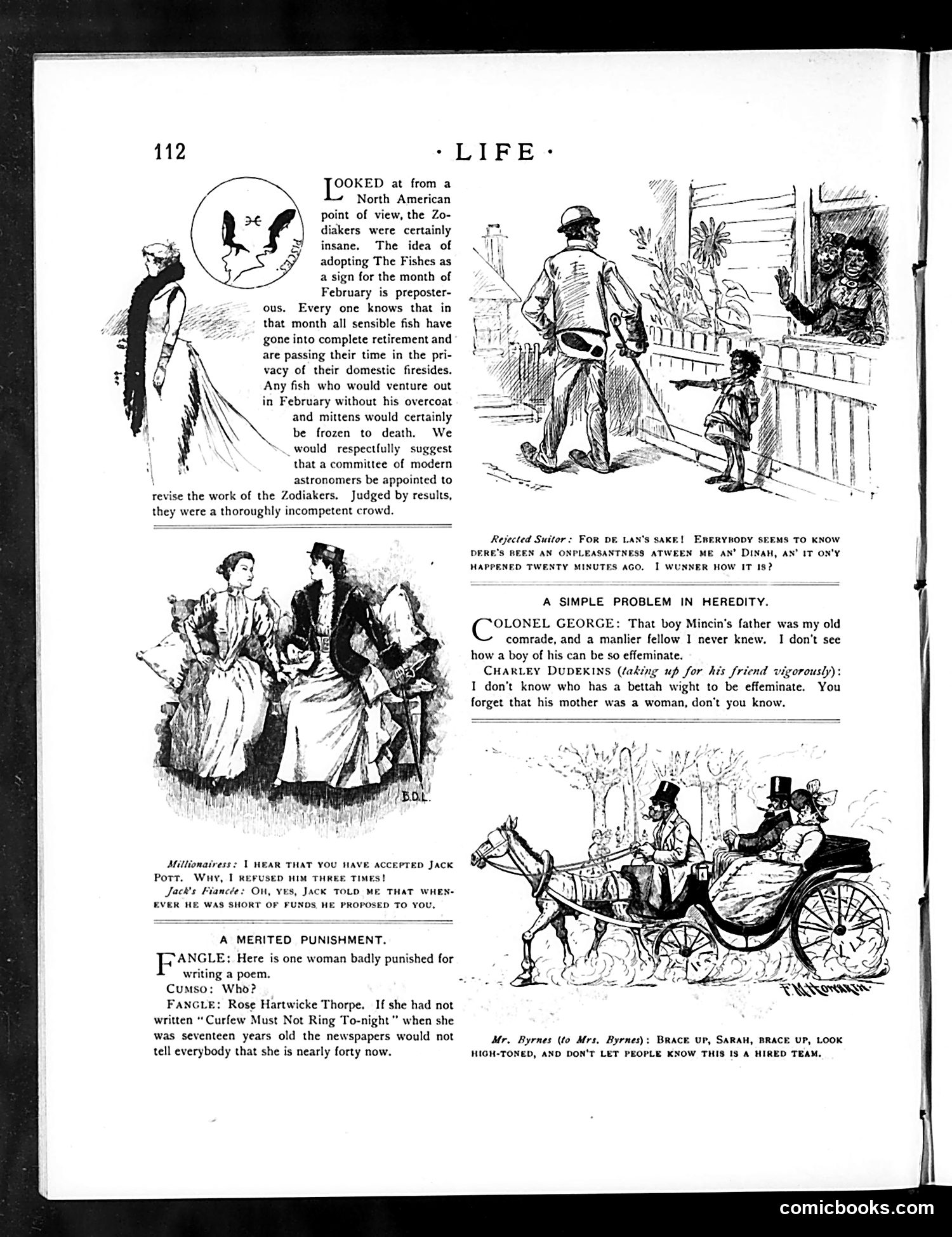
This page from *Life* magazine contains several brief satirical sketches mocking Victorian society: **The Zodiac joke** ridicules astrology by suggesting fish wouldn't venture out in February without proper clothing—absurdist humor questioning the logic of zodiac signs. **"A Simple Problem in Heredity"** features Colonel George and Charley Dudekins debating whether a man can be "effeminate." The satire targets both masculine posturing and the era's anxieties about inherited traits, with Dudekins's retort that the boy's mother was a woman serving as absurdist commentary on biological determinism. **"A Merited Punishment"** mocks poet Rose Hartwicke Thorpe, suggesting her famous poem "Curfew Must Not Ring To-night" (published when young) has now embarrassingly revealed she's nearly forty. The remaining sketches involve romantic/social embarrassments typical of *Life's* humor: a rejected suitor's romantic failure spreading quickly, and a hired team masquerading as owned horses. All target Victorian vanity, social pretension, and the gap between appearance and reality.
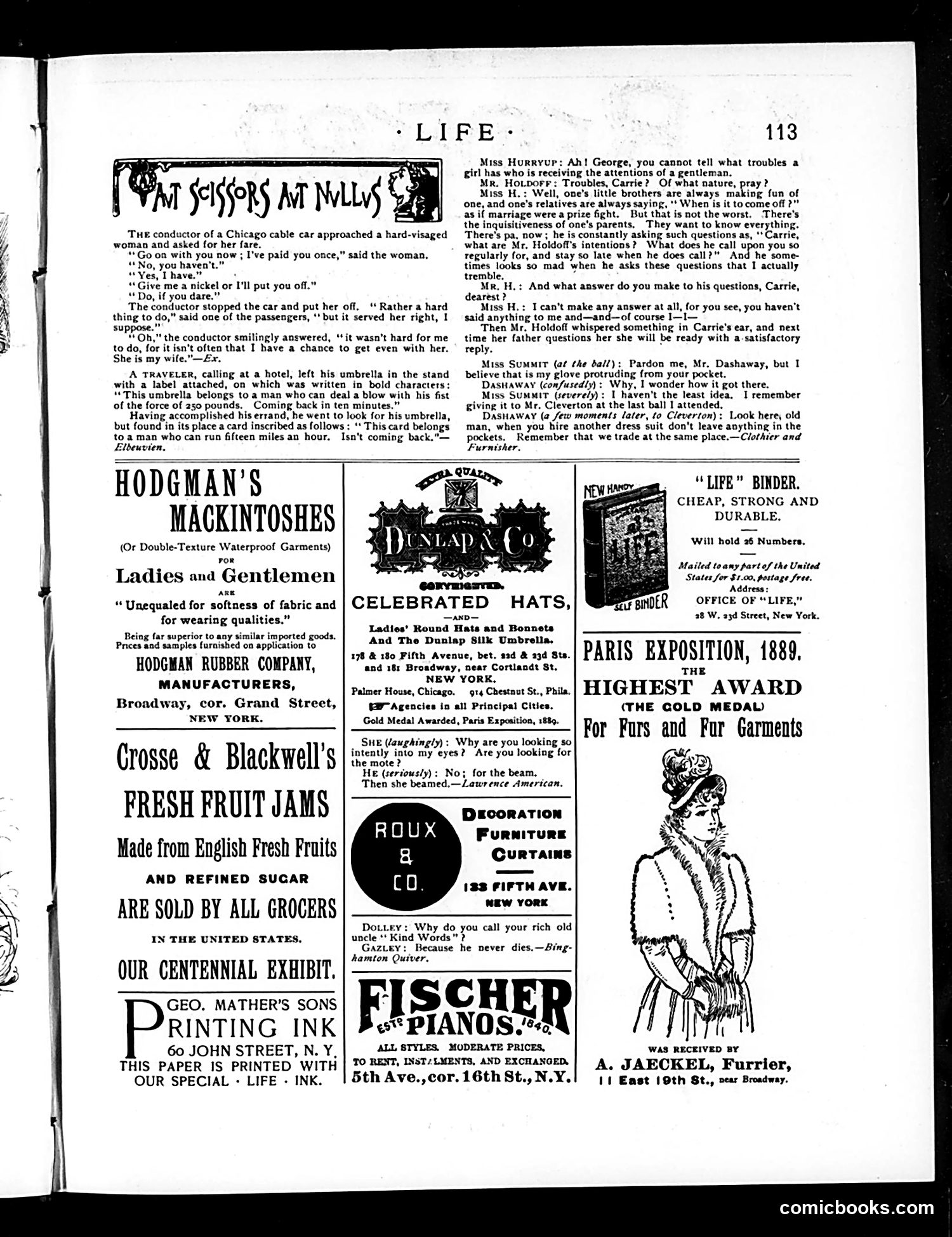
This page contains three brief humorous anecdotes satirizing everyday social situations: 1. **The Cable Car Conductor**: A hard-faced woman refuses to pay fare, claiming she already paid. The conductor ejects her—revealing she's his wife, implying marital discord masked by professional courtesy. 2. **The Umbrella Card**: A traveler's umbrella goes missing, replaced by a card claiming it belongs to a man with a 250-pound punch. The joke plays on theft deterrence through intimidation. 3. **The Gentleman Caller**: Miss Hurryup complains about suitors and parental interrogation about marriage intentions. Mr. Holdoff solves her problem by finally proposing, ensuring she'll have "satisfactory" answers to her father's persistent questions. The remainder is advertising for period products (rubber mackintoshes, fruit jams, printing ink, hats, pianos, furniture, and fur garments). These are gentle, domestic comedies reflecting Victorian-era concerns about courtship, family pressure, and marital relations.
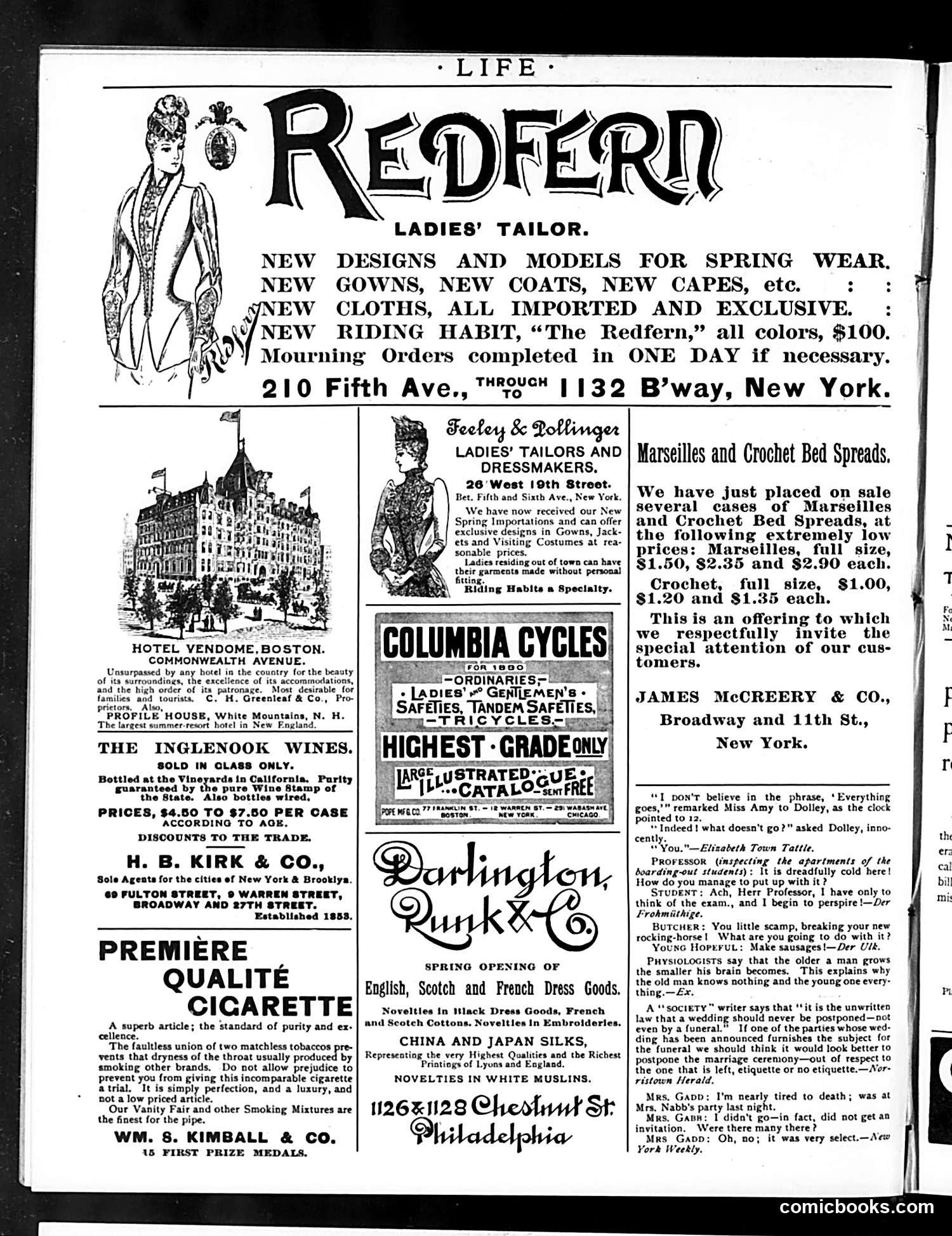
This page is primarily **advertising**, not political satire. It's from an early Life magazine issue featuring luxury goods and services circa 1890s-1900s. The **Redfern** advertisement (top) showcases an exclusive ladies' tailor offering spring fashions and a riding habit ("The Redfern") for $100—a substantial sum then. The image shows an elegantly dressed woman in period dress. **Other ads** promote: fine wines, hotels, cigarettes, bicycles, dress goods, and bed linens—targeting affluent readers. The **small humor items** at bottom are typical period jokes: a professor surprised students stay warm by thinking of exams, a boy planning to make sausages from a broken rocking horse, and commentary on wedding postponements. There is **no significant political content** or social satire here—the page reflects the magazine's focus on entertainment and consumer goods for the wealthy urban audience of its era. The "satire" is gentle domestic humor rather than political commentary.
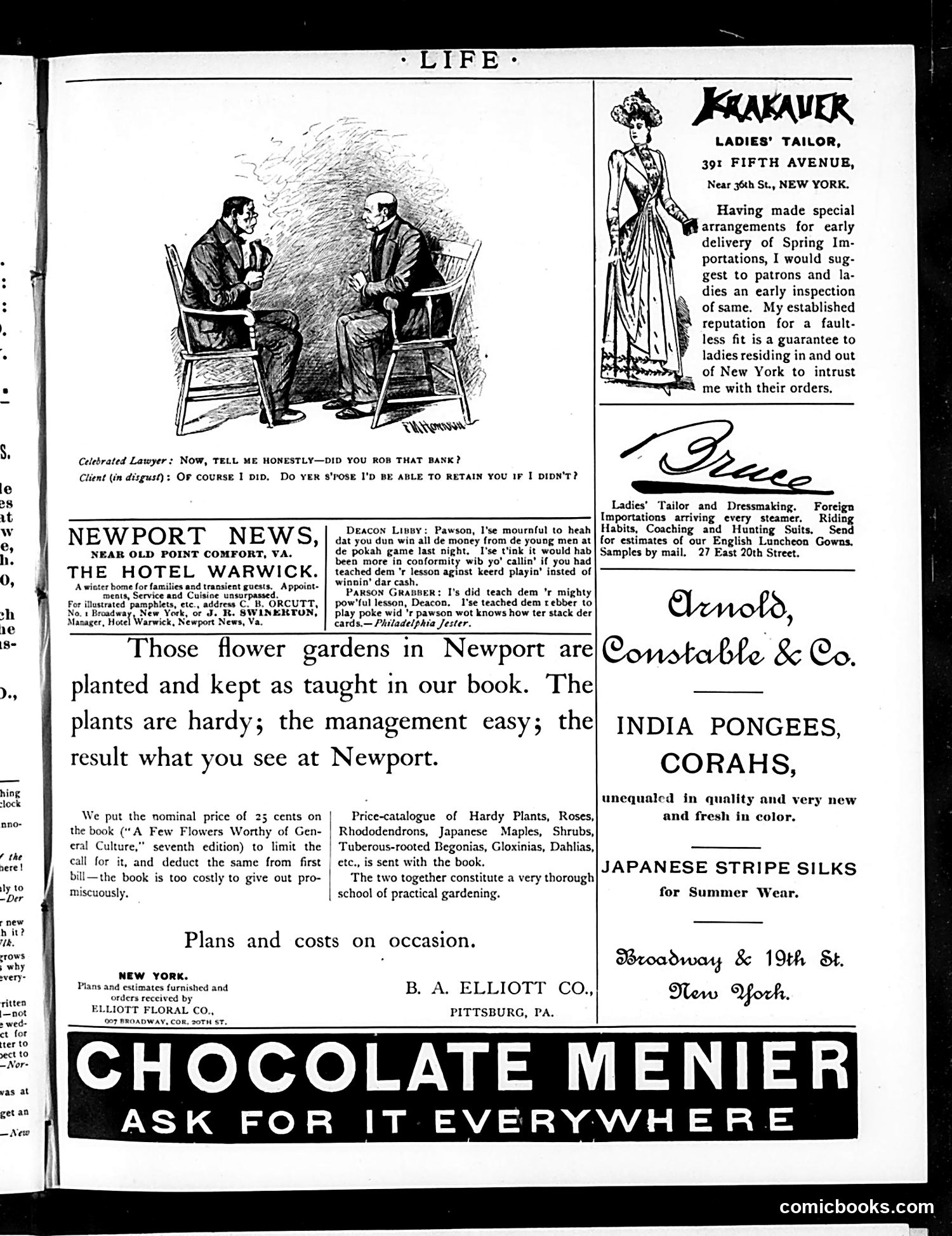
This page contains two satirical cartoons and period advertisements. **Top cartoon**: A lawyer asks his client if he robbed a bank. The client, disgusted, says "Of course I did. Do you suppose I'd be able to retain you if I didn't?" The joke targets both criminal defendants and lawyers—suggesting that only guilty, wealthy criminals can afford good legal representation, and that expensive lawyers implicitly enable crime rather than pursue justice. **Bottom cartoon**: Two Black men (Deacon Lippy and Parson Garber, depicted in offensive dialect) discuss a preacher winning money at poker. The "lesson" punchline—that the preacher taught them not to gamble *with someone who knows how to cheat*—mocks both religious hypocrisy and presents African Americans as foolish. Both cartoons reflect early-20th-century Life magazine's satirical style: cynical about institutions (law, religion) while relying on offensive racial stereotypes standard to the era. The surrounding ads for luxury goods (silk, tailoring, chocolate) target wealthy readers.
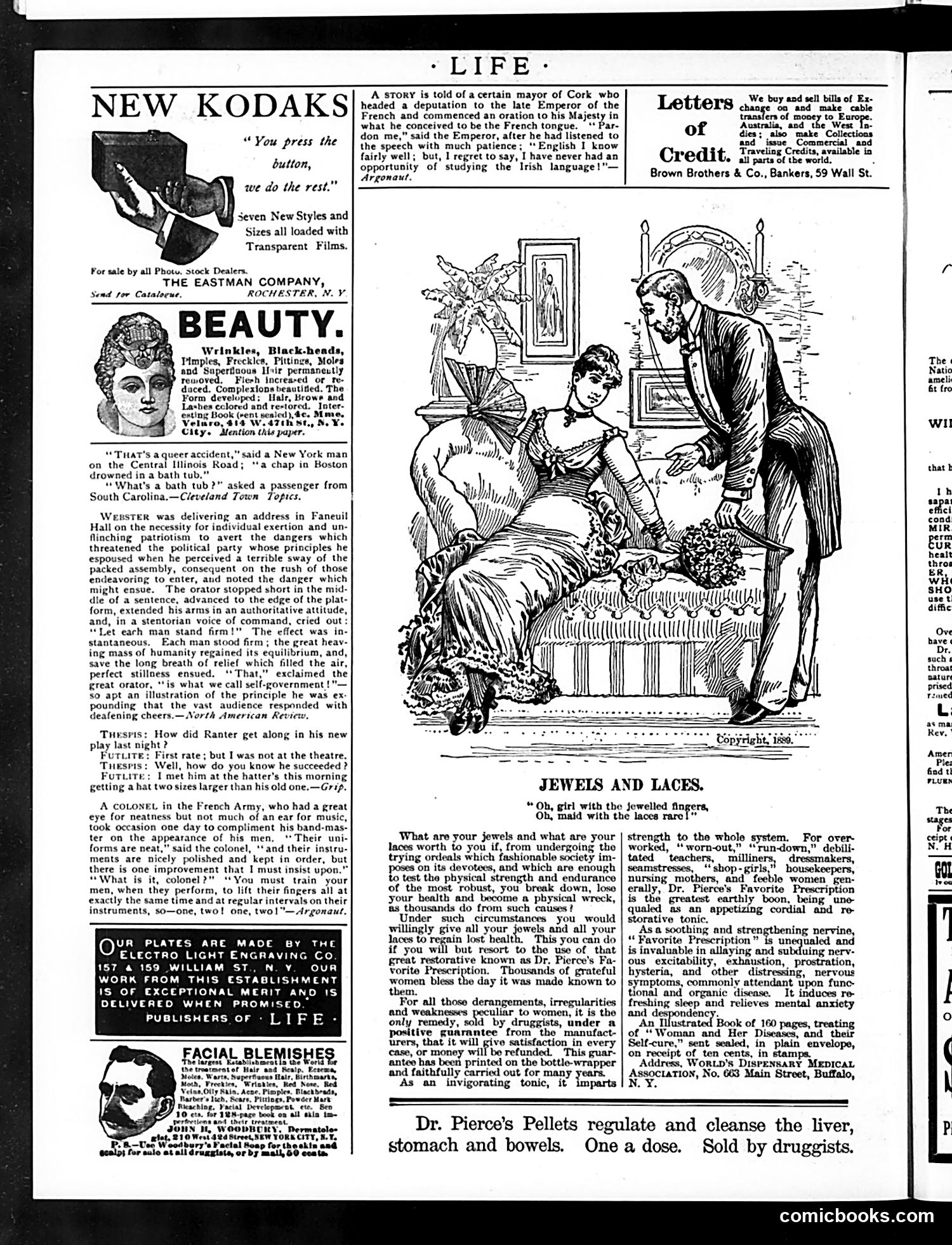
This page is primarily **advertisements and humor anecdotes** rather than political satire. The main illustration depicts a domestic scene: a woman reclining on a bed while a man (likely a doctor or salesman) presents her with jewelry and laces. The accompanying text ("Jewels and Laces") is a **satirical advertisement** for Dr. Pierce's medical remedies. It mockingly suggests that women who sacrifice their health and beauty for material luxuries (jewels, fine laces) should purchase his products to restore themselves. The pitch exploits period anxieties about women's health and appearance, implying that fashionable exhaustion from wearing uncomfortable clothing causes physical weakness. The satire targets both **frivolous consumerism among women** and **quack medical marketing**, presenting the "doctor's" solution as patronizing: women should buy his tonic to recover from the damage caused by pursuing status symbols. The page also contains unrelated jokes and advertisements for Kodak cameras, beauty treatments, and banking services—typical Life magazine content from this era.
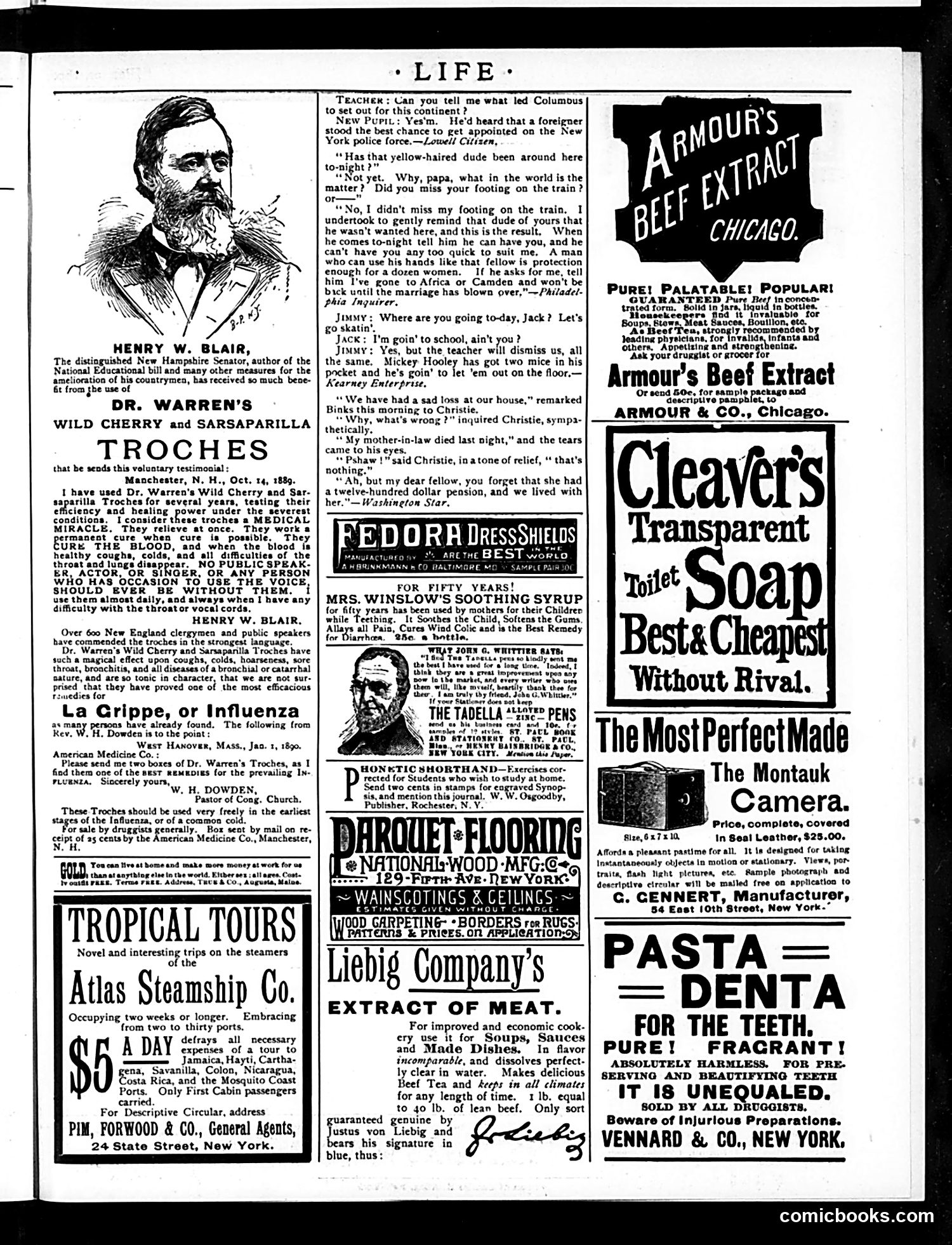
This page is primarily **advertising with minimal cartoon content**. The main satirical elements are brief comic dialogue snippets interspersed among patent medicine ads: 1. **Columbus joke**: A teacher asks a student why Columbus sailed to America. The student answers he heard foreigners "stood the best chance to get appointed on the New York police force"—satirizing political patronage and corruption in late-1880s New York. 2. **The "yellow-haired dude"**: A father angrily rejects a suitor, praising instead a man who uses his fists effectively. This pokes fun at masculine ideals and class tensions. 3. **School mice prank**: Boys plan to release mice in class—a timeless schoolboy joke. The page's primary content is advertisements for dubious patent medicines (Dr. Warren's Troches, Liebig's Extract of Meat) and tours, endorsed by prominent figures like Senator Henry W. Blair. These endorsements were typical 1880s marketing, often fabricated or paid-for—implicitly satirized by Life's juxtaposition with the cynical political jokes above.
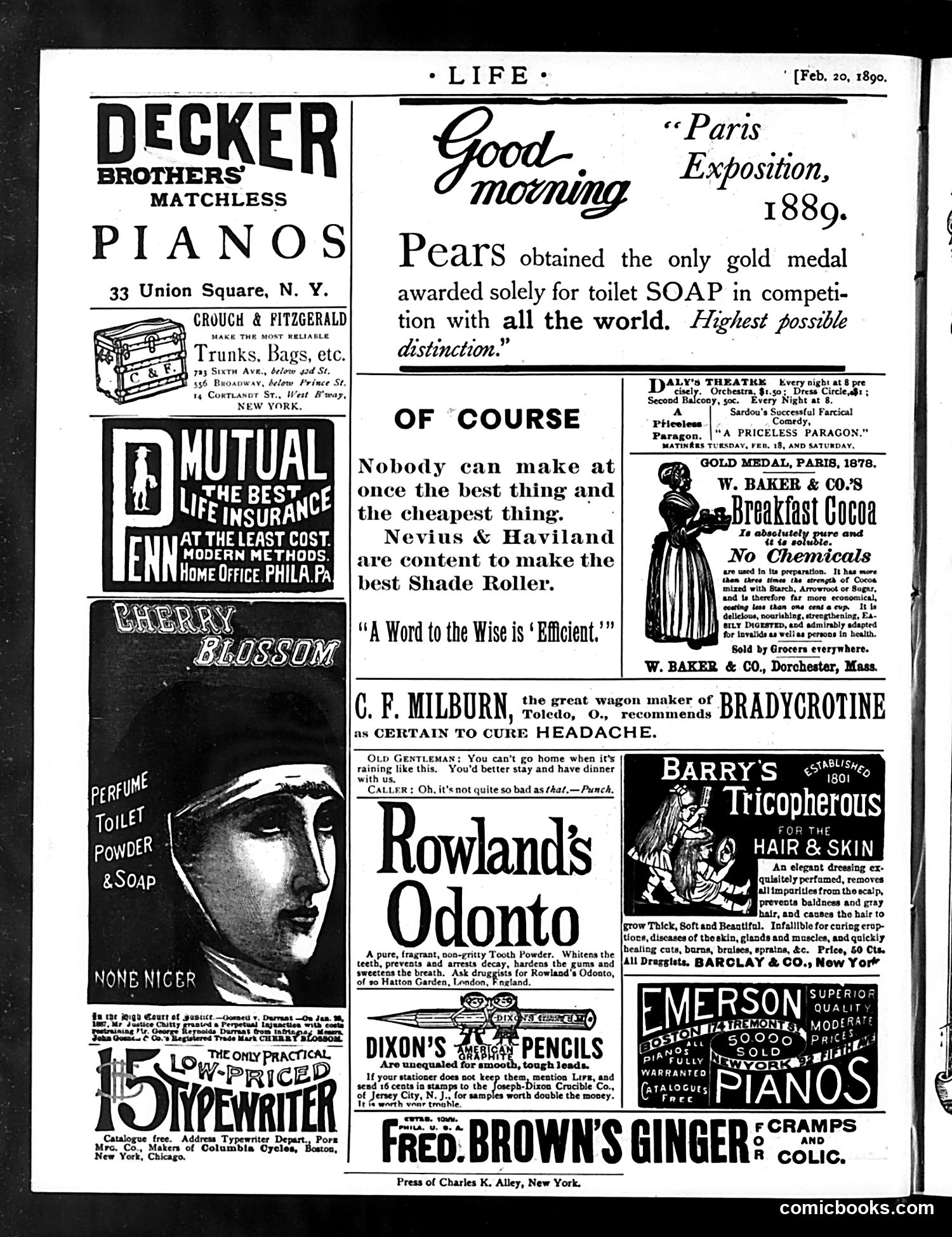
This is primarily an **advertising page** with no political cartoons or satirical content. The page consists entirely of commercial advertisements typical of 1890s American magazines. Notable ads include: - **Pears Soap**: Claims to have won the only gold medal for toilet soap at the 1889 Paris Exposition—a common advertising strategy of the era, leveraging international competitions for credibility. - **Nevius & Haviland Shade Roller**: Uses the witty paradox "Nobody can make at once the best thing and the cheapest thing" to justify premium pricing while claiming superiority. - **Rowland's Odonto toothpaste**: Advertises teeth whitening and decay prevention. - **Barry's Tricopherous**: A hair and skin treatment claiming to prevent baldness and gray hair. - Various pianos, insurance, typewriters, cocoa, and patent medicines round out the page. The page reflects 1890s consumer culture, medical quackery (Bradycrotine for headaches), and the emergence of brand-name advertising. There is **no satirical or political content** to interpret.