
Life, 1890-02-20 · page 6 of 18
Life — February 20, 1890 — page 6: what you’re looking at
What you’re looking at
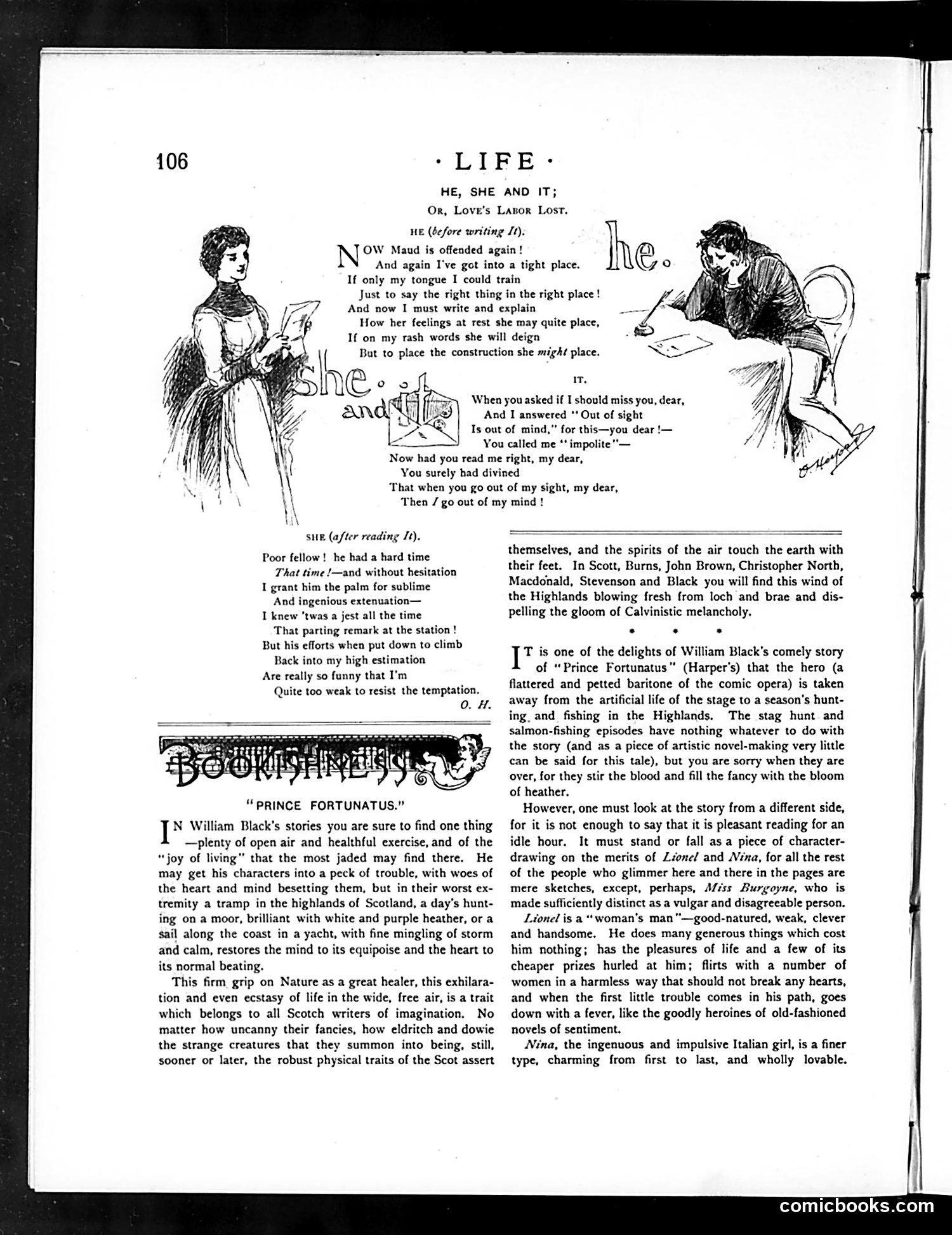
This page from *Life* magazine contains a humorous poem titled "HE, SHE AND IT; Or, LOVE'S LABOR LOST." The illustrations show two figures—a woman reading a letter on the left, and a man writing at a desk on the right—enacting a romantic miscommunication. The poem presents their competing perspectives: he struggles to express his feelings properly, while she interprets his absence literally ("out of sight, out of mind"). The satire targets the awkwardness of romantic correspondence and the gap between intention and reception in love letters. The man's self-conscious worry about saying the "right thing" and the woman's dismissive reading of his explanation create comedy from relatable domestic/romantic tension rather than political commentary. The remaining text discusses William Black's stories and literary characters, unrelated to the cartoon.
📄 Transcribed text from this page (OCR, searchable)
Machine-transcribed from the original scan — historical spelling and the odd misread are preserved.
HE, SHE AND IT; Or, Love's Lazor Lost. HE (before writing It). yow Maud is offended again! And again I've got into a tight place. If only my tongue I could train Just to say the right thing in the right place! And now I must write and explain How her feelings at rest she may quite place, If on my rash words she will deign But to place the construction she might place. IT, When you asked if I should miss you, dear, And I answered ‘* Out of sight Ts out of mind,” for this—you dear !— You called me **impolite"’— Now had you read me right, my dear, You surely had divined ‘That when you go out of my sight, my dear, Then / go out of my mind ! sue (after reading It), Poor fellow! he had a hard time That time !—and without hesitation I grant him the palm for sublime And ingenious extenuation— I knew ‘twas a jest all the time That parting remark at the station ! But his efforts when put down to climb Back into my high estimation Are really so funny that I'm Quite too weak to resist the temptation. “PRINCE FORTUNATUS.” io William Black’s stories you are sure to find one thing —plenty of open air and healthful exercise, and of the “joy of living” that the most jaded may find there. He may get his characters into a peck of trouble, with woes of the heart and mind besetting them, but in their worst ex- tremity a tramp in the highlands of Scotland, a day’s hunt- ing on a moor, brilliant with white and purple heather, or a sail along the coast in a yacht, with fine mingling of storm and calm, restores the mind to its equipoise and the heart to its normal beating. This firm grip on Nature as a great healer, this exhilara- tion and even ecstasy of life in the wide, free air, is a trait which belongs to all Scotch writers of imagination. No matter how uncanny their fancies, how eldritch and dowie the strange creatures that they summon into being, still, sooner or later, the robust physical traits of the Scot assert themselves, and the spirits of the air touch the earth with their feet. In Scott, Burns, John Brown, Christopher North, Macdonald, Stevenson and Black you will find this wind of the Highlands blowing fresh from loch and brae and dis- pelling the gloom of Calvinistic melancholy, . . . J? is one of the delights of William Black's comely story of “Prince Fortunatus” (Harper's) that the hero (a flattered and petted baritone of the comic opera) is taken away from the artificial life of the stage to a season's hunt- ing, and fishing in the Highlands. The stag hunt and salmon-fishing episodes have nothing whatever to do with the story (and as a piece of artistic novel-making very little can be said for this tale), but you are sorry when they are over, for they stir the blood and fill the fancy with the bloom of heather. However, one must look at the story from a different side, for it is not enough to say that it is pleasant reading for an idle hour. It must stand or fall asa piece of character- drawing on the merits of Lone! and Nina, for all the rest of the people who glimmer here and there in the pages are mere sketches, except, perhaps, A/‘ss Burgoyne, who is made sufficiently distinct as a vulgar and disagreeable person. Lionel is a** woman's man"—good-natured, weak, clever and handsome. He does many generous things which cost him nothing; has the pleasures of life and a few of its cheaper prizes hurled at him; flirts with a number of women in a harmless way that should not break any hearts, and when the first little trouble comes in his path, goes down with a fever, like the goodly heroines of old-fashioned novels of sentiment. Nina, the ingenuous and impulsive Italian girl, is a finer type, charming from first to last, and wholly lovable. comicbooks.com