
Life, 1890-02-20 · page 4 of 18
Life — February 20, 1890 — page 4: what you’re looking at
What you’re looking at
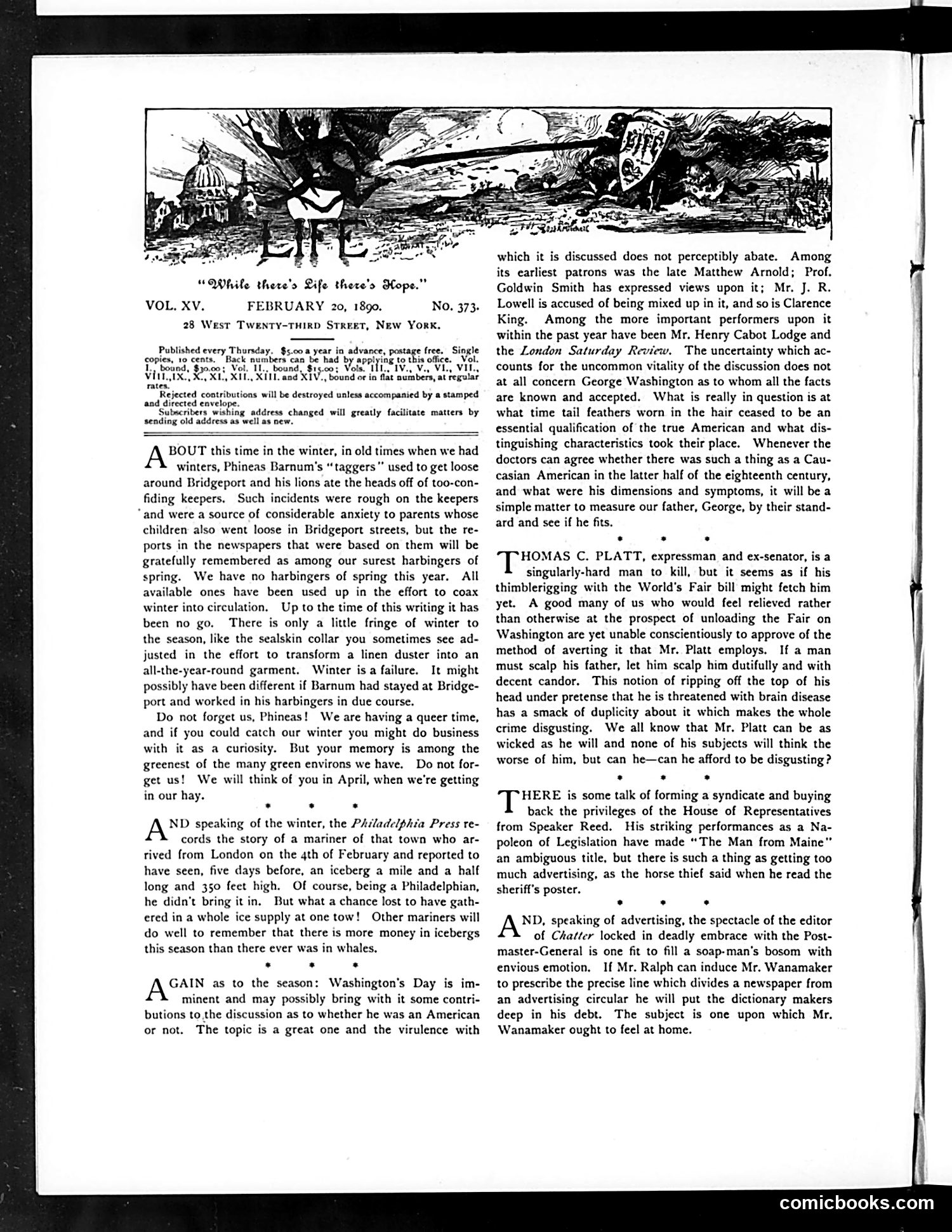
The header cartoon "Where there's Life there's Hope" depicts a skeletal Death figure alongside a living person, likely commenting on winter mortality or seasonal hardship. The accompanying text discusses Bridgeport's winter "raggedy" children and harsh conditions. The page's main content addresses Washington's birthday and whether George Washington was truly "American"—debating what defined an "American" in the late 18th century, particularly regarding ancestry and characteristics. Additional satirical sections target: - **Thomas C. Platt**, a congressman and ex-senator, regarding World's Fair appropriations - **Speaker Reed** and legislative corruption - **The editor of Chatter** magazine and disputes with the Postmaster-General over advertising standards The satire reflects 1890s political scandals and social anxieties about immigration, leadership integrity, and governmental propriety.
📄 Transcribed text from this page (OCR, searchable)
Machine-transcribed from the original scan — historical spelling and the odd misread are preserved.
“While there's Life there's Hope.” VOL. XV. FEBRUARY 20, 1890, No. 373- 28 West Twenty-THIRD Street, New York. Published every Thursday. $5.00 a year in advance, postage free. Single copies, 10 cents. Back numbers can be had by applying to this office. Vol. $30.00; Vol. Il, bound, $rs.co: Vole Ite IV., Vey Vig VIT., umbers, at regular 1. Xitl and X1V., bound or in Rejected contributions will be destroyed unless accompanied by a stamped and directed envelope. Subscribers wishing address changed will greatly facilitate matters by sending old address as well as new. BOUT this time in the winter, in old times when we had winters, Phineas Barnum's “taggers” used to get loose around Bridgeport and his lions ate the heads off of too-con- fiding keepers. Such incidents were rough on the keepers “and were a source of considerable anxiety to parents whose children also went loose in Bridgeport streets, but the re- ports in the newspapers that were based on them will be gratefully remembered as among our surest harbingers of spring. We have no harbingers of spring this year. All available ones have been used up in the effort to coax winter into circulation. Up to the time of this writing it has been no go. There is only a little fringe of winter to the season, like the sealskin collar you sometimes see ad- justed in the effort to transform a linen duster into an all-the-year-round garment. Winter isa failure. It might possibly have been different if Barnum had stayed at Bridge- port and worked in his harbingers in due course. Do not forget us, Phineas! We are having a queer time, and if you could catch our winter you might do business with it as a curiosity. But your memory is among the greenest of the many green environs we have. Do not for- get us! We will think of you in April, when we're getting in our hay. . . . AY? speaking of the winter, the Philadelphia Press re- cords the story of a mariner of that town who ar- rived from London on the 4th of February and reported to have seen, five days before, an iceberg a mile and a half long and 350 feet high. Of course, being a Philadelphian, he didn’t bring it in. But what a chance lost to have gath- ered in a whole ice supply at one tow! Other mariners will do well to remember that there is more money in icebergs this season than there ever was in whales. . . . GAIN as to the season: Washington's Day is im- minent and may possibly bring with it some contri- butions tothe discussion as to whether he was an American or not. The topic is a great one and the virulence with which it is discussed does not perceptibly abate. Among its earliest patrons was the late Matthew Arnold; Prof. Goldwin Smith has expressed views upon it; Mr. J. R. Lowell is accused of being mixed up in it, and so is Clarence King. Among the more important performers upon it within the past year have been Mr. Henry Cabot Lodge and the London Saturday Review. The uncertainty which ac- counts for the uncommon vitality of the discussion does not at all concern George Washington as to whom all the facts are known and accepted. What is really in question is at what time tail feathers worn in the hair ceased to be an essential qualification of the true American and what dis- tinguishing characteristics took their place. Whenever the doctors can agree whether there was such a thing as a Cau- casian American in the latter half of the eighteenth century, and what were his dimensions and symptoms, it will be a simple matter to measure our father, George, by their stand- ard and see if he fits. . . . HOMAS C. PLATT, expressman and ex-senator, is a singularly-hard man to kill, but it seems as if his thimblerigging with the World's Fair bill might fetch him yet. A good many of us who would feel relieved rather than otherwise at the prospect of unloading the Fair on Washington are yet unable conscientiously to approve of the method of averting it that Mr. Platt employs. If a man must scalp his father, let him scalp him dutifully and with decent candor. This notion of ripping off the top of his head under pretense that he is threatened with brain disease has a smack of duplicity about it which makes the whole crime disgusting. We all know that Mr. Platt can be as wicked as he will and none of his subjects will think the worse of him, but can he—can he afford to be disgusting ? . . . "[TuEERE is some talk of forming a syndicate and buying back the privileges of the House of Representatives from Speaker Reed. His striking performances as a Na- poleon of Legislation have made “The Man from Maine" an ambiguous title, but there is such a thing as getting too much advertising, as the horse thief said when he read the sheriff's poster. . . . ND, speaking of advertising, the spectacle of the editor of Chatter locked in deadly embrace with the Post- master-General is one fit to fill a soap-man’s bosom with envious emotion, If Mr. Ralph can induce Mr. Wanamaker to prescribe the precise line which divides a newspaper from an advertising circular he will put the dictionary makers deep in his debt. The subject is one upon which Mr. Wanamaker ought to feel at home. comicbooks.com