
A complete issue · 18 pages · 1890
Life — January 23, 1890
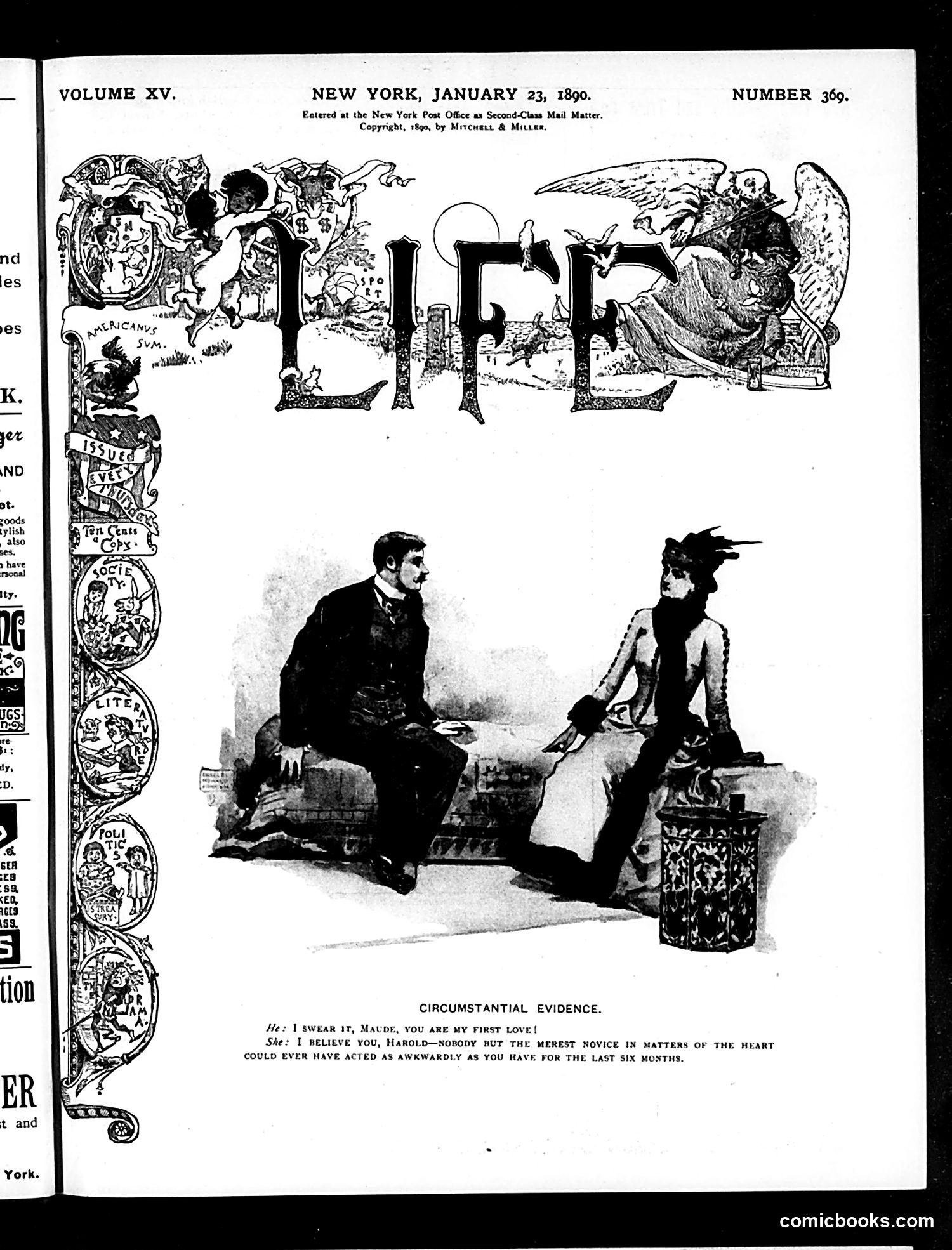
This satirical cartoon depicts a domestic dispute between a well-dressed man (Harold) and a woman (Maude). The caption shows Maude claiming Harold is her "first love," while Harold responds skeptically, noting that nobody involved in "matters of the heart" could have acted as "awkwardly" as Maude has for the past six months. The satire mocks Victorian courtship conventions and relationship dynamics. The "circumstantial evidence" of the title refers to Harold's interpretation of Maude's recent awkward behavior as proof she cannot genuinely love him—turning typical romantic "evidence" on its head for comedic effect. The ornate decorative border was typical of Life's design aesthetic during this period.
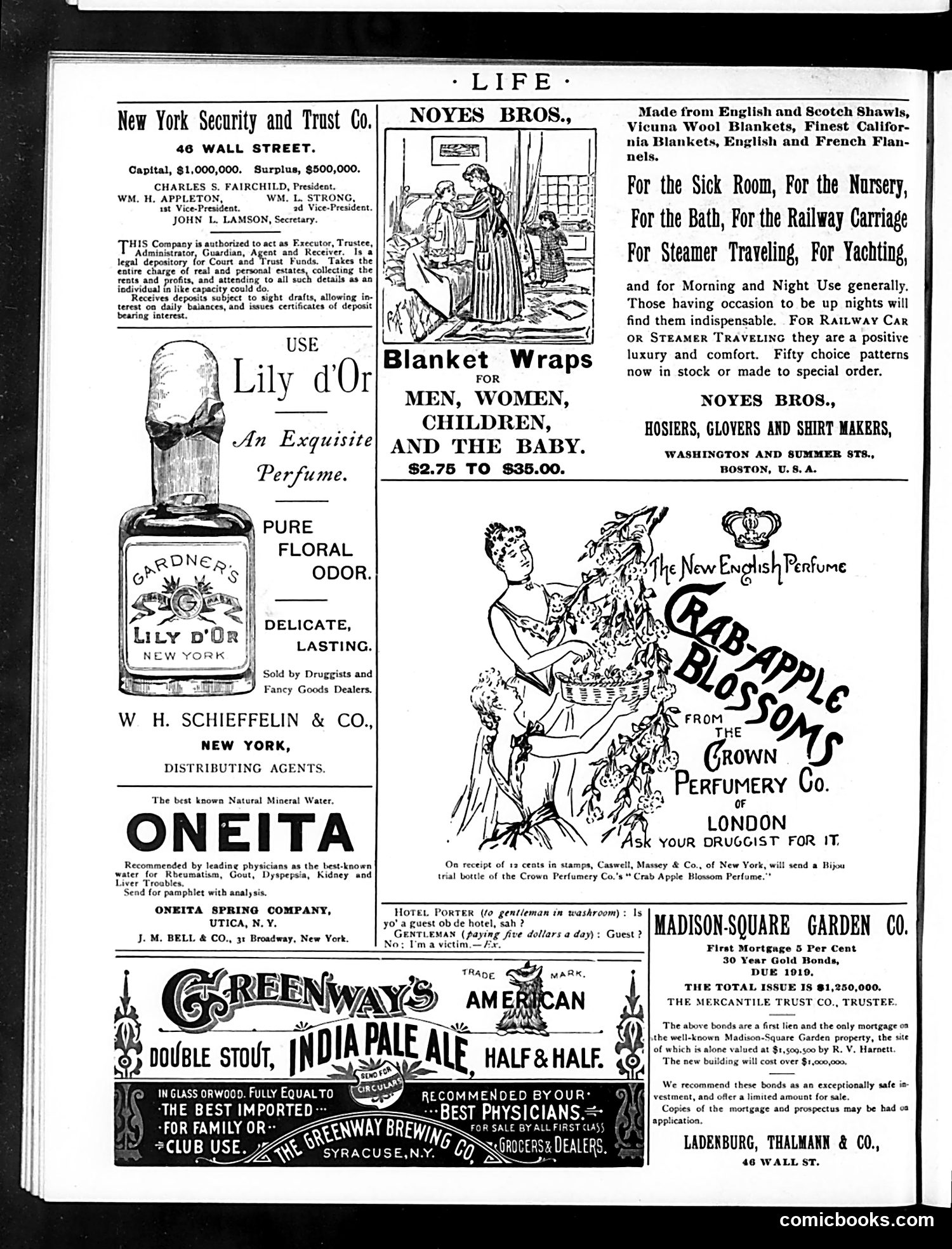
This page is **primarily advertising**, not satire or political commentary. It contains multiple product advertisements typical of early 20th-century magazines: - **Lily d'Or perfume** (Gardner's, New York) - **Oneita mineral water** (for health conditions) - **Greenway's American ales and stout** (brewing company) - **Noyes Bros. blanket wraps** and hosiery - **Crab Apple Blossoms perfume** (Crown Perfumery Co., London) - **Madison-Square Garden bonds** (financial investment) The only illustrated material consists of product imagery—a perfume bottle, a woman with flowers—and a small domestic scene of a woman with children and blankets. These are purely commercial illustrations promoting goods and services, not satirical commentary. The page reflects consumer culture and advertising practices of the era rather than political or social satire.
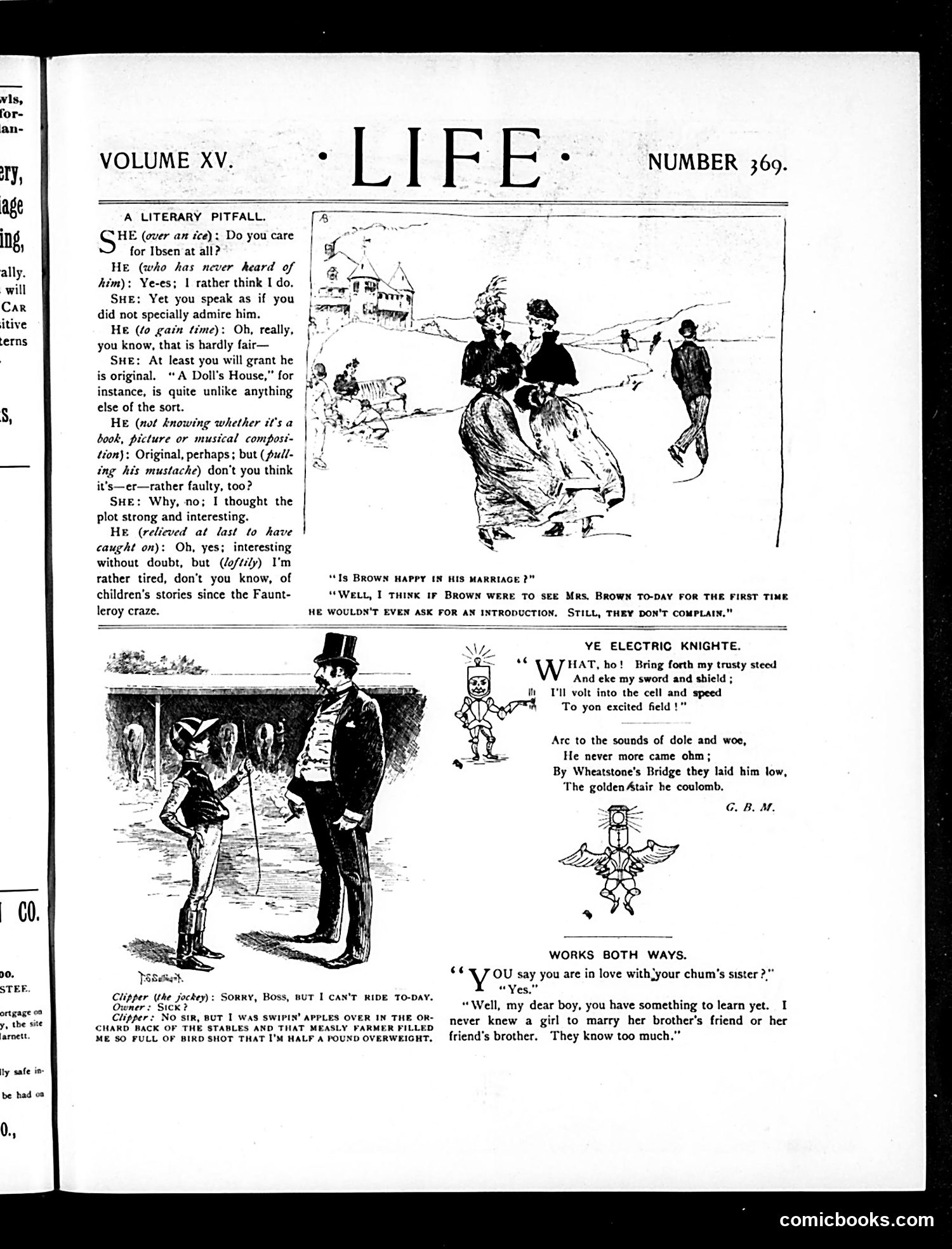
This page contains literary commentary and humorous sketches rather than political cartoons. **"A Literary Pitfall"** presents a dialogue mocking Ibsen's work, suggesting his plays are difficult and original but potentially flawed—the speakers debate whether his originality makes his work admirable or merely "faulty." **"The Electric Knight"** is a whimsical poem about a futuristic armored figure using electricity as a weapon, appearing to satirize modern technological advancement through mock-heroic verse. **"Works Both Ways"** shows a brief comic exchange about romantic relationships and family connections, with the punchline suggesting courtship involves learning uncomfortable truths about one's partner's relatives. The page emphasizes literary and social satire rather than direct political commentary, typical of Life's general-interest humor approach.
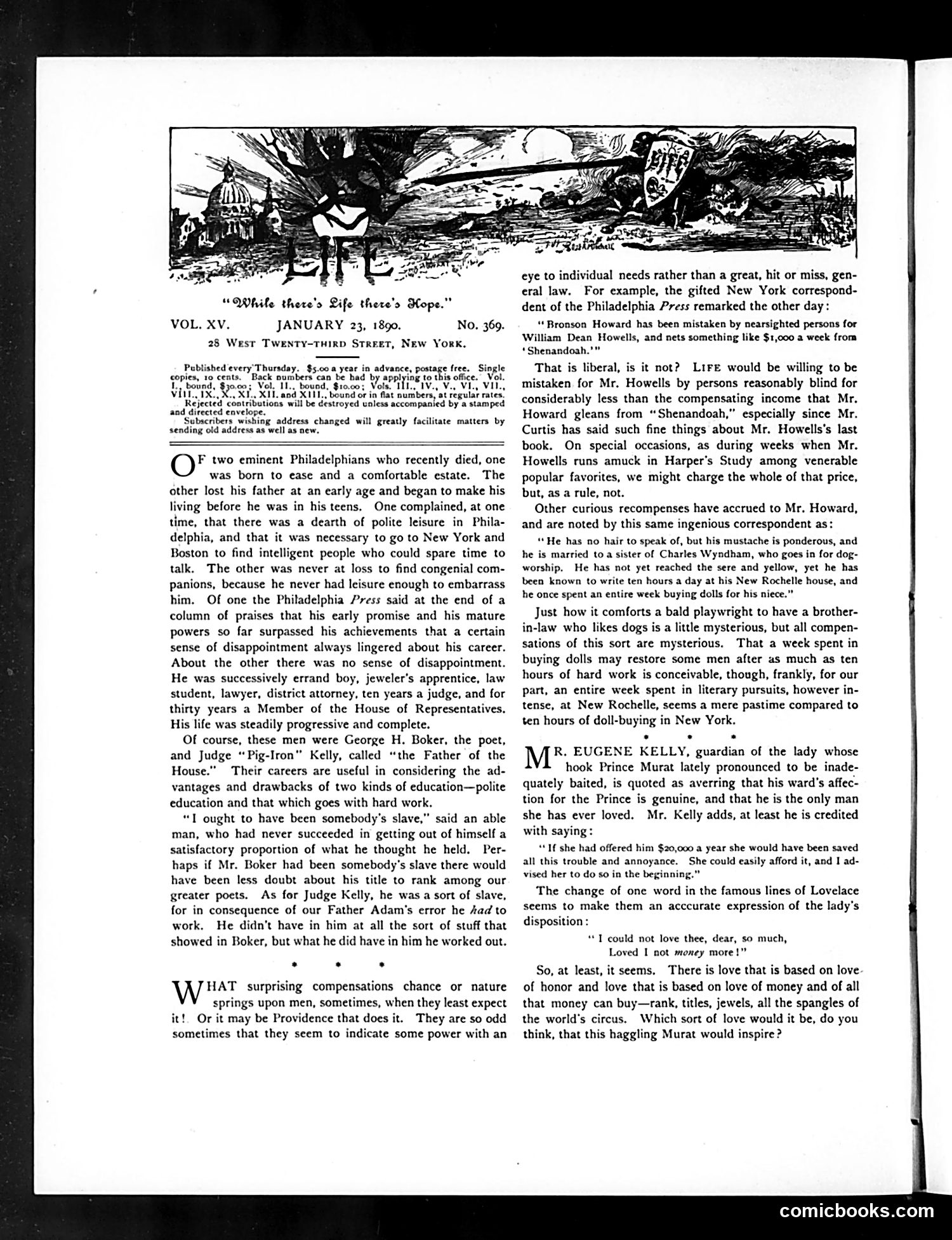
The masthead woodcut cartoon depicts a satirical landscape showing contrasts between poverty and wealth—a cathedral dome alongside humble dwellings, celestial imagery above scenes of earthly struggle. The visual metaphor appears to comment on social inequality and religious hypocrisy, themes common to 1890s Gilded Age satire. The article text discusses two deceased Philadelphia notables (likely George H. Hoker and Judge "Pig-Iron" Kelly) and their contrasting legacies. The satire examines how society compensates certain individuals—some achieving success despite humble origins, others receiving undeserved advantages. A secondary story mocks Mr. Eugene Kelly's guardianship dispute involving Prince Murat, where monetary compensation allegedly replaced genuine affection—critiquing how wealth corrupts relationships and values in high society.
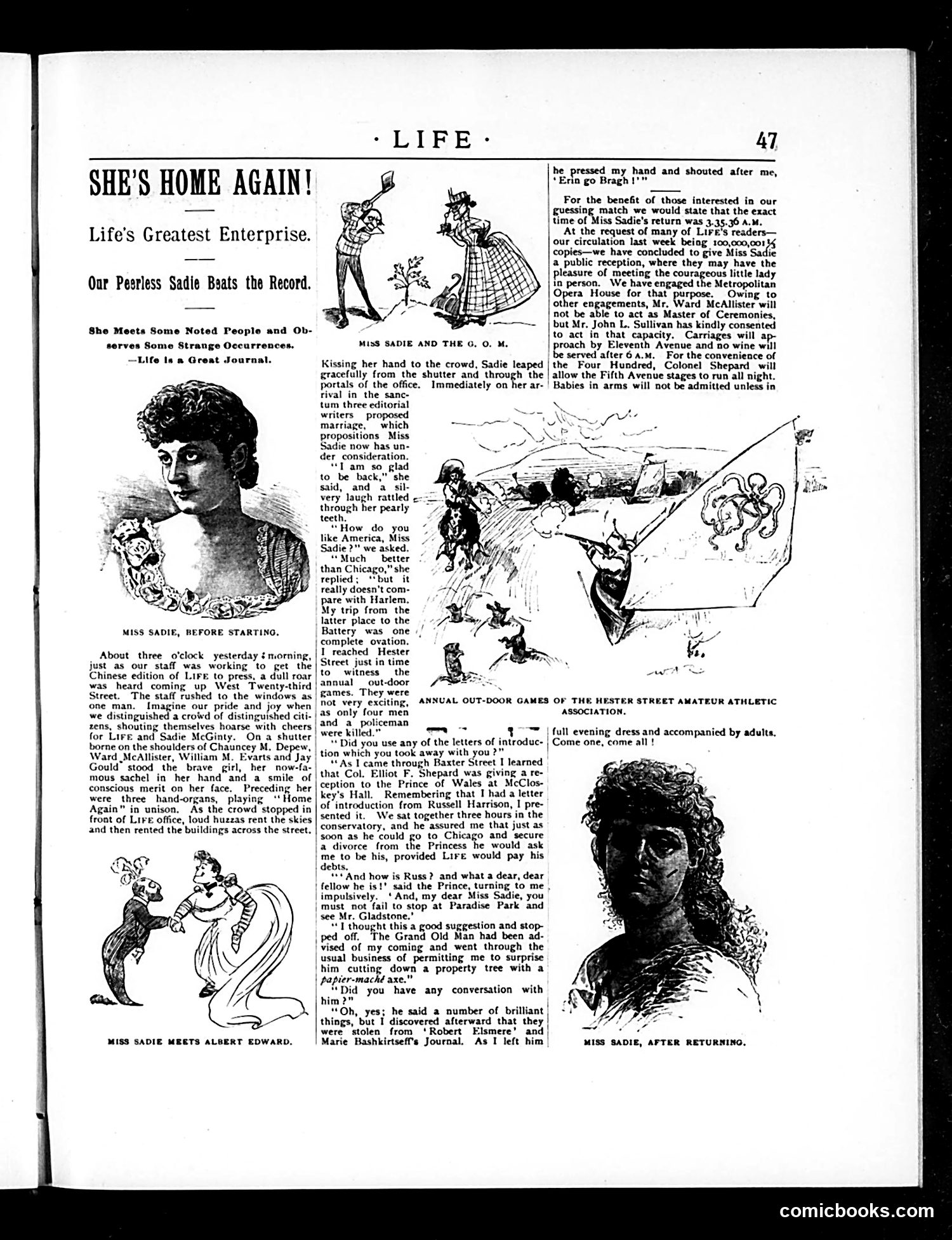
This page announces Miss Sadie's return to America—apparently a notable entertainer or socialite whom Life magazine had covered before. The article describes her meetings with prominent figures during her absence, including Albert Edward (likely Edward VII, then Prince of Wales) and Colonel Elliot F. Shepard. The satire centers on her romanticized foreign travels and high-society encounters contrasted with mundane domestic realities. The "Annual Out-Door Games of the Hester Street Amateur Athletic Association" illustration mocks lower-class street life in immigrant neighborhoods—the contrast implying satire about class differences in American society. The overall tone satirizes both the pretensions of society women and the urban social landscape of early 1900s America, typical of *Life* magazine's satirical approach to contemporary American life and manners.
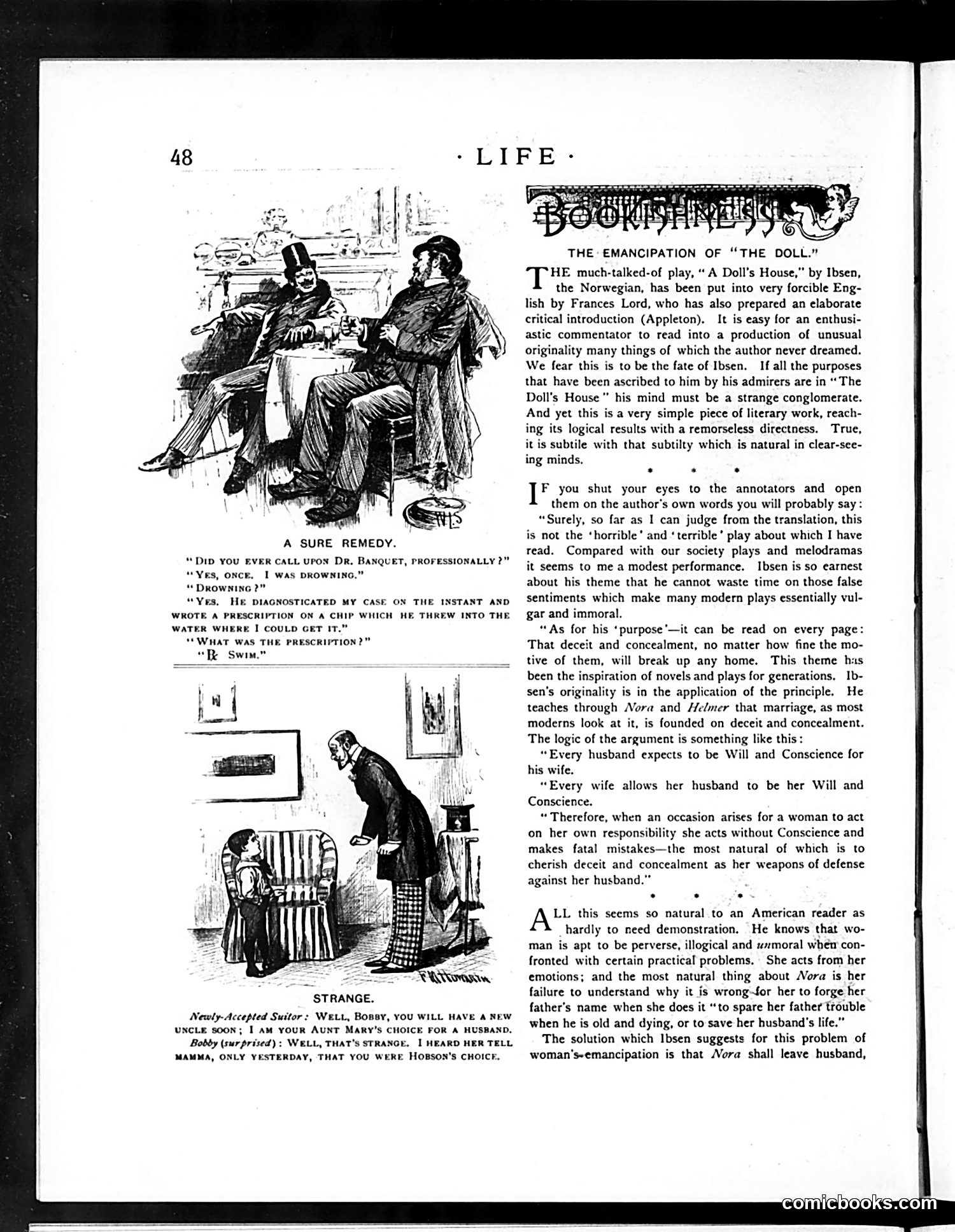
This page discusses Henrik Ibsen's play *A Doll's House*, specifically Frances Lord's English adaptation. The cartoons illustrate Victorian social attitudes the play critiques. The top cartoon ("A Sure Remedy") shows two men discussing a doctor's absurd prescription—throwing a chip in water to cure drowning—satirizing illogical solutions to problems. The bottom cartoon ("Strange") depicts a domestic scene where an aunt announces a young man as a potential husband. The humor lies in the nephew's surprised reaction to this arranged-marriage proposal, mocking Victorian courtship customs. The accompanying text argues that Ibsen's play challenges deception in marriage, proposing that wives should have autonomy and responsibility equal to husbands. The cartoons reinforce how foreign such ideas were to contemporary American readers accustomed to rigid gender roles.
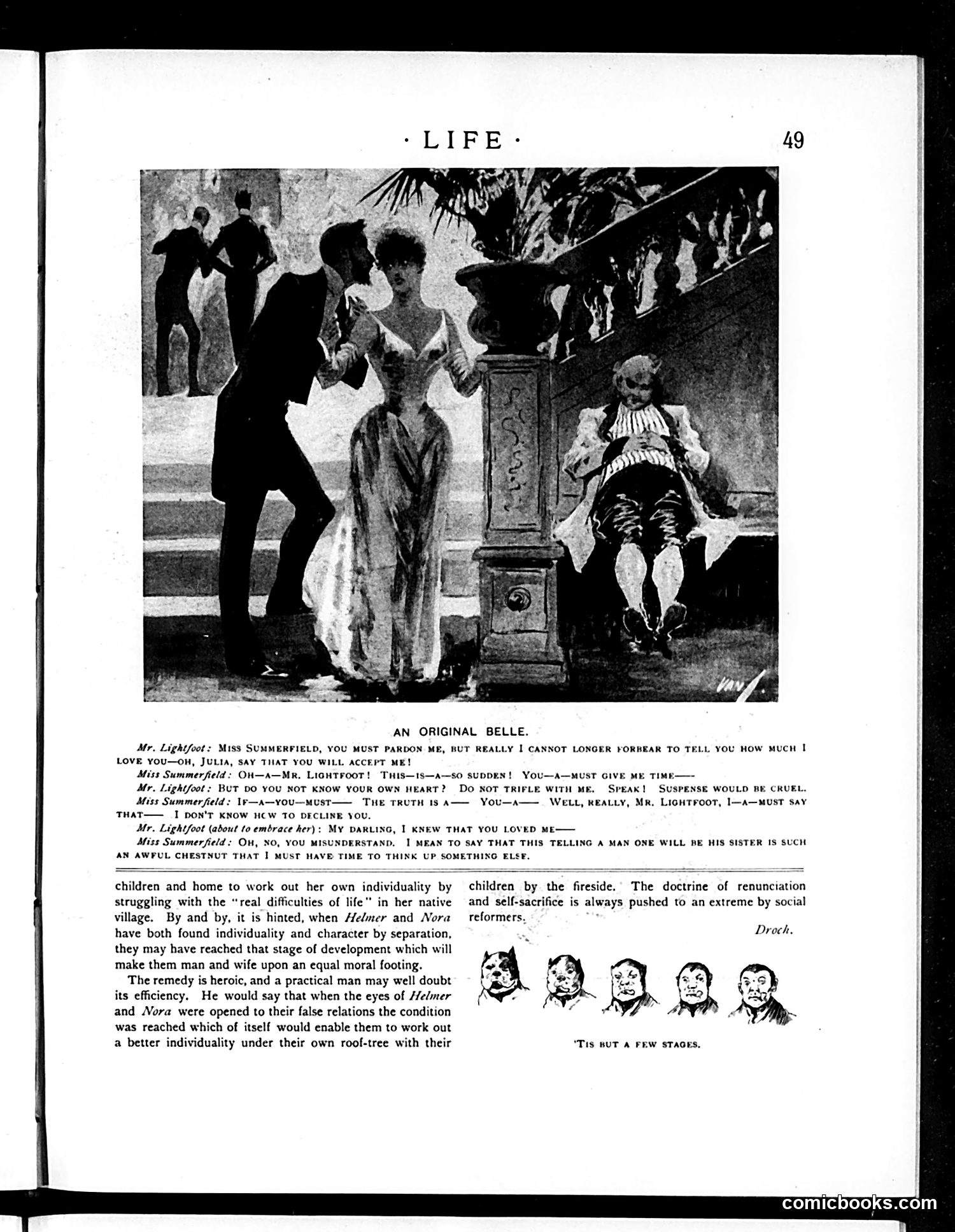
This page contains "An Original Belle," a theatrical scene satirizing romantic melodrama. The dialogue depicts Mr. Lightfoot proposing to Miss Summerfield while her guardian or relative objects, claiming she cannot marry without knowing her own heart. The satire mocks Victorian emotional excess—the overwrought declarations of love and the sanctimonious moralizing about duty and sacrifice. Below the main illustration are five small facial caricatures labeled "Droch" with the caption "'Tis but a few stages," suggesting stages of emotional deterioration or aging. The accompanying text discusses social reform regarding children's welfare and education, advocating for practical development over sentimental "renunciation" doctrines promoted by reformers. The page combines theatrical satire with social commentary on idealistic but impractical reform movements.
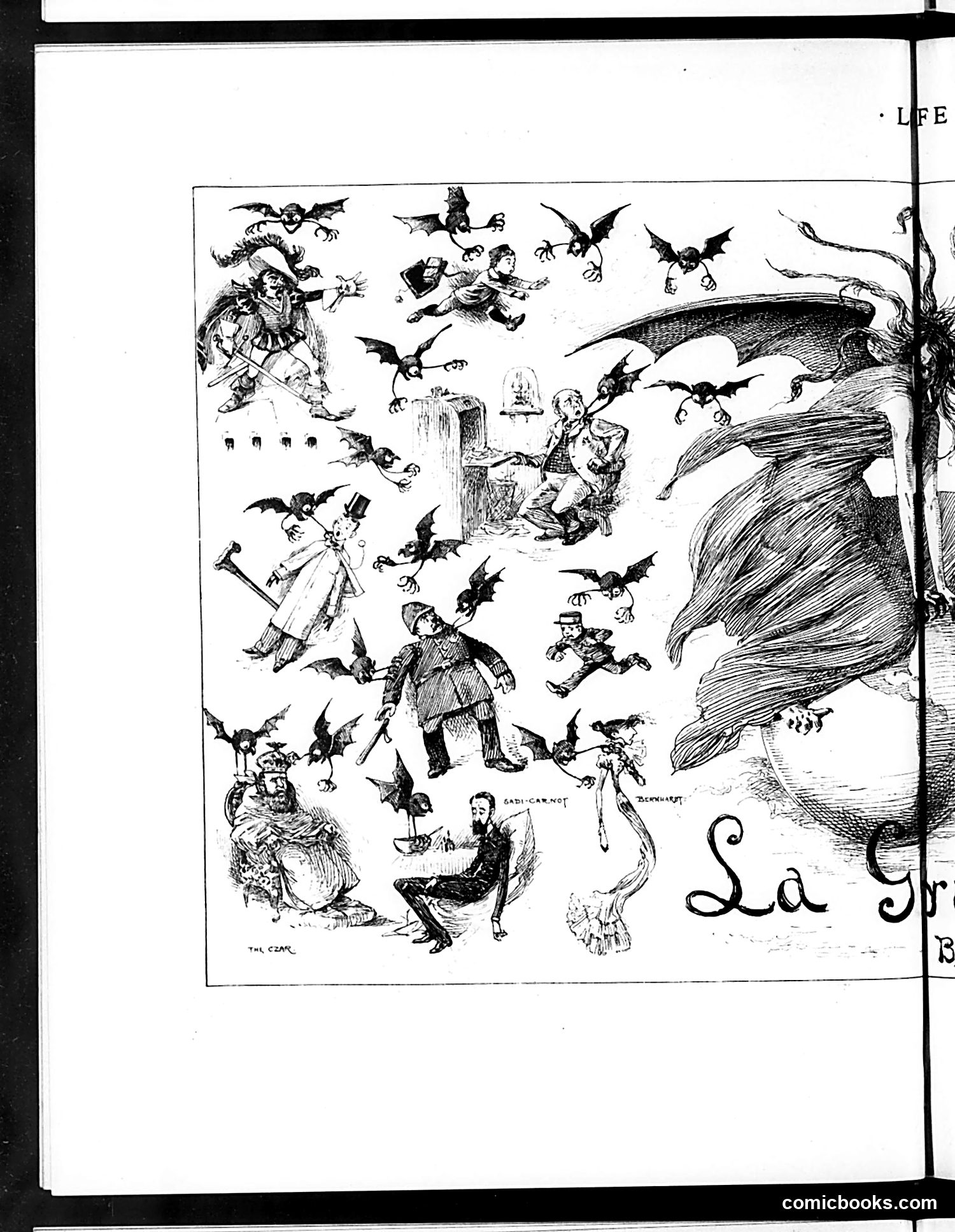
This satirical illustration depicts various figures being attacked or tormented by flying demons and bat-like creatures. The central scene shows what appears to be political or social figures in chaos—men in top hats and formal dress fleeing or struggling against the supernatural assault. The title "La Sorcière" (The Witch) suggests this is mocking either a specific woman or feminine political force causing societal turmoil. The style and subject matter indicate this is likely late 19th-century French or Franco-American satire, possibly referencing political scandal, social upheaval, or feminist movements of that era. The grotesque creatures and panic convey disapproval toward whoever or whatever "the witch" represents, using supernatural imagery as metaphor for perceived chaos or threat to the established order.
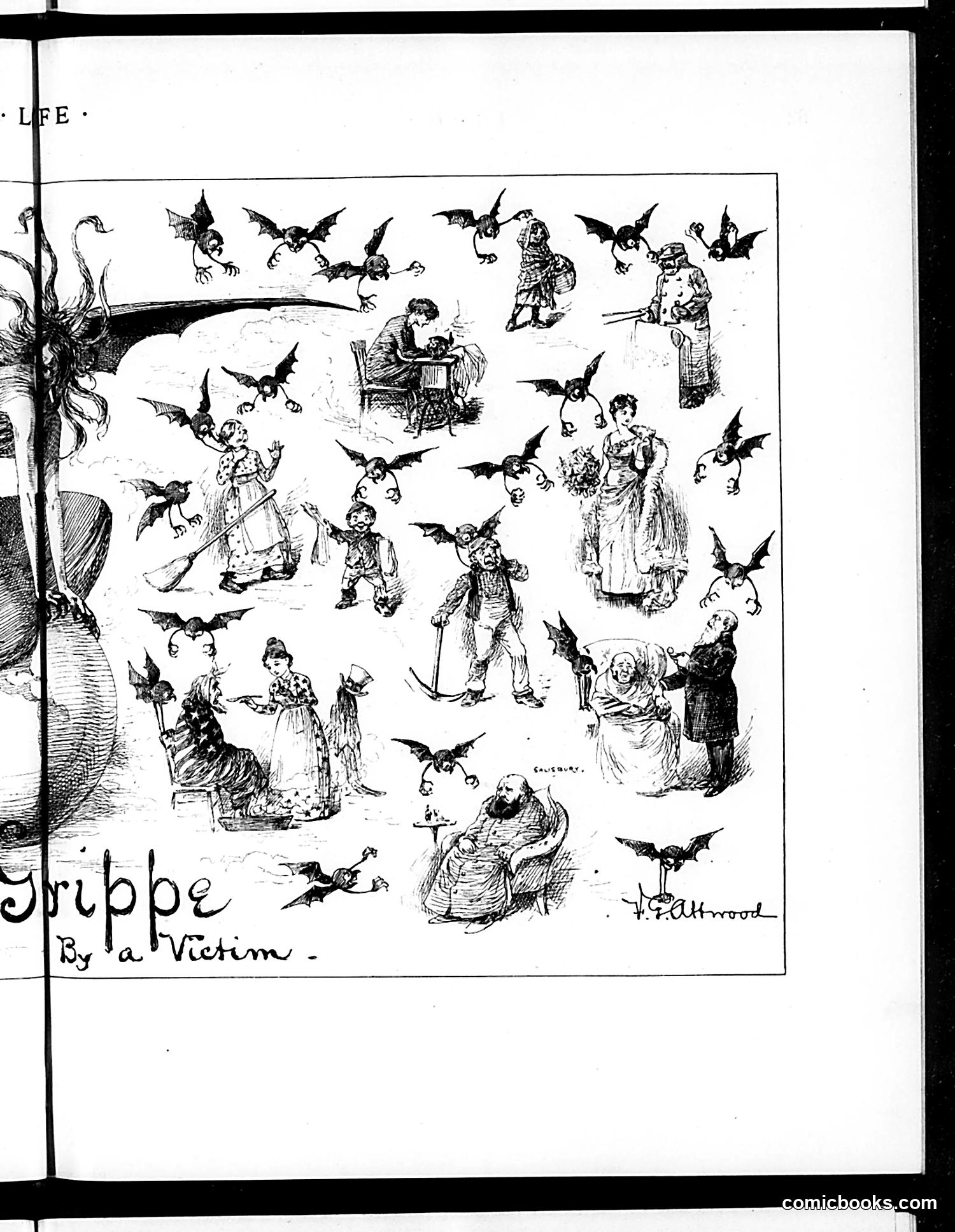
This satirical illustration depicts what appears to be a chaotic infernal scene populated by numerous winged demon or devil figures tormenting various human characters. The title suggests the cartoon comments on being victimized by "jibing" (mocking or taunting). The crowded composition shows people in period dress—some seated, some standing—surrounded by mischievous winged creatures that harass and torment them. The style suggests this is social satire about human suffering caused by ridicule or mockery. Without clearer context about which specific victims or events this references, the exact political or social target remains unclear. However, the hellish setting and emphasis on torment by supernatural tricksters suggests commentary on public humiliation or social persecution of identifiable groups or individuals.
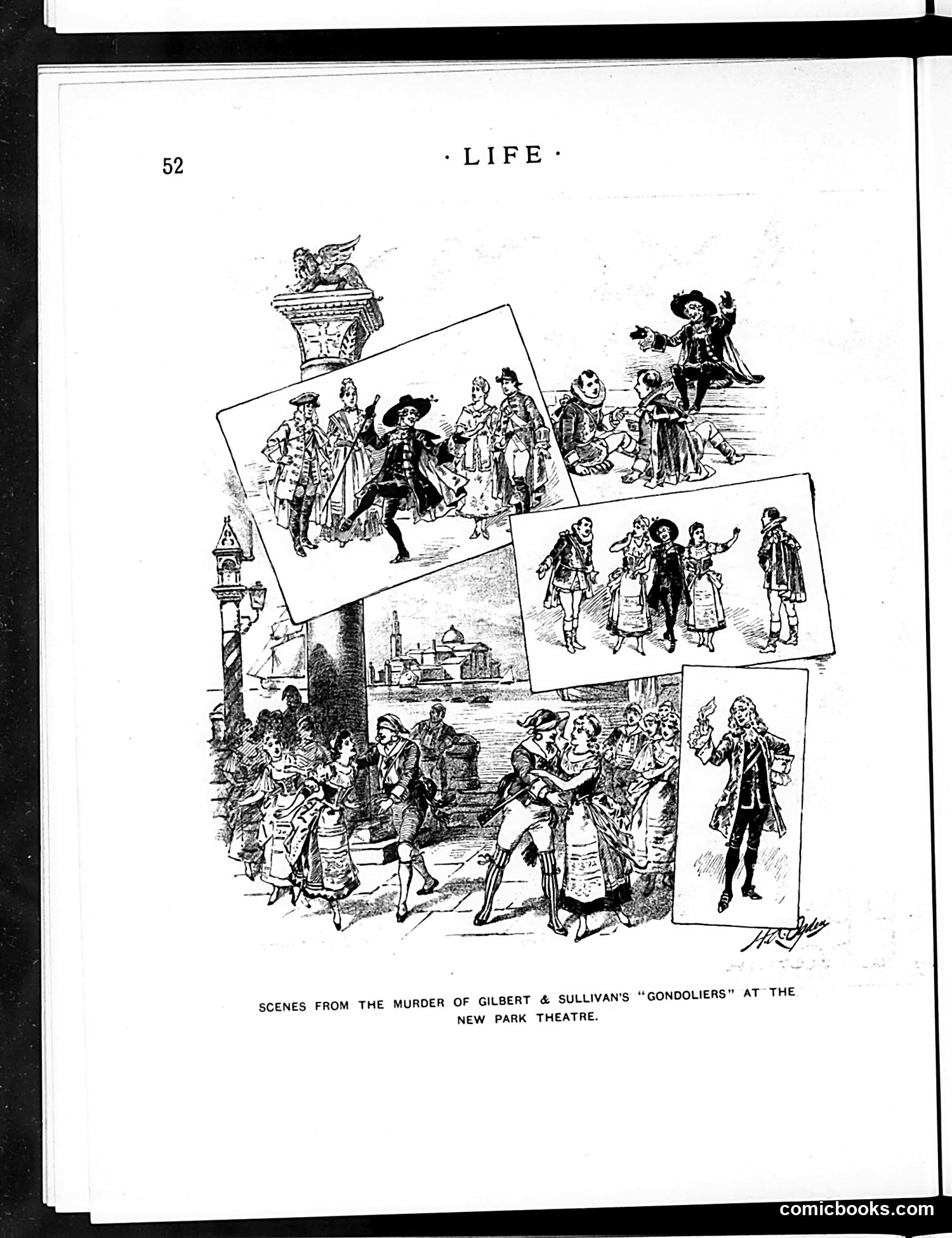
This page from *Life* magazine features theatrical illustration depicting scenes from Gilbert & Sullivan's "The Gondoliers" as performed at the New Park Theatre. The image is a collage of sketch vignettes showing various costumed characters in Victorian-era operatic dress—appearing to be Venetian gondoliers, noblemen, and women in period attire. Rather than political satire, this appears to be theatrical coverage or advertisement for the operetta production. The multiple framed scenes showcase different moments and character types from the show. The winged lion statue at top suggests Venice, the operetta's setting. This represents *Life* magazine's arts and entertainment coverage rather than its better-known satirical political content.
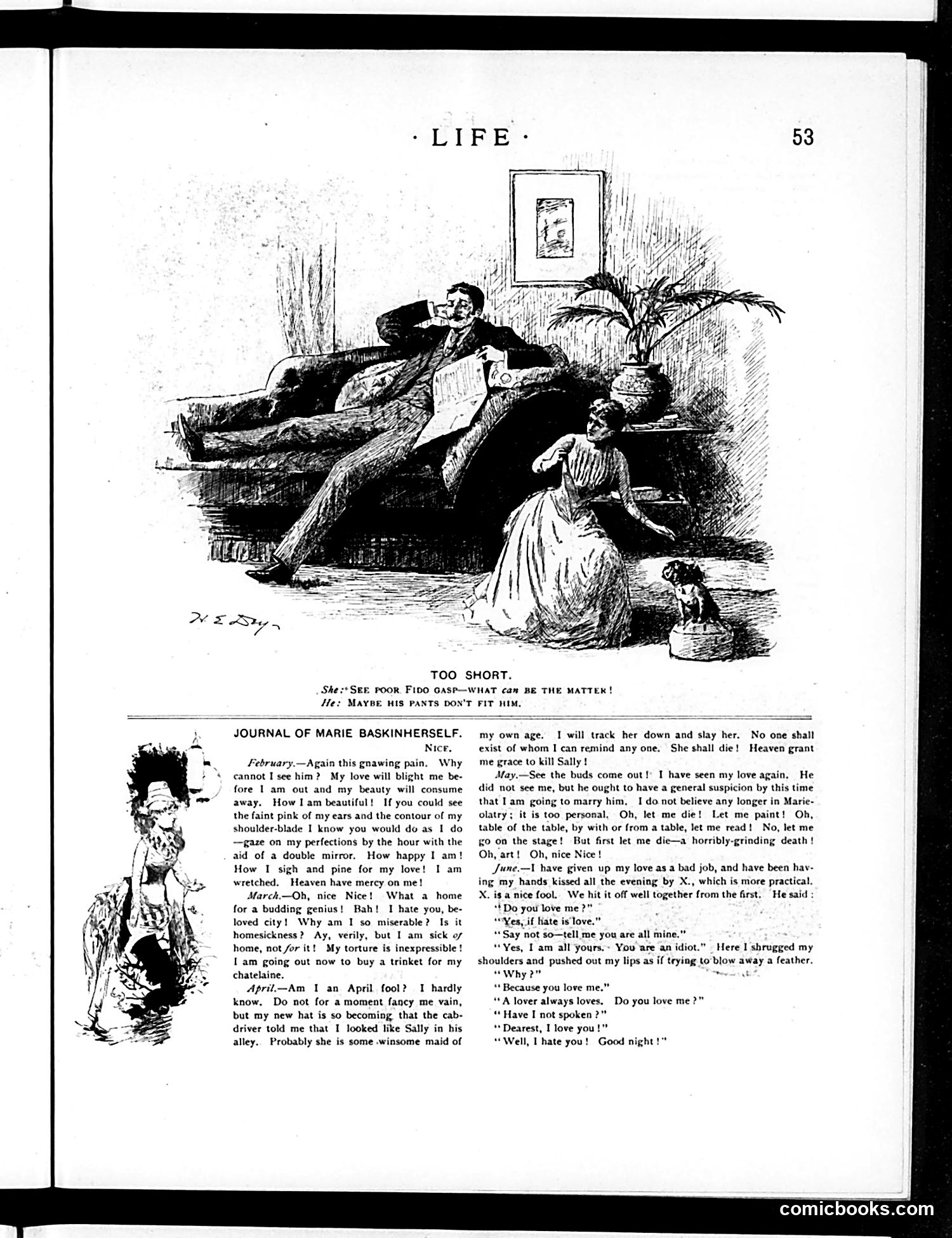
This page contains a satirical cartoon titled "TOO SHORT" depicting a domestic scene where a man lounges on a sofa while a woman kneels before him. The caption suggests he's complaining his pants don't fit properly—a crude visual joke playing on marital dynamics and male entitlement. Below is "Journal of Marie Baskinherself," a humorous diary entry satirizing romantic relationships. The narrator obsesses over her love life across multiple months (February through April), cycling through emotional extremes: despair, hope, jealousy, and reconciliation with her lover "N." The satire mocks women's perceived emotional volatility in romance and the melodrama of Victorian-era courtship. The accompanying illustration shows a woman in various states of romantic distress, reinforcing stereotypes about female emotionalism that Life magazine frequently lampooned.
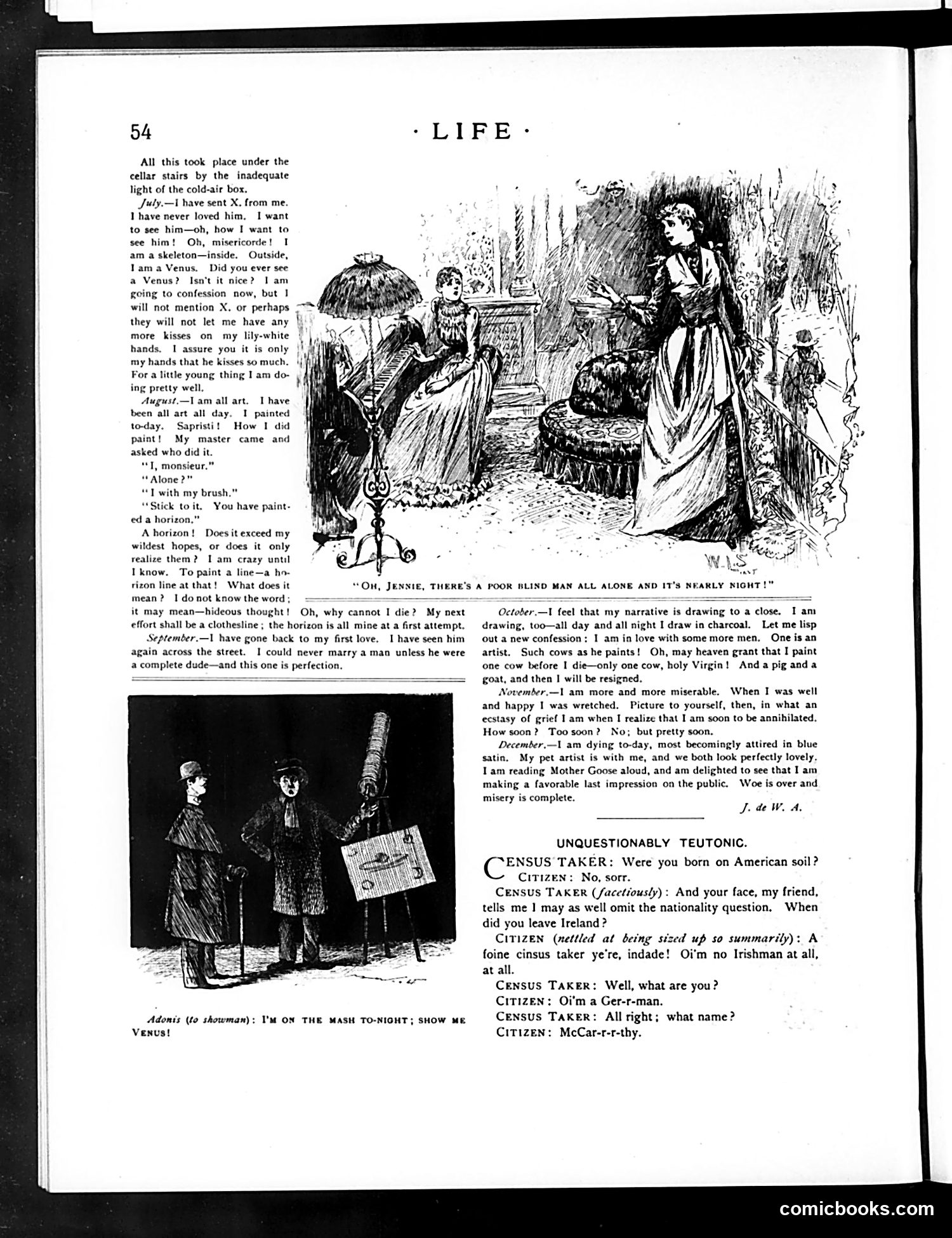
This page contains two distinct satirical pieces: **"The Diary" (top):** A mock-romantic narrative mocking pretentious young artists. The unnamed female narrator—illustrated as an attractive woman—chronicles her theatrical emotional life: romantic obsession, artistic pretensions (painting a "horizon"), and melodramatic declarations of dying in "blue satin." The satire targets overly sentimental, self-absorbed bohemian artists and their affected sensibilities. **"Unquestionably Teutonic" (bottom):** A census taker interrogates an Irish immigrant who initially denies being Irish, then claims to be German—yet reveals his obviously Irish name "McCarthy." The joke satirizes Irish-Americans' attempts to conceal or deny their ethnicity, possibly during a period of anti-Irish prejudice. The misspelled dialect ("Oi'm," "foine") reinforces ethnic caricature stereotyping common in early 20th-century American humor. Both pieces mock their subjects through exaggeration and contradiction.
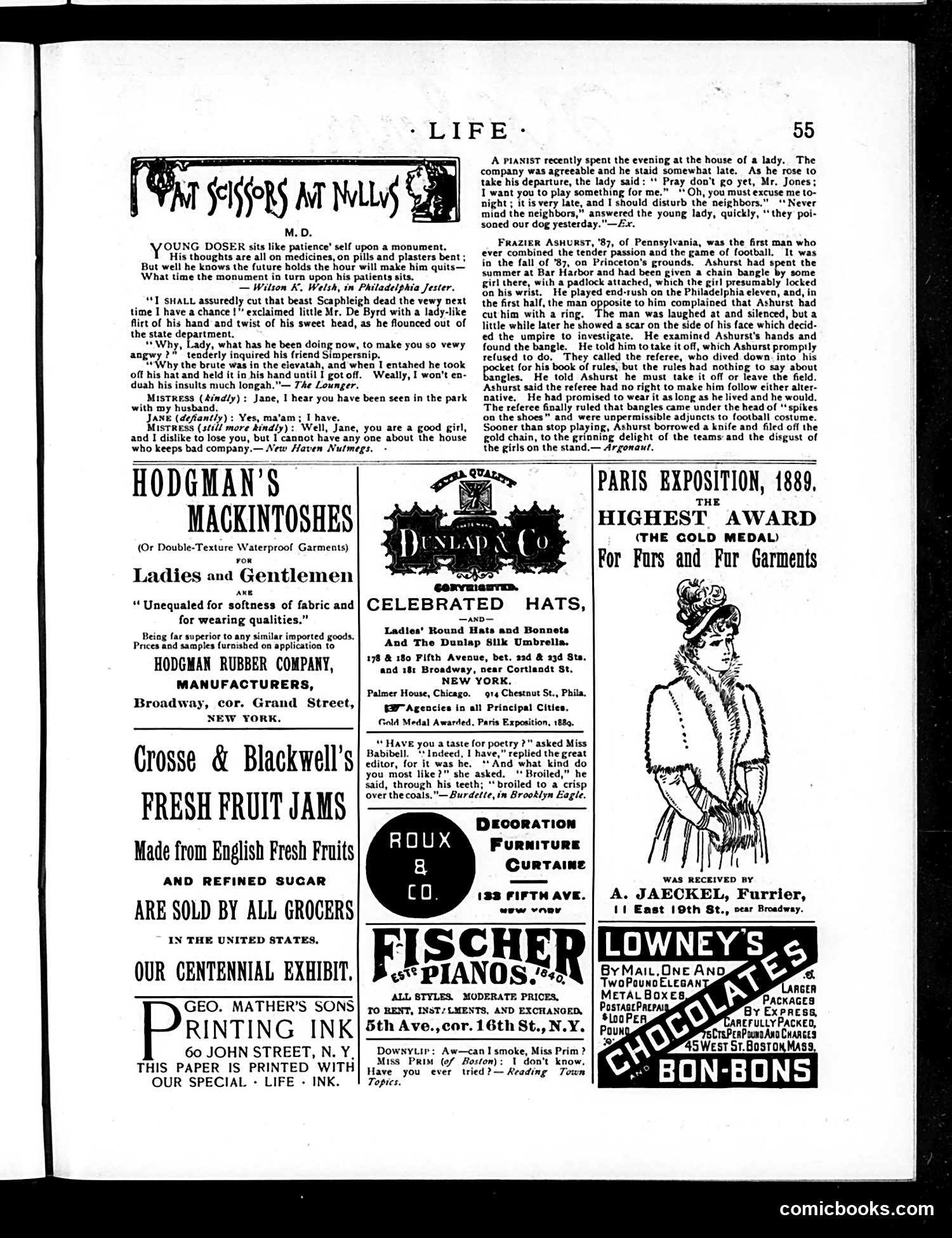
This page contains several satirical short pieces typical of Life's humor format: **Main cartoon/title piece**: "Scissors at Nulls" by M.D. presents a darkly humorous reversal—a young doctor who carefully considers medicines and treatments will eventually become a patient himself, sitting "upon" (as a monument) while others treat him. It's a memento mori joke about professional irony. **The satirical anecdotes** mock social pretension and absurdity: - A foppish man ("Mr. De Byrd") threatens to "cut" an acquaintance for the grave offense of removing his hat in an elevator - A lady casually mentions their dog was poisoned by neighbors while inviting a pianist to play late at night - A football player refuses to remove a love-token bangle despite it injuring opponents, eventually filing it off rather than breaking his romantic promise These pieces ridicule affectation, social one-upmanship, and emotional excess. The page is primarily **advertising** (Hodgman mackintoshes, jams, pianos, chocolates), with humor pieces filling remaining space—typical of 19th-century magazine layout.
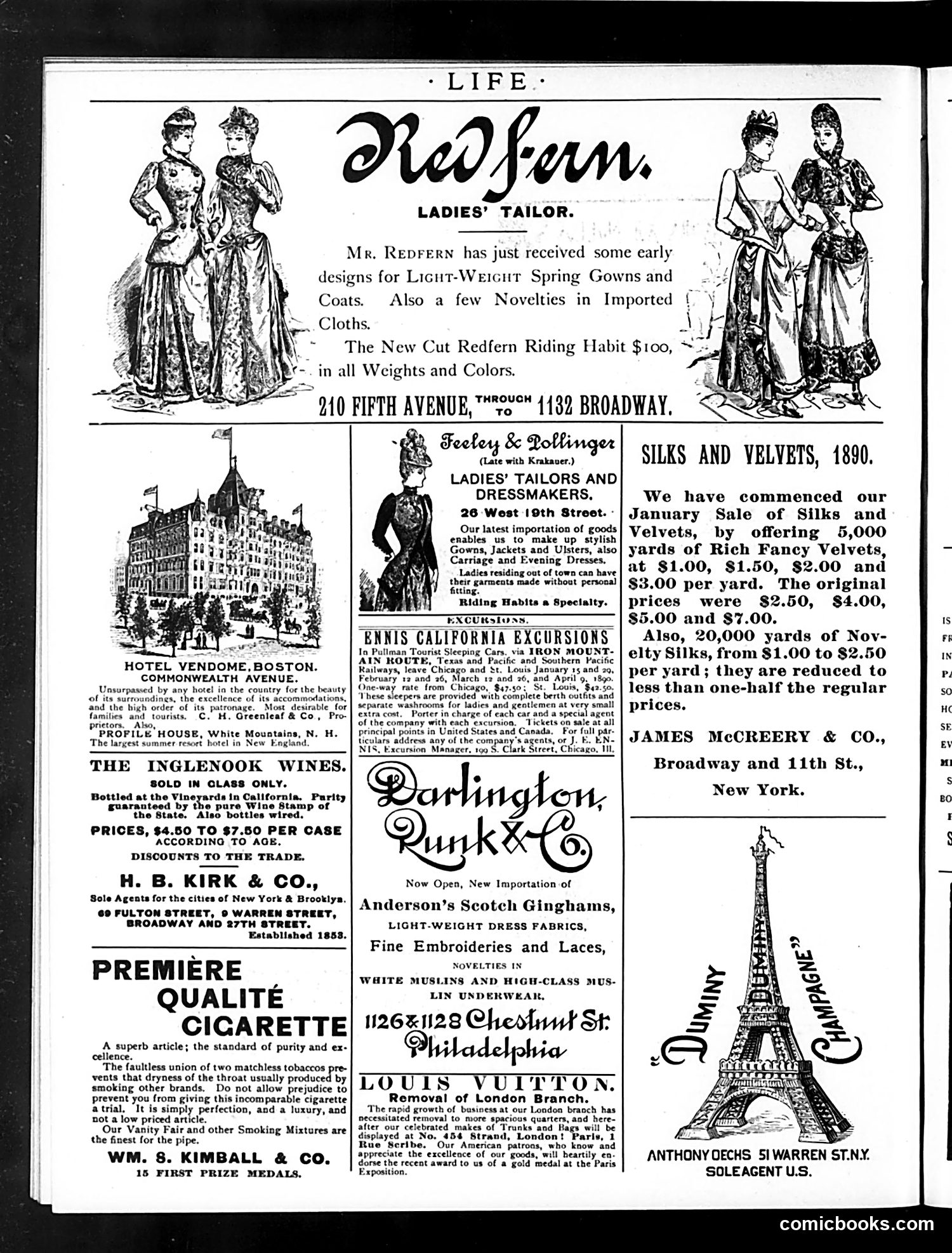
This is primarily an **advertising page** from Life magazine (circa 1890), not a satirical cartoon page. The page features luxury goods and services advertisements targeting wealthy consumers of the Gilded Age. Key advertised items include: - **Redfern Ladies' Tailor** (high-end fashion, $100 riding habits) - **Hotel Vendome** (Boston luxury hotel) - **Inglenook Wines** (California vintages) - **Premiere Qualité Cigarettes** (luxury tobacco) - **Louis Vuitton** (trunks and luggage, announcing London expansion) - **James McCreery & Co.** (silks and velvets sale) - **Darlington, Runk & Co.** (Scottish ginghams and fine textiles) The page reflects **late 19th-century consumer culture** targeting the wealthy elite. The advertisements emphasize imported goods, European prestige (Paris, London), and refined leisure activities. There is **no political satire or cartoon content** visible—this is purely commercial advertising representative of Life's revenue model and its affluent readership.
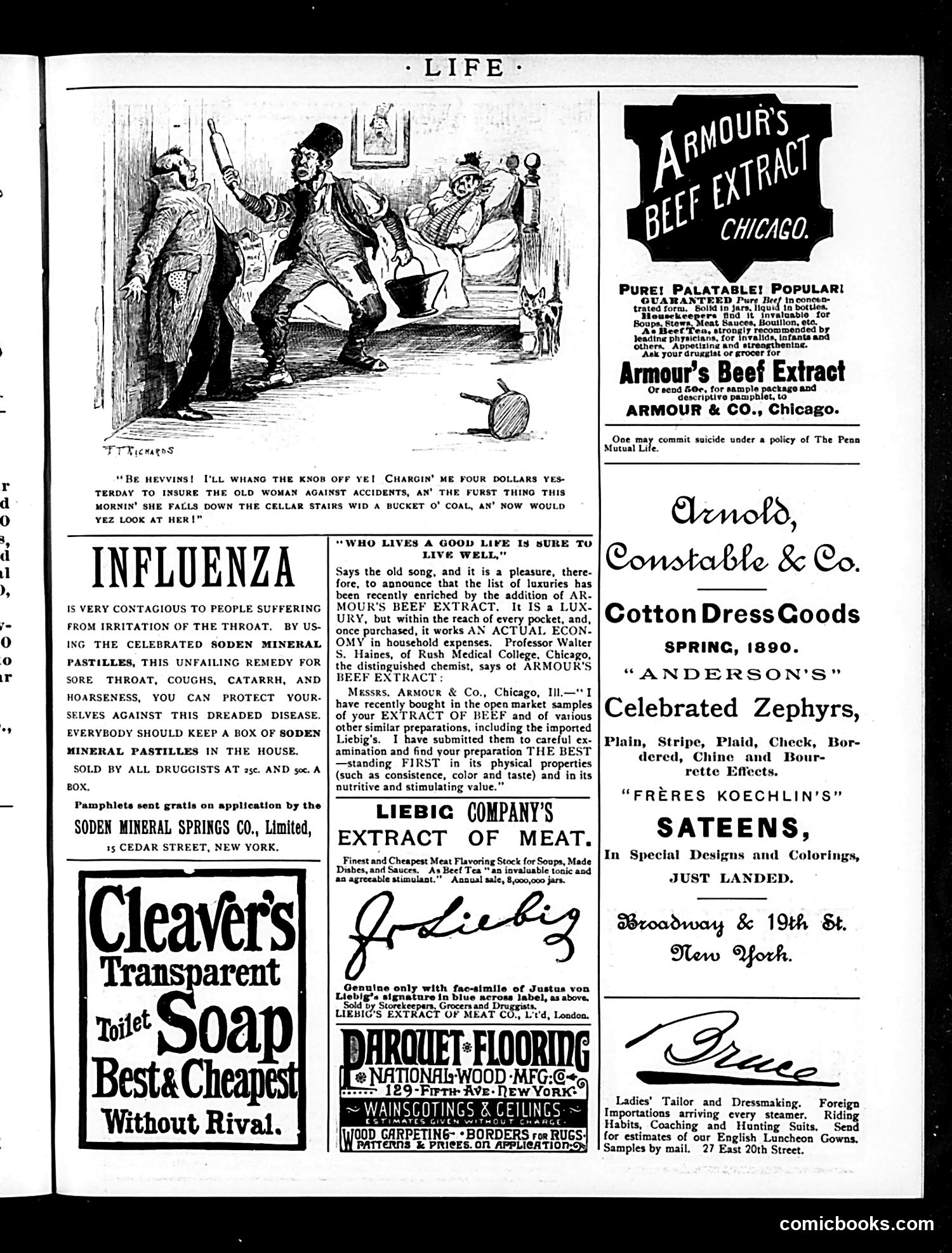
The illustrated joke depicts an Irish immigrant (identifiable by dialect and caricature style) complaining to an insurance agent. He paid four dollars the previous day to insure his wife against accidents, and this morning she fell down the cellar stairs with a bucket of coal. He's angrily demanding payment, questioning why he'd pay for insurance if it won't cover such mishaps. The satire mocks both the absurdity of early accident insurance policies and stereotypes Irish working-class people as litigious and quick to anger. # Context This appears in *Life*, a satirical weekly. The cartoon reflects 1890s anxieties about new insurance products and their ambiguous coverage terms—a common source of consumer frustration. The exaggerated Irish dialect and physicality were standard comedic tropes in period publications, though offensive by modern standards. The page is otherwise filled with product advertisements (beef extract, soap, textiles), typical of the magazine's revenue model.
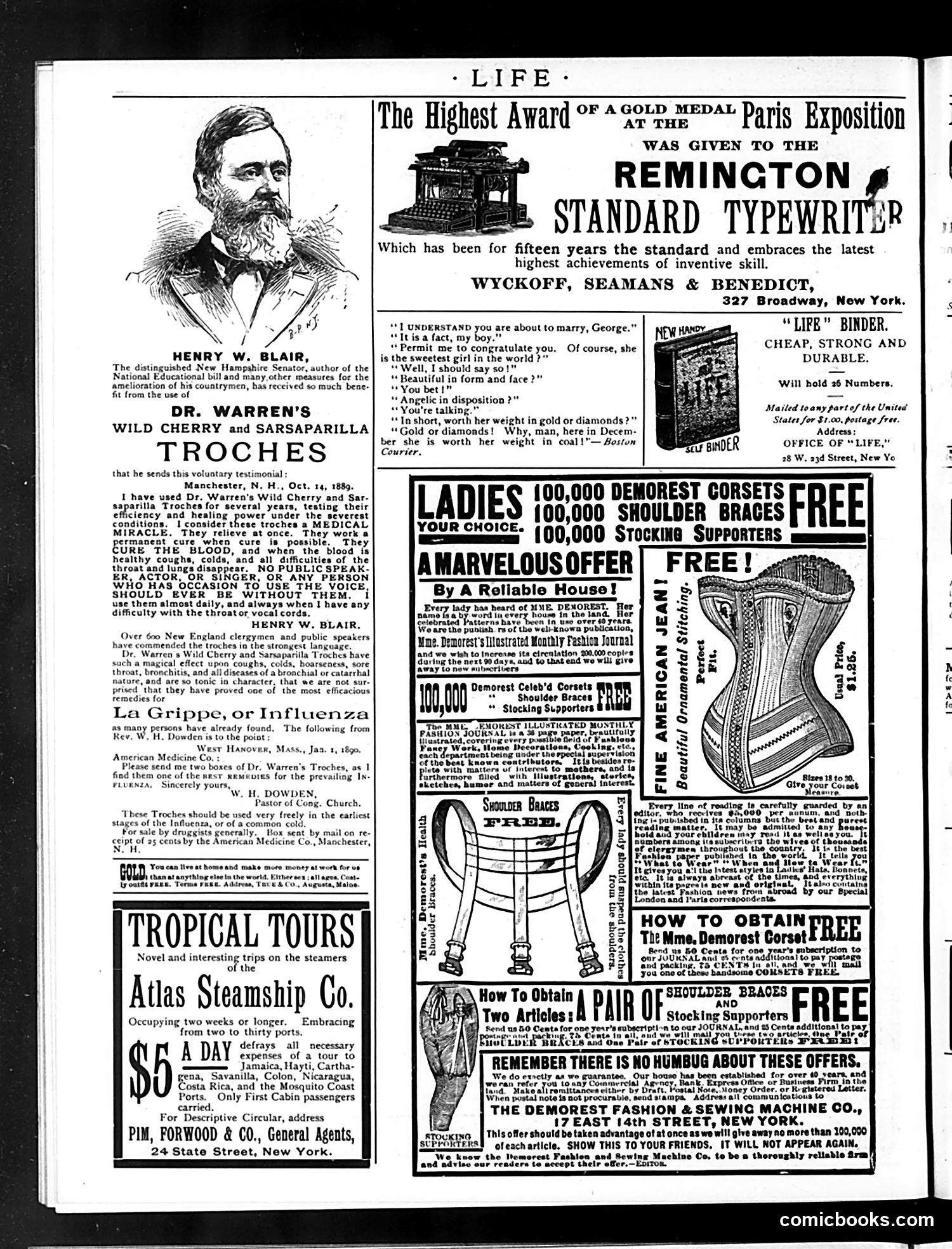
This page is primarily **advertising**, not political satire. The dominant content consists of testimonial ads and product promotions typical of 1880s-90s publications. **Key content:** - **Henry W. Blair testimonial**: A real U.S. Senator from New Hampshire endorses Dr. Warren's Wild Cherry and Sarsaparilla Troches for throat/cough relief, claiming they're essential for public speakers and singers. This reflects the era's patent medicine culture, where prominent figures lent credibility to largely unregulated remedies. - **Remington Typewriter ad**: Announces the machine won a gold medal at the Paris Exposition, positioning it as the standard fifteen-year leader in "inventive skill." - **Humor joke**: A brief comic dialogue about a man's fiancée being "worth her weight in coal" (not gold) in December—a seasonal joke about heating costs. - **Corset/brace giveaway**: The Demorest Fashion company advertises free corsets and shoulder braces to boost magazine subscriptions. The page represents late-Victorian commercial culture: celebrity endorsements, medicinal claims without regulation, and women's fashion marketing.
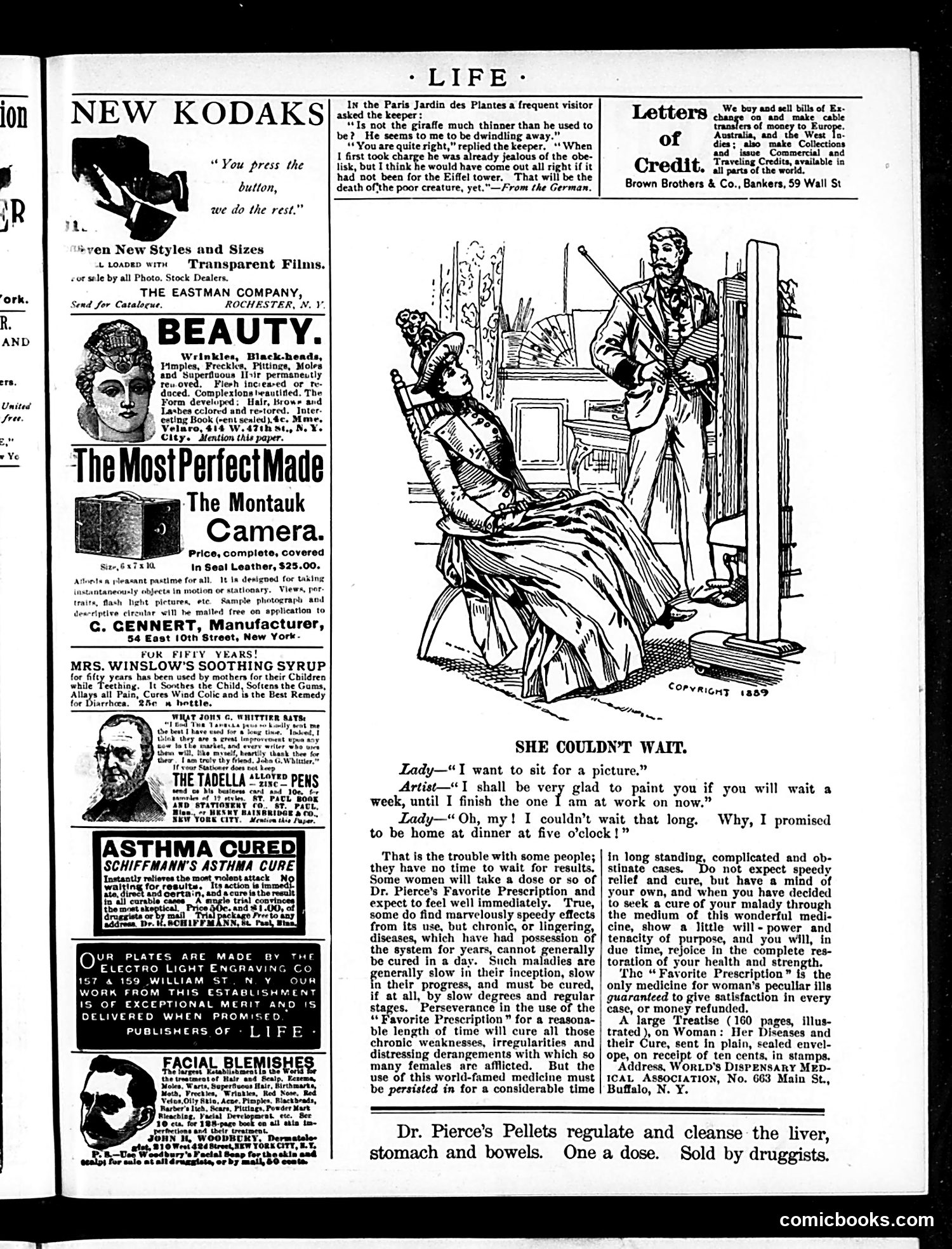
This cartoon mocks the modern impatience of affluent women seeking quick fixes. A lady demands a portrait sitting but refuses to wait weeks for the artist to complete it, claiming she must be home by five o'clock for dinner. The joke connects to the adjacent medical advertisement for Dr. Pierce's "Favorite Prescription" (a patent medicine for women's ailments). The satire suggests that just as the lady expects instant portraiture, people—particularly women—unrealistically expect chronic illnesses to cure overnight from patent medicines, when serious conditions require patience and prolonged treatment. The cartoon reflects late-19th-century skepticism toward both the rushing modern pace and the false promises of patent medicine cure-alls. It's gender-coded commentary on female frivolousness and unrealistic expectations, typical of Life magazine's satirical tone of the era.
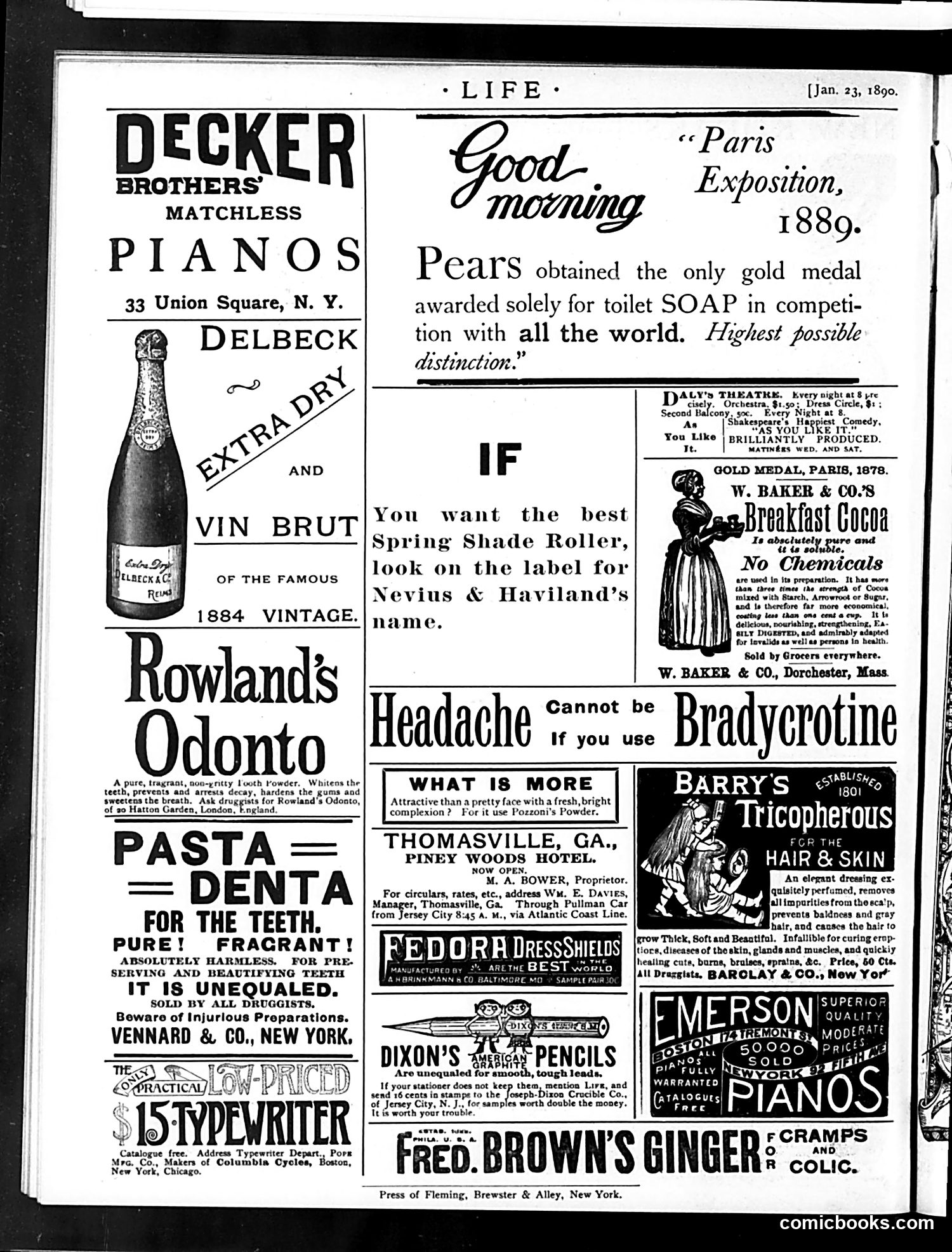
This is primarily an **advertisement page**, not a political cartoon page. It contains no satirical content or political commentary. The page showcases late-19th-century consumer products through paid advertising: pianos, champagne, dental products (tooth powder and paste), typewriters, chocolate, cocoa, spring-shade rollers, pencils, theater listings, and patent medicines like "Bradyerotine" (for headaches) and "Fred. Brown's Ginger" (for cramps). Notable to modern readers: several ads tout "gold medals" from the 1878-1889 Paris Expositions—a common marketing tactic of the era, suggesting international quality validation. The advertisements reflect period consumer concerns (dental hygiene, baldness remedies) and the prevalence of patent medicines before FDA regulation. The layout and typography typify late-Victorian commercial design.