
Life, 1890-01-23 · page 6 of 18
Life — January 23, 1890 — page 6: what you’re looking at
What you’re looking at
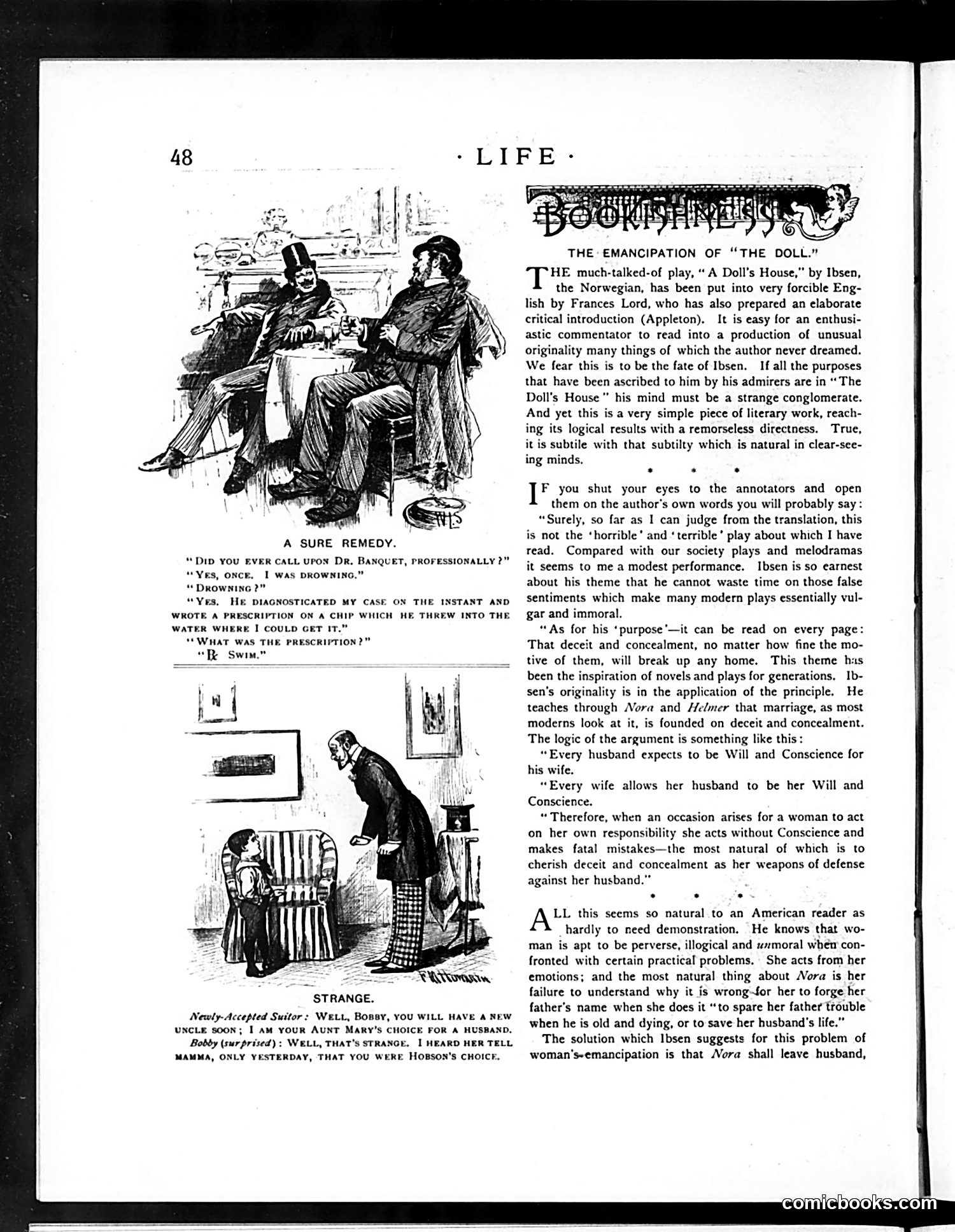
This page discusses Henrik Ibsen's play *A Doll's House*, specifically Frances Lord's English adaptation. The cartoons illustrate Victorian social attitudes the play critiques. The top cartoon ("A Sure Remedy") shows two men discussing a doctor's absurd prescription—throwing a chip in water to cure drowning—satirizing illogical solutions to problems. The bottom cartoon ("Strange") depicts a domestic scene where an aunt announces a young man as a potential husband. The humor lies in the nephew's surprised reaction to this arranged-marriage proposal, mocking Victorian courtship customs. The accompanying text argues that Ibsen's play challenges deception in marriage, proposing that wives should have autonomy and responsibility equal to husbands. The cartoons reinforce how foreign such ideas were to contemporary American readers accustomed to rigid gender roles.
📄 Transcribed text from this page (OCR, searchable)
Machine-transcribed from the original scan — historical spelling and the odd misread are preserved.
A SURE REMEDY. “DID YOU EVER CALL UPON DR. BANQUET, PROFESSIONALLY ?” “Yes, once, 1 WAS DROWNING.” “ Drownino 2?” “Yes, HE DIAGNOSTICATED MY CASE ON THE INSTANT AND WROTE A PRESCRIPTION ON A CHIP WHICH HE THREW INTO THE WATER WHERE I COULD GET IT. ** WHAT WAS THE PRESCRIPTION?” “Be Swain.” STRANGE. Newly- Accepted Suitor: WeLt, BOBBY, YOU WILL HAVE A NEW UNCLE SOON; I AM YOUR AUNT MARY'S CHOICE FOR A HUSBAND. Bobby (surprised): WELL, THAT'S STRANGE. I HEARD HER TELL MAMMA, ONLY YESTERDAY, THAT YOU WERE Hosson's CHOICE, THE: EMANCIPATION OF “THE DOLL.” i Gite much-talked-of play, “A Doll’s House,” by Ibsen, the Norwegian, has been put into very forcible Eng- lish by Frances Lord, who has also prepared an elaborate critical introduction (Appleton). It is easy for an enthusi- astic commentator to read into a production of unusual originality many things of which the author never dreamed. We fear this is to be the fate of Ibsen. If all the purposes that have been ascribed to him by his admirers are in “The Doll's House" his mind must be a strange conglomerate. And yet this is a very simple piece of literary work, reach- ing its logical results with a remorseless directness. True, it is subtile with that subtilty which is natural in clear-see- ing minds. JF you shut your eyes to the annotators and open them on the author's own words you will probably say: “Surely, so far as I can judge from the translation, this is not the ‘horrible’ and ‘terrible’ play about which I have read. Compared with our society plays and melodramas it seems to mea modest performance. Ibsen is so earnest about his theme that he cannot waste time on those false sentiments which make many modern plays essentially vul- gar and immoral. “As for his ‘purpose’—it can be read on every page: That deceit and concealment, no matter how fine the mo- tive of them, will break up any home. This theme has been the inspiration of novels and plays for generations. Ib- sen's originality is in the application of the principle. He teaches through Nora and Helmer that marriage, as most moderns look at it, is founded on deceit and concealment. The logic of the argument is something like this: “Every husband expects to be Will and Conscience for his wife. “Every wife allows her husband to be her Will and Conscience. “Therefore, when an occasion arises for a woman to act on her own responsibility she acts without Conscience and makes fatal mistakes—the most natural of which is to cherish deceit and concealment as her weapons of defense against her husband.” . . . . . . LL this seems so natural to an American reader as hardly to need demonstration. He knows that wo- man is apt to be perverse, illogical and “moral whem con- fronted with certain practical problems. She acts from her emotions; and the most natural thing about Nora is her failure to understand why it is wrong-for her to forge her father’s name when she does it “to spare her father trouble when he is old and dying, or to save her husband's life.” The solution which Ibsen suggests for this problem of woman's-emancipation is that Nora shall leave husband,