
Life, 1890-01-23 · page 4 of 18
Life — January 23, 1890 — page 4: what you’re looking at
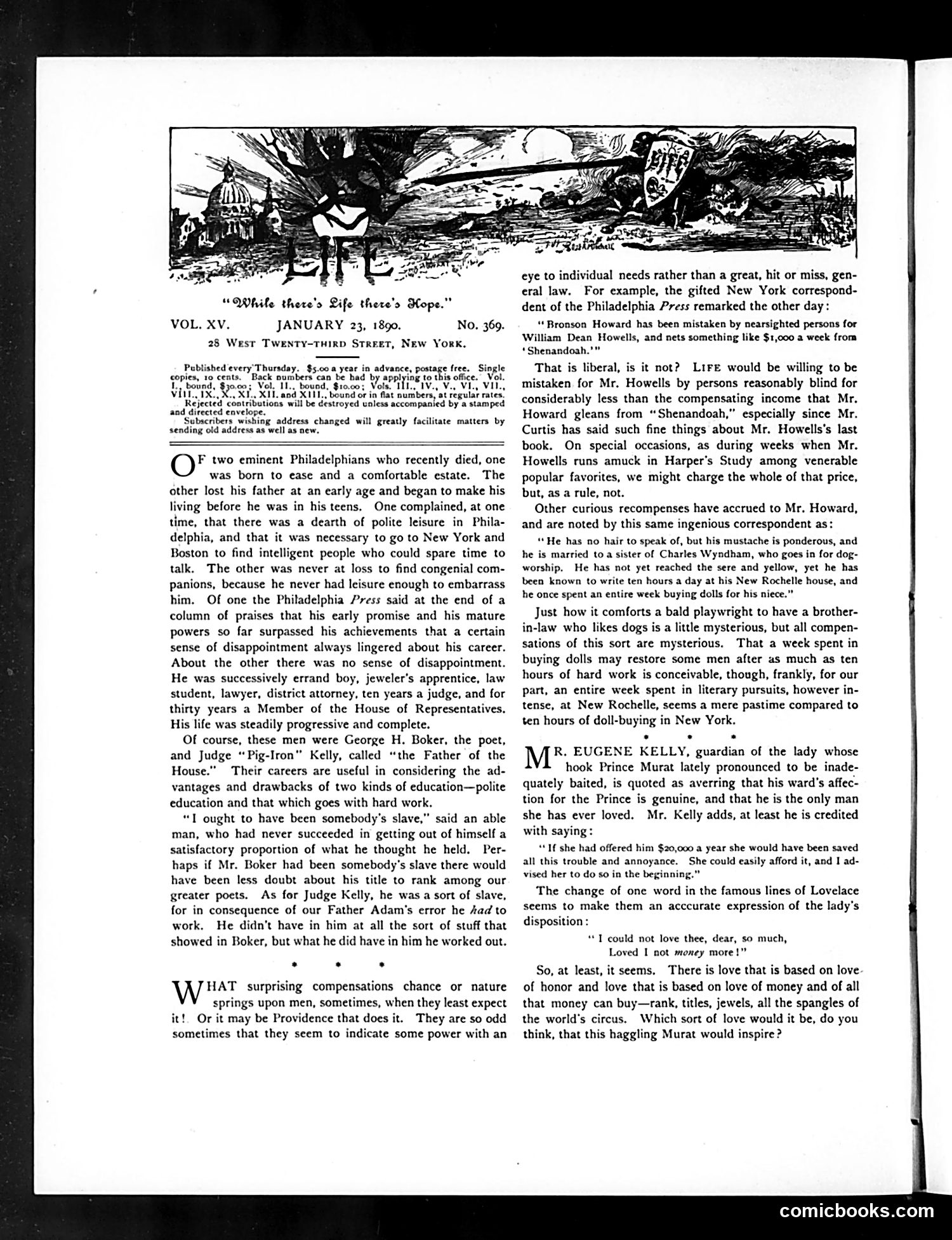
What you’re looking at
The masthead woodcut cartoon depicts a satirical landscape showing contrasts between poverty and wealth—a cathedral dome alongside humble dwellings, celestial imagery above scenes of earthly struggle. The visual metaphor appears to comment on social inequality and religious hypocrisy, themes common to 1890s Gilded Age satire. The article text discusses two deceased Philadelphia notables (likely George H. Hoker and Judge "Pig-Iron" Kelly) and their contrasting legacies. The satire examines how society compensates certain individuals—some achieving success despite humble origins, others receiving undeserved advantages. A secondary story mocks Mr. Eugene Kelly's guardianship dispute involving Prince Murat, where monetary compensation allegedly replaced genuine affection—critiquing how wealth corrupts relationships and values in high society.
📄 Transcribed text from this page (OCR, searchable)
Machine-transcribed from the original scan — historical spelling and the odd misread are preserved.
“Dhile there's Life there's Hope.” VOL. XV. JANUARY 23, 1890. No. 369. 28 West Twenty-THirp Street, New York. Published every'Thursday. $5.00. year in advance, postage free. Single gopies, 10 cents Back ourmbers can be bad by applying to this office. Vol. ; Vol, Tl., bound. $1.00; Vols HL IV., Vi. Vier VII, < X1I1., bound or in flat numbers, at regular rates i will be destroyed unless accompanied by a stamped and directed envelope. Subscribers wishing address changed will greatly facilitate matters by sending old address as well as new. F two eminent Philadelphians who recently died, one was born to ease and a comfortable estate. The other lost his father at an early age and began to make his living before he was in his teens. One complained, at one time, that there was a dearth of polite leisure in Phila- delphia, and that it was necessary to go to New York and Boston to find intelligent people who could spare time to talk. The other was never at loss to find congenial com- panions, because he never had Icisure enough to embarrass him. Of one the Philadelphia Press said at the end of a column of praises that his early promise and his mature powers so far surpassed his achievements that a certain sense of disappointment always lingered about his career. About the other there was no sense of disappointment. He was successively errand boy, jeweler’s apprentice, law student, lawyer, district attorney, ten years a judge, and for thirty years a Member of the House of Representatives. His life was steadily progressive and complete. Of course, these men were George H. Boker, the poet, and Judge “Pig-Iron" Kelly, called “the Father of the House." Their careers are useful in considering the ad- vantages and drawbacks of two kinds of education—polite education and that which goes with hard work. “T ought to have been somebody's slave,” said an able man, who had never succeeded in getting out of himself a satisfactory proportion of what he thought he held. Per- haps if Mr. Boker had been somebody's slave there would have been less doubt about his title to rank among our greater poets. As for Judge Kelly, he was a sort of slave, for in consequence of our Father Adam's error he Aad to work. He didn’t have in him at all the sort of stuff that showed in Boker, but what he did have in him he worked out. . . . HAT surprising compensations chance or nature springs upon men, sometimes, when they least expect it! Or it may be Providence that does it. They are so odd sometimes that they seem to indicate some power with an eye to individual needs rather than a great, hit or miss, gen- eral law. For example, the gifted New York correspond- dent of the Philadelphia Press remarked the other day: “Bronson Howard has been mistaken by nearsighted persons for William Dean Howells, and nets something like $1,000 a week from *Shenandoah.’" That is liberal, is it not? Lire would be willing to be mistaken for Mr. Howells by persons reasonably blind for considerably less than the compensating income that Mr. Howard gleans from “Shenandoah,” especially since Mr. Curtis has said such fine things about Mr. Howells’s last book. On special occasions, as during weeks when Mr. Howells runs amuck in Harper's Study among venerable popular favorites, we might charge the whole of that price, but, as a rule, not. Other curious recompenses have accrued to Mr. Howard, and are noted by this same ingenious correspondent as: “He has no hair to speak of, but his mustache is ponderous, and he is married to a sister of Charles Wyndham, who goes in for dog- worship. He has not yet reached the sere and yellow, yet he has been known to write ten hours a day at his New Rochelle house, and he once spent an entire week buying dolls for his niece." Just how it comforts a bald playwright to have a brother- in-law who likes dogs is a little mysterious, but all compen- sations of this sort are mysterious. That a week spent in buying dolls may restore some men after as much as ten hours of hard work is conceivable, though, frankly, for our part, an entire week spent in literary pursuits, however in- tense, at New Rochelle, seems a mere pastime compared to ten hours of doll-buying in New York. . . . R, EUGENE KELLY, guardian of the lady whose hook Prince Murat lately pronounced to be inade- quately baited, is quoted as averring that his ward's affec- tion for the Prince is genuine, and that he is the only man she has ever loved. Mr. Kelly adds, at least he is credited with saying: “If she had offered him $20,000 a year she would have been saved all this trouble and annoyance. She could easily afford it, and I ad- vised her to do so in the beginning.” The change of one word in the famous lines of Lovelace seems to make them an acccurate expression of the lady's disposition : “1 could not love thee, dear, so much, Loved I not money more!" So, at least, it seems, There is love that is based on love of honor and love that is based on love of money and of all that money can buy—rank, titles, jewels, all the spangles of the world’s circus. Which sort of love would it be, do you think, that this haggling Murat would inspire ? comicbooks.com