
A complete issue · 16 pages · 1890
Life — January 2, 1890
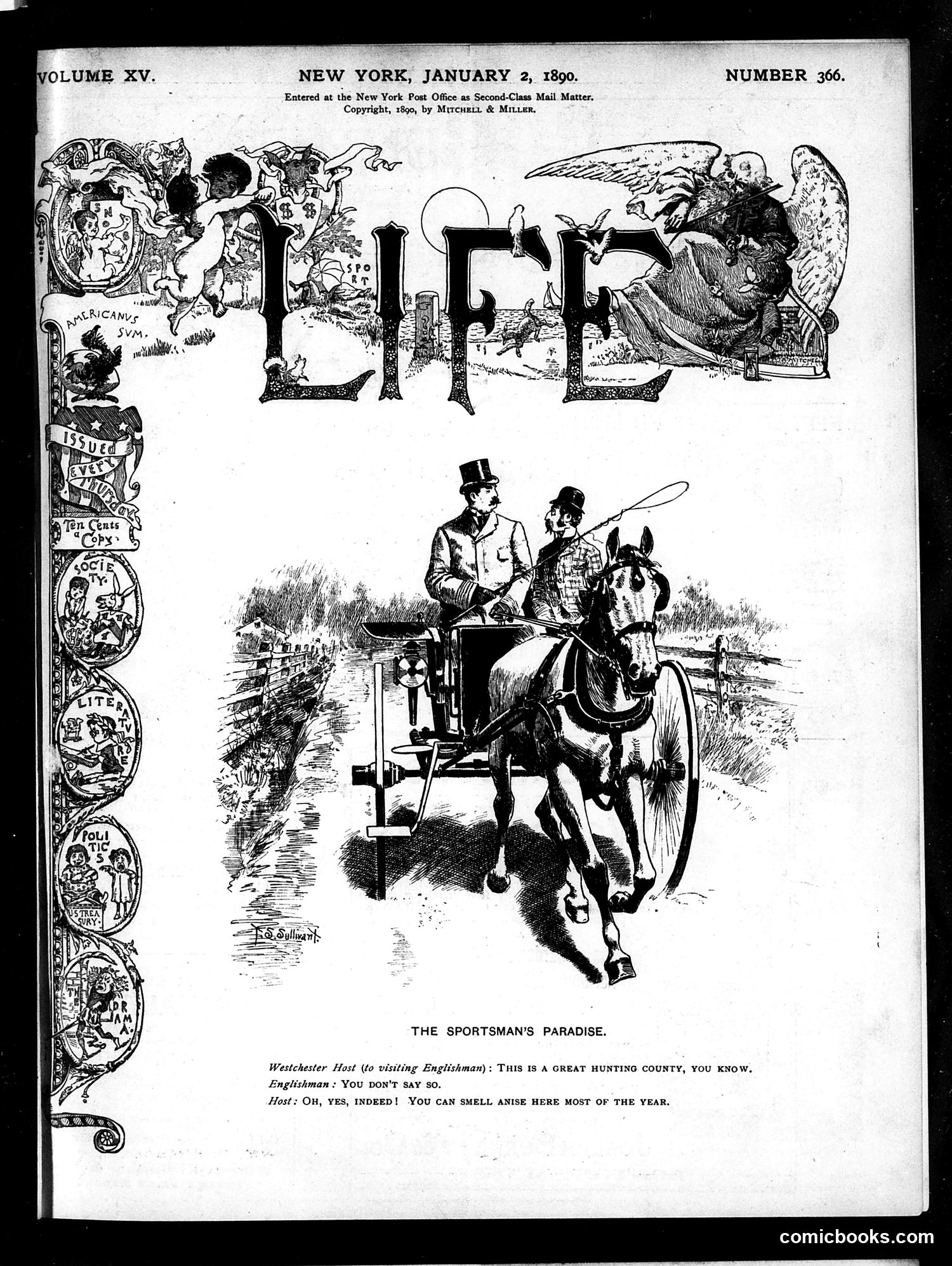
This cartoon depicts a horse-drawn cart carrying two men on a country road, captioned "The Sportsman's Paradise." The dialogue mocks rural English hunting culture: a Westchester host boasts to a visiting Englishman that "this is a great hunting country," but the guest responds sarcastically, "You don't say so." The host then claims "you can smell anise here most of the year." The humor appears to satirize American pretensions to English sporting traditions. The punchline—suggesting the area smells of anise (possibly implying cheap whiskey or inferior conditions)—mocks both the host's exaggerated claims and the gap between American and English sporting standards. The illustration style and setting suggest this targets wealthy American landowners aping British country-gentleman culture during the Gilded Age.
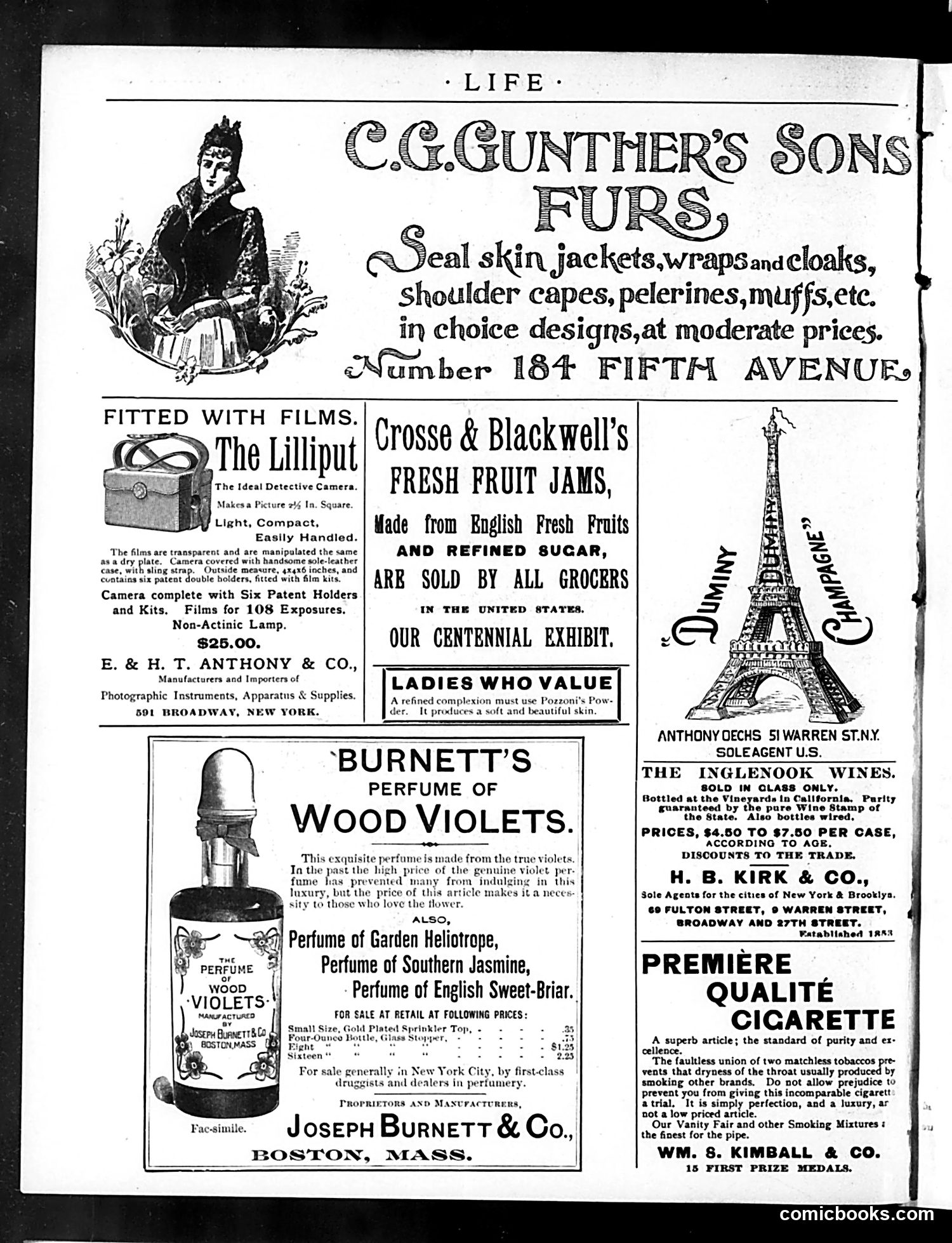
This page is **primarily advertising**, not satirical content. It contains six separate commercial advertisements from the late 19th or early 20th century: 1. **C.G. Gunther's Sons Furs** - seal skin garments at Fifth Avenue 2. **The Lilliput Detective Camera** - a compact film camera 3. **Crosse & Blackwell's Fresh Fruit Jams** - English preserves 4. **Pozoni's Complexion Powder** - cosmetics for women 5. **Burnett's Perfume of Wood Violets** - fragrances made in Boston 6. **Inglenook Wines, Premiere Qualité Cigarettes, and other luxury goods** The illustrated woman at top-left appears to be a fashionable society figure modeling the fur garments. No political satire or cartoon is evident—this is a straightforward commercial page from *Life* magazine's advertising section.
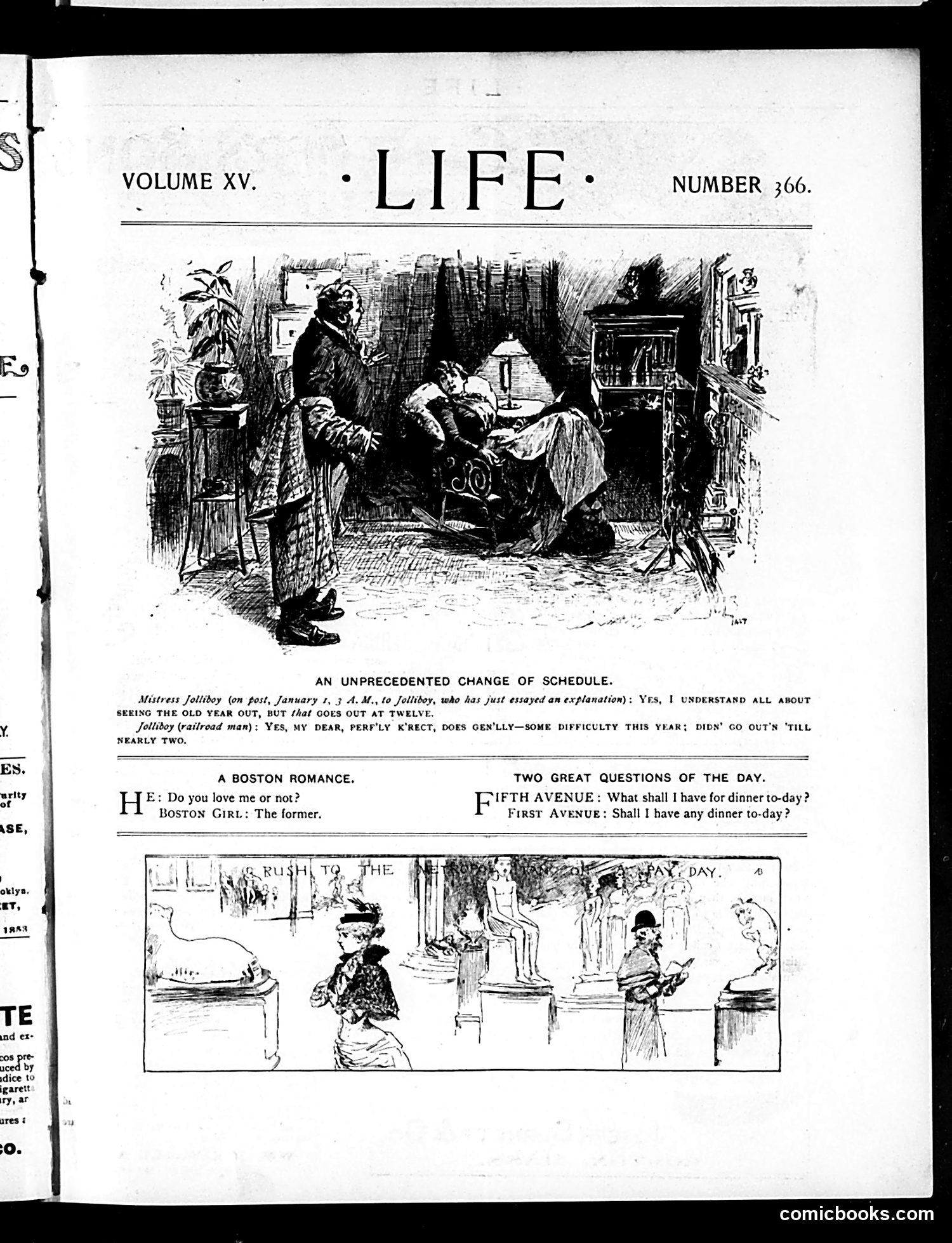
This page contains three distinct satirical pieces: **"An Unprecedented Change of Schedule"**: A sketch mocking someone's New Year's resolution about train schedules, with a railroad employee and passenger discussing the difficulty of adjusting to changes. **"A Boston Romance"**: A brief joke playing on romantic clichés, where a Boston girl's answer to "Do you love me?" is characteristically practical: "The former" (implying she loves his money more than the man himself). **"Two Great Questions of the Day"**: A comic strip satirizing urban poverty and food insecurity. The parallel questions—one from a wealthy Fifth Avenue resident and one from a poor First Avenue resident—both ask about dinner, but the stark contrast highlights class inequality and economic desperation in turn-of-the-century America. The satire targets wealth disparity and social conditions of the era.
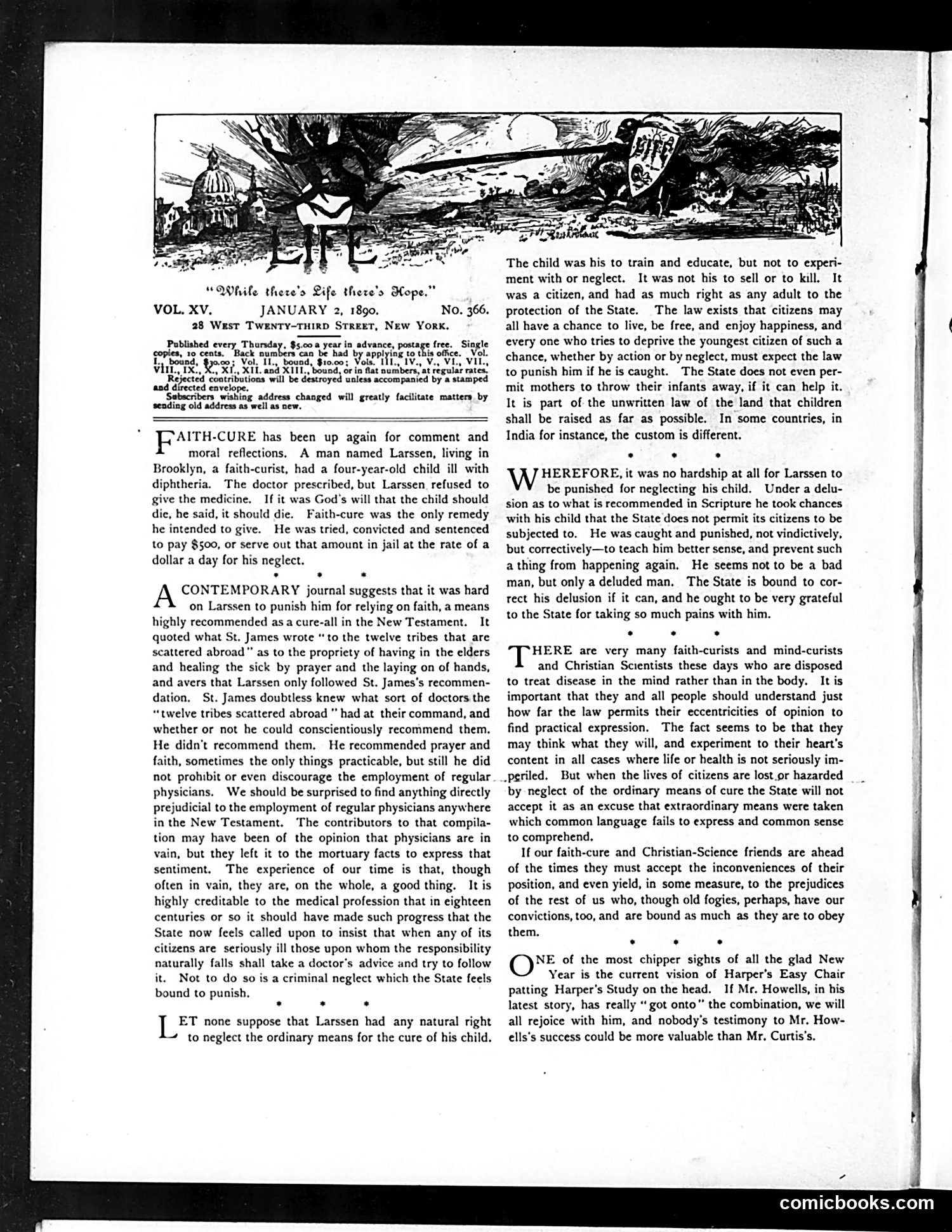
The masthead image depicts a satirical landscape with exaggerated figures and cityscape elements, though specific identities are unclear from the visual alone. The text discusses the "Faith-Cure" controversy—a contemporary religious movement where believers rejected medical treatment in favor of prayer. The case of Larssen, who denied his child medicine, resulting in the child's death and his legal punishment, serves as the article's focal point. The satire critiques both faith-healers and medical doctors, arguing the State must protect children from parental neglect. The piece defends legal intervention while acknowledging concerns about overreach, ultimately advocating reasonable medical standards as a civic responsibility—a progressive stance for 1890 regarding child welfare and state authority.
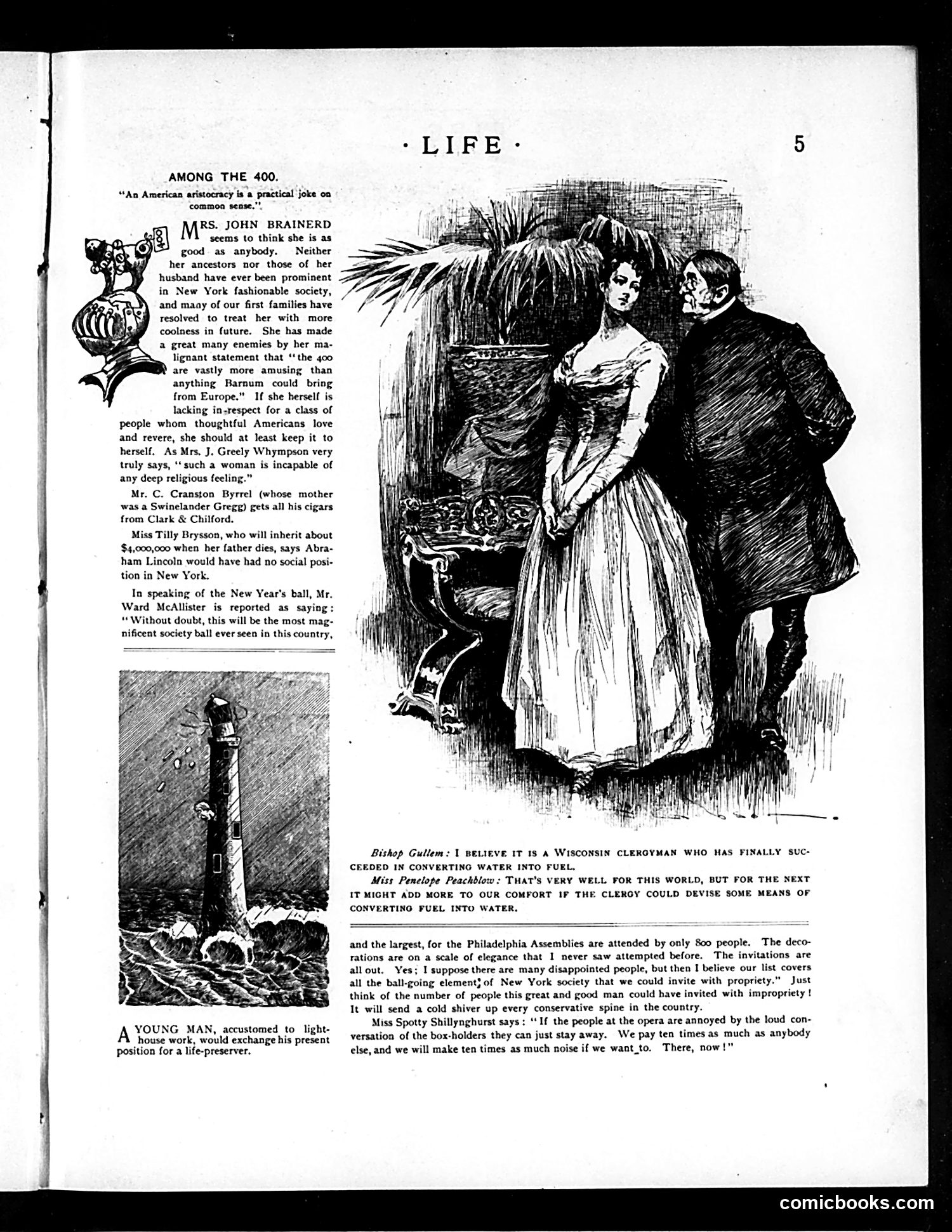
This page satirizes New York high society through two main pieces: **"Among the 400"** (left column) mocks wealthy socialites, particularly Mrs. John Brainerd, critiquing their pretensions and lack of substance. The text quotes society figures dismissively—one claiming American society is "vastly more amusing than anything Barnum could bring from Europe," another noting a wealthy woman is "incapable of any deep religious feeling." The satire suggests the upper class are shallow and self-absorbed. **The main illustration** (right) depicts a couple at what appears to be a social event, with the woman in an elaborate white dress. The accompanying caption jokes about a Wisconsin clergyman converting water to fuel, sarcastically suggesting clergy might similarly "devise some means of converting fuel into water" for the wealthy's comfort. The overall message: New York's elite are frivolous, materialistic, and deserving of ridicule.
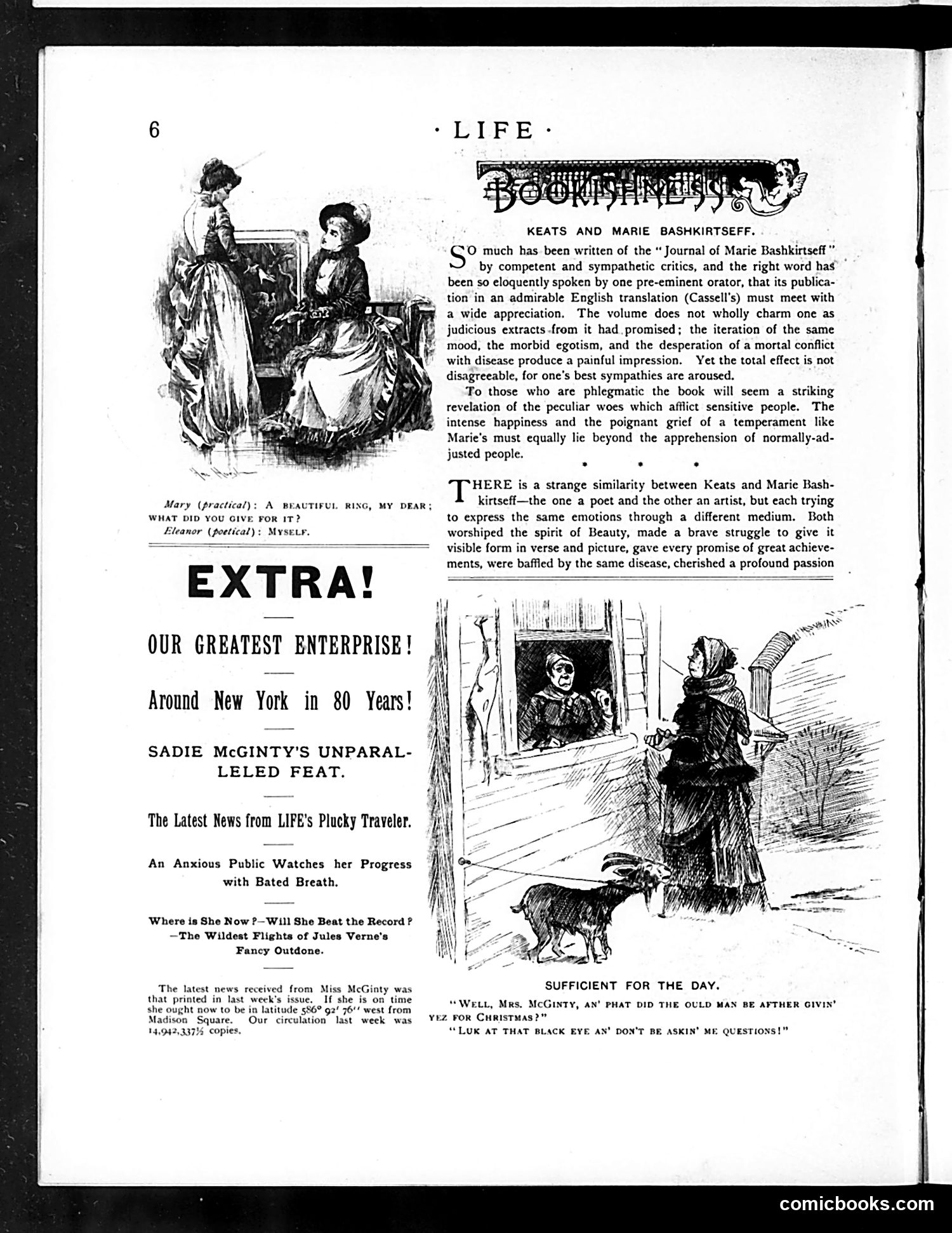
This page combines literary criticism with travel journalism and advertisements. The top section discusses Keats and Marie Bashkirtseff, comparing how both—a poet and an artist—expressed intense emotion through their respective mediums (verse and painting) while struggling with disease and unfulfilled passion. The lower half features "Sadie McGinty's Unparalleled Feat"—coverage of a traveler's journey around New York in 80 years. The accompanying illustration shows an elderly woman with a dog at a window, captioned "Sufficient for the Day," suggesting commentary on modest contentment or domestic life. The page appears primarily devoted to literary and travel content rather than political satire, representing Life magazine's broader cultural coverage beyond its famous political cartoons.
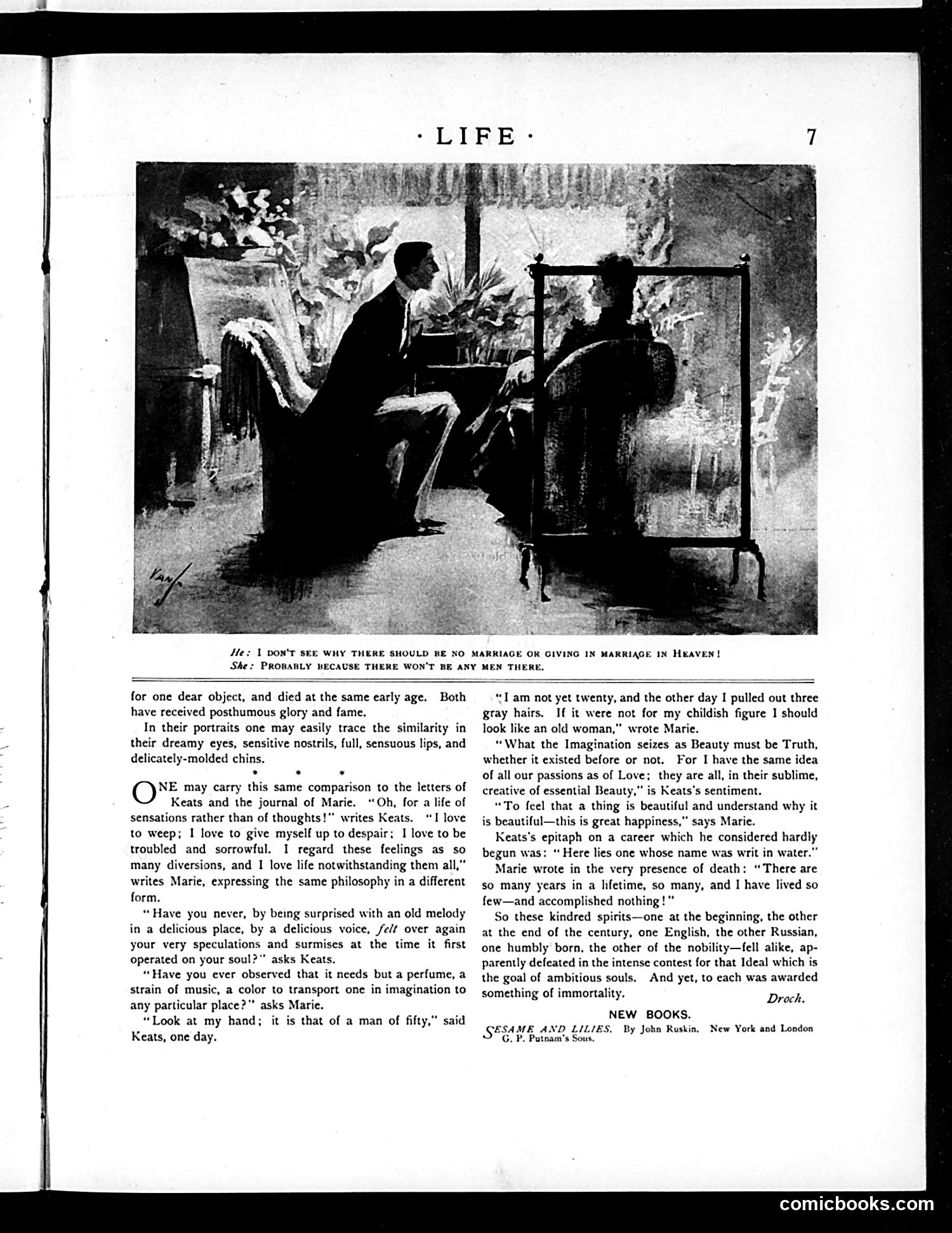
This page from *Life* magazine features a cartoon dialogue about marriage and the afterlife. The illustration shows three figures in silhouette in what appears to be an elegant interior with plants. The caption presents a domestic debate: a man argues there should be "no marriage or giving in marriage in Heaven," while a woman responds, "Probably because there won't be any men there." This is satirical commentary on marital discord—a common *Life* magazine trope of the early-to-mid 20th century. The joke hinges on the woman's implication that heaven without men would be preferable, suggesting she views her husband or marriage skeptically. It reflects period attitudes about gender relations and domestic frustration, presented as light, sophisticated humor for the magazine's educated readership. The remainder of the page contains literary discussion unrelated to the cartoon.
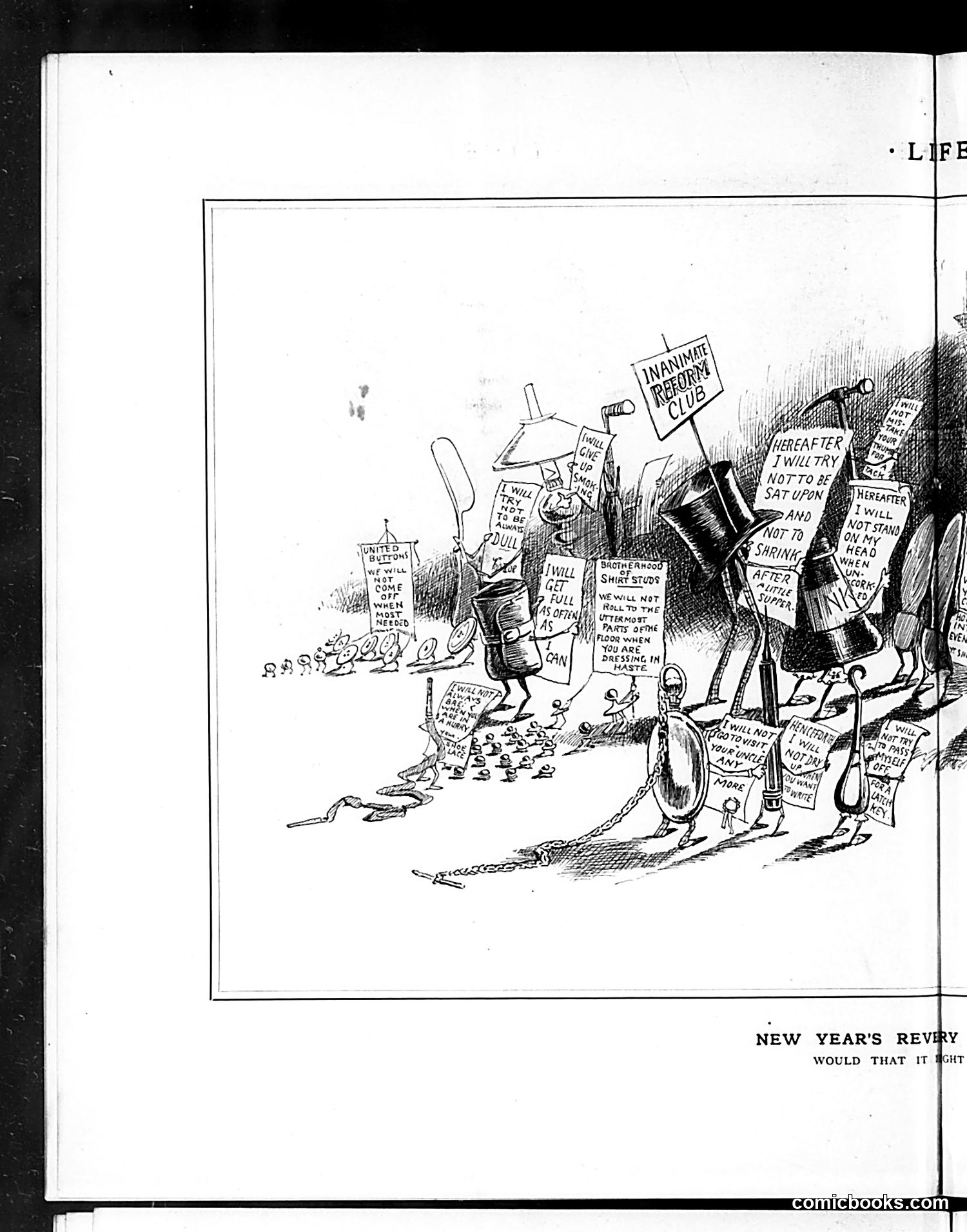
This satirical cartoon depicts anthropomorphized animals (appearing to be mice or rats) marching in procession while carrying signs with pledges and resolutions. The signs read promises like "I will not be sat upon," "I will try not to be set upon," "I will not shrink," and various other self-improvement vows. The "Inanimate Factory Club" sign suggests these are factory workers or laborers. The satire likely mocks the futility of New Year's resolutions, particularly for working-class people facing systemic exploitation. The animals' earnest pledges contrast ironically with their powerless position—they're depicted as tiny creatures dwarfed by larger figures and industrial elements, suggesting their resolutions are wishful thinking rather than achievable goals. The cartoon cynically suggests that workers' good intentions cannot overcome harsh economic realities.
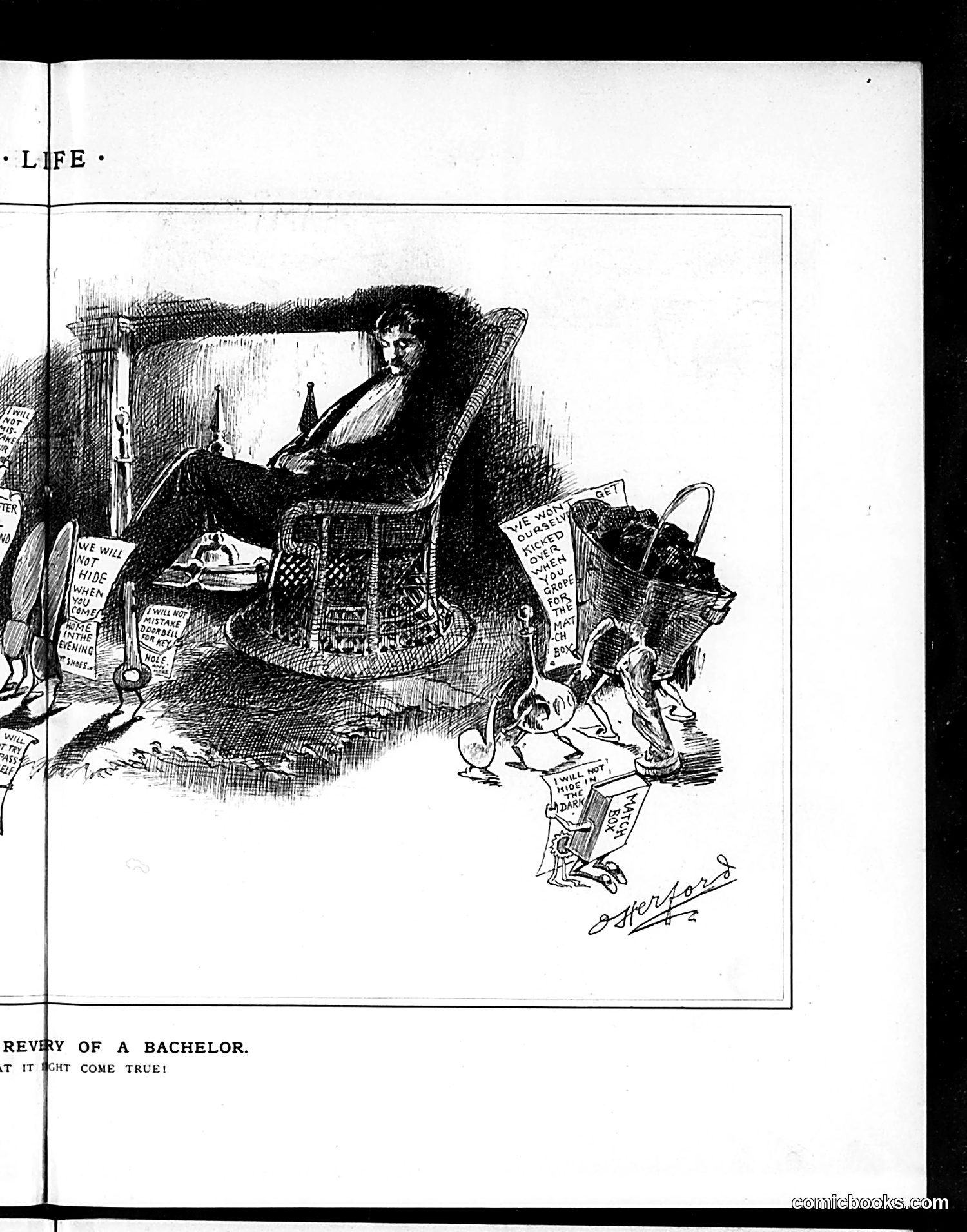
This cartoon satirizes bachelor life through the fantasy daydreams of a relaxed man in an armchair. The central figure imagines domestic scenes represented by small figures and signs surrounding him—likely depicting both the appealing and troublesome aspects of married life he contemplates. The title suggests ironic commentary: what a bachelor *dreams* marriage might be versus reality. The various small scenes with legible signs (though difficult to read in this reproduction) appear to show domestic scenarios—both romantic ideals and mundane or frustrating household situations. The cartoon mocks the bachelor's romanticized notions about marriage, presenting his idle fantasies as disconnected from actual married life's complexities. This reflects early 20th-century *Life* magazine's satirical approach to social institutions and gender relations.
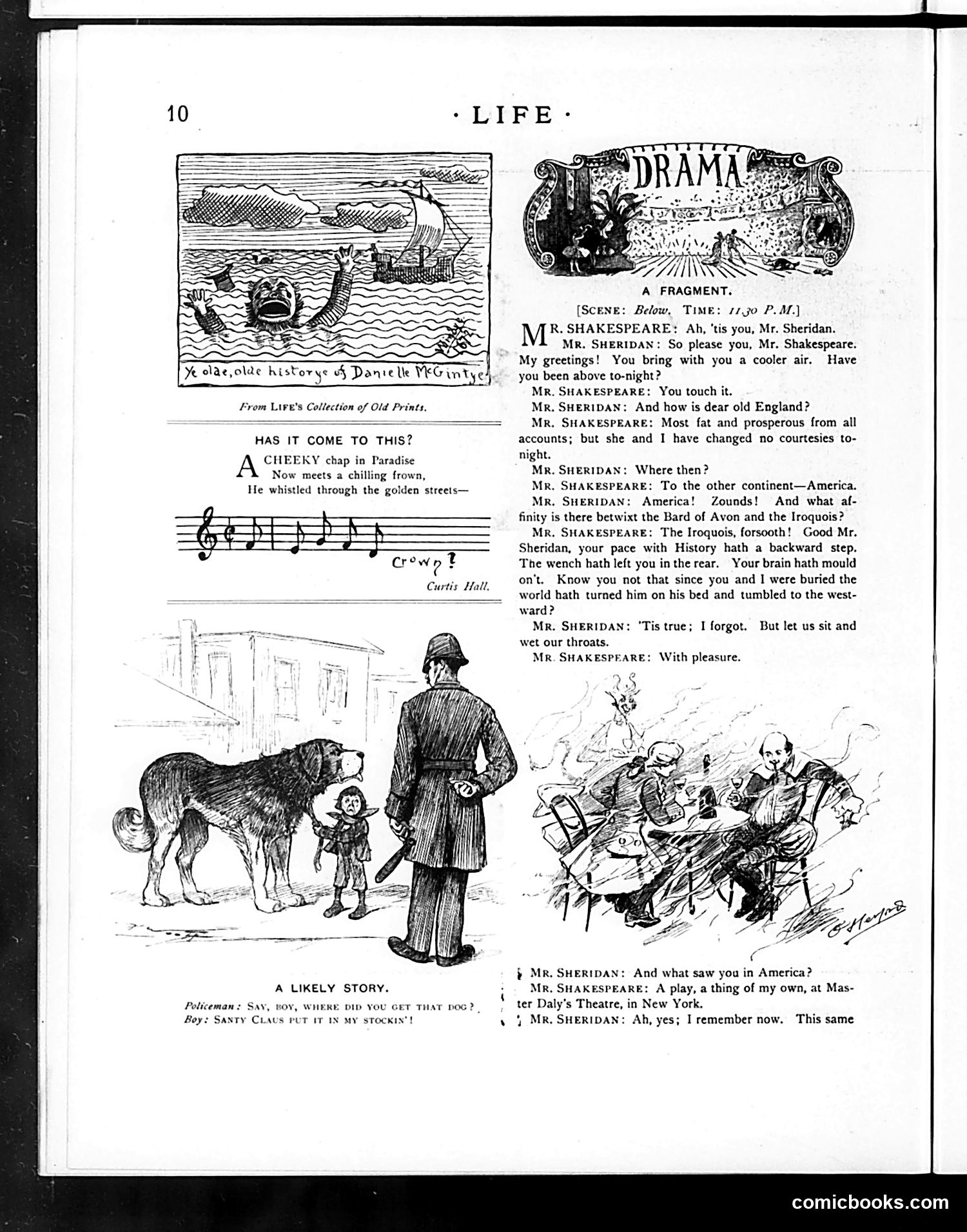
This page contains three satirical pieces: 1. **"Has It Come to This?"** - A poem with musical notation mocking social decline, showing a "cheeky chap" encountering hardship in city streets. 2. **"A Likely Story"** - A cartoon depicting a policeman confronting a boy with a dog about a stolen sausage. The humor lies in the boy's implausible excuse that "Sandy Claus put it in my stockin'!" 3. **"A Fragment"** - A dramatic dialogue between Mr. Shakespeare and Mr. Sheridan (likely the historical playwright), discussing England's prosperity and Shakespeare's experiences in America, including seeing his own play performed in New York. The satire appears to mock literary pretension and transatlantic cultural exchange. The page exemplifies *Life* magazine's characteristic blend of visual humor, social commentary, and literary satire targeting Victorian-era audiences.
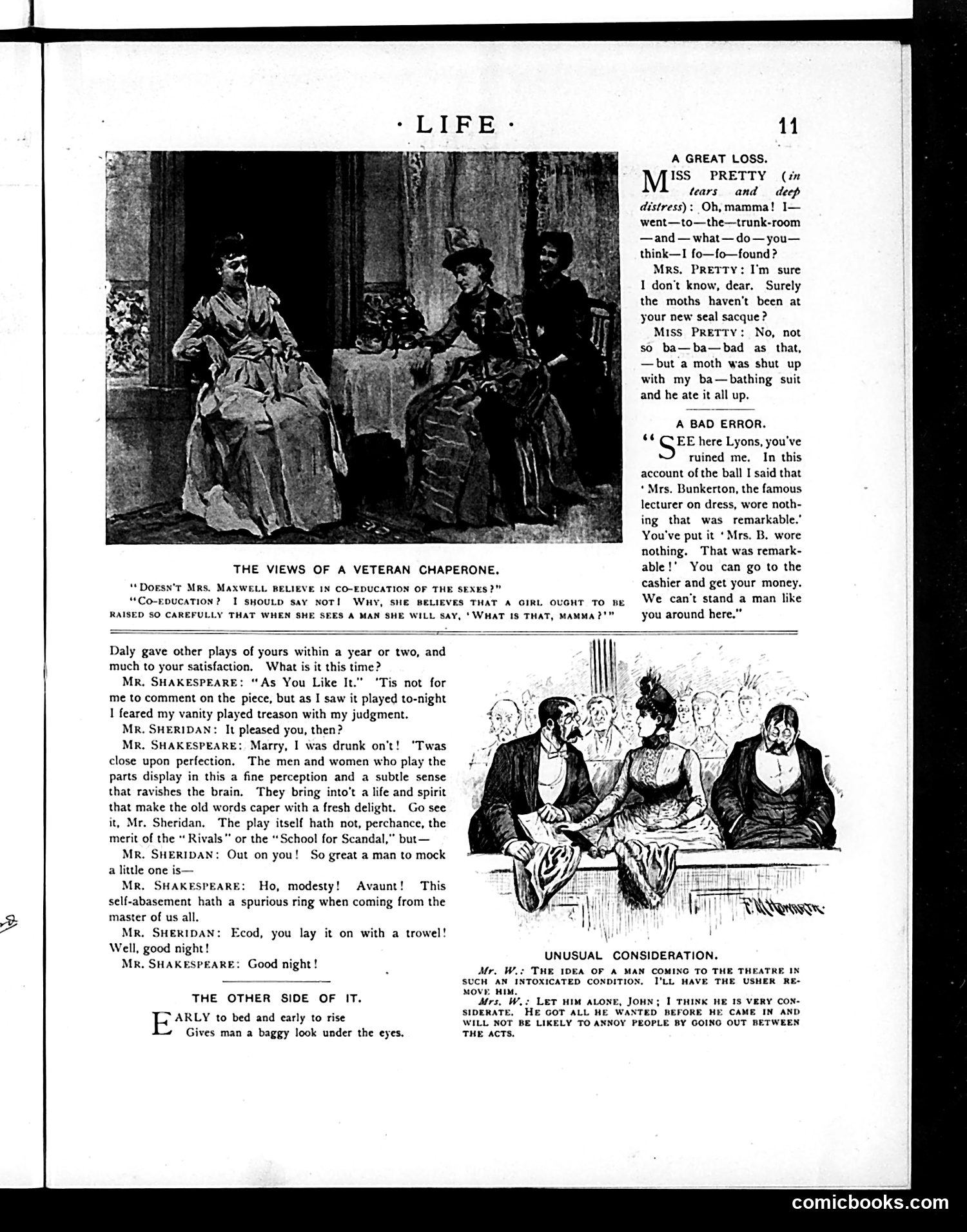
This page contains theatrical humor and social commentary. The top photograph shows "The Views of a Veteran Chaperone," depicting a woman (labeled "Mrs. Maxwell") observing younger people. The caption mocks her disapproval of co-education, suggesting she believes girls need careful supervision around men. Below, a dialogue between Mr. Shakespeare and Mr. Sheridan discusses a recent theatrical production of "As You Like It." They debate its artistic merit—Shakespeare defends it as nearly perfect, while Sheridan critiques the actors' performances, ultimately praising the script itself over the performers. The cartoon at bottom right illustrates "Unusual Consideration," depicting a drunk man being escorted through a theater discreetly by ushers to avoid disturbing other patrons during the performance. The humor targets both Victorian prudishness about gender interaction and theater etiquette.
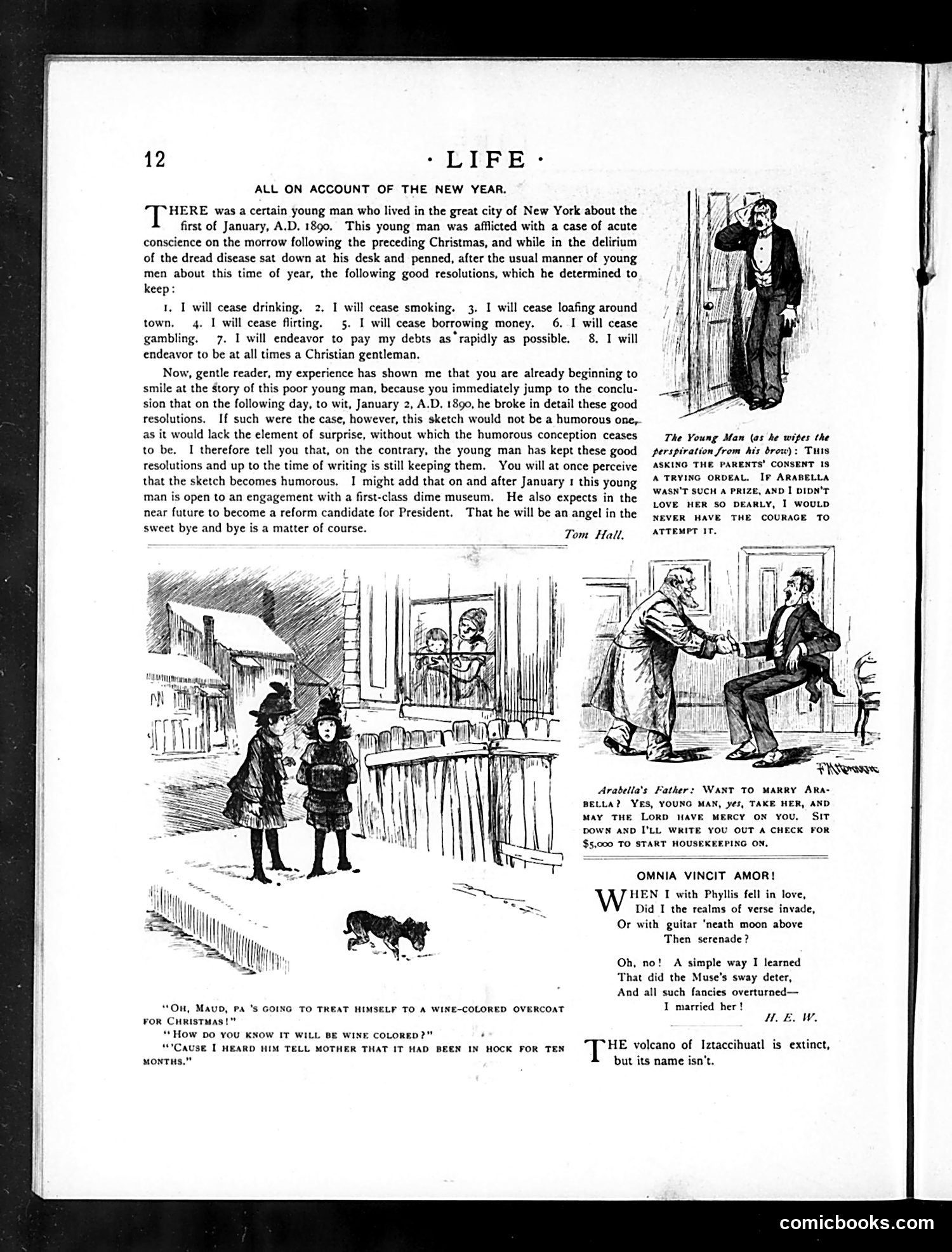
This page satirizes **New Year's resolutions** and courtship customs of the 1890s. The main story mocks the young man who actually *keeps* his eight resolutions (swearing off drinking, smoking, gambling, borrowing money, etc.) after New Year's Day. The satire is that his virtue makes him so unnaturally austere he becomes suitable only for a "dime museum" or as a reform candidate for President—suggesting that keeping resolutions is so absurd it's monstrous. The side cartoons continue the theme: - A suitor asking her father for marriage consent receives $5,000 to start housekeeping—satirizing both the mercenary nature of marriage and the father's obvious desire to be rid of his daughter - A comic poem about courtship where the speaker simply "married her" instead of writing romantic verses—mocking sentimental love poetry as unnecessary The bottom cartoon about a "wine-colored overcoat" jokes that "wine" refers to pawn shop ("hock"), a common fate for clothes.
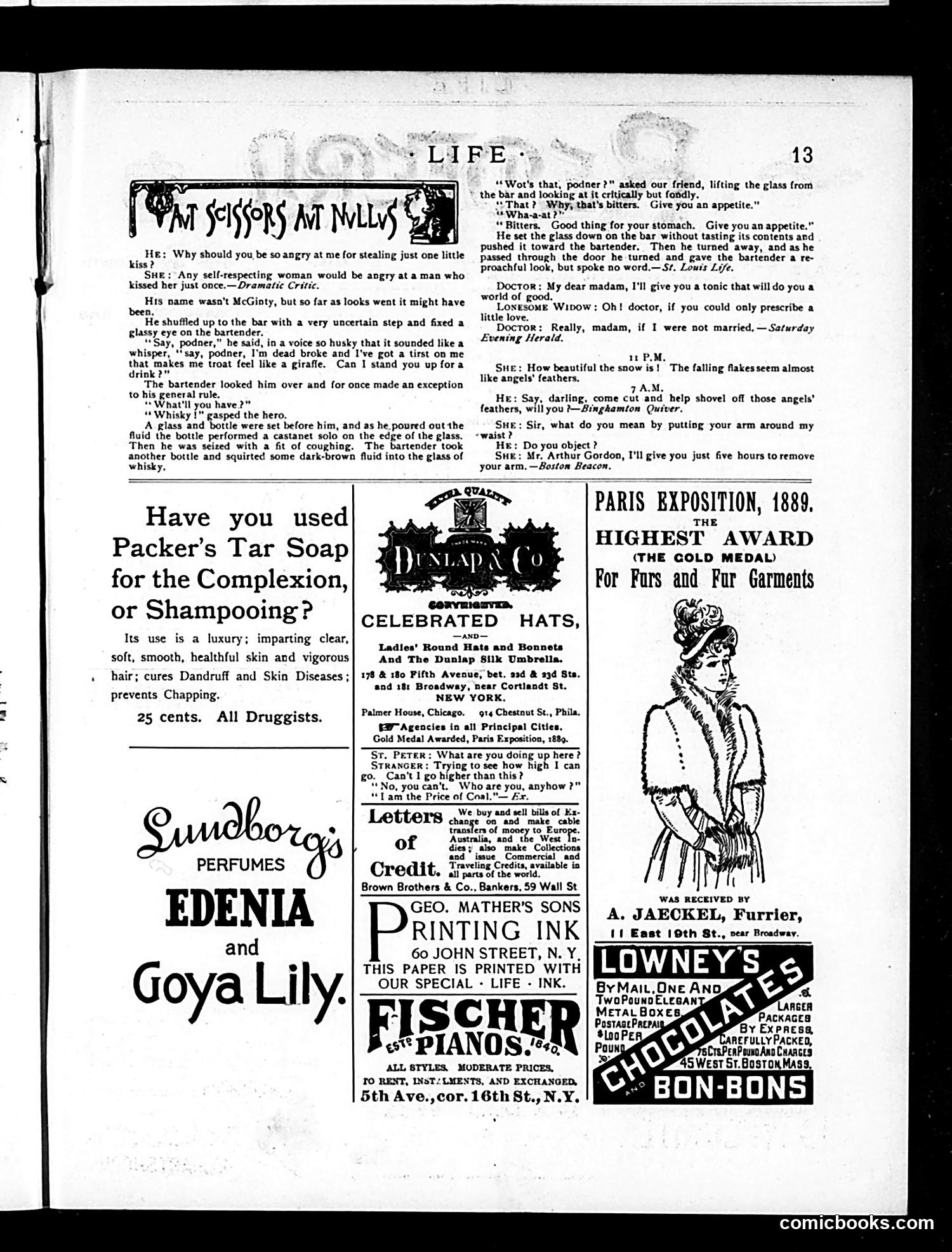
This page is primarily **advertising with brief humorous vignettes** rather than political cartoons. The main content consists of four short joke pieces: 1. **"At Scissors at Nully's"** (top): A Western-themed saloon joke where a drunk cowboy refuses a bartender's offer of bitters with his whisky, finding the suggestion insulting or confusing. 2. **Three brief romantic/domestic jokes** involving couples and misunderstandings about physical affection and winter activities—typical period humor about courtship propriety. 3. **A "Price of Coal" visual gag** (referenced in text): Someone climbing high, claiming to be the "Price of Coal"—likely satirizing inflation or commodity prices of the era. The page is dominated by **late-19th-century advertisements** for luxury goods: Packer's Tar Soap, Dunlap hats, Sudborg's perfumes, pianos, printing ink, and Lowney's chocolates. A Dunlap hat advertisement prominently displays a Paris Exposition 1889 Gold Medal award. The humor is **genteel and domestic**—no political satire or caricature is present. This reflects *Life* magazine's focus on polite, middle-class American society humor of the period.
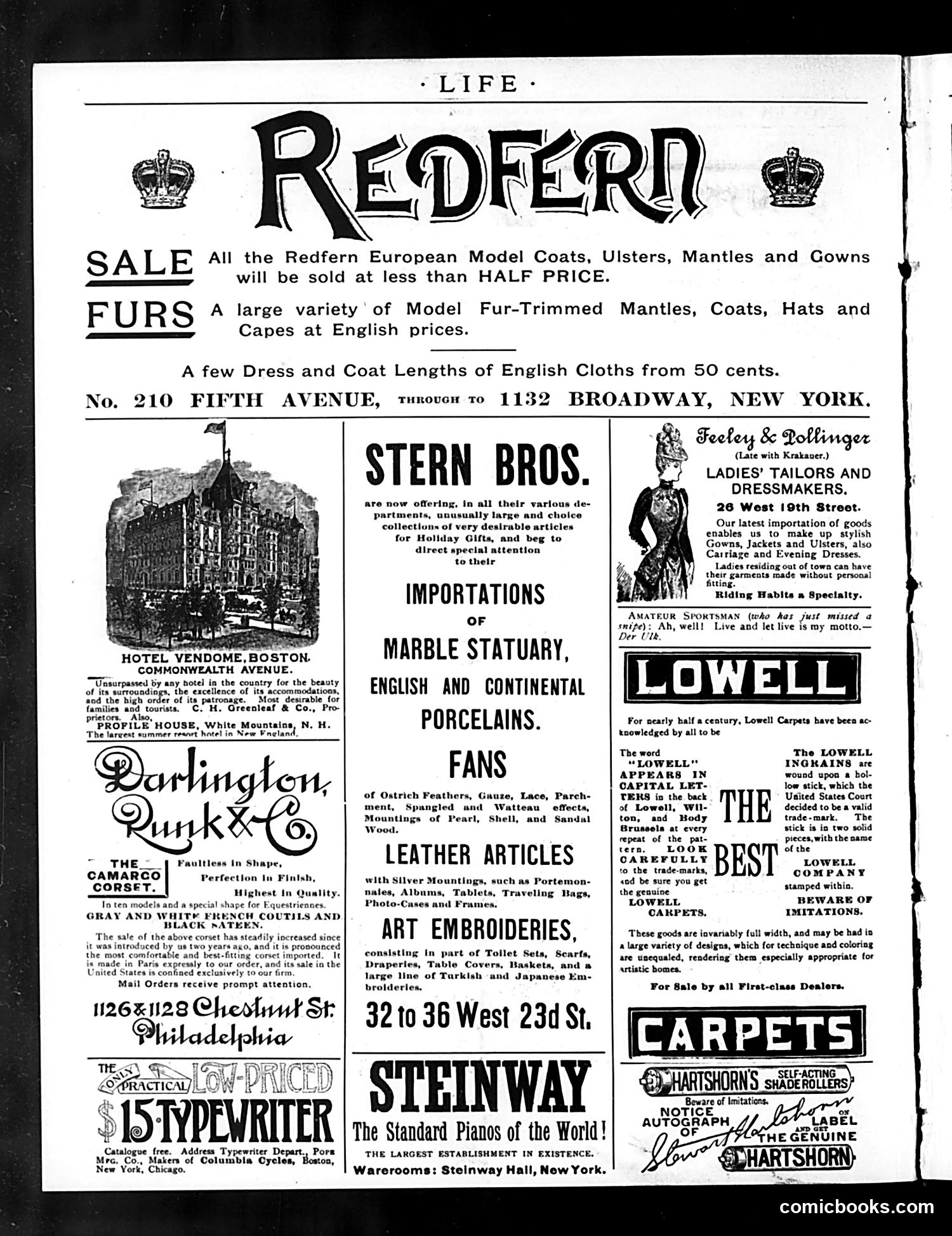
This page is primarily **advertising**, not satirical content. It's a collection of late 19th-century commercial advertisements for luxury goods and services. The only cartoon element is a small illustration labeled "Amateur Sportsman," showing a hunter who has missed shooting a snipe, with the caption "Ah, well! Live and let live is my motto." This is a gentle visual pun—the sportsman ironically adopts a pacifist philosophy after failing at hunting. The bulk of the page features ads for high-end retailers (Stern Bros., Steinway pianos, Lowell Carpets) and services (tailors, hotels, typewriters). These reflect Gilded Age consumer culture targeting wealthy readers. Notable is the emphasis on imported European goods—English fabrics, continental porcelains, Parisian corsets—indicating American aspirations toward European sophistication and style during this period. The page demonstrates how Life magazine financed itself through luxury advertising while maintaining its satirical editorial content elsewhere.
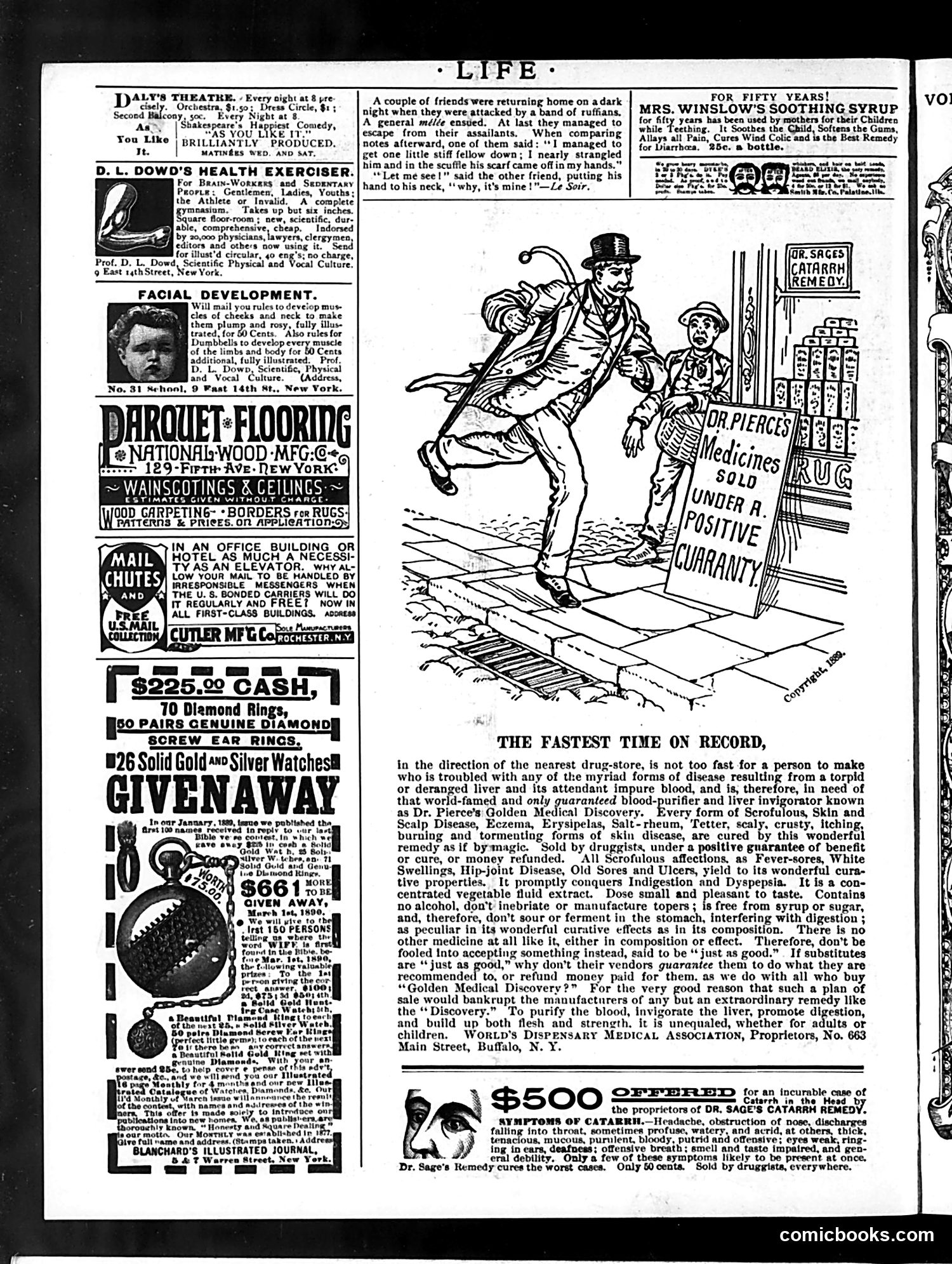
This is primarily an **advertising page** from Life magazine, with one central cartoon joke. **The Main Cartoon:** The illustration shows a man enthusiastically kicking his leg up while entering a pharmacy, with a child watching. The caption "THE FASTEST TIME ON RECORD" is the joke—the man is moving so quickly to reach the drug store that he's breaking a speed record. The humor likely references either: - A common urgency people felt visiting pharmacies for remedies - Or possibly a contemporary reference to speed records (unclear without more context) **The Advertisements:** The page is dominated by vintage patent medicine and health product ads, including: - Mrs. Winslow's Soothing Syrup (for children) - Dr. Pierce's Golden Medical Discovery (a supposed cure-all) - D.L. Dowd's exercise and facial development programs - A jewelry giveaway promotion These ads reflect early-1900s medicine shows and dubious health claims marketed as scientific breakthroughs—products modern readers would recognize as fraudulent.