
Life, 1890-01-02 · page 7 of 16
Life — January 2, 1890 — page 7: what you’re looking at
What you’re looking at
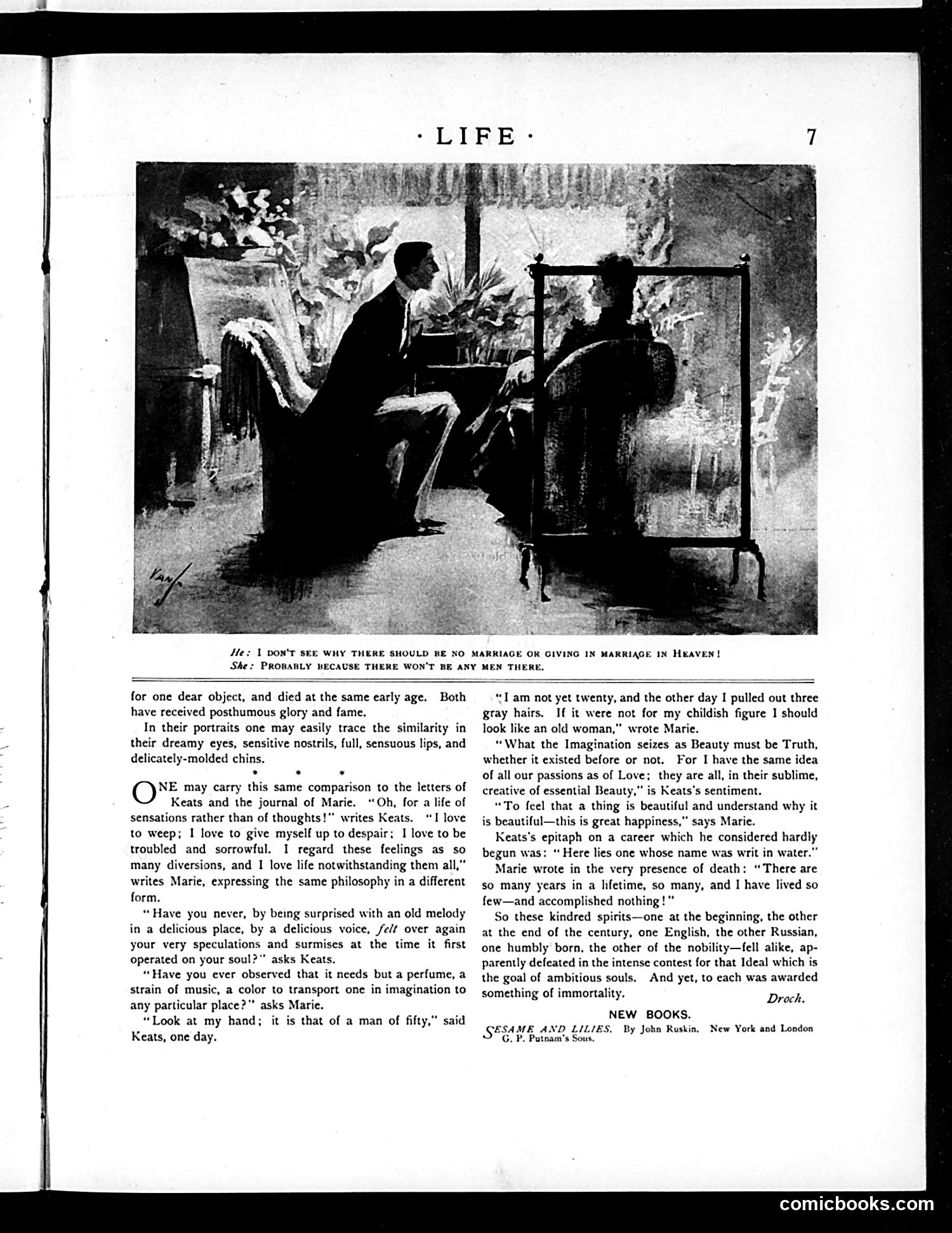
This page from *Life* magazine features a cartoon dialogue about marriage and the afterlife. The illustration shows three figures in silhouette in what appears to be an elegant interior with plants. The caption presents a domestic debate: a man argues there should be "no marriage or giving in marriage in Heaven," while a woman responds, "Probably because there won't be any men there." This is satirical commentary on marital discord—a common *Life* magazine trope of the early-to-mid 20th century. The joke hinges on the woman's implication that heaven without men would be preferable, suggesting she views her husband or marriage skeptically. It reflects period attitudes about gender relations and domestic frustration, presented as light, sophisticated humor for the magazine's educated readership. The remainder of the page contains literary discussion unrelated to the cartoon.
📄 Transcribed text from this page (OCR, searchable)
Machine-transcribed from the original scan — historical spelling and the odd misread are preserved.
He: | DON'T SEE WHY THERE SHOULD BE NO MARRIAGE OR GIVING IN MARRIAGE IN HEAVEN! She: PROBABLY BECAUSE THERE WON'T BE ANY MEN THERE, for one dear object, and died at the same early age. Both have received posthumous glory and fame. In their portraits one may easily trace the similarity in their dreamy eyes, sensitive nostrils, full, sensuous lips, and delicately-molded chins. . NE may carry this same comparison to the letters of Keats and the journal of Marie. ‘Oh, for a life of sensations rather than of thoughts!" writes Keats. “I love to weep; I love to give myself up to despair; I love to be troubled and sorrowful. I regard these feelings as so many diversions, and I love life notwithstanding them all,” writes Marie, expressing the same philosophy in a different form. “Have you never, by being surprised with an old melody in a delicious place, by a delicious voice, fe/¢ over again your very speculations and surmises at the time it first operated on your soul?” asks Keats. “Have you ever observed that it needs but a perfume, a strain of music, a color to transport one in imagination to any particular place?" asks Marie. “Look at my hand; it is that of a man of fifty,” said Keats, one day. “Tam not yet twenty, and the other day I pulled out three gray hairs. If it were not for my childish figure I should look like an old woman,” wrote Marie. “What the Imagination seizes as Beauty must be Truth, whether it existed before or not. For I have the same idea of all our passions as of Love; they are all, in their sublime, creative of essential Beauty,” is Keats's sentiment. “To feel that a thing is beautiful and understand why it is beautiful—this is great happiness,” says Marie. Keats's epitaph on a career which he considered hardly begun was: “ Here lies one whose name was writ in water.” Marie wrote in the very presence of death: “There are so many years in a lifetime, so many, and I have lived so few—and accomplished nothing !"" So these kindred spirits—one at the beginning, the other at the end of the century, one English, the other Russian, one humbly born, the other of the nobility—fell alike, ap- parently defeated in the intense contest for that Ideal which is the goal of ambitious souls. And yet, to each was awarded something of immortality. Droch. NEW BOOKS. SESAME AND LILIES. By John Ruskin. G, P. Putnam's Sous. New York and London comicbooks.com