
Life, 1890-01-02 · page 4 of 16
Life — January 2, 1890 — page 4: what you’re looking at
What you’re looking at
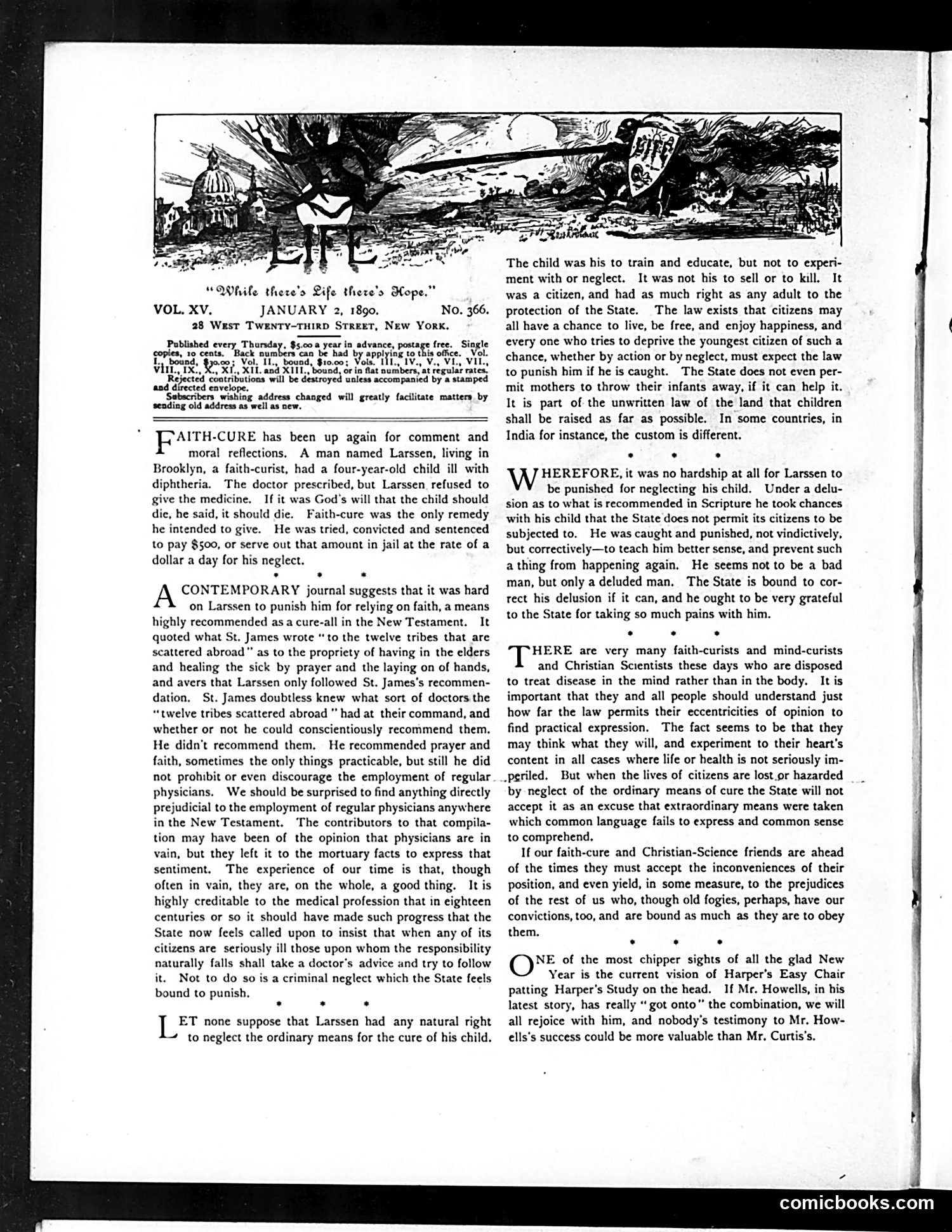
The masthead image depicts a satirical landscape with exaggerated figures and cityscape elements, though specific identities are unclear from the visual alone. The text discusses the "Faith-Cure" controversy—a contemporary religious movement where believers rejected medical treatment in favor of prayer. The case of Larssen, who denied his child medicine, resulting in the child's death and his legal punishment, serves as the article's focal point. The satire critiques both faith-healers and medical doctors, arguing the State must protect children from parental neglect. The piece defends legal intervention while acknowledging concerns about overreach, ultimately advocating reasonable medical standards as a civic responsibility—a progressive stance for 1890 regarding child welfare and state authority.
📄 Transcribed text from this page (OCR, searchable)
Machine-transcribed from the original scan — historical spelling and the odd misread are preserved.
“QMile there's Life there's Hope.” VOL. XV. JANUARY 2, 1890. No. 366. 28 West TwEntTy-THIRD STREET, New York, Published every Thursday, 1 year in advance, postage free. Single copies, 10 cents. Back be had by applying to this office. i I boind, yeco; Vol: Il, bound, $io.co; Vols. II1., IVa Vox View VIl-y VHIL, IX:, XX, X11. and XIII, bound, or in flat numbers, at regular rates, Rejected contributions will be destroyed unless accompanied by a stamped and directed envelope. Sabscribers wishing address changed will greatly facilitate matters by sending old address as well as new. AITH-CURE has been up again for comment and moral reflections. A man named Larssen, living in Brooklyn, a faith-curist, had a four-year-old child ill with diphtheria. The doctor prescribed, but Larssen refused to give the medicine, If it was God's will that the child should die, he said, it should die. Faith-cure was the only remedy he intended to give. He was tried, convicted and sentenced to pay $500, or serve out that amount in jail at the rate of a dollar a day for his neglect. . * A CONTEMPORARY journal suggests that it was hard on Larssen to punish him for relying on faith, a means highly recommended as a cure-all in the New Testament. It quoted what St. James wrote “to the twelve tribes that are scattered abroad" as to the propriety of having in the elders and healing the sick by prayer and the laying on of hands, and avers that Larssen only followed St. James's recommen- dation. St. James doubtless knew what sort of doctors the “twelve tribes scattered abroad " had at their command, and whether or not he could conscientiously recommend them. He didn’t recommend them, He recommended prayer and faith, sometimes the only things practicable, but still he did not prohibit or even discourage the employment of regular physicians. We should be surprised to find anything directly prejudicial to the employment of regular physicians anywhere in the New Testament. The contributors to that compila- tion may have been of the opinion that physicians are in vain, but they left it to the mortuary facts to express that sentiment. The experience of our time is that, though often in vain, they are, on the whole, a good thing. It is highly creditable to the medical profession that in eighteen centuries or so it should have made such progress that the State now feels called upon to insist that when any of its citizens are seriously ill those upon whom the responsibility naturally falls shall take a doctor's advice and try to follow it. Not to do so is a criminal neglect which the State feels bound to punish, . . ET none suppose that Larssen had any natural right ~ to neglect the ordinary means for the cure of his child. The child was his to train and educate, but not to experi- ment with or neglect. It was not his to sell or to kill, It was a citizen, and had as much right as any adult to the protection of the State. The law exists that citizens may all have a chance to live, be free, and enjoy happiness, and every one who tries to deprive the youngest citizen of such a chance, whether by action or by neglect, must expect the law to punish him if he is caught. The State does not even per- mit mothers to throw their infants away, if it can help it. It is part of the unwritten law of the land that children shall be raised as far as possible. In some countries, in India for instance, the custom is different. . . . HEREFORE, it was no hardship at all for Larssen to be punished for neglecting his child. Under a delu- sion as to what is recommended in Scripture he took chances with his child that the State does not permit its citizens to be subjected to. He was caught and punished, not vindictively, but correctively—to teach him better sense, and prevent such a thing from happening again. He seems not to be a bad man, but only a deluded man. The State is bound to cor- rect his delusion if it can, and he ought to be very grateful to the State for taking so much pains with him. . . . Ree are very many faith-curists and mind-curists and Christian Scientists these days who are disposed to treat disease in the mind rather than in the body. It is important that they and all people should understand just how far the law permits their eccentricities of opinion to find practical expression. The fact seems to be that they may think what they will, and experiment to their heart's content in all cases where life or health is not seriously im- -periled. But when the lives of citizens are lost.or hazarded by neglect of the ordinary means of cure the State will not accept it as an excuse that extraordinary means were taken which common language fails to express and common sense to comprehend. If our faith-cure and Christian-Science friends are ahead of the times they must accept the inconveniences of their position, and even yield, in some measure, to the prejudices of the rest of us who, though old fogies, perhaps, have our convictions, too, and are bound as much as they are to obey them. . . . Ore of the most chipper sights of all the glad New Year is the current vision of Harper's Easy Chair patting Harper's Study on the head. If Mr. Howells, in his latest story, has really “ got onto” the combination, we will all rejoice with him, and nobody's testimony to Mr. How- ells’s success could be more valuable than Mr. Curtis's. comicbooks.com