
A complete issue · 16 pages · 1889
Life — December 12, 1889
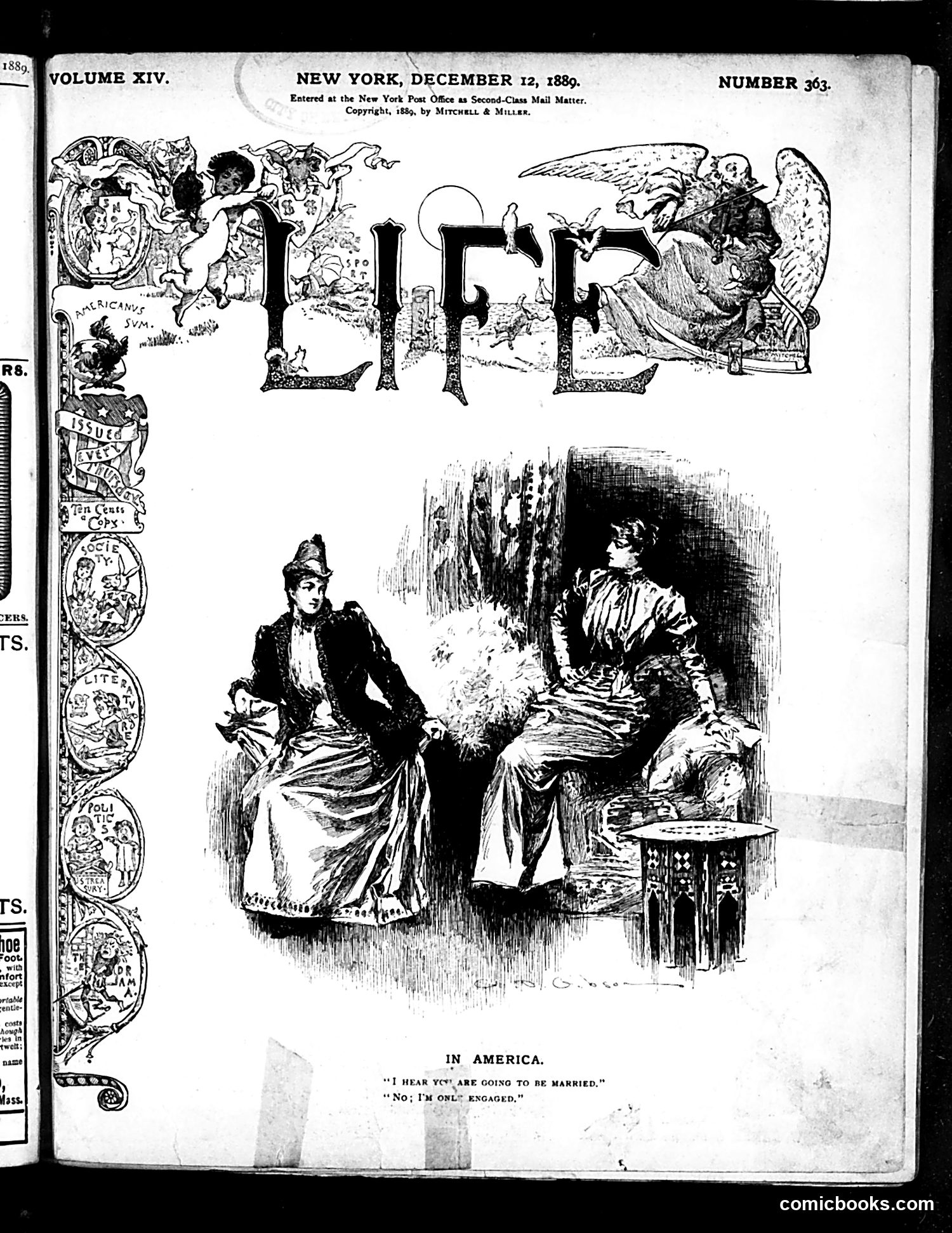
This page from *Life* magazine features a satirical illustration titled "In America" with dialogue: "I hear you are going to be married." / "No; I'm only engaged." The cartoon depicts two women in conversation, likely satirizing American attitudes toward engagement versus marriage during the 1880s-90s. The joke appears to contrast the formality or permanence of marriage with the apparently more casual nature of engagements in America—suggesting that an engagement might not lead to actual marriage, or that American engagements were treated as less binding commitments than elsewhere. The ornate decorative border and the magazine's format indicate this is social commentary typical of *Life*'s humorous take on contemporary manners and customs.
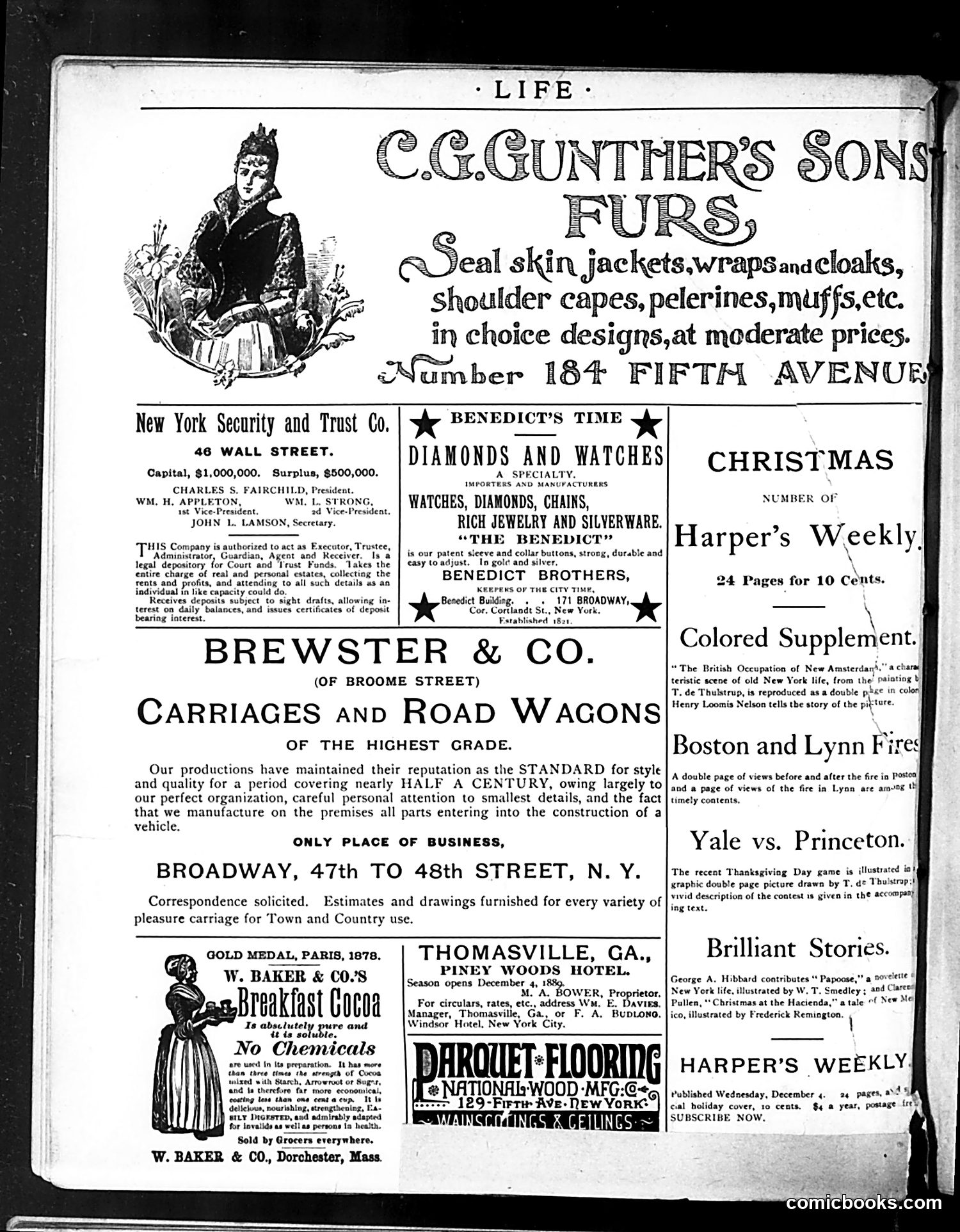
This page is **primarily advertising** with no discernible political cartoon or satirical content visible. The advertisements include: - C.G. Gunther's Sons Furs (seal skin clothing) - New York Security and Trust Co. (financial services) - Benedict's Time (diamonds and watches) - Brewster & Co. (high-end carriages) - W. Baker & Co. (breakfast cocoa) - Thomasville, GA Pinewood Hotel - Parquet Flooring company The right column promotes Harper's Weekly magazine content including sports coverage (Yale vs. Princeton football) and illustrated stories. This appears to be a typical late-19th-century magazine page mixing commercial advertisements with editorial promotion, rather than satirical commentary.
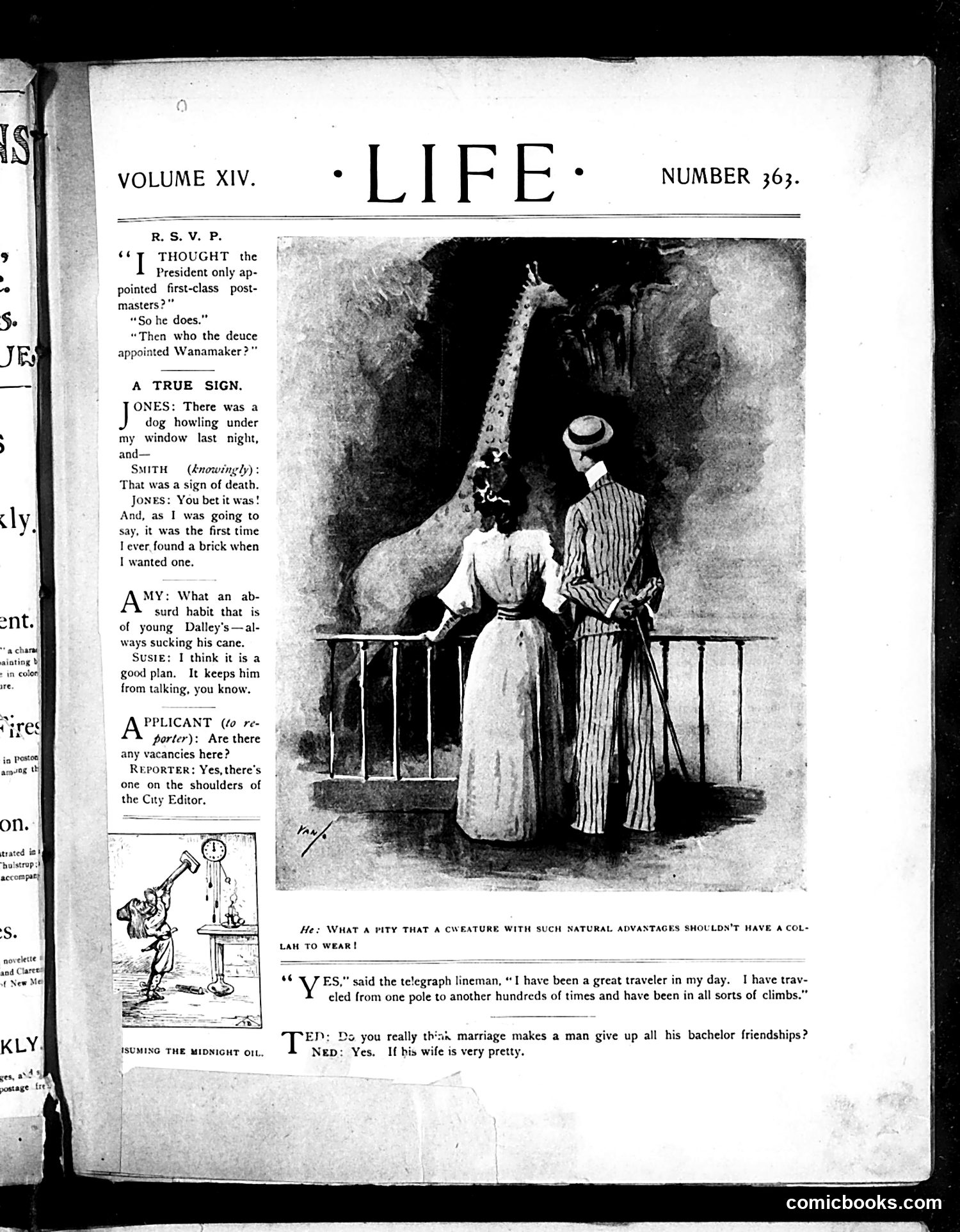
This page contains several brief comedic dialogues and illustrations typical of Life's satirical humor: **"R.S.V.P."** mocks bureaucratic incompetence through a postmaster appointment joke. **"A True Sign"** plays on superstition, with characters debating whether a howling dog portends death—ultimately revealing ironic commentary about human nature and materialistic concerns. **"Amy"** jokes about young Dalley's constant cane-sucking as a behavioral control method. **"An Applicant"** presents a porter's job interview, with the punchline being that a City Editor already fills the vacancy. The main illustration shows two fashionable women on a balcony observing something below, captioned with commentary about a creature's "natural advantages." **"Presuming the Midnight Oil"** (lower cartoon) depicts someone working late at a desk. The final dialogue concerns marriage's effect on bachelor friendships—light social satire typical of the era.
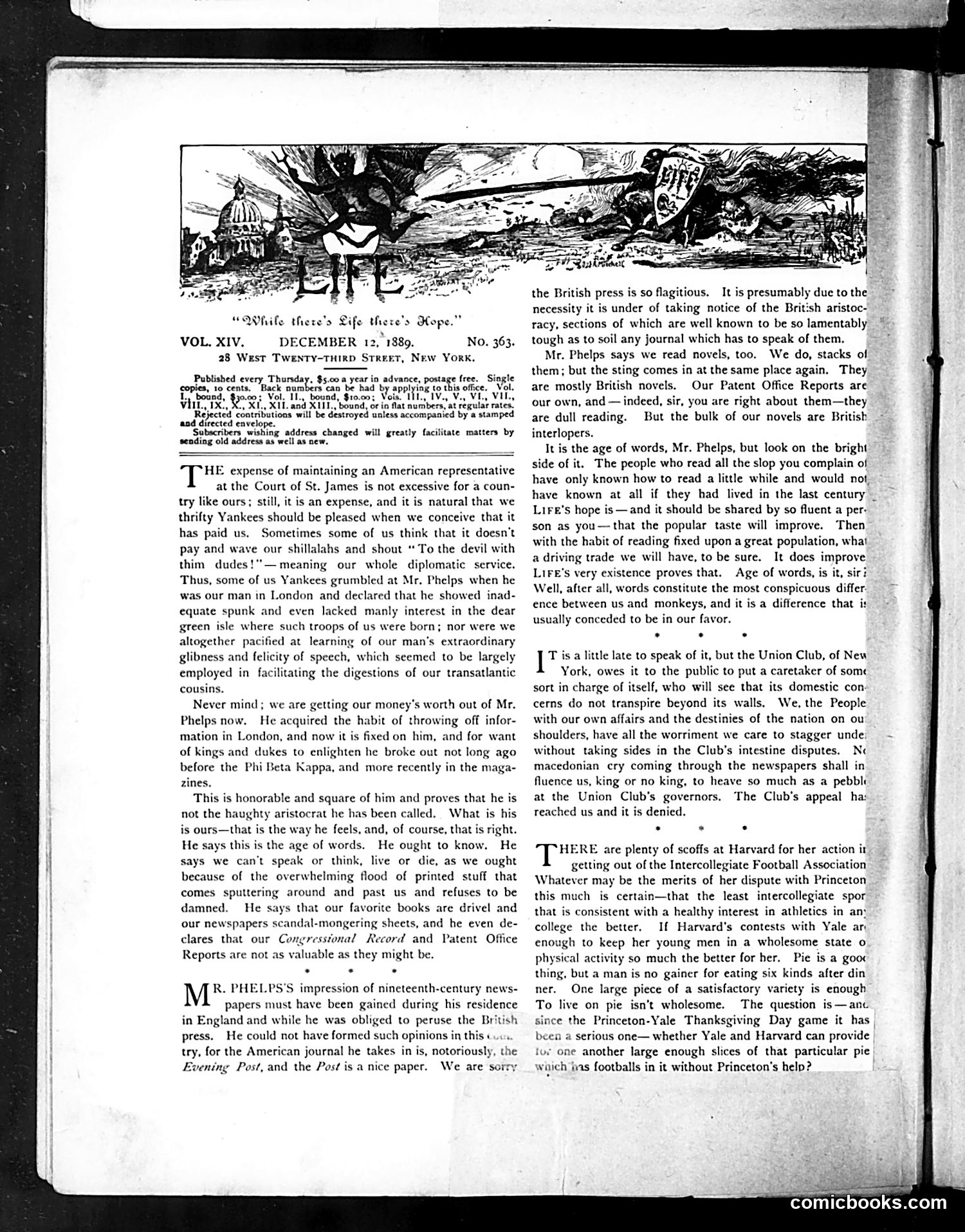
The masthead cartoon depicts a chaotic landscape with classical architecture (suggesting Rome/European civilization) being overwhelmed by turbulent forces—likely representing social upheaval or political instability of the period. The text discusses Mr. Phelps, apparently an American diplomat at the Court of St. James (London), and criticism of his diplomatic competence. The editorial defends American literary and journalistic output against British criticism, sarcastically noting that while British novels dominate American reading, most are "dull reading." The piece then shifts to defending Harvard University's athletic prowess and the upcoming Princeton-Yale Thanksgiving Day football game, suggesting intercollegiate sports were gaining cultural significance in 1880s America. The satire appears aimed at defending American cultural institutions against perceived British superiority.
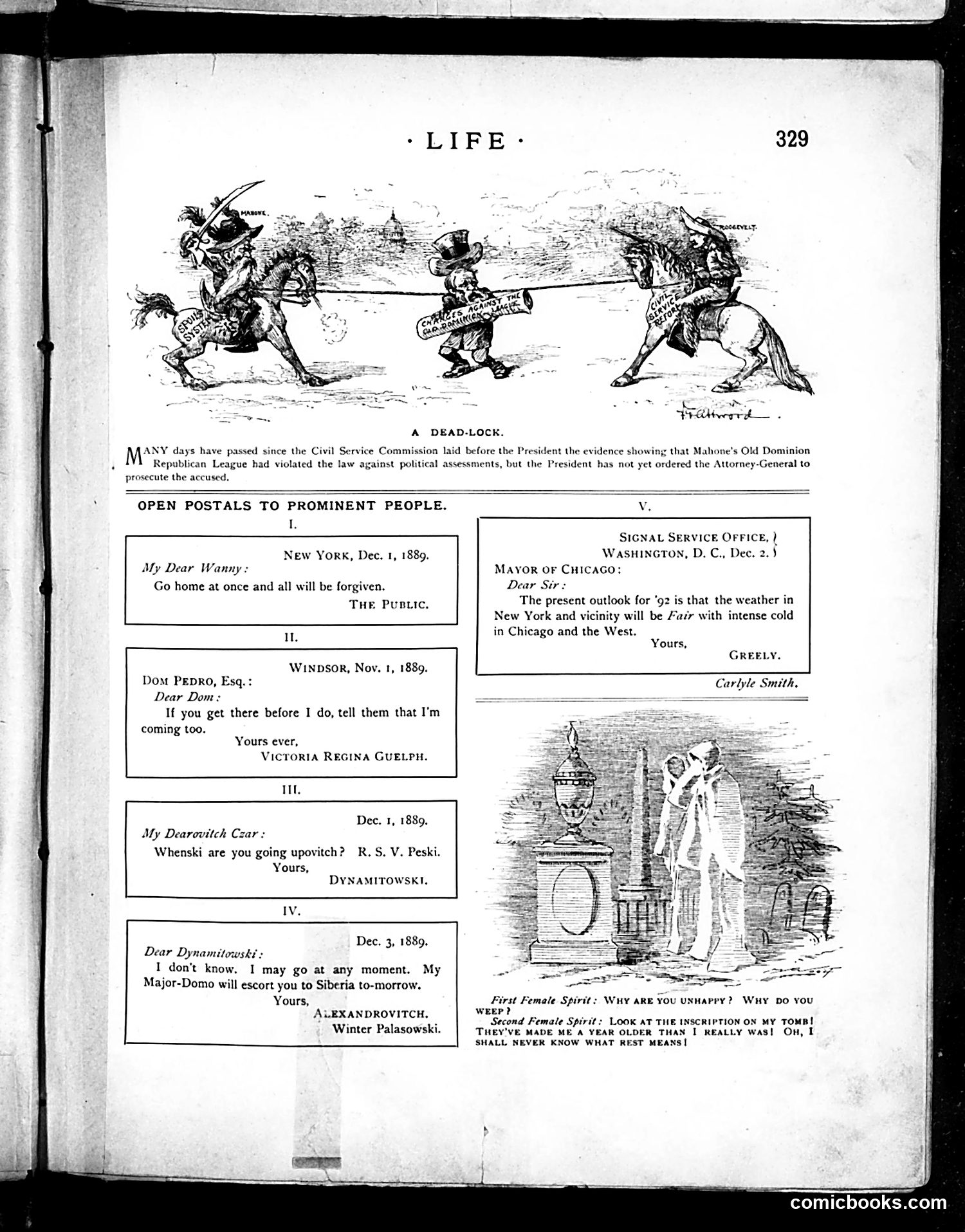
**The Main Cartoon ("A Dead-Lock"):** This political cartoon depicts three figures in a tug-of-war with a rope, suggesting political deadlock. The caption references the Civil Service Commission presenting evidence to the President that Mahone's Old Dominion Republican League violated laws regarding political assessments. The President reportedly refused to prosecute. The "dead-lock" visualizes the stalemate resulting from this inaction—competing political forces locked in conflict with no resolution. **The "Open Postals to Prominent People" Section:** This satirical feature presents humorous fake letters. They mock public figures through invented correspondence, including absurd directives like threatening Siberian exile. The format parodies actual correspondence while commenting on contemporary political and social figures' quirks or misadventures.
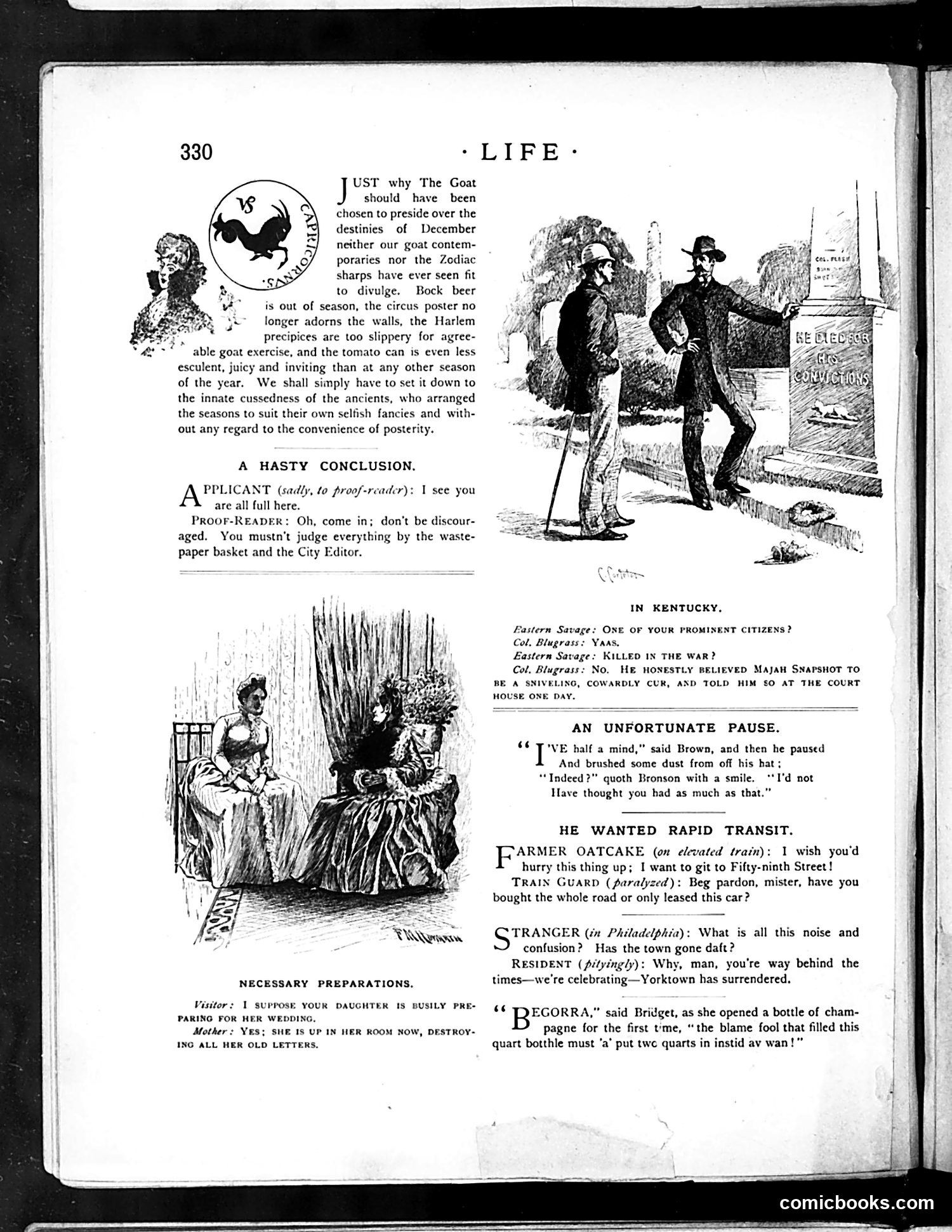
This page contains several humorous anecdotes and sketches rather than a political cartoon. The top section discusses why December is the wrong month for "The Goat"—likely referencing a zodiac column or seasonal humor about goats being unsuitable for winter activities. The sketches illustrate brief comedic scenarios: "A Hasty Conclusion" shows someone misinterpreting a crowded room, "In Kentucky" presents a Civil War reference (mentioning Yorktown's surrender, likely the 1781 Revolutionary War battle), and other vignettes depict everyday social confusion—a man interrupting a train, a mother destroying old love letters before her daughter's wedding. The bottom sketch, "Necessary Preparations," illustrates the caption about destroying old letters during wedding preparations. These are light social satire about human misunderstandings and domestic situations rather than political commentary.
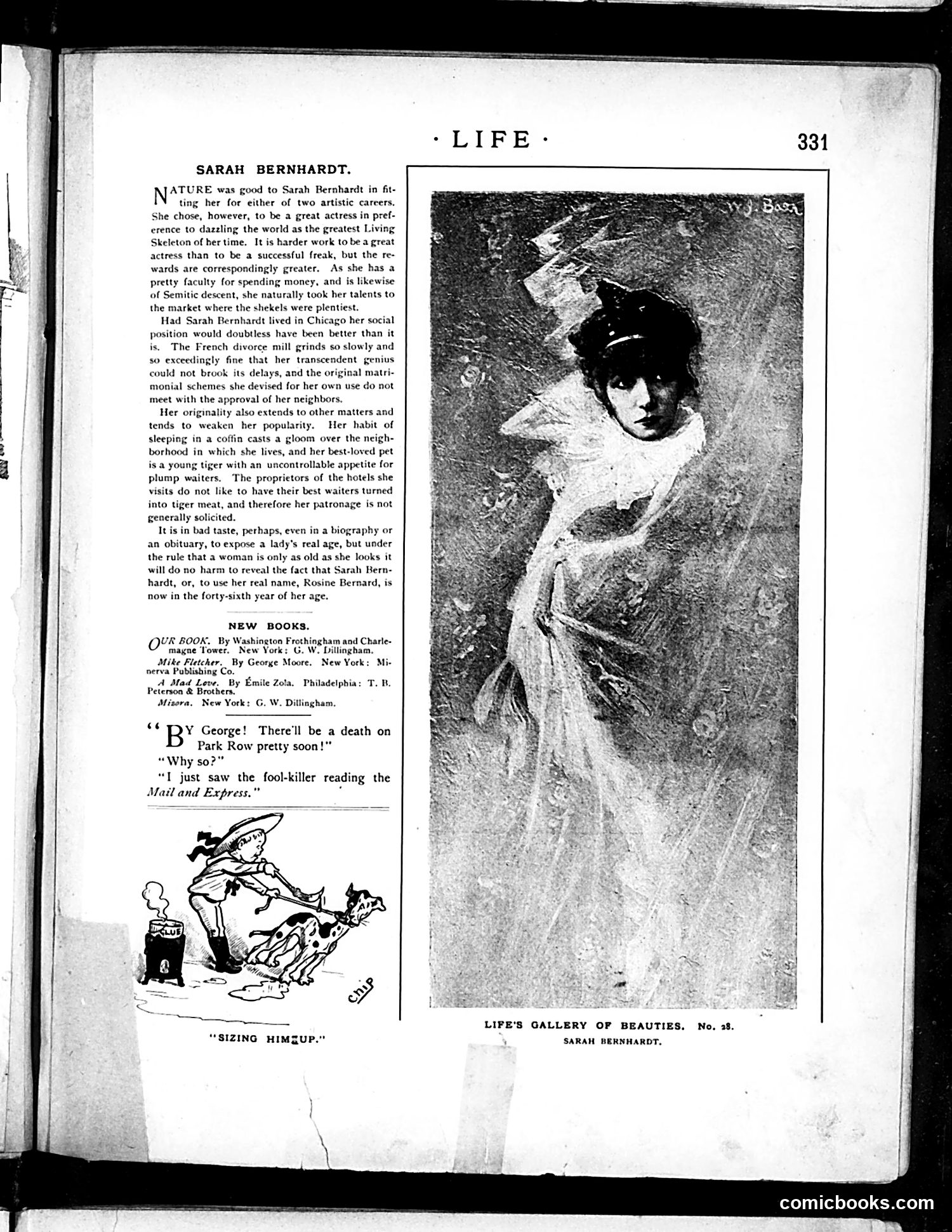
This page contains two distinct elements: **Main Article & Portrait**: An article about Sarah Bernhardt, the famous French actress. The text describes her career choices, personal eccentricities (keeping a pet tiger, sleeping in a coffin), and reveals her real name as Rosine Bernard. It notes she's in her mid-forties at publication. **"Sizing Him Up" Cartoon**: A small satirical sketch showing a figure reading the *Mail and Express* newspaper, appearing to predict "a death on Park Row pretty soon." The joke appears to reference sensationalist newspaper reporting—the reader is a "fool-killer" who finds such journalism absurd enough to warrant violent response. This mocks the exaggerated, melodramatic style of contemporary newspaper coverage. The cartoon uses dark humor typical of Life magazine's satirical approach to press criticism.
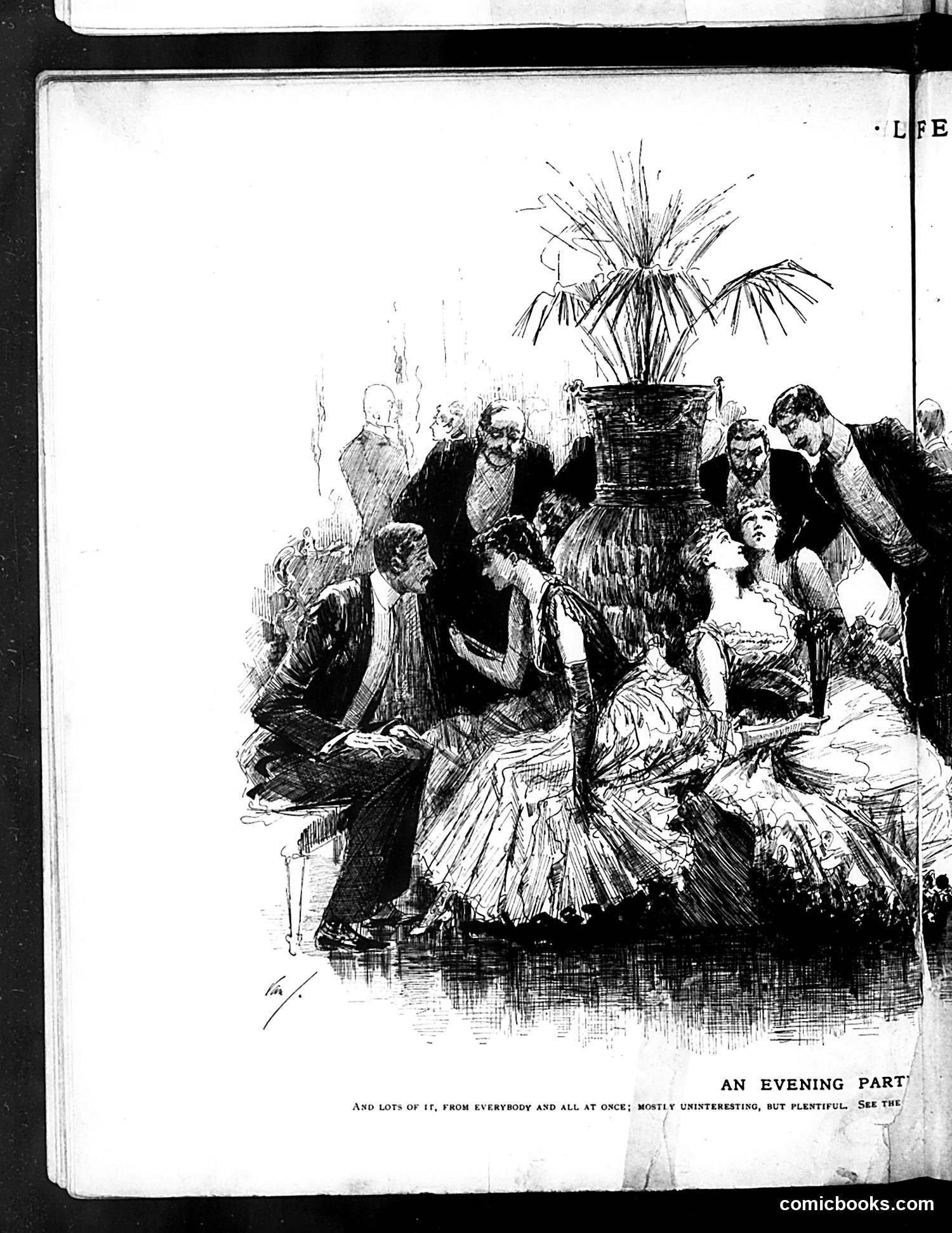
This is a social satire illustration depicting an elite evening gathering. The sketch shows well-dressed men in formal attire mingling with women in elaborate ball gowns around a decorative potted palm plant—a typical status symbol in Victorian-era wealthy homes. The caption reads: "And lots of it, from everybody and all at once; mostly uninteresting, but plentiful." The satire targets the superficiality of high-society social events. The artist critiques how such parties prioritize quantity of guests and conversation over genuine interaction or meaningful discourse. The crowded composition and the description of entertainment as "mostly uninteresting, but plentiful" suggests *Life* magazine is mocking the pretension and tedium of elite social obligations—a common theme in Gilded Age satire.
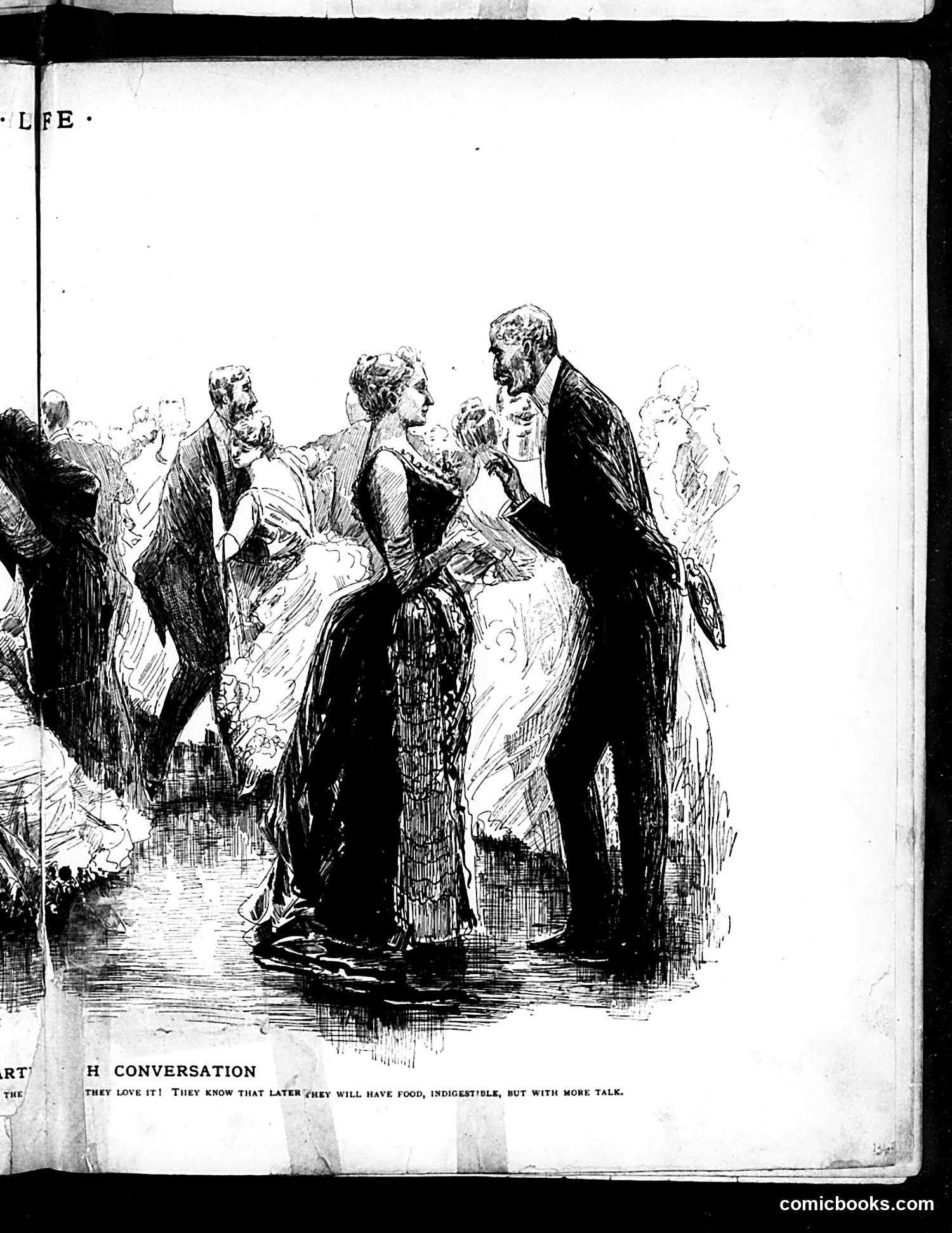
This sketch depicts a social gathering of well-dressed Victorian-era figures engaged in conversation. The caption reads: "They love it! They know that later they will have food, indigestible, but with more talk." The satire targets the social ritual of upper-class gatherings, where the actual appeal lies not in the meal itself but in the opportunity for extended conversation and socializing. The humor is two-fold: first, acknowledging that the food served at such events is typically heavy and difficult to digest ("indigestible"), and second, suggesting that guests tolerate this discomfort for the sake of continued social interaction and gossip ("more talk"). This reflects Life magazine's characteristic mockery of Victorian social pretension and the gap between appearance and reality in polite society.
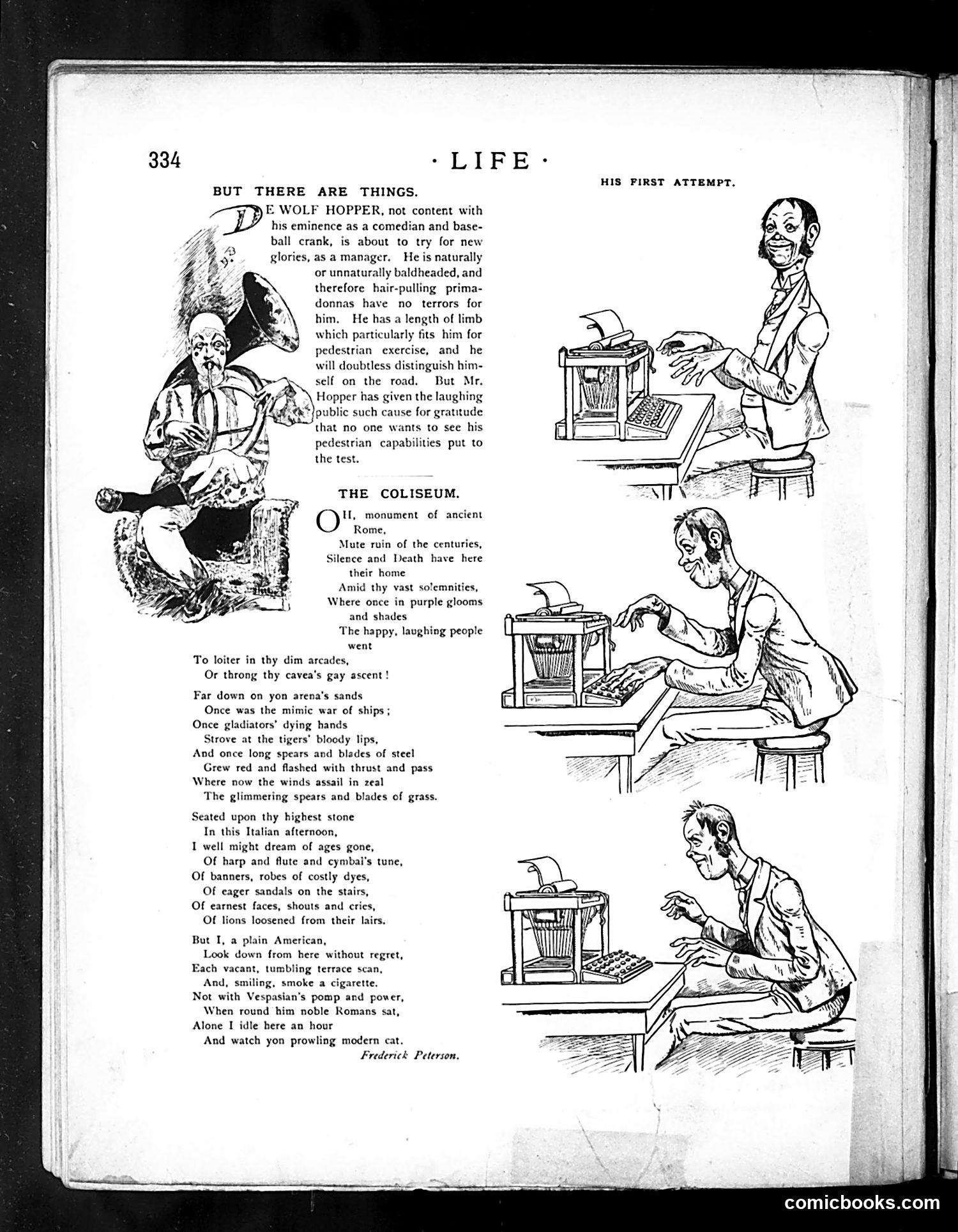
This page contains two distinct pieces: 1. **"His First Attempt"** (right): A three-panel cartoon sequence showing a bald man attempting pedestrian exercise with a trash bin. The humor derives from physical comedy—his awkward postures and apparent difficulty with basic movement, suggesting he's uncoordinated or out of shape. 2. **"The Coliseum"** (left): A poem by Frederick Peterson accompanied by a caricature of a man. The text discusses Wolf Hopper, a comedian/baseball crank, noting his baldness and physical qualities. The poem itself is sentimental verse about Rome's ruins and ancient glory, contrasting with modern American indifference (smoking cigarettes, watching cats). The satire juxtaposes Hopper's theatrical ambitions with his ungainly appearance—the point being that despite his professional pretensions, his physical comedy is unavoidable.
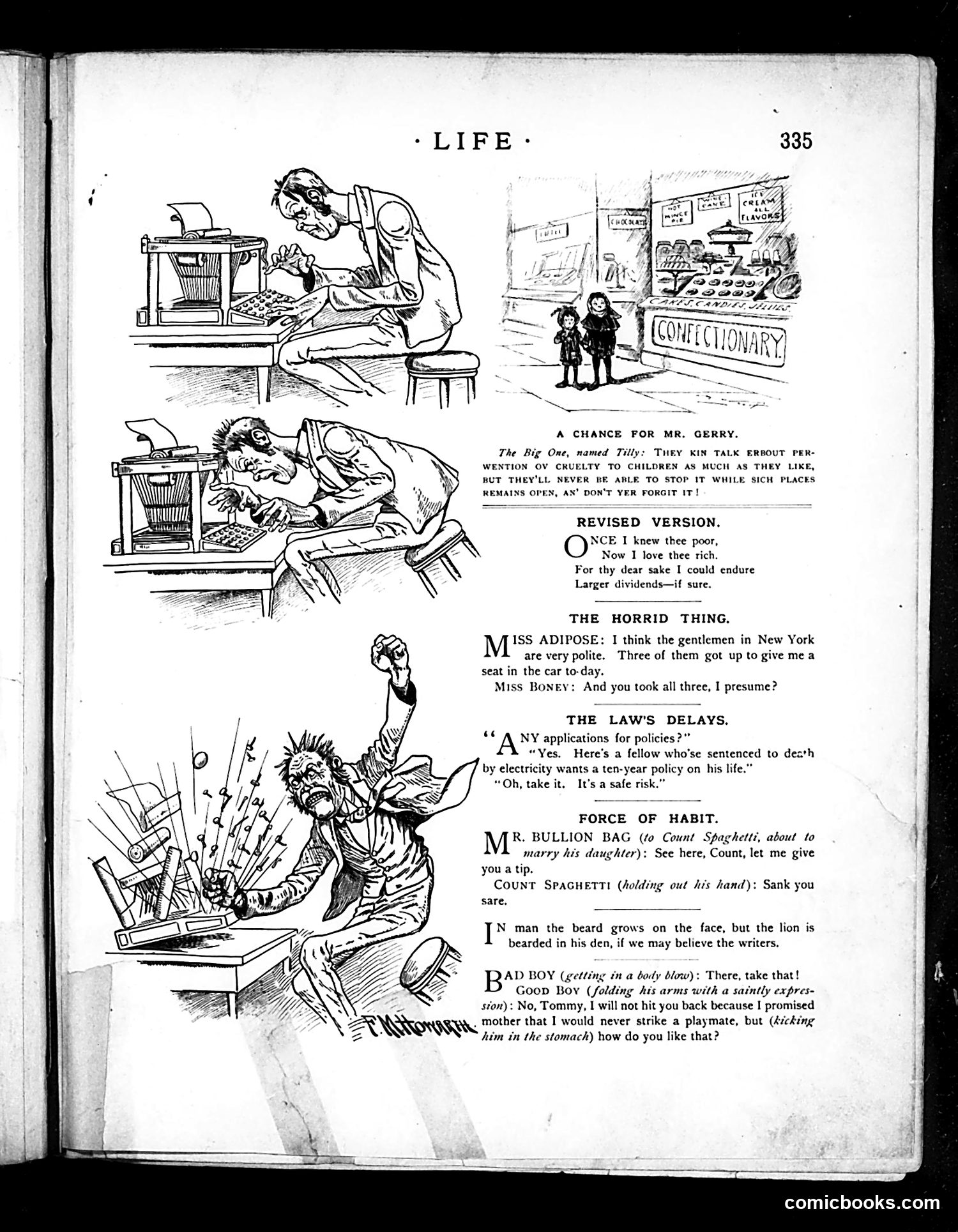
This page contains several humorous sketches and brief comic anecdotes typical of Life's satirical format: **"A Chance for Mr. Gerry"** shows a man force-feeding a child at a confectionery counter, satirizing child welfare concerns—likely referencing Elbridge Gerry's anti-cruelty campaigns. **"The Horrid Thing"** jokes about New York gentlemen's politeness. **"The Law's Delays"** mocks insurance bureaucracy and risk assessment. **"Force of Habit"** depicts Count Spaghetti's comedic attempt to give a tip, playing on immigrant stereotypes. The remaining sketches contain domestic humor involving facial hair, boxing children, and parental discipline—reflecting period attitudes toward corporal punishment and family life that modern readers would find shocking rather than amusing.
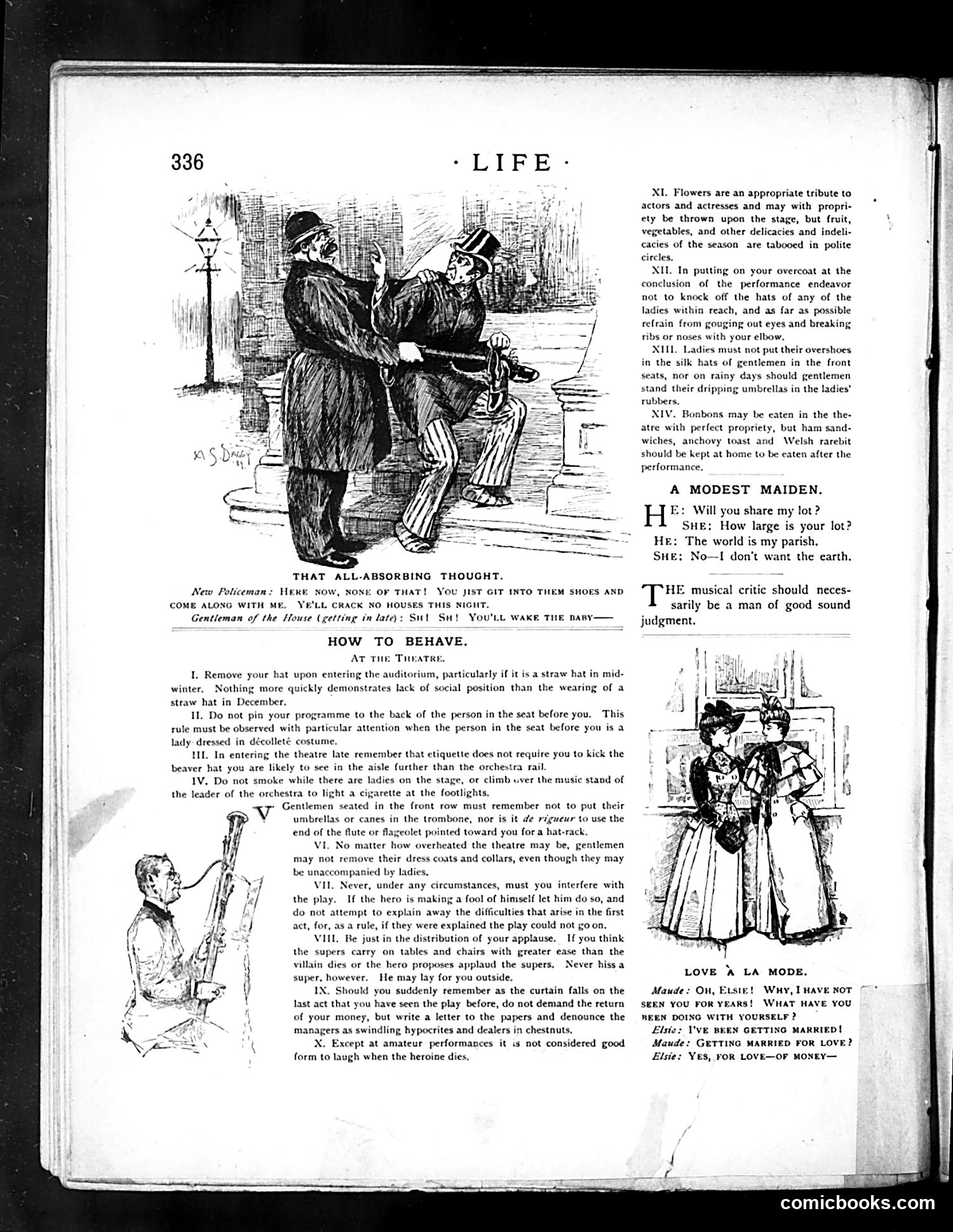
This page contains satirical humor about theater etiquette and courtship customs, likely from the early 1900s. **"That All-Absorbing Thought"** (top cartoon): A new policeman catches a gentleman sneaking home late at night. The joke mocks the husband's anxiety about waking the baby—suggesting his real concern is avoiding his wife's anger, not the infant's sleep. **"How to Behave at the Theatre"** (main section): A humorous list of 14 "rules" mocking actual Victorian theater manners. The satire targets genuinely rude audience behavior (removing hats, smoking, interfering with performances) while exaggerating absurd scenarios (using a flute as a hat-rack, placing umbrellas in trombones). It's gentle social commentary on class consciousness and etiquette obsession. **"A Modest Maiden" and "Love à la Mode"** (bottom): Quick romantic jokes. The first plays on literal vs. figurative language about "sharing a lot." The second jokes that women marry for money, not love—a cynical commentary on marriage economics of the era. The overall tone is lighthearted mockery of middle-class social pretensions.
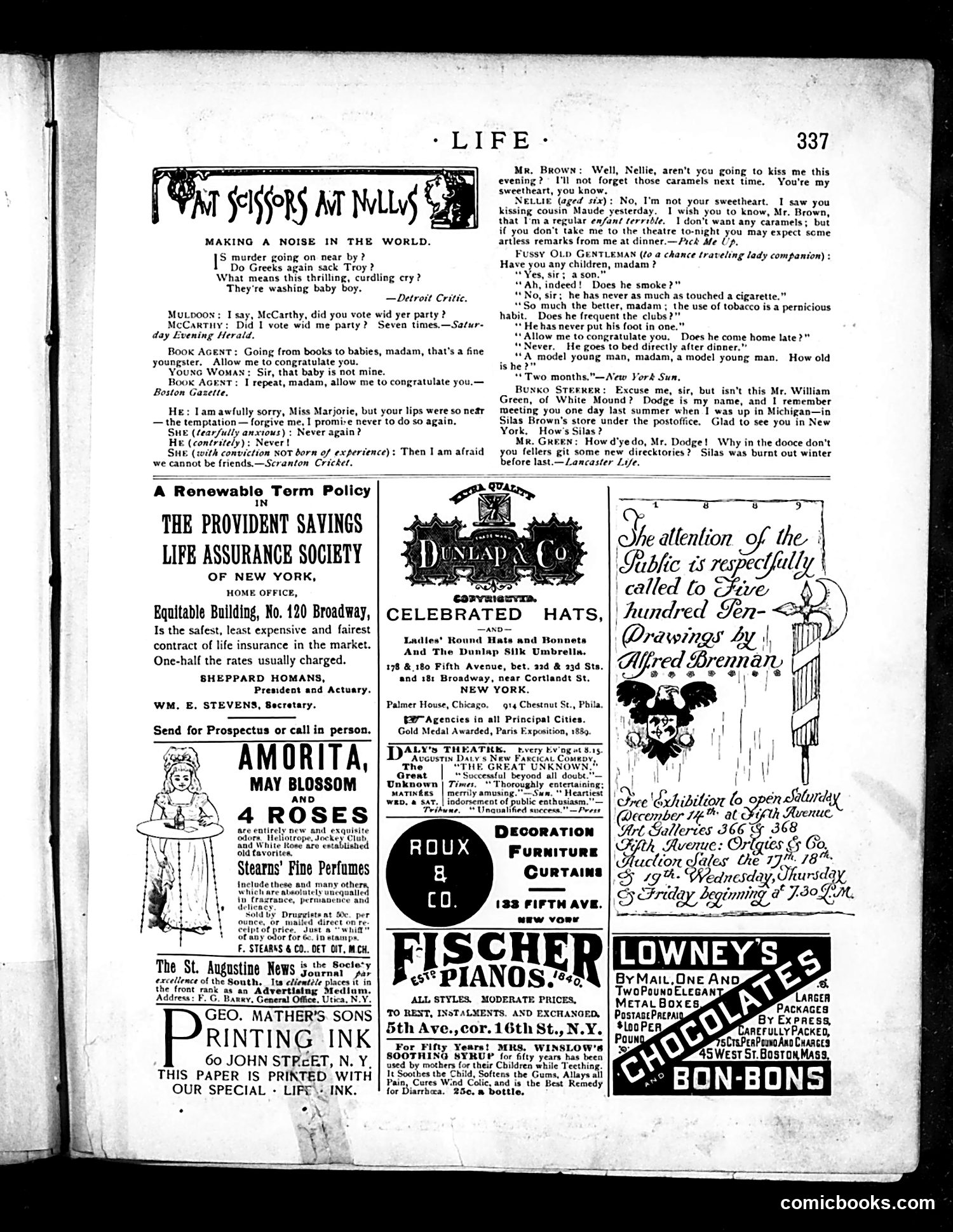
This page is primarily **advertising and miscellaneous humor shorts** rather than a coherent political cartoon. The main content consists of brief comedic vignettes satirizing contemporary social behavior: - A child (Nellie, age six) manipulating an adult suitor with threats of embarrassing dinner remarks—mocking both precocious children and sentimental courtship rituals - A traveling salesman congratulating women on babies that aren't theirs—poking fun at social awkwardness - A fussy old gentleman praising a young man who doesn't smoke, frequent clubs, or stay out late—satirizing Victorian moral standards as absurdly restrictive - Dialogue between two men who recognize each other from years past—gentle humor about small-town connections The cartoons lack specific political references. Instead, they mock universal social pretensions: romantic conventions, parental pride, rigid morality, and the awkwardness of polite society. The humor is genteel rather than biting, typical of Life's family-friendly satirical approach of this era. The page is otherwise filled with period advertisements for perfume, life insurance, hats, pianos, and printing ink.
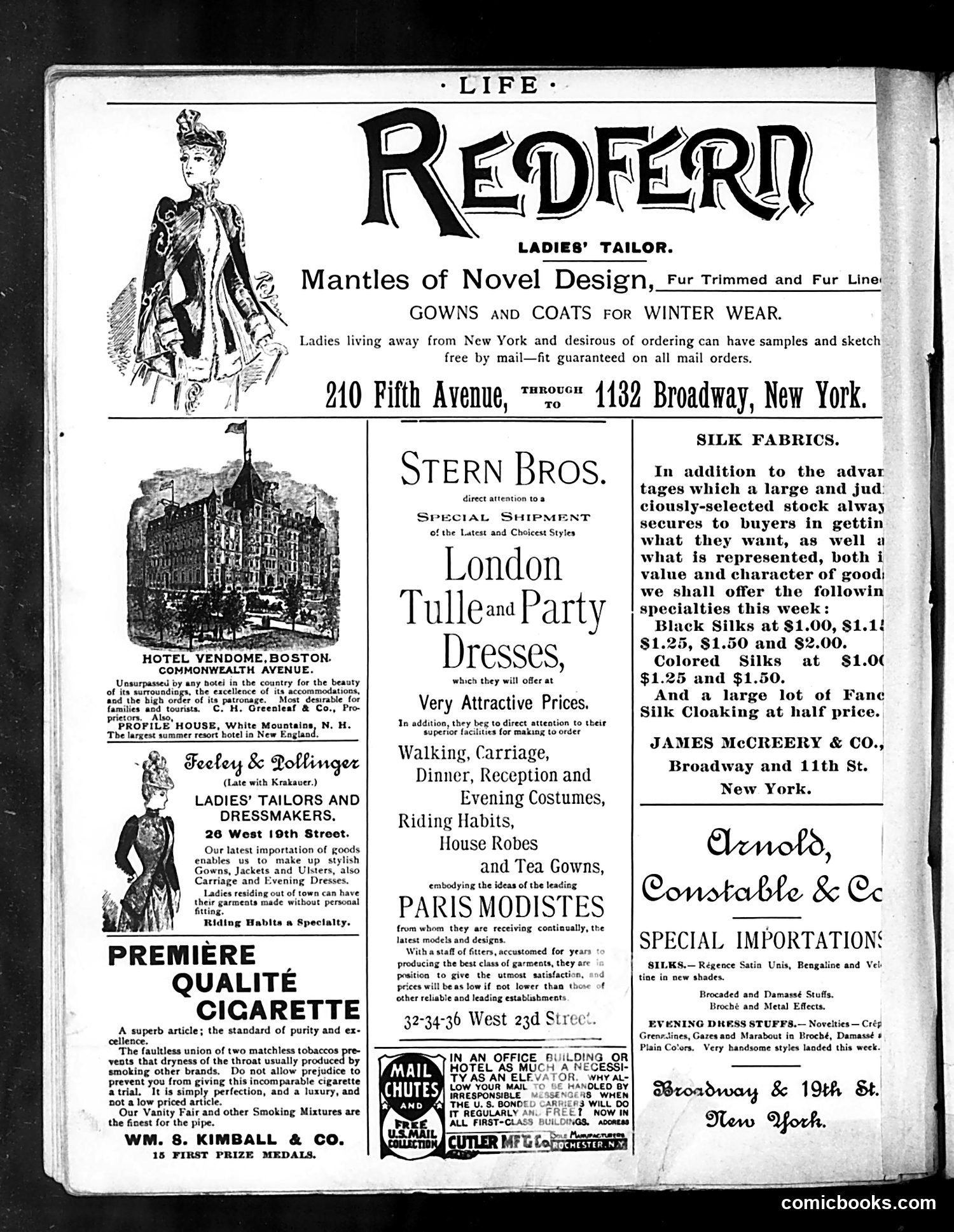
This is primarily an **advertising page** from Life magazine, not a cartoon or satirical piece. It consists entirely of commercial advertisements targeting affluent women in the late 19th/early 20th century. The ads promote **high-end fashion services**: tailors, dressmakers, and fabric merchants in New York City (notably Fifth Avenue and Broadway locations). They emphasize imported goods, particularly from Paris ("Paris Modistes"), custom fitting, and luxury materials like silk. Several ads highlight mail-order services for customers outside New York. The page also includes advertisements for hotels (Hotel Vendôme in Boston) and premium cigarettes (Première Qualité by Wm. S. Kimball & Co.). **For modern readers**: This reflects the era's luxury retail landscape—before department stores dominated, wealthy women relied on bespoke tailors and imported fashions. The repeated emphasis on Paris fashions shows American dependence on European style authority. The mail-order options reveal emerging infrastructure for serving geographically dispersed wealthy clients.
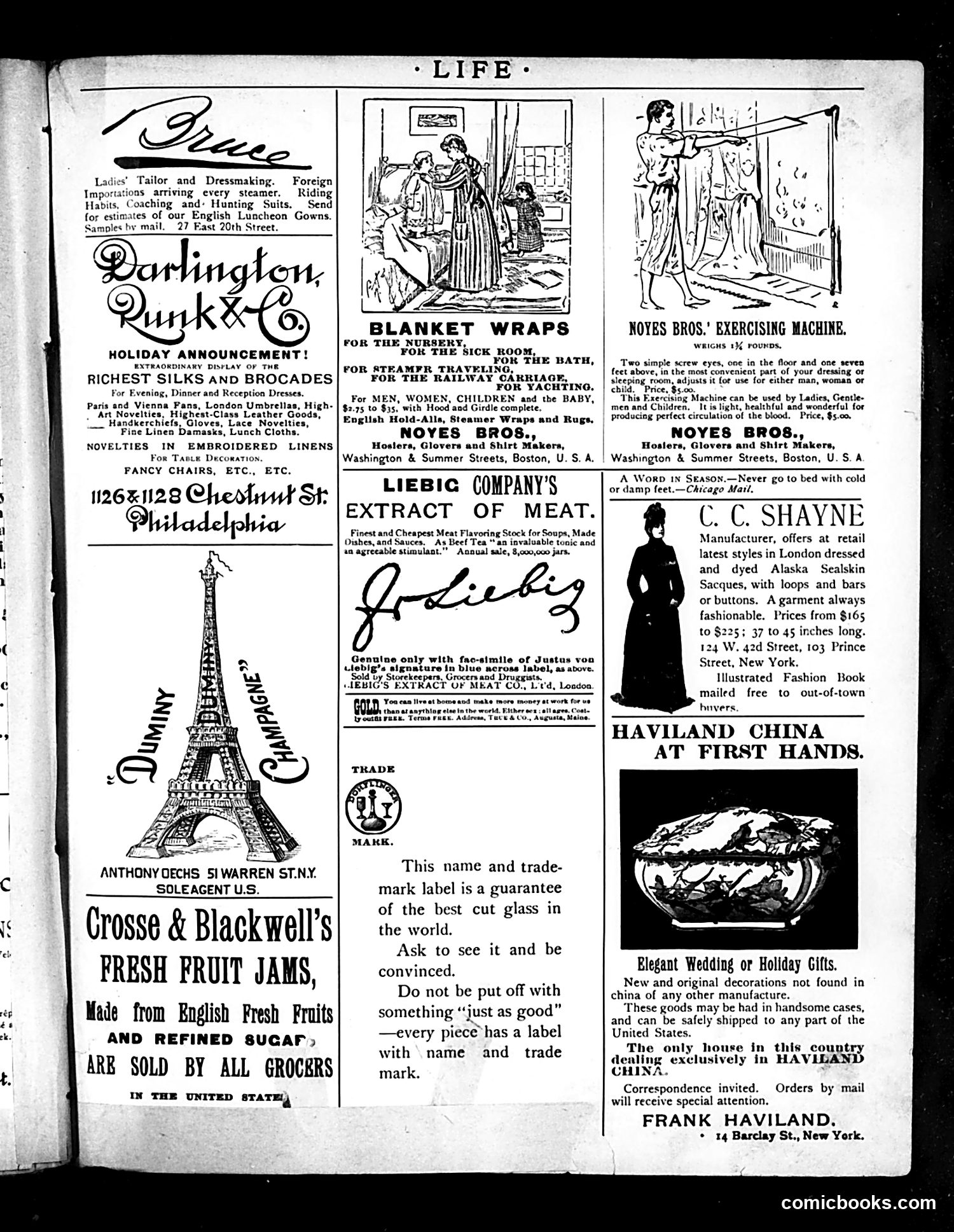
This page is **primarily advertising**, not satirical content. It's a commercial layout from an early American Life magazine issue, featuring luxury goods marketed to wealthy consumers of the era. The advertisements promote high-end products: tailoring services, imported silks and brocades, English jams, blanket wraps, exercise equipment, furs, china, and meat extract. The Eiffel Tower illustration (for a Philadelphia tailor) reflects the period's fascination with European fashion and culture as status markers. Notable is the **Noyes Bros.' Exercising Machine**—a $5 device using "screw eyes" in floors and walls, marketed as producing "perfect circulation" for "Ladies, Gentlemen and Children." This reflects Victorian-era health crazes about mechanical exercise. The **Haviland China** advertisement claims exclusivity as "the only house in this country dealing exclusively in HAVILAND CHINA"—a common marketing claim of the period asserting monopoly or authenticity. Overall, this represents **Gilded Age consumer culture**: foreign imports, new technologies, and emphasis on refinement and health consciousness marketed to affluent readers.
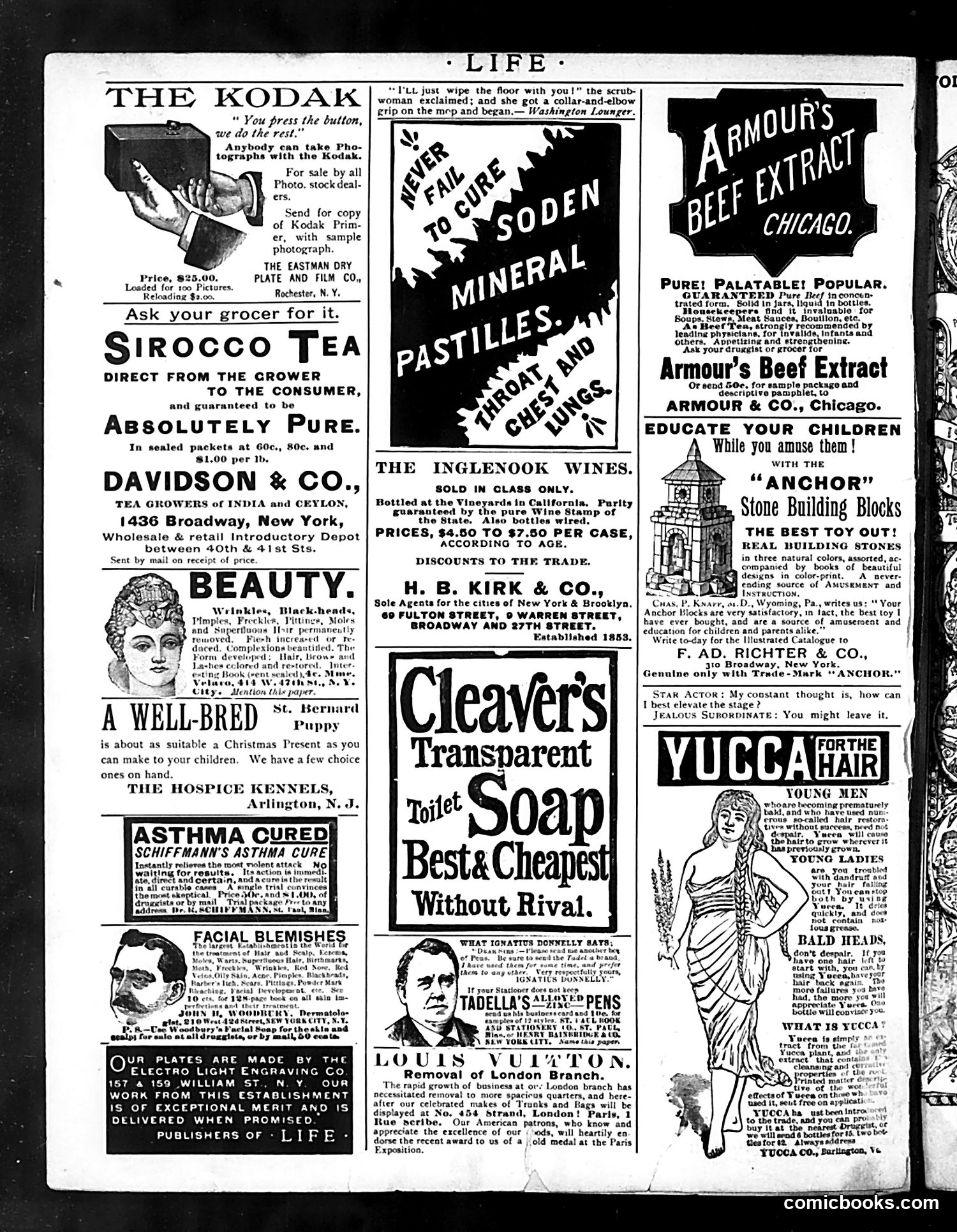
This is primarily an **advertising page** from Life magazine, not a satirical cartoon page. The page contains roughly 15-20 commercial advertisements for consumer goods typical of the late 19th century. Notable products advertised include the **Kodak camera** (emphasizing its ease of use with the famous slogan "You press the button, we do the rest"), tea, beauty treatments for wrinkles and blemishes, asthma cure, wines, soap, beef extract, toy building blocks, and hair restoration products. **The only satirical content** is a small cartoon captioned "The Washington Lounger," showing a scrubwoman threatening to "wipe the floor with you" literally—a pun on the phrase. This brief joke represents Life's typical light, wordplay-based humor. The advertisements themselves reveal period attitudes: aggressive medical claims (asthma cures, beauty treatments), class-consciousness (wine "sold in glass only"), and emerging consumer culture around new technologies like photography.