
Life, 1889-12-12 · page 4 of 16
Life — December 12, 1889 — page 4: what you’re looking at
What you’re looking at
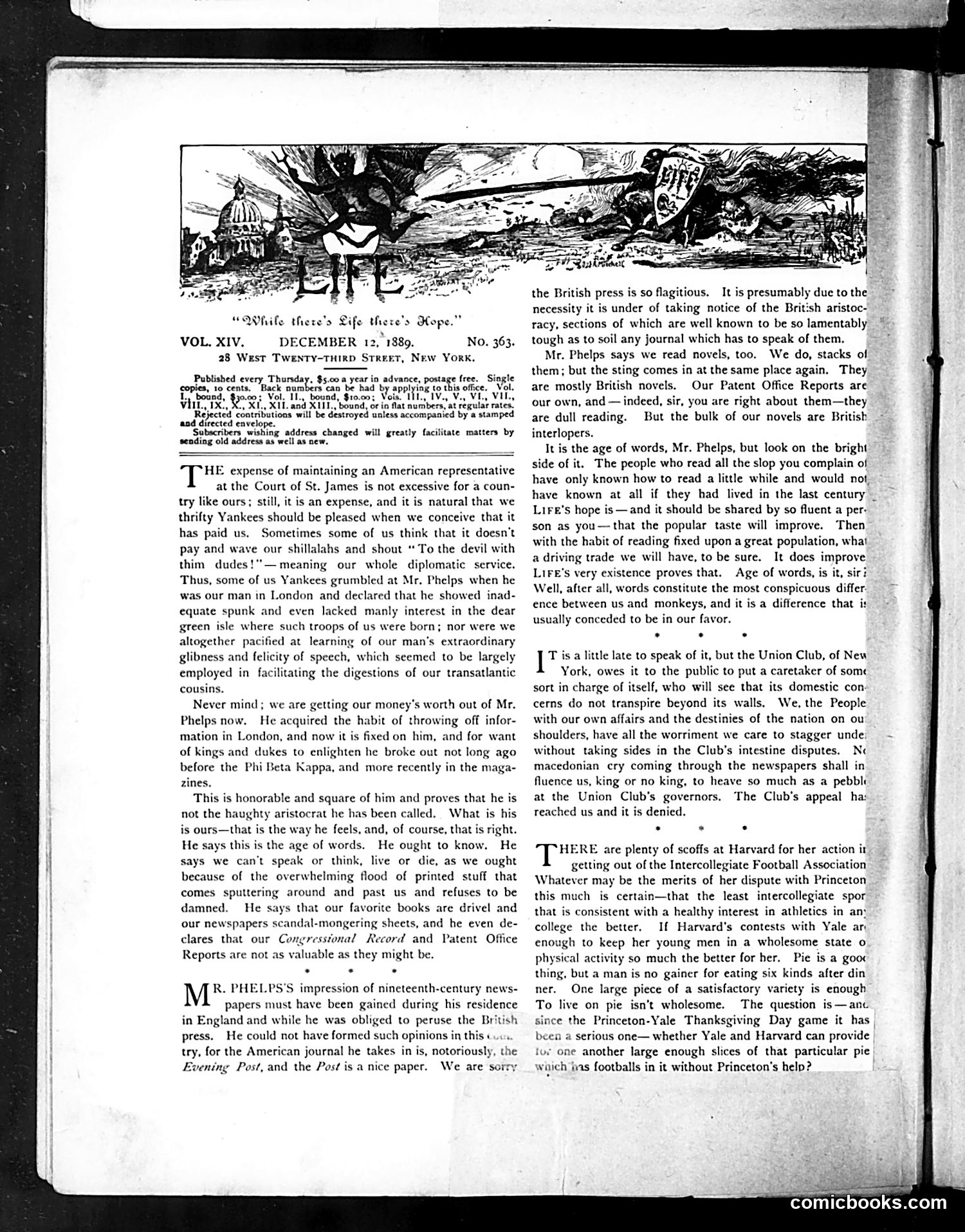
The masthead cartoon depicts a chaotic landscape with classical architecture (suggesting Rome/European civilization) being overwhelmed by turbulent forces—likely representing social upheaval or political instability of the period. The text discusses Mr. Phelps, apparently an American diplomat at the Court of St. James (London), and criticism of his diplomatic competence. The editorial defends American literary and journalistic output against British criticism, sarcastically noting that while British novels dominate American reading, most are "dull reading." The piece then shifts to defending Harvard University's athletic prowess and the upcoming Princeton-Yale Thanksgiving Day football game, suggesting intercollegiate sports were gaining cultural significance in 1880s America. The satire appears aimed at defending American cultural institutions against perceived British superiority.
📄 Transcribed text from this page (OCR, searchable)
Machine-transcribed from the original scan — historical spelling and the odd misread are preserved.
“While there's Life there's Hope.” VOL. XIV. DECEMBER 12, 1889. No. 363. 28 West TweNTy-THIRD StReET, New York, Published every Thursday, $5.00 a year in iedreeee postage free. Single copies, ro cents, Back oumbers can ing ‘gibi ce. V. boun Ti towed, $ioses Vor Nie ss VATS LORE Mi ans KUiteSuode se nhac nucbers at regular rates Rejected contributions will be destroyed unless accompanied by a stamped and directed envelope. Subscribers wishing address changed will greatly facilitate matters by sending old address as well as new. HE expense of maintaining an American representative at the Court of St. James is not excessive for a coun- try like ours; still, it is an expense, and it is natural that we thrifty Yankees should be pleased when we conceive that it has paid us, Sometimes some of us think that it doesn’t pay and wave our shillalahs and shout “To the devil with thim dudes!"— meaning our whole diplomatic service. Thus, some of us Yankees grumbled at Mr. Phelps when he was our man in London and declared that he showed inad- equate spunk and even lacked manly interest in the dear green isle where such troops of us were born; nor were we altogether pacified at learning of our man’s extraordinary glibness and felicity of speech, which seemed to be largely employed in facilitating the digestions of our transatlantic cousins. Never mind; we are getting our money's worth out of Mr. Phelps now. He acquired the habit of throwing off infor- mation in London, and now it is fixed on him, and for want of kings and dukes to enlighten he broke out not long ago before the Phi Beta Kappa, and more recently in the maga- zines. This is honorable and square of him and proves that he is not the haughty aristocrat he has been called. What is his that is the way he feels, and, of course, that is right. this is the age of words. He ought to know. He says we can't speak or think, live or die, as we ought because of the overwhelming flood of printed stuff that comes sputtering around and past us and refuses to be damned. He says that our favorite books are drivel and our newspapers scandal-mongering sheets, and he even de- clares that our Congresstonal Record and Patent Office Reports are not as valuable as they might be. M*: PHELPS'S impression of nineteenth-century news- papers must have been gained during his residence in England and while he was obliged to peruse the Bri press. He could not have formed such opinions in this « try, for the American journal he takes in is, notoriously, the Evening Post, and the Post is a nice paper. We are sorry the British Press is so flagitious. It is presumably due to the necessity it is under of taking notice of the British aristoc- racy, sections of which are well known to be so lamentably tough as to soil any journal which has to speak of them. Mr. Phelps says we read novels, too. We do, stacks of them; but the sting comes in at the same place again, They are mostly British novels. Our Patent Office Reports are our own, and — indeed, sir, you are right about them—they are dull reading. But the bulk of our novels are British interlopers. It is the age of words, Mr. Phelps, but look on the bright side of it. The people who read all the slop you complain of have only known how to read a little while and would not, have known at all if they had lived in the last century _ Lire’s hope is—and it should be shared by so fluent a per- son as you—that the popular taste will improve. Then with the habit of reading fixed upon a great population, what a driving trade we will have, to be sure. It does improve Lire’s very existence proves that. Age of words, is it, siri Well, after all, words constitute the most conspicuous differ: ence between us and monkeys, and it is a difference that usually conceded to be in our favor. . . . I" is a little late to speak of it, but the Union Club, of New York, owes it to the public to put a caretaker of some sort in charge of itself, who will see that its domestic con. cerns do not transpire beyond its walls. We, the People with our own affairs and the destinies of the nation on ou shoulders, have all the worriment we care to stagger unde: without taking sides in the Club's intestine disputes. Nc macedonian cry coming through the newspapers shall in fluence us, king or no king, to heave so much as a pebbl. at the Union Club's governors. The Club's appeal ha: reached us and it is denied. T! RE are plenty of scoffs at Harvard for her action ir getting out of the Intercollegiate Football Association Whatever may be the merits of her dispute with Princeton this much is certain—that the least intercollegiate spor that is consistent with a healthy interest in athletics in an: college the better. If Harvard's contests with Yale ar: enough to keep her young men in a wholesome state o physical activity so much the better for her. Pie is a gooc thing, but a man is no gainer for eating six kinds after din ner. One large piece of a satisfactory variety is enough To live on pie isn't wholesome. The question is—anc since the Princeton-Yale Thanksgiving Day game it has, serious one— whether Yale and Harvard can provide tue one another large enough slices of that particular pie waich has footballs in it without Princeton's help? been Comicbooks. com