
A complete issue · 18 pages · 1889
Life — November 28, 1889
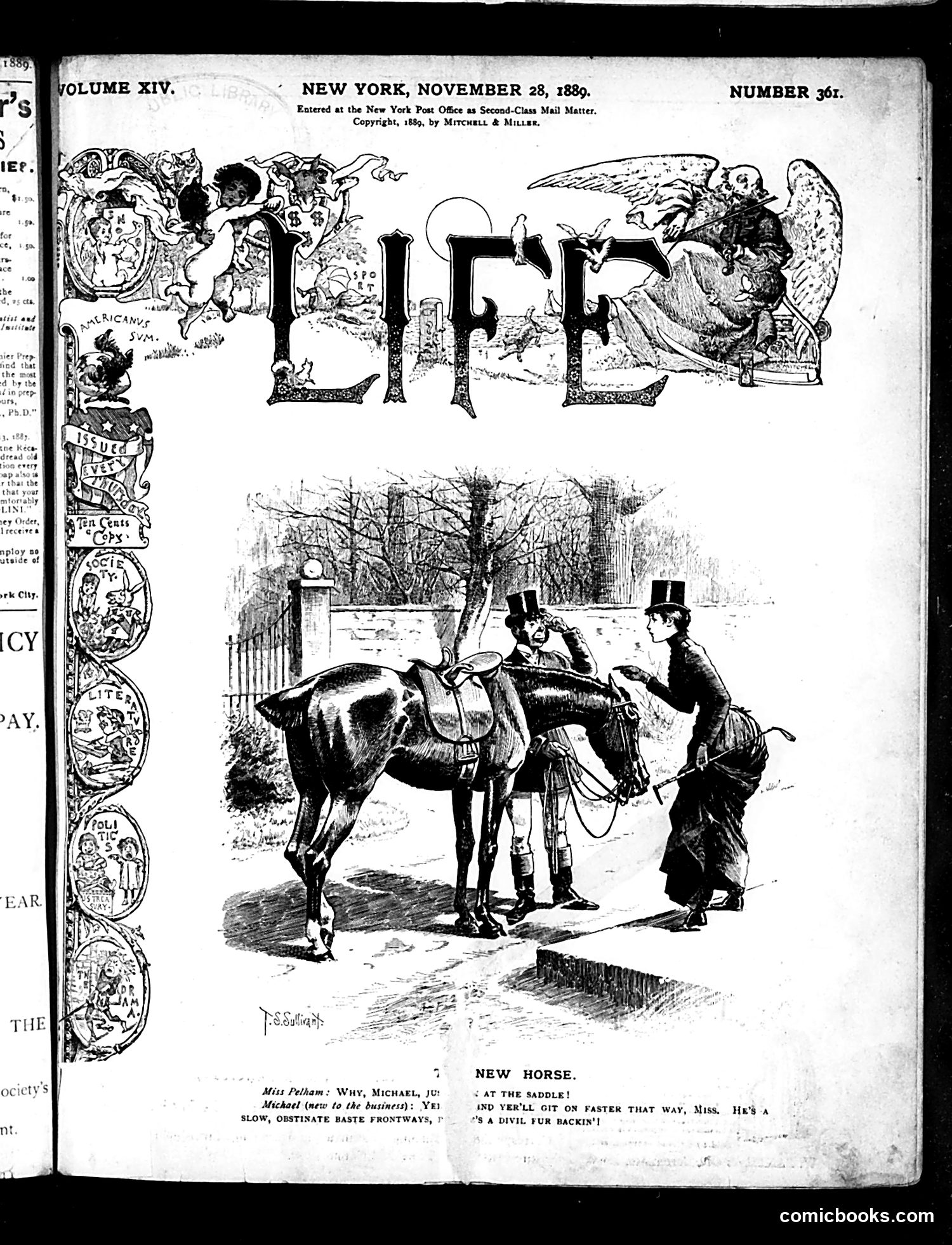
This cartoon satirizes what appears to be a situation involving a woman (Miss Pelham) and a new horse. The dialogue suggests Michael has suggested the horse is "slow, obstinate, haste forwardness" but Miss Pelham wants to ride faster. The joke hinges on a double meaning: Michael recommends she ride the horse "at the saddle" and "git on faster that way," while the punchline implies the horse itself is "a devil for hackin'" (renting out for use). This appears to be wordplay mocking either the horse's poor qualities or, more likely, making an insinuation about the woman's character or reputation through the vehicle of horse-trading metaphor. The satire's precise target remains unclear without additional biographical context.
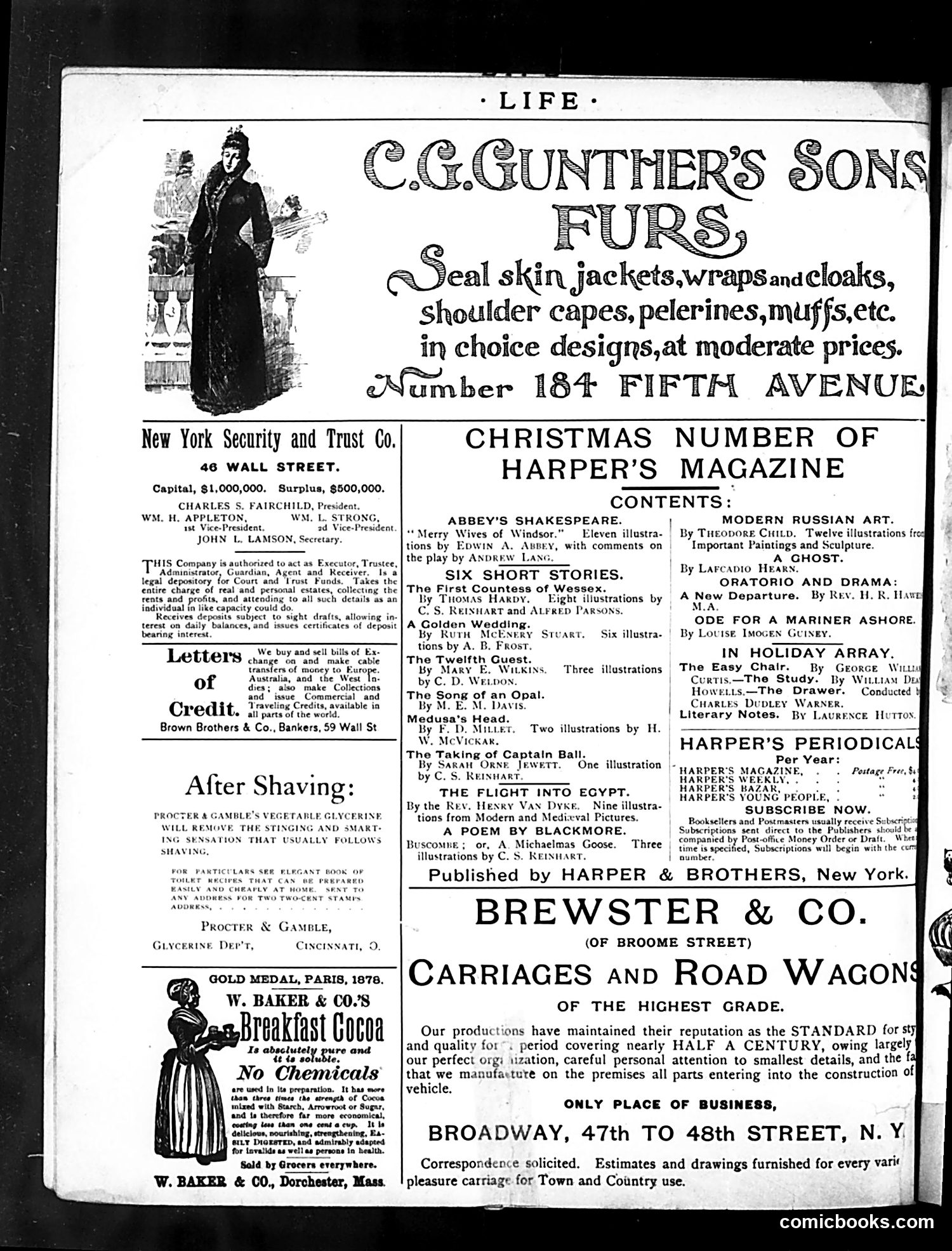
This page is primarily **advertising**, not political satire. The main content includes: **C.G. Gunther's Sons Furs** (top): A fashion advertisement for women's seal skin coats and fur accessories, featuring an illustration of an elegantly dressed woman. **Smaller ads** include financial services (New York Security and Trust Co.), letters of credit, and grooming products (Procter & Gamble's glycerin, Baker's cocoa). **Harper's Magazine content** (center-right): Lists table of contents for their Christmas issue, including literary pieces like "Abbey's Shakespeare" and "The Flight into Egypt." **Brewster & Co.** (bottom): An advertisement for high-end carriages and road wagons manufactured in New York. The page reflects late 19th-century consumer culture targeting wealthy readers—no political satire is evident.
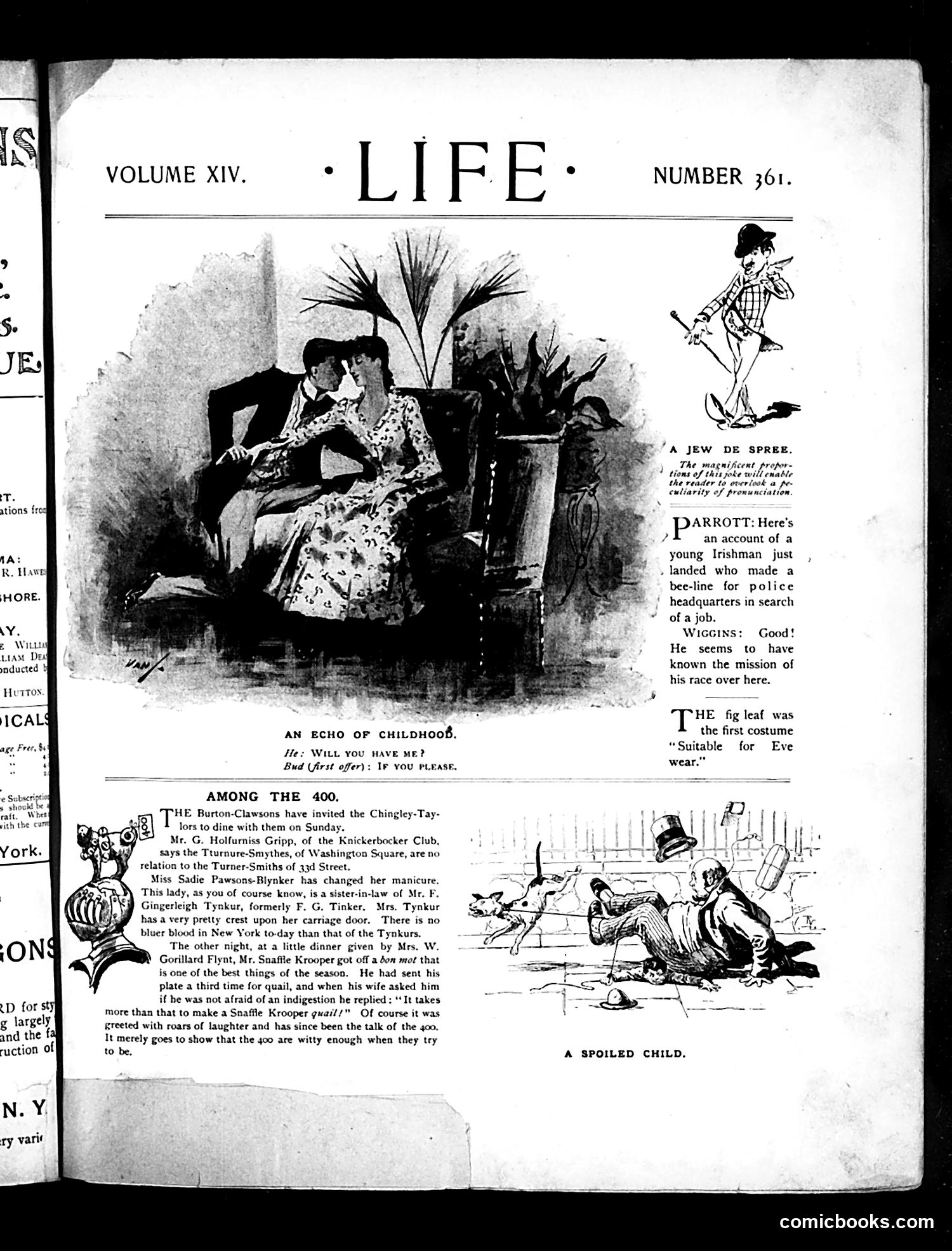
This page contains three distinct satirical pieces: 1. **"An Echo of Childhood"** depicts a woman reclining while reading, with text referencing a character's response: "If you please." The satire appears to mock outdated genteel manners. 2. **"A Jew de Spree"** (right panel) uses wordplay on "Jews" and "jaunt," presenting a caricatured figure. The caption notes this demonstrates "pronunciation peculiarity"—mocking ethnic speech patterns, a common (though offensive) satirical trope of the era. 3. **"Among the 400"** and **"A Spoiled Child"** describe social gossip about wealthy New York families and their behavioral eccentricities, typical of Life's satirical focus on high society's absurdities. The overall tone reflects early-20th-century American satire targeting both upper-class pretension and ethnic stereotypes.
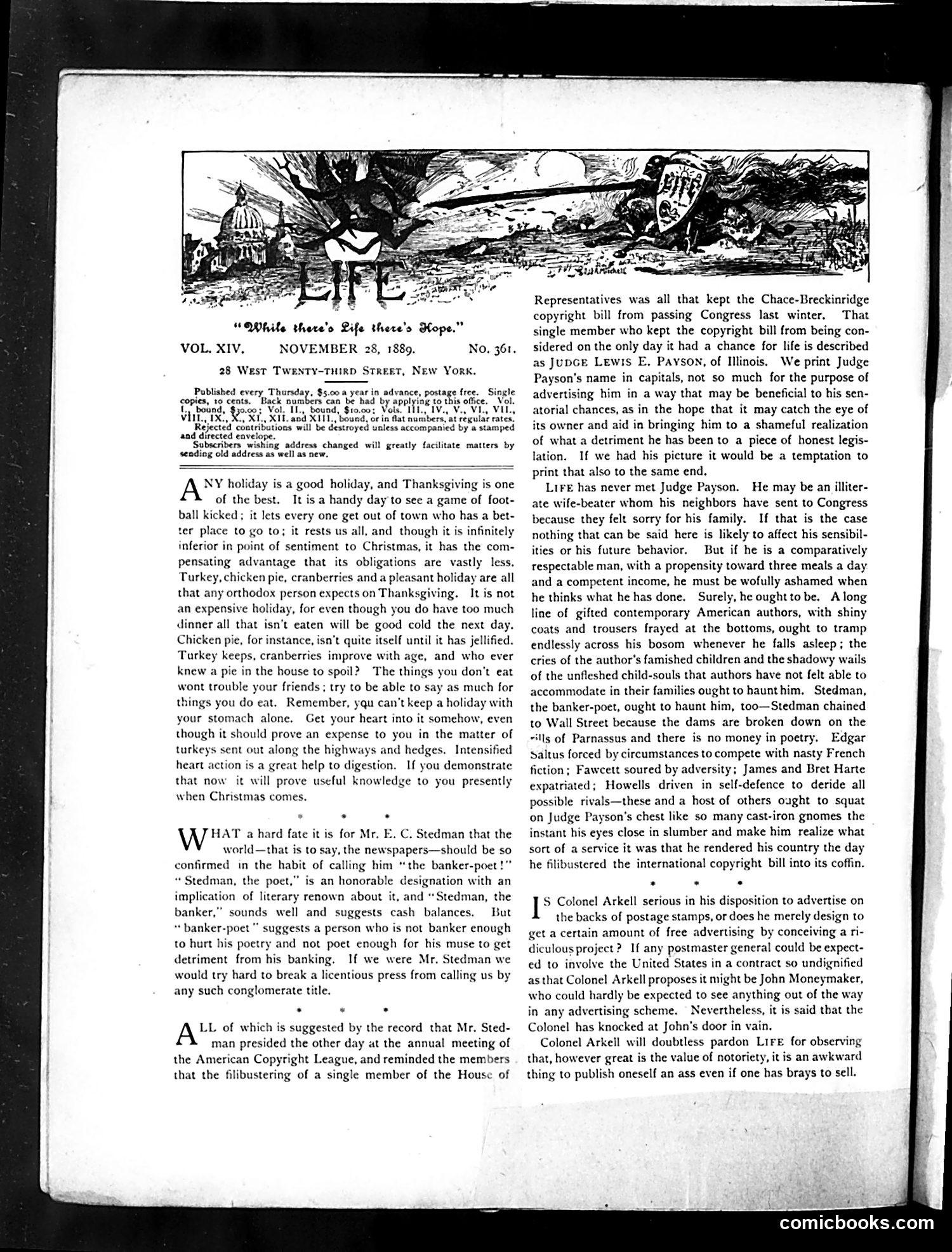
The masthead cartoon depicts a gnarled tree with figures gathered beneath it—likely allegorical imagery about American society or politics, though specific identities are unclear from the image alone. The text addresses copyright legislation. A "Chace-Breckinridge copyright bill" failed to pass Congress, reportedly blocked by a single Representative (Judge Lewis E. Payson of Illinois). The article satirizes Payson's obstruction, suggesting he prevented the bill's passage single-handedly. Life criticizes this as unjust—one congressman shouldn't wield such power against what the magazine apparently supported. The remaining columns discuss T.C. Stedman (called the "banker-poet") and Colonel Arkell's advertising scheme involving postage stamps, both treated with satirical skepticism about dubious financial or promotional schemes.
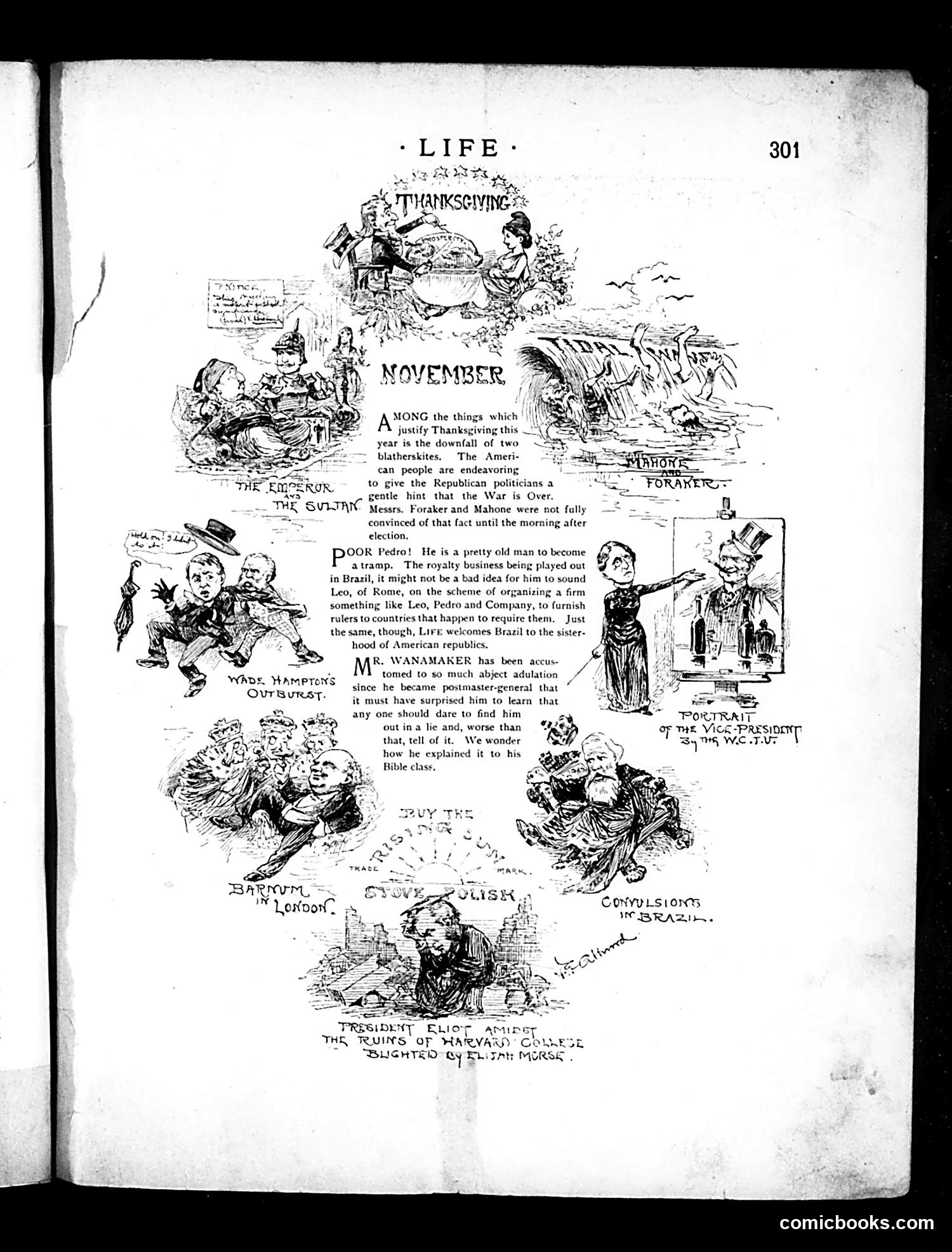
This satirical page mocks American political figures and international affairs circa the 1900s. The text references the "downfall of two blatherskites" (fools) named Foraker and Mahone, suggesting Republican politicians facing electoral defeat. "Poor Pedro" critiques Brazilian affairs, where a figure named Pedro supposedly planned to organize a government company—satirizing imperial schemes. Mr. Wanamaker is accused of lying about his postal service role, mocking his credibility. The various cartoons lampoon political incompetence and international embarrassments. President Eliot at Harvard's ruins (bottom) appears to reference institutional mismanagement. The overall tone: American readers should be grateful this Thanksgiving that incompetent politicians and foreign adventurers faced exposure and defeat, making the nation safer.
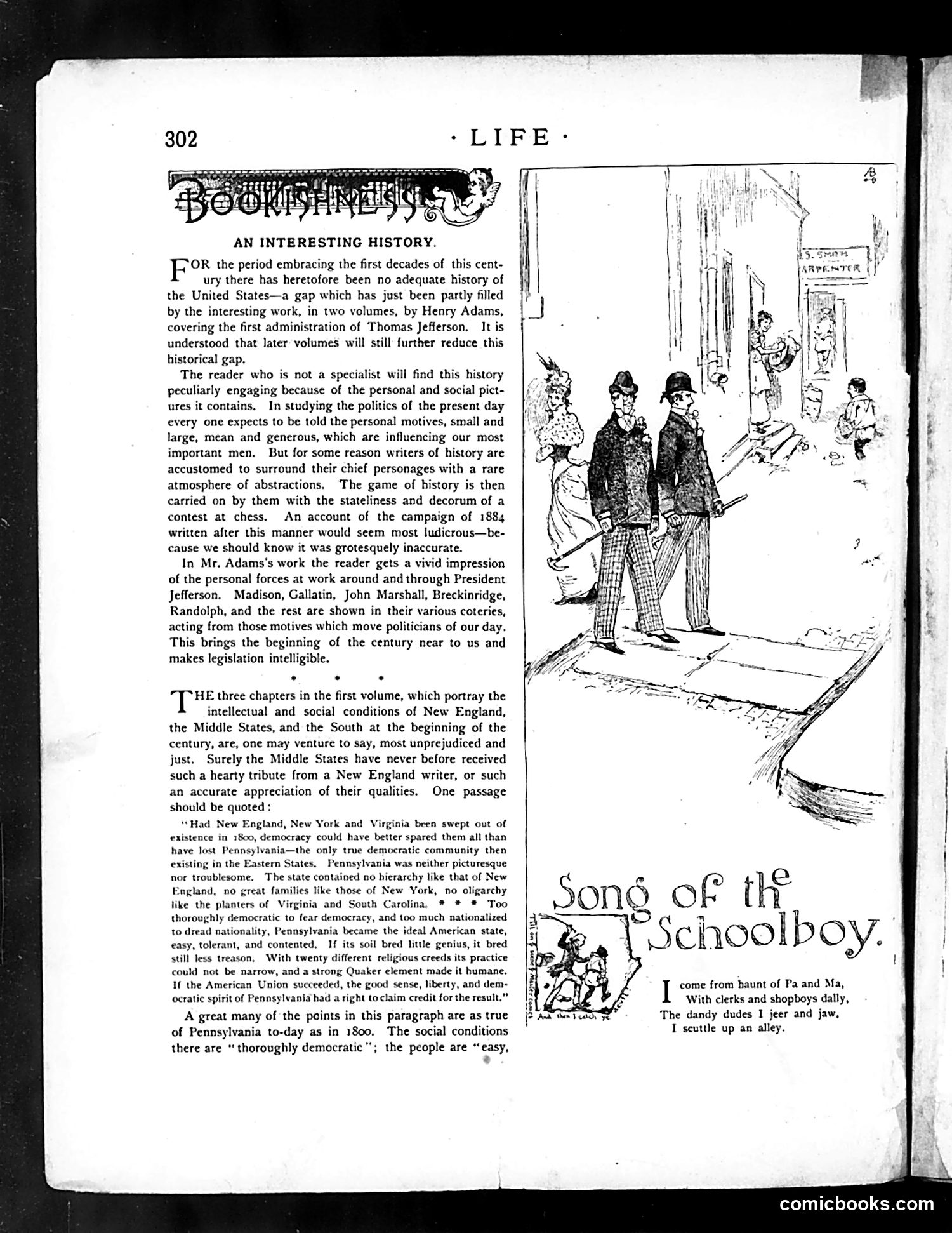
The main illustration depicts a street scene with two well-dressed men in period clothing (appearing to be early 19th century based on their hats and attire) observing something off-page, while children and figures appear in a doorway or building entrance. The accompanying text discusses Henry Adams's historical work on early American history, praising his vivid portrayal of influential figures like Jefferson, Madison, and Marshall. The quoted passage emphasizes Pennsylvania's democratic character compared to New England and Virginia. Below is a poem titled "Song of the Schoolboy" about a child coming from school. **Without seeing identifying captions or clearer details, I cannot confidently name the specific historical figures depicted in the cartoon or identify any particular satirical political point being made.**
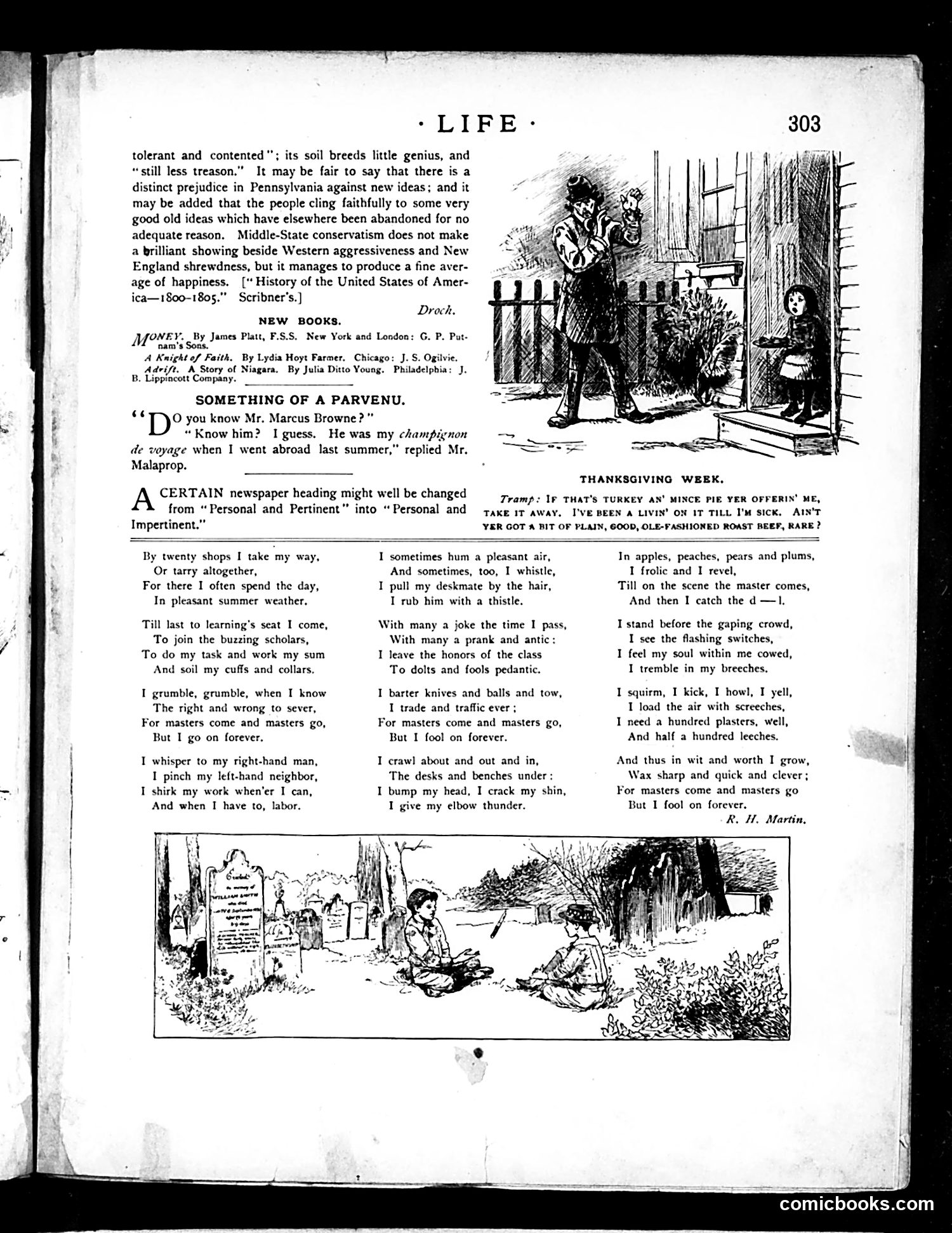
**Top Cartoon ("Thanksgiving Week"):** A scraggly, disheveled man (appearing homeless or destitute) refuses a turkey pie from a well-dressed woman, declaring he's been "livin' on it till I'm sick" and prefers honest work. The satire critiques charity that offers repetitive or inadequate aid—suggesting Thanksgiving-season charity as performative rather than substantive. The contrast between the woman's comfort and the man's ragged appearance emphasizes class disparity. **Lower Illustration:** Two children sit near a graveyard, apparently in conversation—likely accompanying the poem "I Fool on Forever" by R.H. Martin, which uses schoolyard perspectives and mischief as its subject. The page primarily features literary content (poetry and short stories) rather than hard political satire, representing Life's mixed editorial approach to social commentary and entertainment.
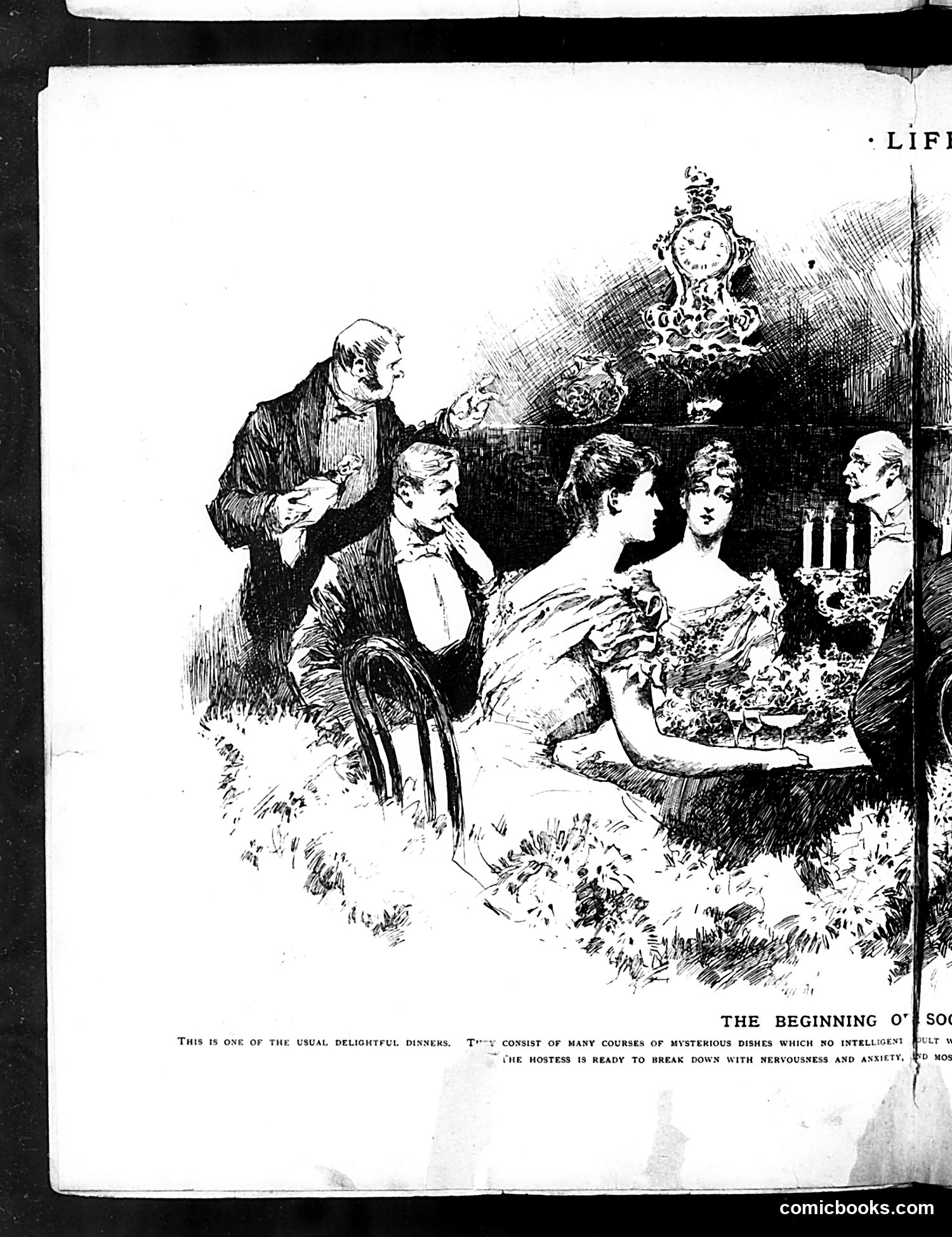
This appears to be a satirical illustration from *Life* magazine depicting an elegant dinner party. The caption describes "one of the usual delightful dinners" consisting of "many courses of mysterious dishes which no intelligent [guest] can identify," with the hostess ready to "break down with nervousness and anxiety." The satire targets upper-class dining pretensions—specifically the absurdity of elaborate, overly complicated multi-course meals featuring unidentifiable dishes served at formal dinners. The humor lies in mocking both the hostess's anxiety about impressing guests and the guests' inability to comprehend what they're actually eating, despite the meal's apparent sophistication. This reflects late 19th/early 20th-century American social satire critiquing nouveau riche affectation and the performative nature of high society.
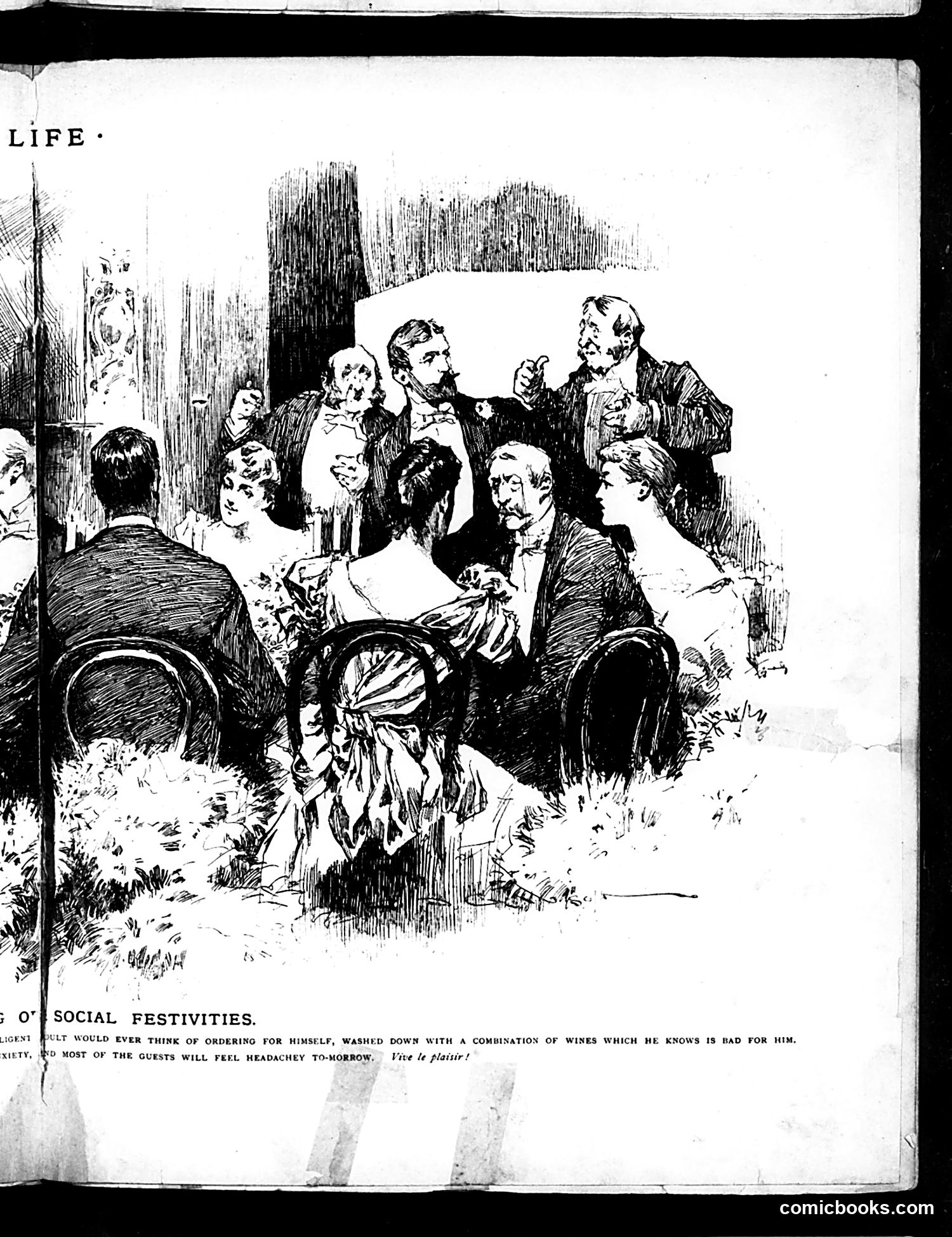
This satirical cartoon mocks upper-class dinner parties and their social pretensions. The caption describes a scenario where a foolish host orders wine he knows is "bad for him," then expects his guests will suffer hangovers the next day—framing poor hospitality as inevitable consequence rather than poor judgment. The sketch depicts a crowded, somewhat chaotic gathering of well-dressed men and women in what appears to be a parlor or dining room. The satire targets the vanity and self-deception of wealthy hosts who serve inferior refreshments while maintaining social appearances. The joke critiques both the host's obliviousness and guests' silent endurance of substandard entertainment—typical subjects of Life magazine's humor about Victorian-era high society.
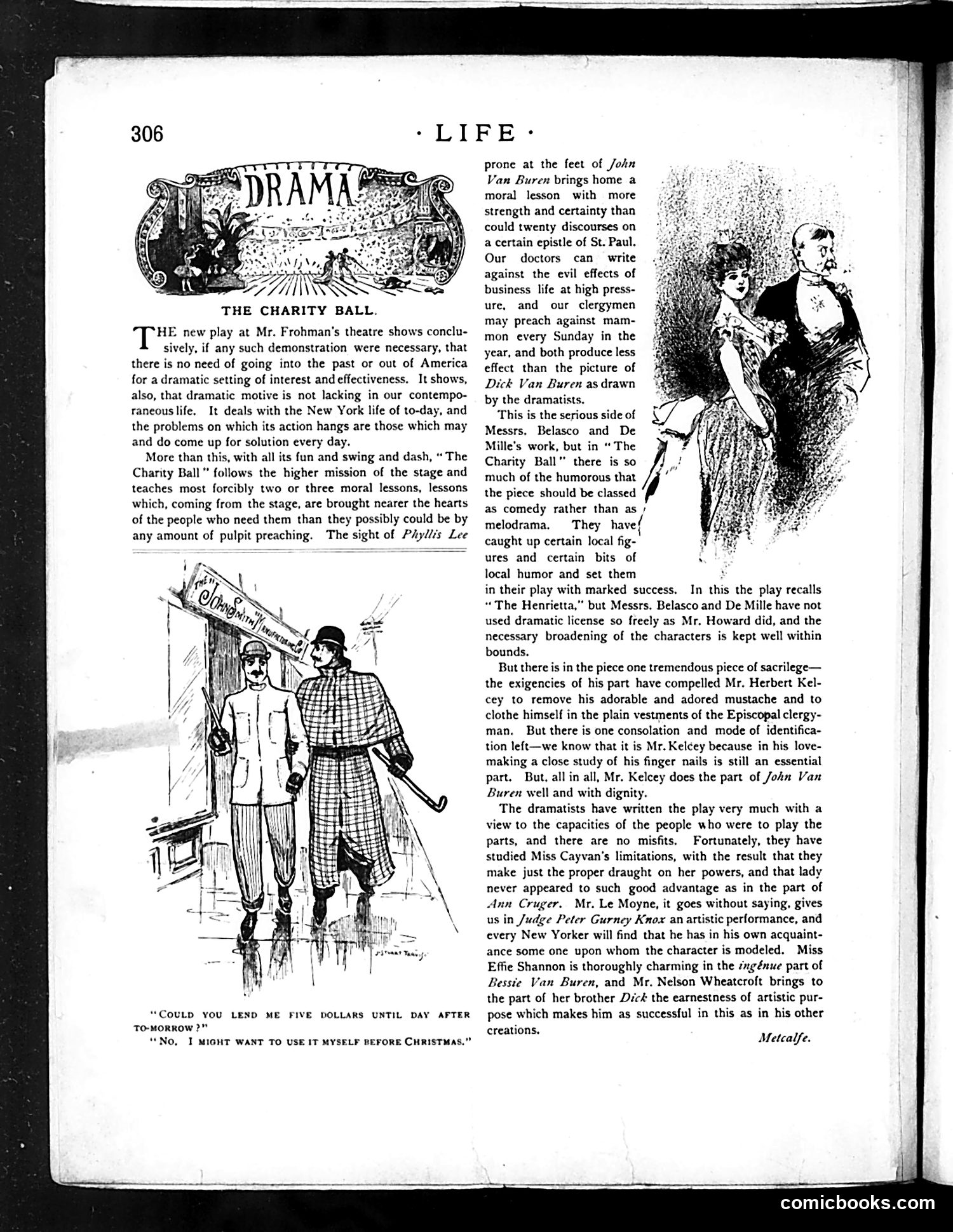
This is a theater review of a play called "The Charity Ball." The illustration shows two men at what appears to be a charity event entrance—one in formal dress, the other in a plaid outfit—with dialogue: "Could you lend me five dollars until day after to-morrow?" / "No, I might want to use it myself before Christmas." The joke satirizes the hypocrisy of charity: wealthy attendees at a "charity" ball are themselves so financially strapped they cannot spare even small loans, undermining the moral purpose of fundraising for the poor. The review praises the play's moral lessons delivered through drama more effectively than preaching. It mentions the cast includes Phyllis Lee and Herbert Kelcey, among others, discussing the theatrical production's quality and character portrayals.
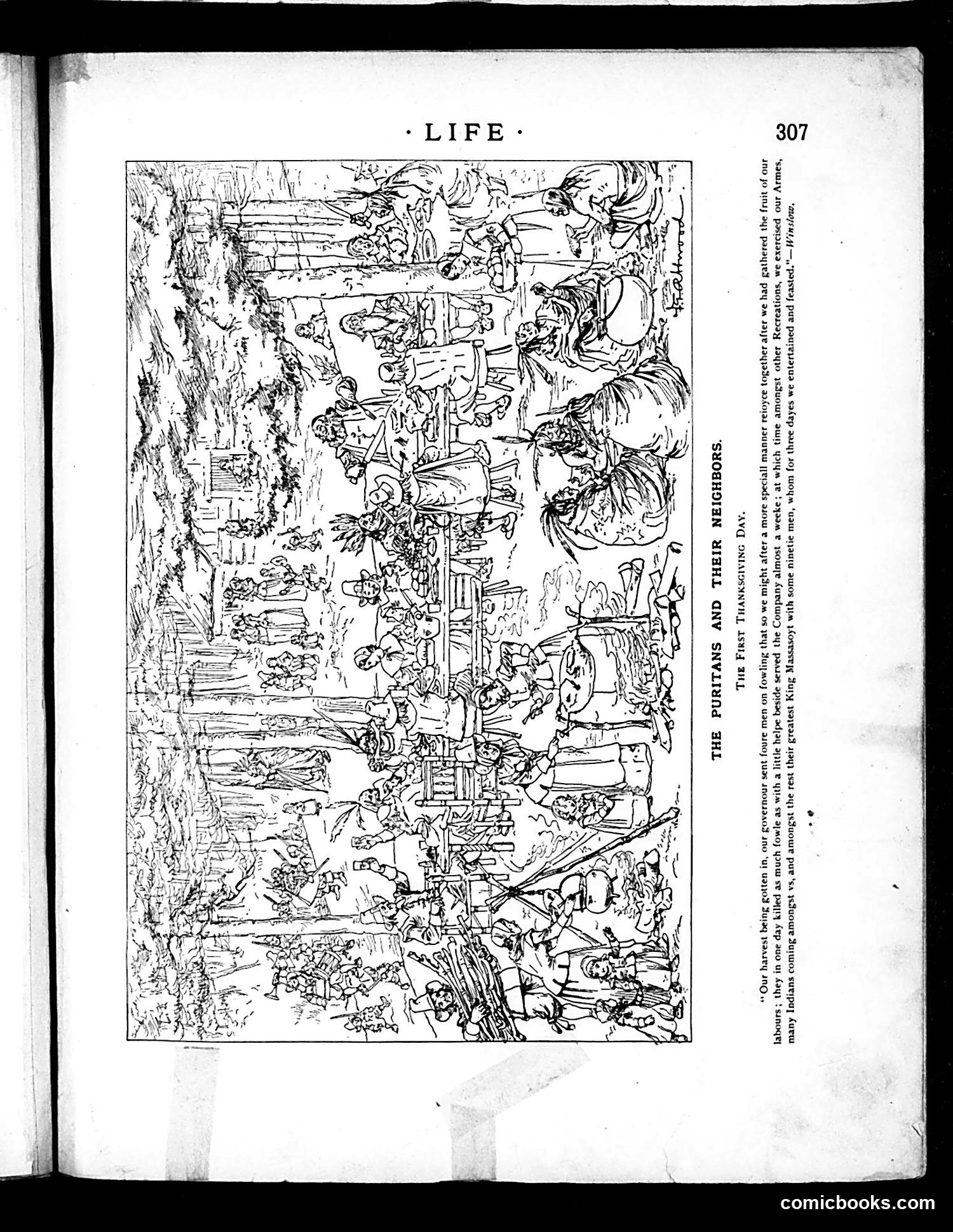
This satirical engraving depicts a chaotic scene of colonial-era Puritans and Native Americans in close quarters. The image shows numerous figures engaged in various activities—some appear to be trading, others socializing or conflicting. The composition is deliberately crowded and frenzied, suggesting tension between the two groups. The title suggests this is commentary on early American colonial encounters. The satire likely mocks either Puritan hypocrisy (their strict moral codes versus actual behavior) or the awkward, complicated relationships between European settlers and indigenous peoples. The detailed, busy illustration style emphasizes disorder and the complexity of these interactions rather than any idealized or simplified historical narrative.
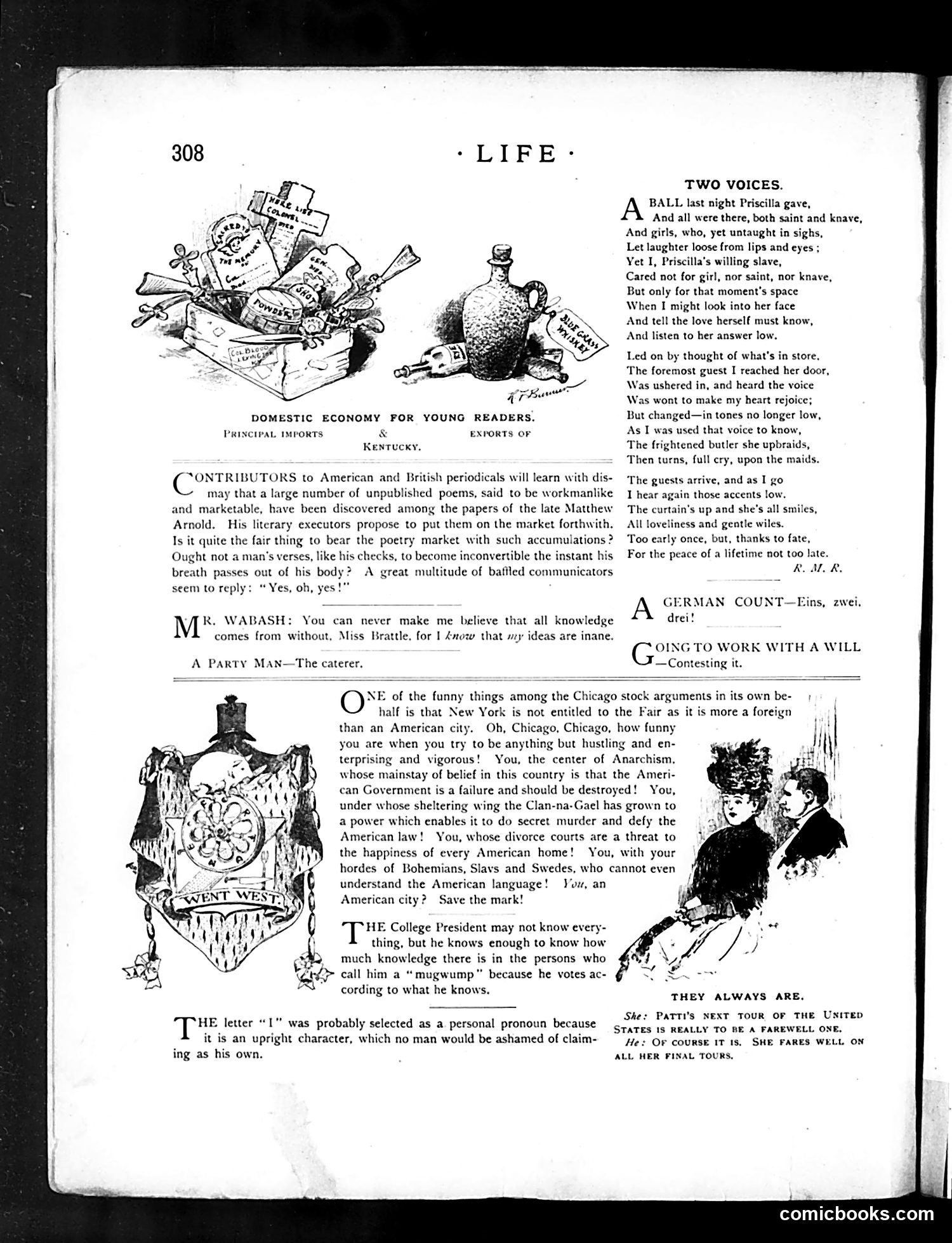
This page contains multiple satirical pieces typical of Life's late 19th/early 20th-century humor: **"Two Voices"** is a romantic poem about a man attending a ball for Priscilla, expecting tender conversation but discovering her shouting orders at servants—satirizing the gap between women's public charm and private behavior. **"Domestic Economy for Young Readers"** mocks the discovery of unpublished Matthew Arnold poems among his papers, questioning whether dead poets' work should flood the market and devalue living writers' efforts. **The Chicago section** contains sharp political criticism: Chicago boasts of hosting the World's Fair but is portrayed as hypocritical—a center of anarchism (referencing the Haymarket affair), harboring the violent Irish-American organization Clan-na-Gael, with high divorce rates and immigrant populations Life's audience viewed as un-American. The cartoon imagery (shield, figures) and shorter jokes flesh out the satirical commentary on contemporary social pretense and urban problems.
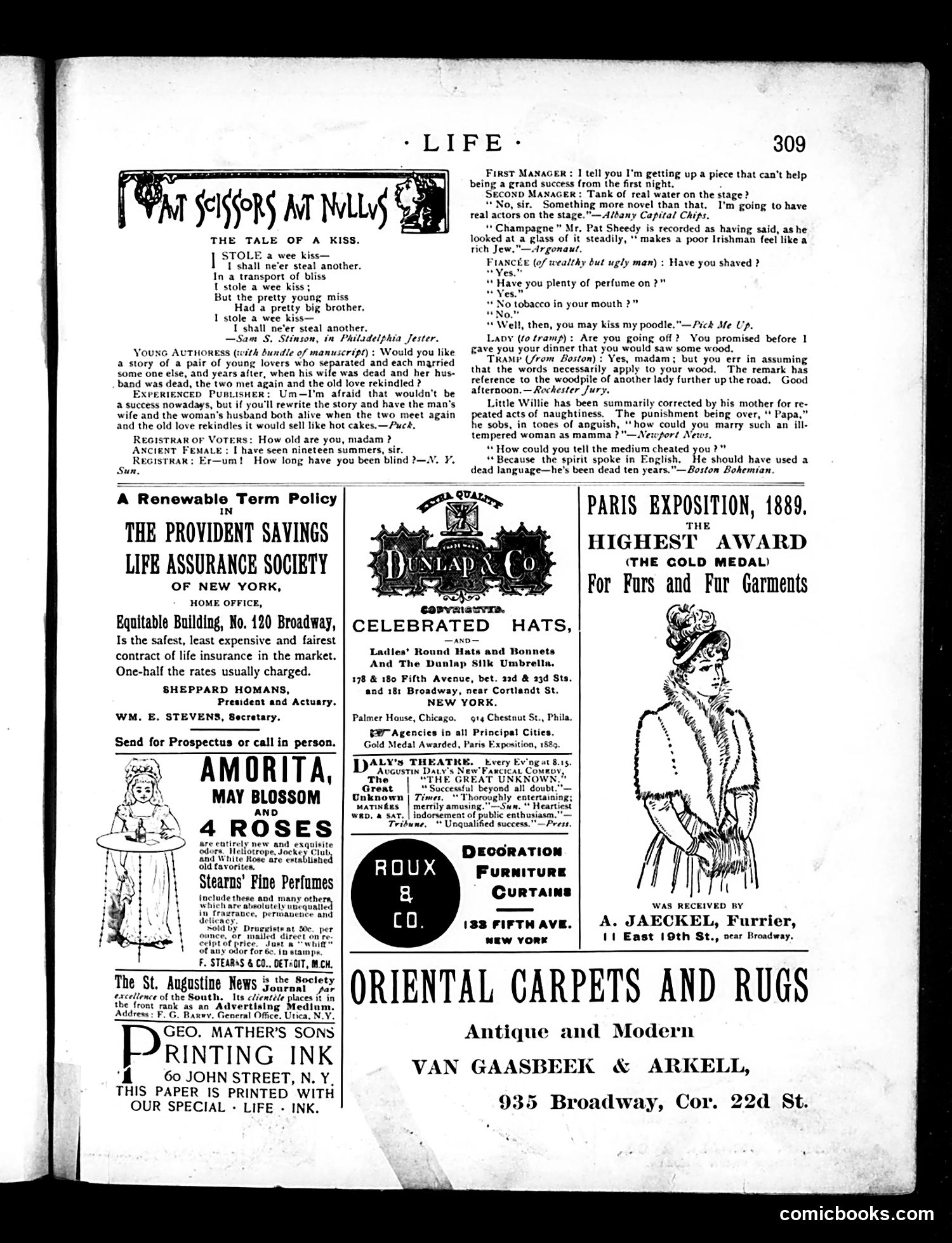
This page consists mainly of brief humorous anecdotes and advertisements typical of *Life* magazine's satirical format. **The title cartoon** "At Scissors at Nullus: The Tale of a Kiss" uses a clever visual pun playing on the rhyming poem below it about stealing a kiss from a girl—only to regret it when her large brother appears, a common joke format of the era about courtship and masculine bravado. The **collected jokes** mock contemporary attitudes: one satirizes theatrical realism (managers claim "real actors" on stage); another mocks wealthy but unattractive suitors; another targets spiritualist mediums as frauds. The joke about the registrar asking a woman "how long have you been blind?" sardonically suggests women voting is absurd. The page is primarily **advertisements** for life insurance, hats, perfume, furniture, and printing services—the typical commercial content subsidizing the magazine—rather than sustained political or social commentary.
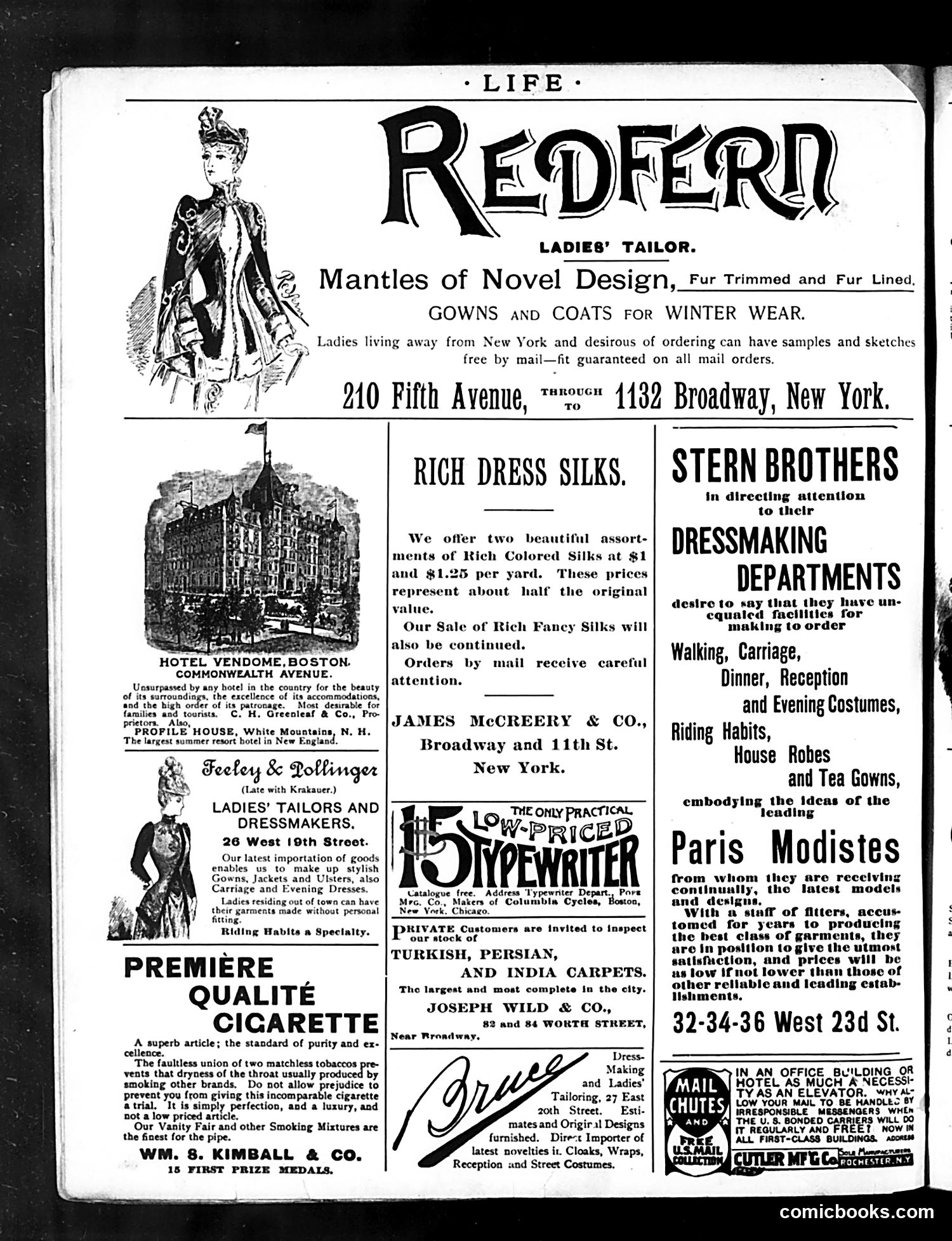
This page contains **no political cartoons or satirical content**—it is purely a collection of period advertisements from what appears to be the late 19th or early 20th century. The ads promote luxury goods typical of that era: high-end dressmaking services (Redfern, Stern Brothers, Feeley & Pollinger), fine silks and carpets, a prestigious Boston hotel, and cigarettes. There is one small utilitarian ad for a typewriter and mail handling services. The imagery reflects the period's fashion emphasis: illustrated women in elaborate fur-trimmed cloaks and formal wear, reflecting the wealth and leisure class these businesses served. Prices like "$1 per yard" for silk suggest this was upscale merchandise. **For modern readers:** This page documents how luxury fashion, hotels, and imported goods were marketed to affluent Americans, emphasizing craftsmanship, European style ("Paris Modistes"), and mail-order service for wealthy women living outside New York City.
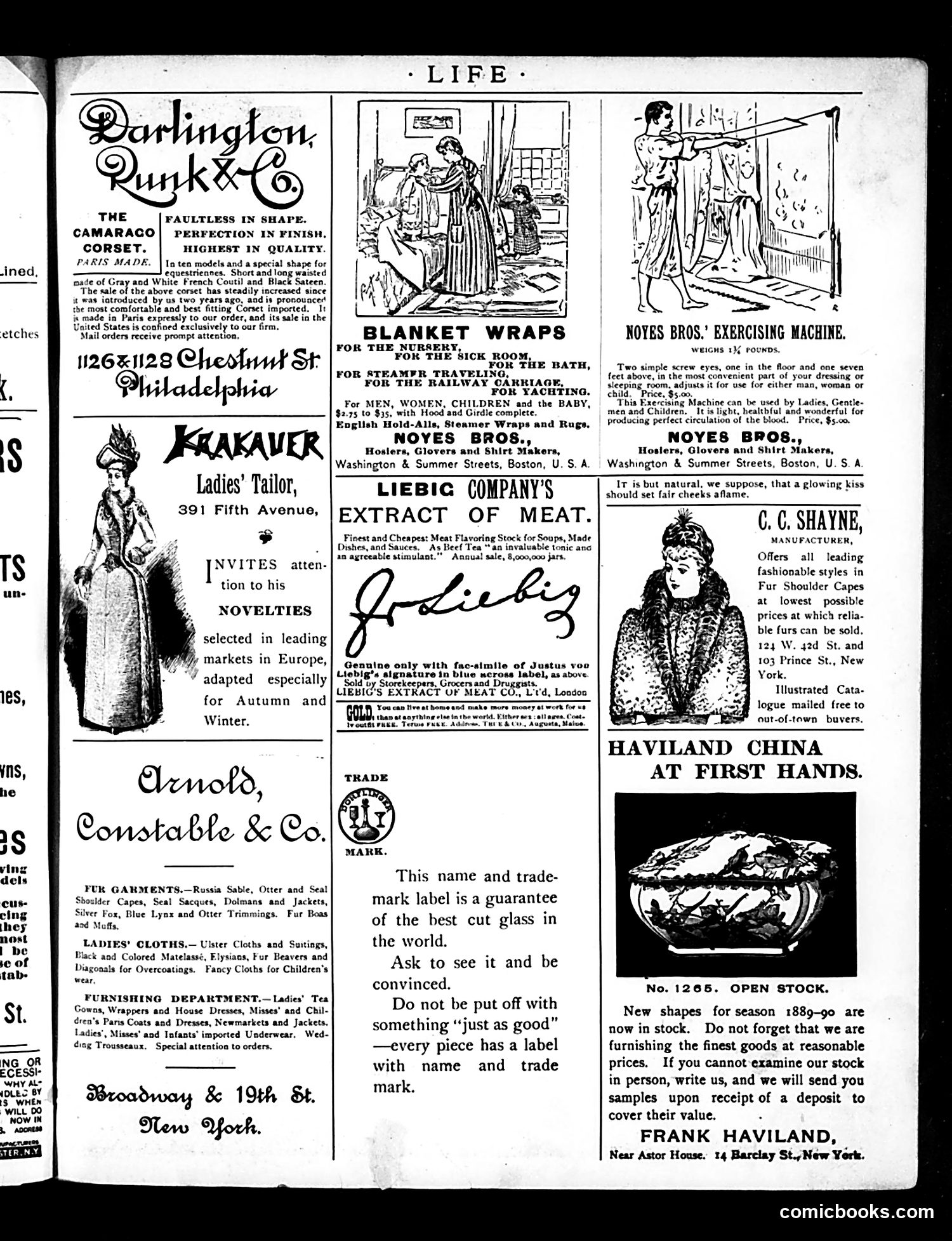
This page is predominantly **advertising**, not satirical content. It's from Life's 1889-90 era and showcases luxury goods marketed to affluent Americans. The advertisements reveal period consumer culture: corsets ("Camaraco," emphasized as imported from Paris), fur garments, elaborate wraps for various occasions (nursery, sick room, yacht travel), meat extract (Liebig's—a trendy "scientific" food product), and high-end housewares (Haviland china, cut glass). Notable is the **Noyes Bros. Exercising Machine**—a Victorian-era fitness device using ceiling-mounted pulleys. The advertisement's claim it's "wonderful for producing perfect circulation of the blood" reflects contemporary pseudoscientific health beliefs about exercise machines. One small cartoon appears (upper right): **"Notes Bros.' Exercising Machine"** shows a figure using the apparatus, though it's more illustrative than satirical. The page documents Gilded Age consumerism and middle/upper-class anxieties about health, fashion, and imported refinement rather than political satire.
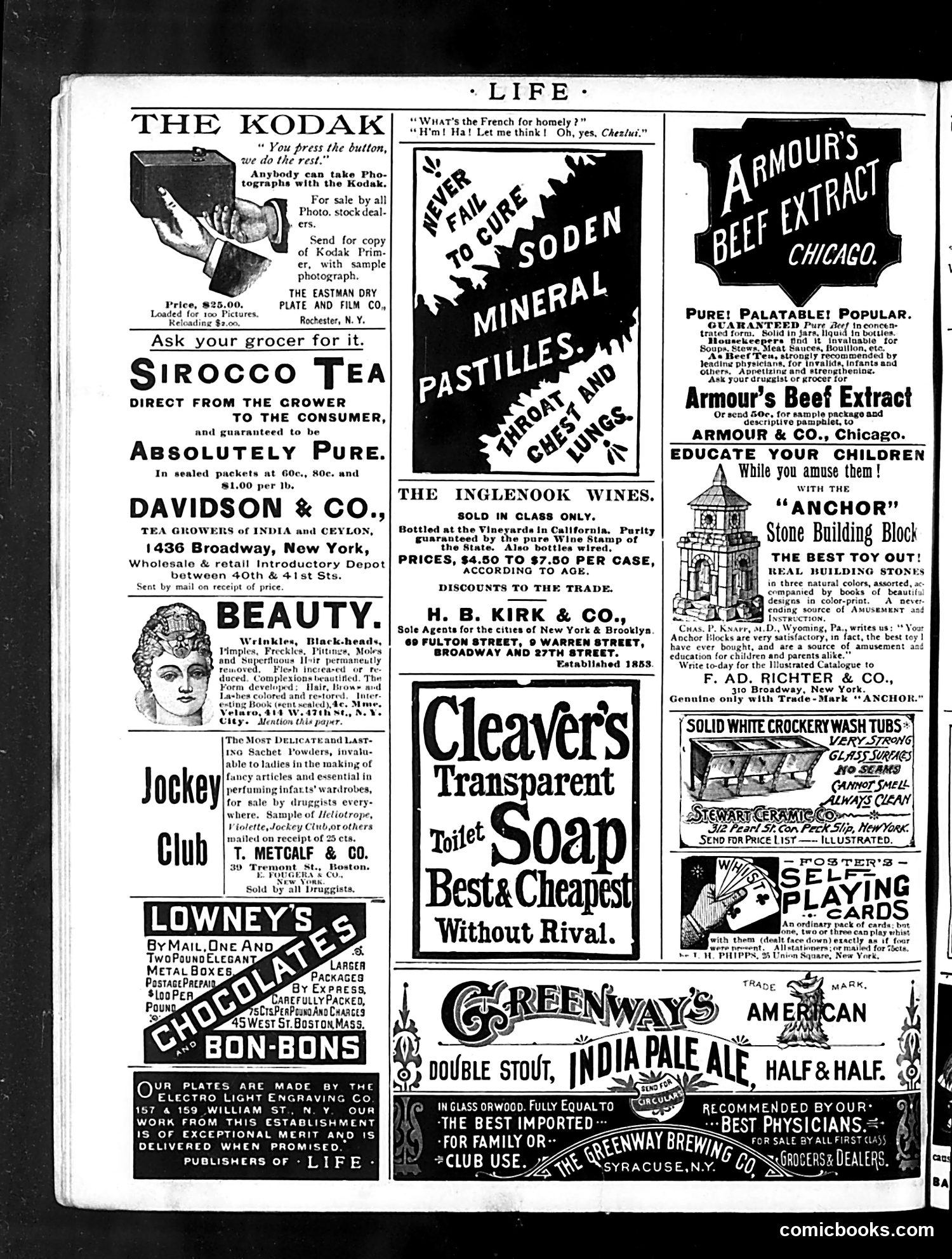
This is primarily an **advertising page** from Life magazine, not a satirical cartoon page. The content consists almost entirely of product advertisements typical of the late 19th century. The one identifiable joke appears at the top center: a small dialogue asking "What's the French for homely?" with the response "I'm! Let me think! Oh, yes, Cherbui." This is a mild pun playing on the French city name "Cherbourg" to suggest an unflattering translation. The rest of the page advertises consumer goods: Kodak cameras, tea, wine, beef extract, soap, building blocks, playing cards, and beer. These ads reflect the commercial nature of Life magazine during this period—it was supported by advertising revenue. No significant political or social satire is present on this particular page. It's a straightforward commercial advertisement section with minimal humor content.
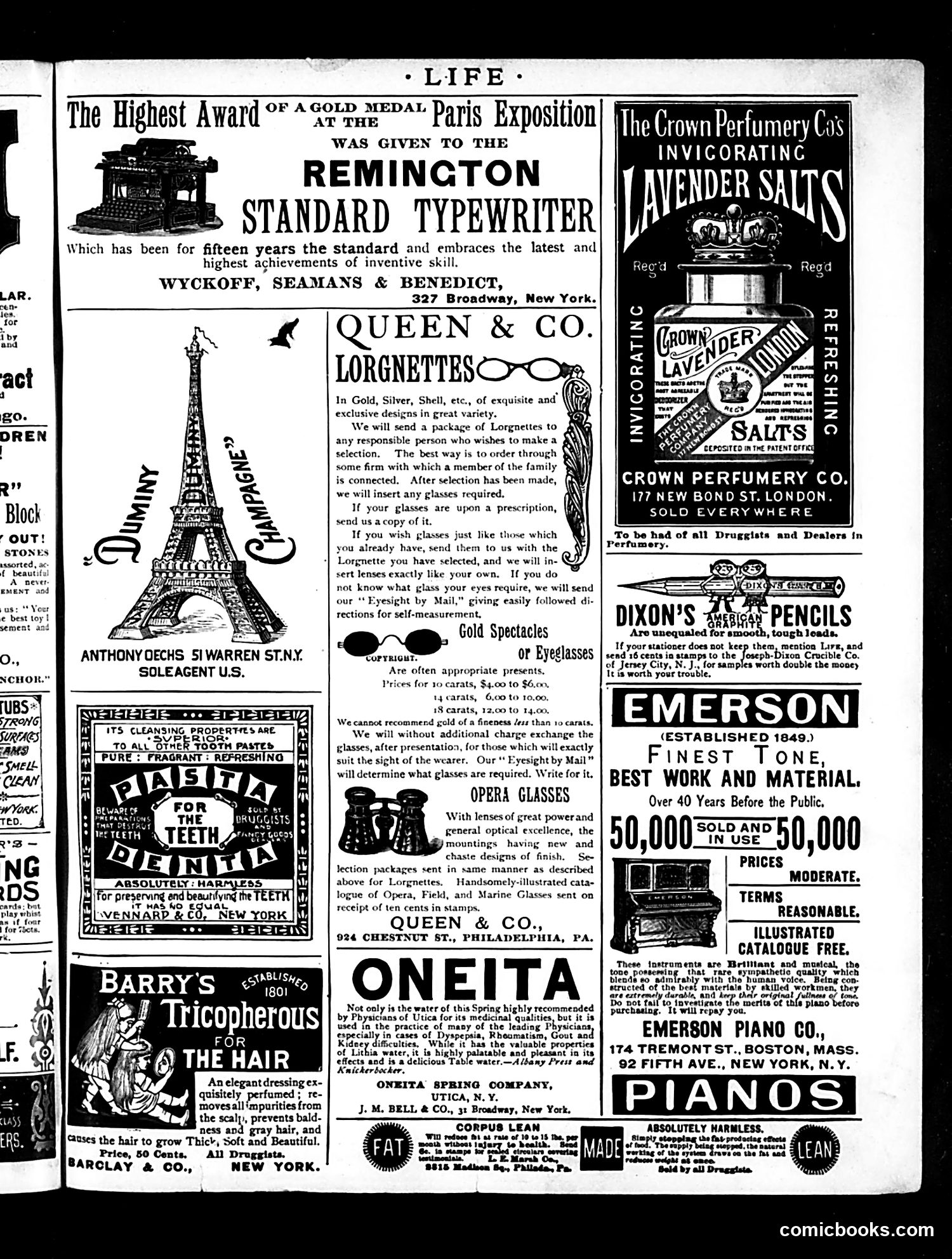
This page is predominantly **advertising**, not editorial content or political satire. It showcases consumer products from the early 20th century aimed at middle and upper-class readers. Key advertisements include: - **Remington Standard Typewriter**: Promotes a business machine that had dominated the market for 15 years - **Queen & Co. Lorgnettes and Opera Glasses**: Luxury eyewear for affluent customers, with mail-order service - **Barry's Tricophorous Hair Tonic**: A patent medicine claiming to prevent baldness - **Oneita Spring Water**: Marketed as medicinal for digestive and rheumatic ailments - **Crown Perfumery Lavender Salts**: Invigorating personal care products - **Dixon's Pencils, Emerson Pianos**: Writing and musical instruments The ads reflect **late Victorian/Edwardian consumer culture**—emphasizing luxury goods, mail-order convenience, and quasi-medical remedies. There is no visible political cartoon or satire on this particular page; it functions as a commercial showcase for Life's affluent readership.
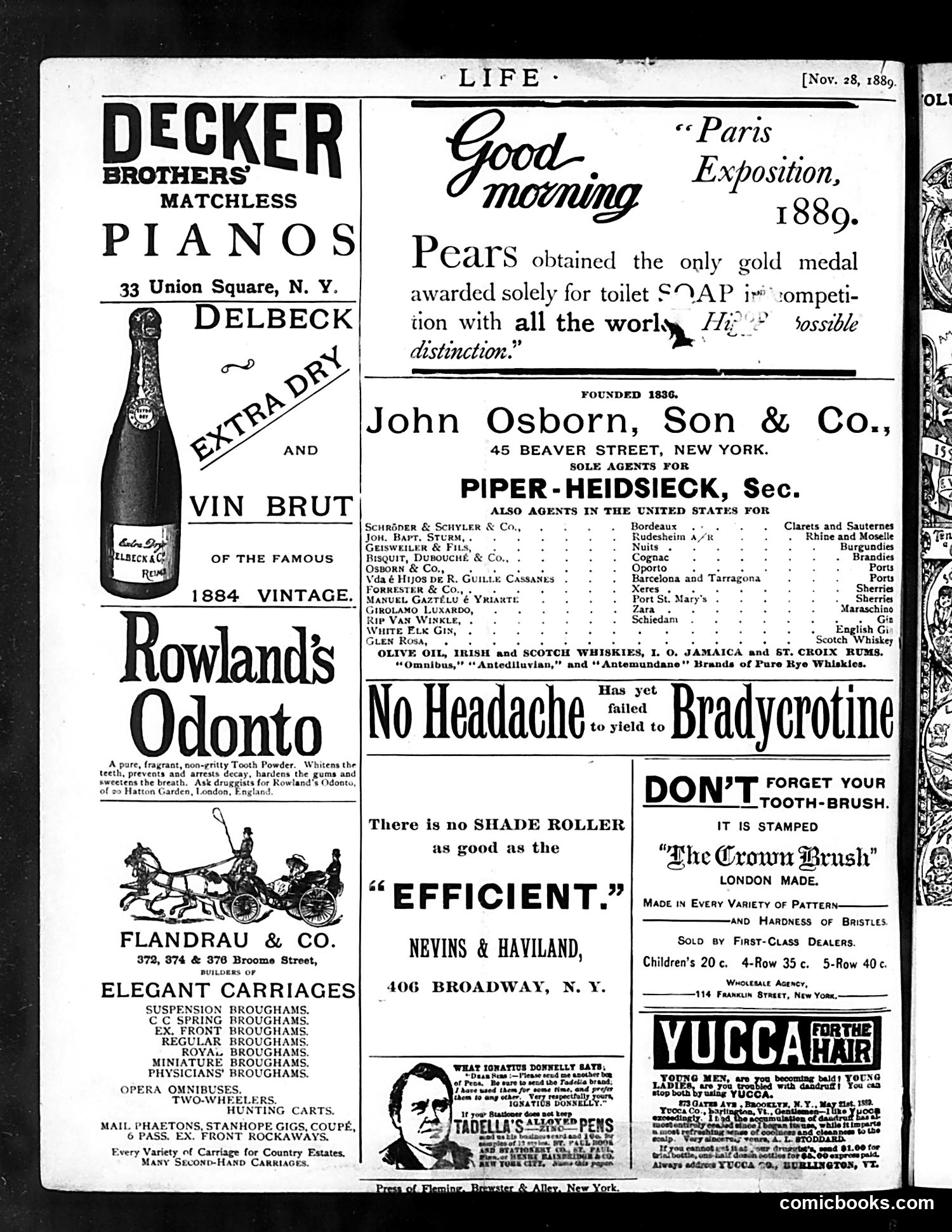
This page is primarily **advertising**, not political satire or editorial cartooning. It contains commercial advertisements from November 28, 1889 *Life* magazine. The content includes ads for luxury goods typical of the Gilded Age: Decker Brothers pianos, Rowland's Odonto tooth powder, Flandrau & Co. carriages, champagne and wines from John Osborn & Co., Bradycrotine (a headache remedy), Crown Brush toothbrushes, and Yucca hair treatment. The only notable editorial element is a brief testimonial from **Ignatius Donnelly** (a Minnesota politician and author) endorsing Tadella's pens. The inclusion of his name suggests he was sufficiently prominent circa 1889 to lend credibility to the product. The page reflects upper-class consumer culture of the 1880s—carriages, fine wines, dental care products—with no apparent political message or satire intended.