
Life, 1889-11-28 · page 10 of 18
Life — November 28, 1889 — page 10: what you’re looking at
What you’re looking at
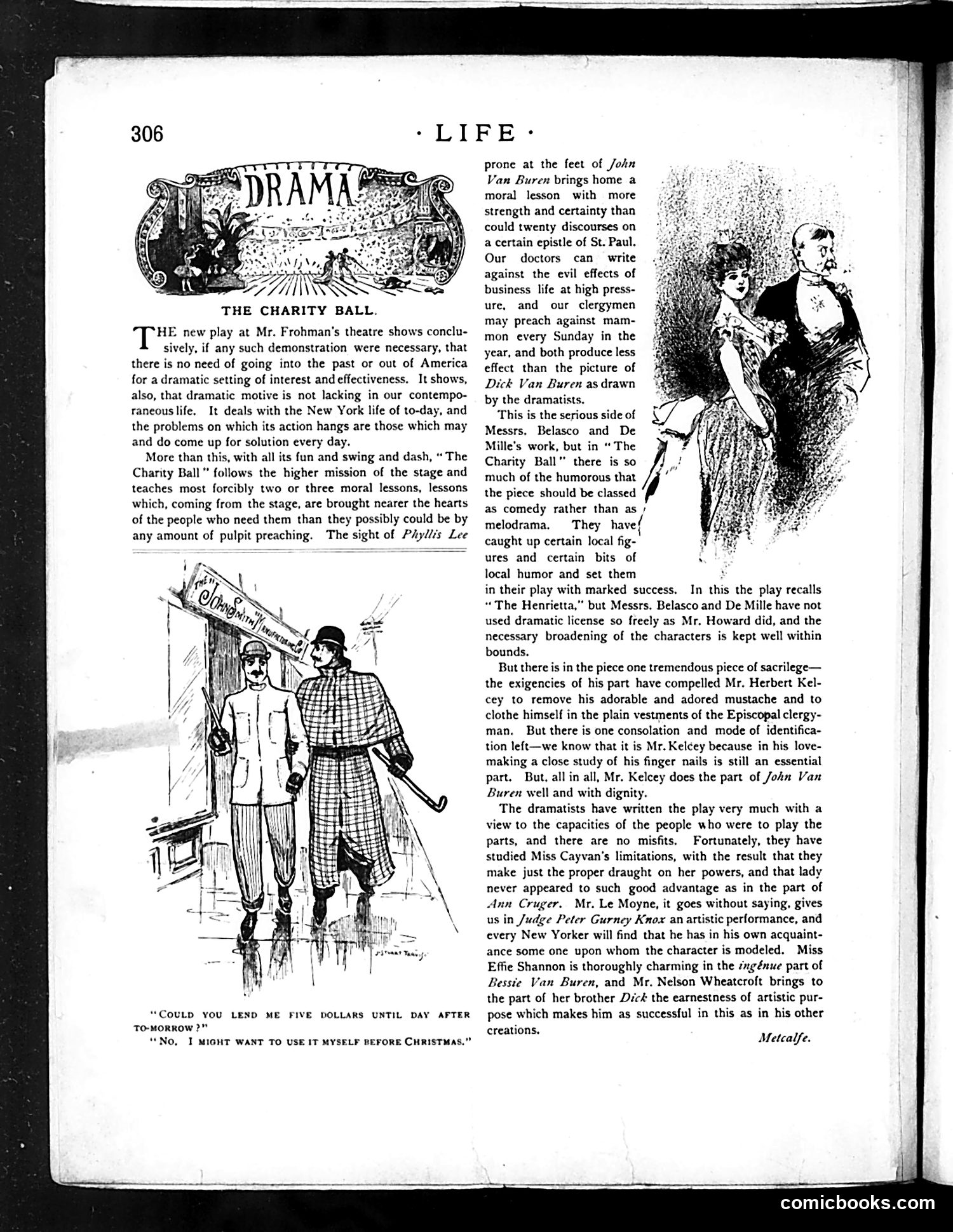
This is a theater review of a play called "The Charity Ball." The illustration shows two men at what appears to be a charity event entrance—one in formal dress, the other in a plaid outfit—with dialogue: "Could you lend me five dollars until day after to-morrow?" / "No, I might want to use it myself before Christmas." The joke satirizes the hypocrisy of charity: wealthy attendees at a "charity" ball are themselves so financially strapped they cannot spare even small loans, undermining the moral purpose of fundraising for the poor. The review praises the play's moral lessons delivered through drama more effectively than preaching. It mentions the cast includes Phyllis Lee and Herbert Kelcey, among others, discussing the theatrical production's quality and character portrayals.
📄 Transcribed text from this page (OCR, searchable)
Machine-transcribed from the original scan — historical spelling and the odd misread are preserved.
- LIFE: THE CHARITY BALL. HE new play at Mr. Frohman’s theatre shows conclu- sively, if any such demonstration were necessary, that there is no need of going into the past or out of America for a dramatic setting of interest and effectiveness. It shows, also, that dramatic motive is not lacking in our contempo- raneouslife, It deals with the New York life of to-day, and the problems on which its action hangs are those which may and do come up for solution every day. More than this, with all its fun and swing and dash, “ The Charity Ball" follows the higher mission of the stage and teaches most forcibly two or three moral lessons, lessons which, coming from the stage, are brought nearer the hearts of the people who need them than they possibly could be by any amount of pulpit preaching. The sight of Piyli’s Lee “COULD YOU LEND ME FIVE DOLLARS UNTIL DAY AFTER TO-MORROW ?”" “No, I MIGHT WANT TO USE IT MYSELF BEFORE CHRISTMAS,” prone at the feet of John Van Buren brings home a moral lesson with more strength and certainty than could twenty discourses on a certain epistle of St. Paul. Our doctors can write against the evil effects of business life at high press- ure, and our clergymen may preach against mam- mon every Sunday in the year, and both produce less effect than the picture of Dick Van Buren as drawn by the dramatists. This is the serious side of Messrs. Belasco and De Mille's work, but in “ The Charity Ball" there is so much of the humorous that the piece should be classed as comedy rather than as + melodrama, They have/ caught up certain local fig- ures and certain bits of local humor and set them in their play with marked success, In this the play recalls “ The Henrietta,” but Messrs. Belasco and De Mille have not used dramatic license so freely as Mr. Howard did, and the necessary broadening of the characters is kept well within bounds. But there is in the piece one tremendous piece of sacrilege— the exigencies of his part have compelled Mr. Herbert Kel- cey to remove his adorable and adored mustache and to clothe himself in the plain vestments of the Episcopal clergy- man. But there is one consolation and mode of identifica- tion left—we know that it is Mr. Kelcey because in his love- making a close study of his finger nails is still an essential part. But, all in all, Mr. Kelcey does the part of John Van Buren well and with dignity. The dramatists have written the play very much with a view to the capacities of the people who were to play the parts, and there are no misfits. Fortunately, they have studied Miss Cayvan’s limitations, with the result that they make just the proper draught on her powers, and that lady never appeared to such good advantage as in the part of Ann Cruger. Mr. Le Moyne, it goes without saying, gives us in Judge Peter Gurney Knox an artistic performance, and every New Yorker will find that he has in his own acquaint- ance some one upon whom the character is modeled. Miss Effie Shannon is thoroughly charming in the ¢xgénwe part of Bessie Van Buren, and Mr. Nelson Wheatcroft brings to the part of her brother Dick the earnestness of artistic pur- pose which makes him as successful in this as in his other ations, creat Metcalfe. comicbooks.com