
Life, 1889-11-28 · page 6 of 18
Life — November 28, 1889 — page 6: what you’re looking at
What you’re looking at
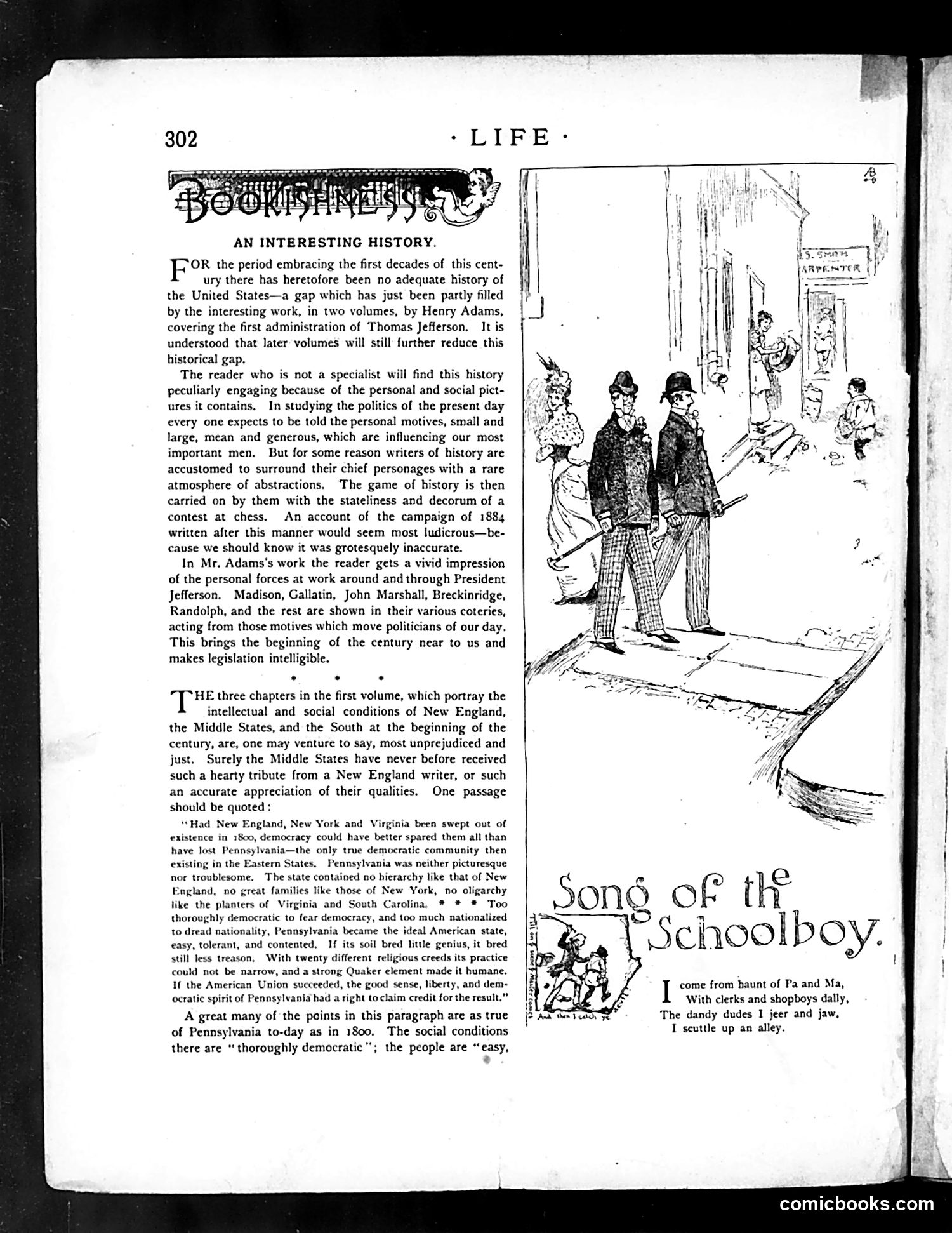
The main illustration depicts a street scene with two well-dressed men in period clothing (appearing to be early 19th century based on their hats and attire) observing something off-page, while children and figures appear in a doorway or building entrance. The accompanying text discusses Henry Adams's historical work on early American history, praising his vivid portrayal of influential figures like Jefferson, Madison, and Marshall. The quoted passage emphasizes Pennsylvania's democratic character compared to New England and Virginia. Below is a poem titled "Song of the Schoolboy" about a child coming from school. **Without seeing identifying captions or clearer details, I cannot confidently name the specific historical figures depicted in the cartoon or identify any particular satirical political point being made.**
📄 Transcribed text from this page (OCR, searchable)
Machine-transcribed from the original scan — historical spelling and the odd misread are preserved.
AN INTERESTING HISTORY. For the period embracing the first decades of this cent- ury there has heretofore been no adequate history of the United States—a gap which has just been partly filled by the interesting work, in two volumes, by Henry Adams, covering the first administration of Thomas Jefferson. It is understood that later volumes will still further reduce this historical gap. The reader who is not a specialist will find this history peculiarly engaging because of the personal and social pict- ures it contains. In studying the politics of the present day every one expects to be told the personal motives, small and large, mean and generous, which are influencing our most important men. But for some reason writers of history are accustomed to surround their chief personages with a rare atmosphere of abstractions. The game of history is then carried on by them with the stateliness and decorum of a contest at chess. An account of the campaign of 1884 written after this manner would seem most ludicrous—be- cause we should know it was grotesquely inaccurate. In Mr. Adams's work the reader gets a vivid impression of the personal forces at work around and through President Jefferson. Madison, Gallatin, John Marshall, Breckinridge, Randolph, and the rest are shown in their various coteries, acting from those motives which move politicians of our day. This brings the beginning of the century near to us and makes legislation intelligible. Te three chapters in the first volume, which portray the intellectual and social conditions of New England, the Middle States, and the South at the beginning of the century, are, one may venture to say, most unprejudiced and just. Surely the Middle States have never before received such a hearty tribute from a New England writer, or such an accurate appreciation of their qualities. One passage should be quoted: **Had New England, New York and Virginia been swept out of existence in 1800, democracy could have better spared them all than have lost Pennsylvania—the only true democratic community then existing in the Eastern States, Pennsylvania was neither picturesque nor troublesome. The state contained no hierarchy like that of New England, no great families like those of New York, no oligarchy like the planters of Virginia and South Carolina. * * * Too thoroughly democratic to fear democracy, and too much nationalized to dread nationality, Pennsylvania became the ideal American state, easy, tolerant, and contented, If its soil bred little genius, it bred still less treason. With twenty different religious creeds its practice could not be narrow, and a strong Quaker element made it humane. If the American Union succeeded, the good sense, liberty, and dem- ocratic spirit of Pennsylvania had a right to claim credit for the result, A great many of the points in this paragraph are as true of Pennsylvania to-day as in 1800. The social conditions there are “thoroughly democratic’; the people are “easy, Song of thr Schoolboy. come from haunt of Pa and Ma, With clerks and shopboys dally, The dandy dudes I jeer and jaw, I scuttle up an alley. comicbooks.com