
Life, 1889-11-28 · page 4 of 18
Life — November 28, 1889 — page 4: what you’re looking at
What you’re looking at
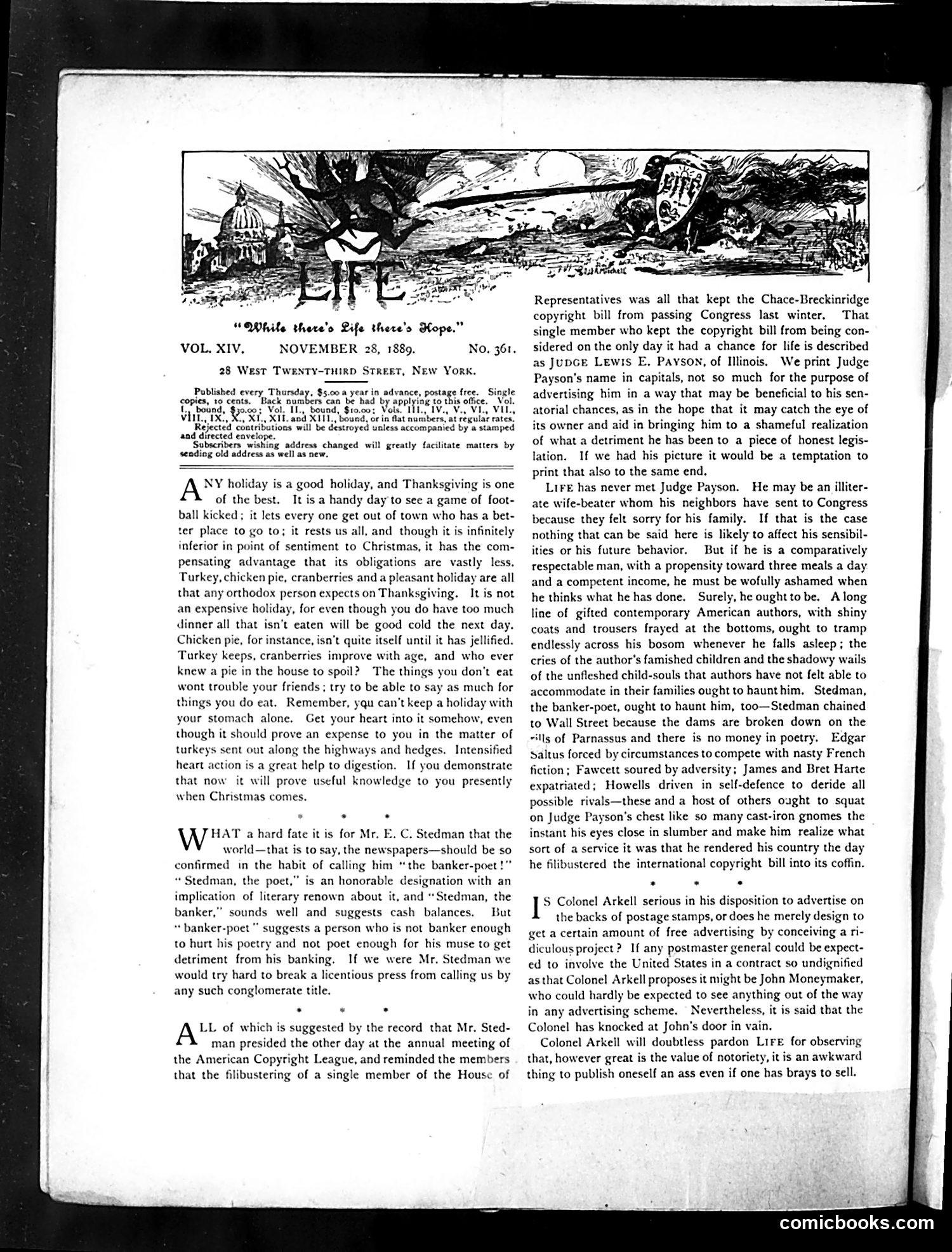
The masthead cartoon depicts a gnarled tree with figures gathered beneath it—likely allegorical imagery about American society or politics, though specific identities are unclear from the image alone. The text addresses copyright legislation. A "Chace-Breckinridge copyright bill" failed to pass Congress, reportedly blocked by a single Representative (Judge Lewis E. Payson of Illinois). The article satirizes Payson's obstruction, suggesting he prevented the bill's passage single-handedly. Life criticizes this as unjust—one congressman shouldn't wield such power against what the magazine apparently supported. The remaining columns discuss T.C. Stedman (called the "banker-poet") and Colonel Arkell's advertising scheme involving postage stamps, both treated with satirical skepticism about dubious financial or promotional schemes.
📄 Transcribed text from this page (OCR, searchable)
Machine-transcribed from the original scan — historical spelling and the odd misread are preserved.
“Mhile there'o Life there's Hope.” VOL. XIV. NOVEMBER 28, 1889. No. 361. 28 West TwenTy-THIRD STREET, New York. Published every Thursday, $5.00 a year in advance, copies, 19 cents. ‘Back sumbers can be had by applying to t Uy bound, $y0.00; Vol: I1., bound, $10.00: Vals Wie tv, ViiL., 1X!, X., X1., X11. and XIII, ‘bound, or in flat numbers, at regular rates, Rejected contributions will be destroyed unless accompanied by a stamped and directed eavelope. Subscribers wishing address changed will greatly facilitate matters by sending old address as well as new. NY holiday is a good holiday, and Thanksgiving is one of the best. It is a handy day to see a game of foot- ball kicked; it lets every one get out of town who has a bet- ter place to go to; it rests us all, and though it is infinitely inferior in point of sentiment to Christmas, it has the com- pensating advantage that its obligations are vastly less. Turkey, chicken pie, cranberries and a pleasant holiday are all that any orthodox person expects on Thanksgiving. It is not an expensive holiday, for even though you do have too much dinner all that isn't eaten will be good cold the next day. Chicken pie, for instance, isn’t quite itself until it has jellified. Turkey keeps, cranberries improve with age, and who ever knew a pie in the house to spoil? The things you don’t eat wont trouble your friends ; try to be able to say as much for things you do eat. Remember, yqu can’t keep a holiday with your stomach alone. Get your heart into it somehow, even though it should prove an expense to you in the matter of turkeys sent out along the highways and hedges. Intensified heart action is a great help to digestion. If you demonstrate that now it will prove useful knowledge to you presently when Christmas comes. Wier a hard fate it is for Mr, E. C. Stedman that the world—that is to say, the newspapers—should be so confirmed in the habit of calling him ‘the banker-poet!” ~ Stedman, the poet,” is an honorable designation with an implication of literary renown about it, and “Stedman, the banker,” sounds well and suggests cash balances, But * banker-poet " suggests a person who is not banker enough to hurt his poetry and not poet enough for his muse to get detriment from his banking. If we were Mr. Stedman we would try hard to break a licentious press from calling us by any such conglomerate title. A of which is suggested by the record that Mr. Sted- man presided the other day at the annual meeting of the American Copyright League, and reminded the members that the filibustering of a single member of the House of Representatives was all that kept the Chace-Breckinridge copyright bill from passing Congress last winter, That single member who kept the copyright bill from being con- sidered on the only day it had a chance for life is described as JuDGE Lewis E, Payson, of Illinois. We print Judge Payson’s name in capitals, not so much for the purpose of advertising him in a way that may be beneficial to his sen- atorial chances, as in the hope that it may catch the eye of its owner and aid in bringing him to a shameful realization of what a detriment he has been to a piece of honest legis- lation. If we had his picture it would be a temptation to print that also to the same end. LiFe has never met Judge Payson. He may be an illiter- ate wife-beater whom his neighbors have sent to Congress because they felt sorry for his family. If that is the case nothing that can be said here is likely to affect his sensibil- ities or his future behavior. But if he is a comparatively respectable man, with a propensity toward three meals a day and a competent income, he must be wofully ashamed when he thinks what he has done. Surely, he oughtto be. Along line of gifted contemporary American authors, with shiny coats and trousers frayed at the bottoms, ought to tramp endlessly across his bosom whenever he falls asleep; the cries of the author's famished children and the shadowy wails of the unfleshed child-souls that authors have not felt able to accommodate in their families ought to haunthim. Stedman, the banker-poet, ought to haunt him, too—Stedman chained to Wall Street because the dams are broken down on the rills of Parnassus and there is no money in poetry. Edgar saltus forced by circumstances to compete with nasty French fiction; Fawcett soured by adversity; James and Bret Harte expatriated; Howells driven in self-defence to deride all possible rivals—these and a host of others ought to squat on Judge Payson’s chest like so many cast-iron gnomes the instant his eyes close in slumber and make him realize what sort of a service it was that he rendered his country the day he filibustered the international copyright bill into its coffin. S$ Colonel Arkell serious in his disposition to advertise on the backs of postage stamps, or does he merely design to get a certain amount of free advertising by conceiving a ri- diculous project ?. If any postmaster general could be expect- ed to involve the United States in a contract so undignified as that Colonel Arkell proposes it might be John Moneymaker, who could hardly be expected to see anything out of the way in any advertising scheme. Nevertheless, it is said that the Colonel has knocked at John’s door in vain. Colonel Arkell will doubtless pardon Lire for observing that, however great is the value of notoriety, it is an awkward thing to publish oneself an ass even if one has brays to sell. comicbooks.com