
A complete issue · 16 pages · 1889
Life — November 14, 1889
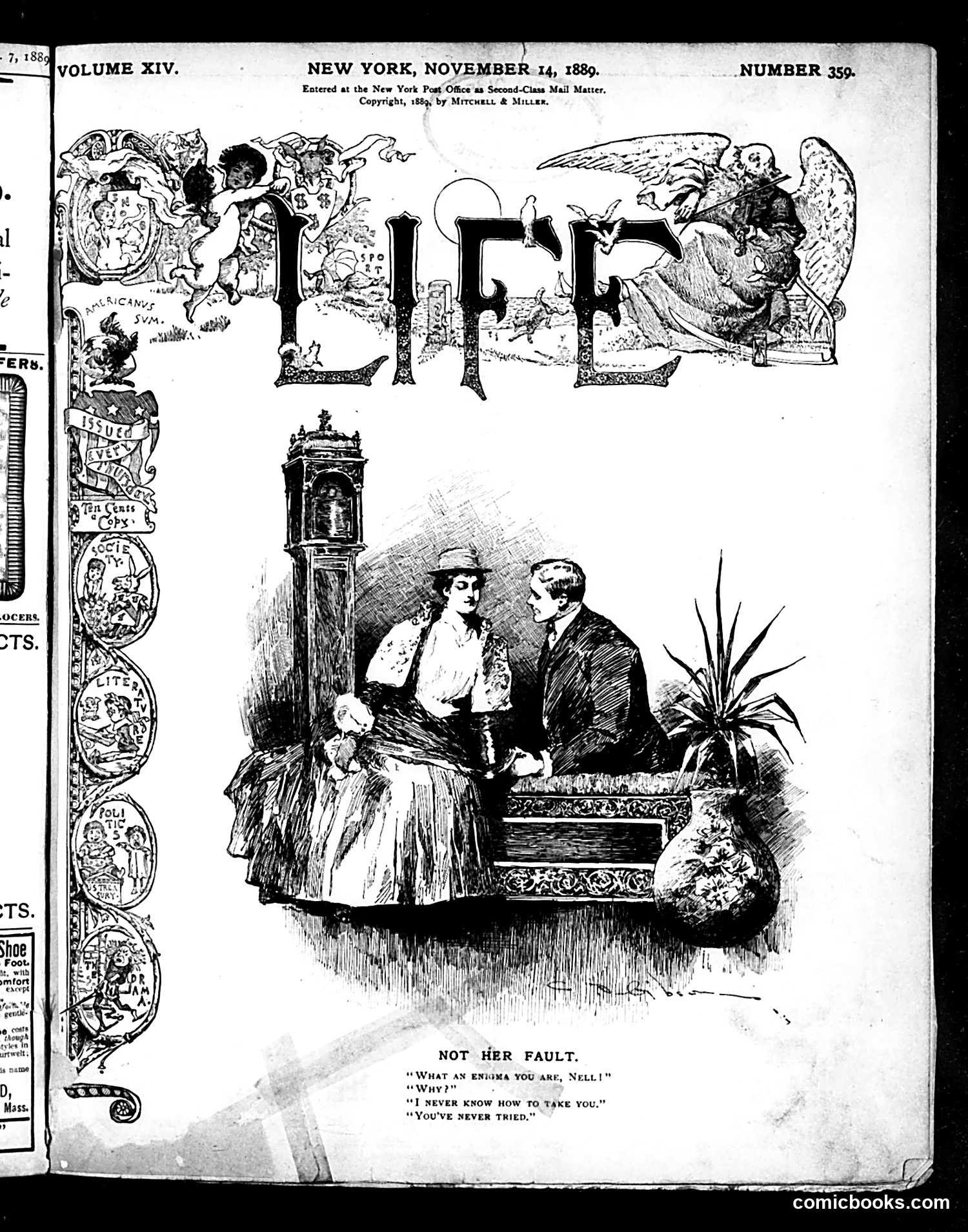
This page features two illustrations: **Top:** An ornate title reading "LIFE" with decorative allegorical figures in the letterforms—typical of the magazine's elaborate masthead design. **Bottom:** A social satire titled "NOT HER FAULT" depicting a man and woman in conversation beside a decorative planter. The dialogue reads: "What an enigma you are, Nell!" / "Why?" / "I never know how to take you." / "You've never tried." The humor relies on a double entendre—the man's innocent statement about being unable to understand her is met with her suggestive response implying romantic/physical advances. This reflects Victorian-era satirical commentary on courtship dynamics and female agency, gently mocking both the man's obtuseness and the woman's boldness in responding with flirtation.
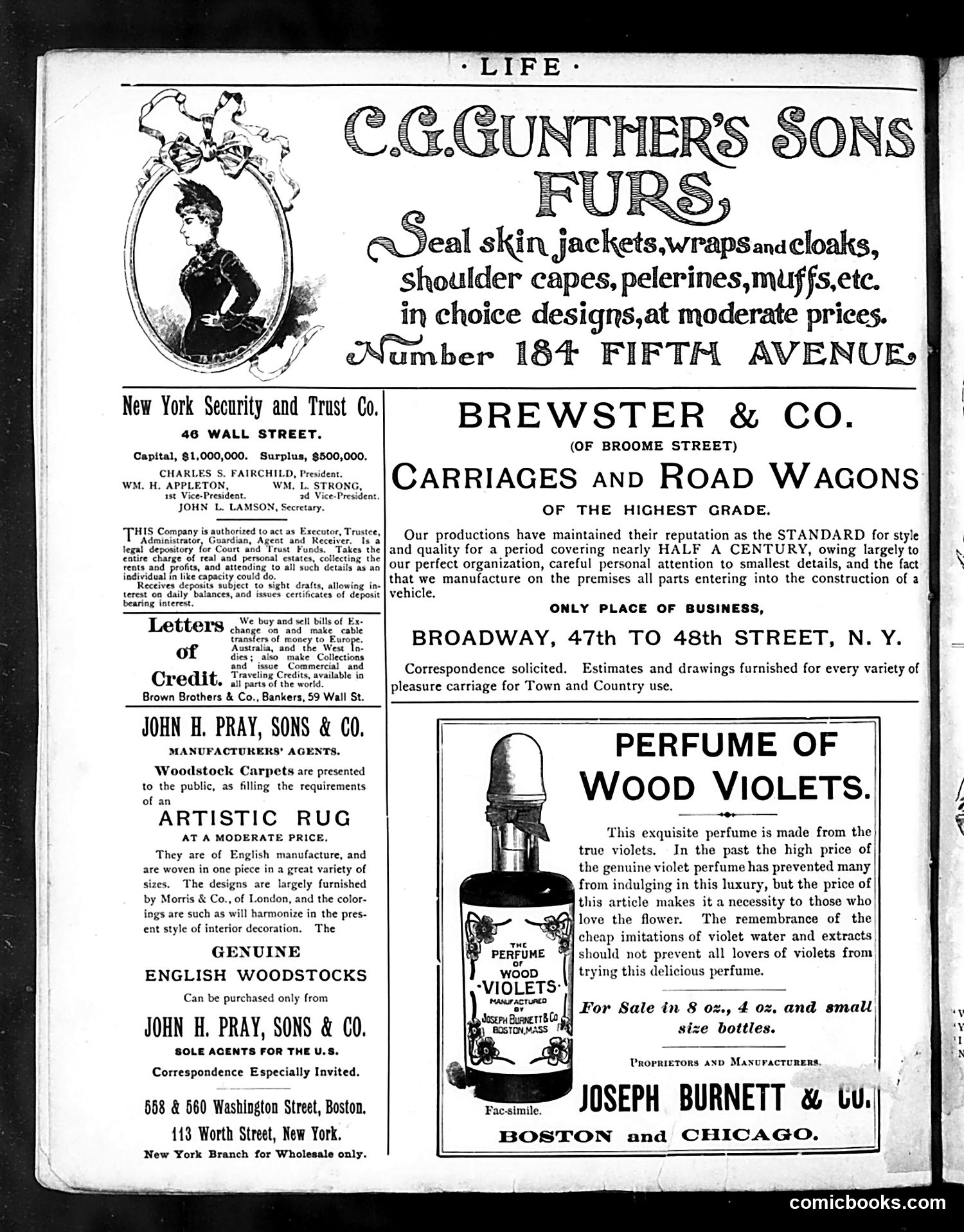
This page is **primarily advertisements** rather than editorial content or political cartoons. It contains ads for: - **C.G. Gunther's Sons Furs** (seal skin jackets and cloaks at 184 Fifth Avenue) - **Brewster & Co.** (high-grade carriages and road wagons) - **New York Security and Trust Co.** (financial services at 46 Wall Street) - **John H. Fray, Sons & Co.** (Woodstock Carpets and English Woodstocks) - **Joseph Burnett & Co.** (Perfume of Wood Violets) The ads feature period-appropriate imagery including a woman's portrait in an oval frame and a perfume bottle. These reflect turn-of-the-century luxury goods marketed to wealthy consumers. There are no political cartoons or satirical content visible on this page.
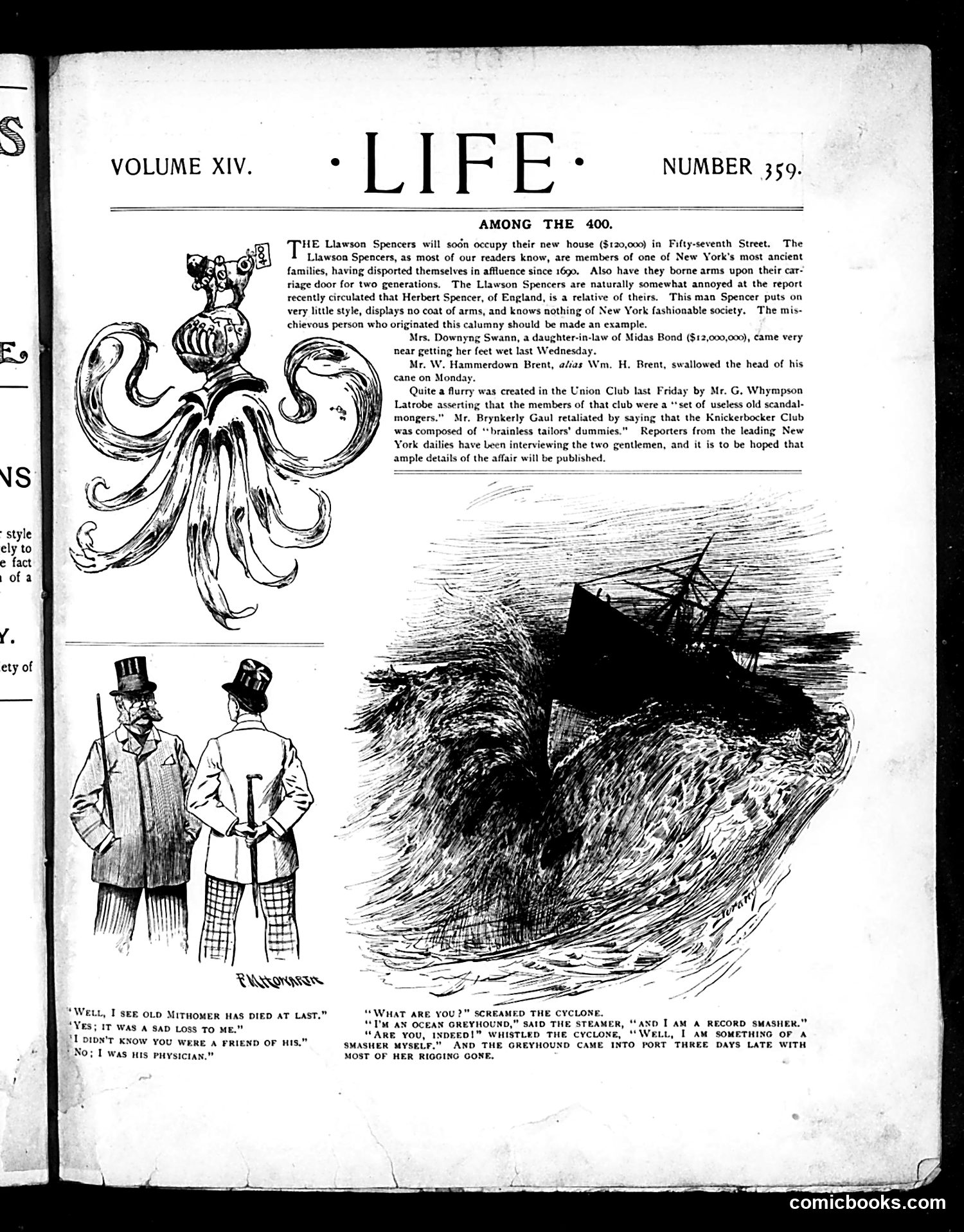
This LIFE magazine page (Volume XIV, Number 359) contains social gossip and satirical commentary typical of the publication's "Among the 400" society column. The top text mocks the Llawson Spencers, an old-money New York family, for moving to a new house and their pretentious social positioning. The column includes brief anecdotes about society figures—Mrs. Downrg Swann nearly fainting and Mr. W. Hammerdown Brent swallowing his cane head—presented as humorous social notes. The cartoon below shows two gentlemen in top hats. The accompanying dialogue jokes about one man's death ("old Mithomer has died at last") and mockingly dismisses the other as merely his physician rather than a friend—satirizing superficial society relationships. The maritime illustration depicts a ship in rough seas with dialogue about cyclones and record-smashing, likely a humorous maritime anecdote.
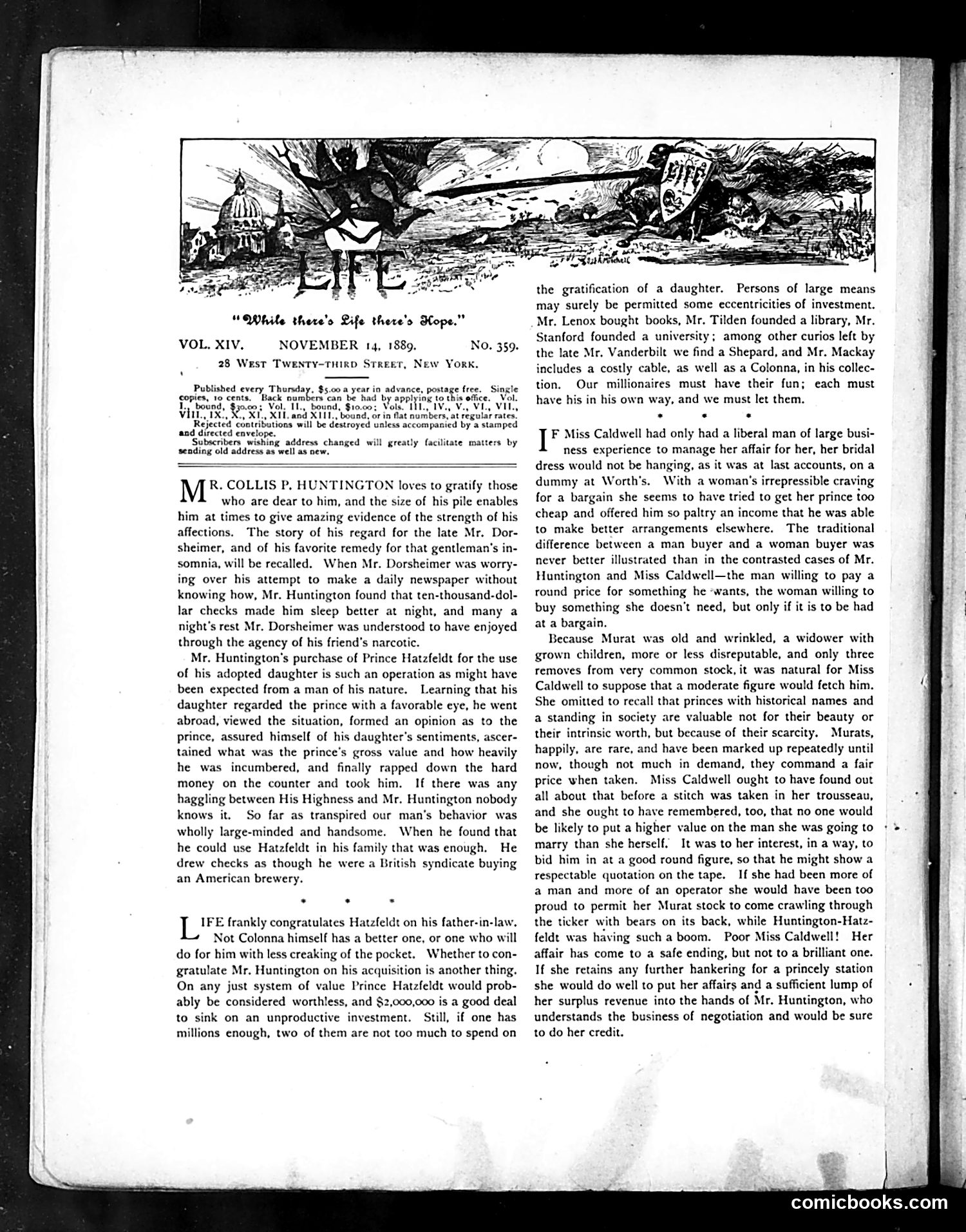
The masthead cartoon depicts "Life" as a classical figure amid a chaotic landscape, with the caption "While there's Life there's Hope." The text discusses Mr. Collis P. Huntington, a wealthy railroad magnate, and his relationship with his adopted daughter. The satire centers on Huntington's attempt to arrange an advantageous marriage for her—specifically mentioning a European prince (Prince Hatsfeldt). The piece mocks the wealthy's practice of purchasing titles and status through marriage arrangements, suggesting Huntington "rapped down the hard money on the counter" to secure the match. The article contrasts Huntington's straightforward financial negotiation with Miss Caldwell's more subtle bargaining tactics as a buyer, satirizing both the commodification of marriage among the wealthy and gender dynamics in these transactions.
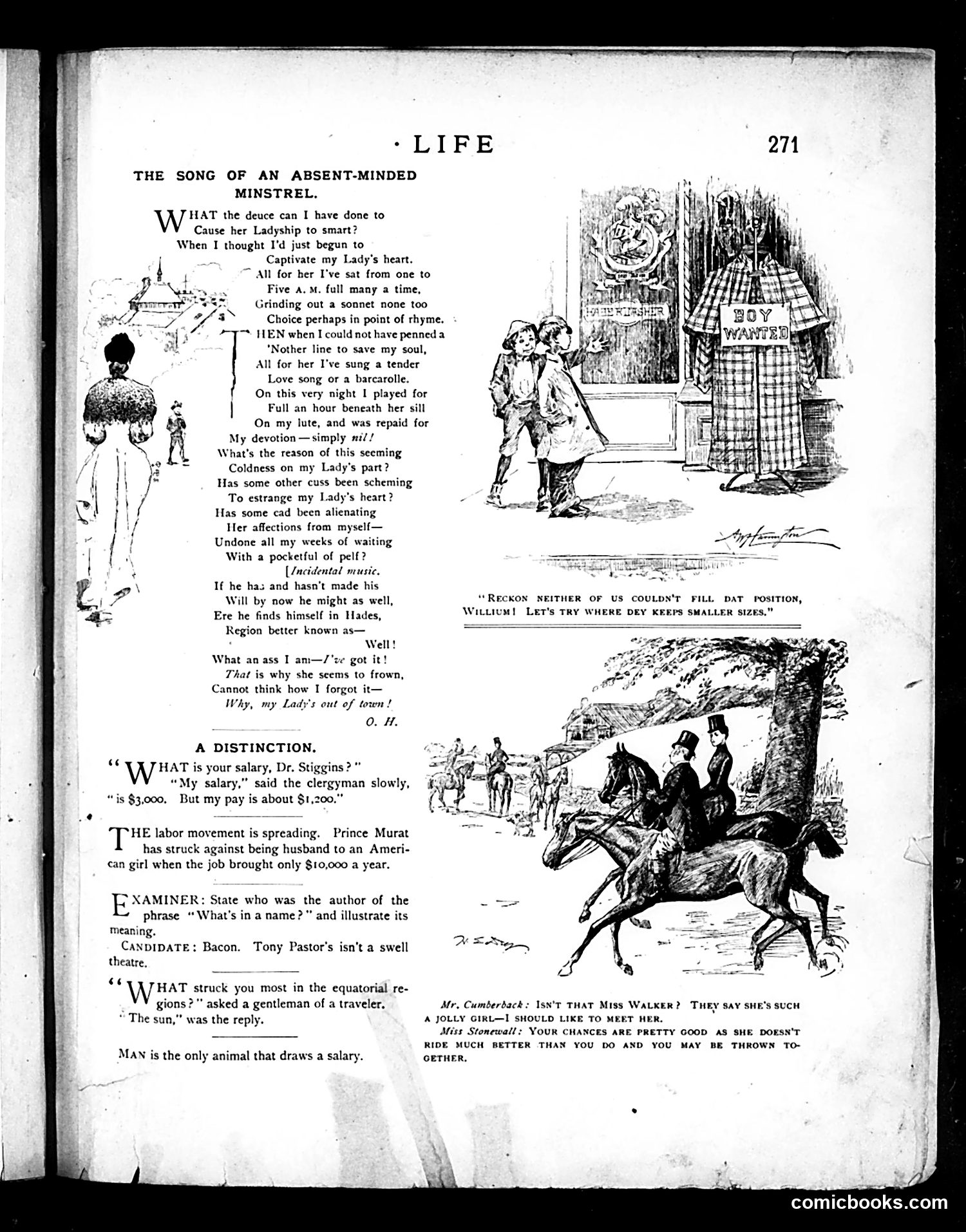
This page contains three satirical pieces: 1. **"The Song of an Absent-Minded Minstrel"**: A poem lamenting a musician's failed romantic pursuit. The accompanying illustration shows a man serenading a woman, who appears indifferent or dismissive. 2. **"A Distinction"**: A brief joke contrasting a clergyman's stated $3,000 salary with his actual $1,200 pay—satirizing the gap between appearance and financial reality. 3. **Lower illustrations and dialogues**: Include commentary on labor movements (Prince Murat refusing American marriage for low wages), a traveler's observation, and a horseback exchange between "Mr. Camberback" and "Miss Walker" about riding abilities—typical turn-of-the-century social humor about class and courtship customs. The final line ("Man is the only animal that draws a salary") offers cynical social commentary on human nature.
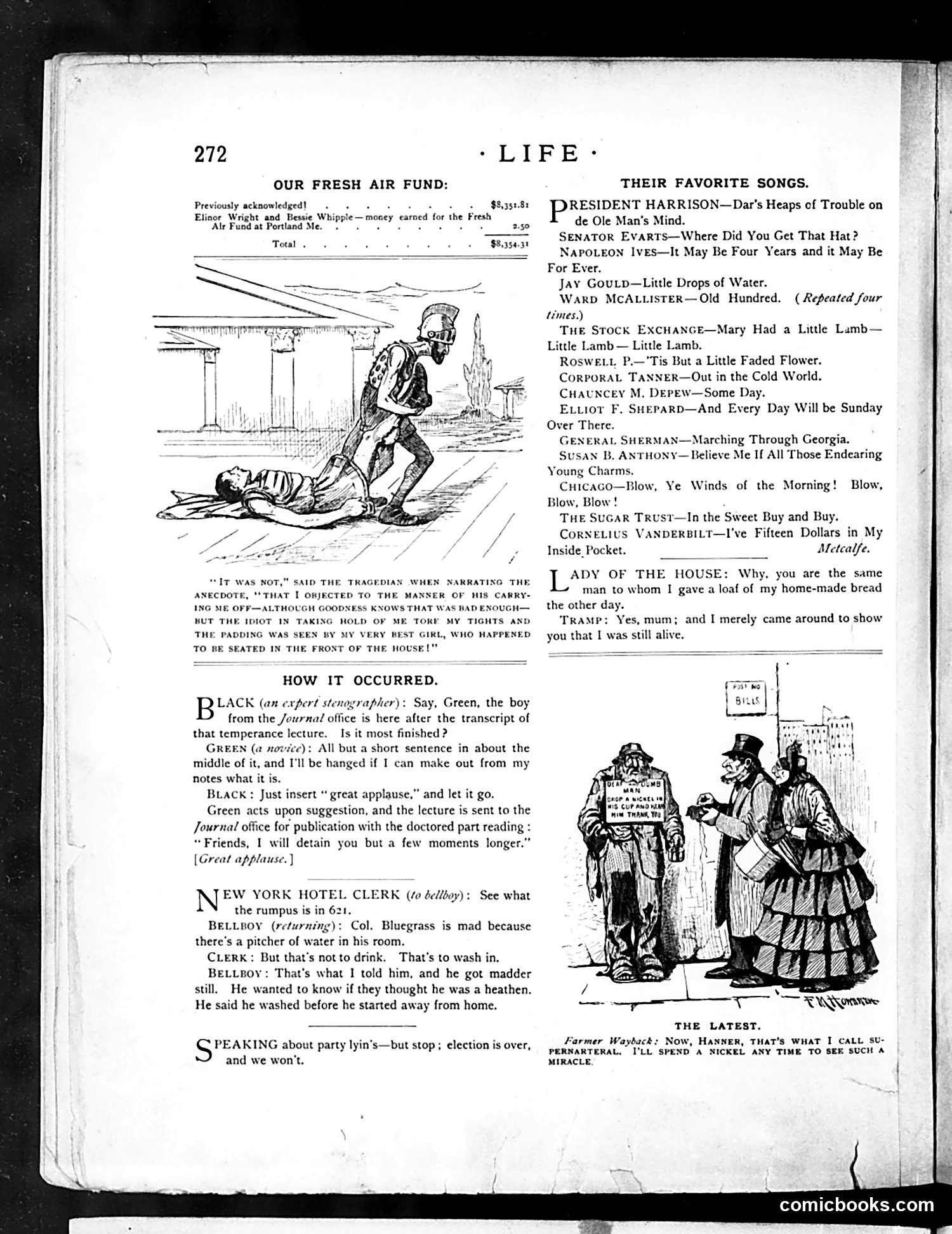
This page combines humor sections with satirical content. The main cartoon "How It Occurred" depicts a dialogue between a stenographer and someone named Green about transcribing a temperance lecture. The joke involves inserting "great applause" into the transcript without actually recording it—satirizing how public speeches can be artificially enhanced or misrepresented in published accounts. Below that, a New York Hotel Clerk anecdote mocks a Colonel Bluegrass's complaint about water in his room, with absurdist humor about hygiene and regional stereotypes. The "Their Favorite Songs" section lists political figures' supposed musical preferences—a humorous device to satirize public personalities by attributing sentimental or ironic song choices to them, likely from the election period referenced at bottom.
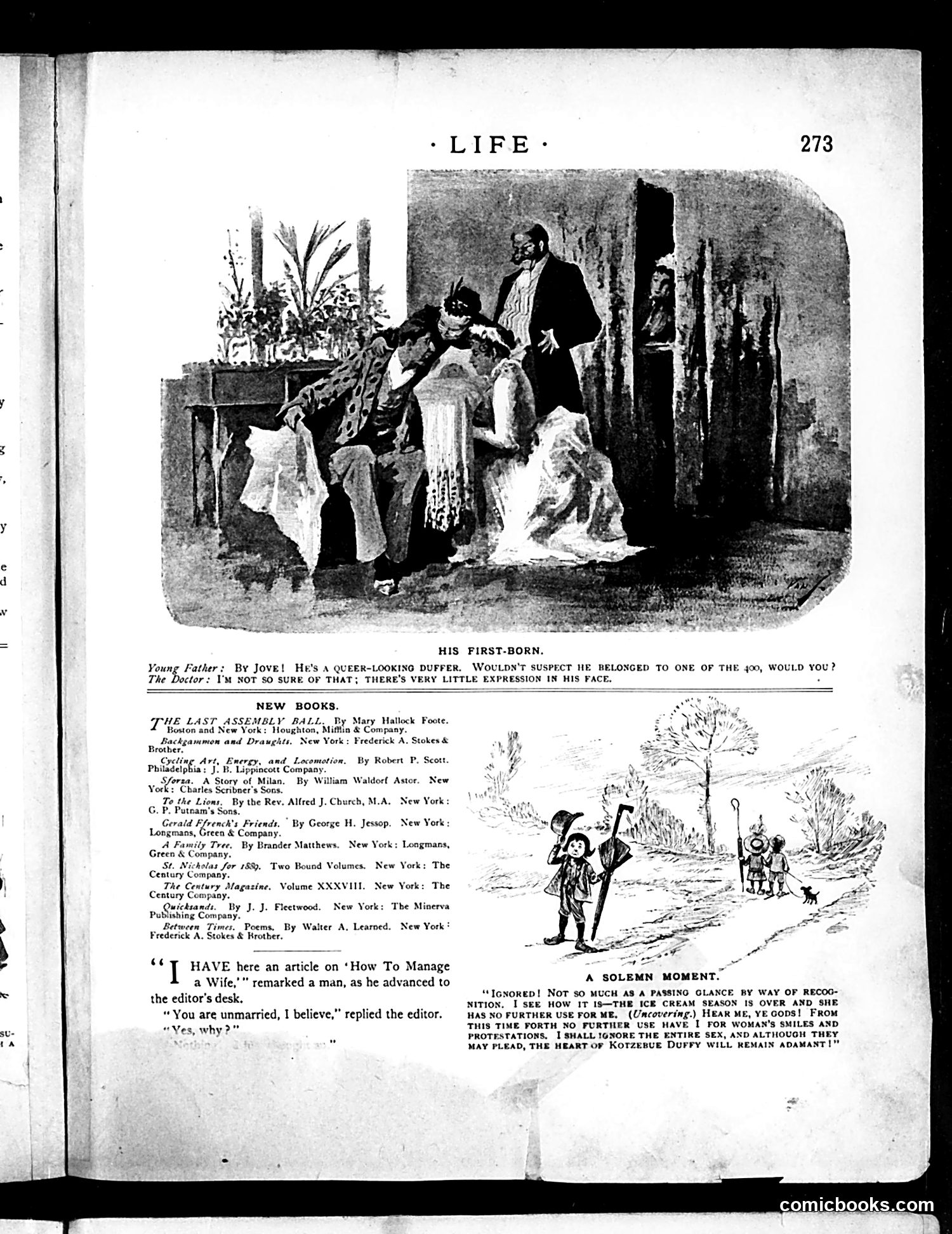
**"His First-Born" Cartoon:** This satirical scene depicts a doctor's visit to examine a newborn infant. The young father anxiously asks if the child "belongs to one of the 400"—a reference to New York's social elite (the approximately 400 families considered acceptable by high society). The doctor's response—"There's very little expression in his face"—is the joke's punchline, suggesting the baby lacks the distinctive features of aristocratic breeding. The satire mocks upper-class anxiety about genealogy and social status, implying that even infants must be evaluated by their pedigree rather than their humanity. This reflects late 19th-century American class consciousness and satirizes the pretensions of wealthy New Yorkers obsessed with maintaining exclusive social hierarchies.
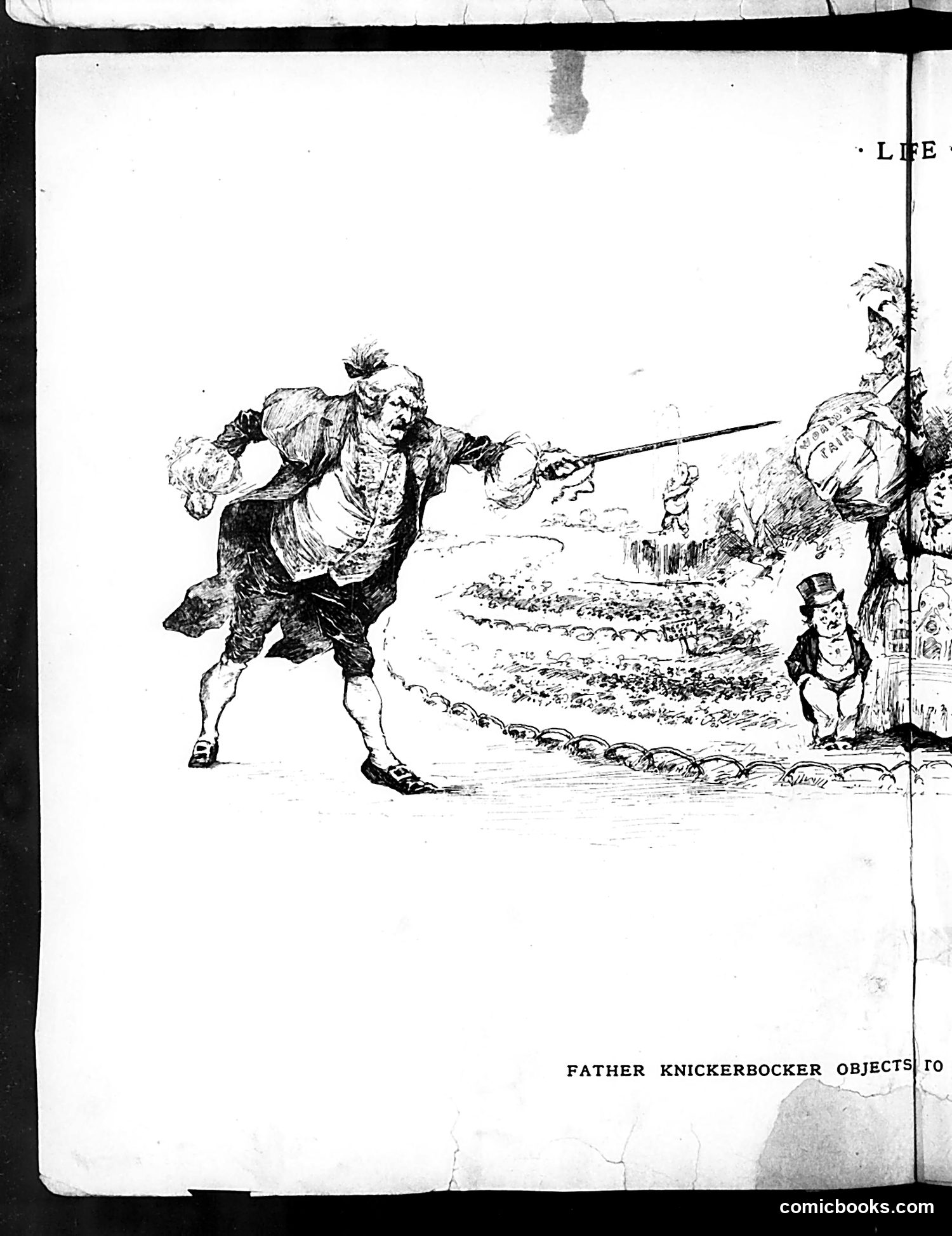
This political cartoon depicts a confrontation in what appears to be New York City (referenced by "Knickerbocker," a historical term for a New York Dutch settler). The text caption indicates "Father Knickerbocker Objects To," suggesting the cartoon satirizes something the personified city/state opposes. The image shows an aggressive figure wielding a long bayonet or sword, drawn in an exaggerated, menacing style. On the right, smaller figures appear to witness or react to this aggression. The artistic style and composition suggest this critiques some form of violence, militarism, or unwanted aggression directed at or within New York. Without the complete caption, the specific target of satire remains unclear, though the imagery emphasizes objection to violent or militaristic action.
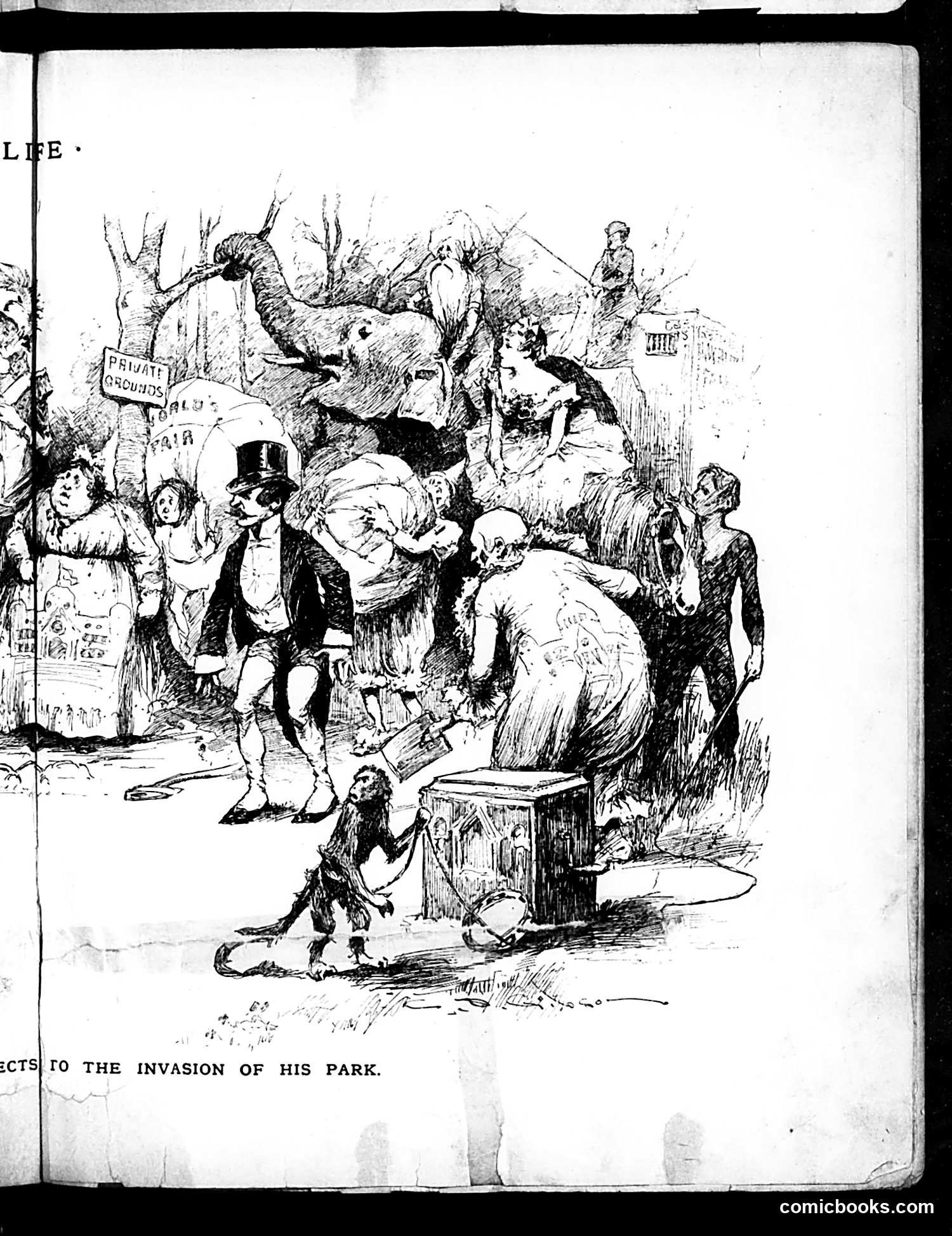
This satirical illustration depicts a chaotic scene titled "...ECTS TO THE INVASION OF HIS PARK" (full title cut off). The cartoon shows a gentleman in formal attire (top hat visible) surrounded by various figures—children, adults, and what appears to be a monkey or ape—causing disruption in what is labeled a private space. The satire targets the tension between private property rights and public access. The well-dressed figure represents a wealthy landowner objecting to common people and animals trespassing on his exclusive park. The crowded, disorderly composition emphasizes how his attempts to maintain exclusivity are being overwhelmed by democratic intrusion. This reflects Victorian-era anxieties about class boundaries and public versus private spaces.
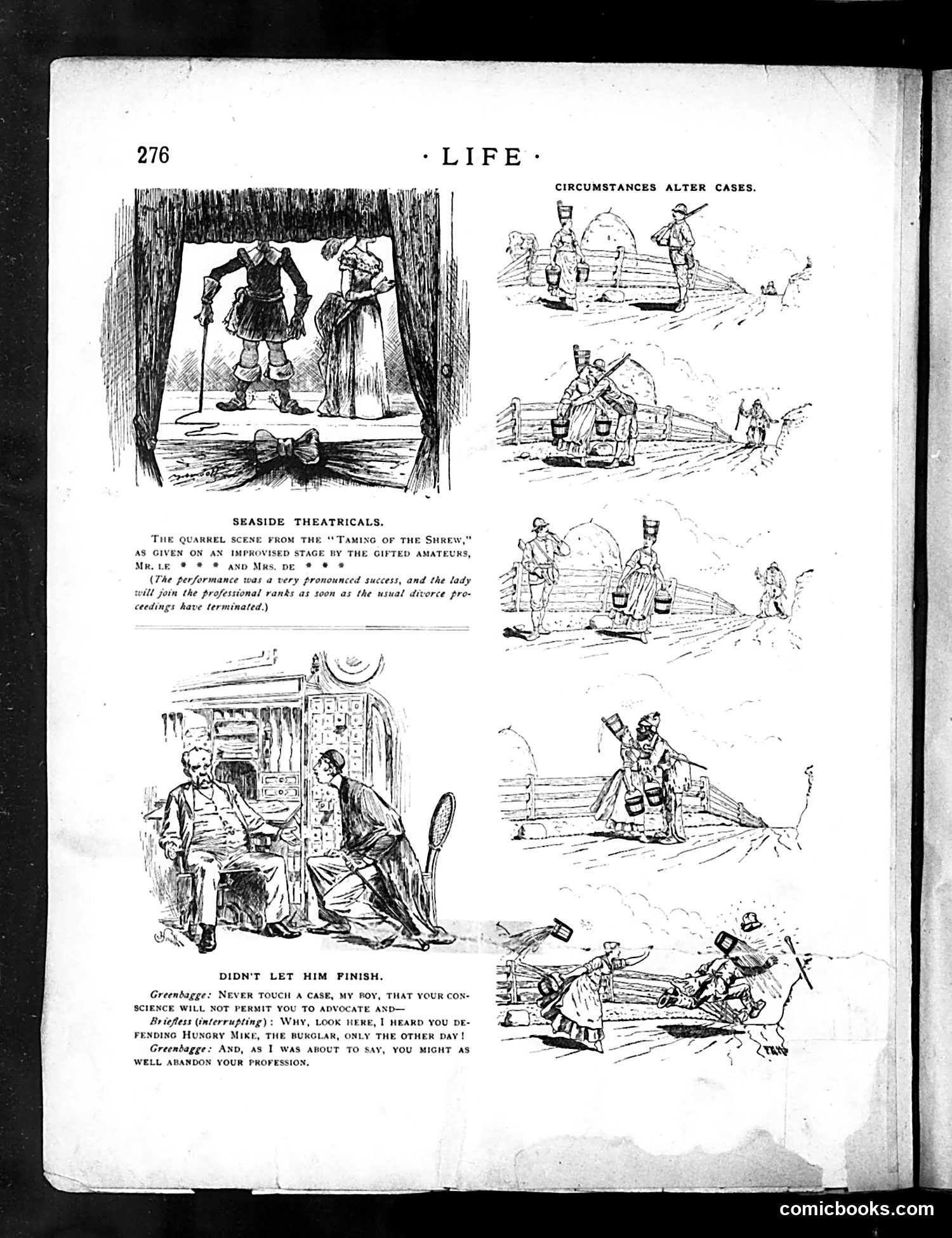
This page from *Life* magazine contains two distinct theatrical sketches: **"Seaside Theatricals"** features amateur performances at the seaside. The top illustration shows a quarrel scene from Shakespeare's "The Taming of the Shrew," performed by amateur actors. The caption notes this performance precedes a "mutual divorce." **"Didn't Let Him Finish"** shows a legal consultation between a greengrocer and a lawyer. The greengrocer wants to defend himself in court ("advocate"), but the lawyer interrupts, advising him to abandon his profession instead. The humor derives from the lawyer's cynical assumption that the client will lose his case—suggesting incompetent legal representation or the futility of the defendant's position. Both sketches satirize incompetence: amateur theatricals and inadequate legal counsel.
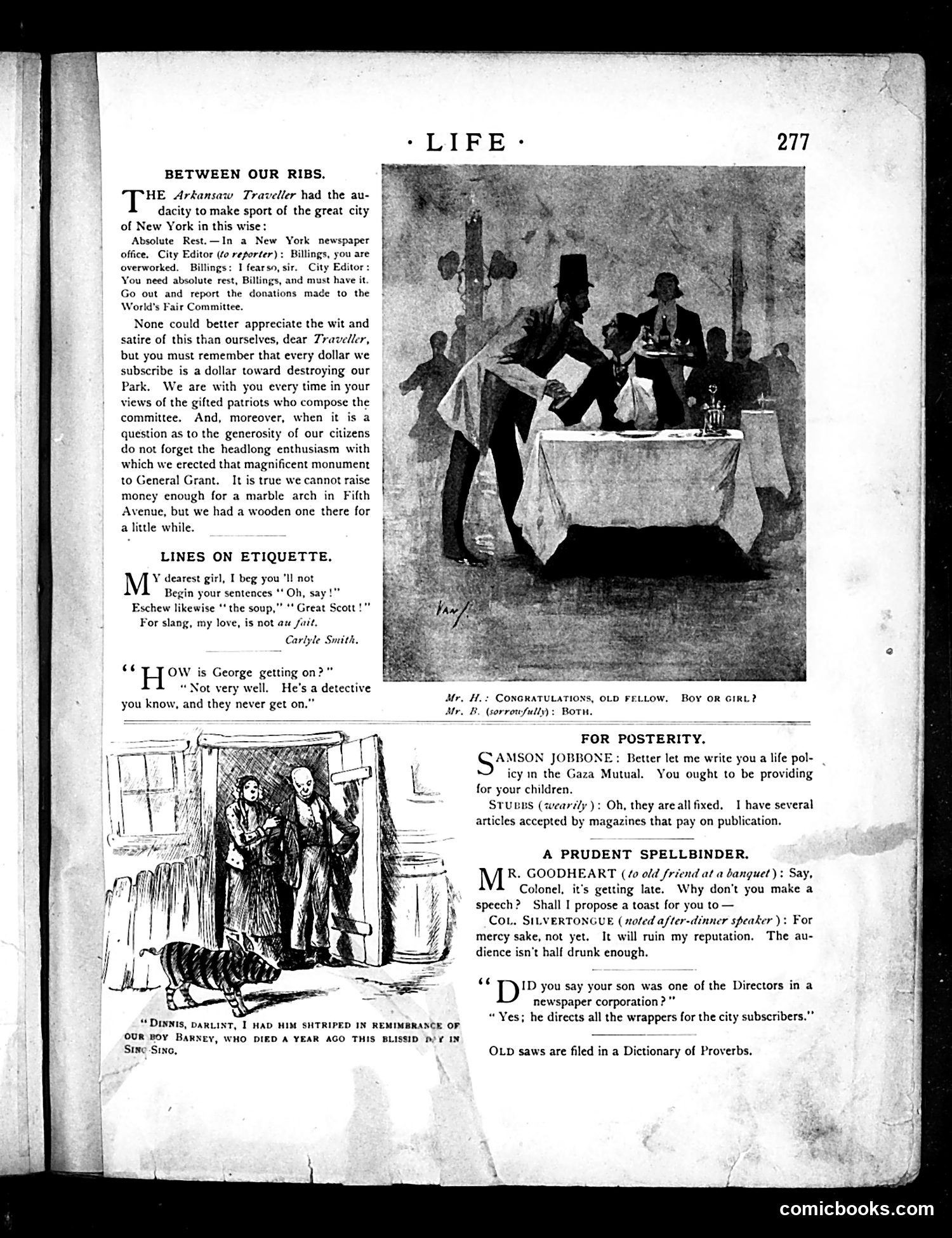
This page satirizes New York newspaper operations and social etiquette. **"Between Our Ribs"** mocks a city editor demanding reporters gather donations for a World's Fair Committee while claiming absolute rest is needed—absurd hypocrisy. The satire critiques how newspapers exploit their staff for charitable causes while working them exhaustively. **"Lines on Etiquette"** jokes about avoiding slang in conversation, quoting poet Carlyle Smith. The illustration shows two figures in a doorway, captioned as a humorous domestic scene about someone named Barney who "died a year ago." **"For Posterity"** and subsequent sections contain brief witty anecdotes about life insurance, speechmaking, and newspaper management—typical Life magazine humor targeting New York's professional classes and their pretensions.
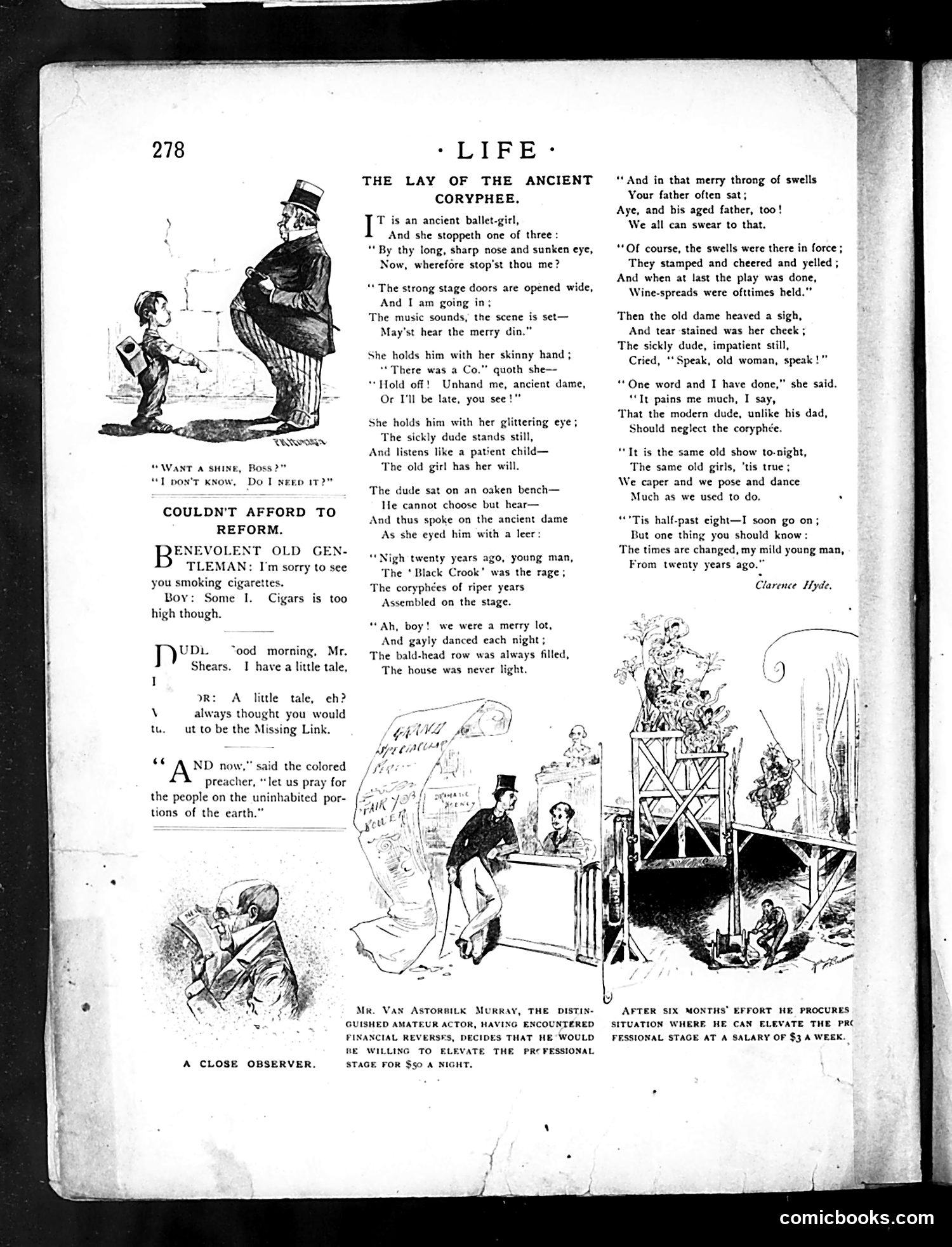
The page contains several unrelated satirical pieces typical of early Life magazine: **"Want a Shine, Boss?"** mocks economic inequality—a poor boy offers shoe shines while a wealthy man questions whether he needs one, suggesting the rich are oblivious to poverty. **"Couldn't Afford to Reform"** jokes that a boy smokes cigarettes (rather than more expensive cigars) due to poverty, satirizing moral reform efforts that ignore economic reality. **"The Lay of the Ancient Coryphee"** (by Clarence Hyde) uses an aging ballet dancer to lament generational decline. She reminisces about the "Black Crook" era (1860s theatrical hit) when wealthy "swells" frequented shows and patronized dancers, but modern young men neglect the theater—social commentary on changing leisure habits and morality. **"A Close Observer"** depicts Van Astorbilk Murray, an amateur actor experiencing financial reverses who volunteers to "elevate the professional stage" for $50/night, then accepts $3/week—satirizing pretentious amateurs and economic desperation in theater.
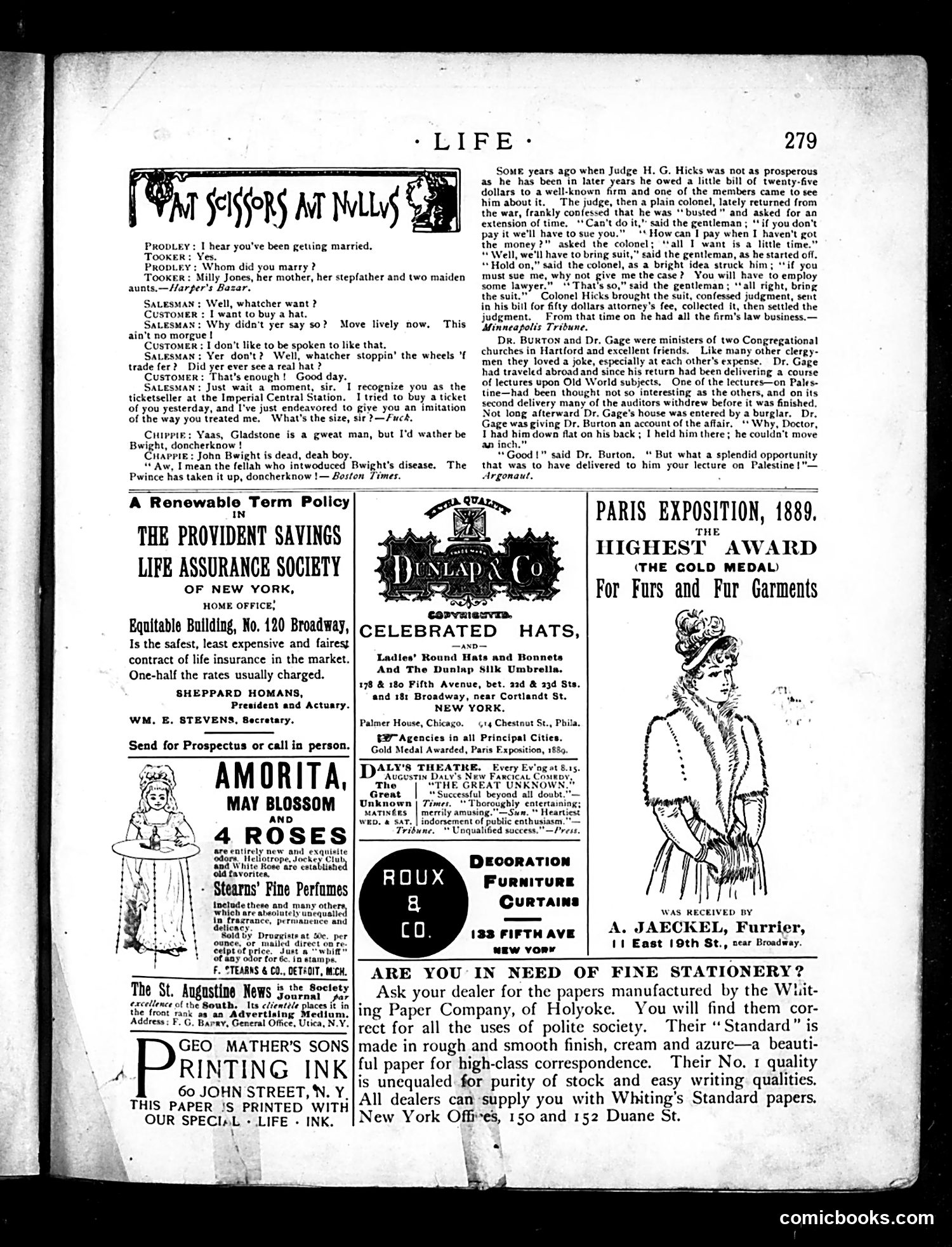
This page is primarily **advertising** interspersed with short humorous anecdotes typical of Life's satirical format. The notable content includes three brief jokes: 1. **"At Scissors and Mullys"** — A wordplay sketch where a rude hat salesman, confronted about his poor customer service, reveals he's deliberately imitating how a ticket seller (the customer's day job) treated him. The joke mocks workplace rudeness cycles. 2. **Gladstone/Bright's Disease** — A British political joke. The speaker admires Gladstone but prefers Bright; told Bright is dead, he clarifies he meant "the fellah who introduced Bright's disease"—satirizing the 19th-century disease's association with politician John Bright. 3. **Judge Hicks anecdote** — A clever story about a broke Civil War colonel who, sued for a small debt, turns the tables by offering to serve as the plaintiff's lawyer, collecting a fee that covers the debt. The remainder comprises **period advertisements** for life insurance, hats, theater, furniture, and printing ink—typical commercial content of the era. No major political figures or events are directly referenced.
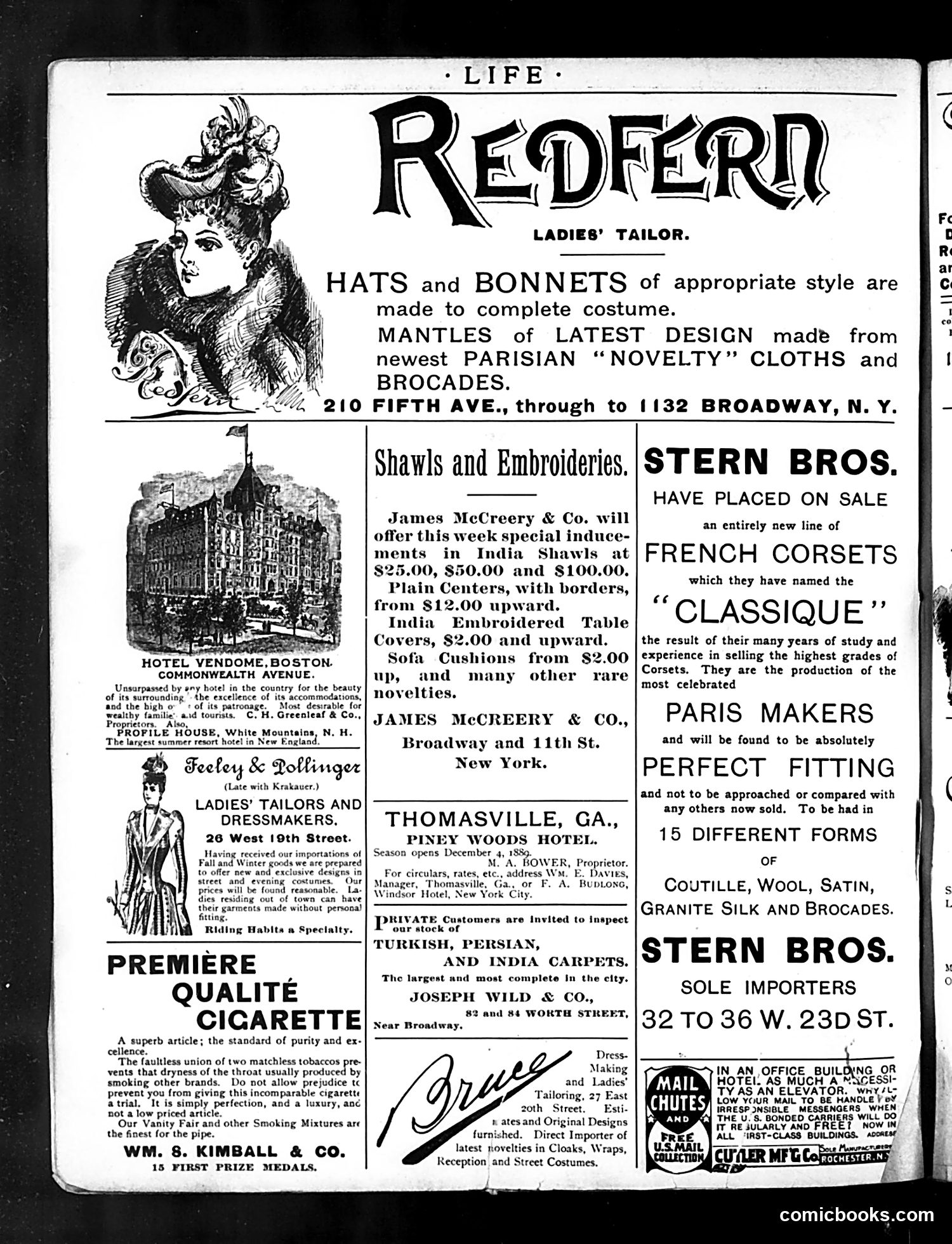
This is **not a cartoon page** but rather a **full-page advertisement section** from Life magazine. It contains no political satire or editorial content. The page showcases luxury retail advertisements targeting wealthy urban consumers in the 1880s-1890s, featuring: - **Redfern** (ladies' tailor on Fifth Avenue/Broadway) - High-end hotels (Hotel Vendome in Boston, Piney Woods Hotel in Georgia) - **Dress makers and tailors** specializing in imported Parisian fashions - **Stern Bros.** advertising French corsets named "Classique" - Premium goods: Indian shawls, embroideries, Turkish carpets, cigars The imagery depicts fashionable women in period dress, reflecting contemporary style aspirations. These ads reveal what affluent Americans—particularly women—valued: imported European goods, elegant tailoring, and luxury travel accommodations. The repeated emphasis on "Parisian" and "latest designs" underscores the era's cultural deference to French fashion. There is **no cartoon or satire present**.
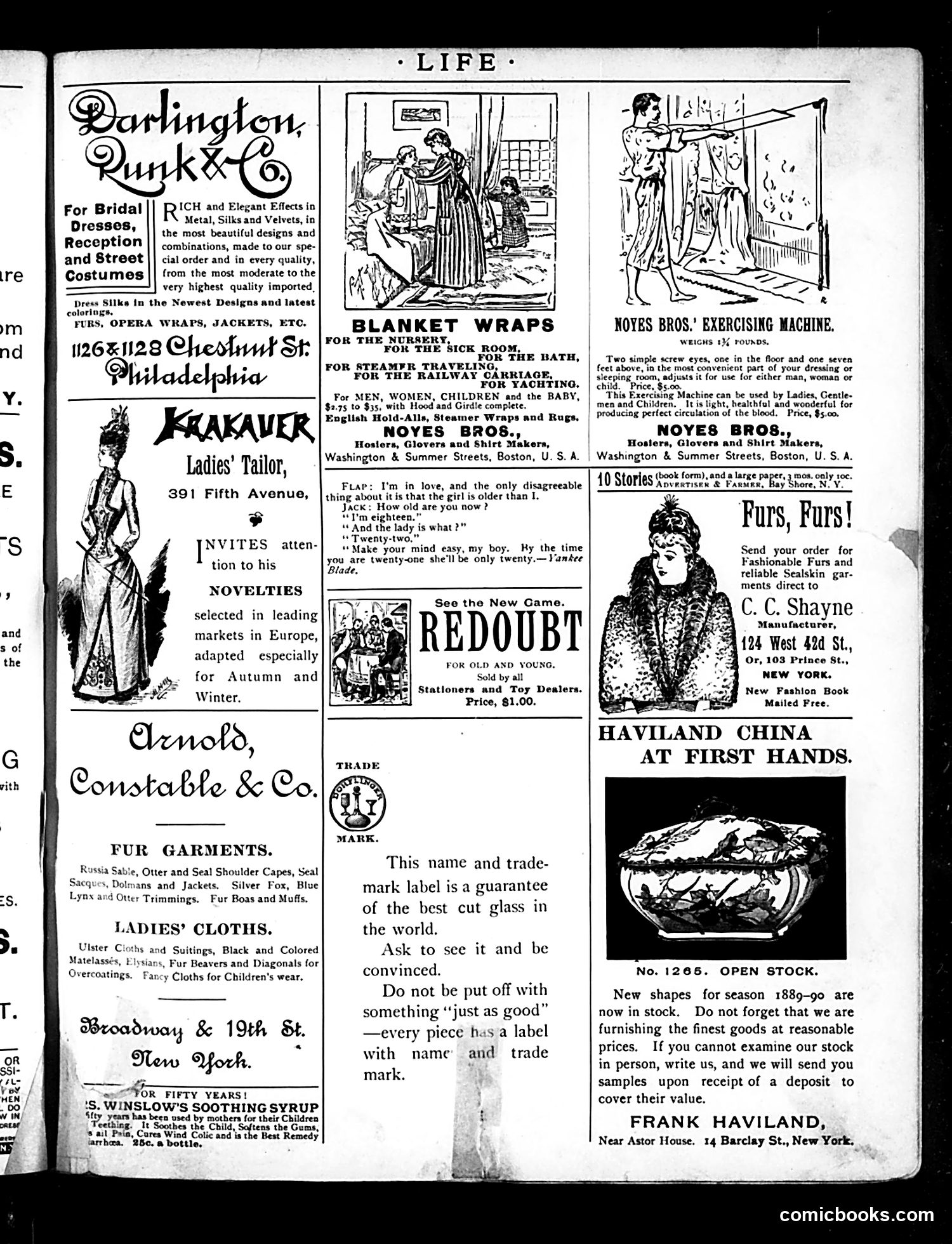
This is primarily an **advertising page** from Life magazine, circa 1889-90, containing no political cartoons or satire. The content consists entirely of period advertisements and one brief comedic dialogue. The sole humorous content is a short joke between characters "Flap" and "Jack" about a May-December romance. The joke plays on mathematical anxiety: a young man (18) is troubled that his girlfriend (22) is older. Jack reassures him that by the time he's 21, she'll only be 25—implying the age gap remains constant (a logic puzzle meant to be amusing). The advertisements reflect **late 19th-century consumer goods**: fur garments, ladies' clothing, exercise machines, china, and notably **Mrs. Winslow's Soothing Syrup** (a patent medicine for teething infants, now known to contain alcohol and opiates—marketed without modern safety regulations). This page documents period commerce and attitudes toward women's fashion, domestic life, and unregulated pharmaceuticals rather than containing satirical commentary.
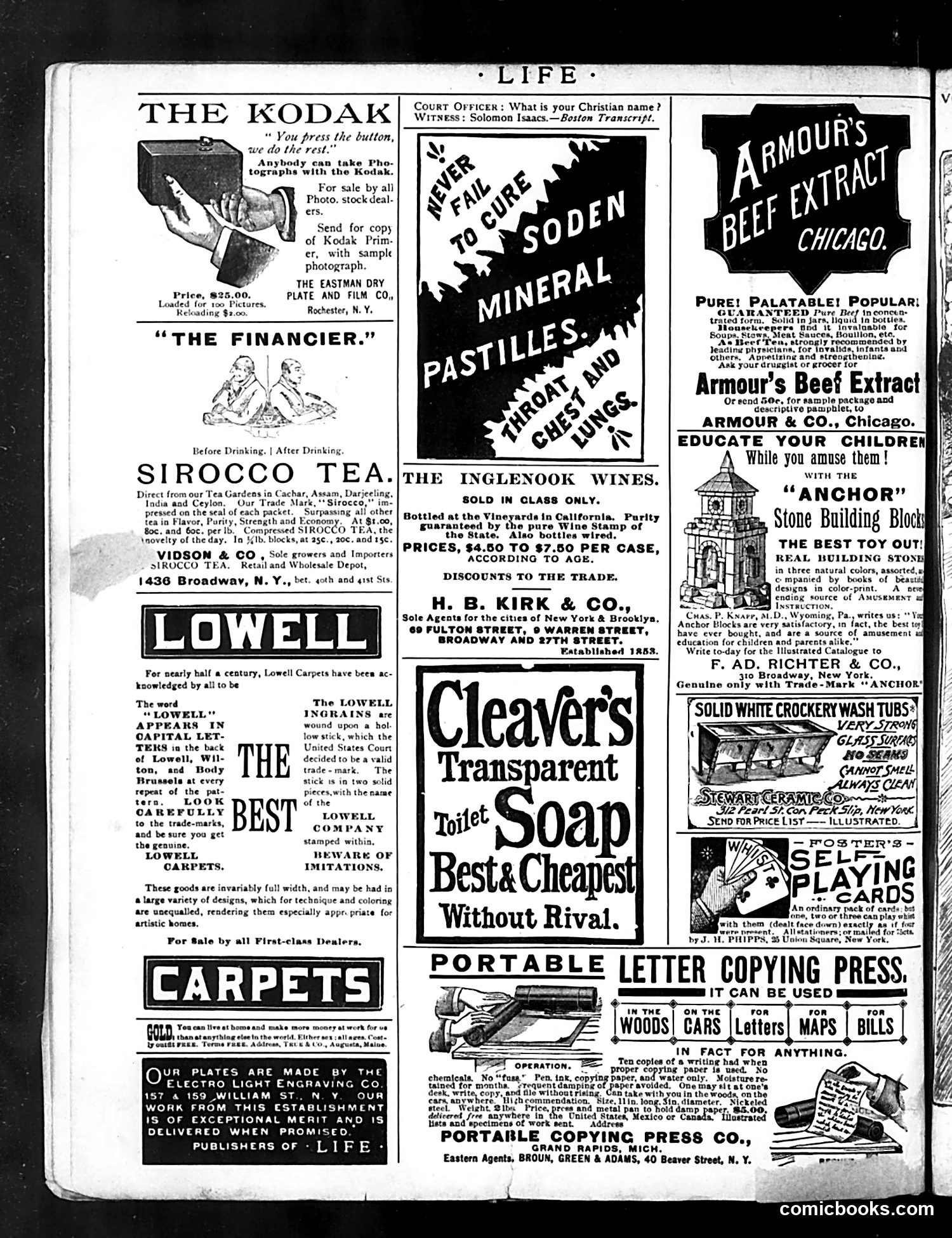
This page is primarily **advertisements** with one small satirical cartoon titled "The Financier." The cartoon shows a single figure in two states: "Before Drinking" and "After Drinking." It appears to joke about alcohol's effects on financial decision-making or judgment. The implication is likely that drinking impairs one's ability to manage money wisely—a man might make poor financial choices while intoxicated. This reflects Victorian-era concerns about alcohol's social dangers, particularly regarding its impact on respectability and financial responsibility. The cartoon uses visual contrast to mock how drinking transforms someone's competence or judgment, a common satirical theme in period publications. The rest of the page consists of product advertisements for Kodak cameras, carpets, tea, wines, beef extract, toys, and office equipment—typical commercial content for *Life* magazine during this era.