
Life, 1889-11-14 · page 4 of 16
Life — November 14, 1889 — page 4: what you’re looking at
What you’re looking at
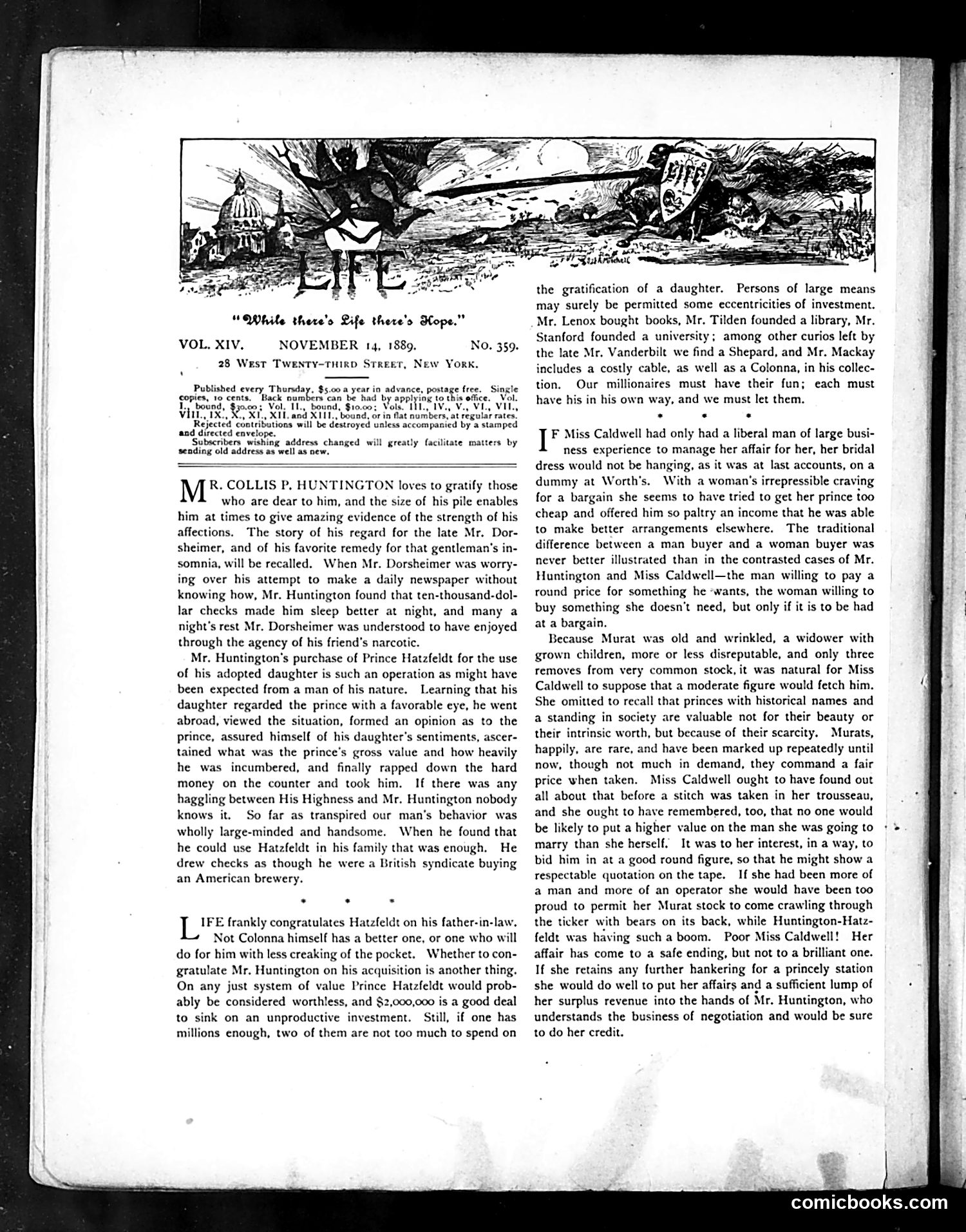
The masthead cartoon depicts "Life" as a classical figure amid a chaotic landscape, with the caption "While there's Life there's Hope." The text discusses Mr. Collis P. Huntington, a wealthy railroad magnate, and his relationship with his adopted daughter. The satire centers on Huntington's attempt to arrange an advantageous marriage for her—specifically mentioning a European prince (Prince Hatsfeldt). The piece mocks the wealthy's practice of purchasing titles and status through marriage arrangements, suggesting Huntington "rapped down the hard money on the counter" to secure the match. The article contrasts Huntington's straightforward financial negotiation with Miss Caldwell's more subtle bargaining tactics as a buyer, satirizing both the commodification of marriage among the wealthy and gender dynamics in these transactions.
📄 Transcribed text from this page (OCR, searchable)
Machine-transcribed from the original scan — historical spelling and the odd misread are preserved.
“While there's Life there's BHope.” VOL. XIV. NOVEMBER 14, 1889. No. 359. 28 West Twenty-THirD Street, New York. Published every Mia $5.00 year in advance, postage fre Back ry can be had by applying tot bound, $10.00: Vole. Il, XTi. and KITT bsund crn tat nomsbers at segular rates, ations wil be destroyed unless accompanied by a stamped Subscribers wishing address changed will greatly facilitate matters by sending old address as well as new. R. COLLIS P, HUNTINGTON loves to gratify those who are dear to him, and the size of his pile enables him at times to give amazing evidence of the strength of his affections. The story of his regard for the late Mr. Dor- sheimer, and of his favorite remedy for that gentleman’ somnia, will be recalled. When Mr. Dorsheimer was worry- ing over his attempt to make a daily newspaper without knowing how, Mr. Huntington found that ten-thousand-dol- lar checks made him sleep better at night, and many a night's rest Mr. Dorsheimer was understood to have enjoyed through the agency of his friend's narcotic. Mr. Huntington's purchase of Prince Hatzfeldt for the use of his adopted daughter is such an operation as might have been expected from a man of his nature. Learning that his daughter regarded the prince with a favorable eye, he went abroad, viewed the situation, formed an opinion as to the prince, assured himself of his daughter's sentiments, ascer- tained what was the prince’s gross value and how heavily he was incumbered, and finally rapped down the hard money on the counter and took him. If there was any haggling between His Highness and Mr. Huntington nobody knows it. So far as transpired our man’s behavior was wholly large-minded and handsome. When he found that he could use Hatzfeldt in his family that was enough. He drew checks as though he were a British syndicate buying an American brewery. IFE frankly congratulates Hatzfeldt on his father-in-law, Not Colonna himself has a better one, or one who will do for him with less creaking of the pocket. Whether to con- gratulate Mr. Huntington on his acquisition is another thing. On any just system of value Prince Hatzfeldt would prob- ably be considered worthless, and $2,000,000 is a good deal to sink on an unproductive investment. Still, if one has millions enough, two of them are not too much to spend on ——_ = = SH Eb the gratification of a daughter. Persons of large means may surely be permitted some eccentricities of investment. Mr. Lenox bought books, Mr. Tilden founded a library, Mr. Stanford founded a university; among other curios left by the late Mr. Vanderbilt we find a Shepard, and Mr. Mackay includes a costly cable, as well as a Colonna, in his collec- tion. Our millionaires must have their fun; each must have his in his own way, and we must let them. . . . F Miss Caldwell had only had a liberal man of large busi- ness experience to manage her affair for her, her bridal dress would not be hanging, as it was at last accounts, on a dummy at Worth's. With a woman's irrepressible craving for a bargain she seems to have tried to get her prince too cheap and offered him so paltry an income that he was able to make better arrangements elsewhere. The traditional difference between a man buyer and a woman buyer was never better illustrated than in the contrasted cases of Mr. Huntington and Miss Caldwell—the man willing to pay a round price for something he ‘wants, the woman willing to buy something she doesn’t need, but only if it is to be had at a bargain. Because Murat was old and wrinkled, a widower with grown children, more or less disreputable, and only three removes from very common stock, it was natural for Miss Caldwell to suppose that a moderate figure would fetch him. She omitted to recall that princes with historical names and a standing in society are valuable not for their beauty or their intrinsic worth, but because of their scarcity. Murats, happily, are rare, and have been marked up repeatedly until now, though not much in demand, they command a fair price when taken. Miss Caldwell ought to have found out all about that before a stitch was taken in her trousseau, and she ought to have remembered, too, that no one would be likely to put a higher value on the man she was going to + > marry than she herself. It was to her interest, in a way, to bid him in at a good round figure, so that he might show a respectable quotation on the tape. If she had been more of a man and more of an operator she would have been too proud to permit her Murat stock to come crawling through the ticker with bears on its back, while Huntington-Hatz- feldt_ was having such a boom. Poor Miss Caldwell! Her affair has come to a safe ending, but not to a brilliant one. If she retains any further hankering for a princely station she would do well to put her affairs and a sufficient lump of her surplus revenue into the hands of Mr. Huntington, who understands the business of negotiation and would be sure to do her credit. comicbooks. com