
A complete issue · 18 pages · 1889
Life — October 31, 1889
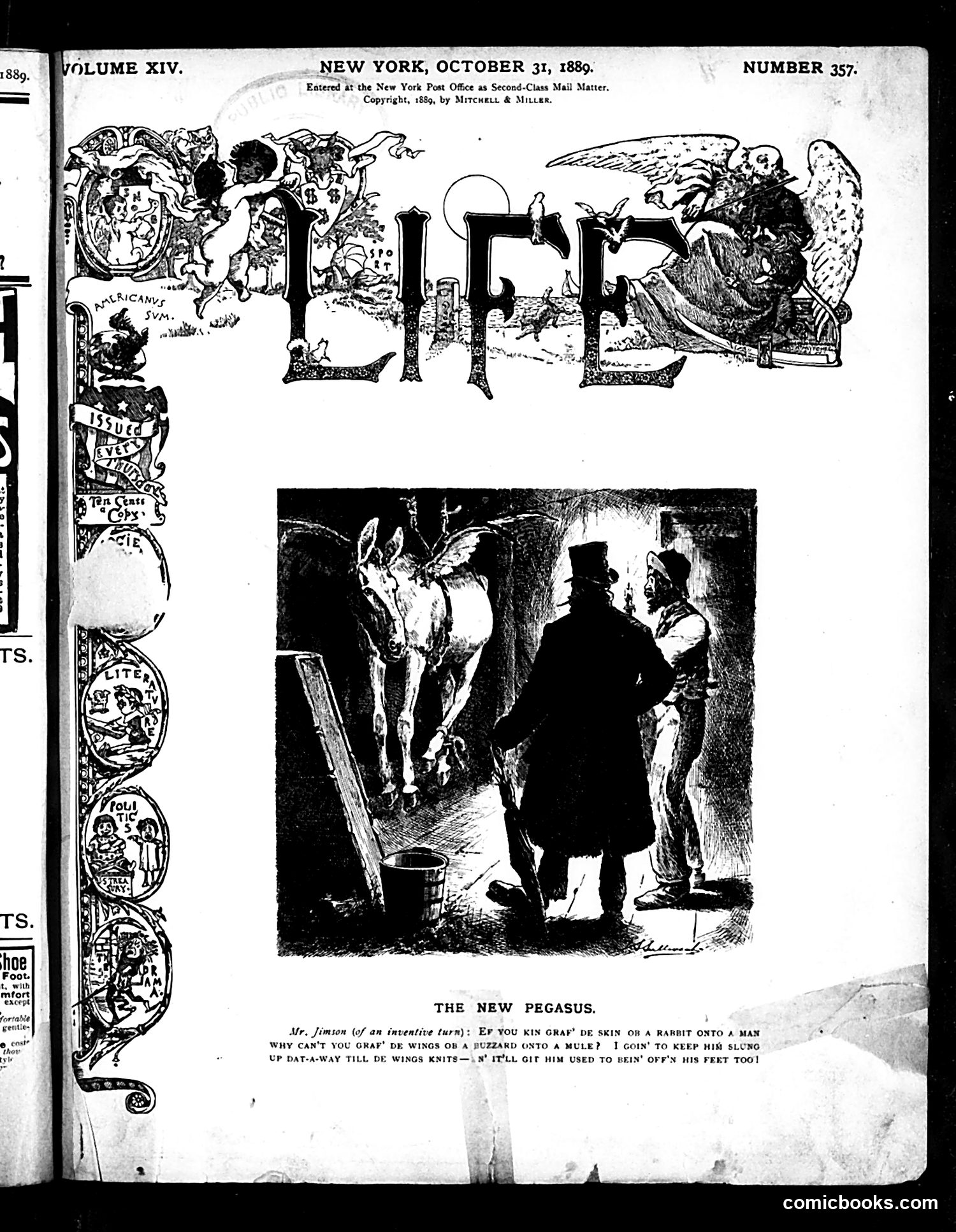
This cartoon satirizes an unnamed inventor (labeled "of an inventive turn") pitching an absurd contraption. The dialogue mocks his proposed creation: grafting rabbit skin onto a mule to give it wings, then using those wings as knitting needles to create socks—which would somehow keep the mule's feet warm. The humor lies in the cascade of ridiculous logic: each impractical step builds on the last. The well-dressed gentleman and woman listen with evident skepticism, their body language suggesting polite bewilderment at this nonsensical scheme. The title "New Pegasus" references the mythological winged horse, further emphasizing the absurdity of trying to create flying creatures through bizarre biological engineering. This mocks contemporary pseudo-scientific invention crazes of the Gilded Age.
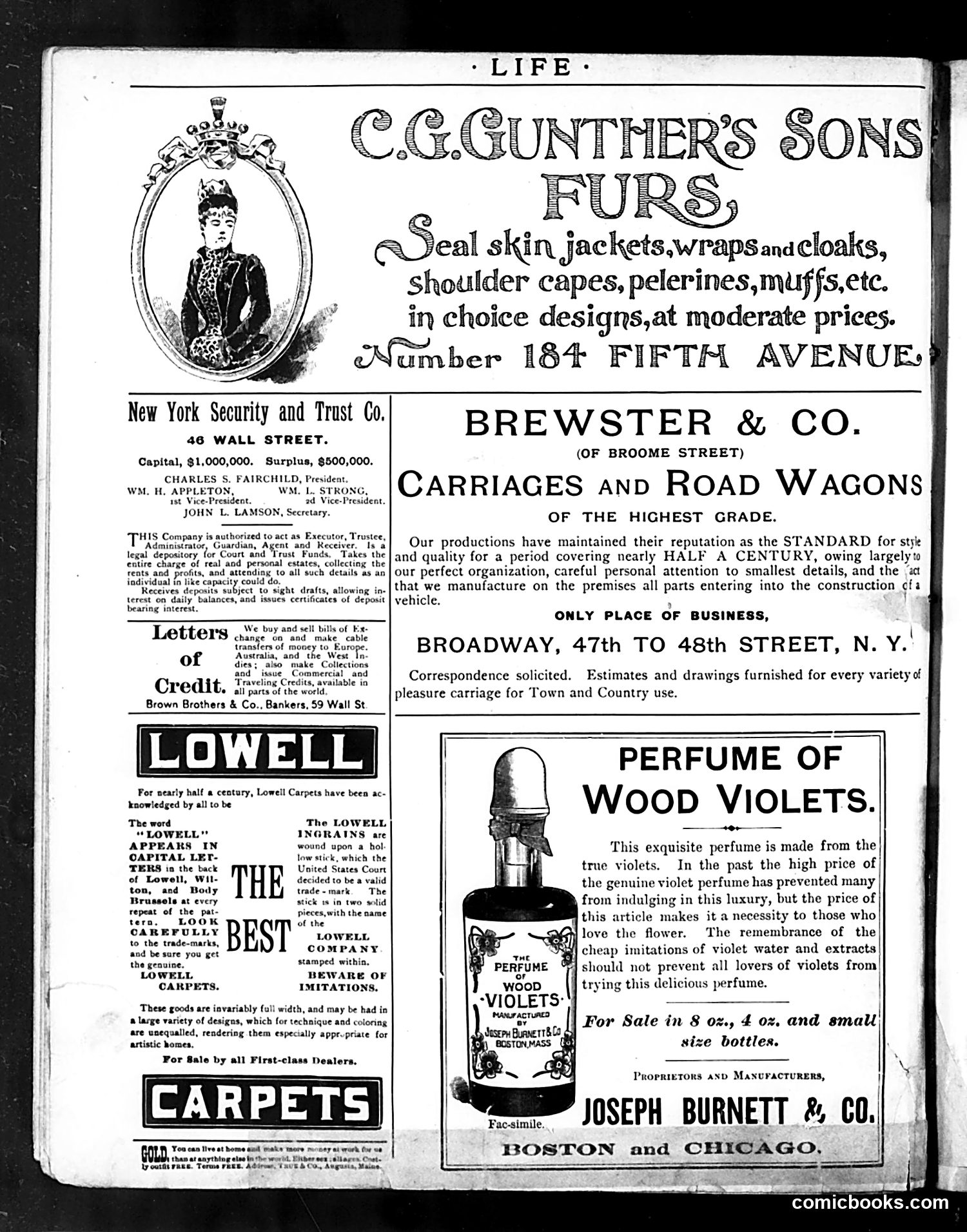
This page is **primarily advertising**, not satirical content. It contains four separate commercial advertisements from what appears to be a late 19th-century issue of *Life* magazine: 1. **C.G. Gunther's Sons Furs** — fur clothing merchant at Fifth Avenue 2. **New York Security and Trust Co.** — financial services 3. **Brewster & Co.** — high-end carriage and wagon manufacturer 4. **Lowell Carpets** — carpet retailer emphasizing quality and authenticity 5. **Joseph Burnett & Co.** — perfume manufacturer selling "Perfume of Wood Violets" The page features period-appropriate illustrations (a woman in fur, a perfume bottle) typical of Victorian-era advertising. There is **no political cartoon or satirical content** visible here—this is straightforward commercial promotion aimed at affluent consumers of the era.
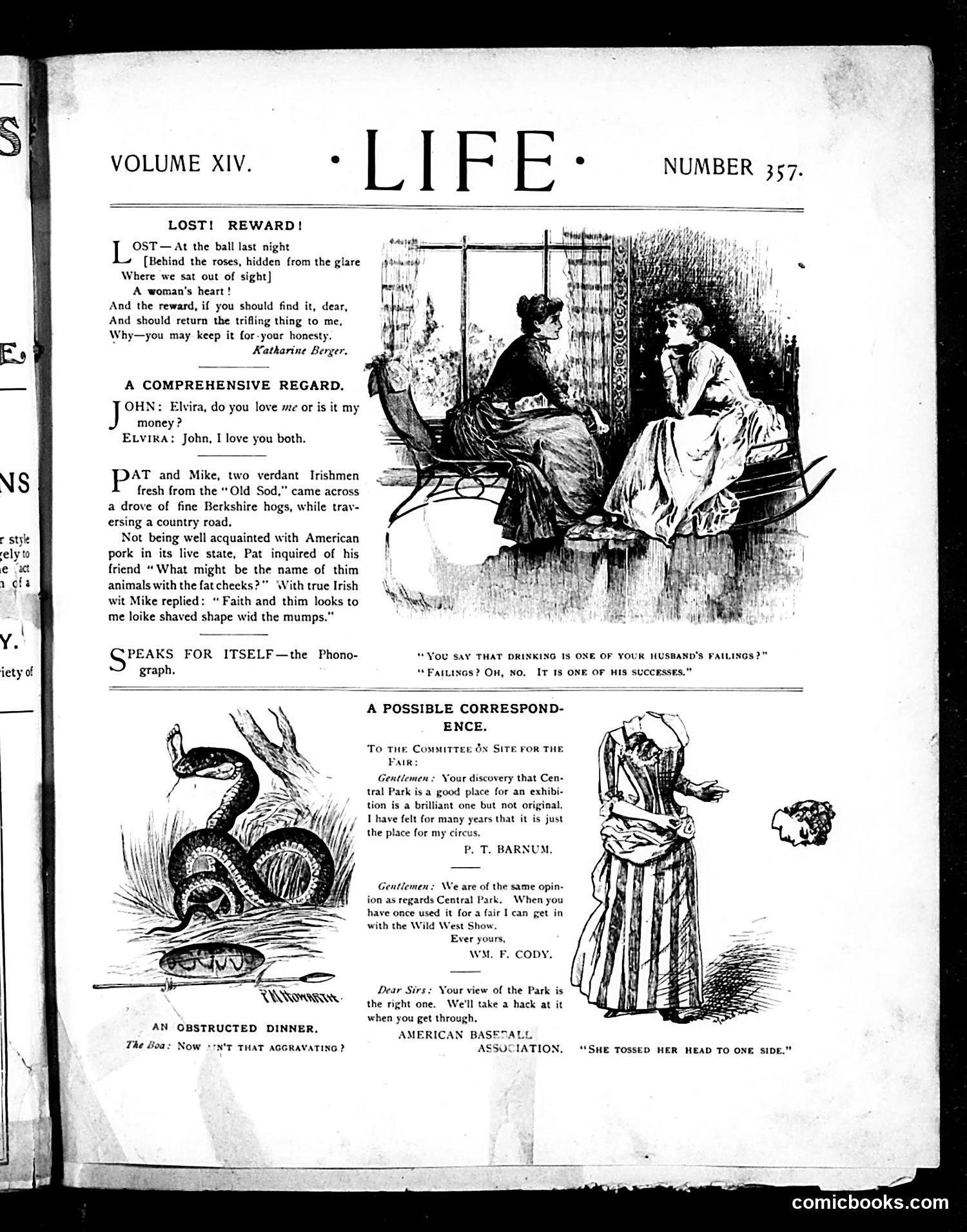
This page contains humor pieces rather than political cartoons: **"Lost! Reward!"** presents a sentimental poem about a lost woman's heart, attributed to Katharine Byxrs. **"A Comprehensive Record"** jokes about a woman's mercenary motivations, asking whether a suitor loves her or her money. **"Pat and Mike"** features Irish immigrant characters making puns about unfamiliar American animals (pigs), playing on ethnic humor common to the period. **"A Possible Correspondence"** contains letters debating whether Central Park is suitable for exhibitions versus Wild West shows. **"An Obstructed Dinner"** shows a snake illustration with minimal caption. The page reflects typical Life magazine content: domestic humor, immigrant jokes, and light social commentary rather than sharp political satire.
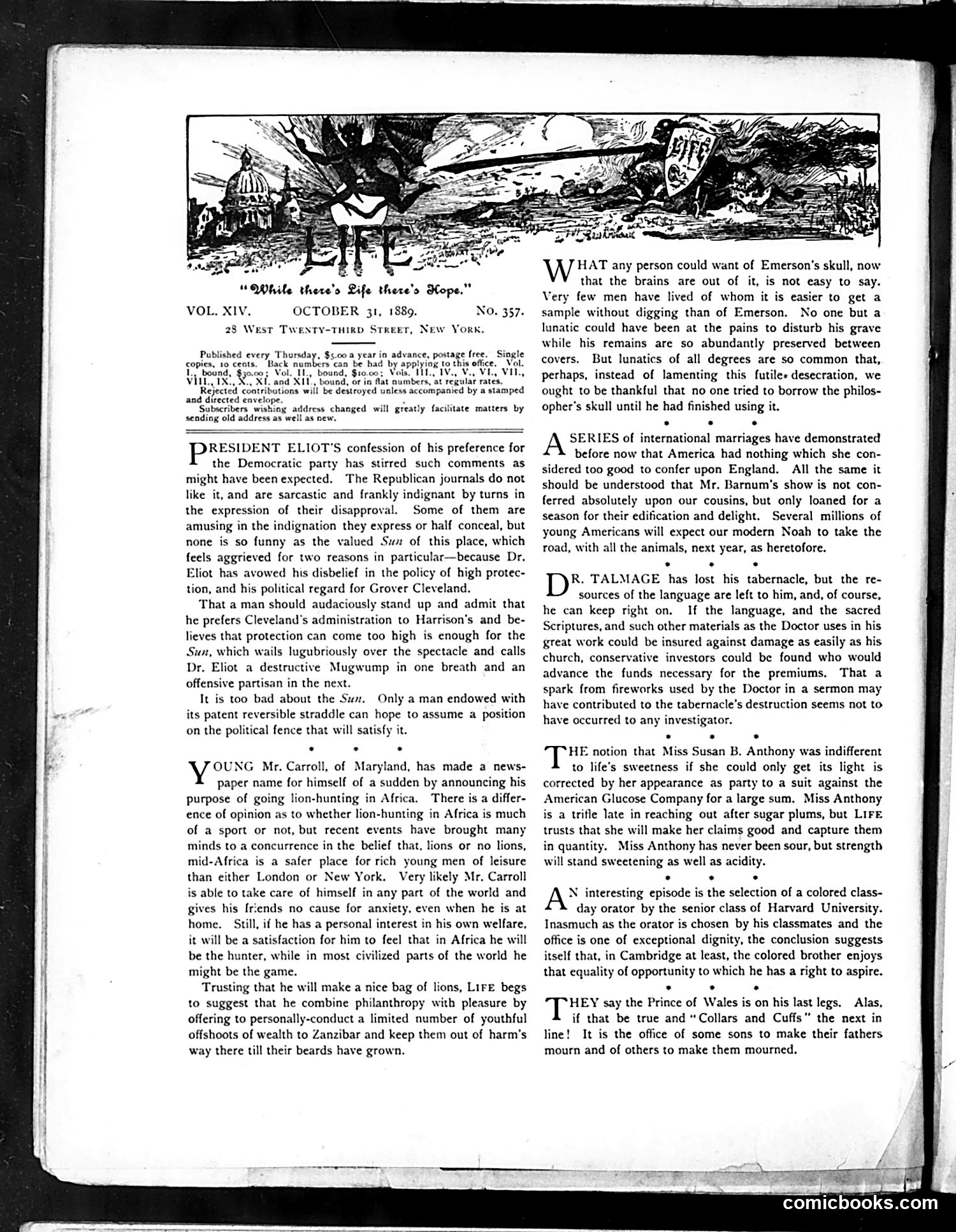
The page contains several brief satirical items rather than a single cartoon. Key references include: **President Eliot's politics**: The opening item mocks President Eliot's (of Harvard) preference for the Democratic party, noting Republican journals criticize his "sarcastic and frankly indignant" disapproval. The piece ironically praises the *Sun* newspaper for wailing over Eliot's "disturbance" to Dr. Eliot's support of Cleveland. **Mr. Carroll's lion-hunting**: A humorous item about a Maryland man announcing plans to hunt lions in Africa—satirizing wealthy young men seeking exotic leisure pursuits. **Miss Susan B. Anthony**: A brief note correcting assumptions about her indifference to life's pleasures. The satire targets elite hypocrisy, partisan politics, and frivolous wealth—typical Life magazine concerns of the Gilded Age.
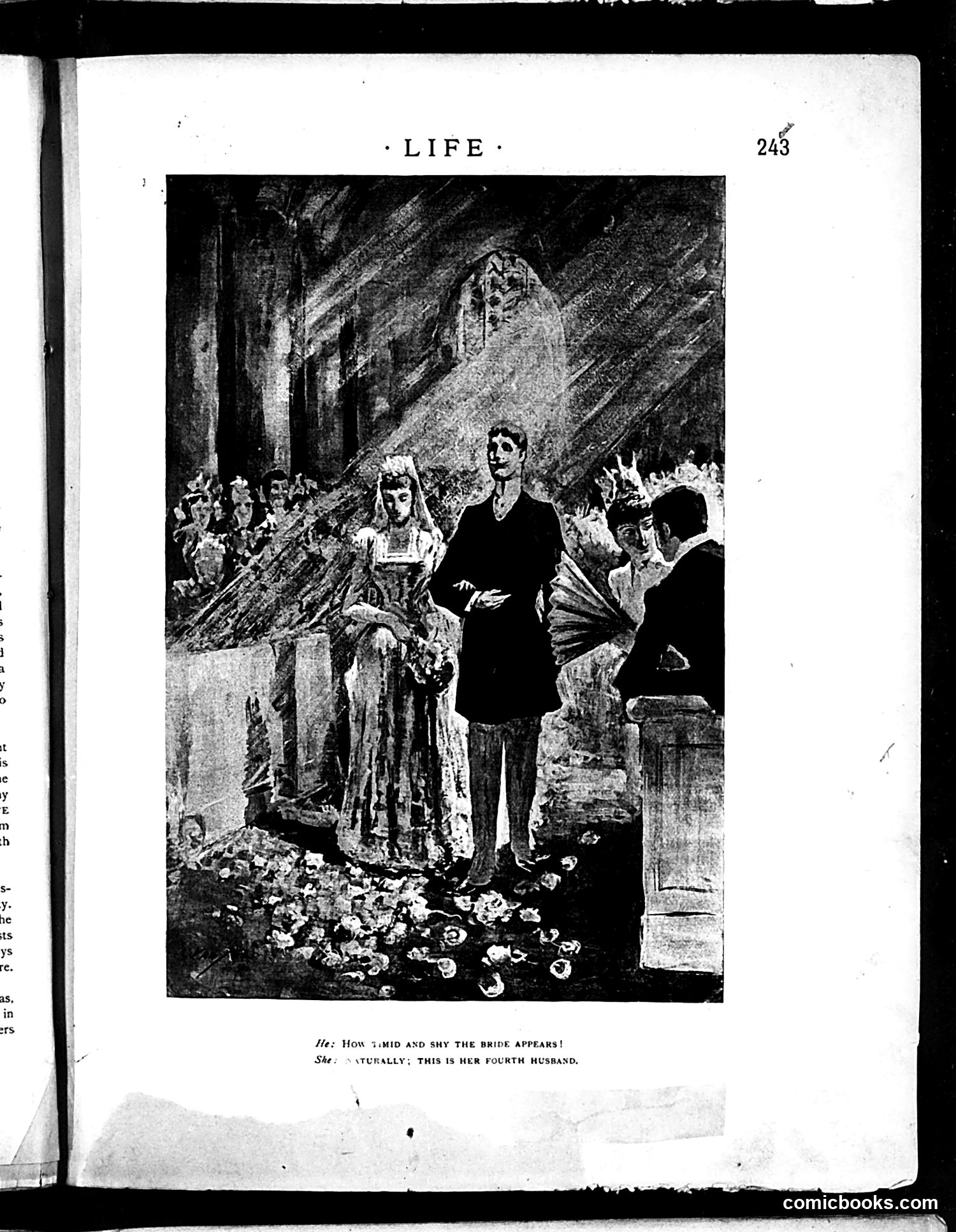
This appears to be a satirical illustration from *Life* magazine (page 243) depicting a wedding scene. The caption reads: "He: 'How mild and shy the bride appears!' / She: 'Naturally; this is her fourth husband.'" The cartoon satirizes the phenomenon of serial marriage, particularly among wealthy or society women. The joke plays on contrasting expectations: a "mild and shy" bride is traditionally associated with first marriages and inexperience, yet here she's supposedly marrying for the fourth time. This suggests she's merely performing modesty for her latest husband, implying cynicism about repeat marriages and questioning the sincerity of women who marry multiple times. The illustration's formal church setting emphasizes the irony—sacred wedding traditions applied to what the satire treats as a transactional, repetitive arrangement.
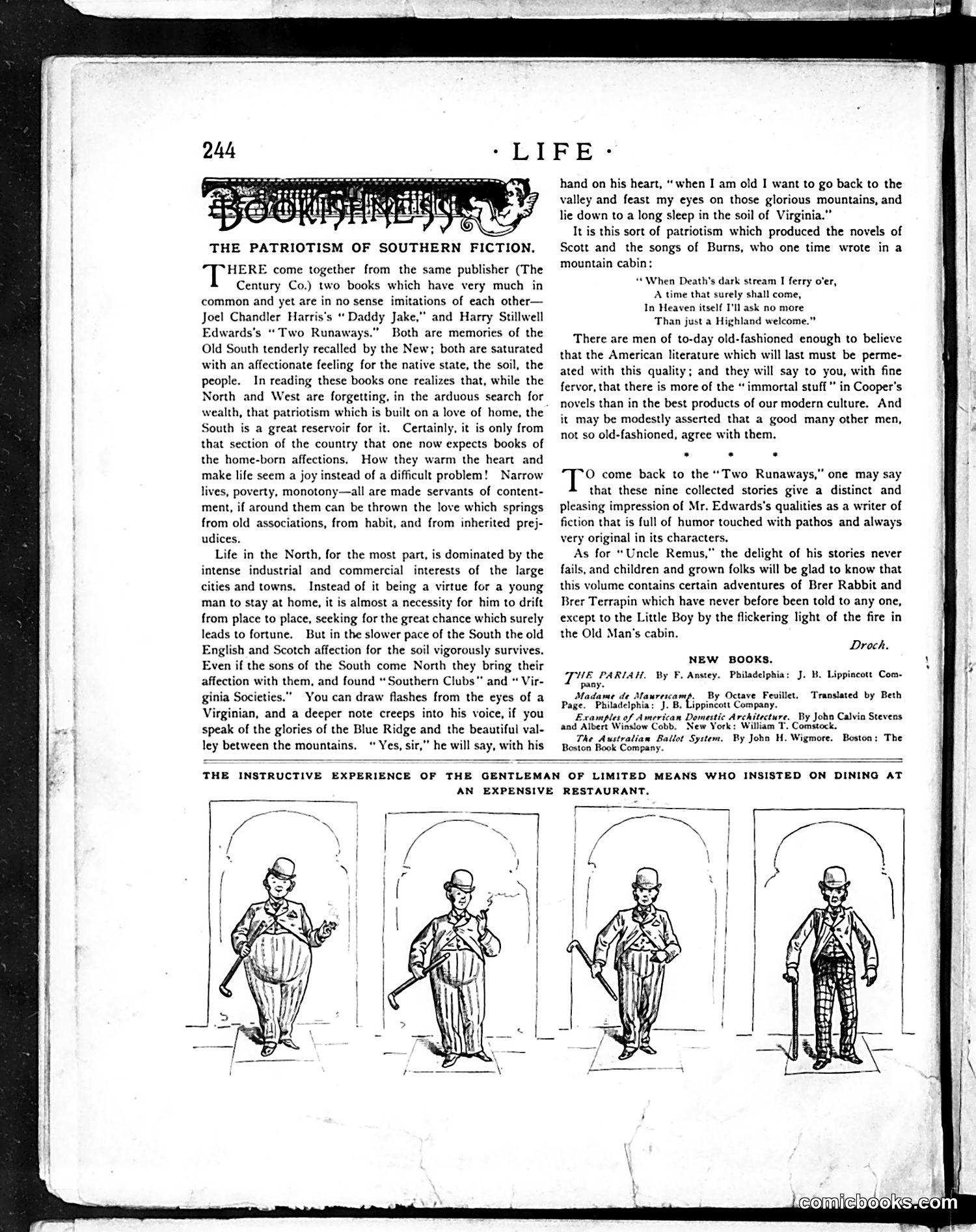
The lower section contains a four-panel cartoon titled "THE INSTRUCTIVE EXPERIENCE OF THE GENTLEMAN OF LIMITED MEANS WHO INSISTED ON DINING AT AN EXPENSIVE RESTAURANT." The satire depicts a poorly-dressed, thin man of modest means attempting to dine at an upscale establishment. Each panel shows him progressively undressing or revealing his shabby clothing beneath his outer coat—suggesting he lacks proper attire for fine dining. The humor derives from the social embarrassment of someone from a lower economic class attempting to access spaces reserved for the wealthy, exposing the gap between his aspirations and his actual means. This reflects turn-of-century class anxieties and the rigid social hierarchies of the era, mocking both the man's pretension and implicitly the exclusionary practices of expensive restaurants.
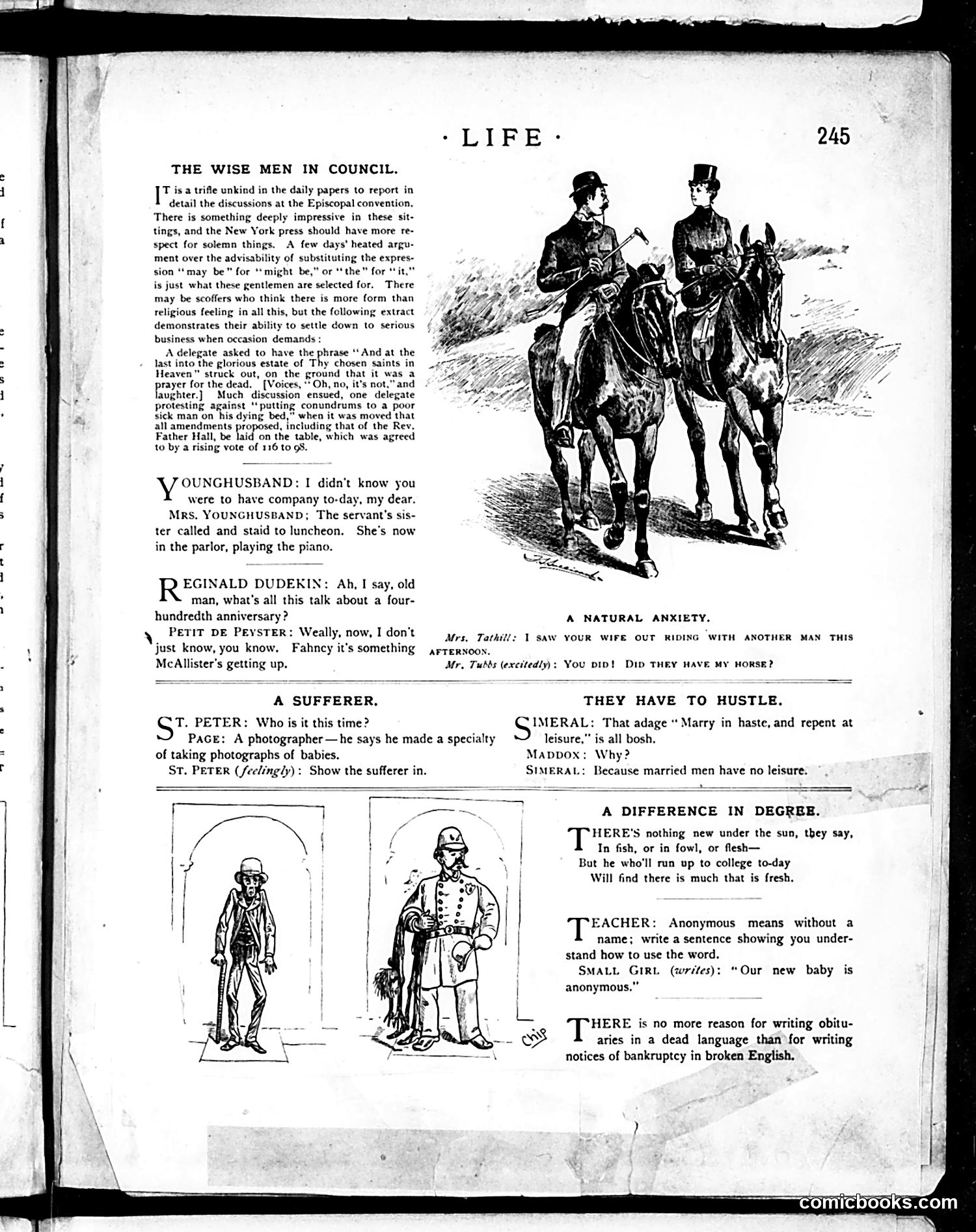
This page contains several brief satirical sketches rather than a single cartoon. The main illustrated piece, "A Natural Anxiety," depicts two men on horseback, with one asking if the other has seen his wife riding out—humorously suggesting marital anxiety about a wife's independence or whereabouts. Other sections include "A Sufferer" (mocking baby photographers), "They Have to Hustle" (joking that married men lack leisure), and "A Difference in Degree" (a poem about fish and fowl). The top section, "The Wise Men in Council," discusses Episcopal convention debates, satirizing serious religious deliberation as pedantic word-parsing. The cartoons mock domestic life, gender relations, and institutional pomposity typical of early 20th-century American satire—themes readily understandable today despite period-specific references.
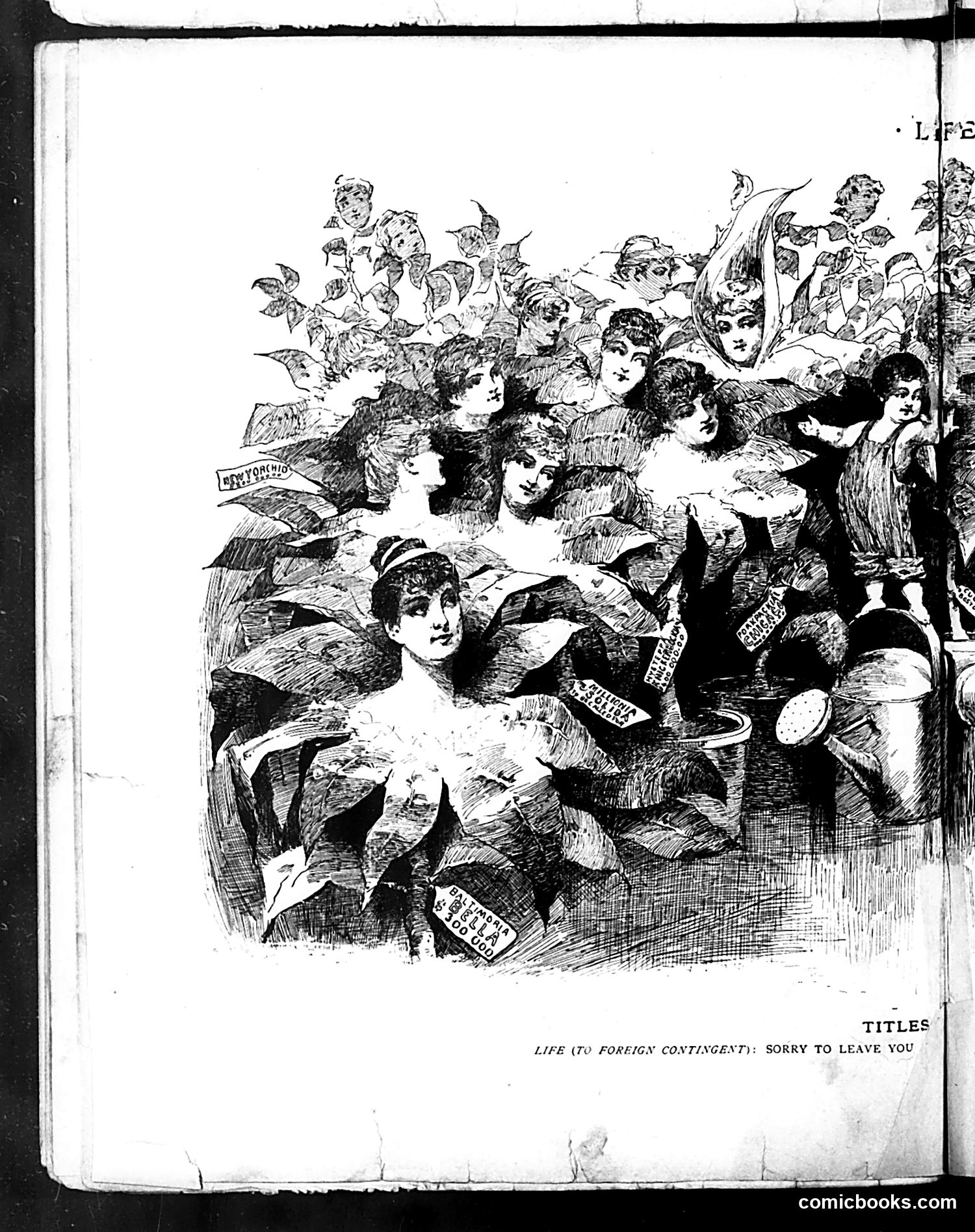
This is a satirical illustration from *Life* magazine titled "Sorry to Leave You" and labeled "Life (To Foreign Contingent)." The cartoon depicts a crowded scene of elegantly dressed women with elaborate hats and fashionable attire, appearing to bid farewell. The "foreign contingent" reference suggests these represent wealthy foreign visitors or immigrants to America. The satire likely comments on either: - The departure of foreign socialites from American high society - The extravagant spending habits of wealthy foreign women in America - Social anxiety about foreign influence on American fashion and culture The crowded, chaotic composition emphasizes the prominence and visibility of these foreign figures in American social life. Without additional historical context, the specific event or individuals referenced remains unclear, though the piece critiques the relationship between wealthy foreigners and American society.
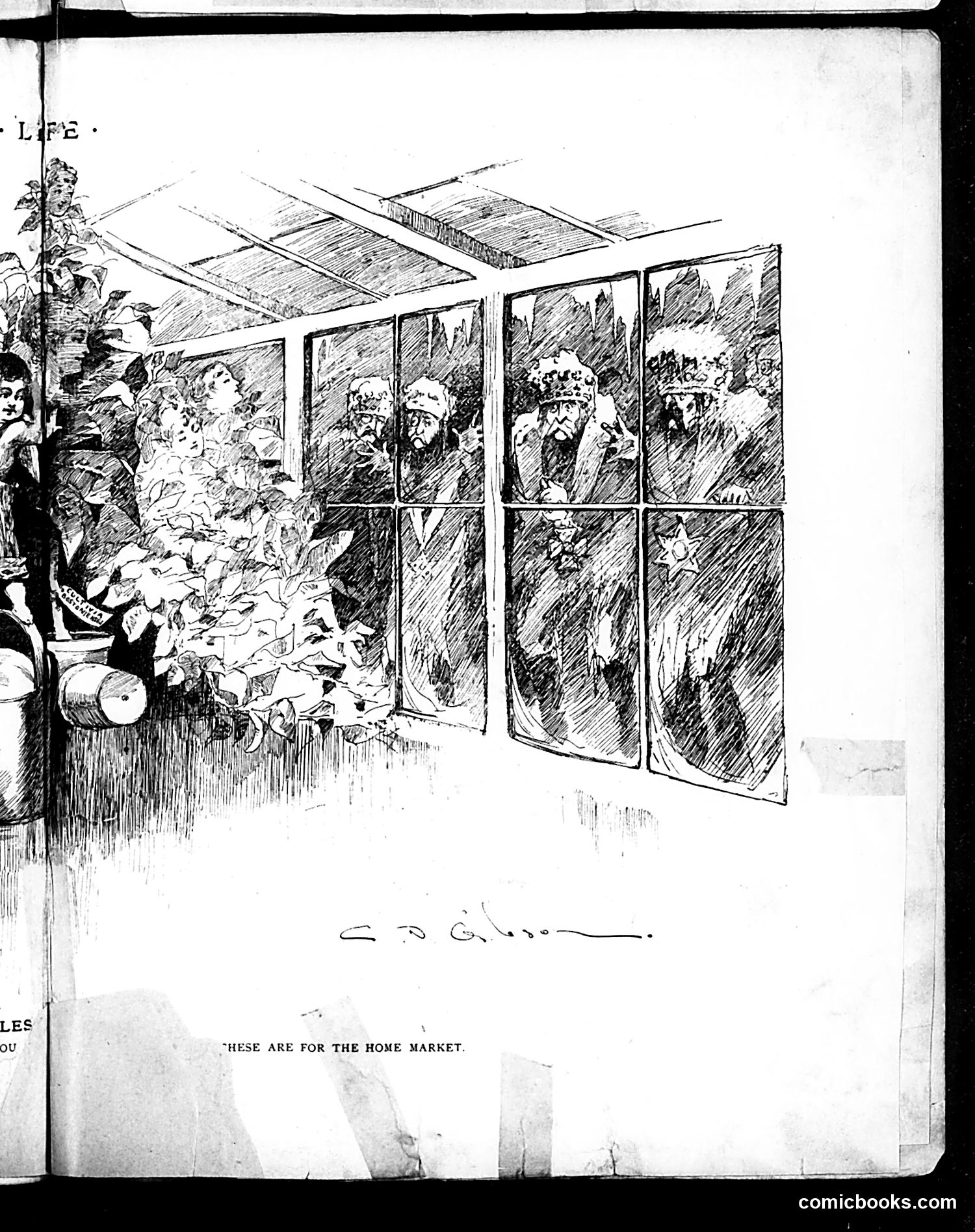
This cartoon depicts a greenhouse or conservatory scene where well-dressed figures with crowns or formal attire are visible through glass panes, appearing to be specimens on display. On the left, a woman tends to flowering plants in a pot. The caption reads: "THESE ARE FOR THE HOME MARKET." The satire appears to target wealthy or aristocratic individuals—possibly European royalty or nobility—by presenting them as hothouse plants being cultivated for domestic consumption or display. The "home market" reference suggests the cartoon mocks either the commodification of the upper classes, their artificial cultivation, or their preservation as relics. The greenhouse framing emphasizes their separation from ordinary life, suggesting they exist in controlled, artificial conditions rather than the real world. The precise historical context remains unclear without additional publication information.
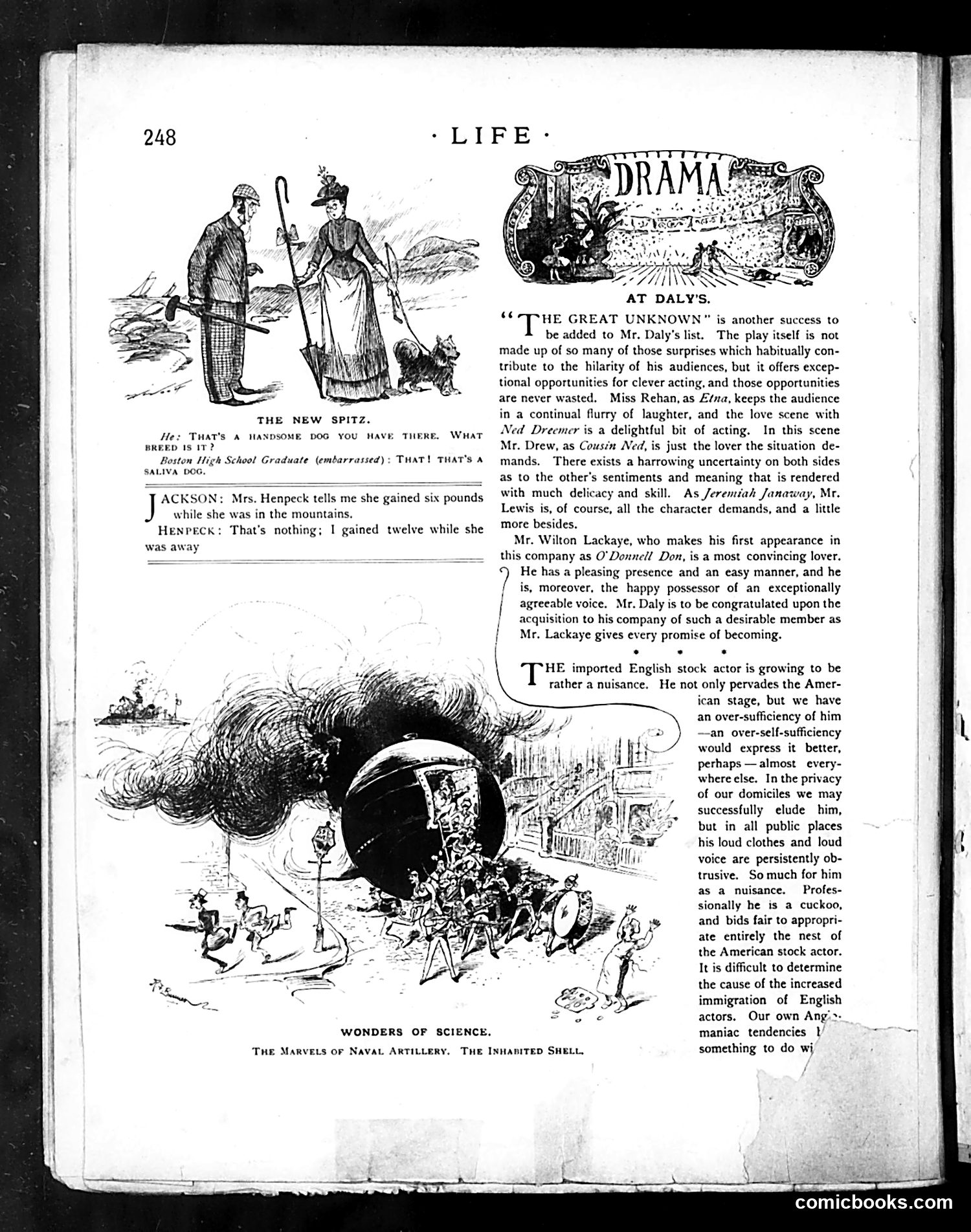
This page contains two satirical cartoons and a drama review. **"The New Spitz"** (top) depicts a couple with a small dog, joking about weight gain—a humorous domestic scene with no clear political content. **"Wonders of Science: The Marvels of Naval Artillery. The Inhabited Shell"** (bottom) is a fantastical illustration showing a massive artillery shell containing tiny people and civilization inside it. This appears to be satirizing contemporary fascination with scientific and military technological advancement, imagining an absurd scenario where weaponry becomes so large it could contain entire worlds—likely mocking both technological boosterism and military excess of the era. The page also reviews Mr. Daly's theatrical production "The Great Unknown," discussing various actors' performances.
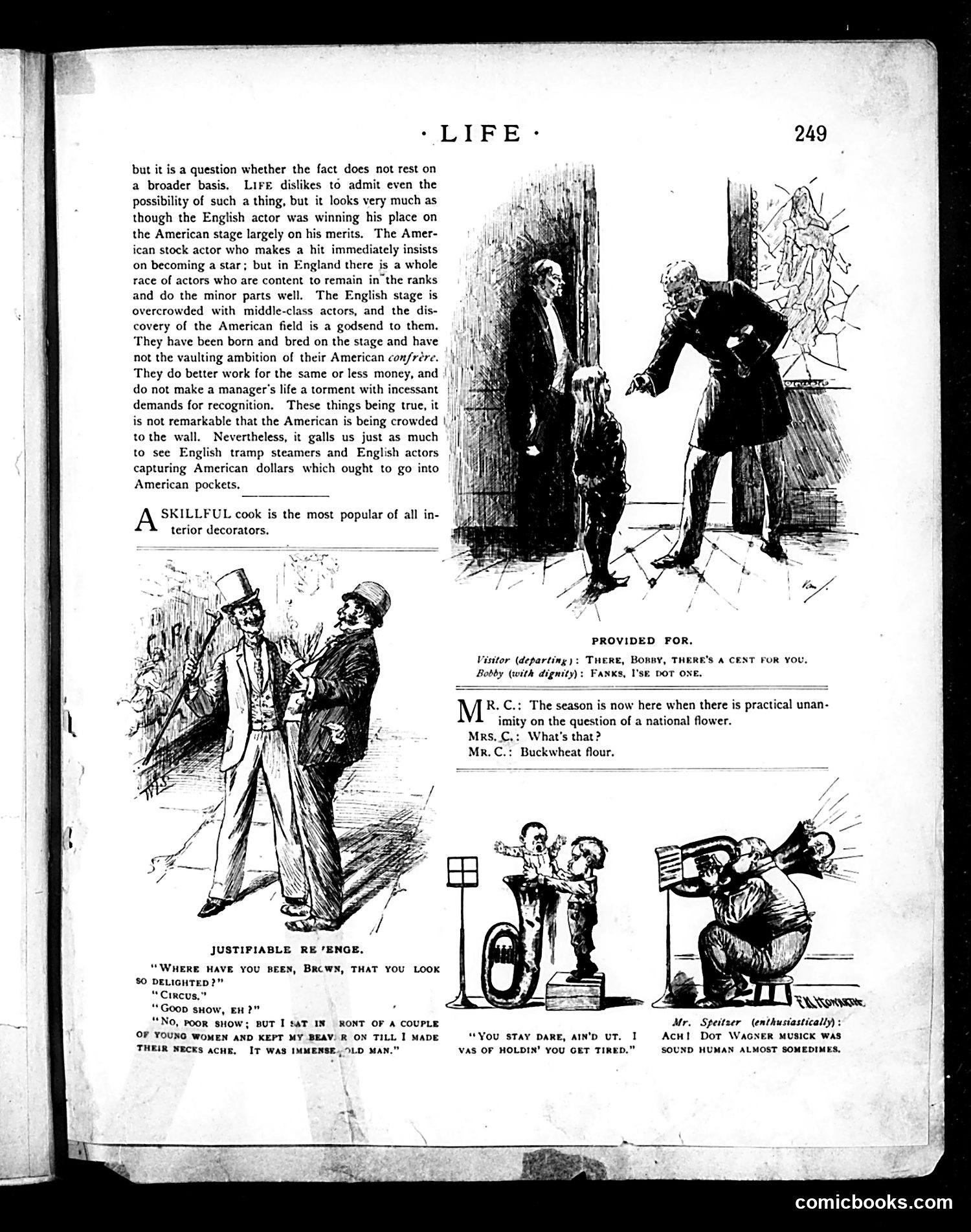
This page contains multiple satirical cartoons and commentary on early 20th-century American life. **Top section**: A debate about American actors versus English actors on stage, arguing that English actors are overrepresented in American theaters despite American actors' superior work ethic. **"Justifiable Revenge"** (left cartoon): Shows two well-dressed men; the caption references a man sitting "in front of a couple of young women" at a show who kept "his beaver on till I made their necks ache." **Center cartoons**: Appear to mock domestic life—one shows children on a scale, another depicts a musician. **Right cartoon**: References "Mr. Spottser" and Wagner's music, suggesting satire about pretentious cultural consumption. The page satirizes American social hierarchies, domestic tensions, and cultural pretensions of the era.
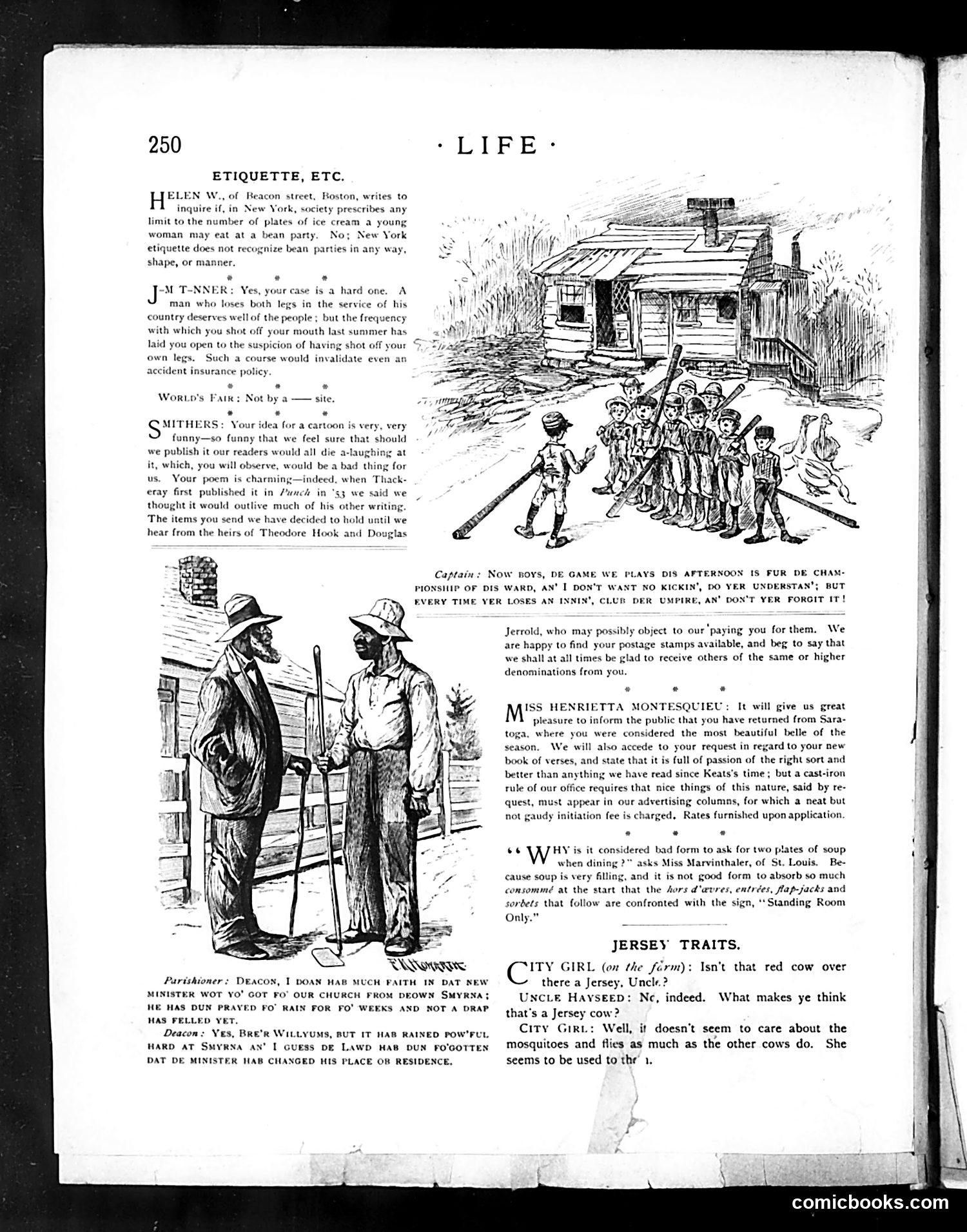
This is a humor/advice column page from Life's satirical section. The content consists of humorous reader letters and editorial responses, plus several cartoon vignettes: **The cartoons satirize:** 1. **Baseball instruction** (top right): A crude coach yelling at boys, mocking aggressive, profane sports management of the era. 2. **Rural religion** (bottom left): Two Black men in dialect discussing a minister whose prayers for rain at his previous church worked too well—joking about divine logistics following clergy relocation. 3. **City girl visiting farm** (bottom): A naive urban girl mistakes a cow's indifference to insects as proof it's a Jersey breed, satirizing urban ignorance of rural life. **The advice responses** mock readers' submissions—rejecting cartoon ideas as too obvious, claiming to have published similar poems decades earlier, and declining to publish reader flattery without payment. The overall tone ridicules human pretension, regional stereotypes, and American social climbing through exaggeration and gentle mockery typical of 1890s-era satirical magazines.
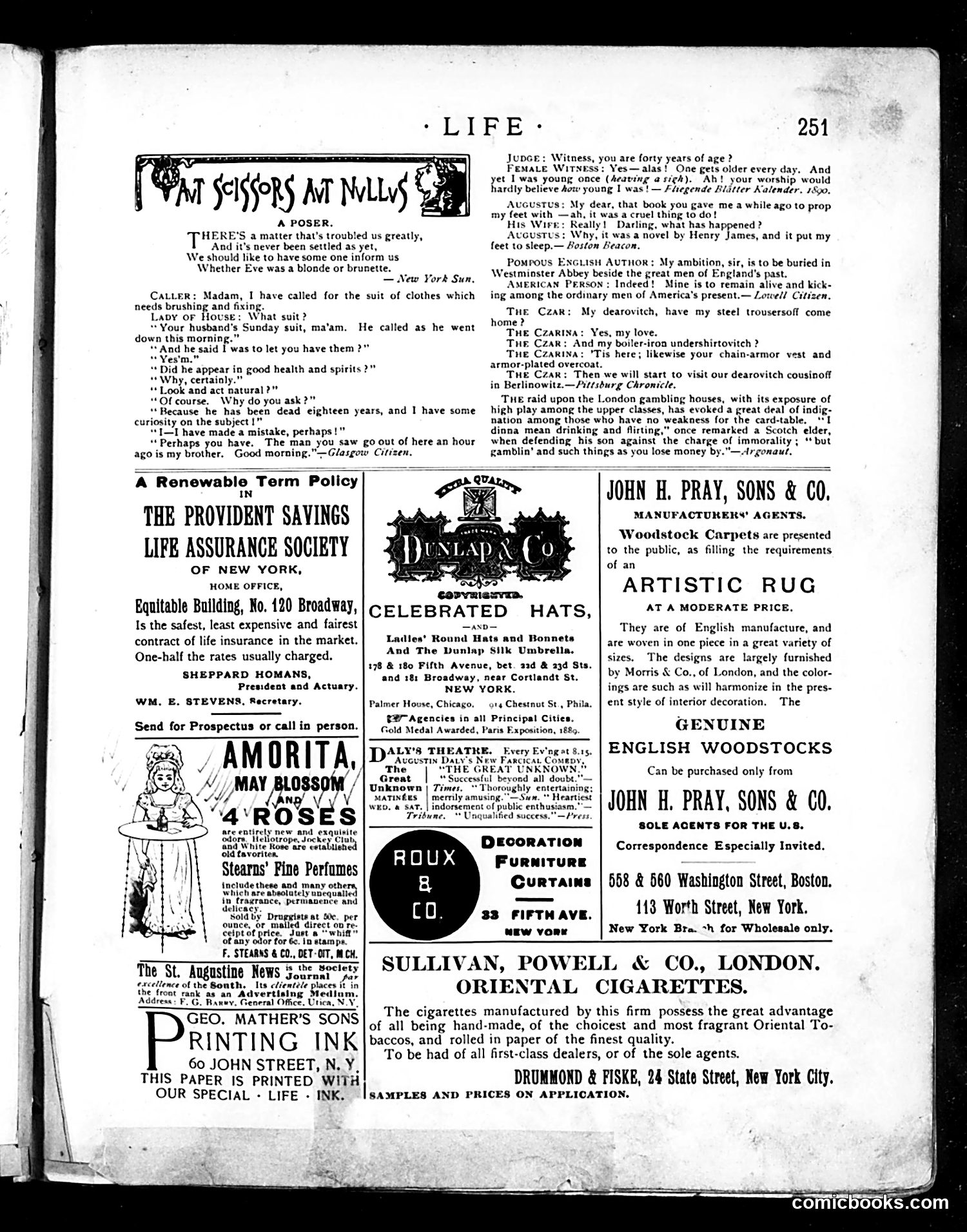
This page contains several brief satirical comic sketches typical of Life magazine's humor format: **The main cartoon** ("Scissors at Nulls") depicts a domestic servant mix-up: a caller retrieves a "Sunday suit" from a house, only to learn the garment belonged to the homeowner's *brother*—not the husband, who died eighteen years prior. The humor relies on the absurdity of the wife allowing a dead man's clothes to be taken for cleaning without correction. **Other brief jokes** mock: a witness's vanity about aging in court; a husband falling asleep while reading a Henry James novel; an English author's ambition to be buried in Westminster Abbey versus an American's preference for staying alive; and a Russian Czar's concern about his "boiler-iron undershirtovitch" (satirizing Russian stereotypes and titles). The page is otherwise dominated by **period advertisements** for life insurance, hats, carpets, printing ink, and cigarettes—typical of Life's revenue model.
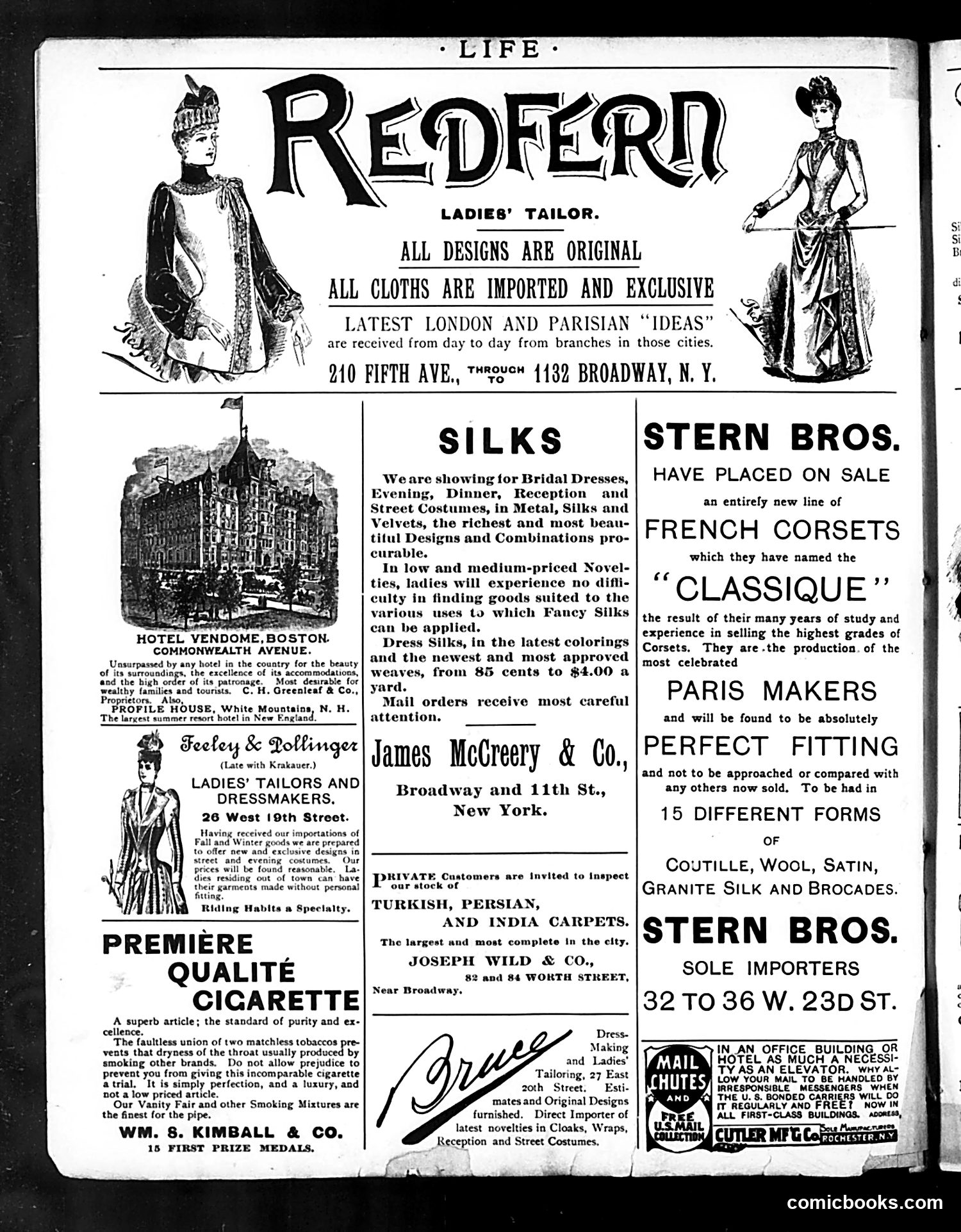
This is primarily an **advertising page**, not a satirical cartoon. It contains luxury goods advertisements typical of early 1900s America, aimed at wealthy urban consumers. The ads reflect the era's class anxieties and aspirations: ladies' tailors emphasize imported "London and Parisian" designs as markers of sophistication; silk merchants stress exclusivity and price ranges; corset makers tout "Paris makers" as superior; carpet dealers highlight "Turkish, Persian, and India" imports. The Hotel Vendôme and Profile House ads target wealthy tourists and families. Notably, all advertising emphasizes **imported foreign goods as superior** to domestic products—a common turn-of-century American cultural stance. The language repeatedly stresses "original," "exclusive," and "imported" to justify premium prices. A small postal service notice at bottom suggests mail-order shopping was becoming standard among this affluent audience, eliminating need for in-person fitting for out-of-town customers—a convenience marketed as refinement.
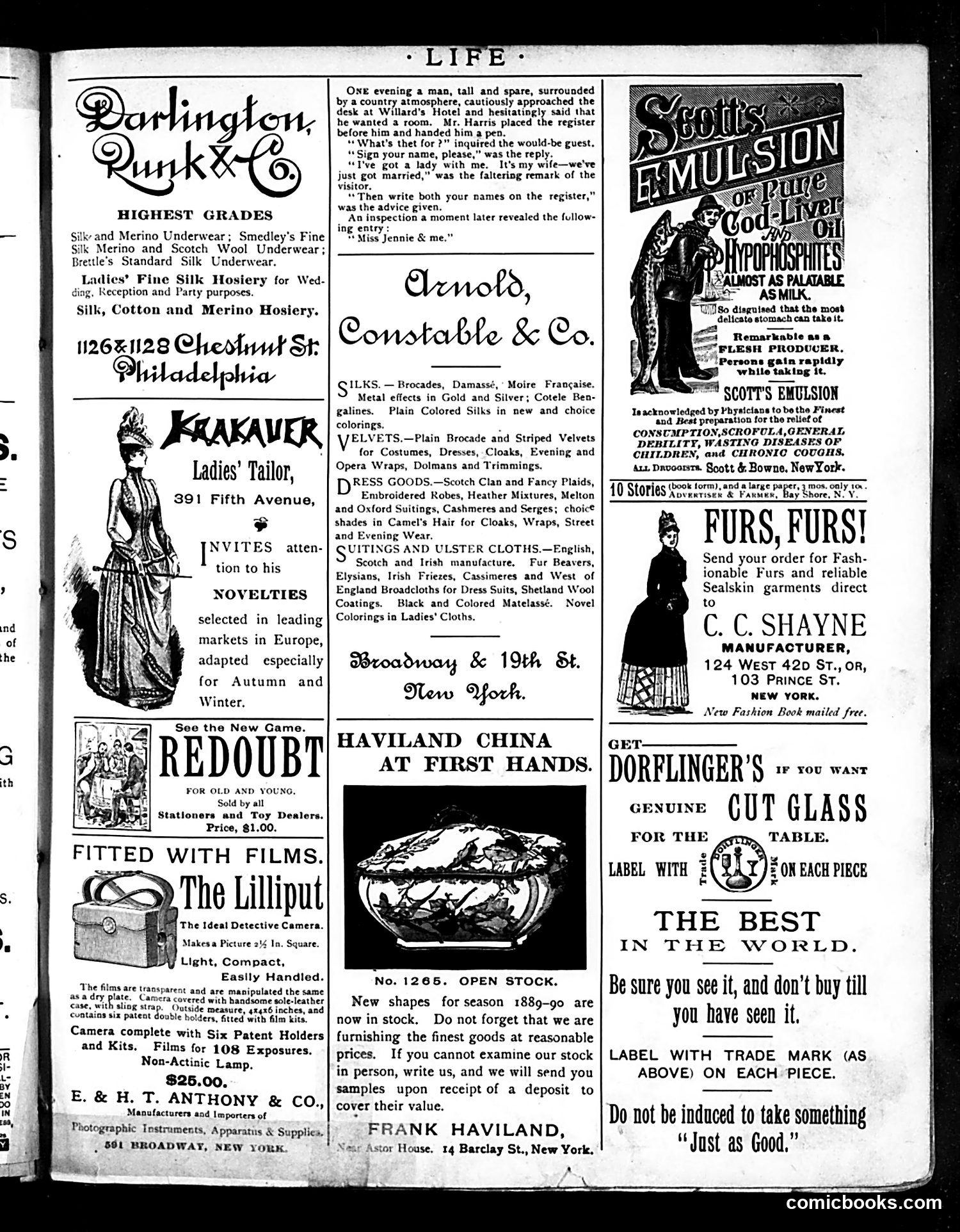
This page is primarily **advertising**, not satire or political commentary. However, it does contain one brief humorous anecdote: The text story describes a newly married couple checking into Willard's Hotel in Washington, D.C. The rural husband, uncomfortable with the situation, writes on the register: "Miss Jennie & me" instead of their proper names. The joke plays on **class/education differences**—the man's awkward grammar and his apparent embarrassment about registering with his new wife (suggesting rural prudishness) are played for gentle humor. The hotel clerk's patient correction of "write both your names" is the setup; the man's malapropism is the punchline. The remainder of the page consists of advertisements for clothing, photography equipment, china, furs, and patent medicines—typical for a late-19th-century *Life* magazine issue. No political figures or events are referenced.
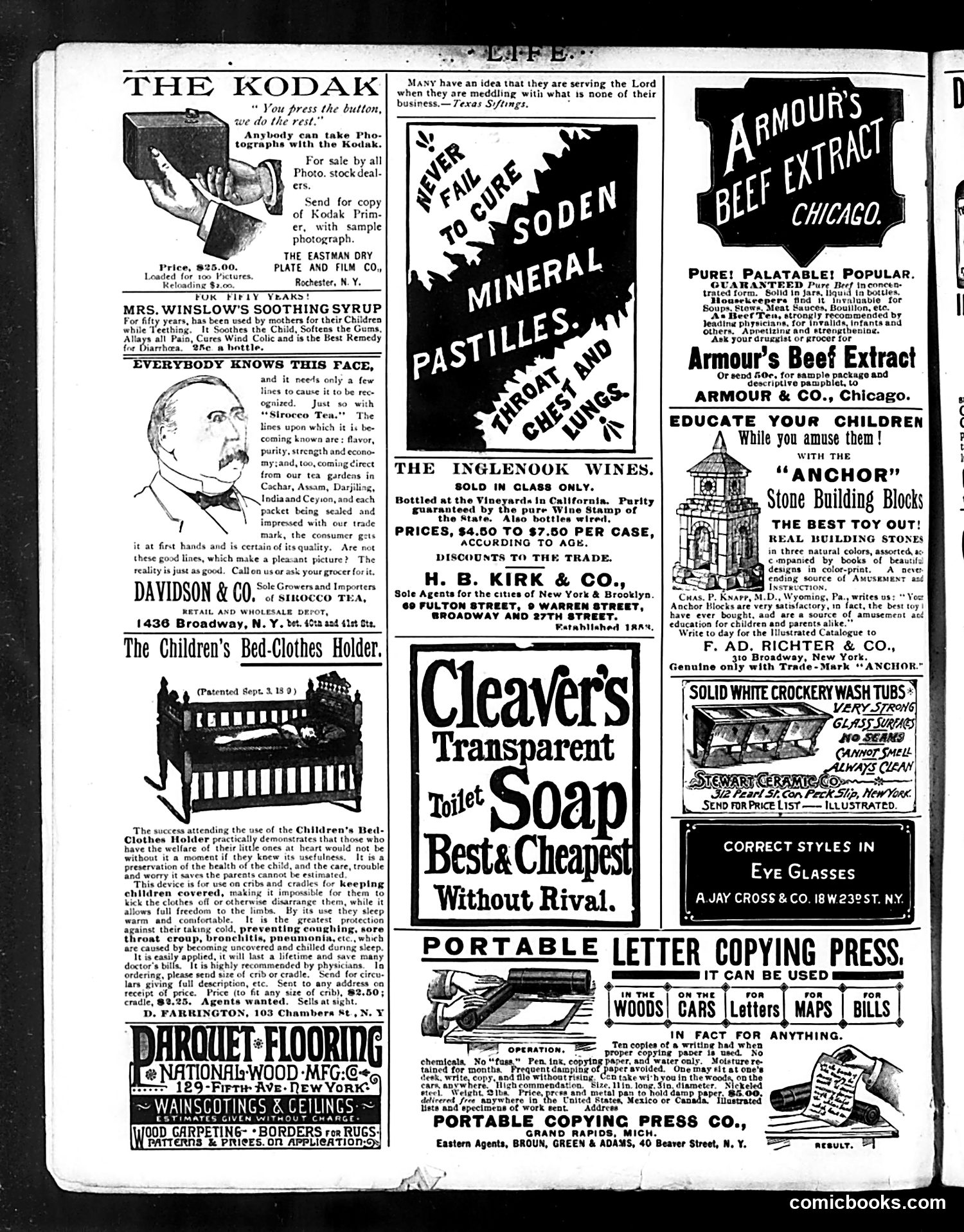
This is primarily an **advertising page** from Life magazine, not a political cartoon. The page contains various late-19th-century product advertisements with minimal satirical content. The most notable element is a **portrait caricature** accompanying Davidson & Co.'s Sirocco Tea advertisement. The accompanying text suggests the illustration represents a recognizable public figure, stating "Everybody knows this face"—implying a well-known person of the era. However, **the identity is not explicitly stated on the page**, so I cannot definitively name who is depicted. The advertisements themselves represent period consumer goods: Kodak cameras ("You press the button, we do the rest"), Mrs. Winslow's Soothing Syrup, tea, wine, beef extract, soap, building blocks, and furniture. These ads reflect late-Victorian commercial culture and marketing strategies, including health claims and testimonials common to the era. The page lacks overt political satire or commentary.
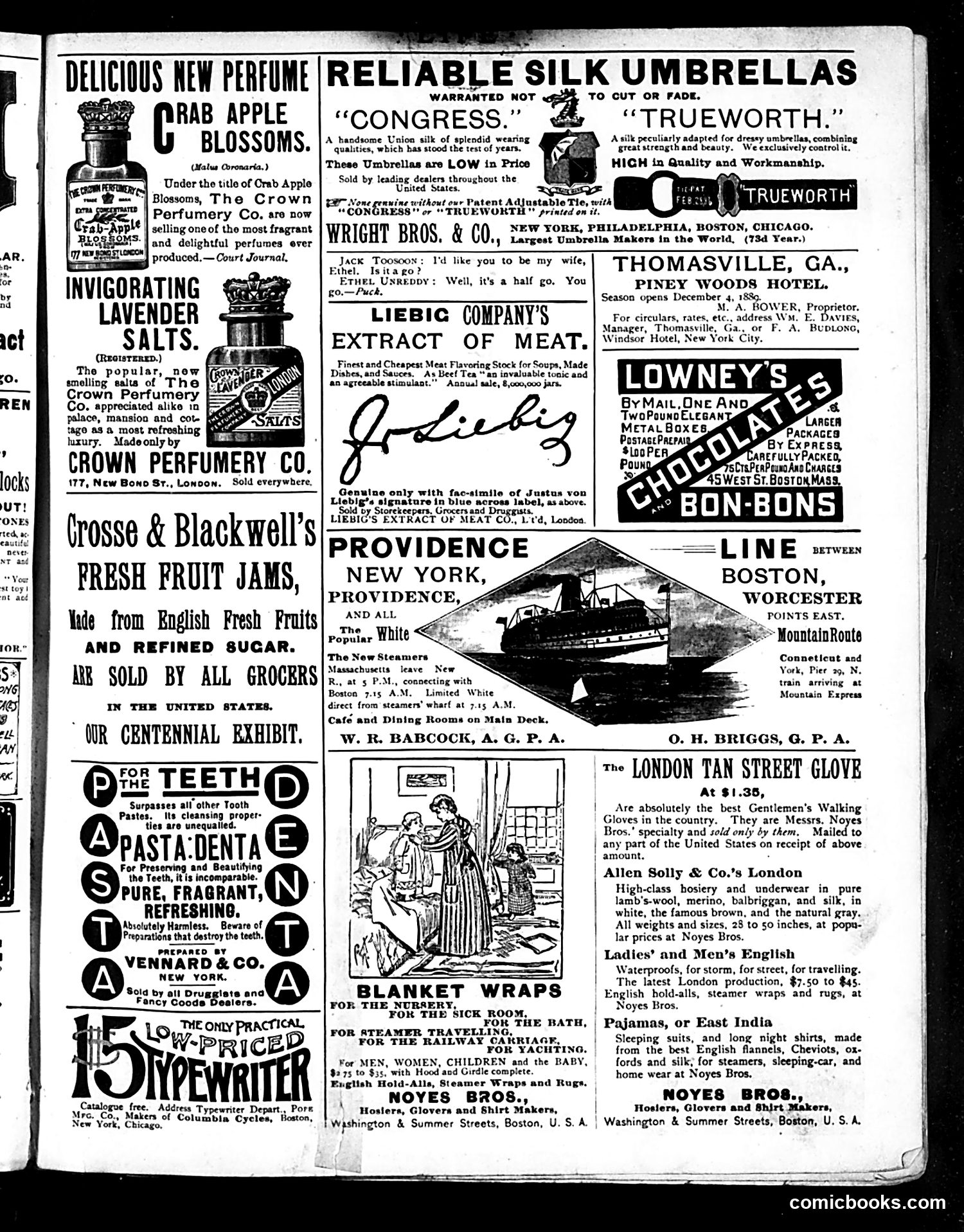
This page is primarily **advertising**, not editorial content or satire. It dates to the late 19th century (likely 1870s-1880s, given the "Centennial Exhibit" reference and typewriter advertisement). The only comic content is a brief **dialogue joke** between Jack Tooson and Ethel Usedby about marriage ("I'd like you to be my wife" / "Well, it's a half go"), which appears as filler amid umbrella advertising. The rest consists of product advertisements for luxury goods targeting affluent Americans and British customers: perfumes, jams, dental products, umbrellas, meat extract, steamship travel, blanket wraps, and clothing. The ads emphasize English/London origin and quality—typical of the period's cultural preference for British goods. There is **no political cartoon or satire** on this page. It functions as a commercial publication, with typography and layout designed to showcase multiple branded products rather than commentary.
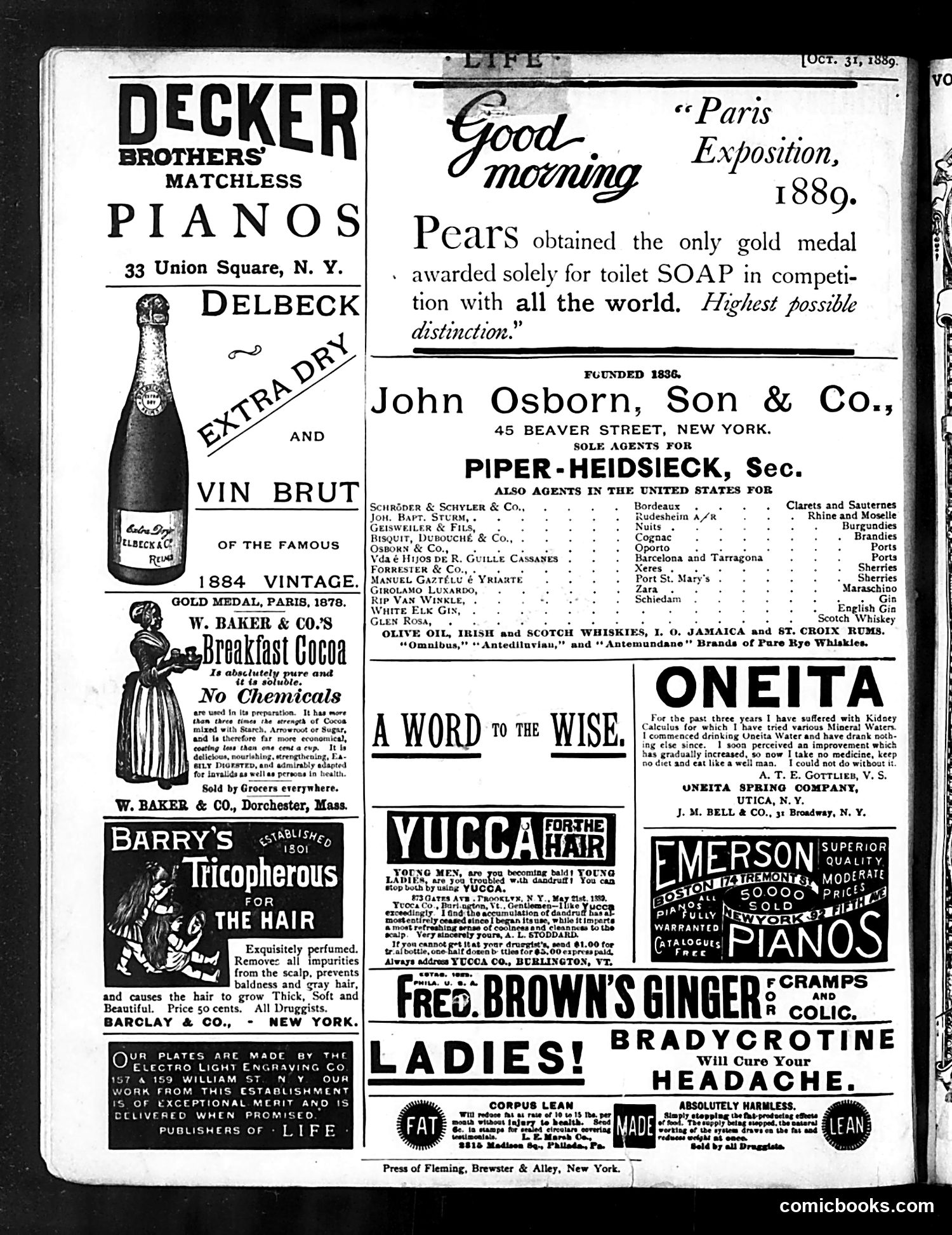
This is primarily an **advertising page** with no political cartoons. The content consists entirely of commercial advertisements typical of the late 1880s. Notable ads include: - **Pears Soap**: Boasts winning the only gold medal for toilet soap at the 1889 Paris Exposition—a marketing claim emphasizing product superiority through international competition. - **Patent medicines**: Barry's Tricopherous (hair growth), Bradycrotine (headaches), Fred. Brown's Ginger (cramps/colic)—reflecting the era's unregulated patent medicine industry. - **Luxury goods**: Decker pianos, Delbeck champagne, fine wines and spirits through John Osborn & Co. - **Breakfast Cocoa and other toiletries**: Standard period advertisements. The page reflects **Gilded Age consumer culture**: companies leveraged international expositions and dubious health claims to market products to middle/upper-class readers. The ads assume readers value European prestige, industrial advancement, and miraculous remedies.