
Life, 1889-10-31 · page 6 of 18
Life — October 31, 1889 — page 6: what you’re looking at
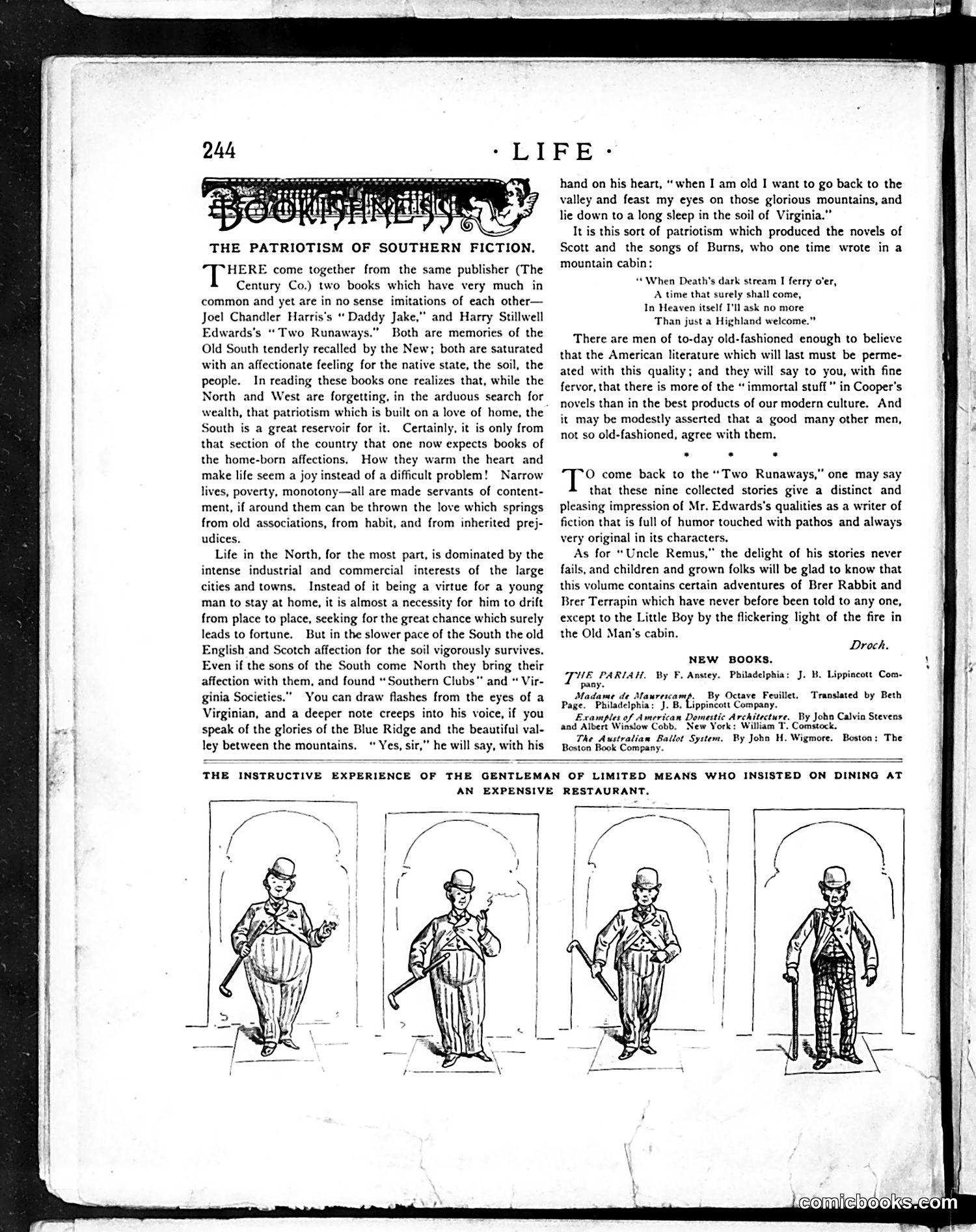
What you’re looking at
The lower section contains a four-panel cartoon titled "THE INSTRUCTIVE EXPERIENCE OF THE GENTLEMAN OF LIMITED MEANS WHO INSISTED ON DINING AT AN EXPENSIVE RESTAURANT." The satire depicts a poorly-dressed, thin man of modest means attempting to dine at an upscale establishment. Each panel shows him progressively undressing or revealing his shabby clothing beneath his outer coat—suggesting he lacks proper attire for fine dining. The humor derives from the social embarrassment of someone from a lower economic class attempting to access spaces reserved for the wealthy, exposing the gap between his aspirations and his actual means. This reflects turn-of-century class anxieties and the rigid social hierarchies of the era, mocking both the man's pretension and implicitly the exclusionary practices of expensive restaurants.
📄 Transcribed text from this page (OCR, searchable)
Machine-transcribed from the original scan — historical spelling and the odd misread are preserved.
- LIFE: THE PATRIOTISM OF SOUTHERN FICTION. “PPHERE come together from the same publisher (The Century Co.) two books which have very much in common and yet are in no sense imitations of each other— Joel Chandler Harris's “Daddy Jake," and Harry Stillwell Edwards's “Two Runaways.” Both are memories of the Old South tenderly recalled by the New; both are saturated with an affectionate feeling for the native state, the soil, the people. In reading these books one realizes that, while the North and West are forgetting, in the arduous search for wealth, that patriotism which is built on a love of home, the South is a great reservoir for it. Certainly, it is only from that section of the country that one now expects books of the home-born affections. How they warm the heart and make life seem a joy instead of a difficult problem! Narrow lives, poverty, monotony—all are made servants of content- ment, if around them can be thrown the love which springs from old associations, from habit, and from inherited prej- udices. Life in the North, for the most part, is dominated by the intense industrial and commercial interests of the large cities and towns, Instead of it being a virtue for a young man to stay at home, it is almost a necessity for him to drift from place to place, seeking for the great chance which surely leads to fortune. But in the slower pace of the South the old English and Scotch affection for the soil vigorously survives. Even if the sons of the South come North they bring their affection with them, and found “Southern Clubs” and “ Vir- ginia Societies.” You can draw flashes from the eyes of a Virginian, and a deeper note creeps into his voice, if you speak of the glories of the Blue Ridge and the beautiful val- ley between the mountains. “ Yes, sir," he will say, with his hand on his heart, “when I am old I want to go back to the valley and feast my eyes on those glorious mountains, and lie down to a long sleep in the soil of Virginia.” It is this sort of patriotism which produced the novels of Scott and the songs of Burns, who one time wrote in a mountain cabin: “When Death's dark stream I ferry o'er, A time that surely shall come, In Heaven itself I'll ask no more Than just a Highland welcome.” There are men of to-day old-fashioned enough to believe that the American literature which will last must be perme- ated with this quality; and they will say to you, with fine fervor, that there is more of the “immortal stuff" in Cooper's novels than in the best products of our modern culture. And it may be modestly asserted that a good many other men, not so old-fashioned, agree with them. O come back to the “Two Runaways,” one may say that these nine collected stories give a distinct and pleasing impression of Mr. Edwards's qualities as a writer of fiction that is full of humor touched with pathos and always very original in its characters, As for “Uncle Remus,” the delight of his stories never fails, and children and grown folks will be glad to know that this volume contains certain adventures of Brer Rabbit and Brer Terrapin which have never before been told to any one, except to the Little Boy by the flickering light of the fire in the Old Man's cabin. Droch. NEW BOOKS. TUE PARIAH. By F. Anstey. Philadelphia: J, B. Lippincott Com- pany. Madame de Maurescamp. By Octave Feuillet. Page. Philadelphia: J. B. Lippincott Company. Examples of American Domestic Architecture. By John Calvin Stevens and Albert Winslow Cobb. New York: William T. Comstock. The Australian Ballot System. By John H. Wigmore. Boston Book Company. Translated by Beth Boston: The THE INSTRUCTIVE EXPERIENCE OF THE GENTLEMAN OF LIMITED MEANS WHO INSISTED ON DINING AT AN EXPENSIVE RESTAURANT.