
A complete issue · 18 pages · 1889
Life — October 24, 1889
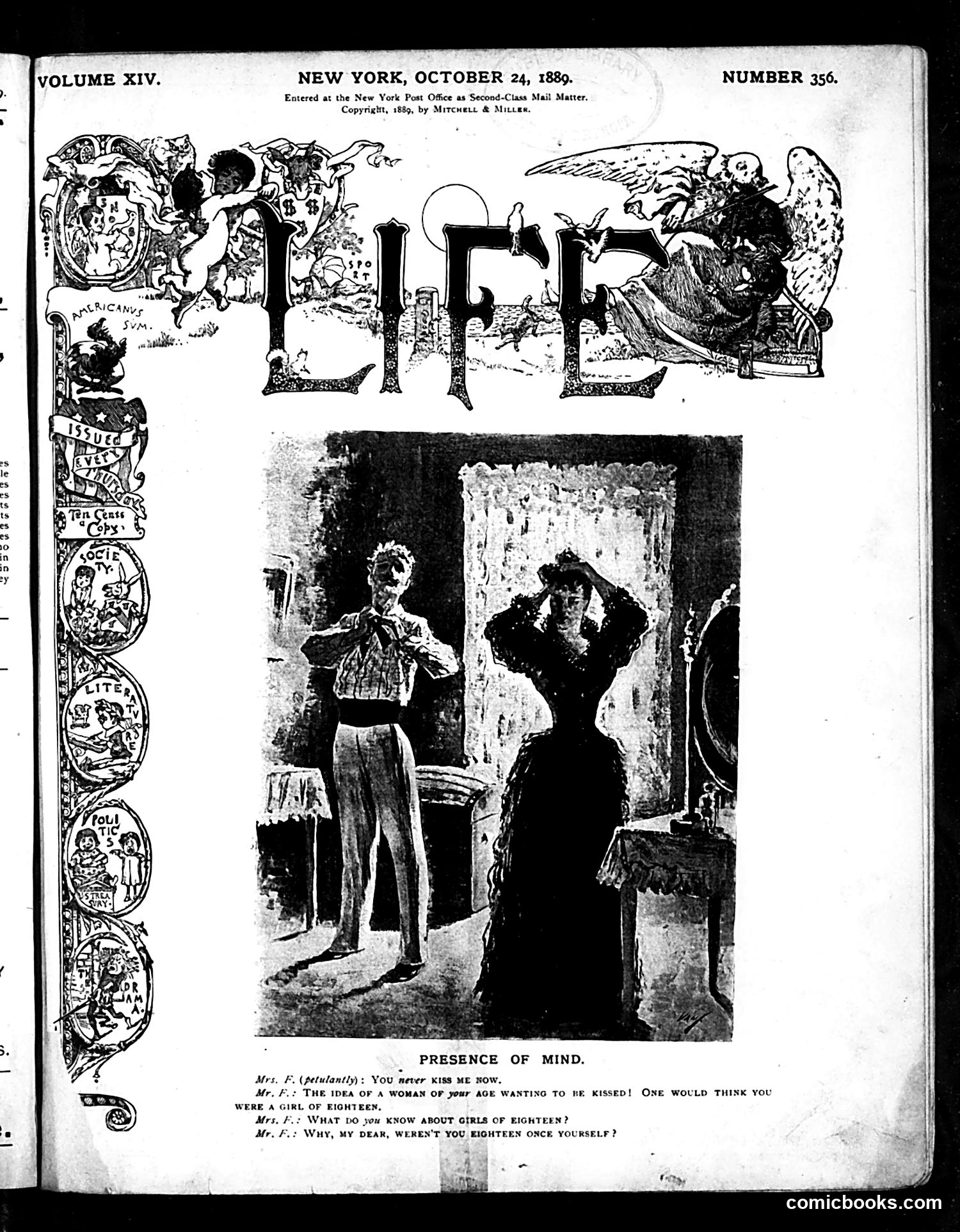
This cartoon satirizes gender relations and courtship norms of the 1880s. The dialogue depicts a couple where the man (Mr. F.) attempts to kiss an older woman (Mrs. F.), who rejects him by claiming she's too old. He responds sarcastically that a woman her age shouldn't want kisses—suggesting that wanting romantic affection at her age is ridiculous. The humor targets Victorian-era attitudes about aging women and sexuality. The caption "Presence of Mind" ironically praises her quick comeback, though the real satire critiques the man's condescending assumptions about women's desires diminishing with age. The exchange exposes the double standards and awkward social dynamics surrounding courtship in this period.
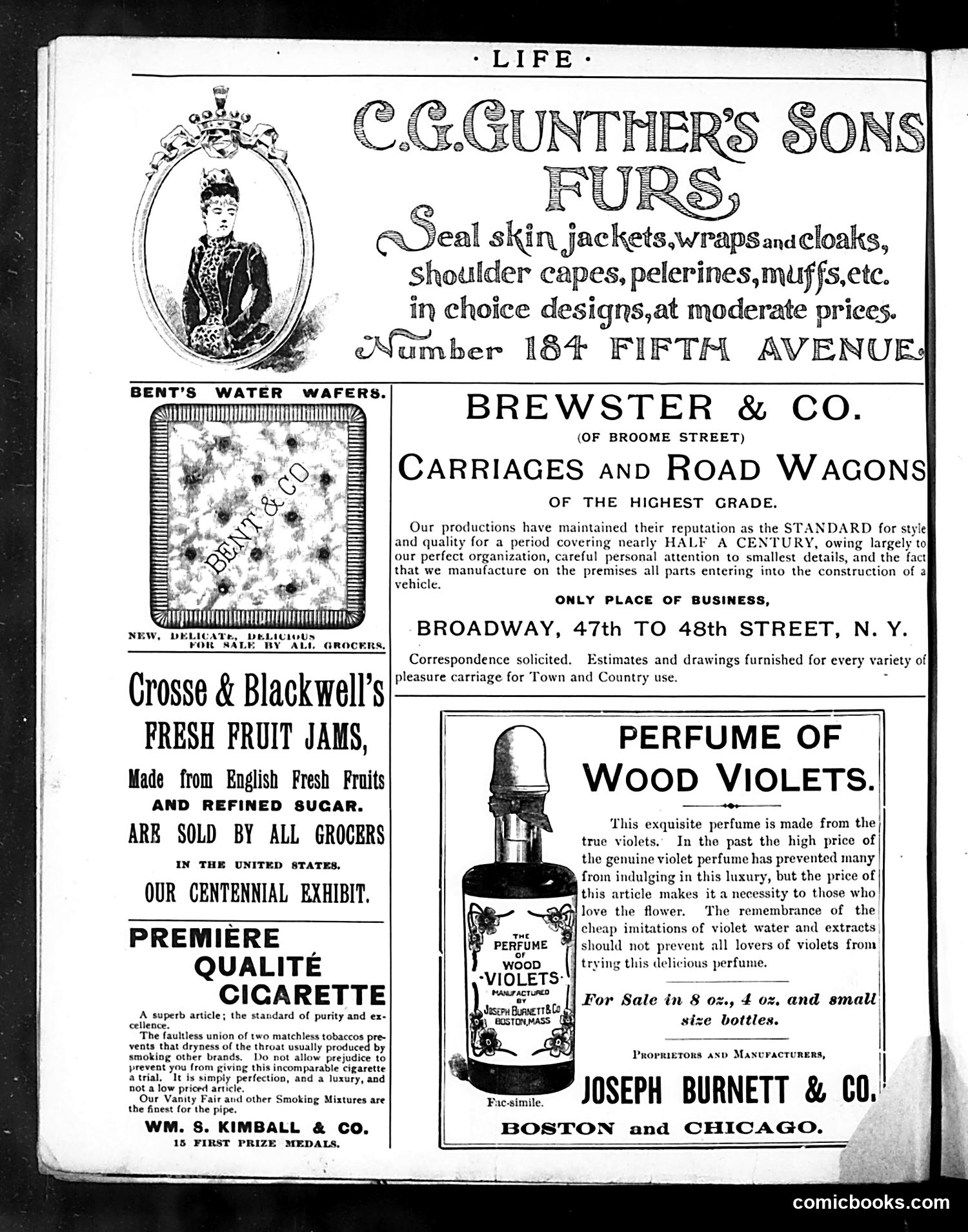
This page is **primarily advertisements** with no political cartoons or satirical content visible. The ads include: - **C.G. Gunther's Sons Furs** (top): Seal skin jackets and capes at Fifth Avenue - **Bent's Water Wafers**: A food product sold by grocers - **Crosse & Blackwell's Jam**: English preserves marketed nationwide - **Premiere Qualité Cigarette** by Wm. S. Kimball & Co.: Claims purity and throat comfort - **Brewster & Co.**: High-end carriages and wagons on Broadway - **Joseph Burnett & Co.**: Perfume of Wood Violets from Boston and Chicago The single illustrated element is a **portrait of a fashionable woman** (top left), likely advertising Gunther's furs as a luxury item for wealthy consumers. This reflects late 19th/early 20th-century *Life* magazine's mixture of satirical editorial content with upscale advertising.
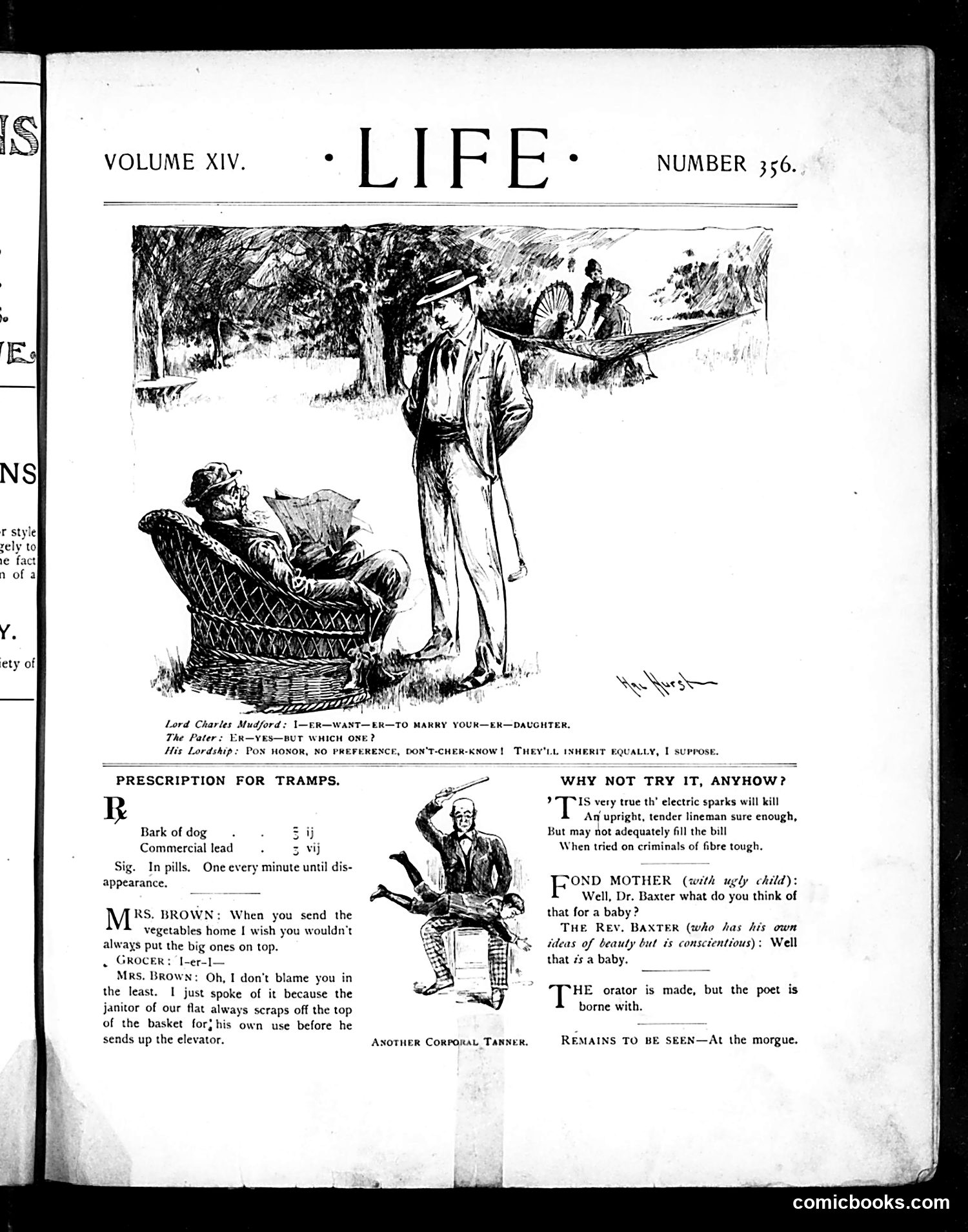
The main cartoon depicts a wealthy man in a suit confronting a seated elderly woman, likely his mother, about her choice of heir. The caption indicates "Lord Charles Medford" asking his father which heir will inherit the estate. The satire targets inheritance disputes and family tensions over wealth—a common theme in early 20th-century literature and high society. Below are brief humorous anecdotes ("Prescription for Tramps," exchanges between Mrs. Brown and a grocer about vegetable placement, and witty one-liners) typical of Life's satirical format. The page represents genteel, class-conscious humor aimed at educated readers familiar with domestic servants, inheritance law, and upper-class pretensions.
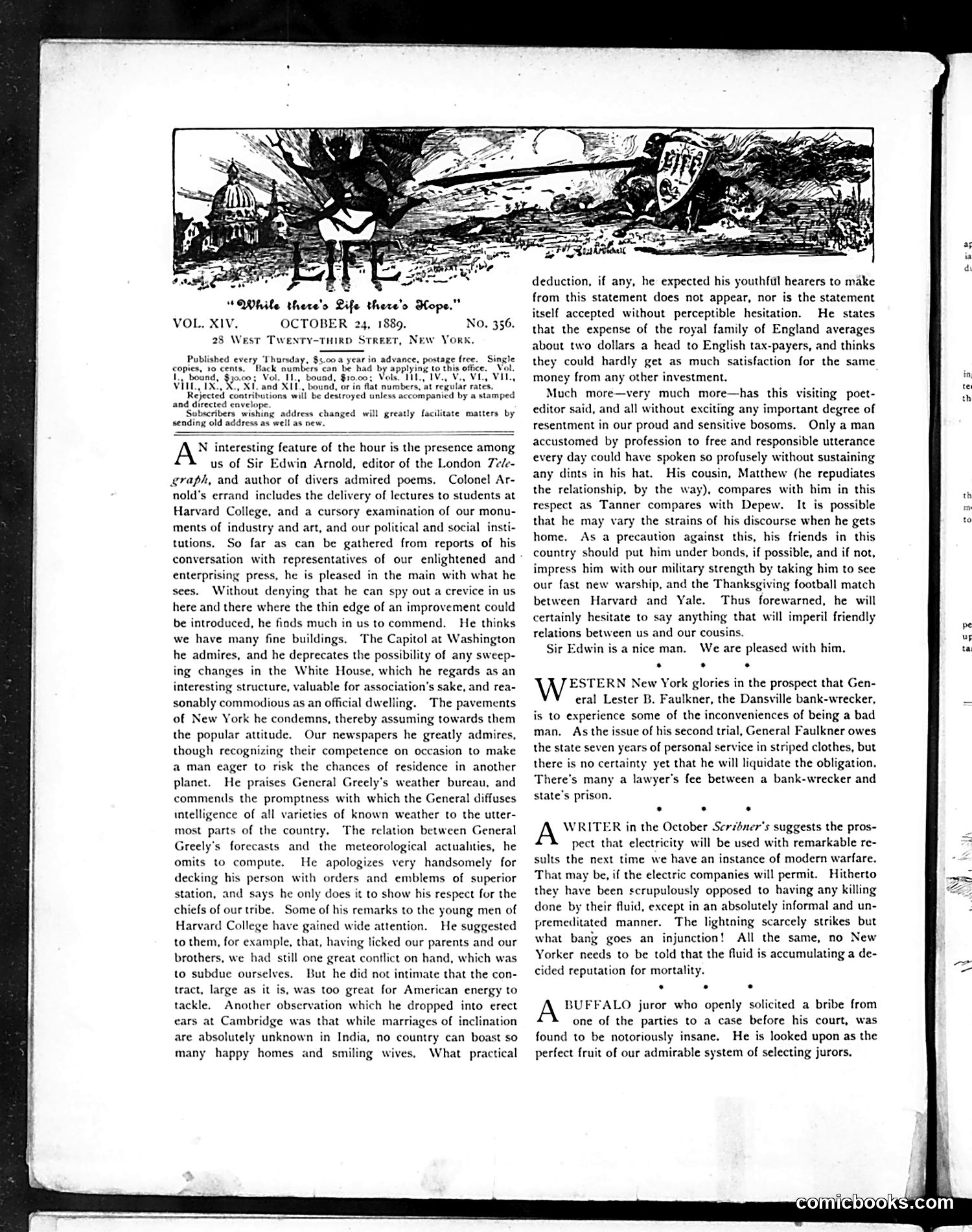
The masthead cartoon depicts a nighttime scene with a crescent moon and figures gathered beneath a large tree—likely illustrating the magazine's title "While there's Life there's Hope." The page contains social commentary rather than political cartoons. It discusses Colonel Edwin Arnold, editor of the London Telegraph and admired poet, visiting America. The text praises his observations about American institutions (Harvard, the Capitol, White House) while gently mocking his critical remarks about American pavement quality and weather forecasting. Additional brief items satirize General Lester Faulkner (a bank-wrecker facing consequences), electricity's potential in future warfare, and a Buffalo juror deemed "notoriously insane"—described as perfect proof of America's jury-selection system, clearly meant as ironic social criticism of the judicial process.
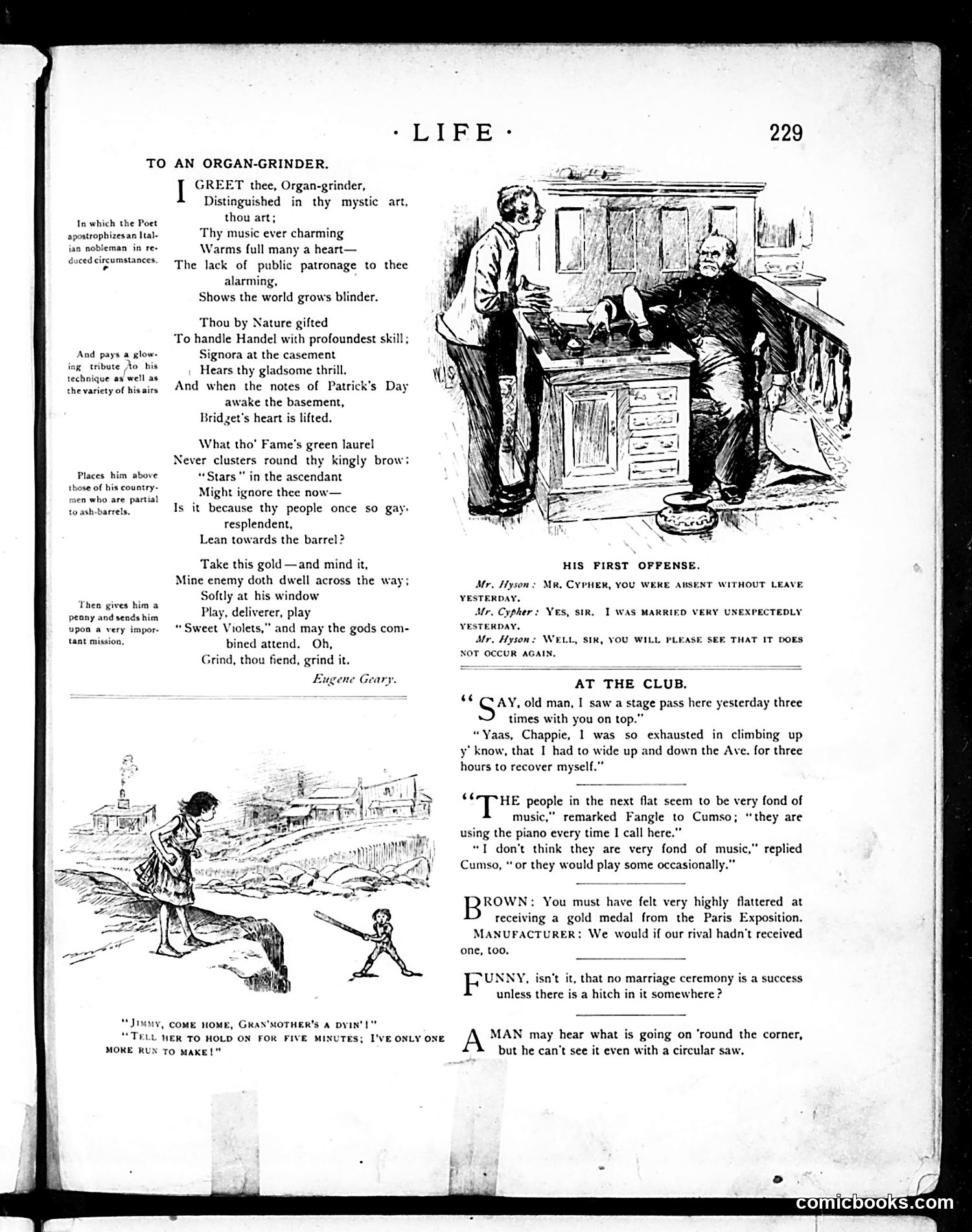
This page contains three distinct sections: 1. **"To an Organ-Grinder"** (left): A poem by Eugène Goray praising a street musician's skill, particularly his ability to play Handel and charm audiences. References "Patrick's Day" and "Bridget's heart," suggesting Irish immigrant themes common in late 19th-century American satire. 2. **"His First Offense"** (top right): A sketch showing a domestic dispute where a husband admits to coming home without leave. The joke mocks marital authority and a wife's control over her husband's whereabouts—typical Victorian-era humor. 3. **"At the Club"** (bottom right): Brief humorous exchanges about neighbors playing piano constantly, receiving medals, and absurdist observations about marriage and circular saws—light social satire on urban domestic life and pretension. The overall tone targets working and middle-class social behaviors.
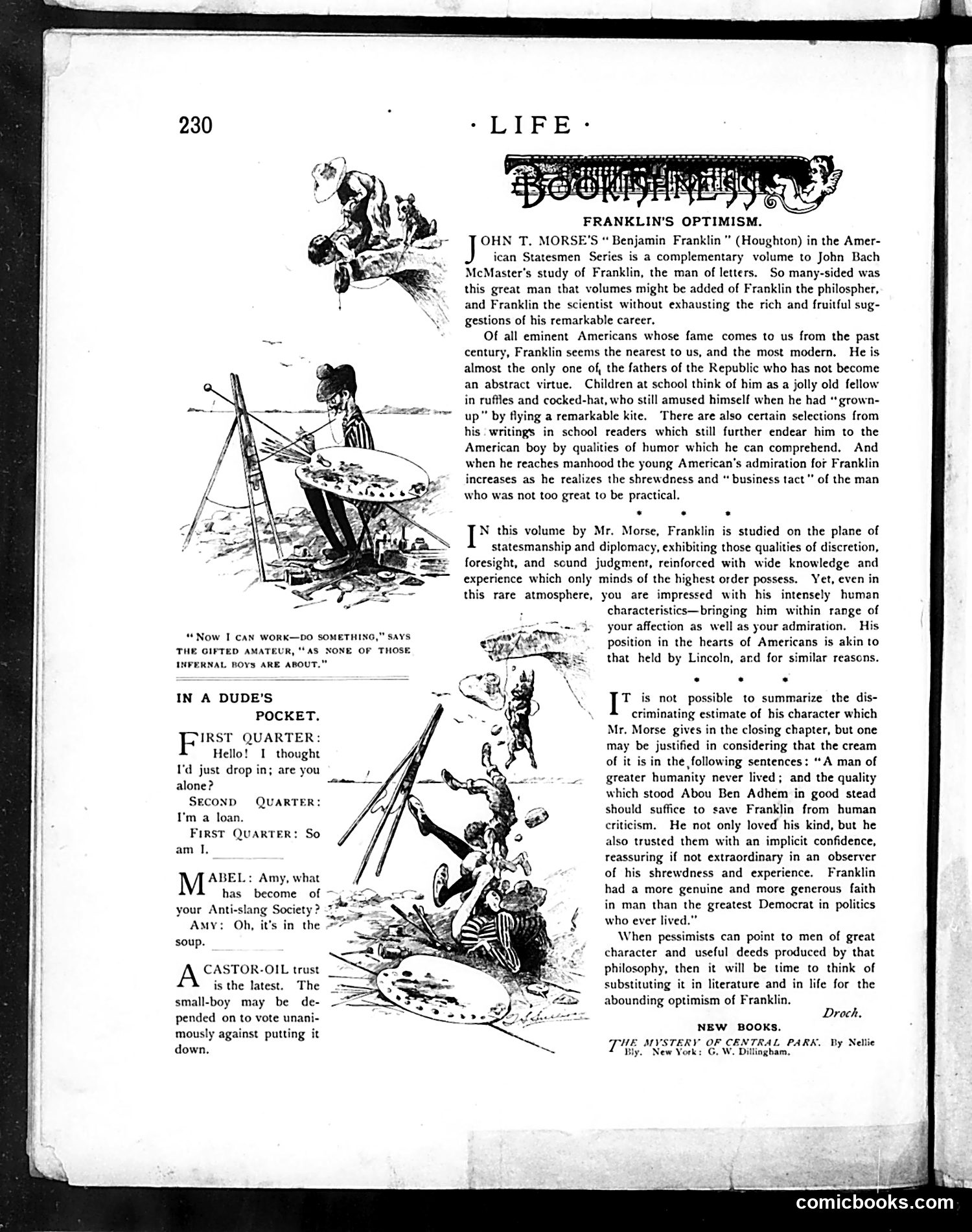
This Life magazine page combines a book review with humor content. The main feature reviews John T. Morse's "Benjamin Franklin" from the American Statesmen Series, praising Franklin as uniquely relatable among historical figures—a founding father who remained practical and humorous rather than becoming an abstract virtue. The review emphasizes Franklin's character and his appeal to American boys. Below is a separate comic sketch titled "In a Dude's Pocket," showing dialogue between characters discussing a loan and the Anti-Saloon Society. The accompanying illustrations depict figures in casual poses with period clothing and accessories, likely satirizing social types or fashionable society figures of the era, though the specific satirical target isn't entirely clear from this excerpt alone.
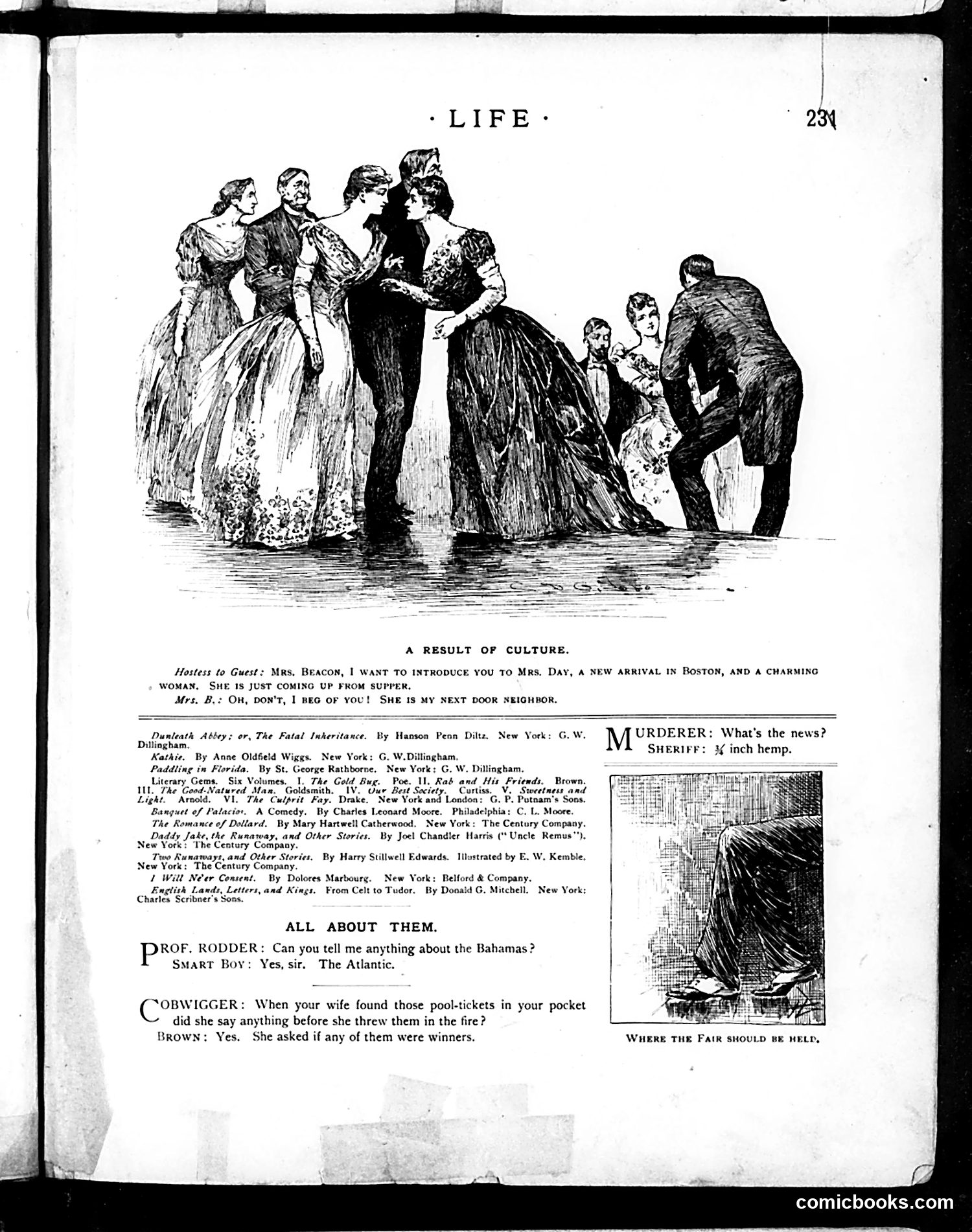
This satirical cartoon depicts a social embarrassment: a proper Boston hostess (Mrs. Beacon) introduces a newly arrived woman (Mrs. Day) to her guests, but the newcomer is still wearing her outdoor coat and hat—appearing unkempt among the formally dressed company. The caption's dialogue reveals the joke: Mrs. Day has just arrived "from supper," suggesting she came directly from a casual meal without properly preparing herself for polite society. The satire mocks nouveau riche or socially awkward individuals who lack cultural refinement and proper etiquette. "Culture" here means the social graces and dress codes expected of respectable society. The cartoon suggests that some people, despite their wealth or status, cannot master the unwritten rules of upper-class presentation—a common *Life* magazine theme critiquing American social pretension and class anxiety during the Gilded Age.
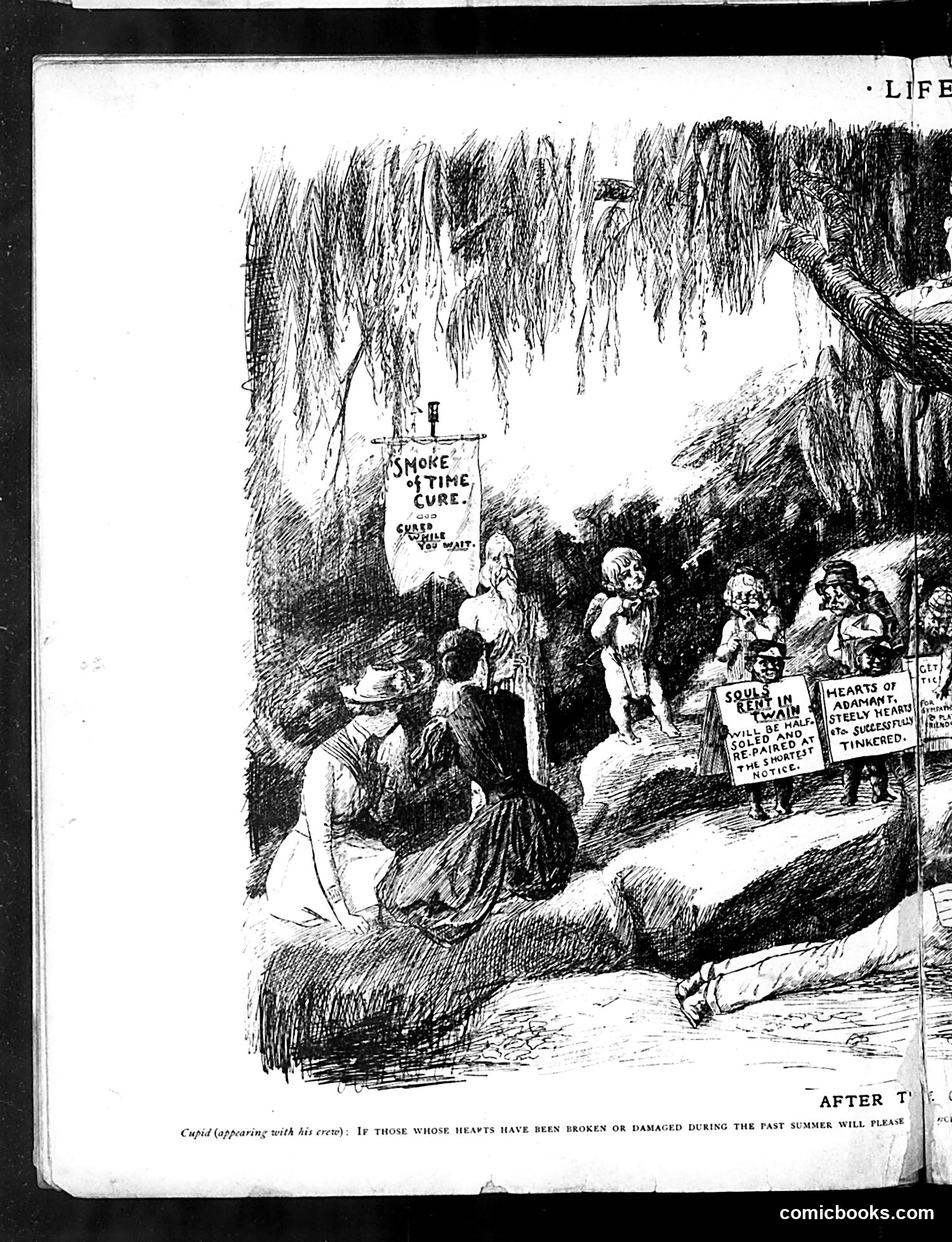
This appears to be a post-WWI satirical cartoon depicting a memorial or gathering beneath a weeping willow tree. A sign reads "SMOKE of TIME / CURLS / SURE / FOR WAIT," though the meaning is unclear from the OCR. The central figure appears to be Cupid (labeled in the visible text), surrounded by mourning figures. Several signs visible on the right reference broken or damaged hearts from "the past summer," suggesting romantic casualties. The satire likely mocks post-war disillusionment—perhaps commenting on how quickly wartime sacrifices were forgotten, or how romantic ideals were shattered by reality. The weeping willow and mourning poses reinforce themes of loss, while the somewhat absurdist signage suggests the inadequacy of commemorating such damage with mere words or gestures. The specific historical context remains partially unclear from this single page.
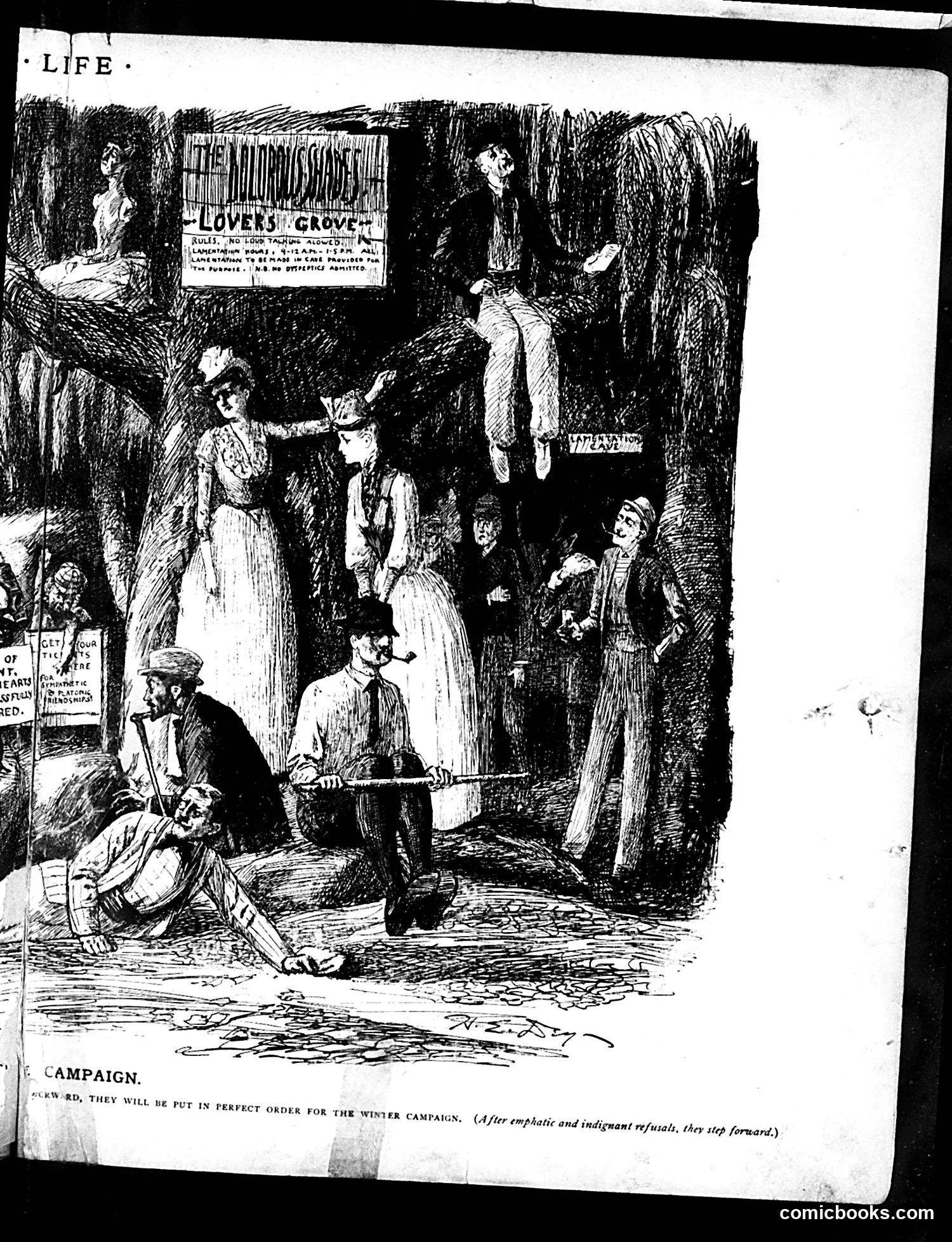
This satirical cartoon depicts a political campaign scene set in a wooded area labeled "Lovers' Grove." The caption states figures "will be put in perfect order for the winter campaign" with emphasis on "emphatic and indignant refusal, they step forward." The cartoon shows various people in period dress gathered around what appears to be a political rally or organizing effort. A campaign sign for "Lovers' Grove" is visible. The satire appears to target political organizing tactics—specifically how political parties recruited or coerced supporters, treating them like military units being "put in perfect order." Without additional context about the specific historical period or publication date, the exact political figures and campaign being mocked remain unclear, though the imagery suggests turn-of-the-century American political mobilization.
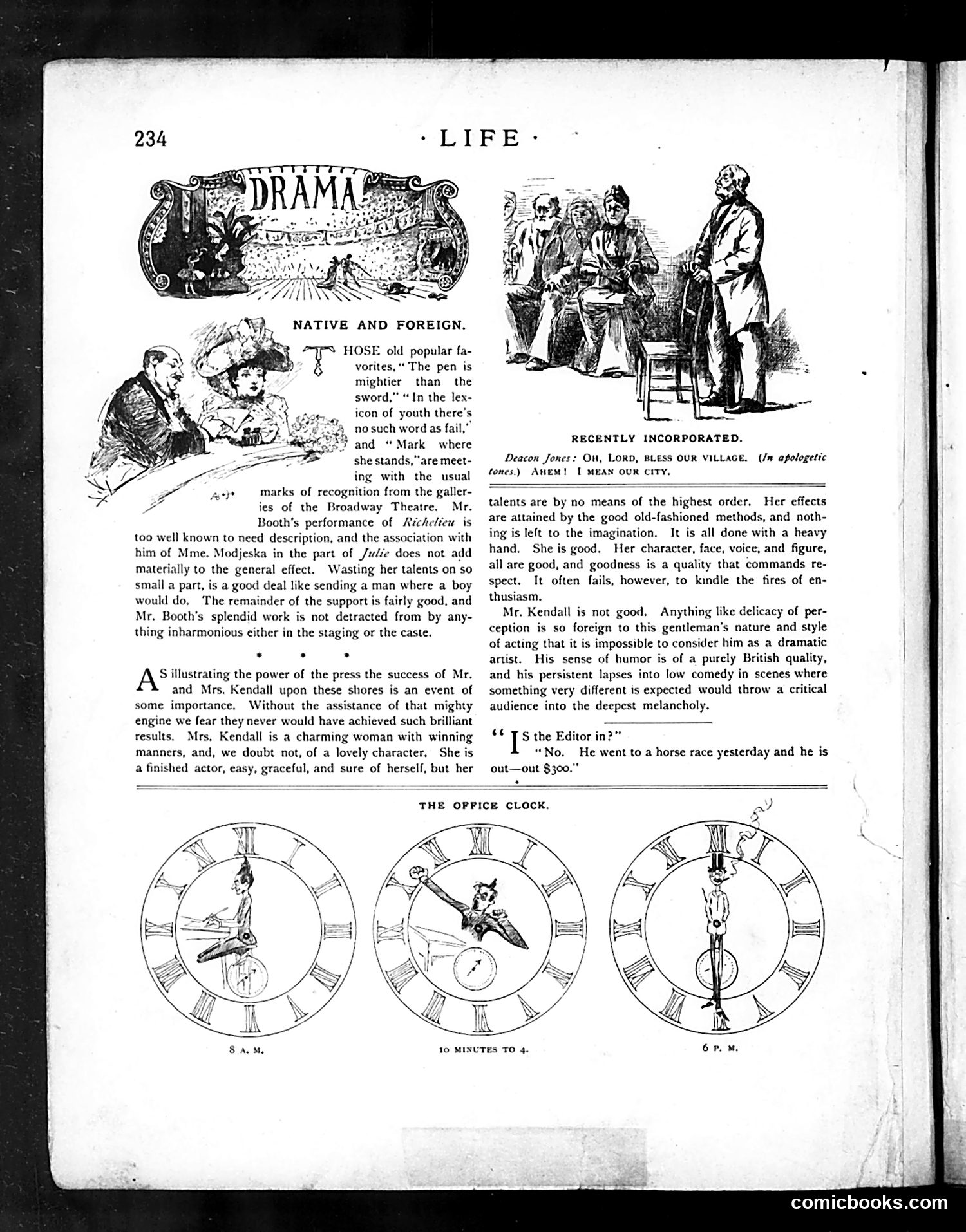
This page critiques theatrical performances, likely from early 1900s Broadway. The "Drama" section reviews actors in contemporary productions: **Mrs. Kendall** receives praise for her "charming" performance and natural grace, though the critic notes her talents are "not of the highest order" and rely on old-fashioned methods rather than innovation. **Mr. Kendall** is criticized for his "purely British quality" and reliance on low comedy—his humor is dismissed as failing to elevate audiences intellectually. The page also includes a humorous anecdote about an editor attending a horse race and losing $300. "The Office Clock" illustrations below are a visual joke showing the passage of time during a workday (8 A.M. to 6 P.M.), likely satirizing office culture and the tedium of professional work.
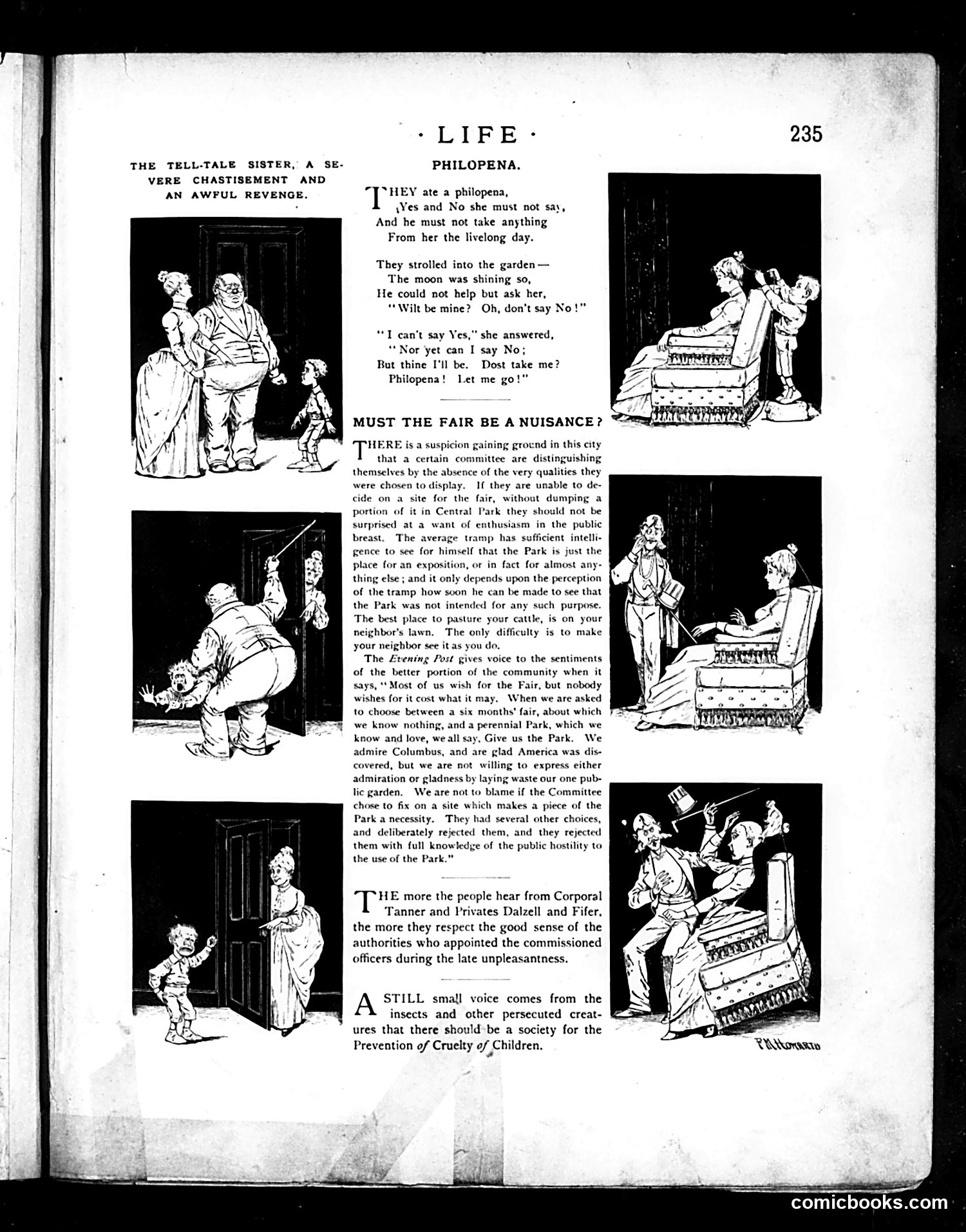
This page satirizes a public controversy over a proposed fair's location in Central Park. The left-side illustrations mock those opposing the fair—depicting what appear to be wealthy or influential citizens being ejected or removed, suggesting they're hypocritically trying to prevent public use of the park. The main text defends the fair's placement, arguing that critics claiming to love Columbus and America are actually just protecting their own neighborhood interests. It contrasts their stated principles with selfish behavior. The right-side vignettes (signed by the artist) appear to show domestic scenes, possibly illustrating the "nuisance" theme of the opposition's complaints. A final note advocates for child protection societies, shifting tone to a more earnest social concern. The overall message: the park belongs to the public, not elite gatekeepers.
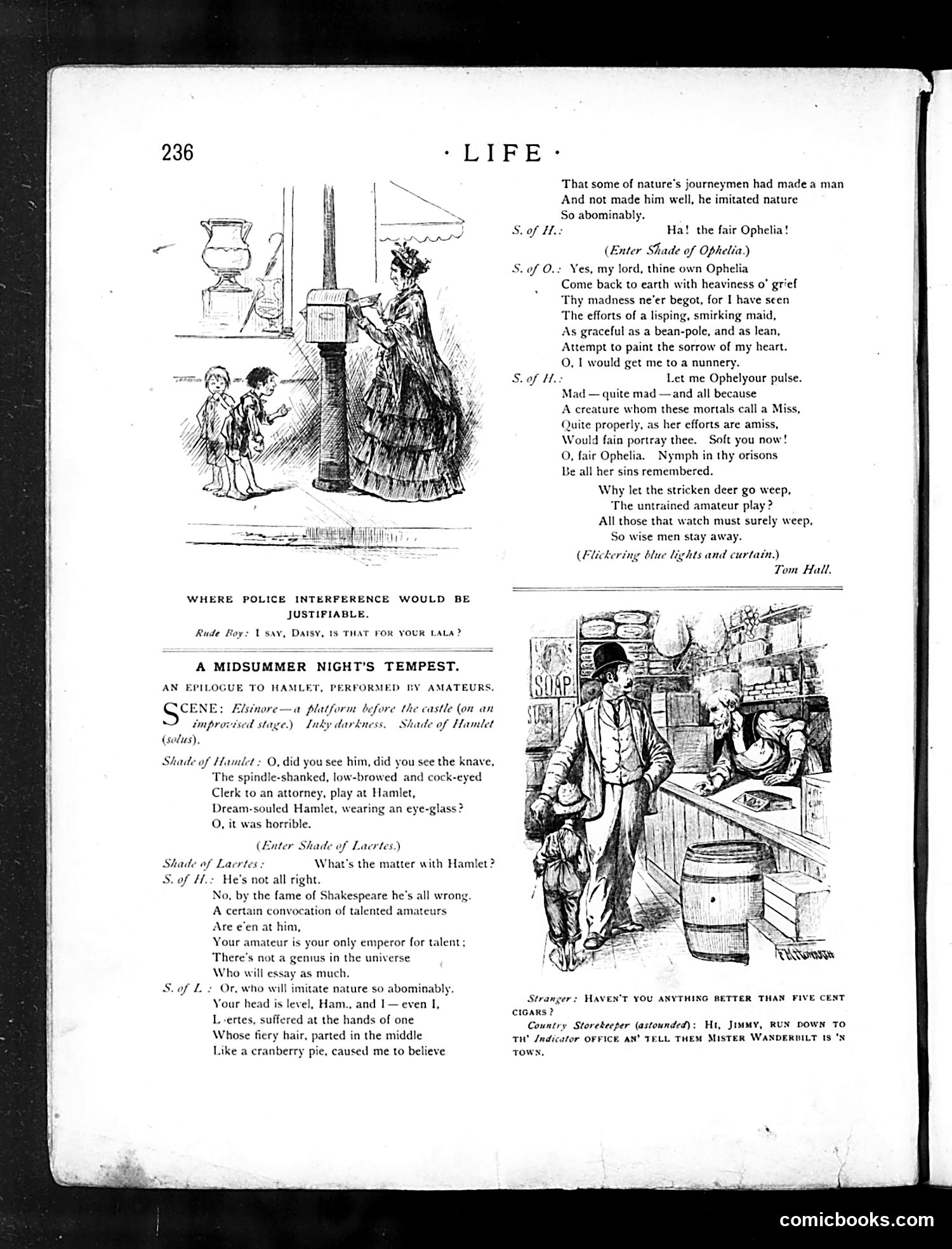
This page contains two satirical pieces mocking amateur theatrical performances: **Main cartoon**: "A Midsummer Night's Tempest" is a parody epilogue to *Hamlet* where the ghost of Hamlet complains about a terrible amateur production he witnessed. The joke targets incompetent amateur actors—specifically a "spindle-shanked, low-browed and cock-eyed / Clerk to an attorney" attempting to play Hamlet while wearing an eye-glass. The satire ridicules how amateur performers butcher Shakespeare, with the ghost of Laertes describing an actress playing Ophelia as "lisping, smirking" and "graceful as a bean-pole." **Top illustration** (unlabeled): Shows what appears to be a woman in elaborate dress confronting children, captioned "Where Police Interference Would Be Justifiable"—likely mocking overzealous amateur performances or theatrical pomposity. **Bottom illustration**: A separate scene in a country store, unrelated to the theatrical satire above. The core joke: amateur theater is so bad that even the dead complain about it, and audiences should stay away.
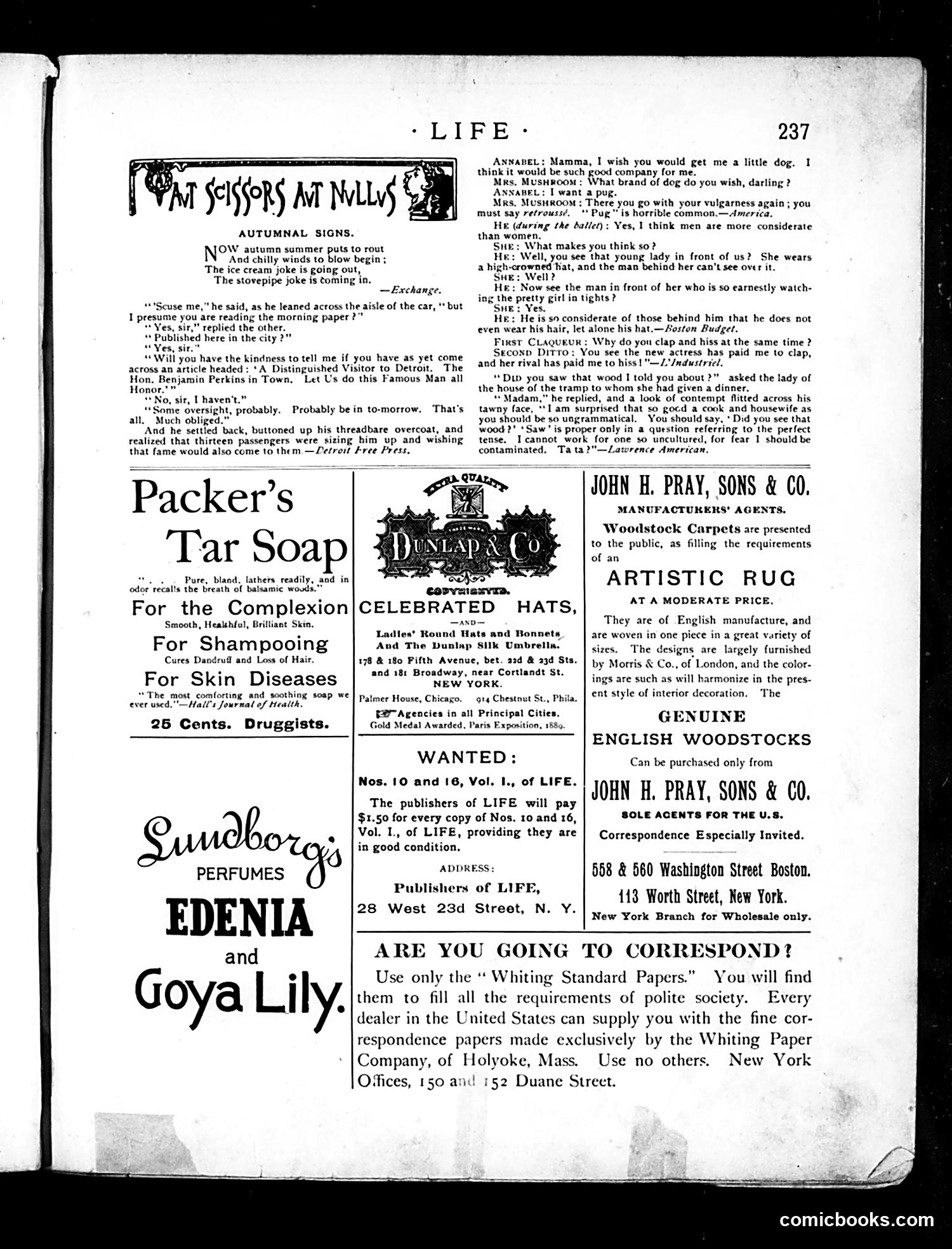
This page from Life magazine (a 19th-century American humor publication) contains multiple brief comedic sketches mocking social pretension and absurdity. The main cartoon, "At Scissors at Nulls," depicts a man embarrassedly discovering that "Benjamin Perkins," whom he hoped was a famous visitor warranting newspaper coverage, is actually himself—a nobody. The joke satirizes social vanity and the human desire for recognition. Other sketches include commentary on fashion snobbery (a mother correcting her daughter's use of "pug" instead of the French "retroussé"), theater etiquette (a bald man considerate enough not to wear a hat blocking others' views), and pretension (a tramp correcting his benefactor's grammar, then refusing employment due to her "unculture"). The page also contains period advertisements for products like Packer's Tar Soap and Lundborg Perfumes, along with a notice that Life seeks back issues for purchase. The overall tone reflects Life's signature style: mocking middle-class affectation and social climbing through gentle, observational humor.
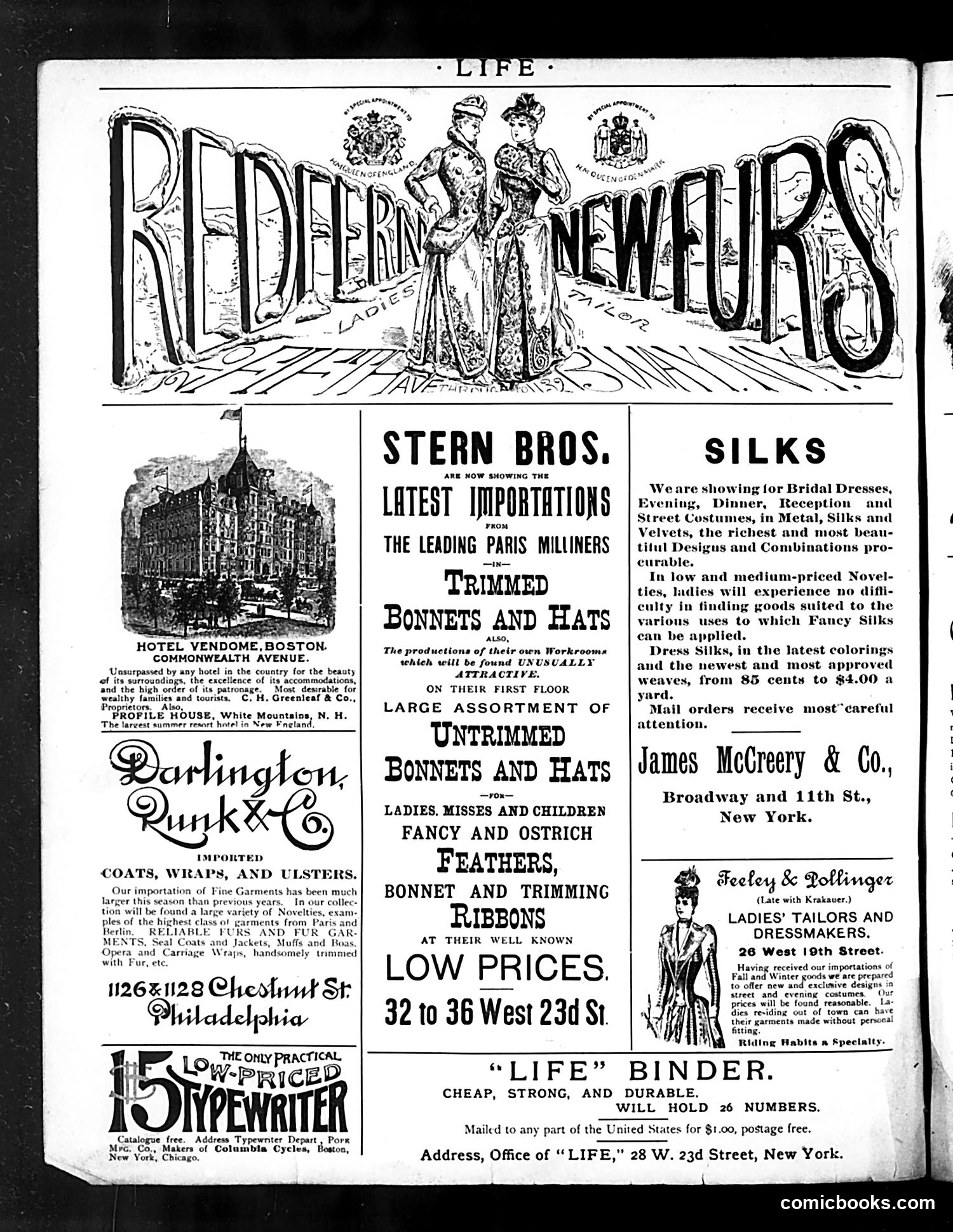
This is **primarily a advertisements page**, not a satirical cartoon. The page features commercial advertisements for late-19th-century retailers, predominantly focused on women's fashion and accessories. The large header "BIDDERN NEWFURS" at the top is decorative advertising copy showing two fashionably dressed women, illustrating the era's high-fashion silhouettes. Below are advertisements for: - **Stern Bros.** (bonnets, hats, feathers, ribbons) - **James McCreery & Co.** (silks for bridal and evening wear) - **Feeley & Pollinger** (ladies' tailors and dressmakers) - **Burlington, Runk & Co.** (imported coats and furs in Philadelphia) - Various hotels and a typewriter manufacturer The page reflects **Gilded Age consumer culture** targeting wealthy women—advertising imported Parisian fashions, elaborate bonnets with ostrich feathers, and luxury fabrics. There is **no apparent political satire or joke**; this is a straightforward commercial publication page typical of Life's mixed editorial and advertising content.
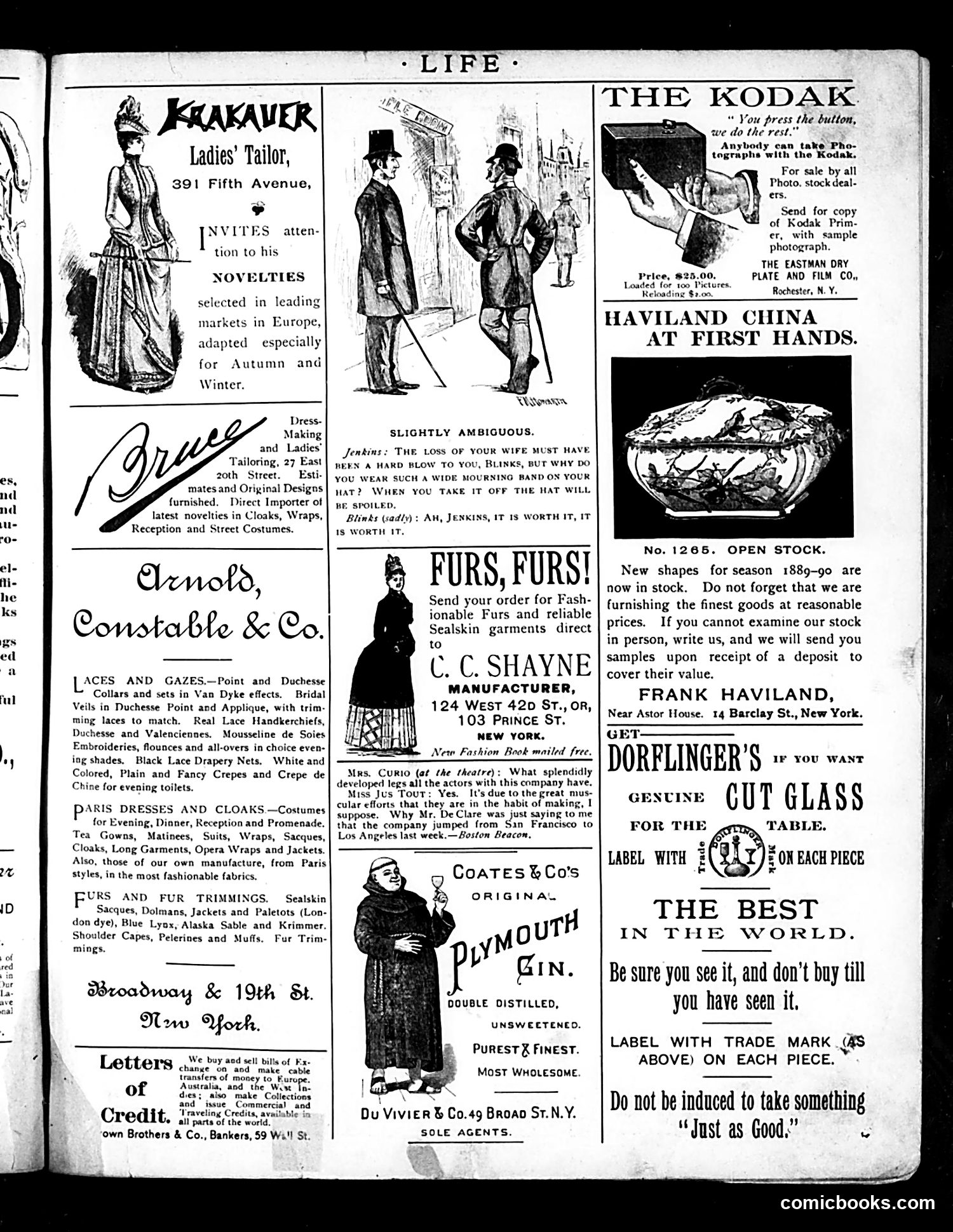
This page is primarily **advertisements** for late-19th-century luxury goods, with two brief satirical cartoons embedded among them. **The cartoons:** 1. **"Slightly Ambiguous"** shows two men discussing a third man's unusually wide mourning band on his hat. The joke: Blinks wears an excessive mourning band for his deceased wife, and when Jenkins points out it will ruin the hat when removed, Blinks replies it's "worth it"—suggesting he's more concerned with *appearing* bereaved than actually grieving, or that he's cheaply trying to get wear from a hat he'd otherwise discard. It's satirizing performative mourning and practical hypocrisy. 2. The second cartoon (unmarked) shows theater-goers discussing actors' "splendidly developed legs," which the responder attributes to their "muscular efforts" and theatrical jumps—a euphemistic joke obscuring that the real reason is simply their stage costumes and positioning. **The advertisements** showcase wealthy consumer culture: imported French fashions, furs, fine china, cut glass, and the new Kodak camera (revolutionary for enabling amateur photography).
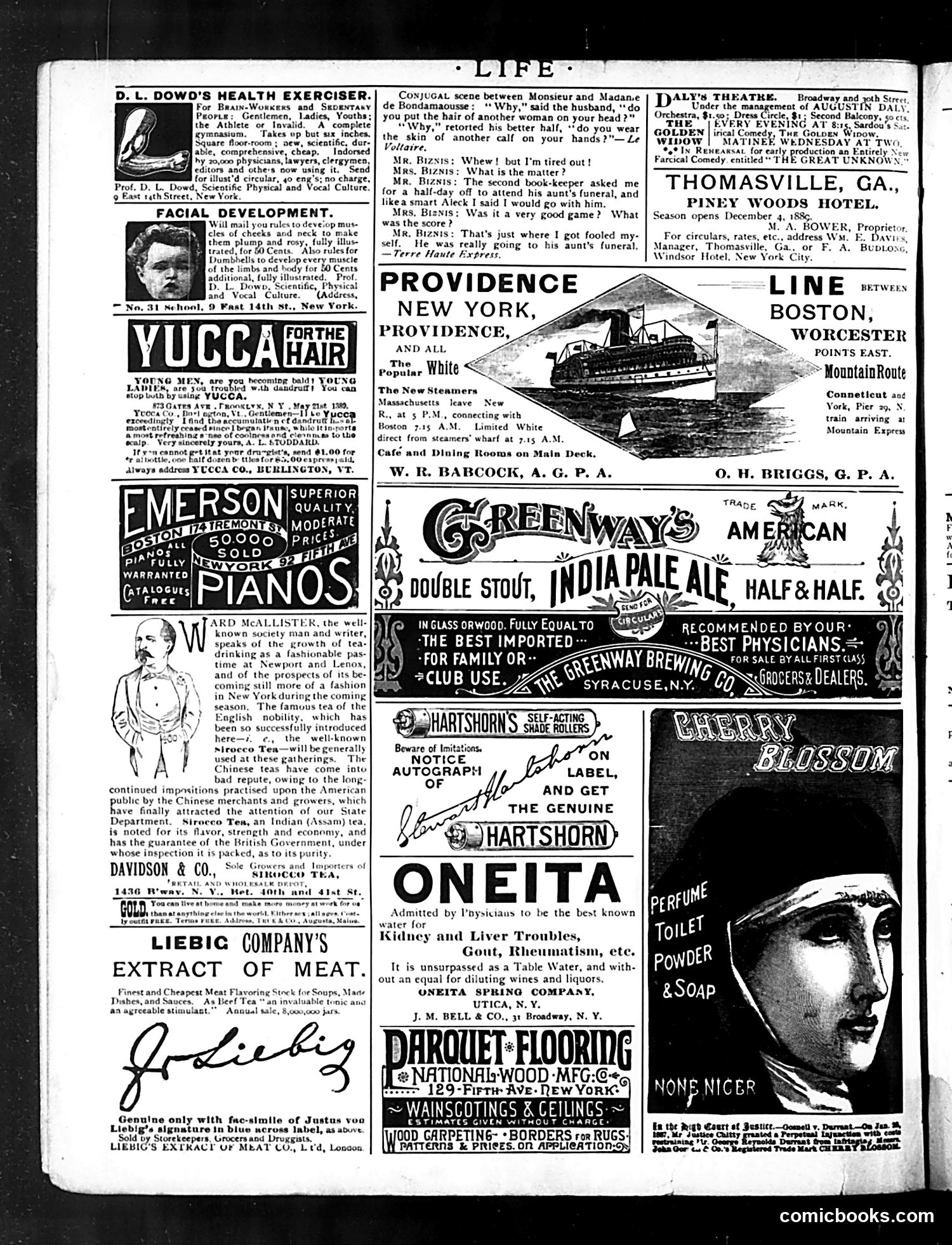
This page is primarily **advertising** rather than editorial content or political satire. It consists of product and service advertisements from the 1880s. The few brief humorous items are light domestic humor rather than satire: - A conjugal joke from *Le Voltaire* about a husband questioning his wife's hairpiece while wearing a calf-skin glove—wordplay on hypocrisy - A comedic anecdote about a businessman tricked into attending what he thought was a baseball game but was actually a funeral The advertisements themselves reflect **period concerns**: health exercisers and facial development products (reflecting anxiety about physical appearance), tea-drinking as fashionable society practice, and various patent medicines. These reveal contemporary values but contain no political message or satire worthy of extended explanation.
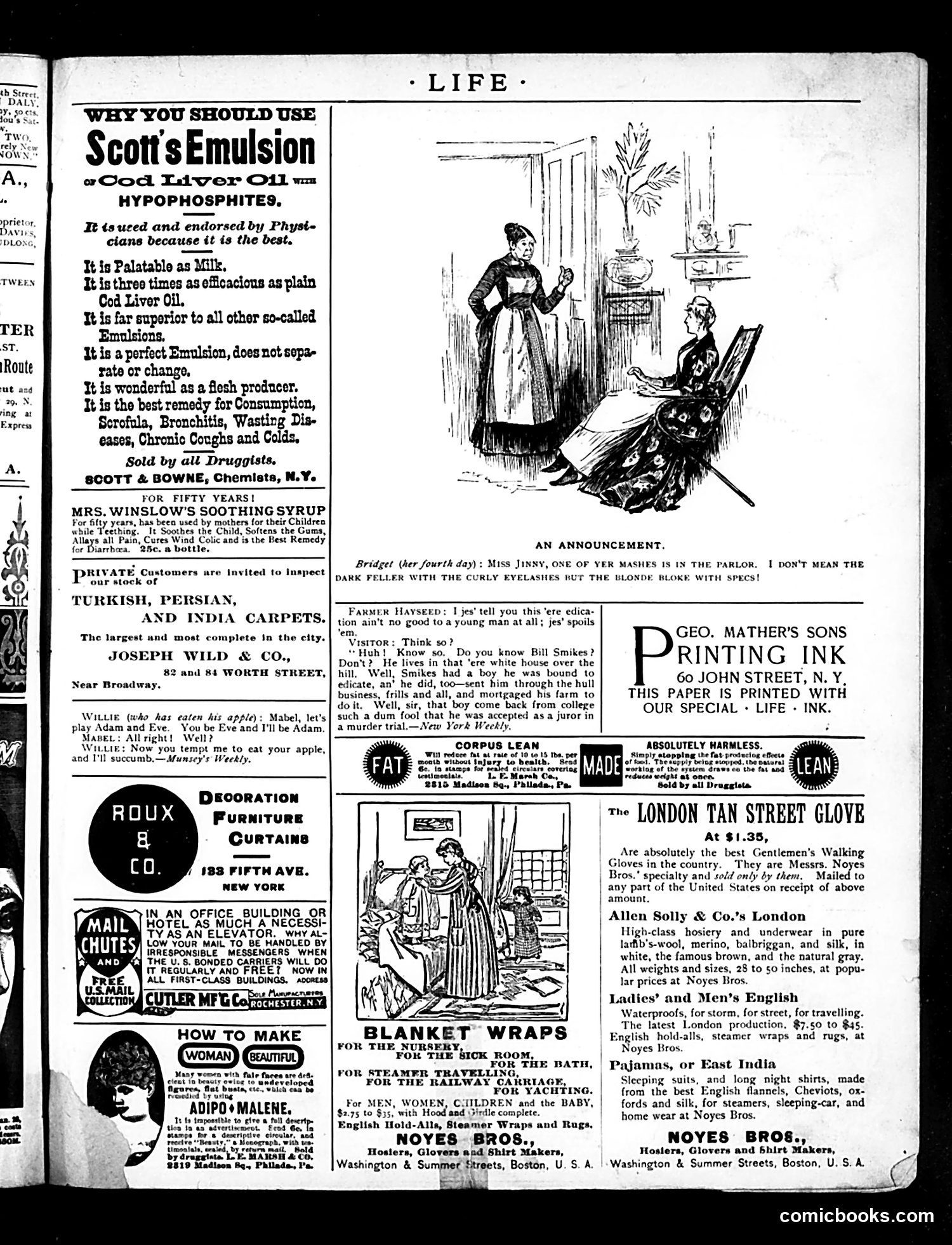
This page is primarily **advertisements and humorous anecdotes**, not political cartoons. The humor pieces mock rural ignorance and Irish servants: - **"Farmer Hayseed"** satirizes a country bumpkin who claims education ruins young men, citing Bill Smikes, who became so foolish he qualified as a juror in a murder trial—a joke equating formal education with stupidity. - **"Bridget"** presents an Irish domestic servant (indicated by the name and dialect) describing her suitor to her employer, Miss Jinny, distinguishing between two men by ethnicity ("the dark feller" vs. "the blonde bloke")—reflecting period attitudes about immigrant domestic workers. - **"Willie and Mabel"** shows children playing Adam and Eve, with an innocent double-entendre about temptation and eating fruit. The bulk of the page features ads for cod liver oil, carpets, printing ink, gloves, and hosiery—typical of *Life* magazine's mixed editorial-advertising format during this era.
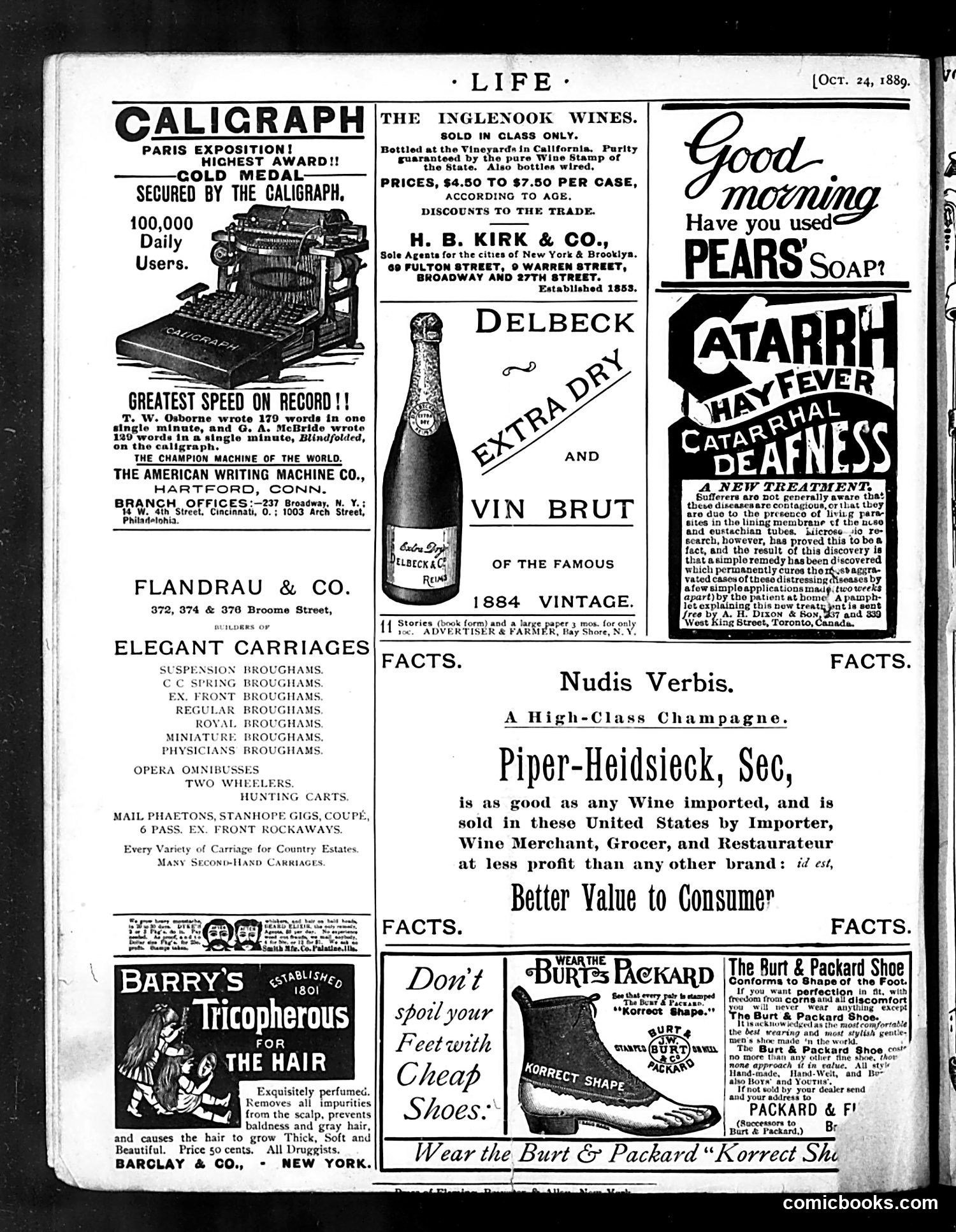
This is primarily a **advertisements page** with no political cartoons. The content reflects late-19th-century consumer products and sales claims typical of the era. Key advertisements include: - **Caligraph typewriter**: Claims a Paris Exposition award and "greatest speed on record" (179 words typed in one minute), positioning it as "champion machine of the world." - **Barry's Tricopherous**: A hair product claiming to prevent baldness and gray hair, cure impurities, and promote thick growth—representative of patent medicines and unregulated cosmetic claims common in 1889. - **Wine and champagne ads**: Multiple European wine imports (Delbeck, Piper-Heidsieck, Inglenook) marketed as quality goods with profit margins emphasized to merchants. - **Catarrh Fever treatment**: A medical "discovery" claiming to permanently cure nasal problems with simple home application—typical of the era's dubious medical claims. - **Burt & Packard shoes**: Advertised as conforming to foot shape and providing comfort superior to competitors. The page reflects 1889's unregulated advertising landscape where exaggerated health claims and "scientific" breakthroughs were standard marketing tactics.