
Life, 1889-10-24 · page 4 of 18
Life — October 24, 1889 — page 4: what you’re looking at
What you’re looking at
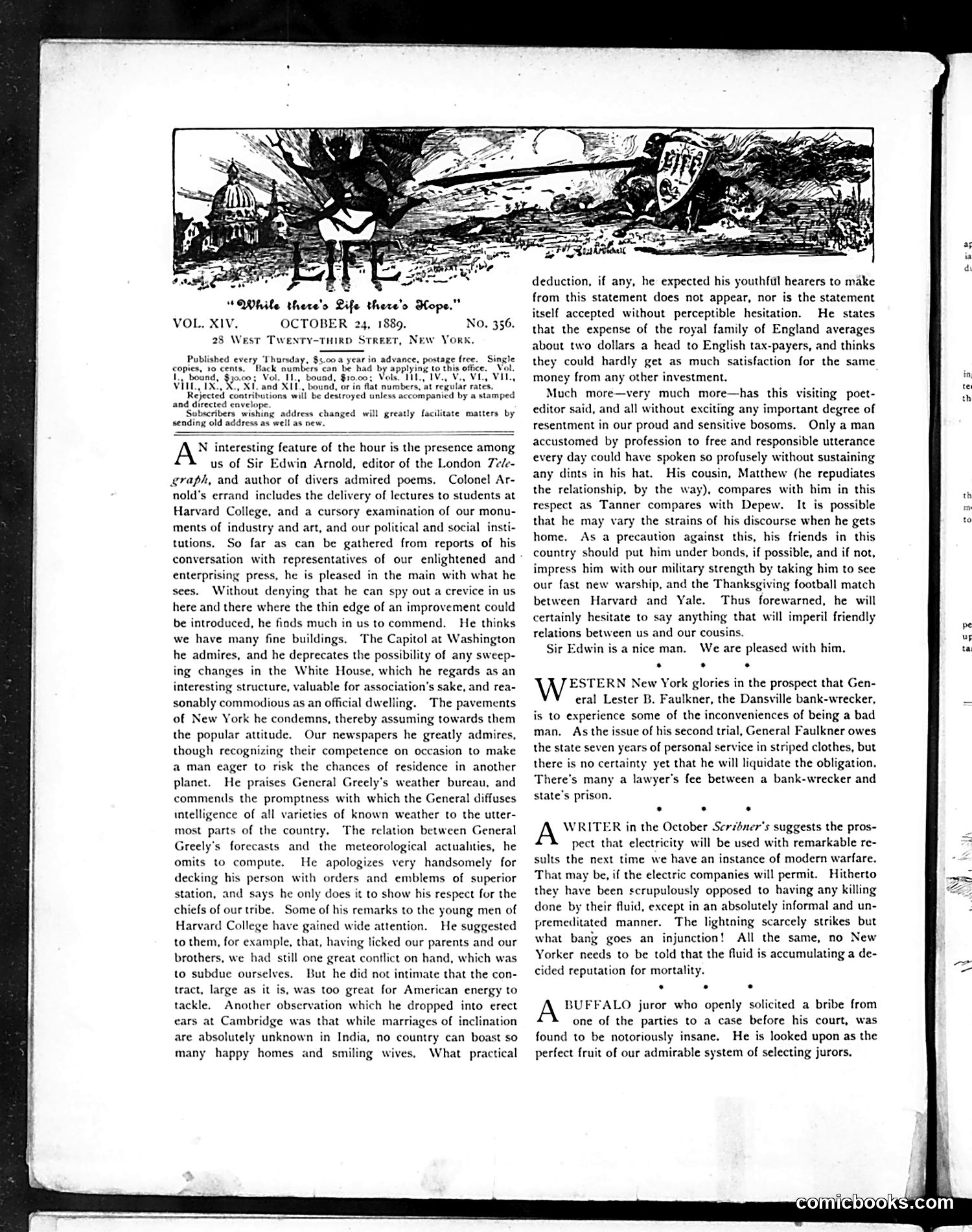
The masthead cartoon depicts a nighttime scene with a crescent moon and figures gathered beneath a large tree—likely illustrating the magazine's title "While there's Life there's Hope." The page contains social commentary rather than political cartoons. It discusses Colonel Edwin Arnold, editor of the London Telegraph and admired poet, visiting America. The text praises his observations about American institutions (Harvard, the Capitol, White House) while gently mocking his critical remarks about American pavement quality and weather forecasting. Additional brief items satirize General Lester Faulkner (a bank-wrecker facing consequences), electricity's potential in future warfare, and a Buffalo juror deemed "notoriously insane"—described as perfect proof of America's jury-selection system, clearly meant as ironic social criticism of the judicial process.
📄 Transcribed text from this page (OCR, searchable)
Machine-transcribed from the original scan — historical spelling and the odd misread are preserved.
< ES “OMhile there's Life there's Hope.” VOL. XIV. OCTOBER 24, 1889. No. 356. 23 West Twenty-THirD STR » New Yorn. Published every ‘Thursday, $5.00 year in advance, postage free. Single gto this office. Vol. copies, 1, bound, $3 VHIL IX), X., 3 Rejected coat and directed envelope ribers wishing address changed will greatly facilit sending old address as well as new. A interesting feature of the hour is the presence among us of Sir Edwin Arnold, editor of the London Te/e- graph, and author of divers admired poems. Colonel Ar- nold’s errand includes the delivery of lectures to students at Harvard College, and a cursory examination of our monu- ments of industry and art, and our political and social insti- tutions, So far as can be gathered from reports of his conversation with representatives of our enlightened and enterprising press, he is pleased in the main with what he sees. Without denying that he can spy out a crevice in us here and there where the thin edge of an improvement could be introduced, he finds much in us to commend. He thinks we have many fine buildings. The Capitol at Washington he admires, and he deprecates the possibility of any sweep- ing changes in the White House, which he regards as an interesting structure, valuable for association's sake, and rea- sonably commodious as an official dwelling. The pavements of New York he condemns, thereby assuming towards them the popular attitude. Our newspapers he greatly admires, though recognizing their competence on occasion to make a man eager to risk the chances of residence in another planet. He praises General Greely’s weather bureau, and comments the promptness with which the General diffuses intelligence of all varieties of known weather to the utter- most parts of the country. The relation between General Greely’s forecasts and the meteorological actualities, he omits to compute. He apologizes very handsomely for decking his person with orders and emblems of superior station, and says he only does it to show his respect for the chiefs of our tribe. Some of his remarks to the young men of Harvard College have gained wide attention. He suggested to them, for example, that, having licked our parents and our brothers, we had still one great contlict on hand, which was to subdue ourselves. But he did not intimate that the con- tract, large as it is, was too great for American energy to tackle. Another observation which he dropped into erect ears at Cambridge was that while marriages of inclination are absolutely unknown in India, no country can boast so many happy homes and smiling wives. What practical by applyi ; Vole t deduction, if any, he expected his youthftl hearers to make from this statement does not appear, nor is the statement itself accepted without perceptible hesitation. He states that the expense of the royal family of England averages about two dollars a head to English tax-payers, and thinks they could hardly get as much satisfaction for the same money from any other investment. Much more—very much more—has this visiting poet- editor said, and all without exciting any important degree of resentment in our proud and sensitive bosoms. Only a man accustomed by profession to free and responsible utterance every day could have spoken so profusely without sustaining any dints in his hat. His cousin, Matthew (he repudiates the relationship, by the way), compares with bim in this respect as Tanner compares with Depew. It is possible that he may vary the strains of his discourse when he gets home. As a precaution against this, his friends in this country should put him under bonds, if possible, and if not, impress him with our military strength by taking him to see our fast new warship, and the Thanksgiving football match between Harvard and Yale. Thus forewarned, he will certainly hesitate to say anything that will imperil friendly relations between us and our cousins. Sir Edwin is a nice man. We are pleased with him. . . . W TERN New York glories in the prospect that Gen- eral Lester B. Faulkner, the Dansville bank-wrecker, is to experience some of the inconveniences of being a bad man. As the issue of his second trial, General Faulkner owes the state seven years of personal service in striped clothes, but there is no certainty yet that he will liquidate the obligation. There's many a lawyer's fee between a bank-wrecker and state's prison, . . . WRITER in the October Scrzéner’s suggests the pros- pect that electricity will be used with remarkable re- sults the next time we have an instance of modern warfare. That may be, if the electric companies will permit. Hitherto they have been scrupulously opposed to having any killing done by their fluid, except in an absolutely informal and un- premeditated manner. The lightning scarcely strikes but what bang goes an injunction! All the same, no New Yorker needs to be told that the fluid is accumulating a de- cided reputation for mortality. BUFFALO juror who openly solicited a bribe from one of the parties to a case before his court, was found to be notoriously insane. He is looked upon as the perfect fruit of our admirable system of selecting jurors.