
Life, 1889-10-24 · page 6 of 18
Life — October 24, 1889 — page 6: what you’re looking at
What you’re looking at
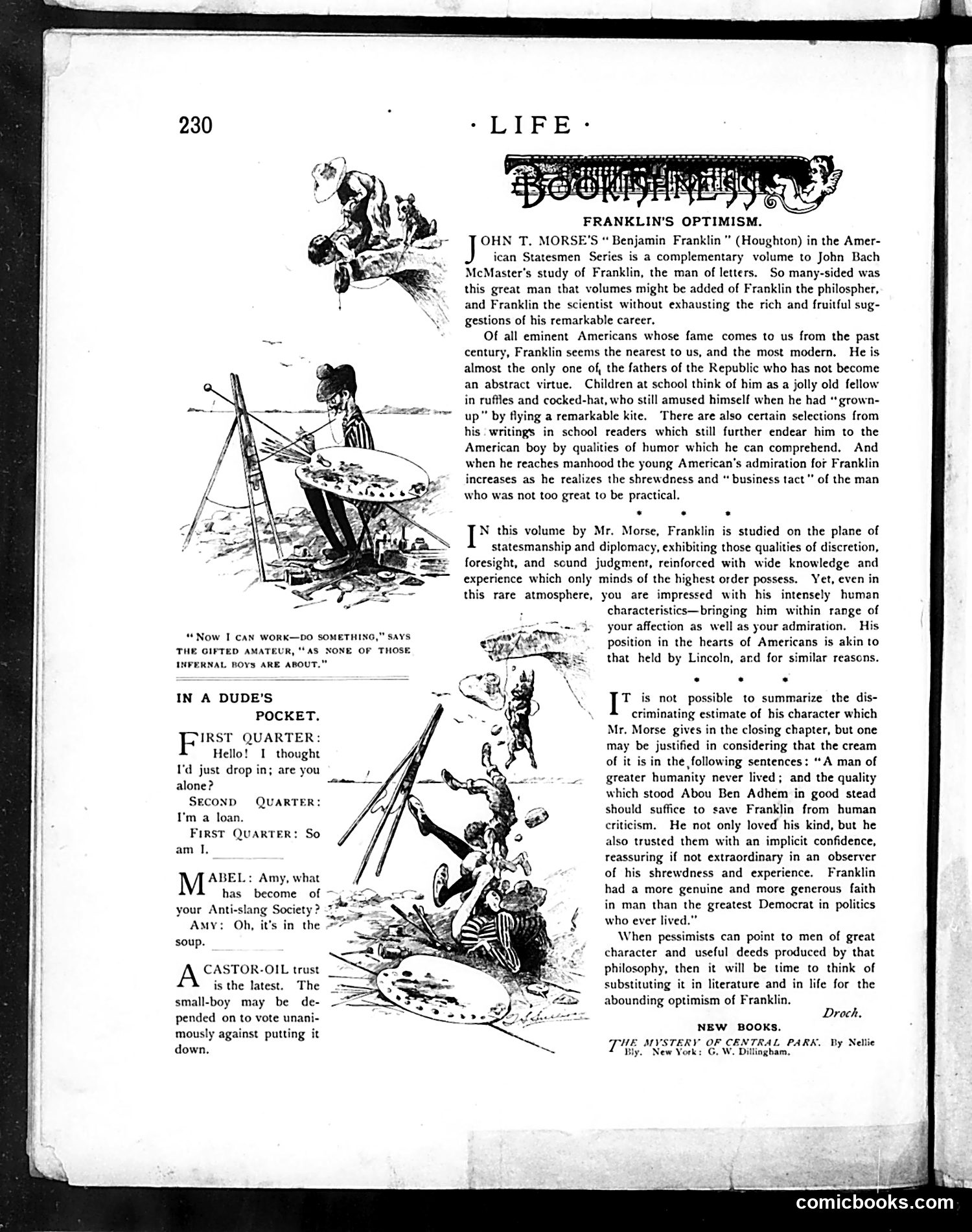
This Life magazine page combines a book review with humor content. The main feature reviews John T. Morse's "Benjamin Franklin" from the American Statesmen Series, praising Franklin as uniquely relatable among historical figures—a founding father who remained practical and humorous rather than becoming an abstract virtue. The review emphasizes Franklin's character and his appeal to American boys. Below is a separate comic sketch titled "In a Dude's Pocket," showing dialogue between characters discussing a loan and the Anti-Saloon Society. The accompanying illustrations depict figures in casual poses with period clothing and accessories, likely satirizing social types or fashionable society figures of the era, though the specific satirical target isn't entirely clear from this excerpt alone.
📄 Transcribed text from this page (OCR, searchable)
Machine-transcribed from the original scan — historical spelling and the odd misread are preserved.
“Now I CAN WORK—DO SOMETHING,” SAYS THE GIFTED AMATEUR, “AS NONE OF THOSE INFERNAL BOYS ARE ABOUT.” IN A DUDE’'S POCKET. IRST QUARTER: Hello! I thought I'd just drop in; are you alone? SECOND QUARTER: I'm a loan. FIRST QUARTER: So am I, ABEL: Amy, what has become of your Anti-slang Society ? AMY: Oh, it's in the soup. A CASTOR-OIL trust is the latest. The small-boy may be de- — pended on to vote unani- mously against putting it down. FRANKLIN'S OPTIMISM. OHN T. MORSE'’S “ Benjamin Franklin" (Houghton) in the Amer- J ican Statesmen Series is a complementary volume to John Bach MeMaster’s study of Franklin, the man of letters. So many-sided was this great man that volumes might be added of Franklin the philospher, and Franklin the scientist without exhausting the rich and fruitful sug- gestions of his remarkable career. Of all eminent Americans whose fame comes to us from the past century, Franklin seems the nearest to us, and the most modern, He is almost the only one of, the fathers of the Republic who has not become an abstract virtue. Children at school think of him as a jolly old fellow in ruffles and cocked-hat, who still amused himself when he had “grown- up” by flying a remarkable kite. There are also certain selections from his writings in school readers which still further endear him to the American boy by qualities of humor which he can comprehend. And when he reaches manhood the young American's admiration for Franklin increases as he realizes the shrewdness and “ business tact" of the man who was not too great to be practical. . . . i this volume by Mr. Morse, Franklin is studied on the plane of statesmanship and diplomacy, exhibiting those qualities of discretion, foresight, and scund judgment, reinforced with wide knowledge and experience which only minds of the highest order possess. Yet, even in this rare atmosphere, you are impressed with his intensely human characteristics—bringing him within range of your affection as well as your admiration. His position in the hearts of Americans is akin to that held by Lincoln, ard for similar reasons. I" is not possible to summarize the dis- criminating estimate of his character which Mr. Morse gives in the closing chapter, but one may be justified in considering that the cream of it is in the following sentences: “A man of greater humanity never lived; and the quality which stood Abou Ben Adhem in good stead should suffice to save Franklin from human criticism. He not only loved his kind, but he also trusted them with an implicit confidence, reassuring if not extraordinary in an observer of his shrewdness and experience. Franklin had a more genuine and more generous faith in man than the greatest Democrat in politics who ever lived.” When pessimists can point to men of great character and useful deeds produced by that philosophy, then it will be time to think of substituting it in literature and in life for the abounding optimism of Franklin. Droch, NEW BOOKS. TH": ‘STERV OF CENTRAL PARK. By Nellie Y ew York: G, W. Dillingham,