
Life, 1889-10-24 · page 11 of 18
Life — October 24, 1889 — page 11: what you’re looking at
What you’re looking at
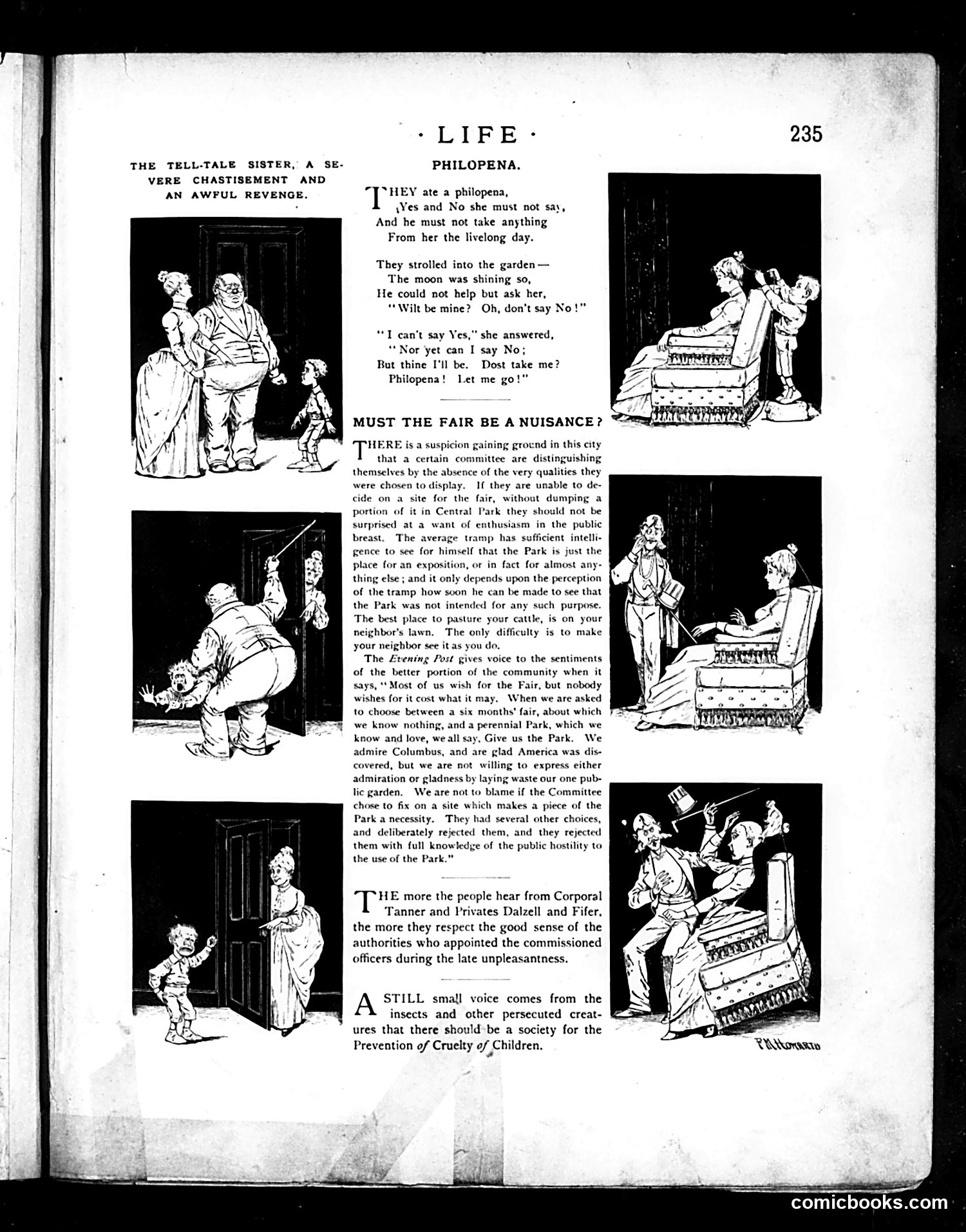
This page satirizes a public controversy over a proposed fair's location in Central Park. The left-side illustrations mock those opposing the fair—depicting what appear to be wealthy or influential citizens being ejected or removed, suggesting they're hypocritically trying to prevent public use of the park. The main text defends the fair's placement, arguing that critics claiming to love Columbus and America are actually just protecting their own neighborhood interests. It contrasts their stated principles with selfish behavior. The right-side vignettes (signed by the artist) appear to show domestic scenes, possibly illustrating the "nuisance" theme of the opposition's complaints. A final note advocates for child protection societies, shifting tone to a more earnest social concern. The overall message: the park belongs to the public, not elite gatekeepers.
📄 Transcribed text from this page (OCR, searchable)
Machine-transcribed from the original scan — historical spelling and the odd misread are preserved.
-LIFE-: THE TELL-TALE SISTER, A SE- PHILOPENA. VERE CHASTISEMENT AND AN AWFUL REVENGE. i ate a philopena, . \Yes and No she must not say, And he must not take anything From her the livelong day. They strolled into the garden — The moon was shining so, He could not help but ask her, “Wilt be mine? Oh, don't say No!” ““T can't say Yes,” she answered, Nor yet can I say No; But thine I'll be. Dost take me? Philopena! Let me go!" MUST THE FAIR BE A NUISANCE? THERE is a suspicion gaining grocnd in this city that a certain committee are distinguishing themselves by the absence of the very qualities they were chosen to display. If they are unable to de- cide on a site for the fair, without dumping a portion of it in Central Park they should not be surprised at a want of enthusiasm in the public breast. The average tramp has sufficient intelli- gence to see for himself that the Park is just place for an exposition, or in fact for almost any- thing else ; and it only depends upon the perception of the tramp how soon he can be made to see that the Park was not intended for any such purpose. The best place to pasture your cattle, is on your neighbor's lawn, The only difficulty is to make your neighbor see it as you do, The Evening Post gives voice to the sentiments of the better portion of the community when it says, Most of us wish for the Fair, but nobody wishes for it cost what it may. When we are asked to choose between a six months' fair, about which we know nothing, and a perennial Park, which we know and love, we all say, Give us the Park. We admire Columbus, and are glad America was dis- covered, but we are not willing to express either admiration or gladness by laying waste our one pub- lic garden, We are not to blame if the Committee chose to fix on a site which makes a piece of the Park a necessity. They had several other choices, and deliberately rejected them, and they rejected them with full knowledge of the public hostility to the use of the Park.” HE more the people hear from Corporal Tanner and Privates Dalzell and Fifer, the more they respect the good sense of the authorities who appointed the commissioned officers during the late unpleasantness. STILL small voice comes from the insects and other persecuted creat- ures that there should be a society for the 3 Prevention of Cruelty of Children. Wires, comicbooks.com