
A complete issue · 18 pages · 1889
Life — October 10, 1889
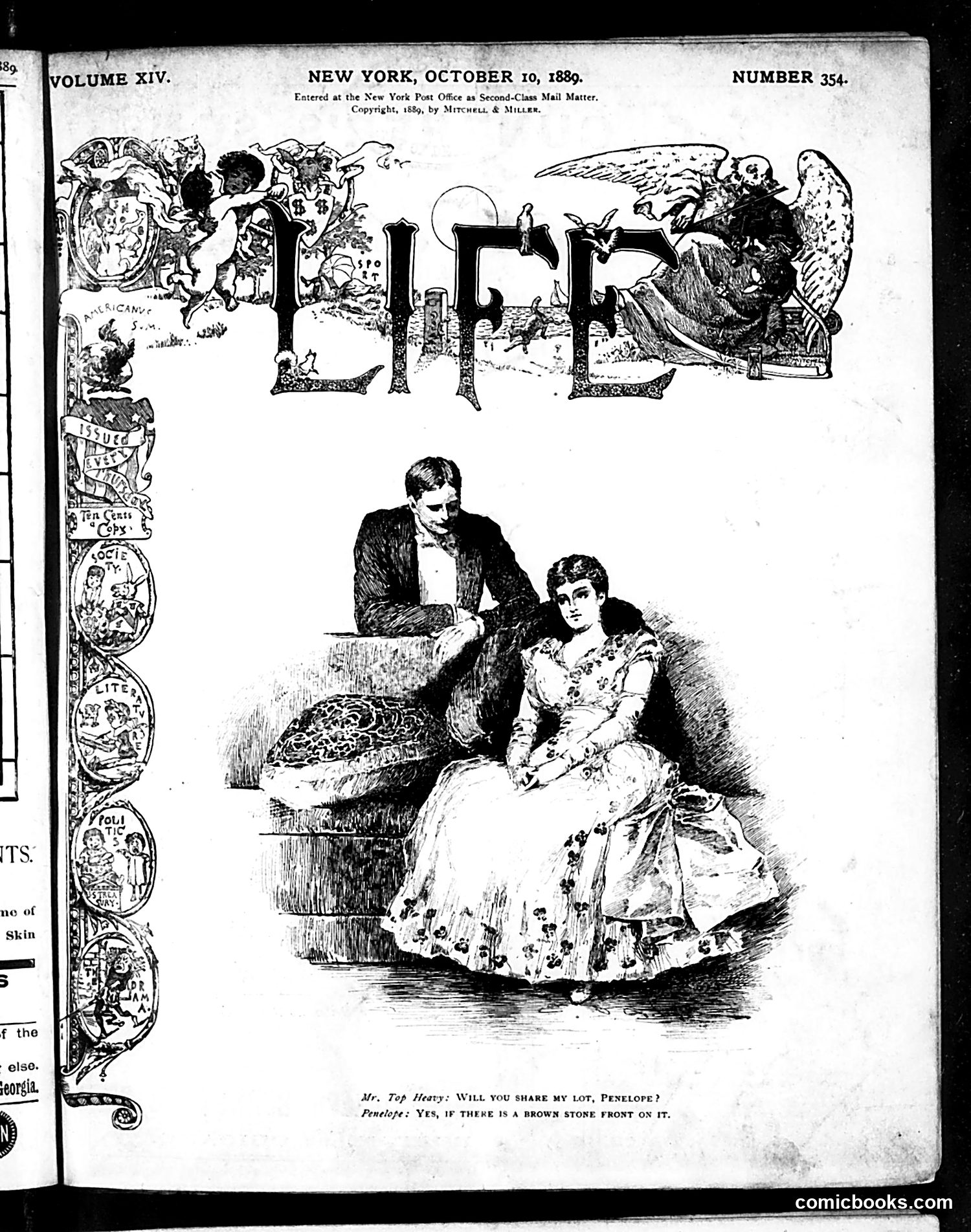
This page features a satirical illustration with the caption: "Mr. Top Heavy: Will you share my lot, Penelope? / Penelope: Yes, if there is a brown stone front on it." The cartoon mocks the materialism of wealthy New York society during the Gilded Age. "Top Heavy" likely refers to a suitor whose wealth or social standing is unstable or ostentatious—his head disproportionately inflated. Penelope's response satirizes how marriage prospects among the elite were contingent on concrete material wealth: specifically, ownership of a fashionable brownstone townhouse in Manhattan. The joke exposes the mercenary nature of courtship in the upper classes, where romantic commitment depends entirely on real estate and financial security rather than genuine affection.
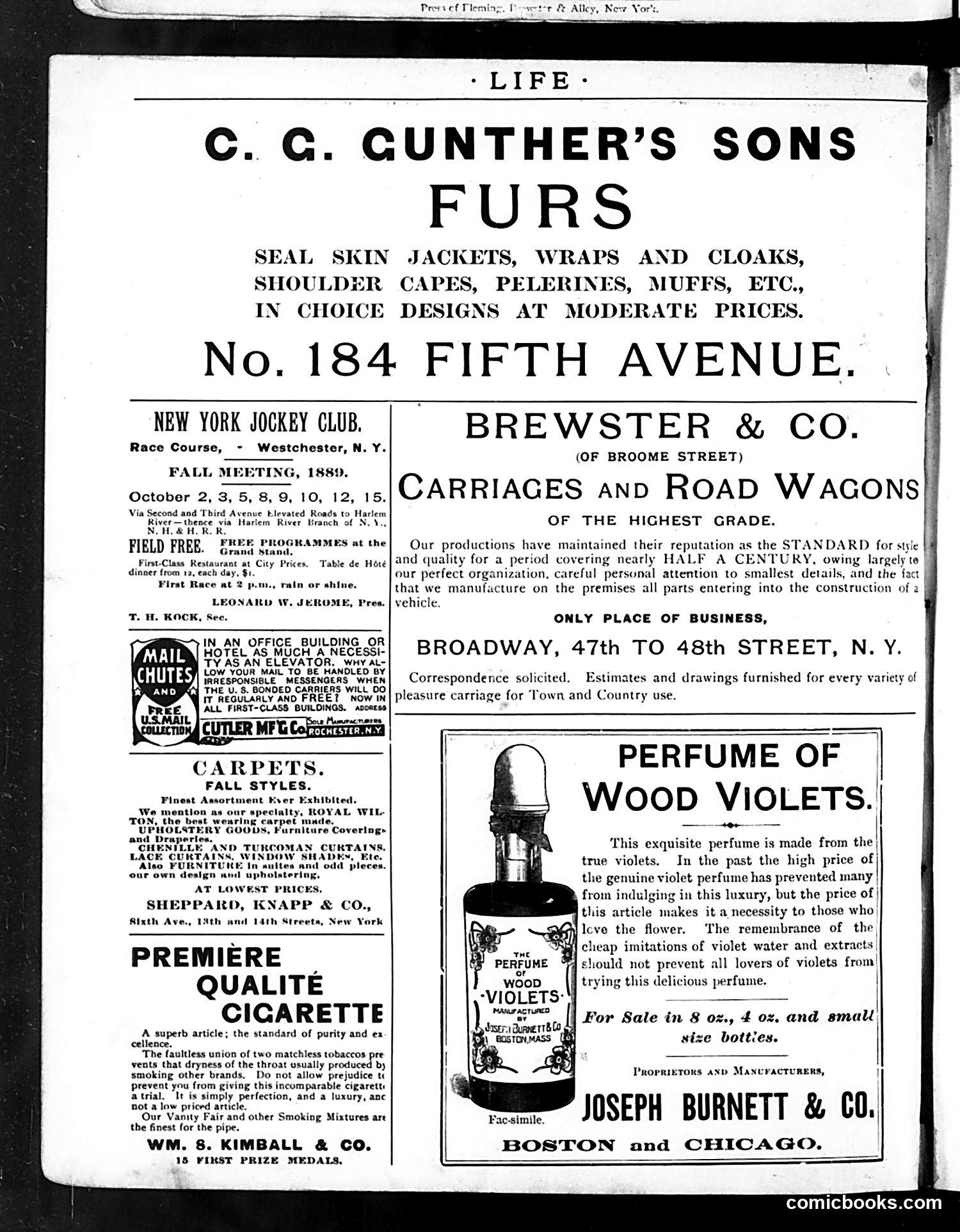
This page is primarily **advertising content**, not editorial cartoons or satire. It contains multiple commercial advertisements from the 1880s: - C.C. Gunther's Sons fur business - Brewster & Co. carriages and wagons - Sheppard, Knapp & Co. carpets - Premiere Qualité cigarettes - Joseph Burnett & Co. perfume - Mail chutes/postal equipment The only potentially noteworthy item is a New York Jockey Club racing announcement at top left, but this appears informational rather than satirical. **There are no political cartoons or social satire visible on this page.** The Joseph Burnett perfume advertisement includes a product illustration (the bottle), but this is straightforward marketing copy about violet-scented perfume availability, not commentary or humor.
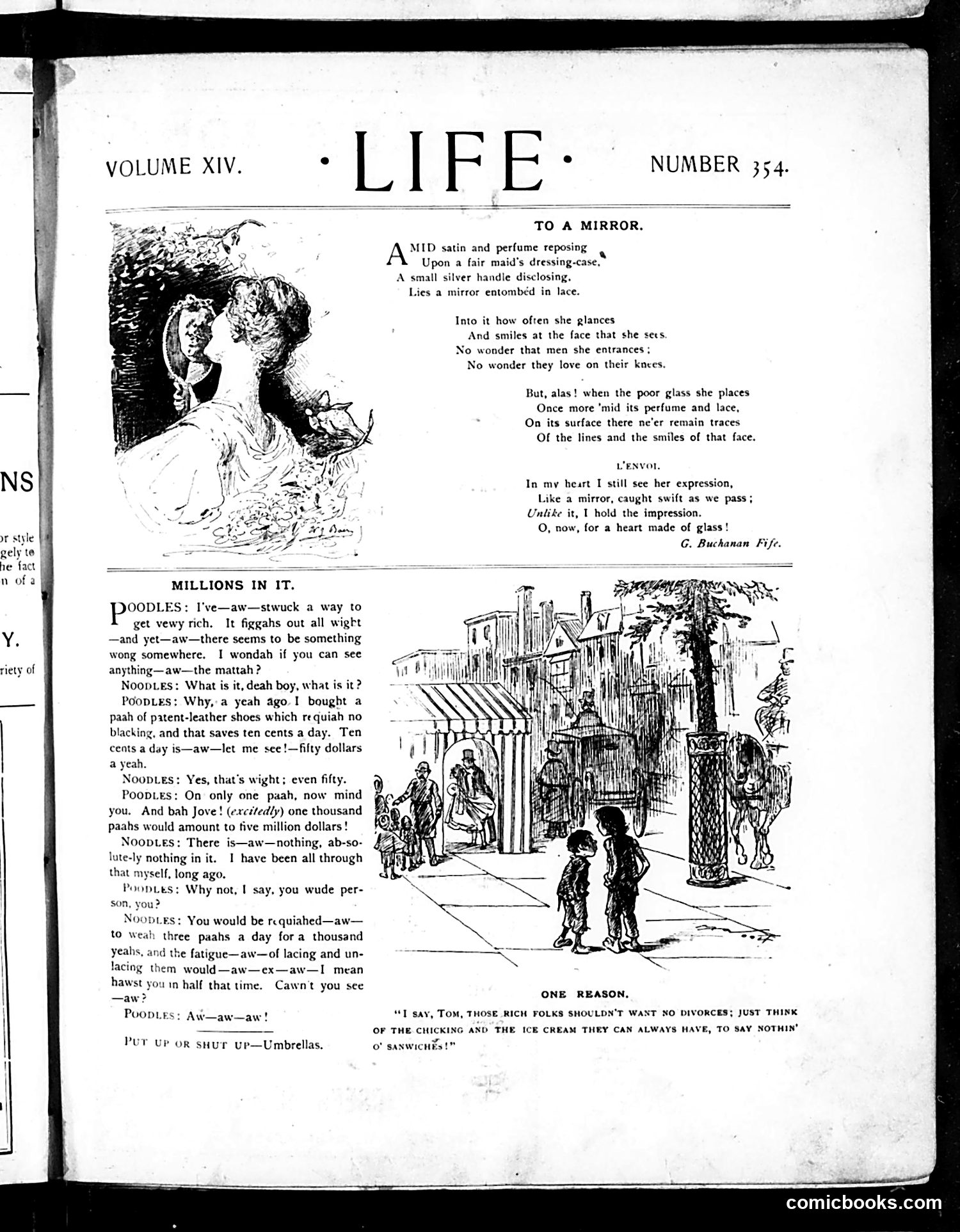
This page contains three distinct pieces: 1. **"To a Mirror"** (top): A romantic poem about a woman admiring herself in a mirror, with accompanying illustration. The satire is gentle—celebrating female vanity while the accompanying verse by "G. Buchanan Fife" suggests a man's romanticized view of women's self-regard. 2. **"Millions in It"** (middle): A comic dialogue between characters named Poodles and Noodles about getting rich through a scheme involving patent-leather shoes with daily blackings. The humor is in Poodles' absurd business pitch and Noodles' increasingly exasperated responses—satirizing get-rich-quick schemes common in the era. 3. **"One Reason"** (bottom): A street scene with the caption mocking wealthy families' divorce practices, suggesting they stay together primarily to maintain access to luxuries like chicken and ice cream sandwiches—social satire about class and marriage.
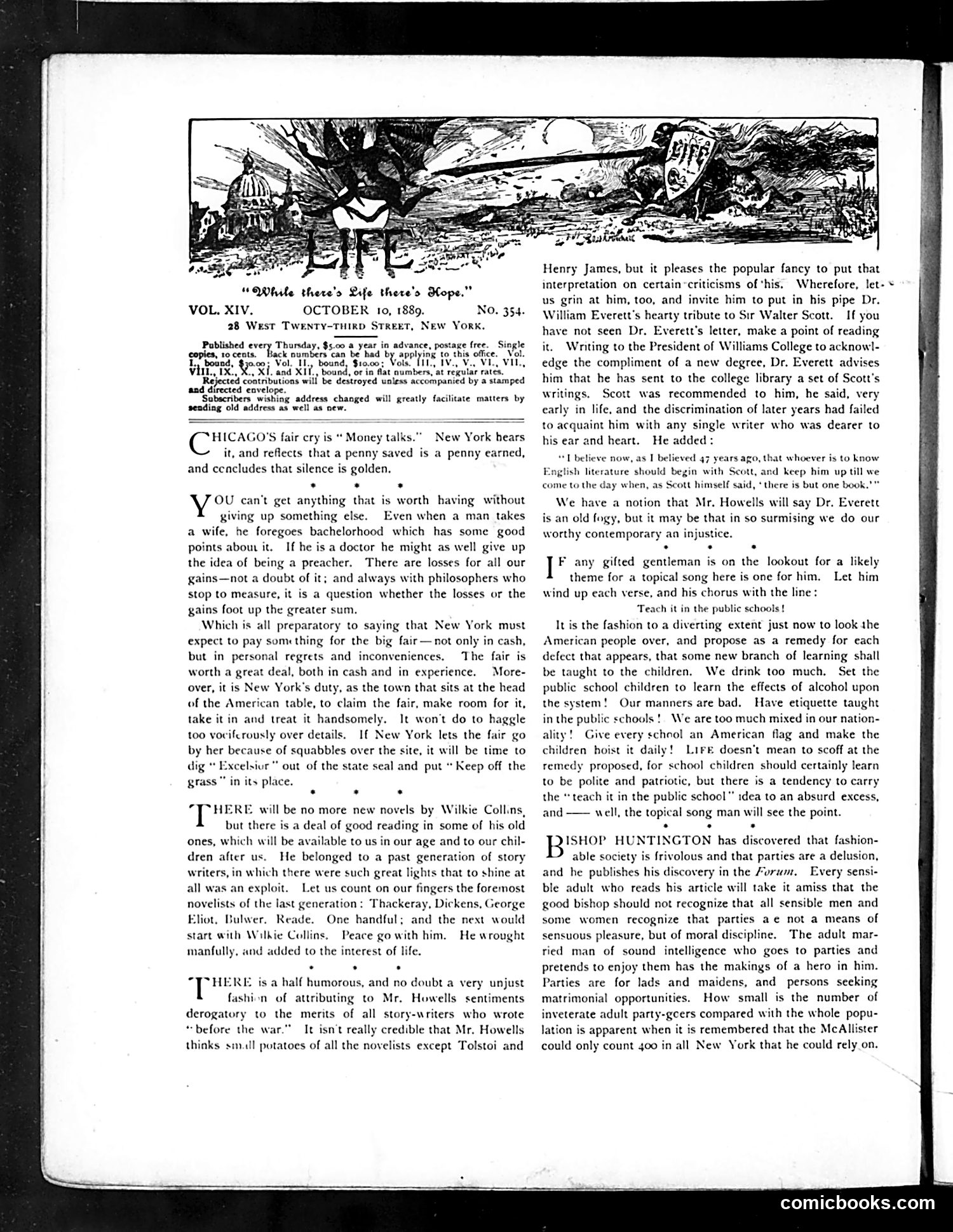
The masthead cartoon depicts **Life magazine's personification as a figure with a banner**, illustrated in the magazine's characteristic satirical style. The accompanying editorial discusses New York's upcoming fair, arguing the city should invest properly in it rather than haggle over details. The piece advocates removing obstacles and making room for the fair's success, using the phrase "Keep off the grass" metaphorically—suggesting New York shouldn't let bureaucratic concerns undermine the event. The editorial also addresses literary criticism of Henry James and discusses William Everett's writings on Walter Scott, touching on debates about American versus British literature. Additionally, there's commentary on public schools' need to teach patriotism and etiquette, and Bishop Huntington's observations about fashionable society and parties. The page functions primarily as editorial commentary rather than visual satire.
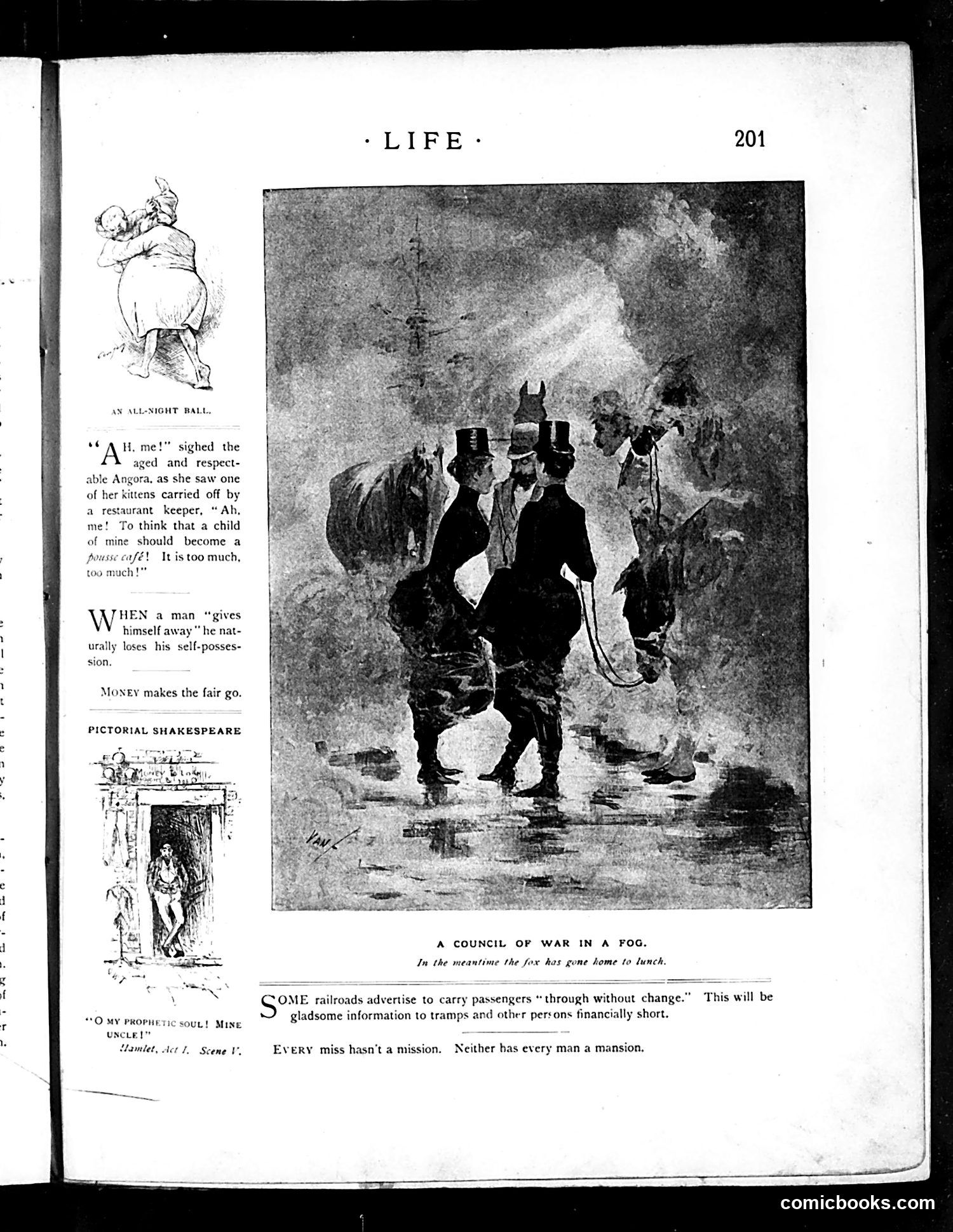
The main cartoon, "A Council of War in a Fog," depicts military figures in silhouette conducting a wartime meeting while obscured by fog. The caption notes "the fox has gone home to lunch," suggesting military leadership is absent or ineffective during a critical moment. The accompanying text contains satirical quips about human nature and social behavior. One joke mocks railroad advertising about "passengers through without change," suggesting this would appeal to financially struggling people. Another states "Every miss hasn't a mission. Neither has every man a mansion"—social commentary on poverty and unfulfilled potential. The page appears to date from World War I era, using fog and absent military leadership as metaphors for wartime confusion and incompetence. The satire critiques both military management and broader social inequality.
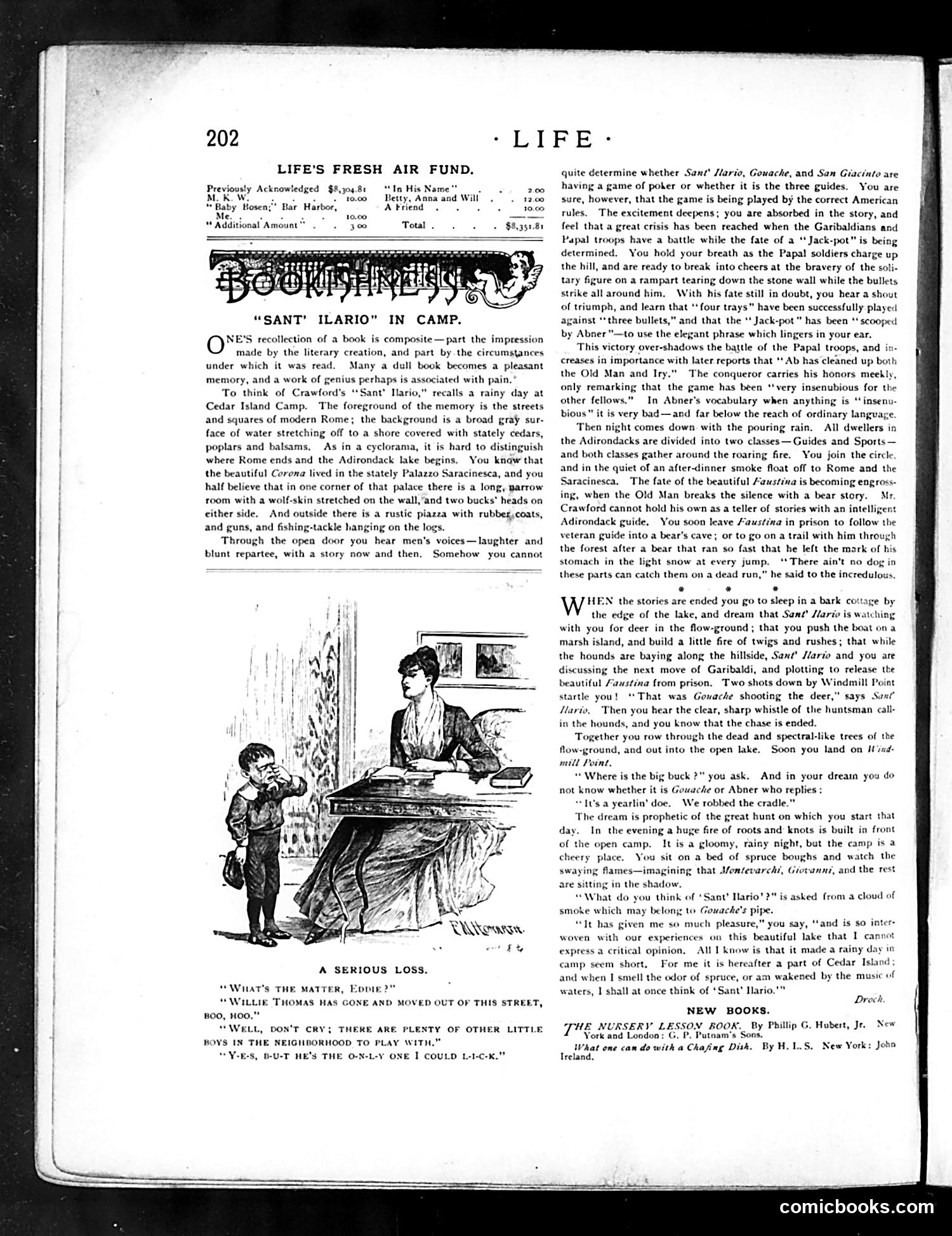
This page contains two distinct sections: **"Sant' Ilario" in Camp** — A literary discussion about F. Marion Crawford's novel "Sant' Ilario," describing how the book evokes the Adirondack region and its atmosphere. The accompanying illustration shows a woman at a desk with a boy, likely depicting a scene from the narrative or representing the reading experience. **"A Serious Loss"** — A brief comic dialogue at bottom where Willie Thomas has gone and won't come out, with Eddie responding that there are other boys to play with, but "he's the o-n-l-y one I could l-i-c-k." This is a children's joke playing on the double meaning of "lick"—suggesting both playful wrestling and defeat. Neither section contains political satire. The page is primarily literary commentary and light humor rather than political cartooning.
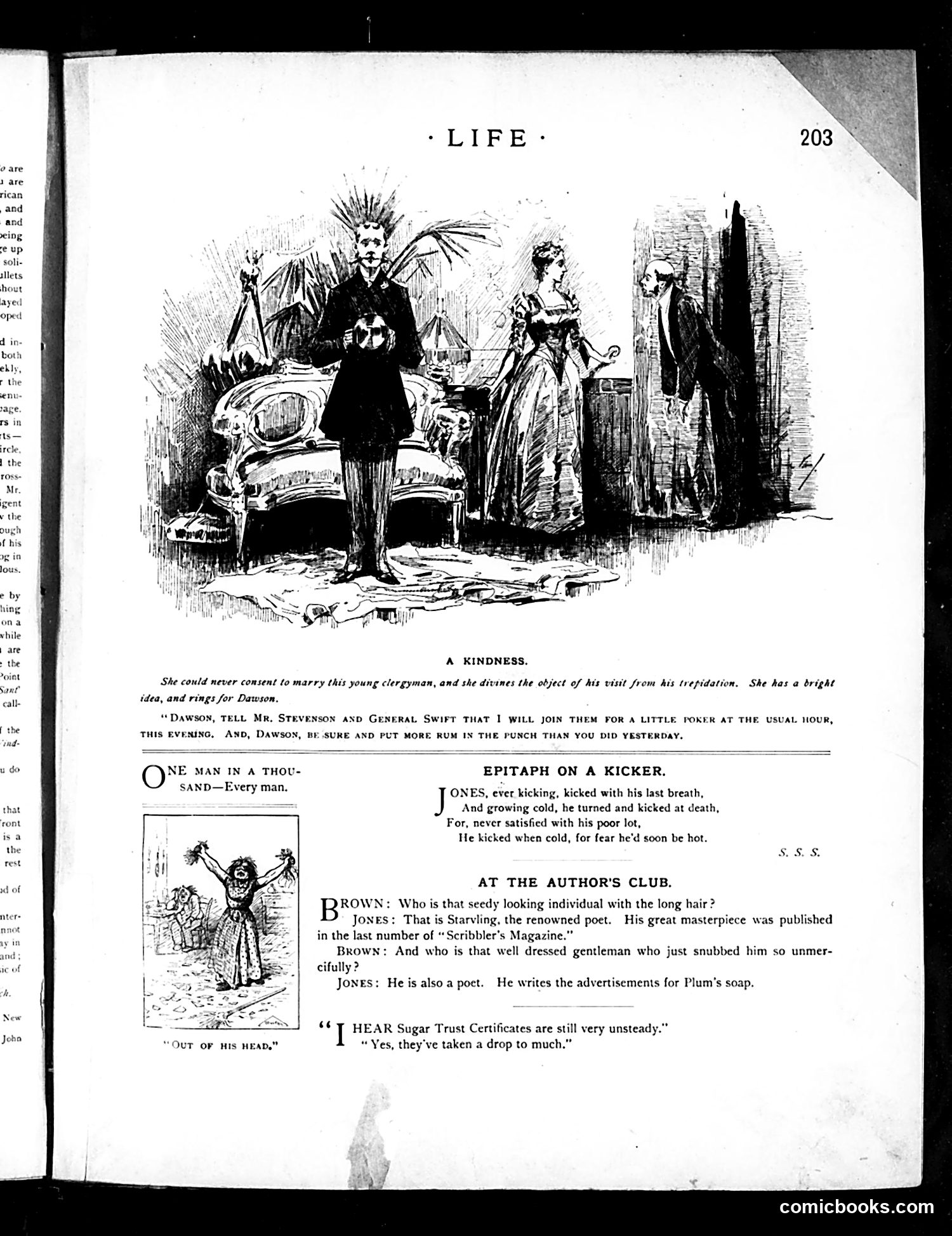
**"A Kindness"** (top illustration): Shows a woman refusing to marry a young clergyman, citing his poverty. She invites him instead to poker and rum—satirizing either hypocrisy (moral judgment masked by dissolute behavior) or the clergy's financial struggles in this era. **"Epitaph on a Kicker"**: A short, cynical poem mocking someone perpetually dissatisfied, who "kicked when cold, for fear he'd soon be hot"—likely social satire on chronic complainers. **"At the Author's Club"**: Dialogue mocking literary pretension—contrasting a published poet in Scribbler's Magazine with someone reduced to writing soap advertisements, satirizing the gap between artistic ambition and commercial reality in publishing. **"One Man in a Thousand"**: Small cartoon (caption unclear) appears separate from main content.
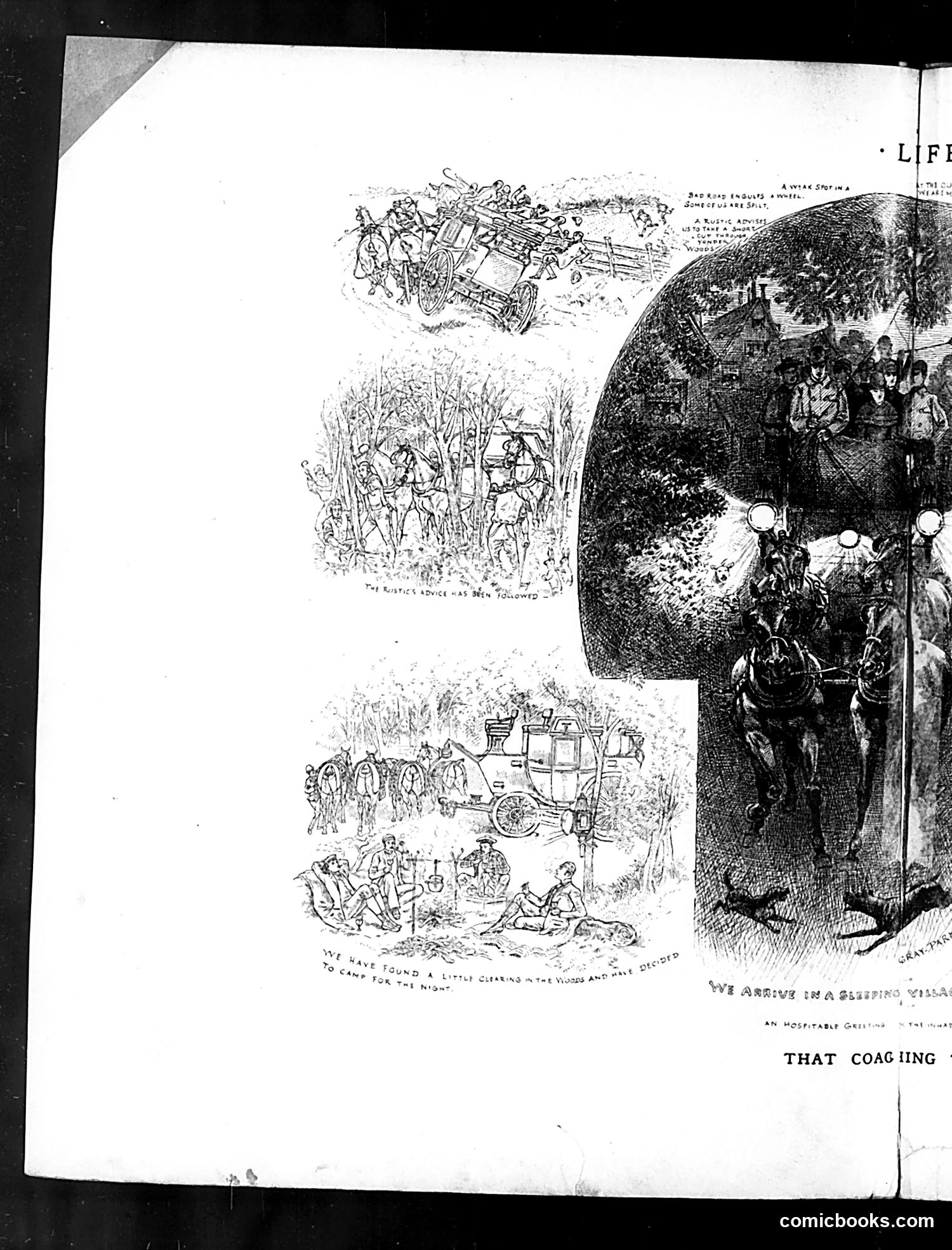
This page from *Life* magazine contains three sketch-based cartoons depicting stagecoach travel scenes. The top illustration shows a horse-drawn coach on a road. The middle and bottom sketches appear to satirize the discomforts and mishaps of coaching travel—including what seems to be passengers dealing with rough roads, cramped conditions, and overnight stops. The visible captions reference seeking shelter "for the night" and finding "a little change in the woods," suggesting humor about the inconveniences of 19th-century coach travel. The large image on the right shows what appears to be a coaching inn scene with figures gathered outside. The overall theme mocks the romantic notion of coaching as adventure, instead emphasizing its practical hardships—a common satirical subject in *Life* magazine during the era when rail travel was becoming preferred.
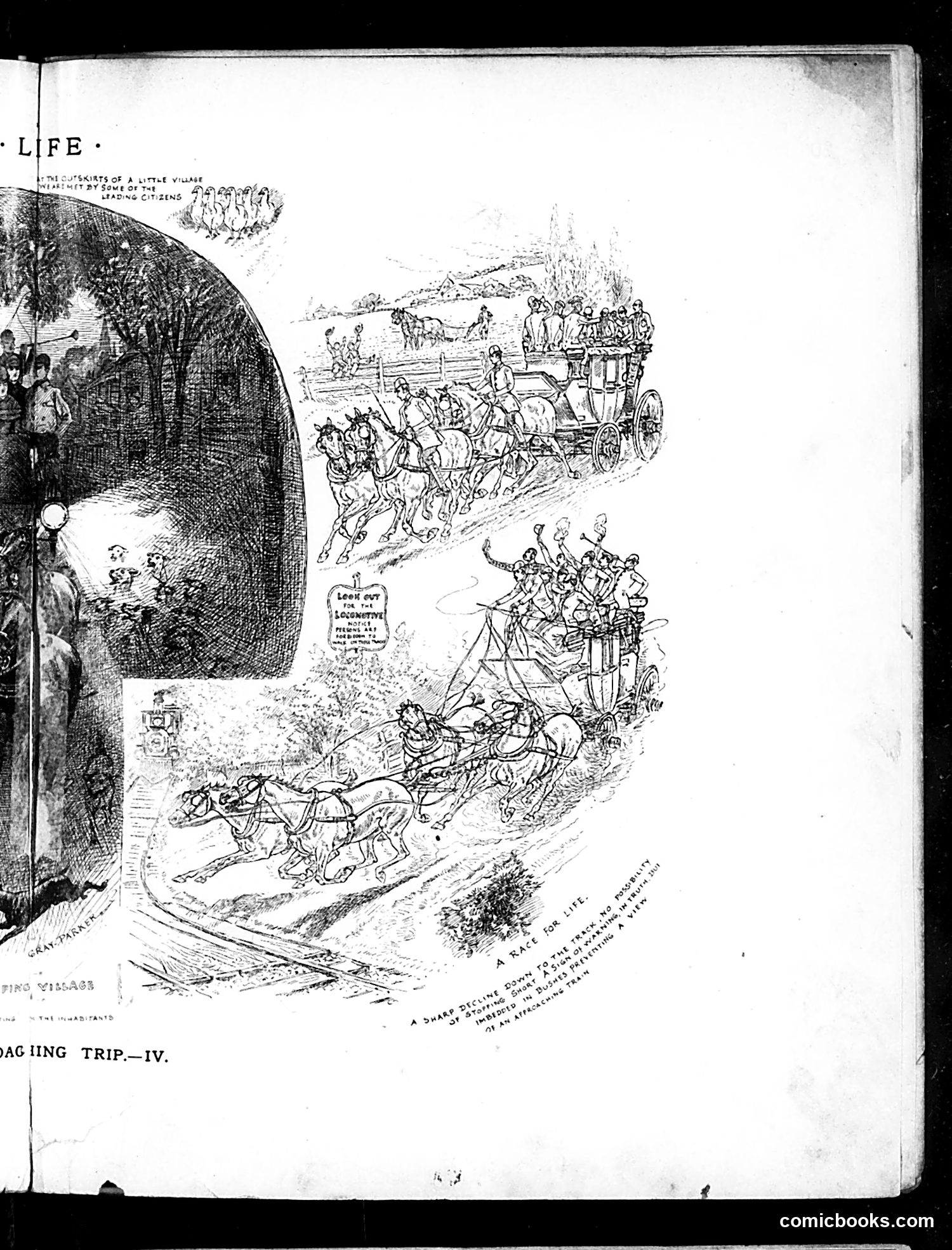
This page from *Life* magazine shows a satirical illustration titled "A Road Trip—IV," depicting a chaotic coaching journey. The cartoon illustrates the hazards and disorder of early automobile travel or coach transportation through the American countryside. The composition shows multiple vehicles and horse-drawn coaches in disarray on a rural road, with passengers tumbling about and animals in distress. The style suggests early 20th-century satire mocking the confusion and danger of emerging transportation systems. A speech bubble appears to reference "lead[ing] over" something, though the exact text is unclear in the reproduction. The overall commentary appears to satirize the unpredictability and comic misadventures of modern travel infrastructure—a common *Life* magazine theme during the transition from horse-drawn to motorized transport.
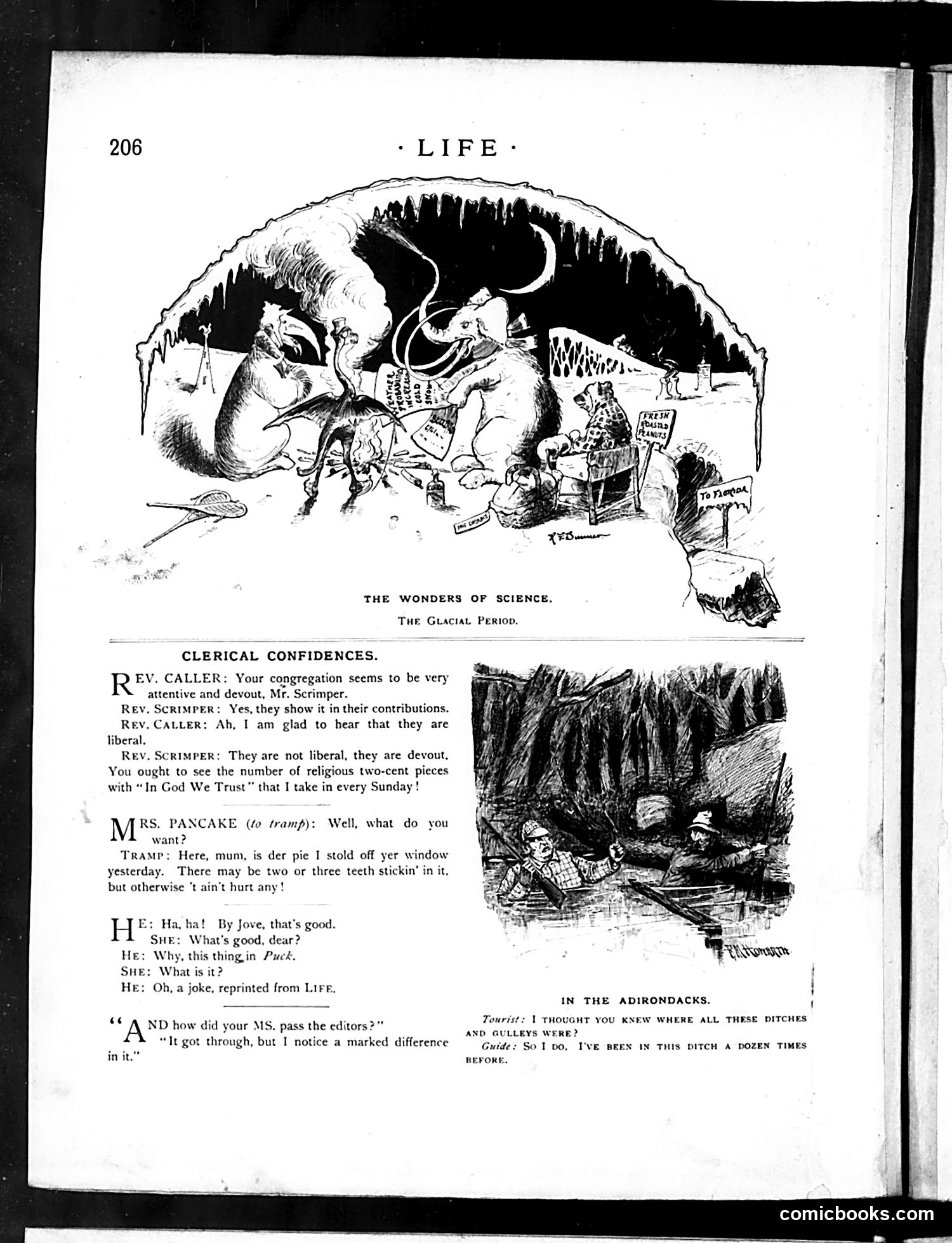
The top cartoon, titled "The Wonders of Science: The Glacial Period," depicts two large prehistoric figures (likely Neanderthals or early humans) in an ice cave, apparently engaged in domestic life with primitive tools and fire. The satire appears to mock contemporary scientific debates about human evolution and prehistory that were contentious in early 20th-century America. Below are three separate comic sketches: 1. **"Clerical Confidences"** satirizes church fundraising, with clergy discussing parishioners' modest donations despite claims of liberality. 2. **"Mrs. Pancake"** presents a landlady's crude humor about a pie sold to a tenant. 3. **"In the Adirondacks"** shows tourists unaware they're in a frequently-used location, poking fun at tourist ignorance. The page exemplifies Life's humor targeting science, religion, domesticity, and American social pretension.
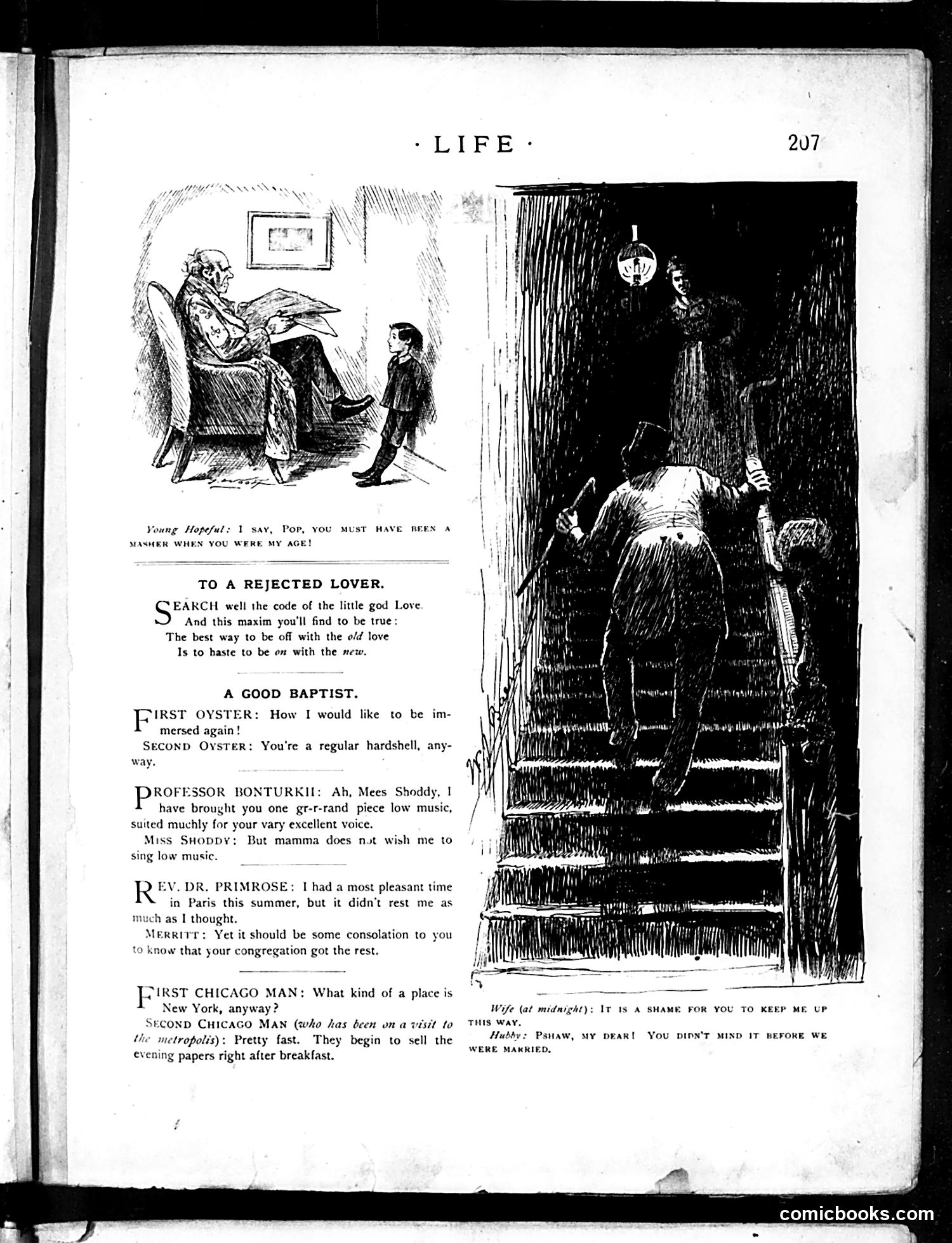
This page contains several short humorous dialogues rather than political cartoons: **"To a Rejected Lover"** is a brief poem about unrequited love. **"A Good Baptist"** depicts an exchange between oyster vendors and a Professor Honturkh about singing. The humor relies on wordplay and social class contrast. **The Chicago Men dialogue** jokes about New York's fast pace—selling evening papers right after breakfast, implying the city operates at an absurd speed. The right-side illustration shows a domestic scene where a wife confronts her husband about staying out late, with his weak excuse that he didn't mind before they were married. This is standard marital humor about changed behavior after marriage. These are light, society-page humor pieces typical of Life's satirical content—no deep political meaning, mostly focused on everyday social observations and domestic comedy.
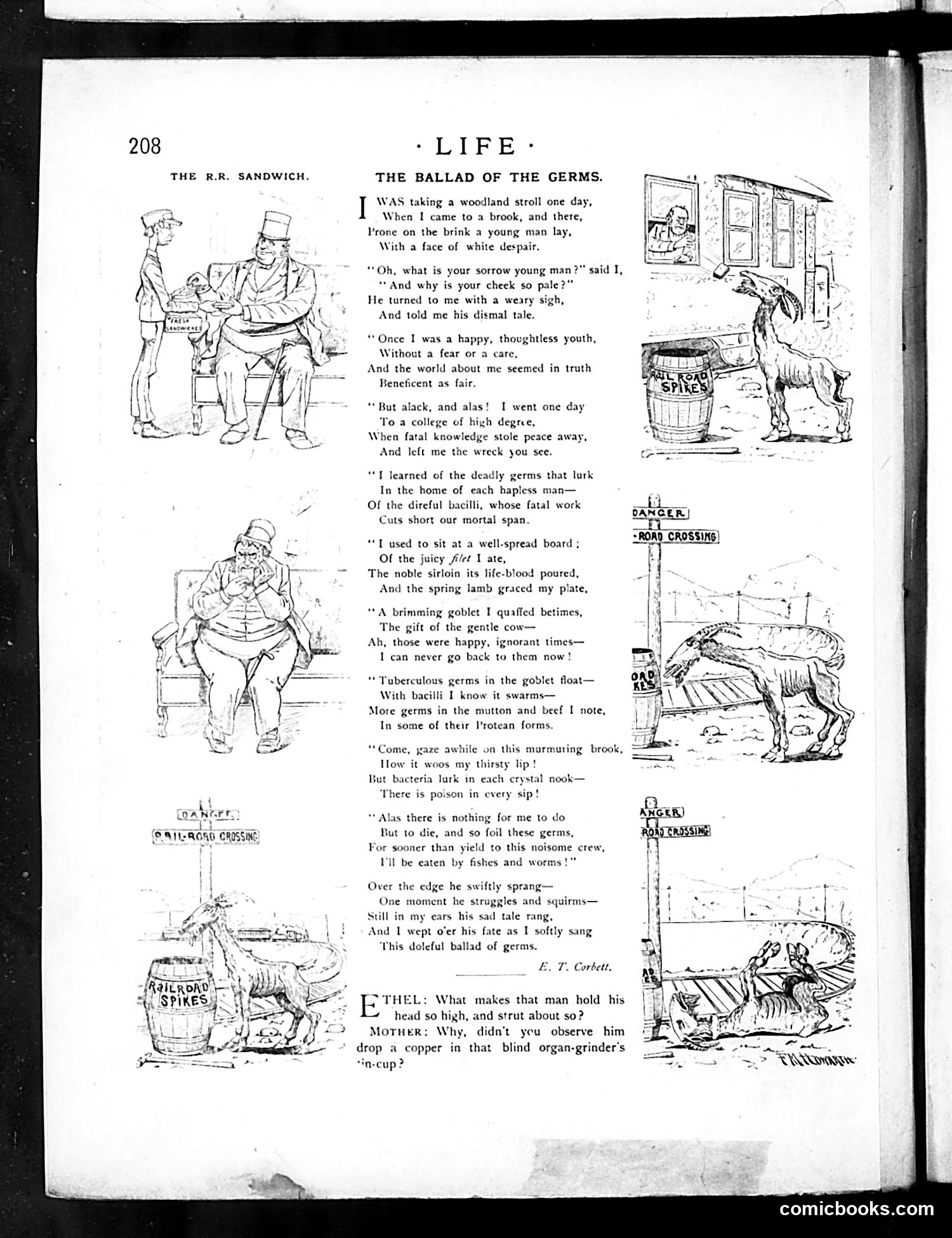
This page satirizes early-20th-century germ theory anxiety. The ballad tells of a young man driven to suicide after attending college, where he learned about bacteria and microorganisms lurking everywhere—in meat, milk, and drinking water. The joke targets educated society's newly-acquired fear of invisible pathogens. The protagonist, once happily ignorant, becomes paralyzed by knowledge of germs in every food and drink, ultimately choosing death over contamination. The accompanying cartoons (labeled "The R.R. Sandwich" and "Road Crossing" scenes) appear to extend this theme—mocking how germaphobia infiltrated everyday life and dining. The bottom dialogue joke provides comic relief: a mother praises a man for charity, but the satirical point is that his smug self-satisfaction over a small donation mirrors the protagonist's distorted priorities—misplaced concerns dominating behavior. The satire mocks both scientific anxiety and the absurdity of letting theoretical knowledge paralyze practical living.
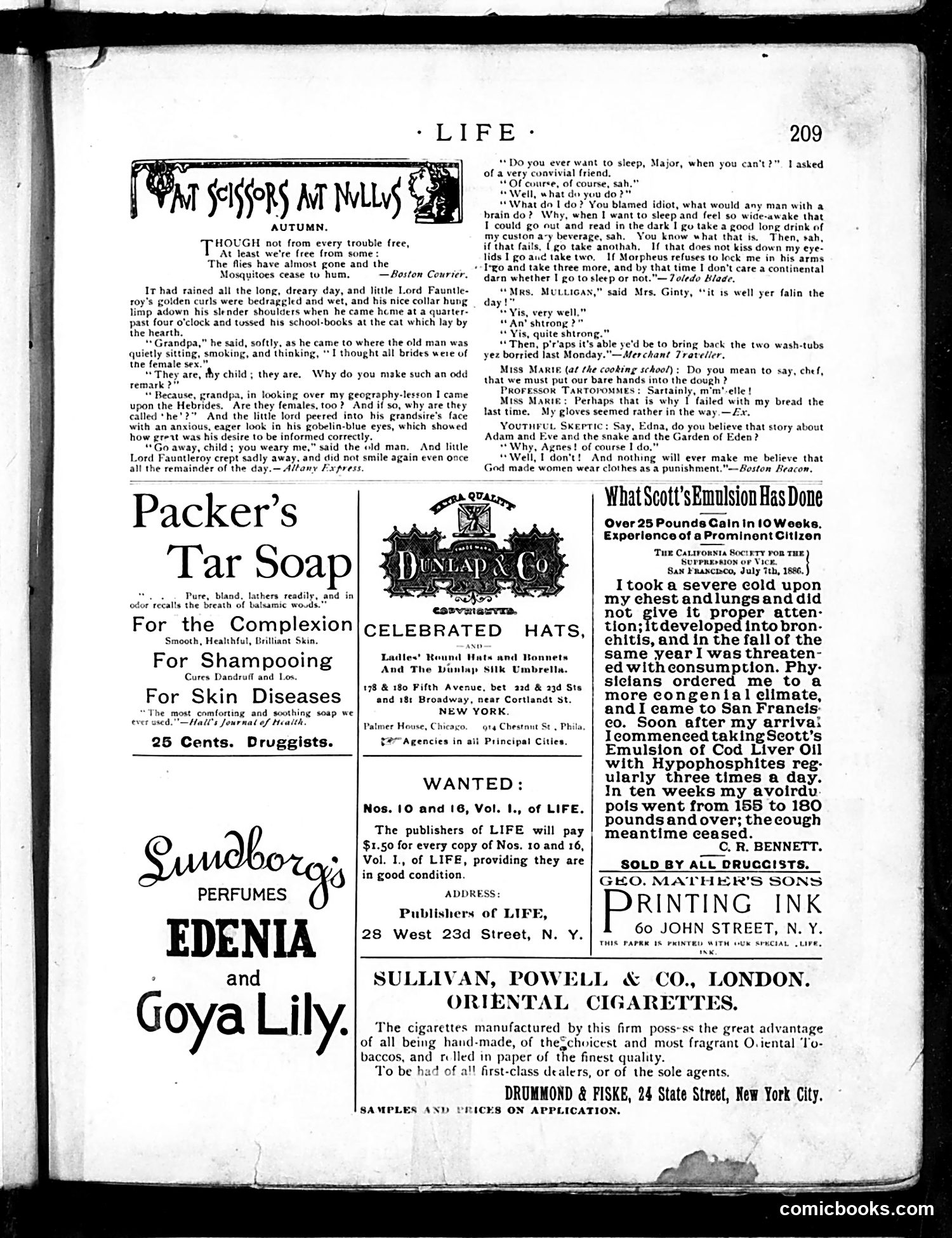
This page combines humor pieces with Victorian-era advertisements. The main content includes three comic anecdotes: **"Lord Fauntleroy's Question"**: A child's misunderstanding of geography—confusing the Hebrides islands with "he-brides" (female brides). The humor relies on innocent wordplay from a well-mannered young protagonist. **"The Major's Sleeping Solution"**: A Southern gentleman character ("sah") humorously describes using alcohol as a sleep aid, escalating from one drink to three if needed—satirizing both drinking culture and the gentleman's matter-of-fact attitude toward excess. **Other brief jokes** involve Irish domestics borrowing wash-tubs, a cooking student's failed bread-making, and skepticism about biblical accounts. The page is primarily **advertising-driven**, featuring Packer's Tar Soap, Dunlap Hats, perfumes, and Scott's Emulsion (a cod liver oil supplement). The social satire is mild—poking fun at class differences, gender expectations, and period stereotypes rather than addressing serious political issues.
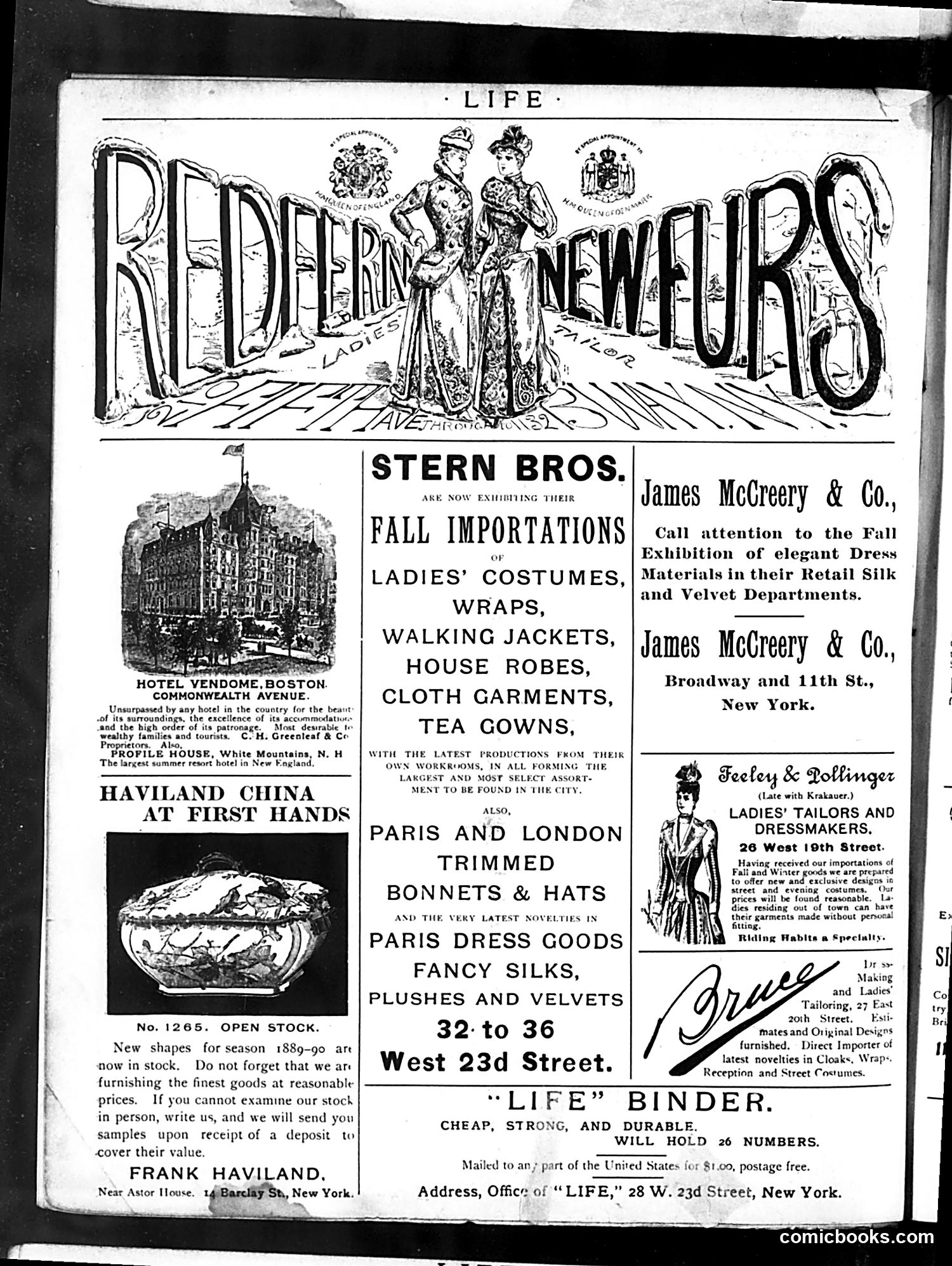
This is primarily an **advertising page** from Life magazine (circa 1889-90, based on the season dates mentioned). The large decorative header "REDTERN'S NEWCLOAKS" at the top appears to be the main advertisement, featuring an illustrated couple in fashionable dress with royal crests. The page contains **no political cartoon or satire**—instead, it's filled with retail advertisements for high-end clothing and home goods targeting wealthy customers: department stores (Stern Bros., James McCreery & Co.), dressmakers, hotels (Hotel Vendome in Boston), and china importers. The advertisements emphasize **imported European fashions** ("Paris and London trimmed bonnets"), luxury materials (silks, velvets, plushes), and exclusive designs for women's clothing—walking jackets, tea gowns, riding habits. This reflects the late 19th-century American upper class's desire for European sophistication. The "Life Binder" at bottom advertises the magazine's subscription format, offering to bind 26 issues for $1.00 postage-free.
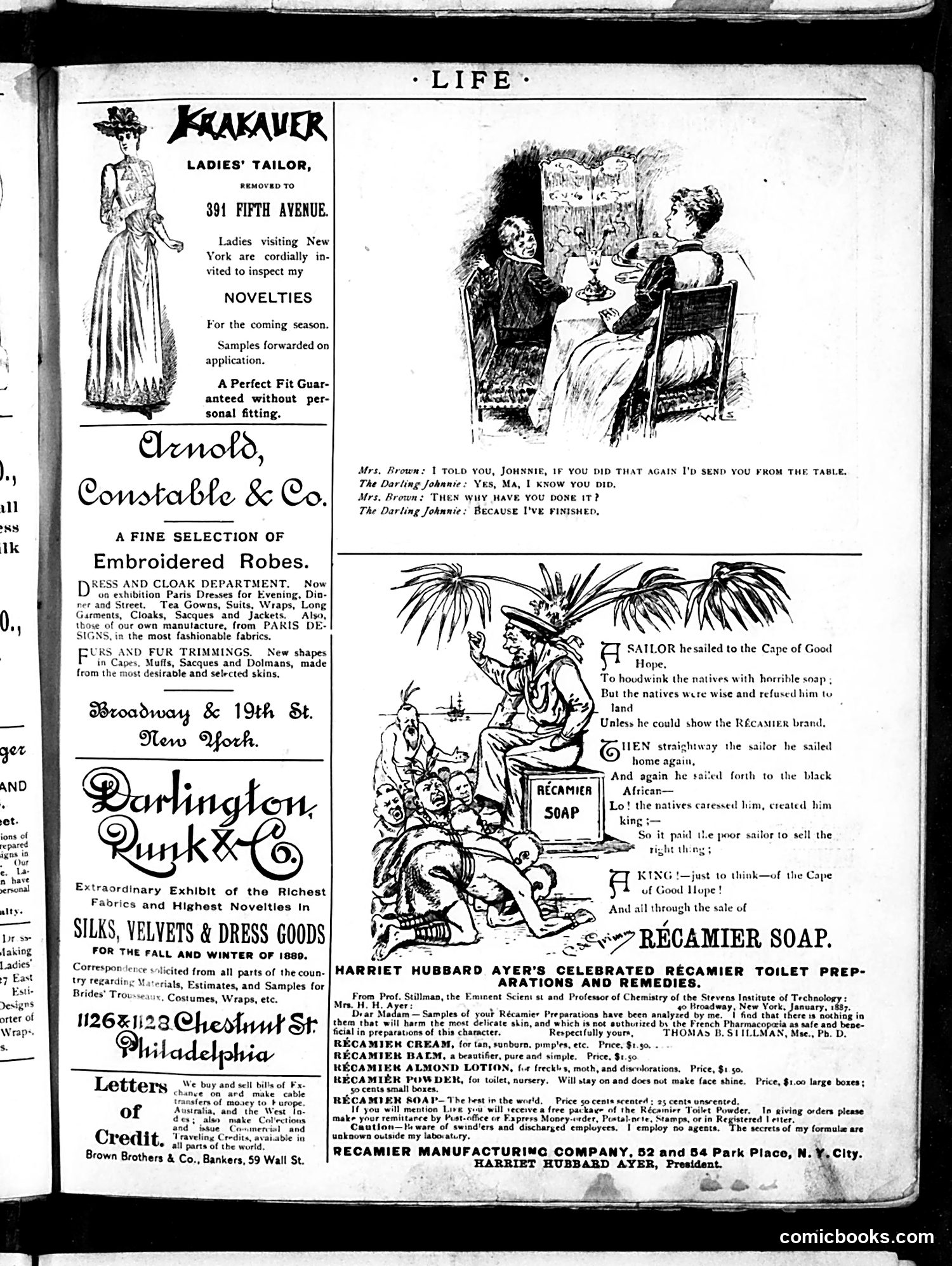
This page is primarily **advertising** with one brief cartoon joke. The small cartoon depicts a domestic scene: a mother threatens her mischievous son "Johnnie" with banishment from the table if he misbehaves again. When asked why he repeated the offense, he replies: "Because I've finished"—the humor lying in his literal interpretation of her threat. He's not afraid of punishment *after* he's done eating. The bulk of the page comprises **late-19th-century fashion and beauty advertisements**: Krakauer's ladies' tailoring, Arnold Constable's embroidered robes, Darlington Runk's silks and dress goods, and notably **Recamier Soap and beauty products** (featuring a whimsical illustrated tale about a sailor selling the brand to African natives). The Recamier ad includes a testimonial from "Prof. Stillman" authenticating the product's safety—a common marketing tactic for cosmetics in this era, lending scientific credibility to beauty preparations. The page reflects **1880s consumer culture**, targeting wealthy urban women with luxury goods and validated cosmetic claims.
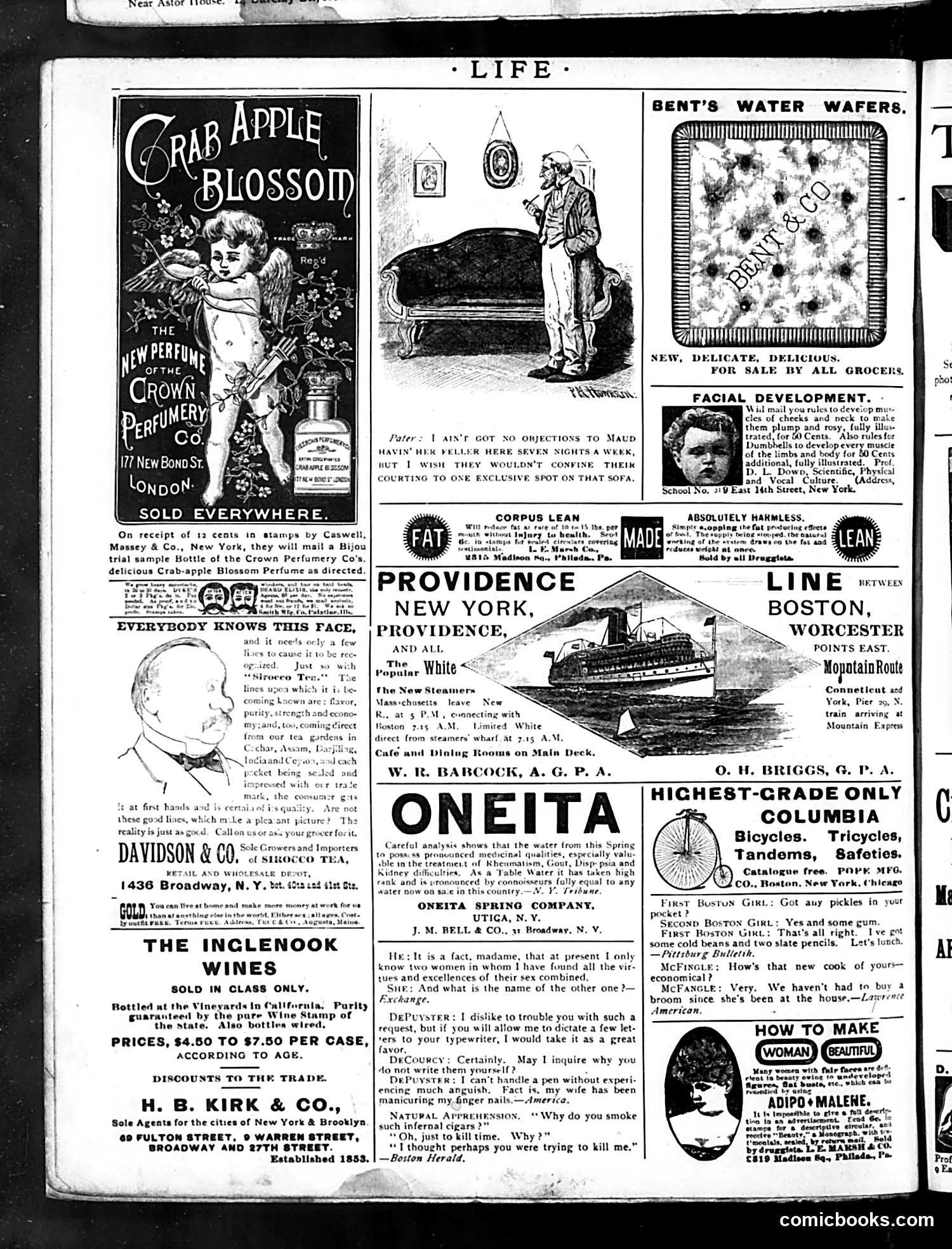
This is primarily an **advertising page** from Life magazine, with minimal editorial cartooning. The single cartoon of note is small and appears mid-page: **The Main Cartoon:** A man and woman sit on a sofa. The caption reads: "I ain't got no objections to Maud havin' her feller here seven nights a week, but I wish they wouldn't confine their courting to one exclusive spot on that sofa." **The Joke:** This is a domestic humor piece about a father tolerating his daughter's boyfriend's frequent visits, but complaining that their constant cuddling in the same sofa spot is wearing it out—a mild, genteel critique of young courtship behavior that would resonate with Victorian/Edwardian parents. **Context:** The page reflects turn-of-century consumer culture, featuring advertisements for perfume, wines, bicycles, steamship lines, and patent medicines promising "facial development" and "absolutely harmless" treatments. The brief comedic exchanges scattered throughout are typical of Life's light, genteel humor for middle-class readers.
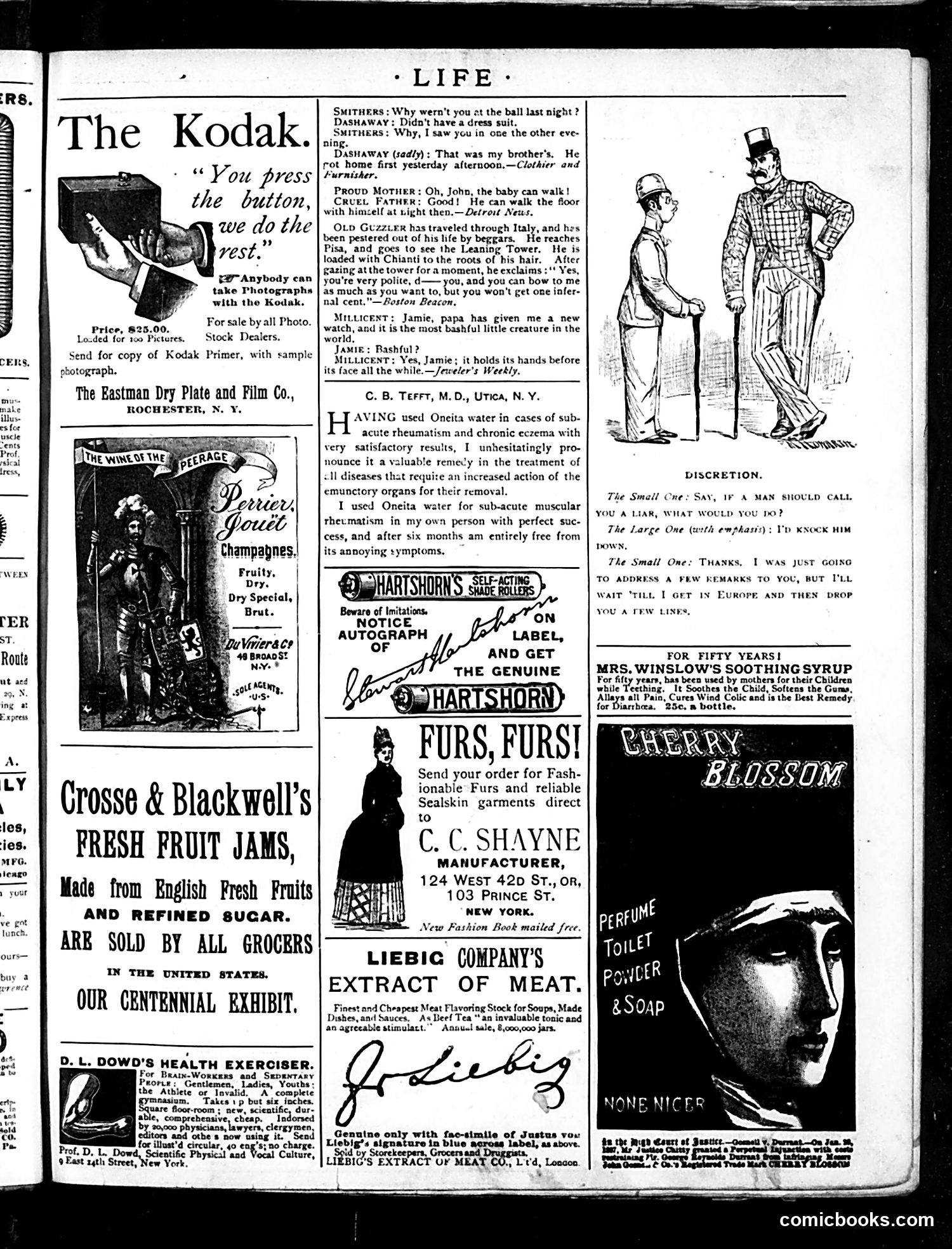
This page is primarily **advertising with some brief comedic anecdotes** rather than political cartoons. The main illustrated item is a cartoon titled "Discretion" showing two men of different sizes in conversation. The joke plays on physical intimidation: the smaller man asks what he'd do if called a liar; the larger man threatens violence. The smaller man then admits he was planning to insult the larger man but will wait until traveling to Europe to send insulting letters instead—a cowardly but practical approach to avoiding confrontation. The page otherwise consists of **period product advertisements**: Kodak cameras, Crosse & Blackwell jams, health exercise equipment, furs, patent medicines (Hartshorn, Liebig's meat extract, Mrs. Winslow's soothing syrup), and perfume. Several anecdotes mock social pretension (borrowed dress suits, drunk tourists, bashful gifts). The content reflects **late 19th-century American consumer culture** and genteel humor about manners and social embarrassment rather than political satire.
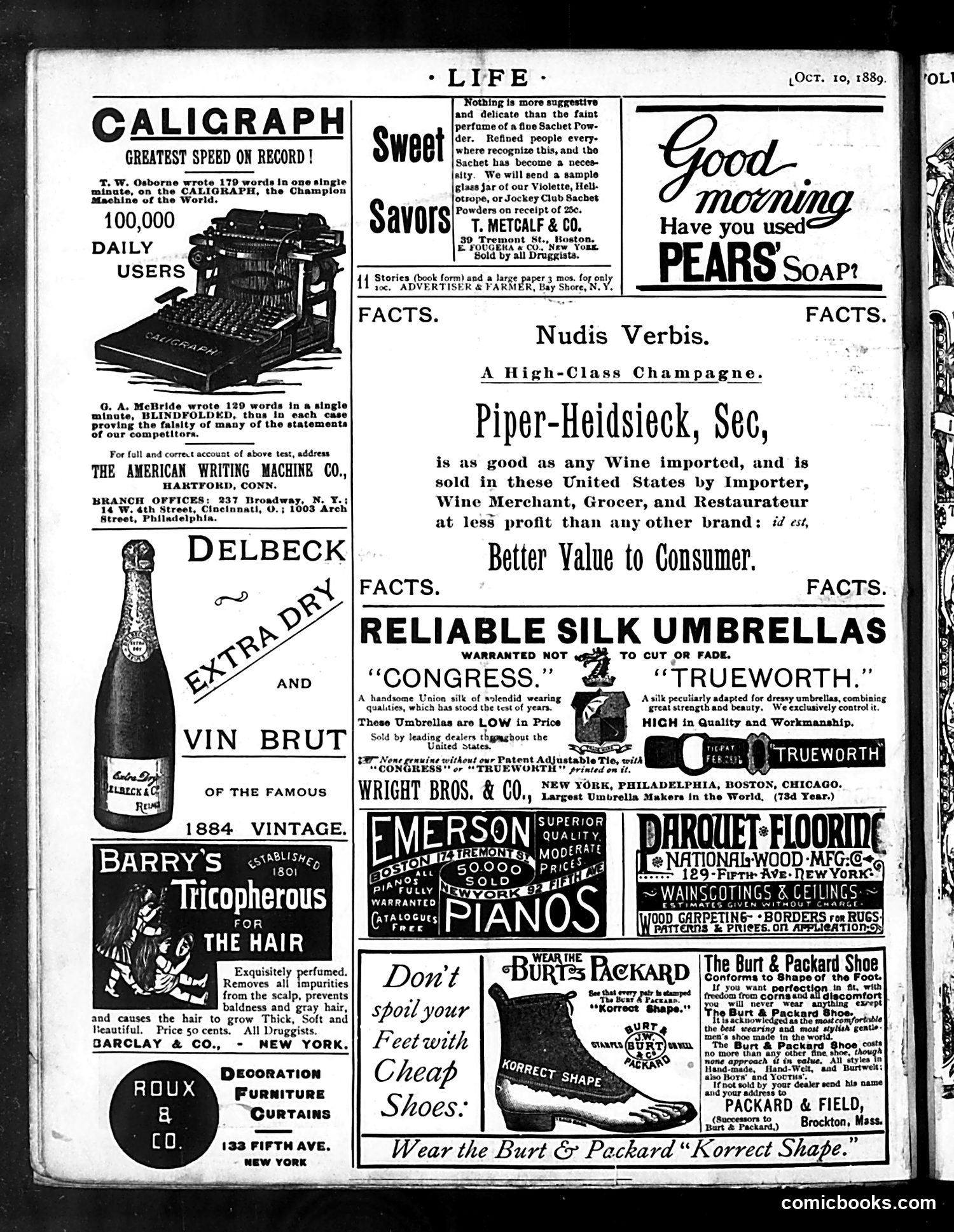
This page is **primarily advertising**, not satire or political commentary. It represents a typical late-Victorian magazine layout mixing product endorsements with minimal editorial content. Notable advertisements include: - **Caligraph typewriter**: Boasts speed records (179 and 129 words typed in single minutes), competing in the emerging typewriter market. - **Pears' Soap**: A popular British brand using the "Good Morning" greeting to establish brand familiarity. - **Barry's Tricopherous**: A hair-growth product promising to prevent baldness—reflecting period anxieties about personal grooming. - **Burt & Packard shoes**: Emphasizing proper foot shape and comfort, a competitive luxury shoe brand. - **Pianos, champagne, umbrellas, and furniture**: Typical consumer goods for affluent readers. The page captures 1889 consumer culture: typewriter technology was novel, branded personal-care products were proliferating, and advertisements used pseudo-scientific claims and genteel aesthetic appeals to target middle/upper-class readers.