
Life, 1889-10-10 · page 12 of 18
Life — October 10, 1889 — page 12: what you’re looking at
What you’re looking at
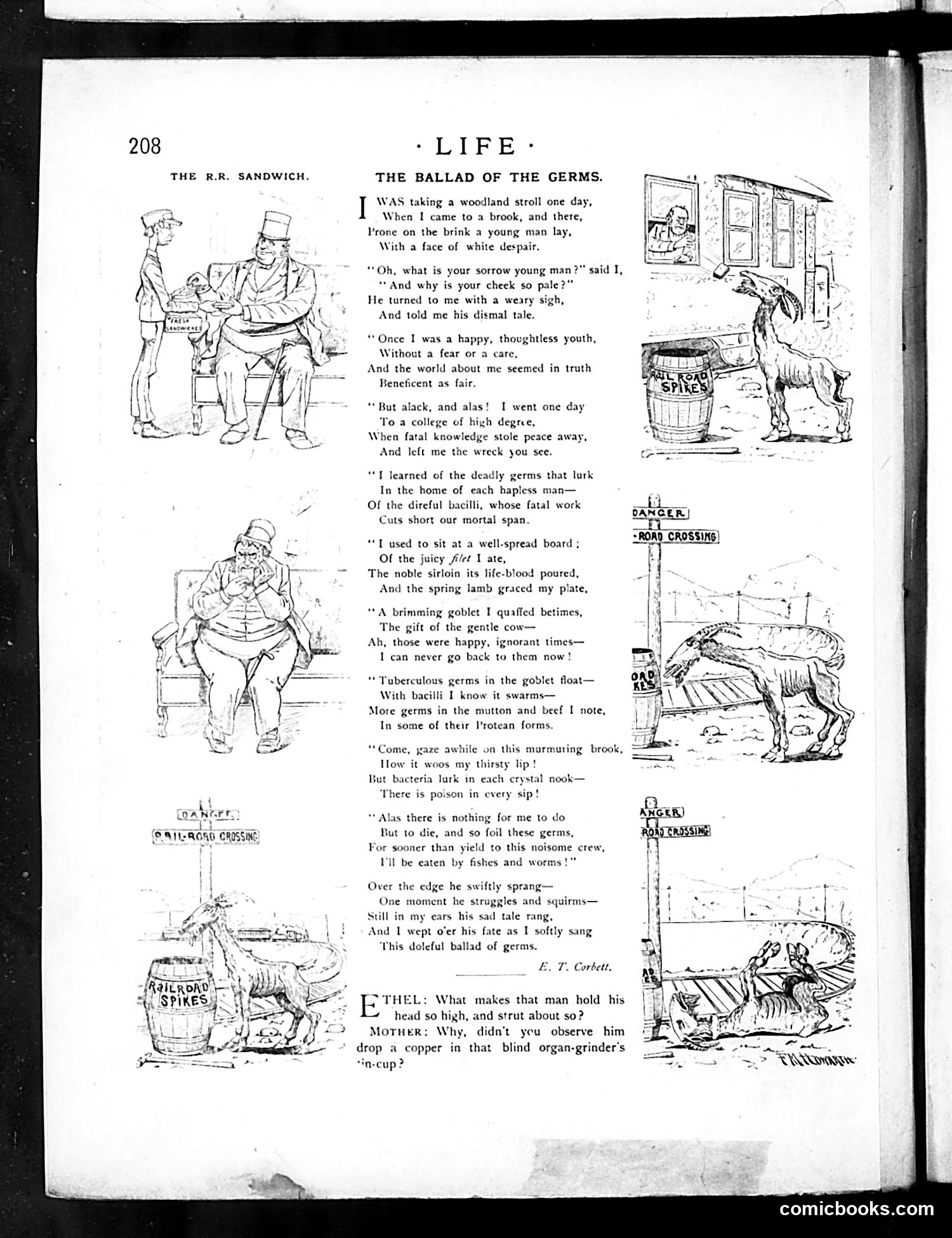
This page satirizes early-20th-century germ theory anxiety. The ballad tells of a young man driven to suicide after attending college, where he learned about bacteria and microorganisms lurking everywhere—in meat, milk, and drinking water. The joke targets educated society's newly-acquired fear of invisible pathogens. The protagonist, once happily ignorant, becomes paralyzed by knowledge of germs in every food and drink, ultimately choosing death over contamination. The accompanying cartoons (labeled "The R.R. Sandwich" and "Road Crossing" scenes) appear to extend this theme—mocking how germaphobia infiltrated everyday life and dining. The bottom dialogue joke provides comic relief: a mother praises a man for charity, but the satirical point is that his smug self-satisfaction over a small donation mirrors the protagonist's distorted priorities—misplaced concerns dominating behavior. The satire mocks both scientific anxiety and the absurdity of letting theoretical knowledge paralyze practical living.
📄 Transcribed text from this page (OCR, searchable)
Machine-transcribed from the original scan — historical spelling and the odd misread are preserved.
THE R.R. SANDWICH. THE BALLAD OF THE GERMS. WAS taking a woodland stroll one day, When I came to a brook, and there, Prone on the brink a young man lay, With a face of white despair. “Oh, what is your sorrow young man?" said I, “And why is your cheek so pale?” He turned to me with a weary sigh, And told me his dismal tale. ‘Once I was a happy, thoughtless youth, Without a fear or a care, And the world about me seemed in truth Beneficent as fair. “But alack, and alas! I went one day To a college of high degree, When fatal knowledge stole peace away, And left me the wreck you see. “T learned of the deadly germs that lurk In the home of each hapless man— Of the direful bacilli, whose fatal work Cuts short our mortal span. ““L used to sit at a well-spread board ; Of the juicy fi/et I ate, The noble sirloin its life-blood poured, And the spring lamb graced my plate, “A brimming goblet I quaffed betimes, The gift of the gentle cow— Ah, those were happy, ignorant times— I can never go back to them now ! “Tuberculous germs in the goblet float— With bacilli I know it swarms— More germs in the mutton and beef I note, In some of their l’rotean forms. “Come, yaze awhile on this murmuring brook, How it woos my thirsty lip! But bacteria lurk in each crystal nook— ‘There is poison in every sip! a! TAN? Alas there is nothing for me to do PAT ROAG CROSSE But to die, and so foil these germs, , a For sooner than yield to this noisome crew, Vil be eaten by fishes and worms!” Over the edge he swiftly sprang— One moment he struggles and squirms— Still in my ears his sad tale rang, And I wept o'er his fate as I softly sang ‘This doleful ballad of germs. E. T. Corbett, THEL: What makes that man hold his head so high, and strut about so? MoTHER: Why, didn't yeu observe him drop a copper in that blind organ-grinder’s ‘in-cup? comicbooks.com