
Life, 1889-10-10 · page 4 of 18
Life — October 10, 1889 — page 4: what you’re looking at
What you’re looking at
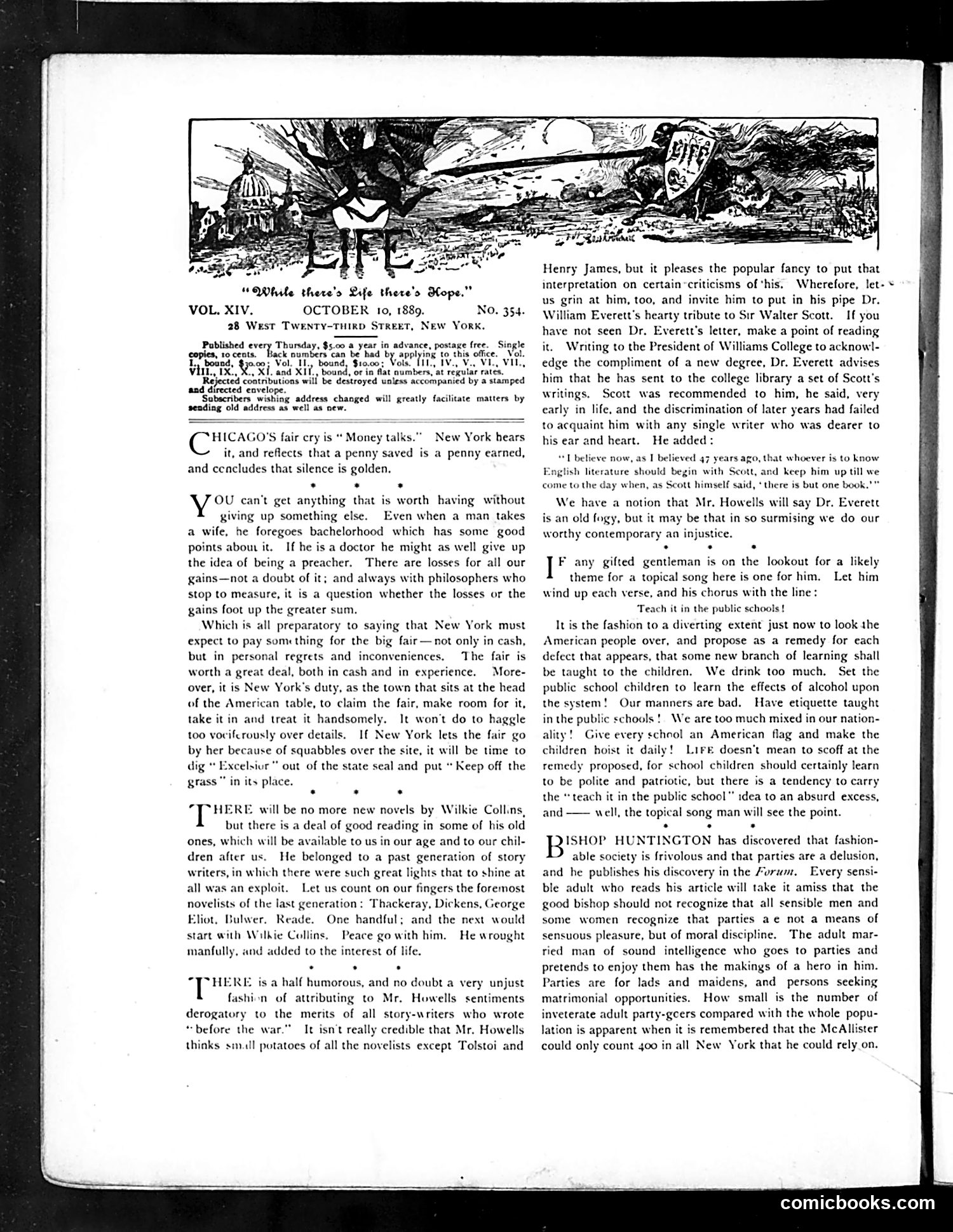
The masthead cartoon depicts **Life magazine's personification as a figure with a banner**, illustrated in the magazine's characteristic satirical style. The accompanying editorial discusses New York's upcoming fair, arguing the city should invest properly in it rather than haggle over details. The piece advocates removing obstacles and making room for the fair's success, using the phrase "Keep off the grass" metaphorically—suggesting New York shouldn't let bureaucratic concerns undermine the event. The editorial also addresses literary criticism of Henry James and discusses William Everett's writings on Walter Scott, touching on debates about American versus British literature. Additionally, there's commentary on public schools' need to teach patriotism and etiquette, and Bishop Huntington's observations about fashionable society and parties. The page functions primarily as editorial commentary rather than visual satire.
📄 Transcribed text from this page (OCR, searchable)
Machine-transcribed from the original scan — historical spelling and the odd misread are preserved.
“OWDtite there's Life there's Hope.” VOL. XIV. OCTOBER 10, 1889. No. 354- 28 West TWENTY-THIRD STREET, New York. Published every Thursday, $5.00 a year in advance, postage free. toceots. Back numbers can be had by applying to this office. Vol. 1, bound, Lad Vol. I1., bound, $10.00; Vols. III, IV. Vi, VIL, vit. 1X), X) Xi. and XI7., bound, of in flat aumbers, at regular rates. Rejected contributions will be destroyed unless accompanied by a stamped and directed envelope. Subscribers wishing address changed will greatly facilitate matters by sending old address as well as new. Single HICAGO'S fair cry is “ Money tal New York hears it, and reflects that a penny saved is a penny earned, and cencludes that silence is golden. . . . Yo ‘an’t get anything that is worth having without iving up something else. en when a man takes a wife, he foregoes bachelorhood which has some good points about it. If he is a doctor he might as well give up the idea of being a preacher. There are losses for all our gains—not a doubt of it; and always with philosophers who stop to measure, it is a question whether the losses or the gains foot up the greater sum. Which is all preparatory to saying that New York must expect to pay somthing for the big fair—not only in cash, but in personal regrets and inconveniences, The fair is worth a great deal, both in cash and in experience. More- over, it is New York's duty, as the town that sits at the head of the American table, to claim the fair, make room for it, take it in and treat it handsome! It won't do to haggle too vovifcrously over details. If New York lets the fair go by her because of squabbles over the site, it will be time to dig “ Excelsiur” out of the state seal and put “Keep off the grass” in its place. . . . T" E will be no more new novels by Wilkie Collins, but there is a deal of good reading in some of his old ones, which will be available to us in our age and to our chil- dren after us. He belonged to a past generation of story writers, in which there were such great lights that to shine at all was an exploit. Let us count on our fingers the foremost novelists of the last generation: Thackeray, Dickens, George Eliot, Bulwer. Reade. One handful; and the next would start with Wilkie Collins, Peace go with him. He wrought manfully, and added to the interest of life. Paks is a half humorous, and no doubt a very unjust fashion of attributing to Mr. Howells sentiments derogatory to the merits of all story-writers who wrote “before the war.” It isn't really credible that Mr. Howells thinks sin.ull potatoes of all the novelists except Tolstoi and Henry James, but it pleases the popular fancy to put that interpretation on certain-criticisms of ‘his. Wherefore, let- + us grin at him, too, and invite him to put in his pipe Dr. William Everett's hearty tribute to Sir Walter Scott. If you have not seen Dr. Everett's letter, make a point of reading it. Whiting to the President of Williams College to acknowl- edge the compliment of a new degree, Dr. Everett advises him that he has sent to the college library a set of Scott's writings. Scott was recommended to him, he said, very early in life, and the discrimination of later years had failed to acquaint him with any single writer who was dearer to his ear and heart. He added: “+1 believe now, as I believed 47 years ago, that whoever is to know English literature should begin with Scott, and keep him up till we come to the day when, as Scott himself said, ‘ there is but one book.’ We have a notion that Mr. Howells will say Dr. Everete is an old fogy, but it may be that in so surmising we do our worthy contemporary an injustice. . . . I' any gifted gentleman is on the lookout for a likely theme for a topical song here is one for him. Let him wind up each verse, and his chorus with the line: Teach it in the public schools ! It is the fashion to a diverting extent just now to look the American people over, and propose as a remedy for each defect that appears, that some new branch of learning shall be taught to the children. We drink too much, Set the public school children to learn the effects of alcohol upon the system! Our manners are bad, Have etiquette taught in the public schools !| We are too much mixed in our nation- ality! Give every school an American flag and make the children hoist it daily! LiFe doesn’t mean to scoff at the remedy proposed, for school children should certainly learn to be polite and patriotic, but there is a tendency to carry the “teach it in the public school” idea to an absurd excess, and —— well, the topical song man will see the point. . . . ISHOP HUNTINGTON has discovered that fashion- able society is frivolous and that parties are a delusion, and he publishes his discovery in the Forum. Every sensi- ble adult who reads his article will take it amiss that the good bishop should not recognize that all sensible men and some women recognize that parties ae not a means of sensuous pleasure, but of moral discipline. The adult mar- ried man of sound intelligence who goes to parties and pretends to enjoy them has the makings of a hero in him. Parties are for lads and maidens, and persons seeking matrimonial opportunities. How small is the number of inveterate adult party-gcers compared with the whole popu- lation is apparent when it is remembered that the McAllister could only count 400 in all New York that he could rely on. comicbooks.com