
A complete issue · 16 pages · 1889
Life — August 22, 1889
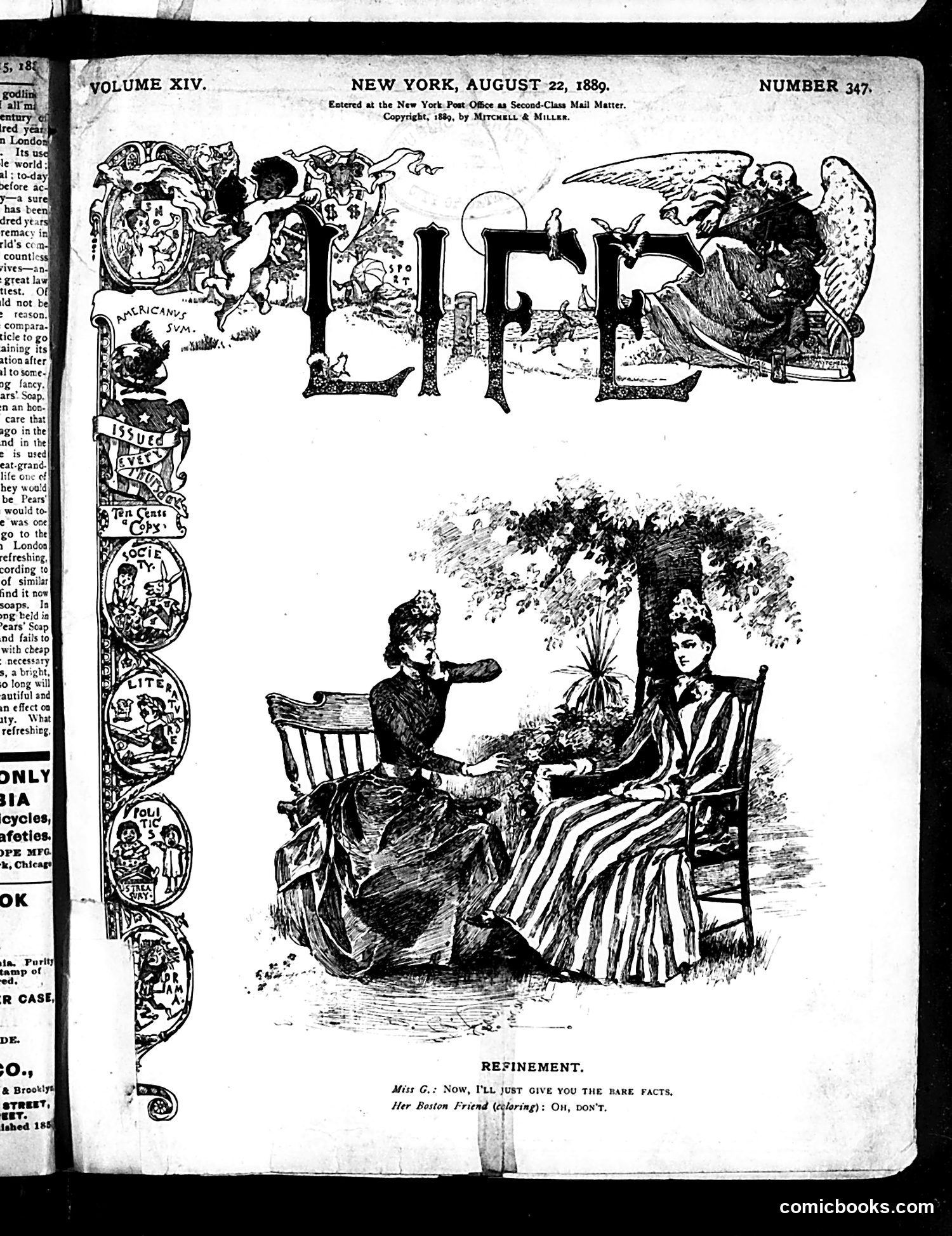
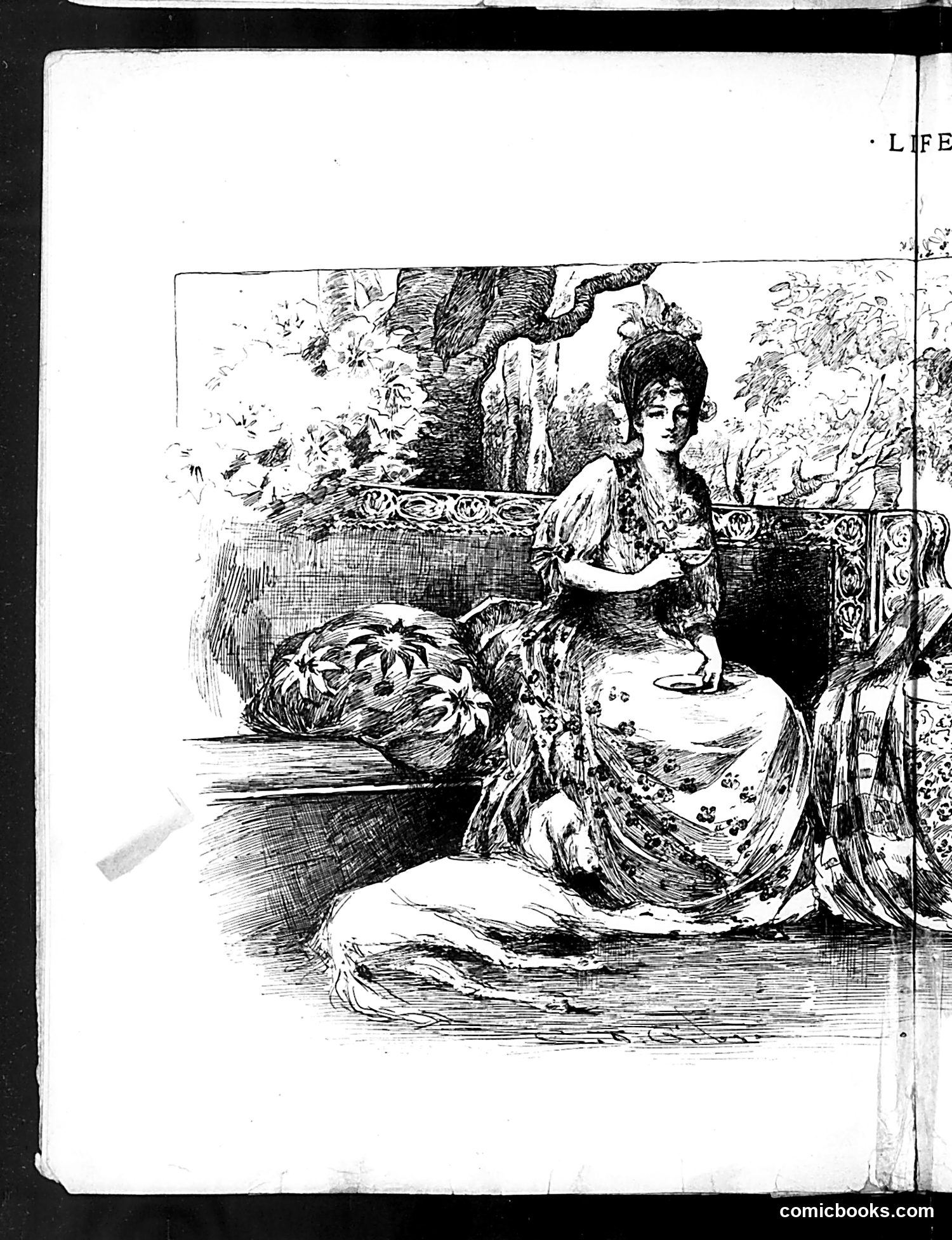
The cartoon depicts two Victorian-era women in conversation beneath a tree. The caption reads: "Miss G.: Now, I'll just give you the bare facts. / Her Boston Friend (interposing): Oh, don't." This is social satire about Boston gentility and euphemistic speech. The joke targets the pretension of refined Boston society, where even stating plain facts must be dressed up in delicate language rather than expressed "bare." The interrupting friend's objection to direct communication satirizes the excessive propriety of upper-class Victorian discourse—the idea that honest, straightforward speech is considered crude and unladylike among the supposedly cultured elite. The ornate decorative border features classical and whimsical figures, typical of Life's design aesthetic.
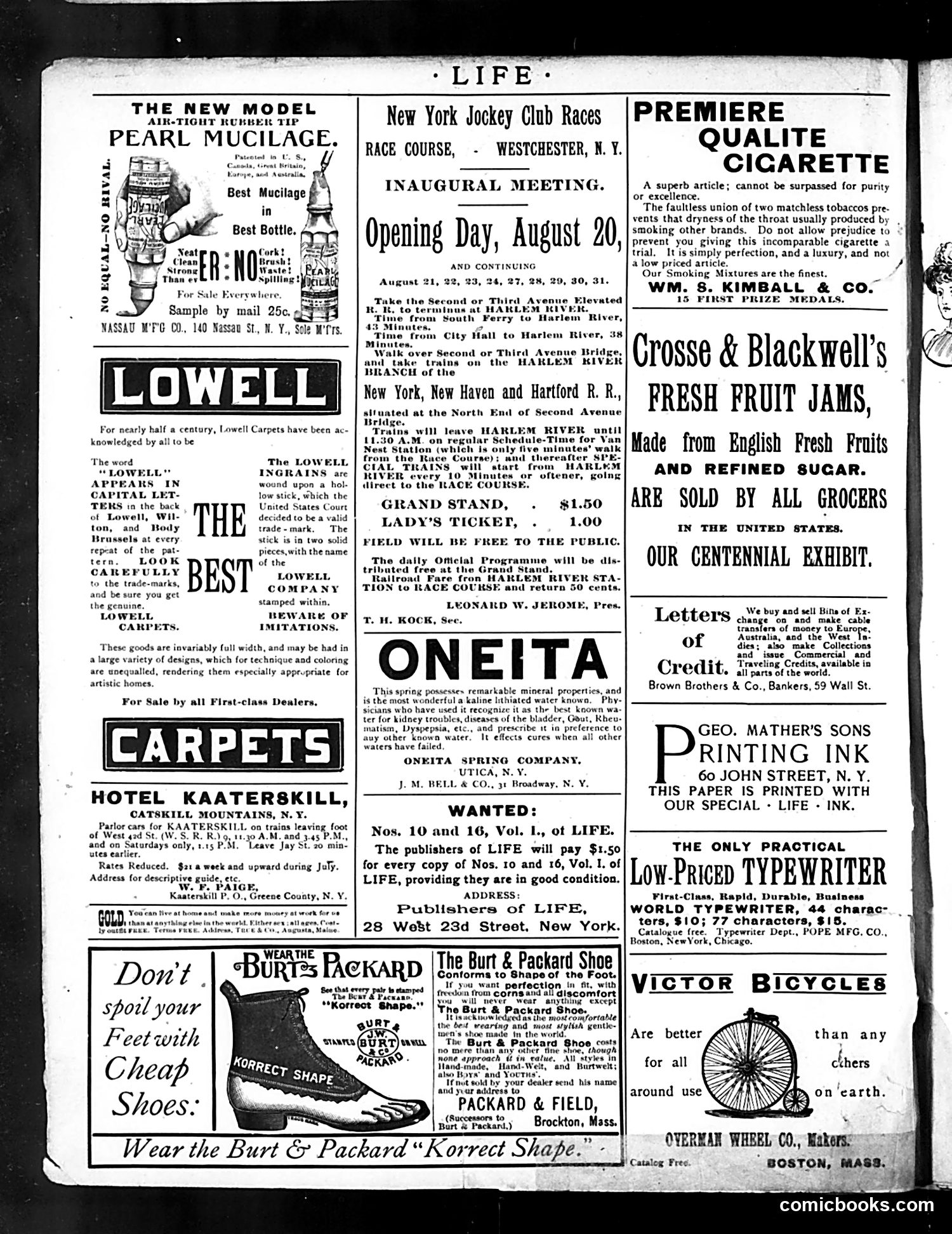
This page is **predominantly advertising** with no significant political cartoons or satirical content visible. The main advertisements include: - **Pearl Mucilage** (adhesive product) - **Lowell Carpets** - **Hotel Kaaterskill** (Catskill Mountains resort) - **Burt & Packard Shoes** (with a shoe illustration and slogan "Don't spoil your Feet with Cheap Shoes") - **Victor Bicycles** - Various other commercial products The center column contains **event information** for the New York Jockey Club's inaugural race meeting at Westchester, N.Y., opening August 20. There is **no political satire or meaningful cartooning** on this page—it reflects Life magazine's business model as a vehicle for advertising revenue rather than editorial commentary. The Burt & Packard shoe ad is the only illustration with any visual interest.
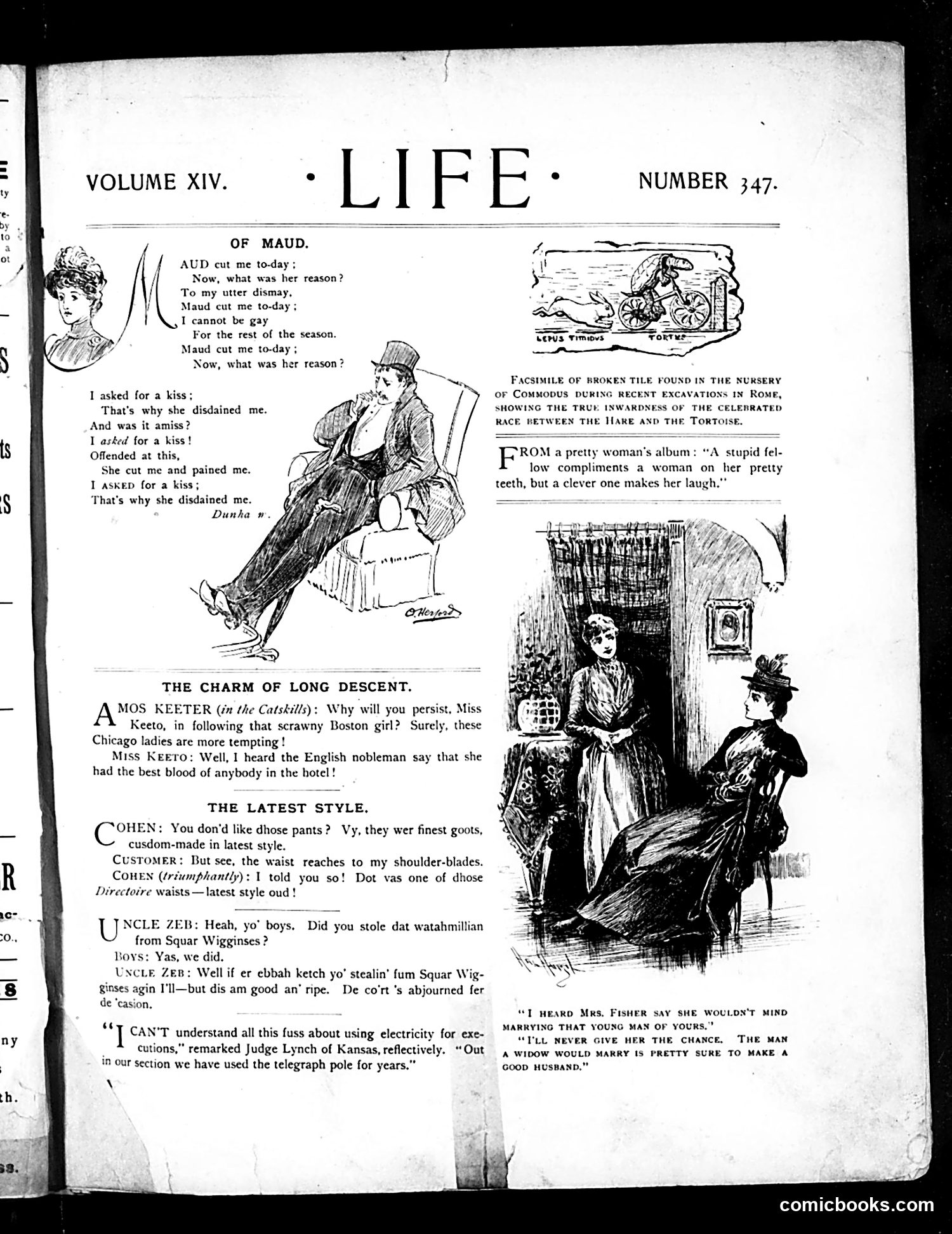
This page contains several unrelated humorous sketches typical of Life's satirical format: **"Of Maud"** presents a poem about a woman who repeatedly "cuts" (socially rejects) a suitor. The joke hinges on his misunderstanding her rejection—he interprets her cutting him as romantic interest rather than deliberate snubbing. **"The Charm of Long Descent"** satirizes social climbing, with a character claiming superior Boston ancestry while pursuing a working-class Chicago woman, suggesting ironic commentary on American class pretensions. **"The Latest Style"** mocks fashion and tailoring, featuring dialogue about trendy trousers and their exaggerated length. **"Uncle Zeb"** contains dialect humor about stealing, typical of period comedy relying on stereotyped speech patterns. The page also includes archaeological imagery and romantic vignettes, representing Life's mix of social satire, domestic humor, and lighthearted commentary on contemporary manners.
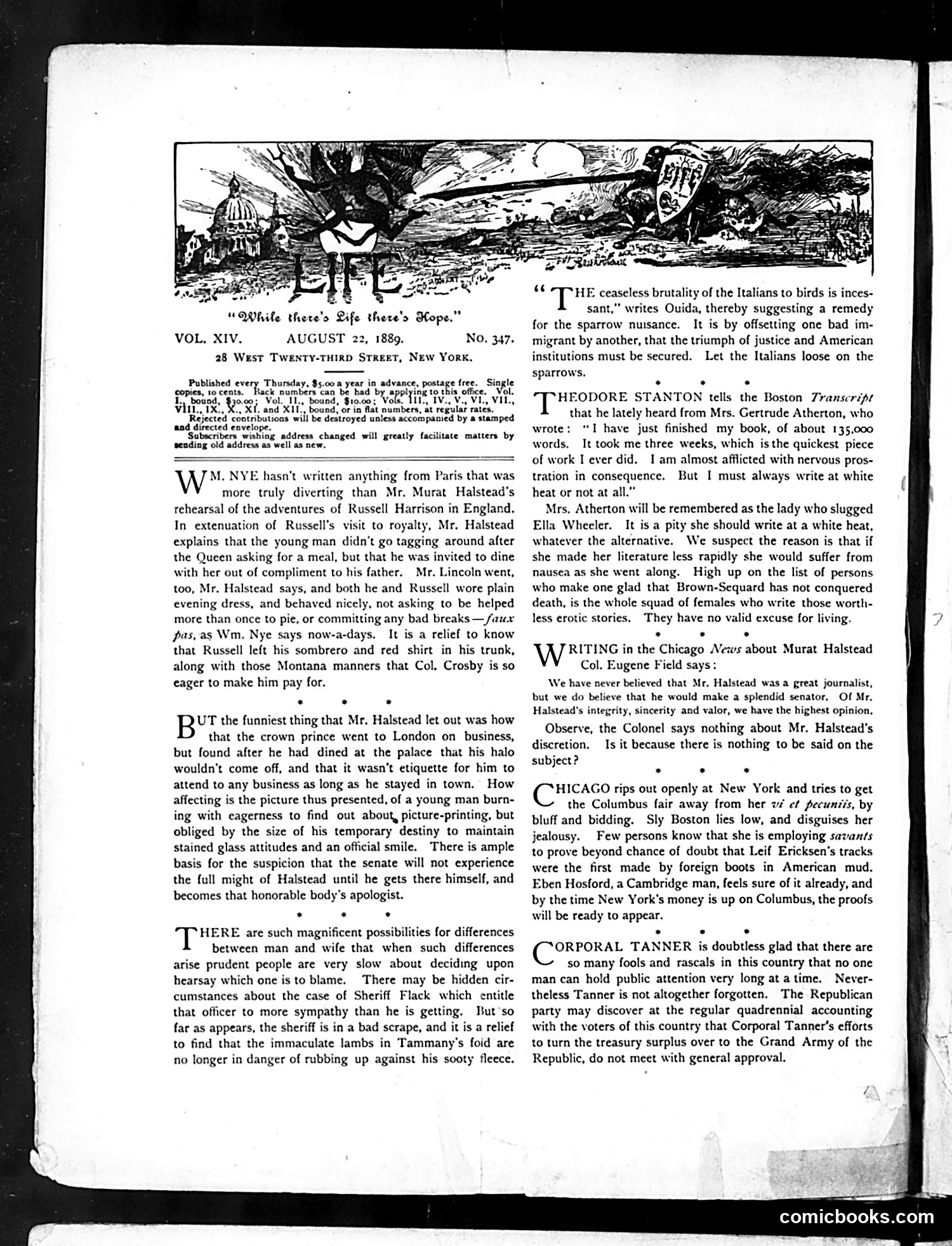
**The Cartoon:** The masthead illustration titled "While there's Life there's Scope" depicts a grim reaper figure looming over a landscape with a domed building (likely representing a government institution). The imagery suggests mortality and institutional vulnerability. **Page Content:** The text discusses Murat Halstead, a prominent journalist and editor. The articles criticize his integrity and journalistic practices, with references to his coverage of the Columbus expedition and disputes over credit for discoveries. One section sardonically praises him while questioning his discretion. **The Satire:** Life magazine is attacking Halstead's credibility and character through pointed commentary—typical of 1880s political satire. The editorial tone suggests Halstead was a controversial, ambitious figure whose journalistic ethics were questionable to Life's editors.
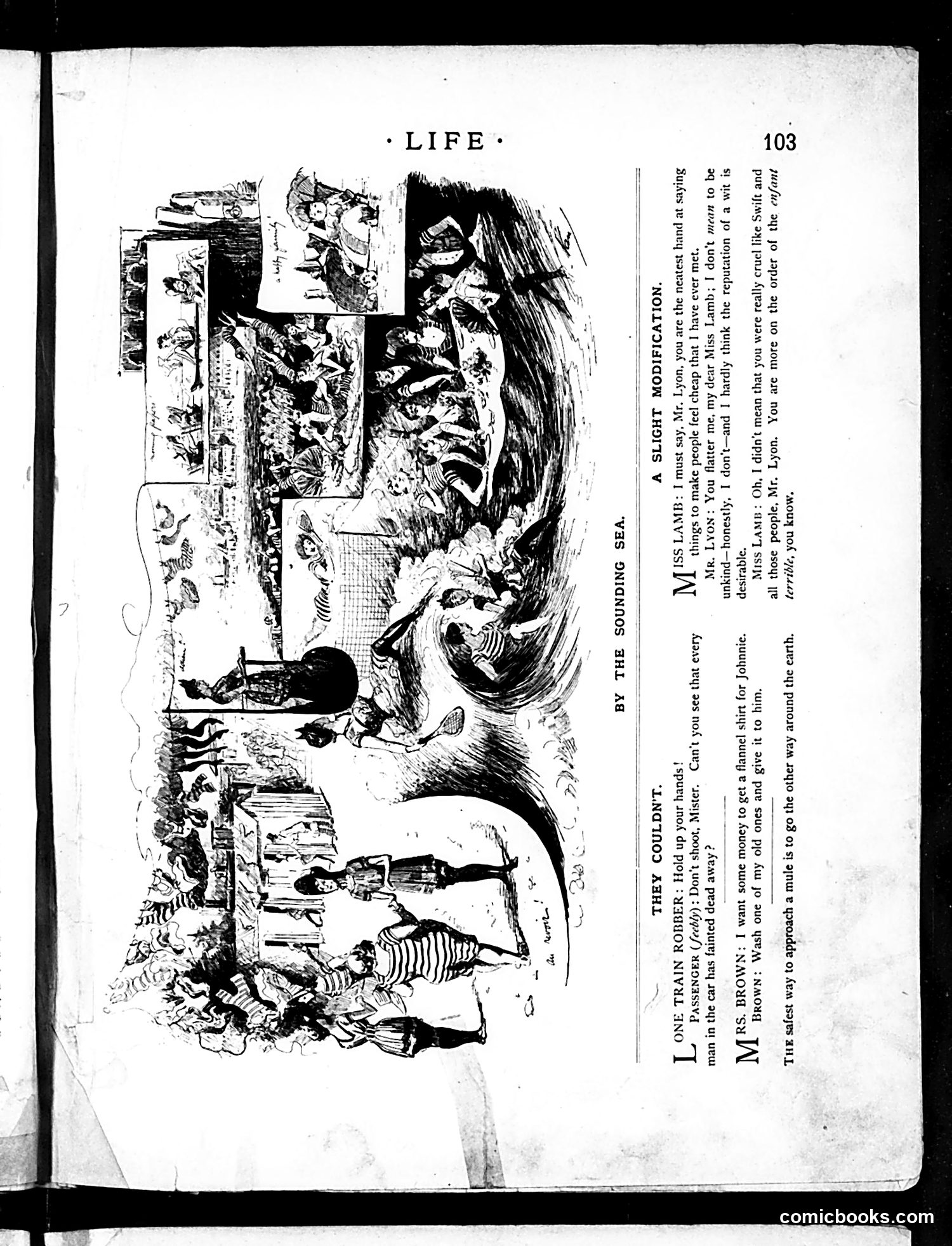
This cartoon satirizes maritime rescue protocol. The text presents a scenario where a ship's captain reports finding survivors at sea, then requests permission to modify standard rescue procedures—apparently seeking authorization to abandon the rescued people rather than assist them. The satire targets bureaucratic absurdity: the notion that a captain would need official permission to ignore drowning sailors contradicts basic maritime law and human decency. The joke hinges on the ridiculous formality of the request itself. The detailed maritime scene (visible in the illustration) provides context for what should be straightforward rescue operations. The cartoon criticizes either excessive bureaucratic procedures or, more darkly, institutional indifference to human suffering masked in official language.
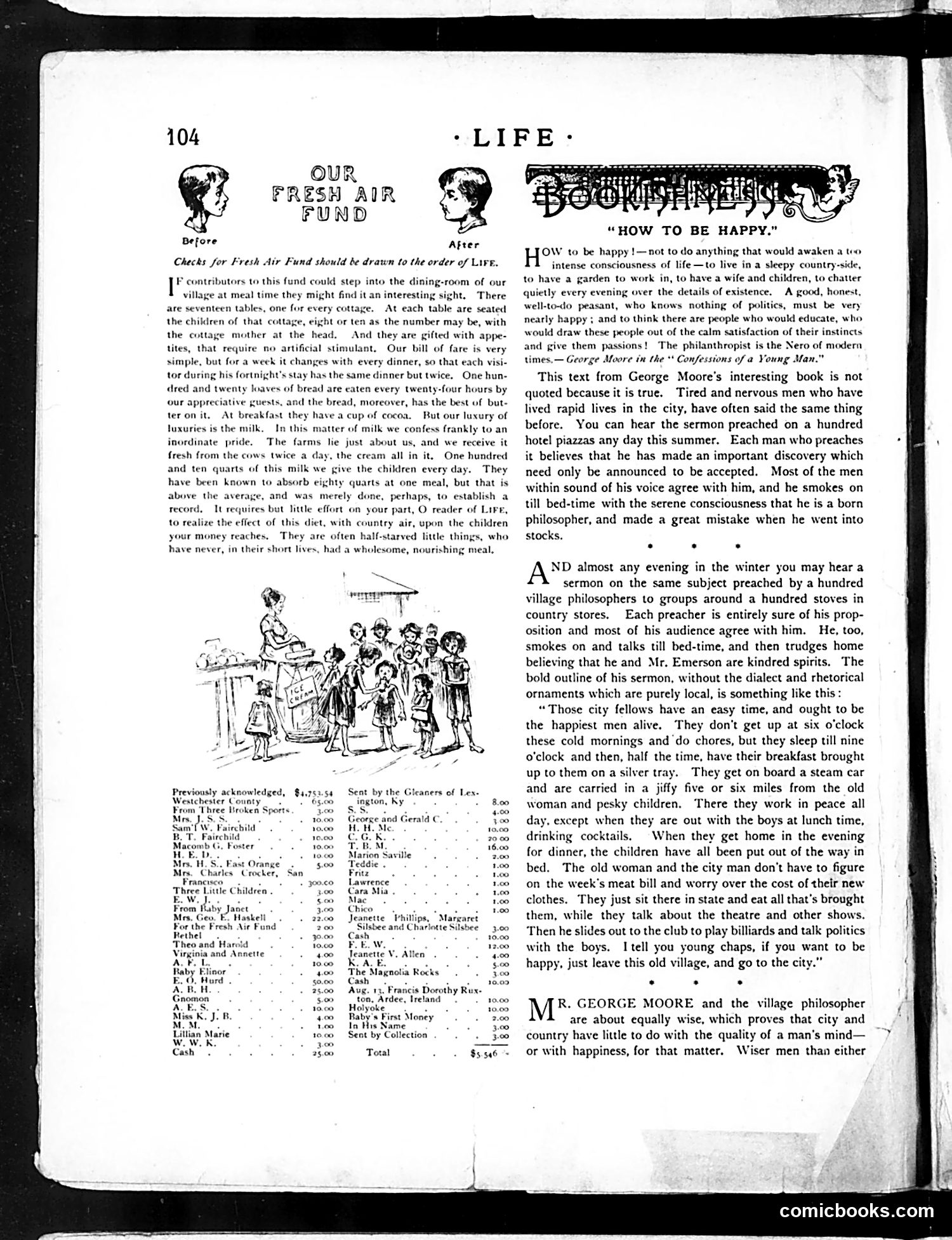
This page presents a satirical contrast between urban and rural happiness. The main article quotes George Moore's philosophy that contentment comes from simple living—having a garden, family, and quiet evenings—rather than material luxuries. The satire targets two groups: wealthy city dwellers who pursue comfort through consumption (with servants, elaborate meals, and luxury goods), and rural "village philosophers" who preach simplicity while actually enjoying leisurely lives free from urban drudgery. The cartoon illustrating the rural scene shows children and adults in a village setting, satirizing the romanticized notion that country life is inherently happier. The piece suggests that true happiness depends on one's mindset rather than location or wealth—a moderately progressive social commentary for the era.
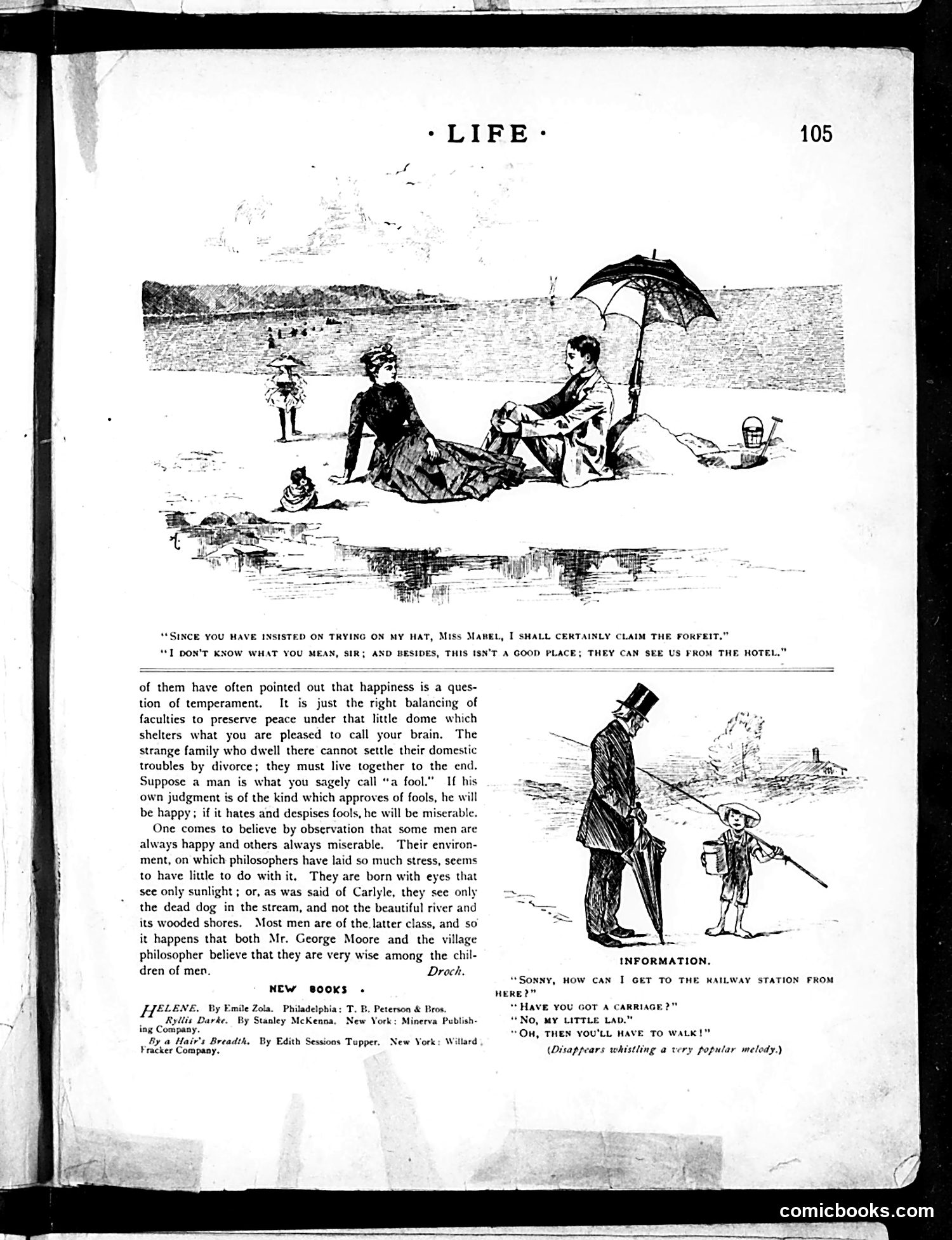
**Top Cartoon:** This seaside scene shows two women and a man on a beach. A woman in dark clothing objects to the man's suggestion that she try on his hat, fearing they'll be seen from the hotel. The satire targets Victorian-era social propriety—the anxiety that even minor improprieties (sharing a hat) could damage one's reputation if observed by others. The humor derives from the absurdity of such rigid social conventions. **Bottom Comic ("Information"):** A tall man asks a small boy for directions to the railway station. The boy responds with a nursery rhyme about disappearing while whistling, a nonsensical answer. This gentle humor mocks children's evasiveness or the difficulty of extracting useful information from youngsters. Both pieces reflect early 20th-century social anxieties and everyday domestic comedy.
This appears to be an illustration from *Life* magazine showing two elegantly dressed women in a garden or outdoor setting with classical architectural elements (decorative railing, tree, foliage). One woman is seated while another stands nearby. However, **the OCR text provided contains no actual content**—it appears blank or failed to capture the text. Without the accompanying text, I cannot identify: - Which specific figures or social types are being satirized - What political or social commentary the illustration makes - The joke or point of the satire The artistic style and composition suggest social satire about upper-class women or gender dynamics of the era, but without the text, I cannot responsibly explain what specific situation, behavior, or social issue this cartoon critiques.
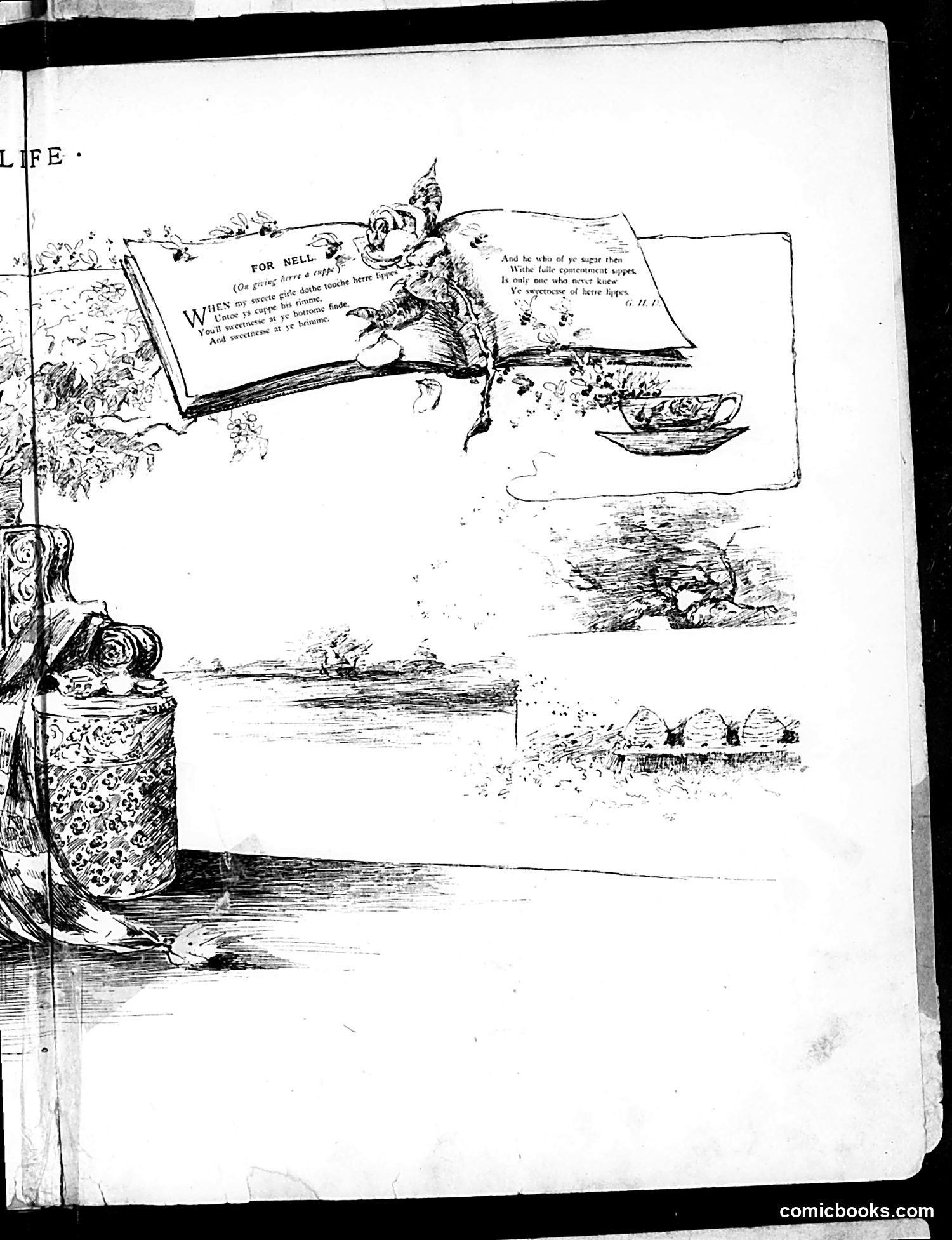
This appears to be a satirical illustration featuring a skeletal or demonic figure perched atop an open book labeled "FOR HELL." The figure gestures toward text passages, suggesting a commentary on religious hypocrisy or condemnation. The visible text references damnation and eternal consequences ("be who of ye argue them / While false accusers appear, / We scarcely of have here"). The scholarly or authoritative presentation—shown through the formal book format—suggests satire of how religious institutions or figures use scripture to condemn others. The illustration's dark, grotesque style emphasizes the mockery of hellfire rhetoric. Without knowing the specific historical context or date, this likely critiques how religious doctrine was weaponized for moral judgment, a common target of Life magazine's satirical content.
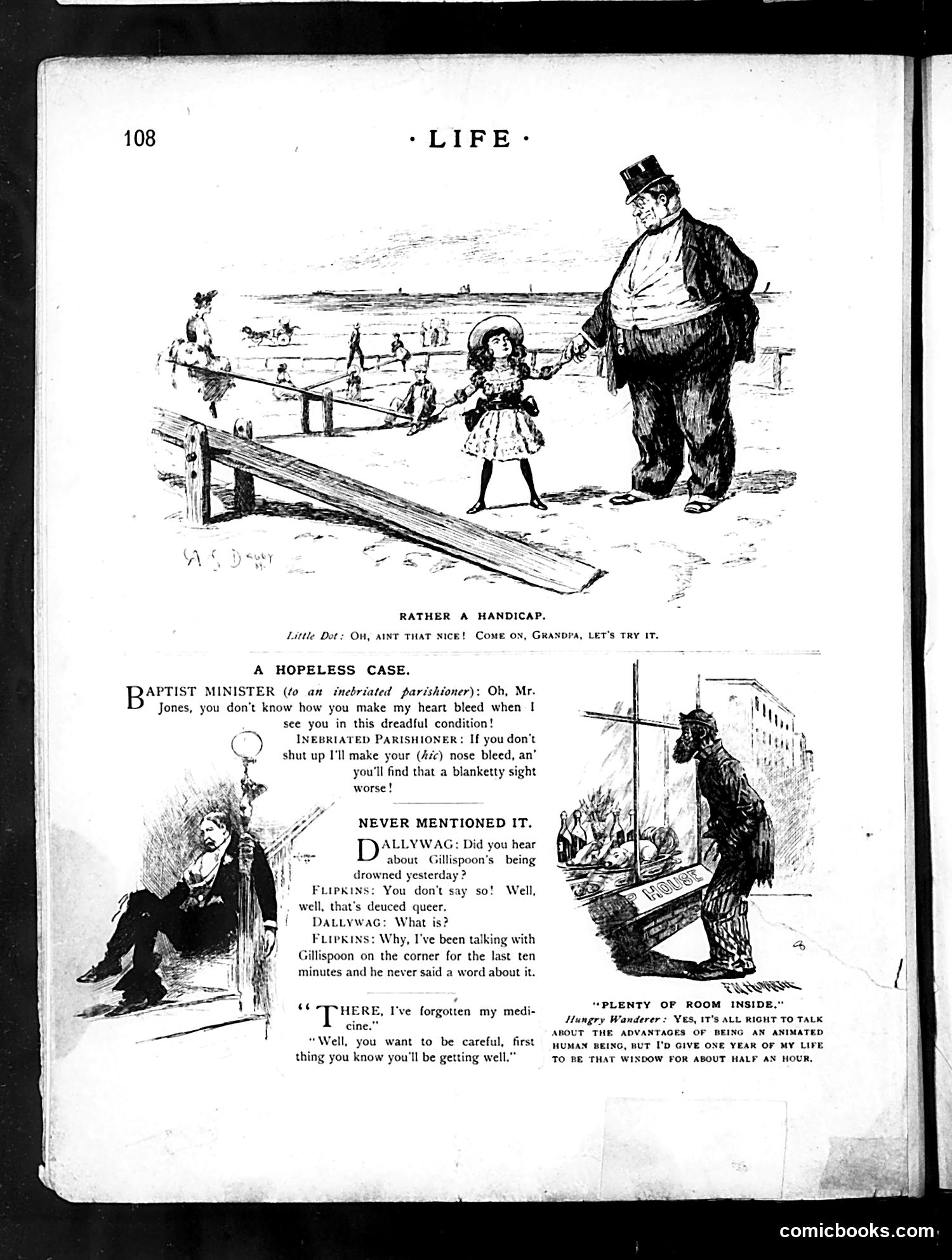
This page contains three separate satirical sketches: 1. **"Rather a Handicap"** (top): A well-dressed grandfather and young girl at a beach. The girl invites him to try a seesaw, apparently unaware his considerable weight makes him a poor partner for a child's play equipment—gentle satire on elderly gentlemen and physical limitations. 2. **"A Hopeless Case"** (left): A Baptist minister and inebriated parishioner debate doctrine. The drunk claims the minister's preaching causes him distress; the parishioner threatens violence. Social satire targeting both clergy and alcoholism. 3. **"Never Mentioned It"** (right): Two women gossip about someone named Gillispoon drowning, yet pretend ignorance when directly asked—satirizing selective social awareness and hypocrisy in gossiping circles. All three mock human nature and social pretense.
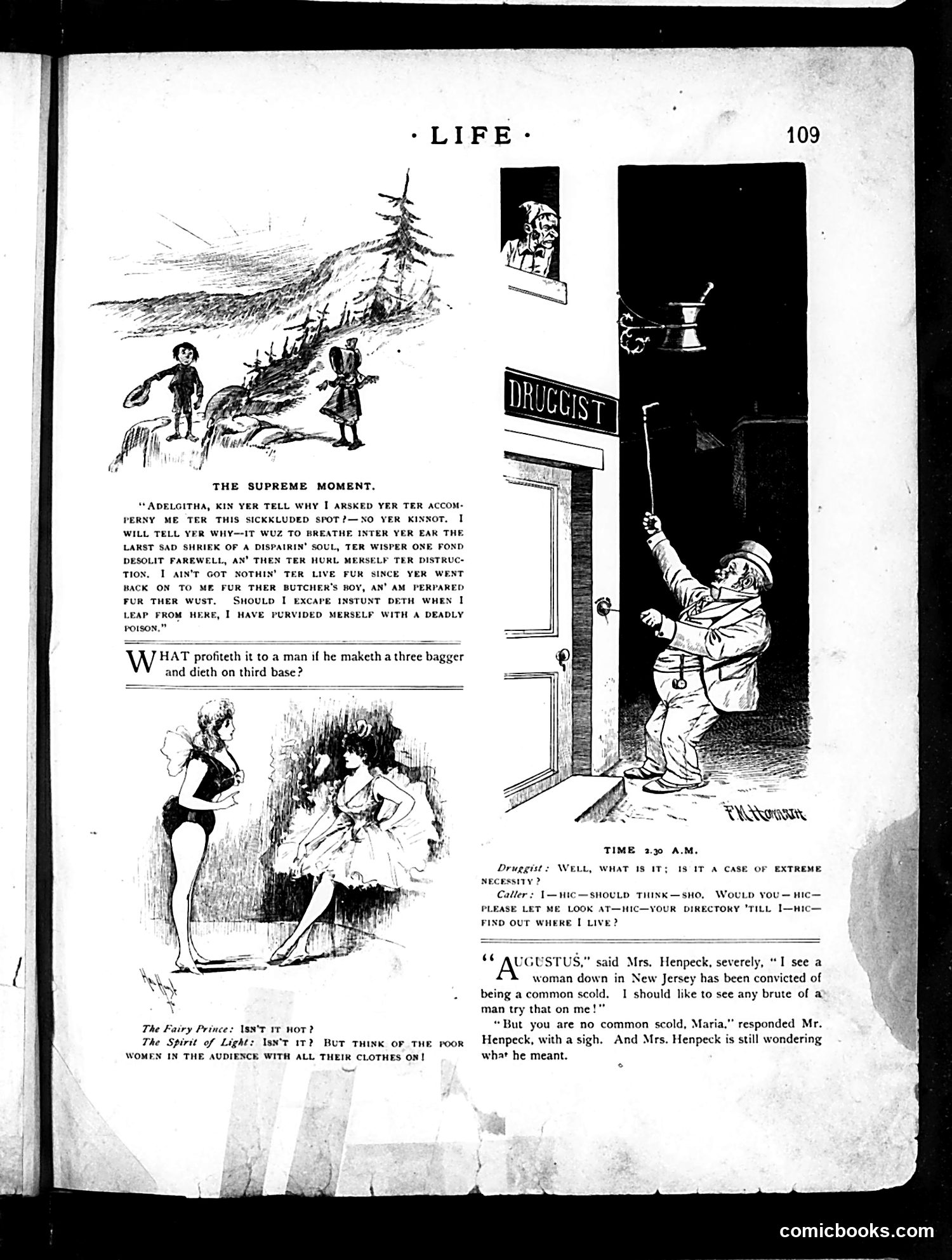
This page contains several satirical cartoons and brief stories typical of early 20th-century American humor: **"The Supreme Moment"** (top left): A sketch mocking overly dramatic farewell speeches, likely satirizing theatrical sentimentality. **"What profited it to a man if he maketh a three bagger and dieth on third base?"** (center): A baseball joke comparing biblical phrasing with sports failure—hitting successfully but failing to score. **"The Fairy Prince" / "The Spirit of Light"** (bottom left): A society satire about wealthy women's extravagant clothing at theatrical events, questioning why audiences attend to see fashions rather than performances. **"Time 2:20 A.M."** (right): A darkly comic scenario about a drugstore clerk's panicked late-night customer seeking an address, suggesting morally questionable desperation. **"Augustus" segment** (bottom): A brief narrative about marital discord regarding a woman's purported "common cold."
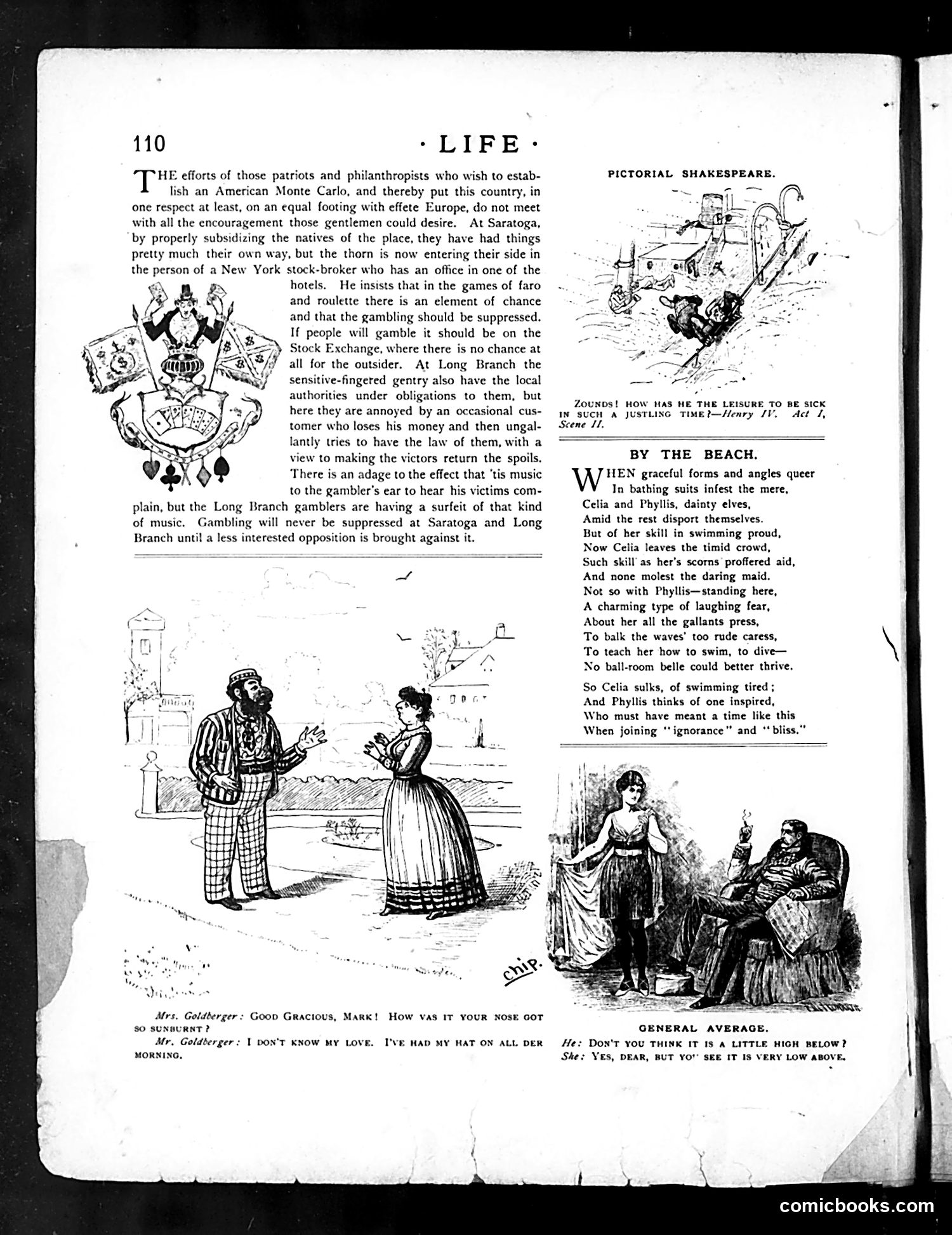
This page contains three satirical pieces: **Main article:** Criticizes efforts to establish American gambling resorts (Monte Carlo-style casinos at Saratoga and Long Branch). The satire targets the hypocrisy: gamblers want to suppress games of chance at casinos while the Stock Exchange—where "there is no chance at all for the outsider"—operates freely. The complaint is that losing gamblers occasionally appeal to authorities, disrupting the con. **"Pictorial Shakespeare":** A humorous visual comparing a Shakespeare quote about sickness and busyness to a beach scene. Celia confidently swims alone while Phyllis attracts male attention offering swimming assistance—illustrating the contrast between independent skill and performing femininity for male approval. **"General Average" (bottom cartoon):** A married couple joke. The husband's sunburned nose (from hat-wearing) prompts a discussion of measurement and proportion—a mild double entendre about the wife's observation of his physical features being "high below" and "low above." The overall tone is typical late-19th-century American satirical humor targeting social pretension and gender dynamics.
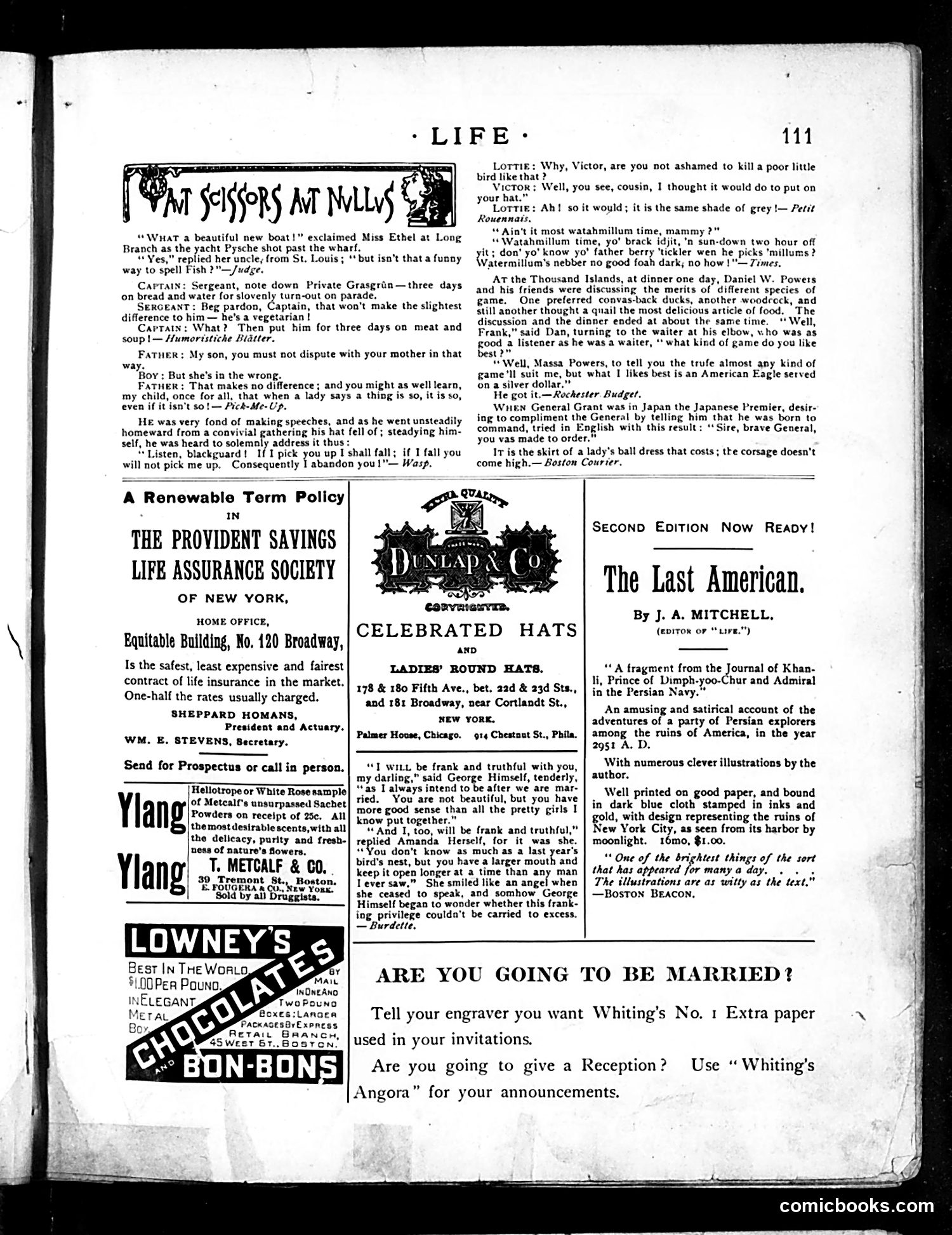
This page consists primarily of **short humor pieces and advertisements** rather than political cartoons. The jokes are brief, satirical vignettes on everyday social topics: **The humor pieces** mock: - A wealthy man misspelling "Psyche" as a yacht name (upper left) - Military discipline applied absurdly to vegetarians - Gender relations—a father telling his son that women's assertions are "true" regardless of reality - A drunk man's philosophical address to his fallen hat - Racial dialect humor featuring an African American servant joking about liking "American Eagle served on a silver dollar" (a period stereotype) - Romance and courtship conventions **The advertisements** dominate the lower half, promoting life insurance, hats, chocolates, and perfume—typical late-19th/early-20th century marketing. The page reflects *Life's* style: lighthearted social satire targeting middle-class anxieties about propriety, marriage, authority, and race relations, presented through brief jokes reprinted from various sources.
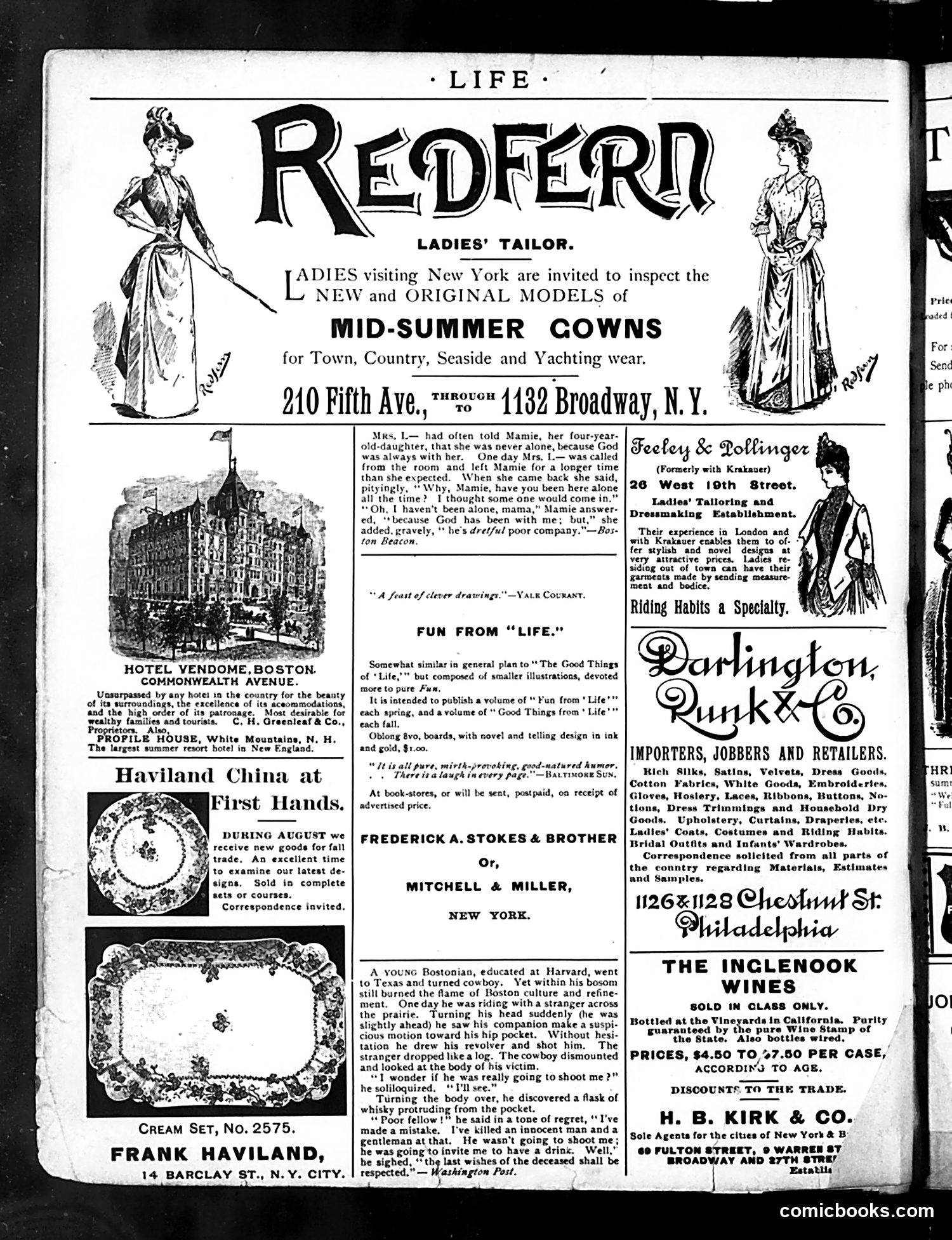
This is primarily an **advertising page** from Life magazine, with minimal editorial content—mostly classifieds for ladies' fashion, hotels, china, wines, and books. The only substantive editorial content is a brief **humorous anecdote** about a young Harvard-educated Bostonian who became a cowboy in Texas. The joke plays on **class incongruity**: a refined Easterner retains his cultured sensibilities despite frontier life, yet this education proves useless—he shoots a stranger preemptively out of paranoia, only to discover the man carried only whiskey, not a weapon. The humor derives from the contrast between Boston gentility and violent frontier behavior, suggesting that education cannot overcome raw survival instinct. A shorter joke about a child named Mamie jokes that God is "dreadful poor company"—mild religious humor typical of era publications. The page reflects **Gilded Age consumer culture**: targeting wealthy women shopping in New York for fashion, furnishings, and luxury goods.
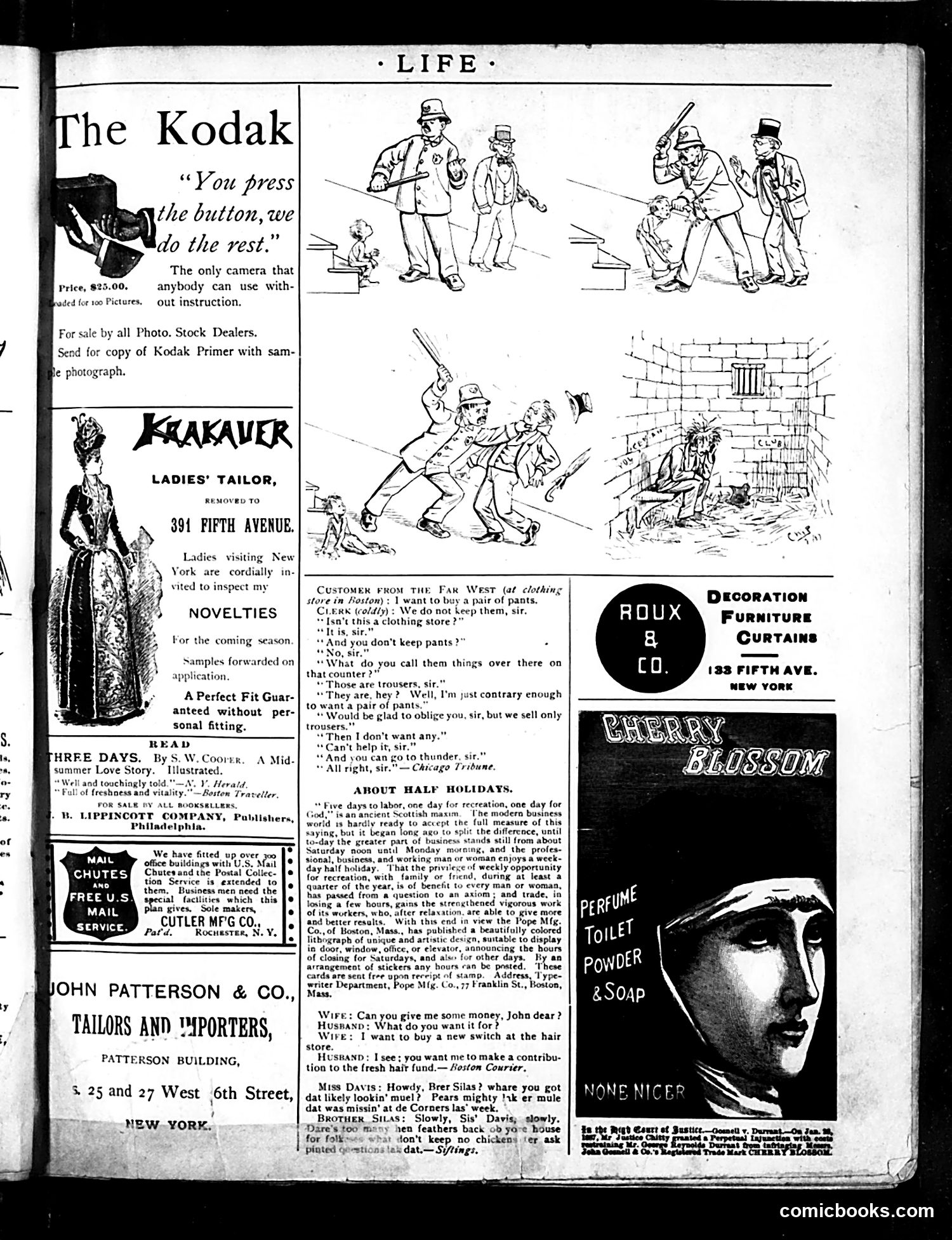
This page primarily contains **humorous anecdotes and advertisements** rather than political cartoons. The main comedic content includes: **"Customer from the Far West"** joke: A rural Westerner enters a Boston clothing store demanding "pants," but the clerk insists they only sell "trousers"—a snobbish distinction between colloquial and formal terminology. The customer refuses to buy, finding the semantic pretension absurd. This satirizes **class and regional differences**, mocking Eastern urban affectation versus plain-spoken Western directness. Other brief jokes target **marital dynamics** (wives spending money on hair switches) and **racial stereotypes** (dialect humor involving African American characters). The page is primarily filled with **period advertisements** for Kodak cameras, tailoring services, mail chutes, and ladies' fashion—typical Life magazine content. The illustrated vignettes at top show casual scenes of people using a Kodak camera, advertising its ease of use ("You press the button, we do the rest"). No specific political figures or events are referenced. The satire targets social pretension and regional/class attitudes rather than politics.
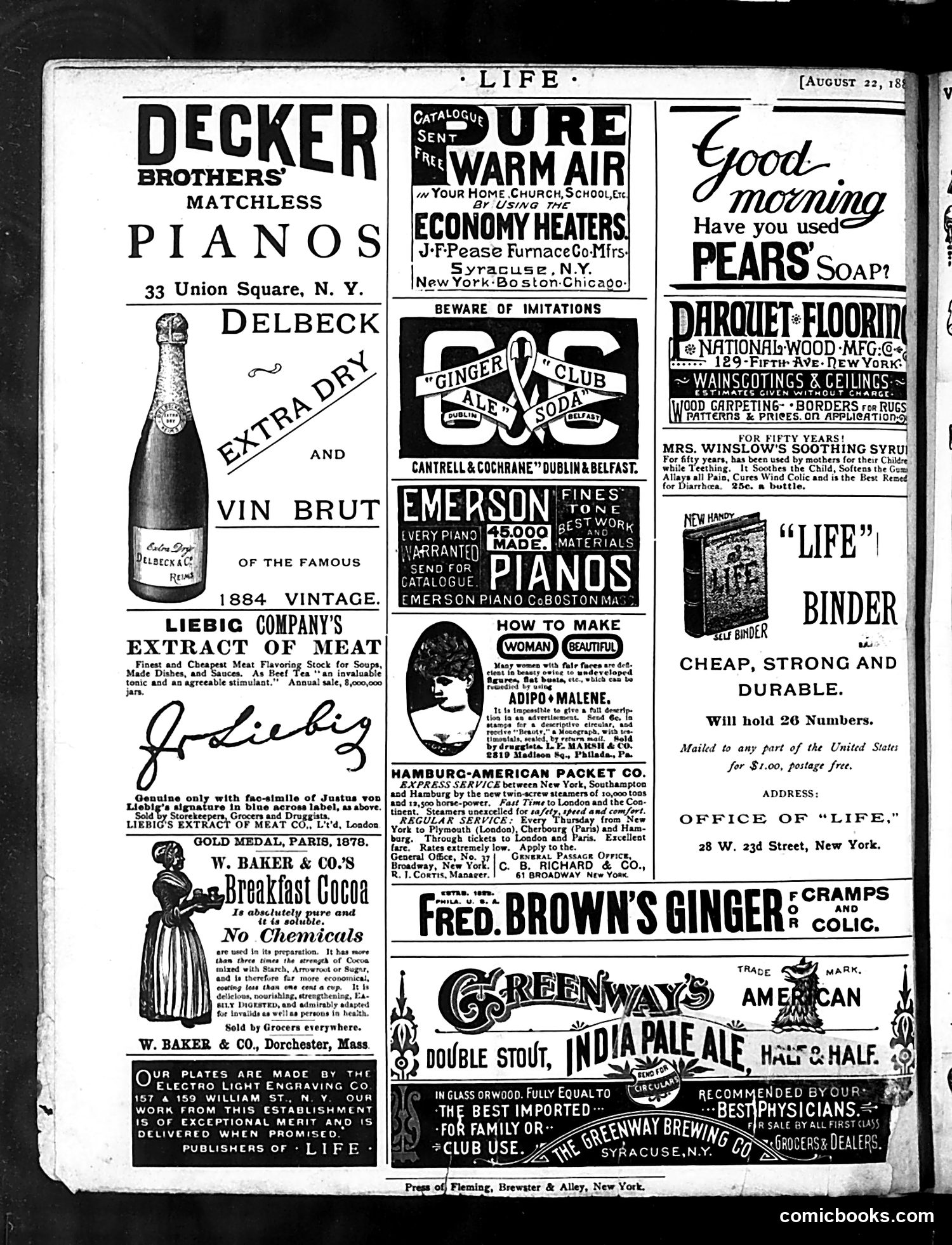
This is primarily a **advertisements page**, not a satirical cartoon page. It contains dozens of commercial ads typical of the 1880s, including: - **Pianos** (Decker Brothers, Emerson) - **Food/beverage products** (Liebig's meat extract, W. Baker cocoa, Ginger ale, beer) - **Patent medicines** (Mrs. Winslow's Soothing Syrup, Adipomalene) - **Household goods** (wood flooring, binders) - **Shipping services** (Hamburg-American steamships) The ads reveal period concerns: teething remedies for infants, "beauty" products with unknown ingredients, and European travel. Many ads exploit health anxieties with dubious claims—typical of an era before FDA regulations. The page demonstrates how *Life* magazine was funded: it relied heavily on advertising revenue alongside its satirical content. There are no identifiable political cartoons or social satire visible on this particular page.