
Life, 1889-08-22 · page 6 of 16
Life — August 22, 1889 — page 6: what you’re looking at
What you’re looking at
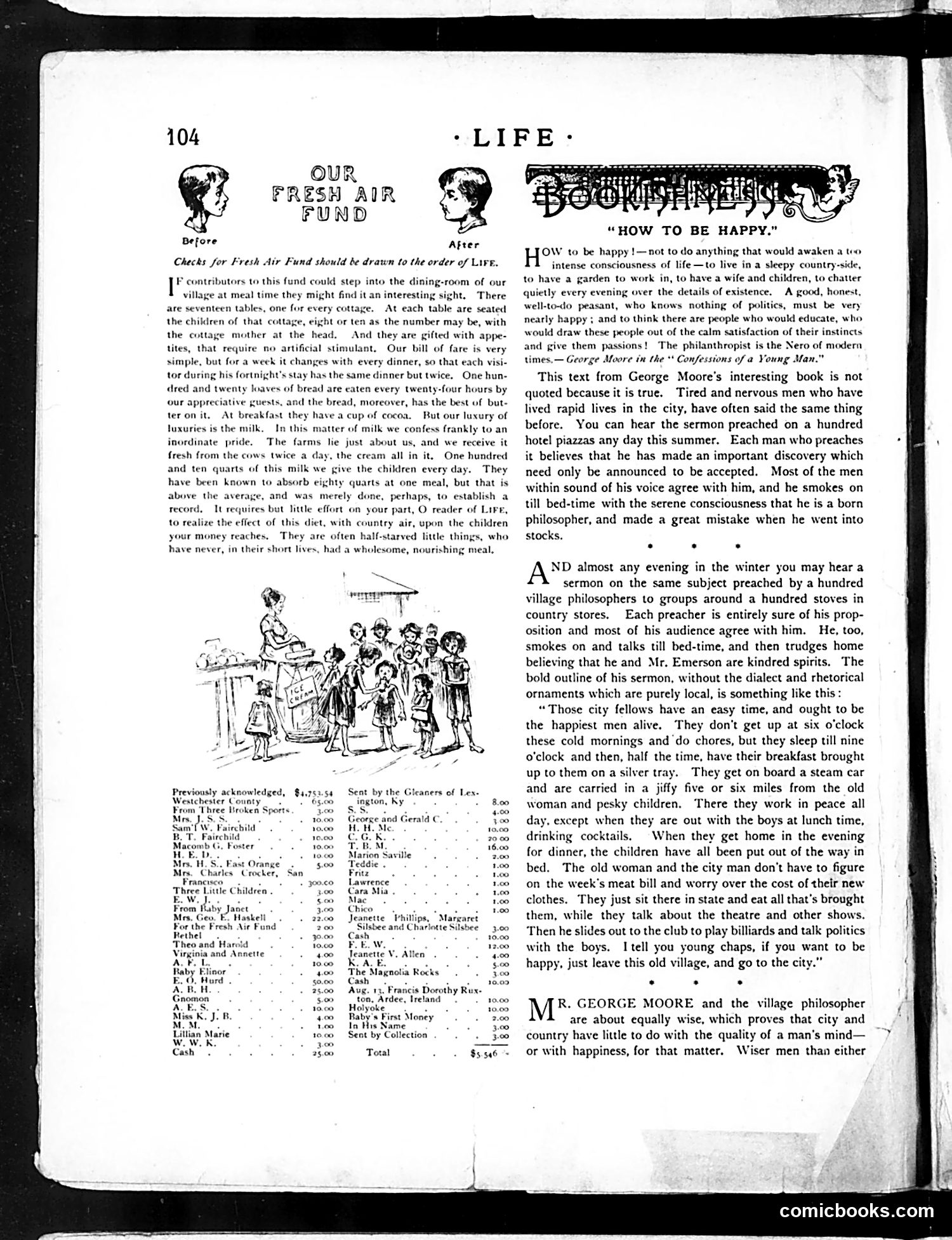
This page presents a satirical contrast between urban and rural happiness. The main article quotes George Moore's philosophy that contentment comes from simple living—having a garden, family, and quiet evenings—rather than material luxuries. The satire targets two groups: wealthy city dwellers who pursue comfort through consumption (with servants, elaborate meals, and luxury goods), and rural "village philosophers" who preach simplicity while actually enjoying leisurely lives free from urban drudgery. The cartoon illustrating the rural scene shows children and adults in a village setting, satirizing the romanticized notion that country life is inherently happier. The piece suggests that true happiness depends on one's mindset rather than location or wealth—a moderately progressive social commentary for the era.
📄 Transcribed text from this page (OCR, searchable)
Machine-transcribed from the original scan — historical spelling and the odd misread are preserved.
OUR FRESH AIR FUND Before After Checks for Fresh Air Fund should be drawn to the order of Live. F contributors to this fund could step into the dining-room of our village at meal time they might find it an interesting sight. There are seventeen tables, one for every cottage. At each table are seated the children of that cottage, eight or ten as the number may be, with the cottage mother at the head. And they are gifted with appe- tites, that require no artificial stimulant, Our bill of fare is very simple, but fora week it changes with every dinner, so that each visi- tor during his fortnight’s stay has the same dinner but twice. One hun- dred and twenty loaves of bread are eaten every twenty-four hours by our appreciative guests, and the bread, moreover, has the best of but- At breakfast they have a cup of cocoa, But our luxury of luxuries is the milk. In this matter of milk we confess frankly to an The farms lie just about us, and we receive it One hundred and ten quarts of this milk we give the children every day. They have been known to absorb eighty quarts at one meal, but that is above the average, and was merely done, perhaps, to establish a It requires but little effort on your part, O reader of Lire, to realize t ter on it. inordinate pride. fresh from the cows twice a day, the cream all in it, record fiect of this diet, with country air, upon the children your money reaches, They are often half-starved little things, who have never, in their short lives, had a wholesome, nourishing meal, Previously acknowledged, Westchester County From Three Uroken Spo Sent by the Gleaners of Lex- ington, Ky s.S $4.7: George Gerald € reco HH. H. Me woo C.G.K. . =M . . . 10.00 larion Saville Mrs. HLS Orange $00 Teddie . Mrs. Charles Crocker, San Fritz Franco. . 300.0 Lawrence Three Little Children. 300 C From faby Janet”. 300 Ch . 100 Mrs, Geo. E. Haskell For the Fresh Air Fund Rethel ‘Theo and v Mr JSS a: 10.00 Sam'fW, Fairchild B. T. Fairchitd Macomb G, Foster HELL 3.00 10.00 12.60 4-00 $00 3.00 10.09 “HOW TO BE HAPPY.” OW to be happy !—not to do anything that would awaken a too intense consciousness of life—to live in a sleepy country-side, to have a garden to work in, to have a wife and children, to chatter quietly every evening over the details of existence. A good, honest, well-to-do peasant, who knows nothing of politics, must be very nearly happy ; and to think there are people who would educate, who would draw these people out of the calm satisfaction of their instincts ‘The philanthropist is the Nero of modern times.— George Moore in the “ Confessions of a Young Man.” and give them passions ! This text from George Moore's interesting book is not quoted because it is true. Tired and nervous men who have lived rapid lives in the city, have often said the same thing before. You can hear the sermon preached on a hundred hotel piazzas any day this summer. Each man who preaches it believes that he has made an important discovery which need only be announced to be accepted. Most of the men within sound of his voice agree with him, and he smokes on till bed-time with the serene consciousness that he is a born philosopher, and made a great mistake when he went into stocks. . . . ND almost any evening in the winter you may hear a sermon on the same subject preached by a hundred village philosophers to groups around a hundred stoves in country stores. Each preacher is entirely sure of his prop- osition and most of his audience agree with him. He, too, smokes on and talks till bed-time, and then trudges home believing that he and Mr. Emerson are kindred spirits. The bold outline of his sermon, without the dialect and rhetorical ornaments which are purely local, is something like this : “Those city fellows have an easy time, and ought to be the happiest men alive. They don’t get up at six o'clock these cold mornings and ‘do chores, but they sleep till nine o'clock and then, half the time, have their breakfast brought up to them on a silver t They get on board a steam car and are carried in a jiffy five or six miles from the old woman and pesky children. There they work in peace all day, except when they are out with the boys at lunch time, drinking cocktail: When they get home in the evening for dinner, the children have all been put out of the way in bed. The old woman and the city man don't have to figure on the week's meat bill and worry over the cost of their new clothes. They just sit there in state and eat all that’s brought them, while they talk about the theatre and other shows. Then he slides out to the club to play billiards and talk politics with the boys. I tell you young chaps, if you want to be happy, just leave this old village, and go to the city.” . . . R. GEORGE MOORE and the village philosopher are about equally wise, which proves that city and country have little to do with the quality of a man's mind— or with happiness, for that matter. Wiser men than either comicbooks.com