
A complete issue · 16 pages · 1889
Life — August 8, 1889
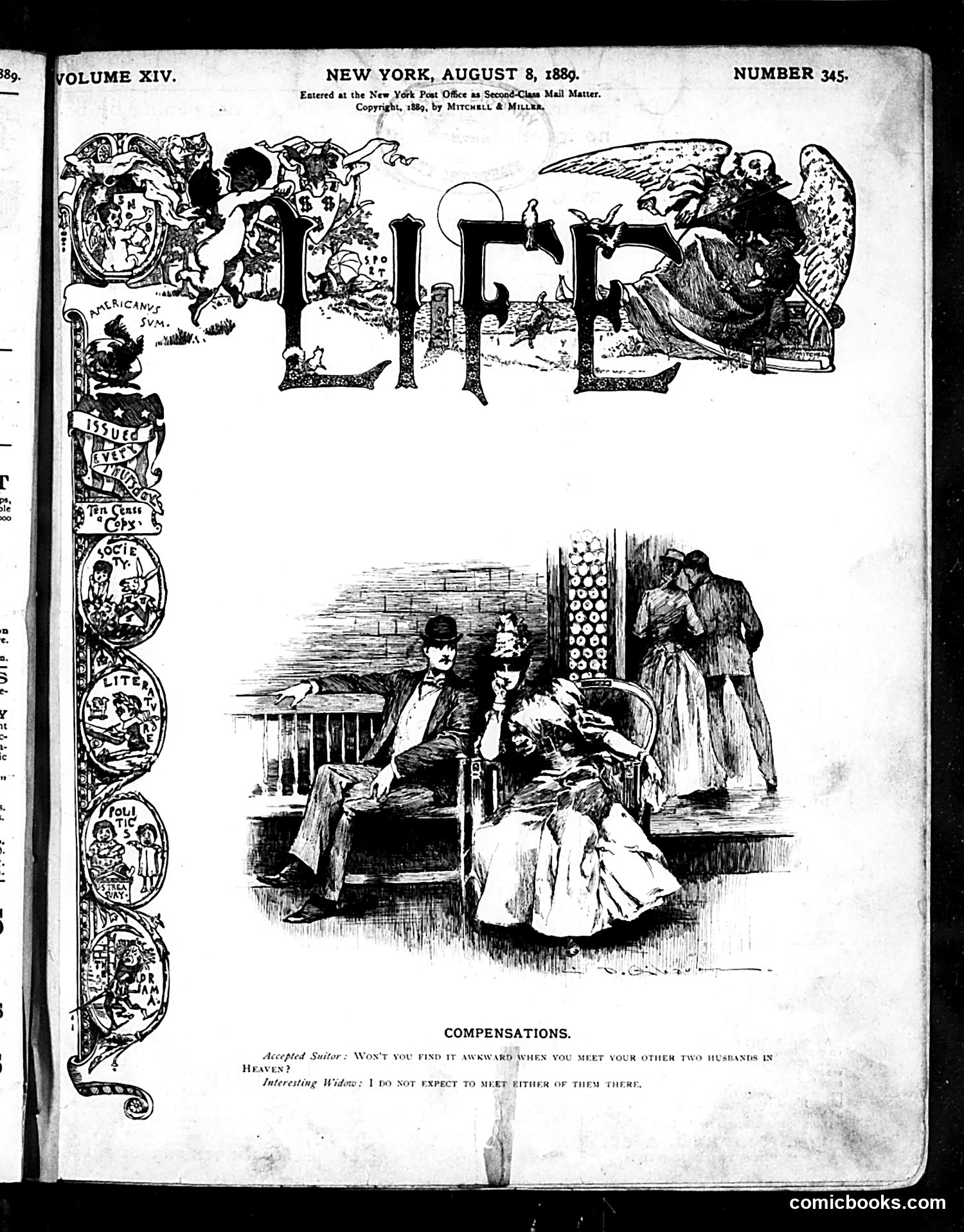
This single-panel cartoon satirizes marital infidelity through a joke about the afterlife. An "Accepted Suitor" asks a widow if she won't find it "awkward" meeting her other two husbands in Heaven. Her dry response—"I do not expect to meet either of them there"—implies both husbands were morally unfit for Heaven, likely due to infidelity or other transgressions. The humor plays on Victorian anxieties about marriage fidelity and women's vulnerability to serial matrimony. The widow's sardonic comeback suggests she's aware of (or resigned to) her husbands' failings. The elaborate decorative border and ornamental masthead are typical of Life's aesthetic during this period.
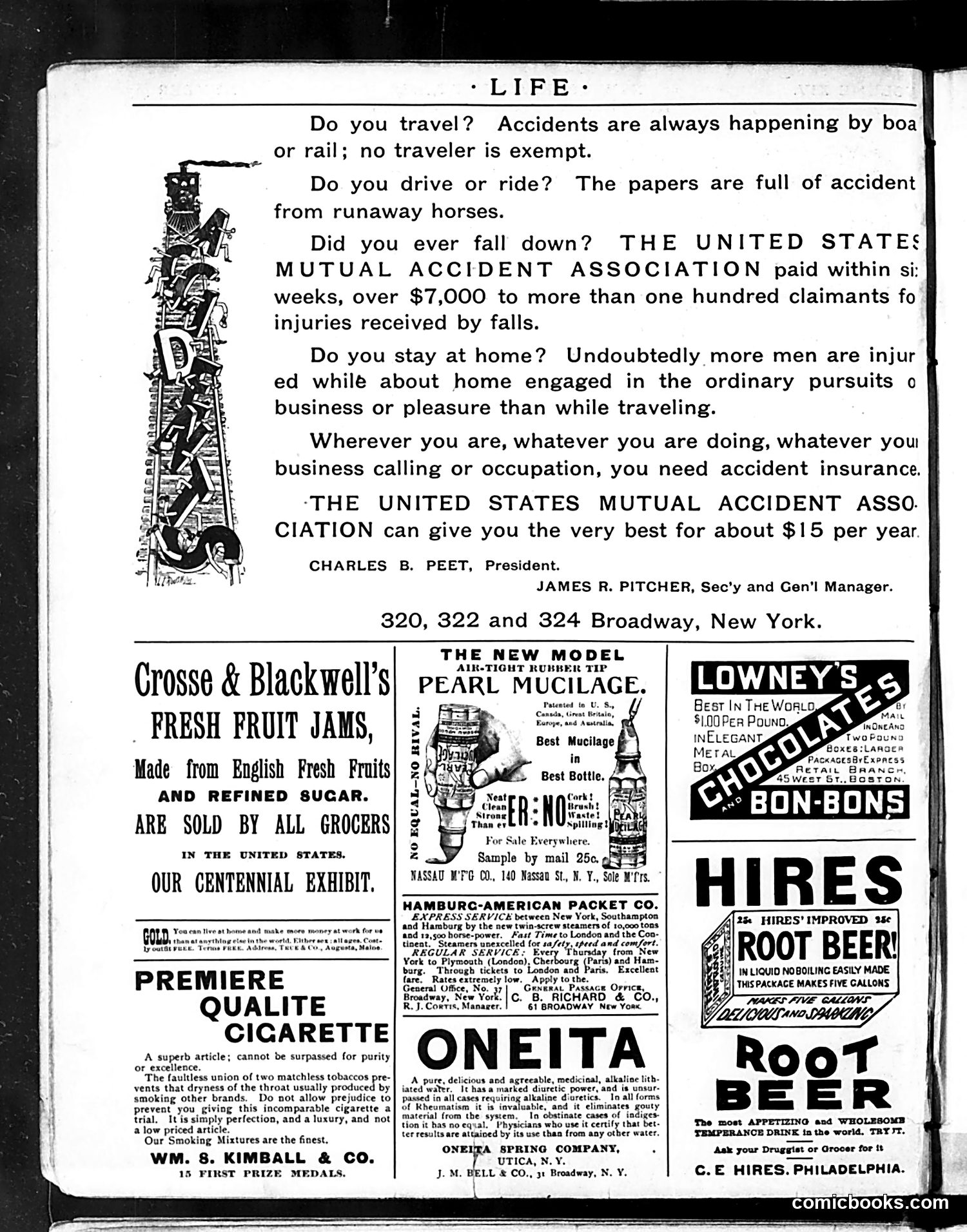
This page is primarily **advertising**, not satire or political commentary. The top third contains an advertisement for the United States Mutual Accident Association, promoting accident insurance at "$15 per year" for travelers, drivers, and homeowners. The message emphasizes that accidents happen everywhere—by boat, rail, horseback, or at home. Below are various product advertisements: Crosse & Blackwell's jams, Pearl Mucilage, Lowney's chocolates, Hires Root Beer, and Premiere Qualite cigarettes. A small decorative emblem appears on the left side of the insurance ad. The page reflects early 20th-century commercial practices, with no discernible political cartoons or satirical content—it is straightforward advertising for consumer products and insurance services.
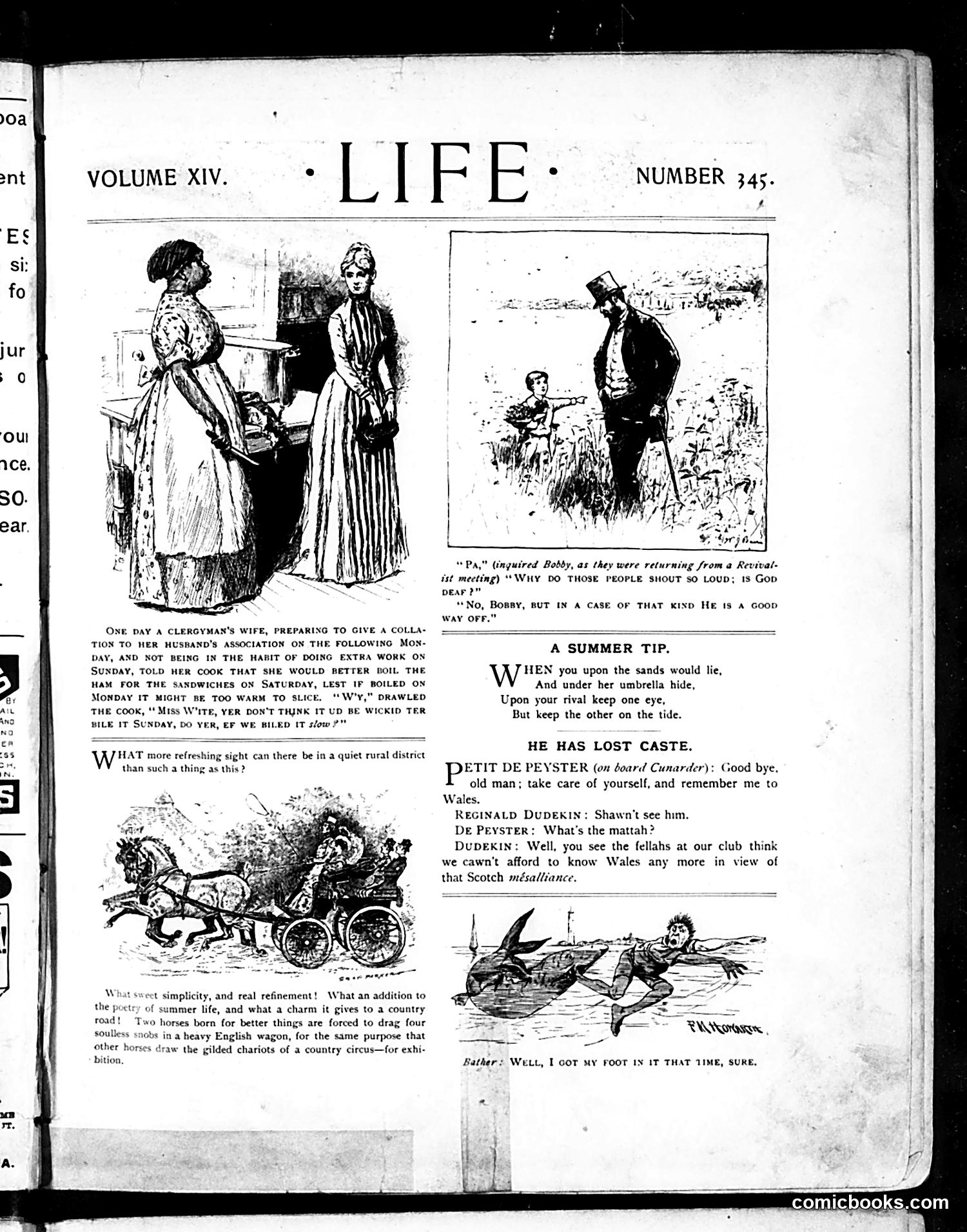
This page contains several satirical sketches and short humor pieces typical of Life's style. The top left cartoon depicts a clergyman's wife preparing to give her husband's church association extra work on Sunday, with the husband objecting—satirizing domestic negotiations and religious obligations. The right panel shows a rural scene with dialogue about "deaf" people and "good ways off," though the specific reference is unclear. "A Summer Tip" is a light verse about beach behavior. "He Has Lost Caste" depicts social commentary about a character who can no longer afford Welsh associations due to "Scottish misalliance"—likely satirizing class consciousness and ethnic prejudices of the era. The bottom illustration shows someone stuck in mud, with the caption "Well, I got my foot in it that time, sure"—a visual pun on the common expression.
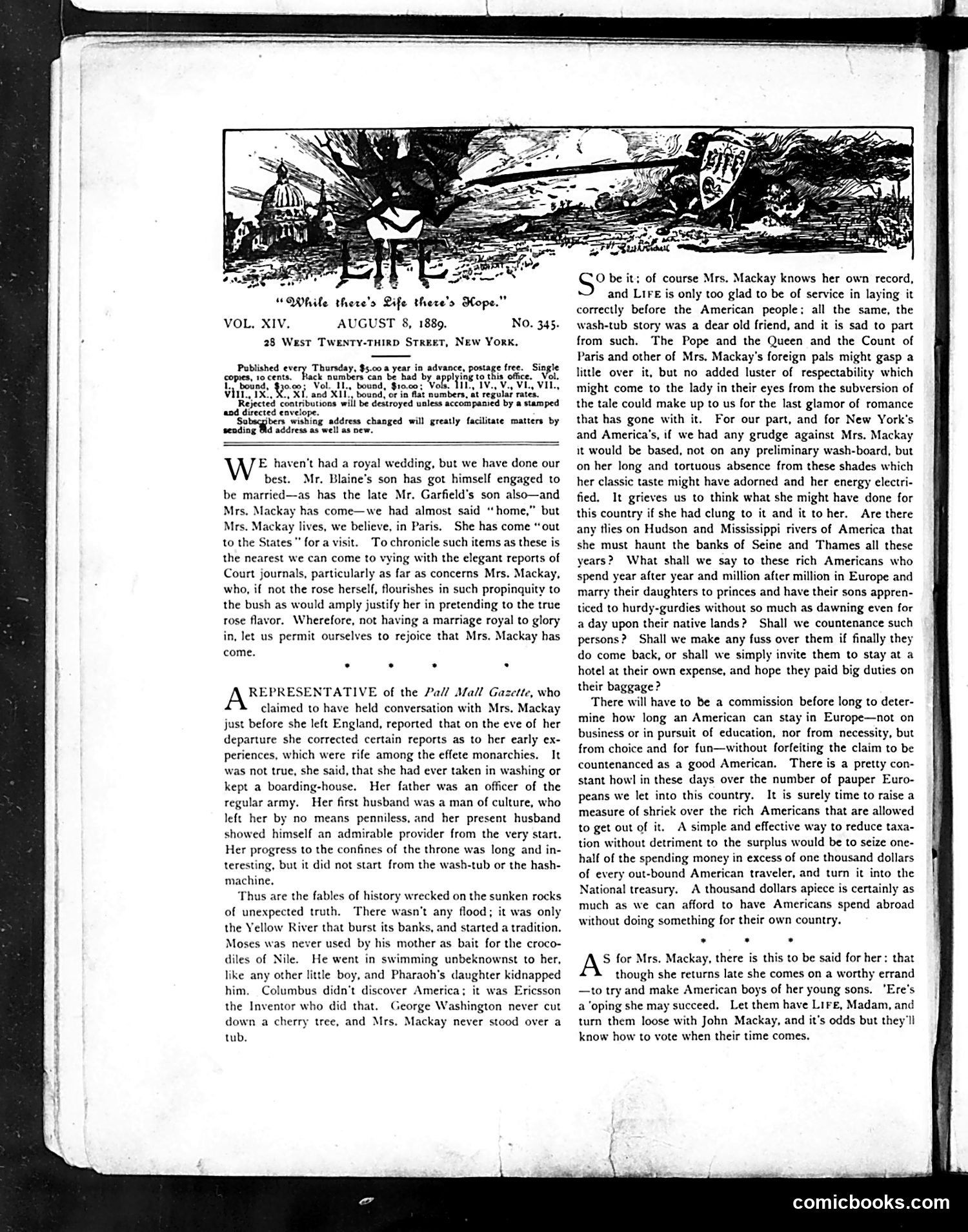
The masthead image appears to be a decorative header rather than a political cartoon. The page's main content is editorial commentary about Mrs. Mackay, a wealthy American socialite. The text satirizes Mrs. Mackay's social ambitions in Europe—she has apparently been making false claims about her family's aristocratic connections and history. The editors mock her pretensions, referencing invented stories about papal and royal connections. The satire criticizes wealthy Americans generally for spending lavishly abroad while remaining culturally insecure. The editors advocate for redirecting this wealth toward American institutions and question whether such wealthy travelers truly understand American civic values, humorously suggesting they don't know how to vote. The piece is social criticism disguised as gossip about one prominent family's European aspirations.
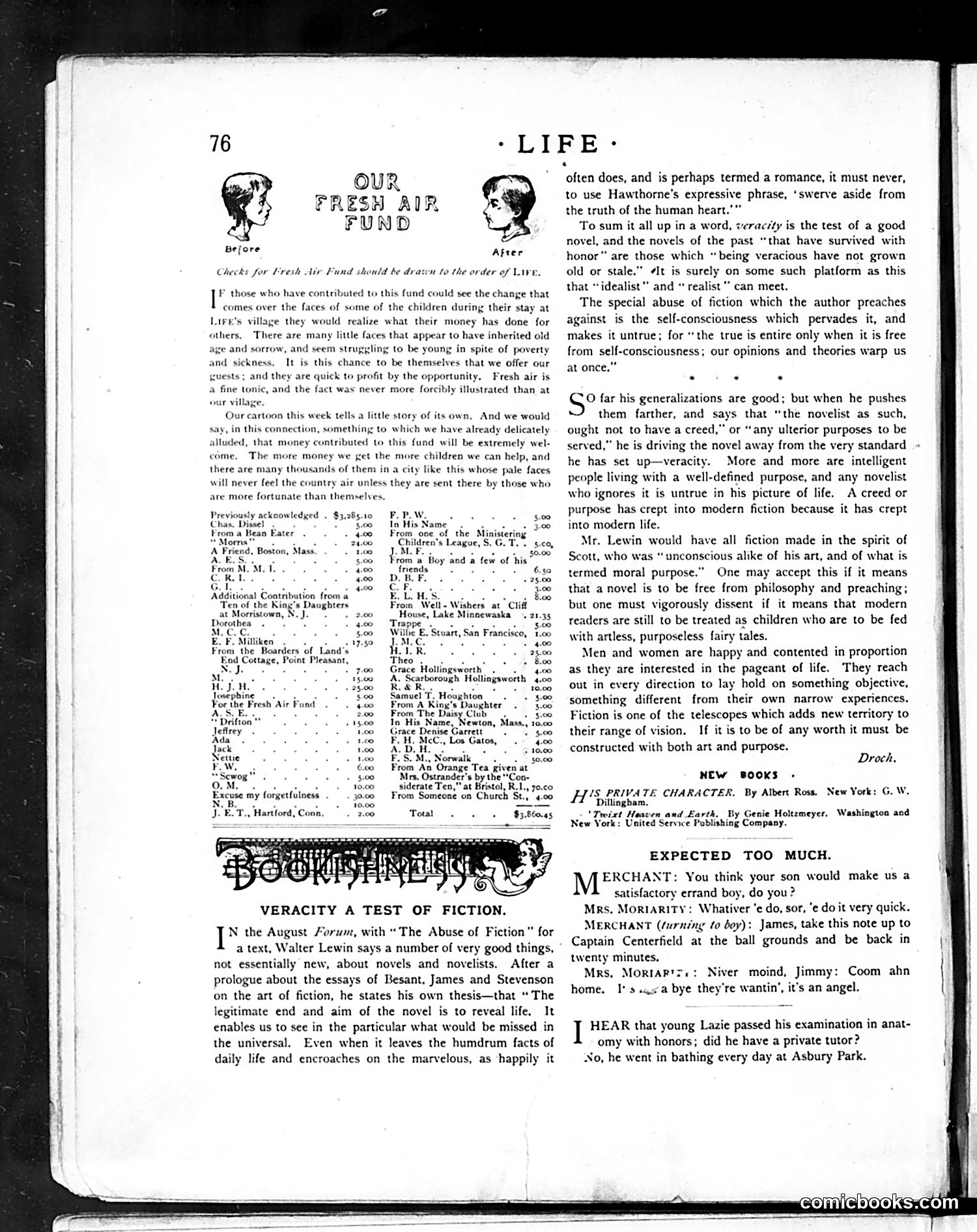
This page contains two distinct sections: **"Our Fresh Air Fund"** (top left): A fundraising list for a children's charity providing outdoor relief to impoverished urban youth. The accompanying illustration shows "Before" and "After" profile sketches of a child, presumably demonstrating the health benefits of fresh air exposure—a Progressive Era concern about city poverty and public health. **"Veracity a Test of Fiction"** (bottom): A literary criticism piece discussing novelist William Lewin's views on fiction's moral purpose. The author argues against didactic fiction that preaches morality, contending novels should depict life truthfully rather than serve as vehicles for philosophy. The **"Expected Too Much"** humor sketch depicts a merchant sending a boy on an errand, with comedic family dialogue about the child's reluctance—typical period domestic humor.
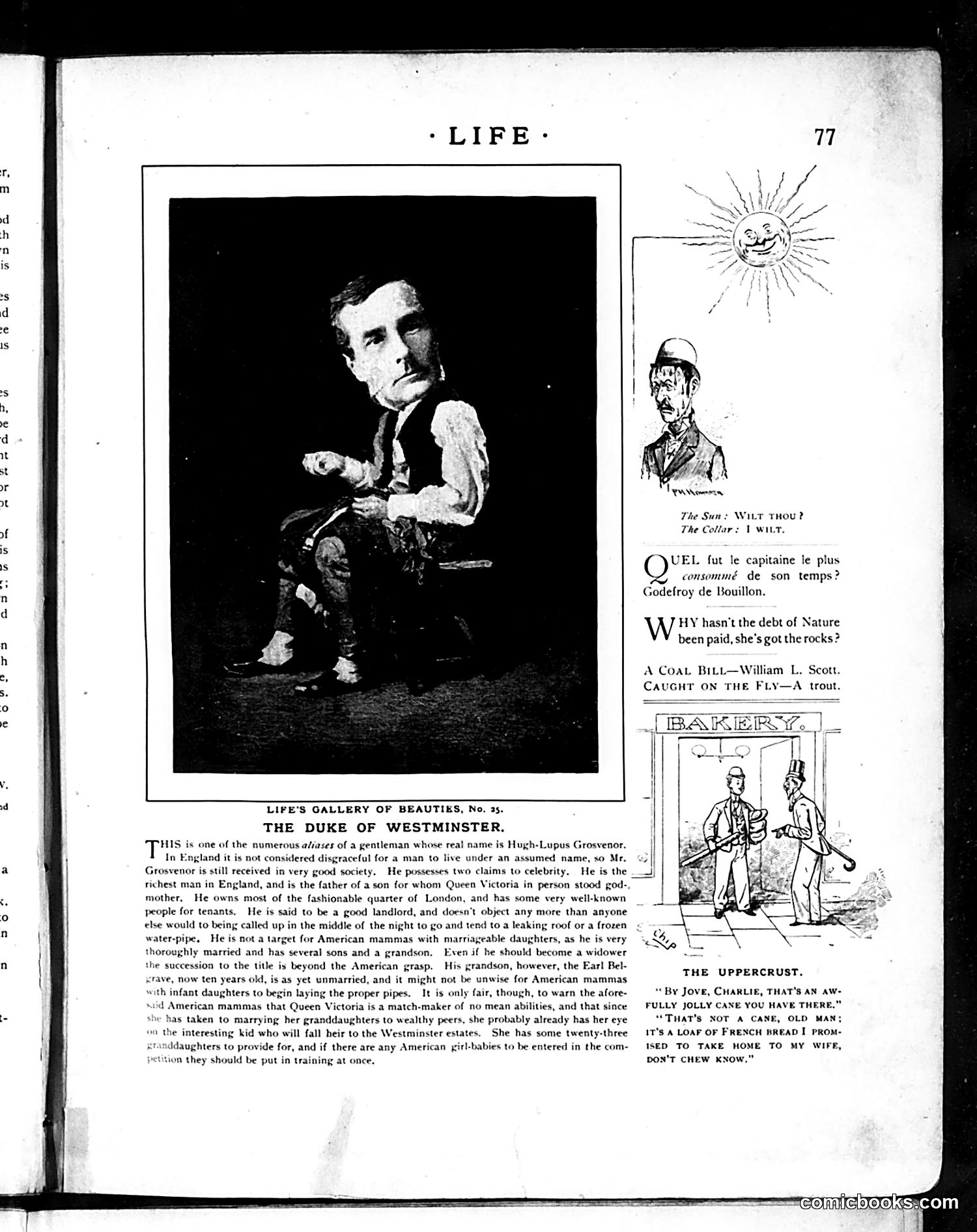
**Main Content: "The Duke of Westminster"** The large photograph shows Hugh-Lupus Grosvenor, a wealthy British aristocrat. The accompanying text satirizes his status as one of England's richest landowners who lives under an assumed name. The satire emphasizes the absurdity of his vast wealth and property holdings while questioning whether American heiresses should marry British peers—a common concern of the era regarding wealthy American daughters marrying impoverished European nobility. **"The Uppercrust" Comic Strip** This brief comic features working-class dialogue mocking middle-class pretension about French bread, with a character rejecting fancy continental food in favor of familiar fare. The page reflects early-20th-century American anxieties about aristocratic wealth and Anglo-American matrimonial alliances.
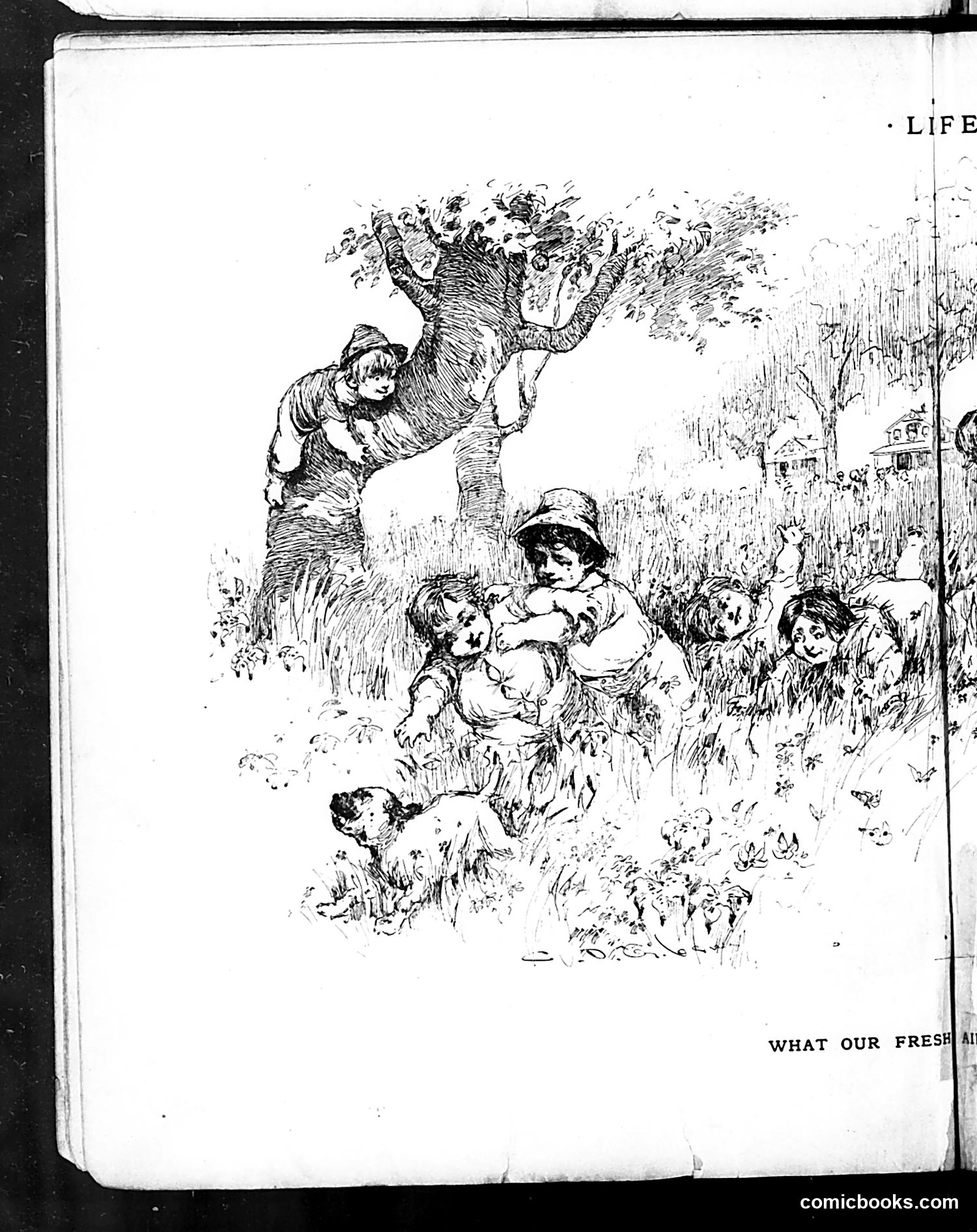
This is a whimsical illustration rather than political satire. The image shows a man climbing a gnarled tree while children and a small dog play below in a pastoral setting, with buildings visible in the distant background. The partial text at bottom reads "WHAT OUR FRESH" (likely continuing on the next page), suggesting this illustrates a story or article about outdoor recreation and childhood pleasures. The artwork appears to celebrate simple, wholesome leisure activities—tree-climbing and countryside play—common themes in early-20th-century American magazine content. The detailed cross-hatching and sketch style is typical of Life magazine's illustrative approach during this period. Without the complete article text or caption, I cannot identify specific satirical intent or political commentary this may have contained.
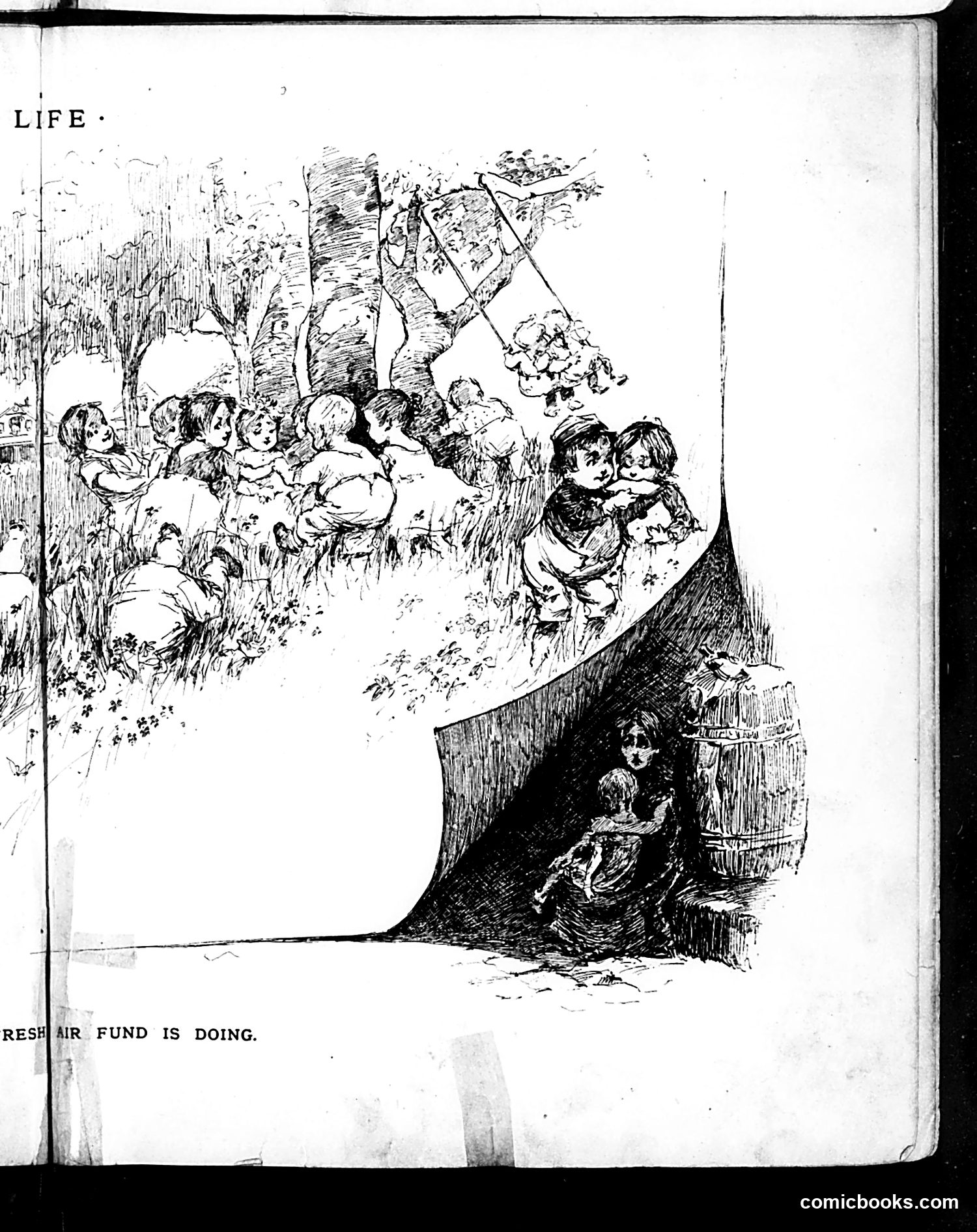
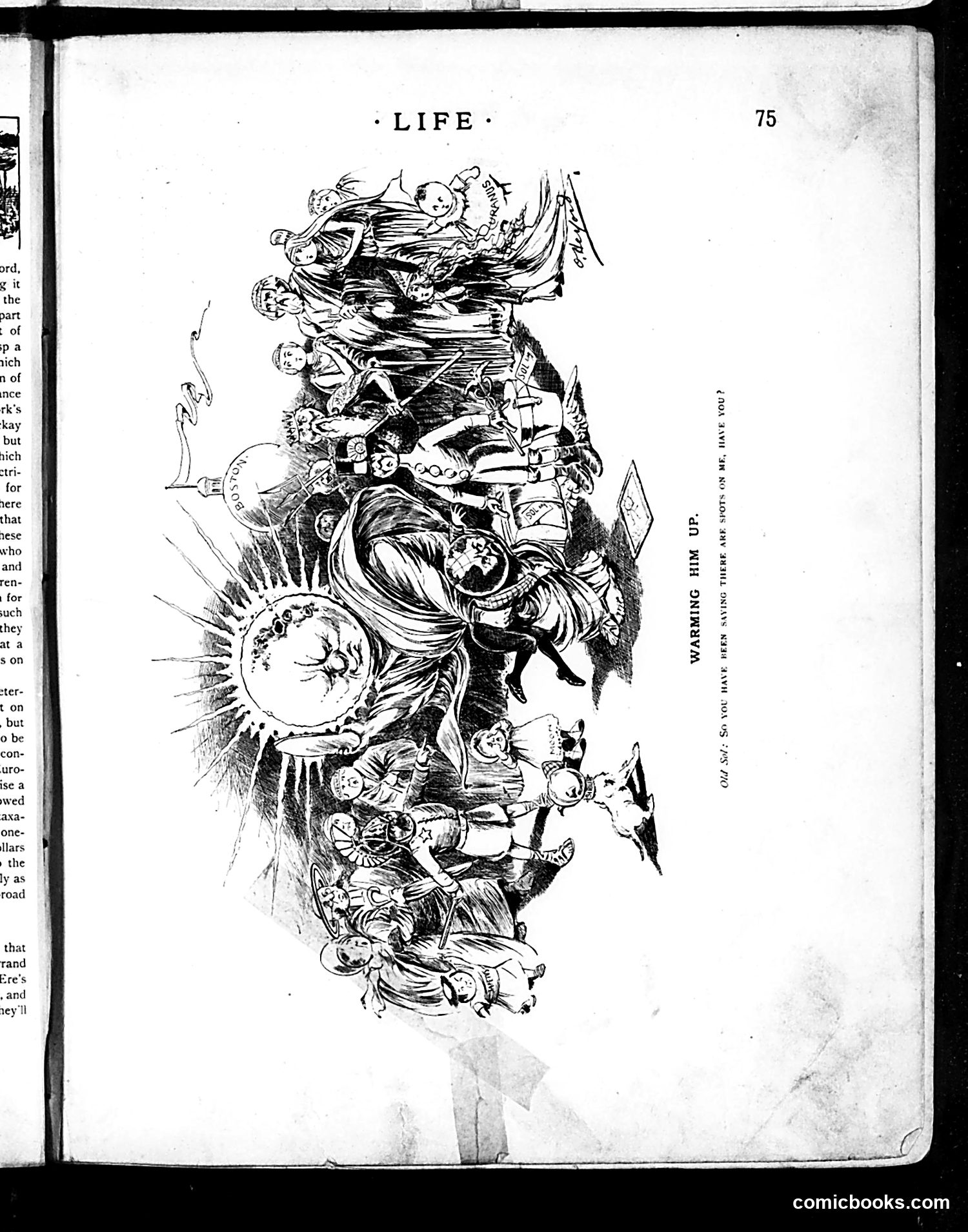
This cartoon illustrates economic inequality and child welfare during the Progressive Era. The image contrasts two scenes: children playing freely and healthily in sunlight near a birch tree (upper portion), versus a mother and child huddled in darkness beneath what appears to be a shadow or enclosed space (lower portion). The caption "FRESH AIR FUND IS DOING" references a real charitable organization that provided poor urban children outdoor recreation. The cartoon critiques the inadequacy of such charitable efforts—suggesting that while some children enjoy fresh air and natural spaces, vulnerable poor children remain trapped in darkness and deprivation. The satire suggests charity alone cannot solve systemic poverty; structural solutions are needed.
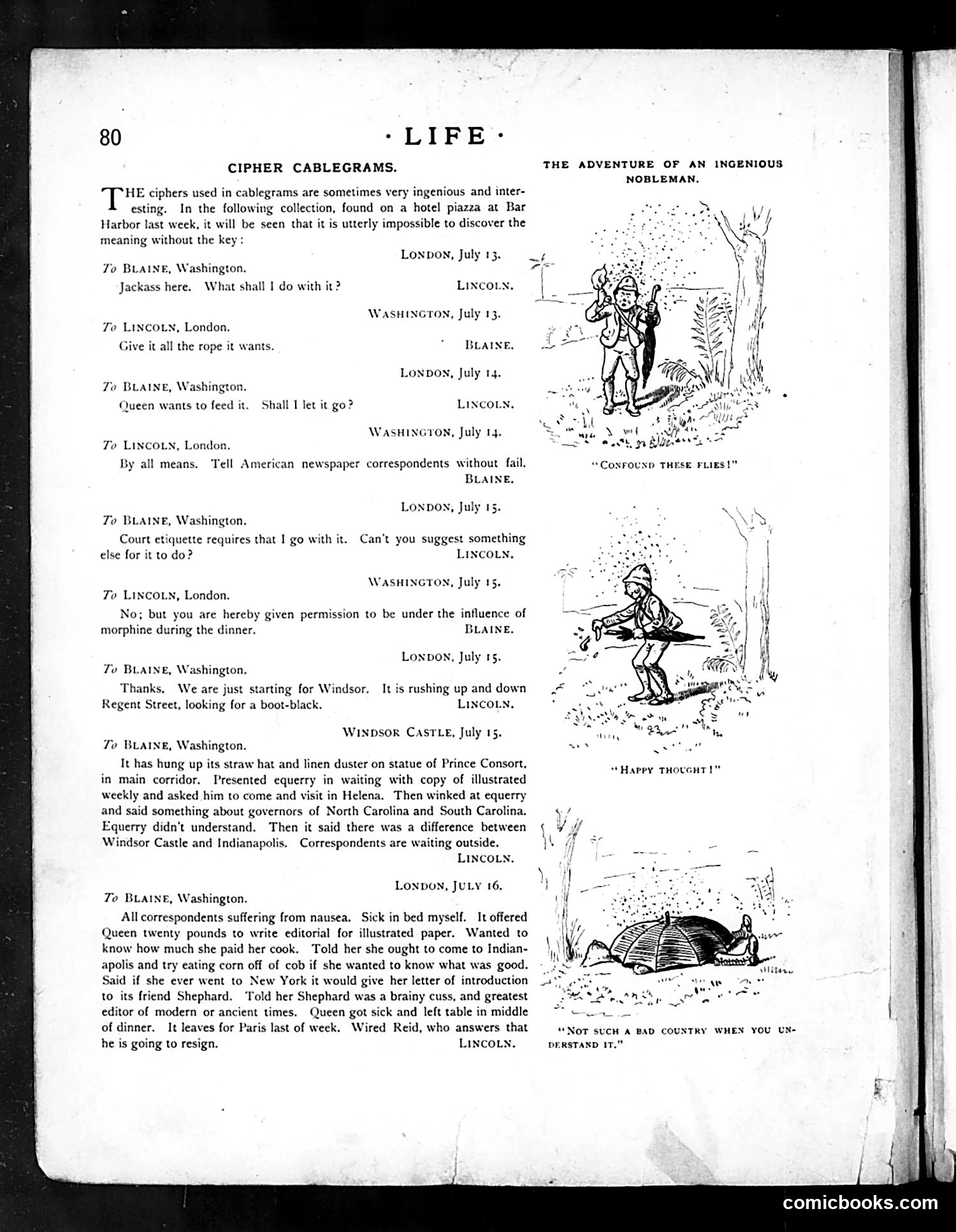
The left column presents **satirical telegraph exchanges** between "Blaine" (likely James G. Blaine, a prominent American politician) in Washington and "Lincoln" (possibly John Hay, Lincoln's secretary, or another figure) in London. The cryptic messages mock diplomatic communication and court etiquette—references to feeding a "jackass," morphine at dinners, and Windsor Castle's confusion between locations suggest absurdist humor about political pomposity and bureaucratic incompetence. The three illustrations on the right depict a gentleman outdoors encountering flies and unfamiliar terrain, captioned "Confound these flies!", "Happy thought!", and "Not such a bad country when you understand it." This appears to be light social satire about British tourists or aristocrats struggling with rural or unfamiliar environments.
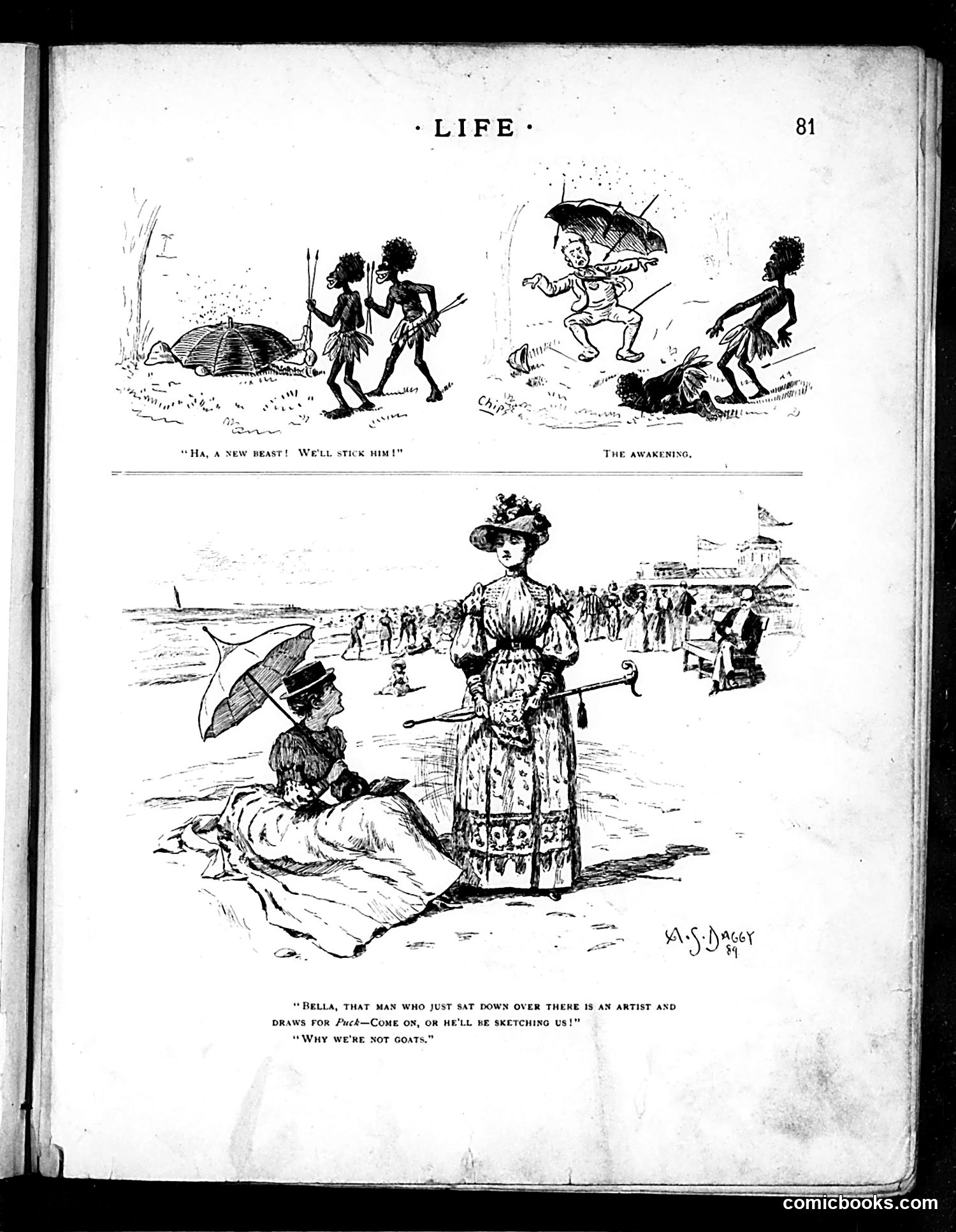
This page contains two separate cartoons: **Top panel** ("Ha, a New Beast! We'll Stick Him!" and "The Awakening"): Depicts indigenous people discovering and reacting to what appears to be a European visitor or colonizer. The satire seems to mock either colonial encounters or the "discovery" narrative by reversing perspective—showing natives as the observers treating the newcomer as a curiosity or threat. **Bottom panel**: Shows a beach scene where a well-dressed woman and reclining man are present. The dialogue mocks artistic pretension: a man sketching nearby claims to be an "artist," but the woman dismissively suggests he's just a "goat"—implying he's lecherous or untrustworthy rather than genuinely artistic. The cartoons appear to satirize social hypocrisy and colonial attitudes, though specific historical context remains unclear.
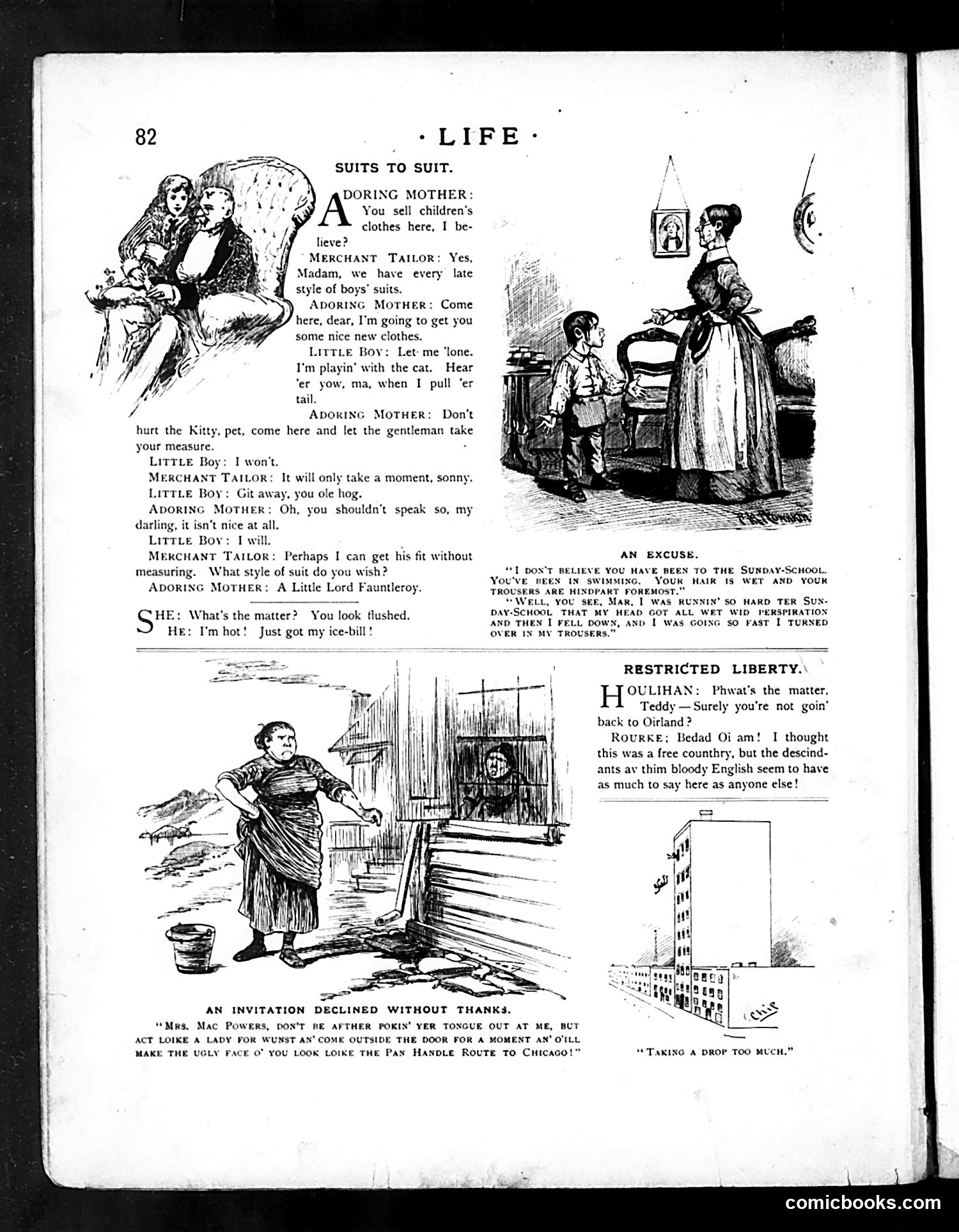
This page contains four unrelated satirical vignettes mocking Victorian-era social pretensions and immigrant stereotypes: **"Suits to Suit"**: A doting mother wants to dress her unruly son in a "Little Lord Fauntleroy" suit—a fashionable but overly delicate children's style. The joke satirizes parents who prioritize genteel appearance over their child's actual nature; the boy resists measurement, calls the tailor "an ole hog," and misbehaves. **"An Excuse"**: A boy caught skipping Sunday school invents an elaborate lie about running so hard he sweated profusely and literally fell upside-down in his trousers. It mocks children's transparent deceptions. **"Restricted Liberty"**: Irish immigrant characters ("Rourke," "Houlihan") complain that despite America being a "free country," English-descended Americans ("descendants av thim bloody English") restrict their freedom as much as anyone else—satirizing nativist attitudes toward Irish immigrants. **"Taking a Drop Too Much"**: A cityscape cartoon (caption only visible) likely mocks urban drunkenness. The page reflects turn-of-century American anxieties about class, immigration, and child-rearing.
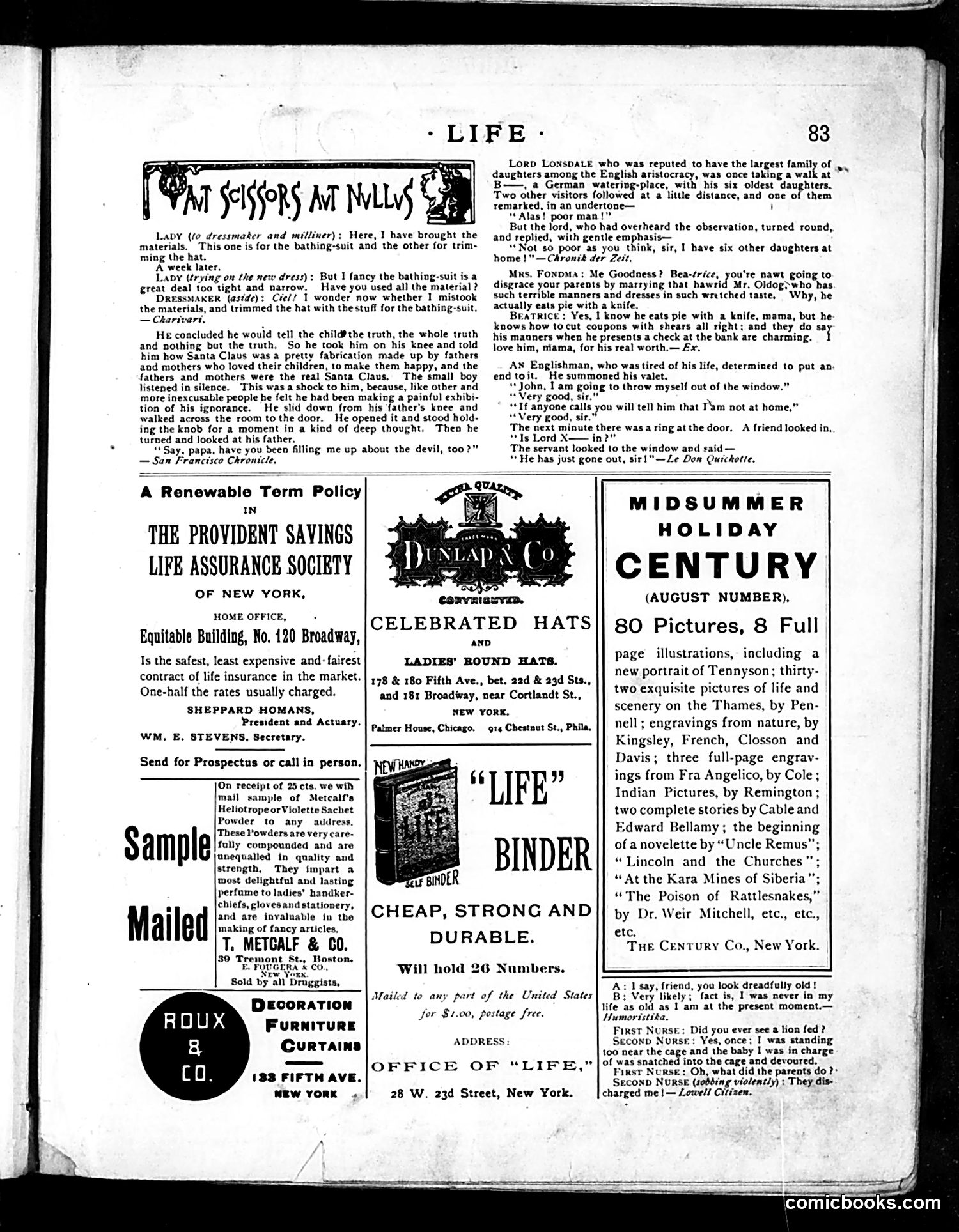
This page contains three brief humorous anecdotes rather than political cartoons: 1. **"At Scissors At Nullus"**: A dressmaker mixes up fabric intended for a bathing suit and hat trim, resulting in a comically ill-fitting garment. The joke plays on wardrobe mishaps and absent-minded tailoring. 2. **Santa Claus story**: A father tells his son the truth about Santa Claus, explaining parents invented him to bring happiness. The boy's response—asking if his father also lied about the devil—offers dark humor about childhood disillusionment and parental honesty. 3. **Lord Lonsdale anecdote**: An English aristocrat with many daughters overhears someone pitying his situation. He humorously reframes it as advantage, having "six other daughters at home," turning sympathy into boasting about his large family. The page is primarily **advertisements** for life insurance, hat companies, and products. These brief satirical pieces rely on Victorian-era social conventions—class distinctions, gender roles, and family dynamics—now unfamiliar to modern readers.
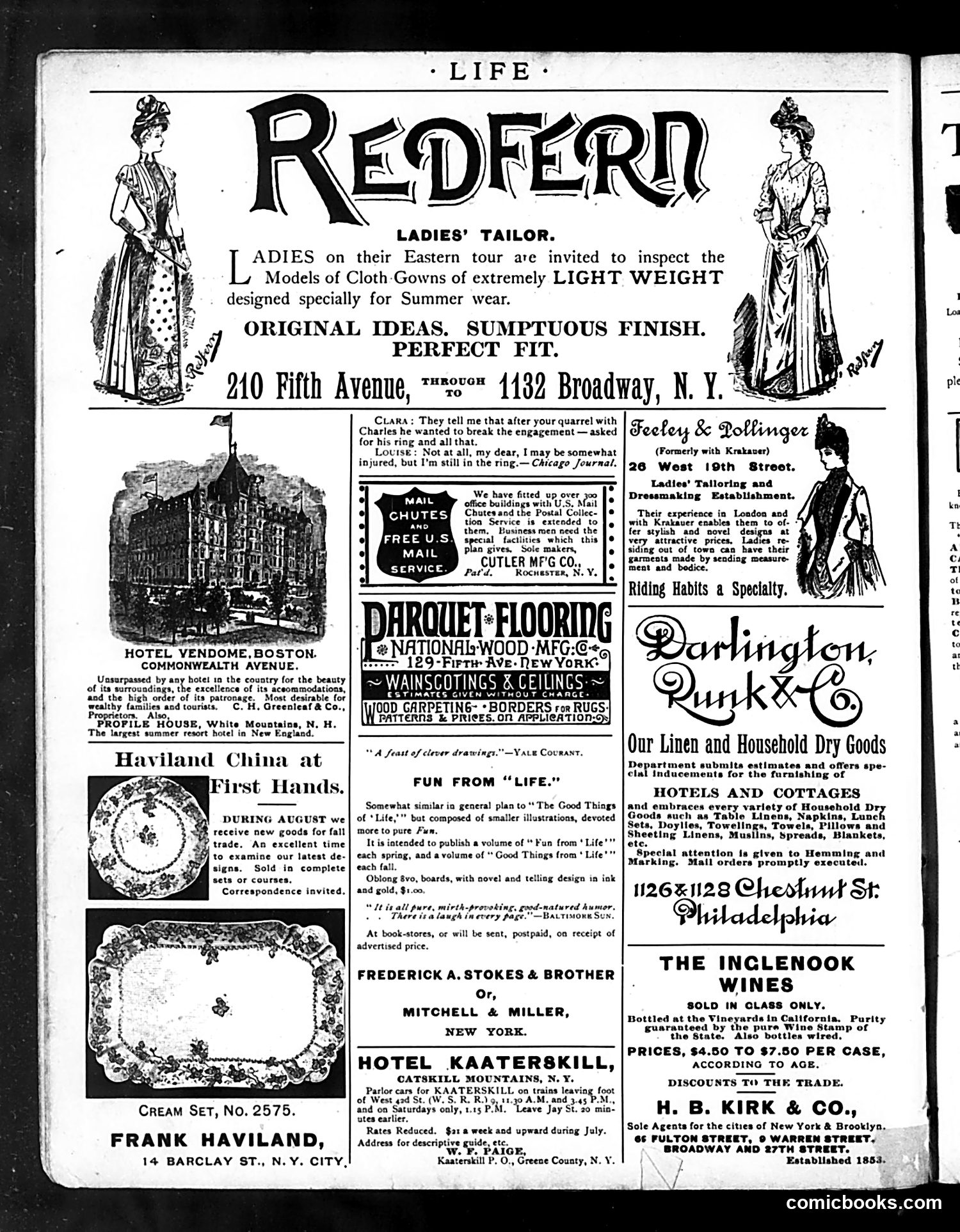
This is primarily an **advertising page** from Life magazine, not a political cartoon. The page features: **Main Content:** - A large advertisement for "Redfern," a ladies' tailor specializing in lightweight summer gowns (240 Fifth Avenue to 1182 Broadway, NYC) - Multiple hotel and business advertisements (Hotel Vendôme Boston, Haviland China, Hotel Kaaterskill) **The Humor:** A small joke appears mid-page: Clara tells Louise that her fiancé Charles wanted to break their engagement after a quarrel. Louise replies she's "still in the ring"—a boxing metaphor suggesting she remains engaged despite the conflict. This is gentle domestic humor typical of Life's era. **Context for Modern Readers:** The advertisements reflect Gilded Age consumer culture: expensive tailoring for wealthy women, luxury hotels, fine china, and wine—aimed at affluent readers. The page itself demonstrates how Life supported itself through paid advertising, not just editorial content. No significant political satire appears here.
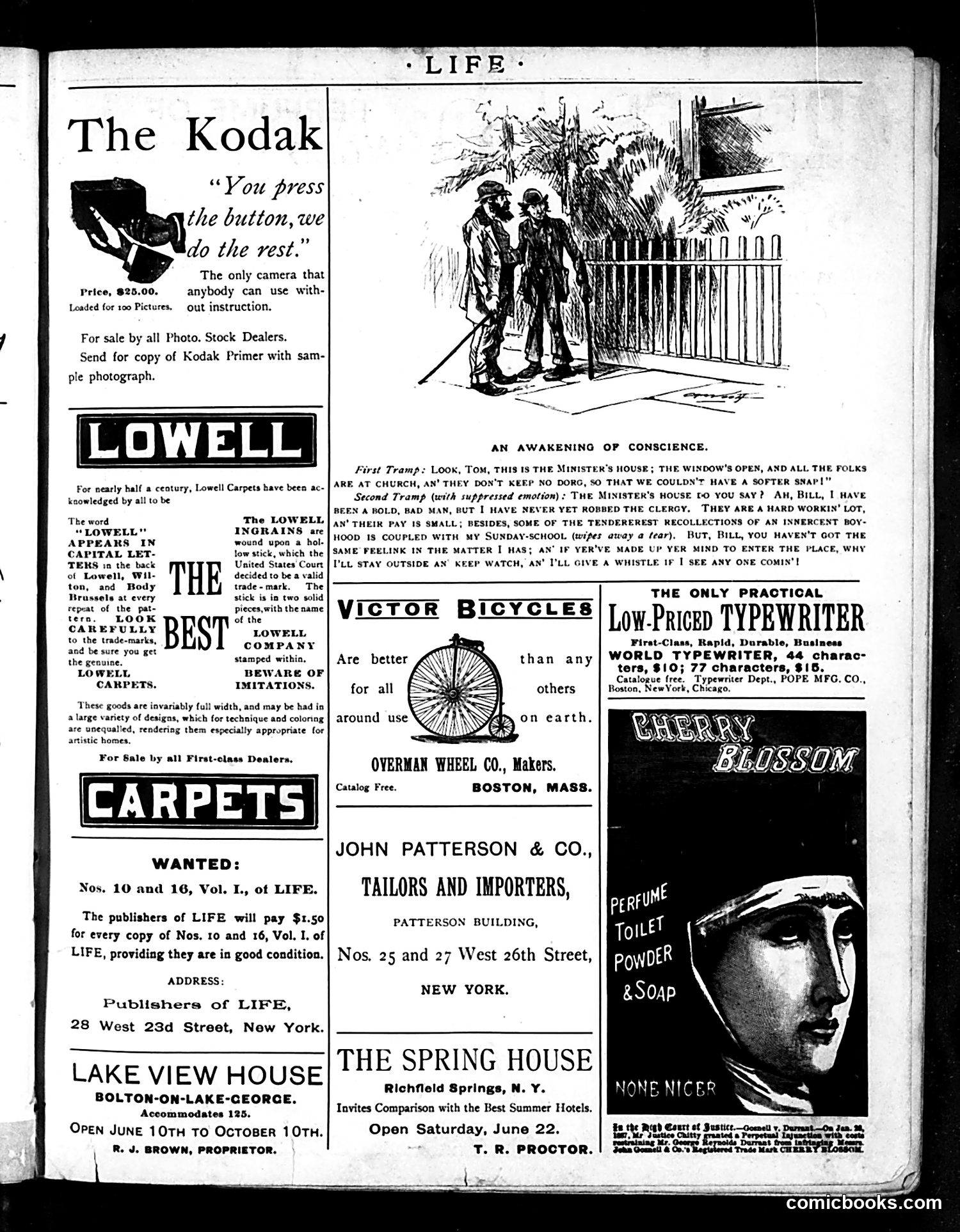
This cartoon depicts two tramps considering robbing a minister's house while the congregation is at church. The first tramp, Bill, points out the opportunity: an open window, no dog, and no one home. The second tramp, Tom, initially agrees but then experiences a moral crisis. Despite his criminal past, he refuses to rob clergy because: they work hard for meager pay, and his childhood Sunday-school memories trigger genuine conscience. He agrees to keep watch outside instead, unwilling to cross this particular line. The satire operates on multiple levels: it mocks Victorian sentimentality about morality (even "bold, bad" criminals respect the clergy), while simultaneously celebrating that religious education and childhood piety can inspire genuine ethical boundaries. The irony is that a hardened criminal exhibits more moral principle than expected—suggesting either that goodness is universal or that society's moral hierarchy (clergy as untouchable) runs deep even in the criminal underworld. The cartoon's title makes the joke explicit: witnessing conscience "awaken" in an unlikely subject.
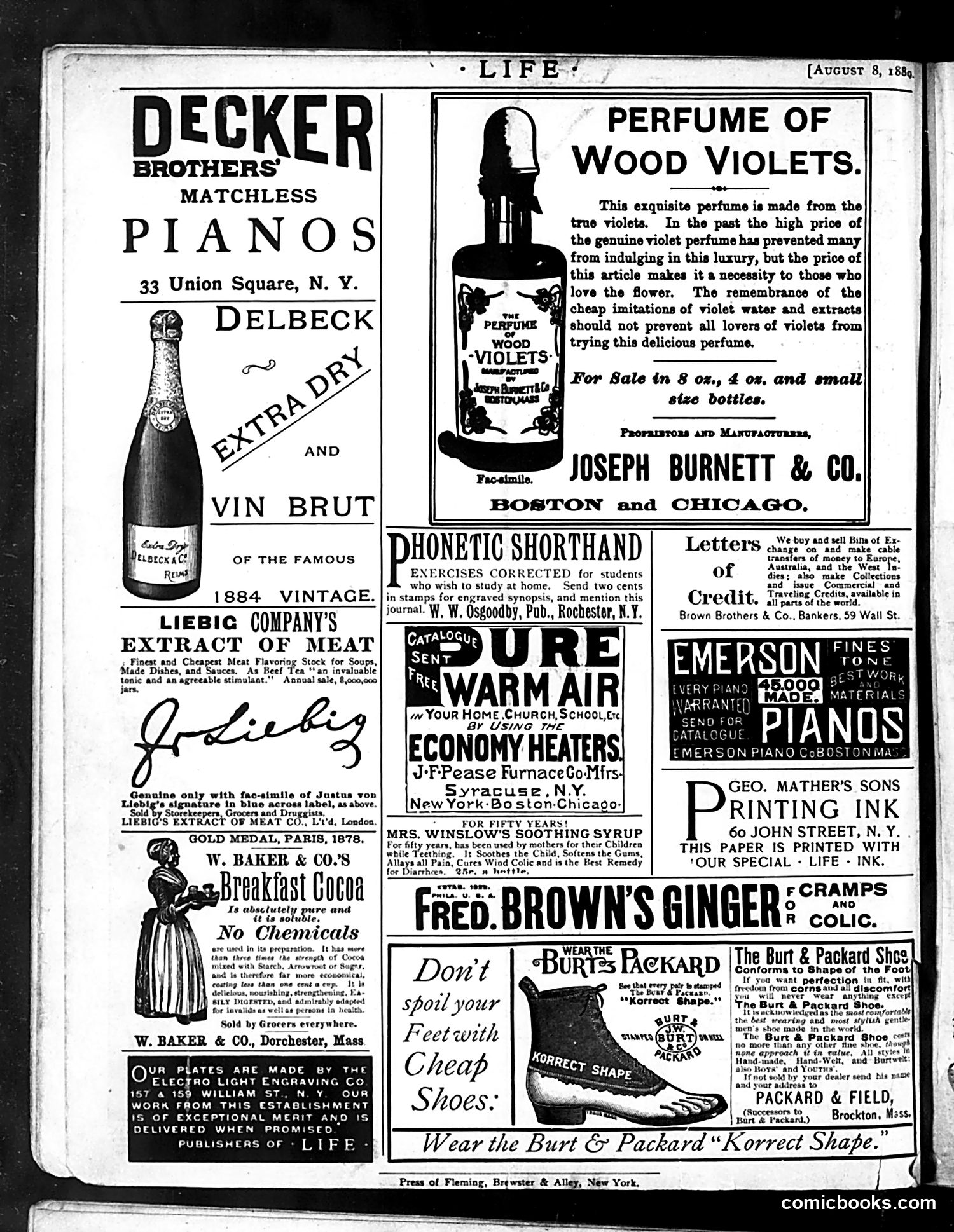
This page contains **no political cartoons or satire**—it is primarily a collection of commercial advertisements typical of late-19th-century American magazines. The ads showcase luxury and practical goods: Decker Brothers pianos, Delbeck champagne (1884 vintage), Liebig's meat extract, W. Baker & Company's breakfast cocoa, Joseph Burnett & Company's perfume of wood violets, and various other products including pianos, shorthand instruction, heating systems, and shoes. The ads employ period marketing tactics: emphasizing gold medals, scientific purity ("No Chemicals"), affordability of luxury items ("prevents many from indulging in this luxury"), and long-established reputations (Mrs. Winslow's Soothing Syrup claims "fifty years" of use). There is no satirical content visible. The page reflects the commercial culture and consumer goods available to middle and upper-class Americans in 1884.