
Life, 1889-08-08 · page 6 of 16
Life — August 8, 1889 — page 6: what you’re looking at
What you’re looking at
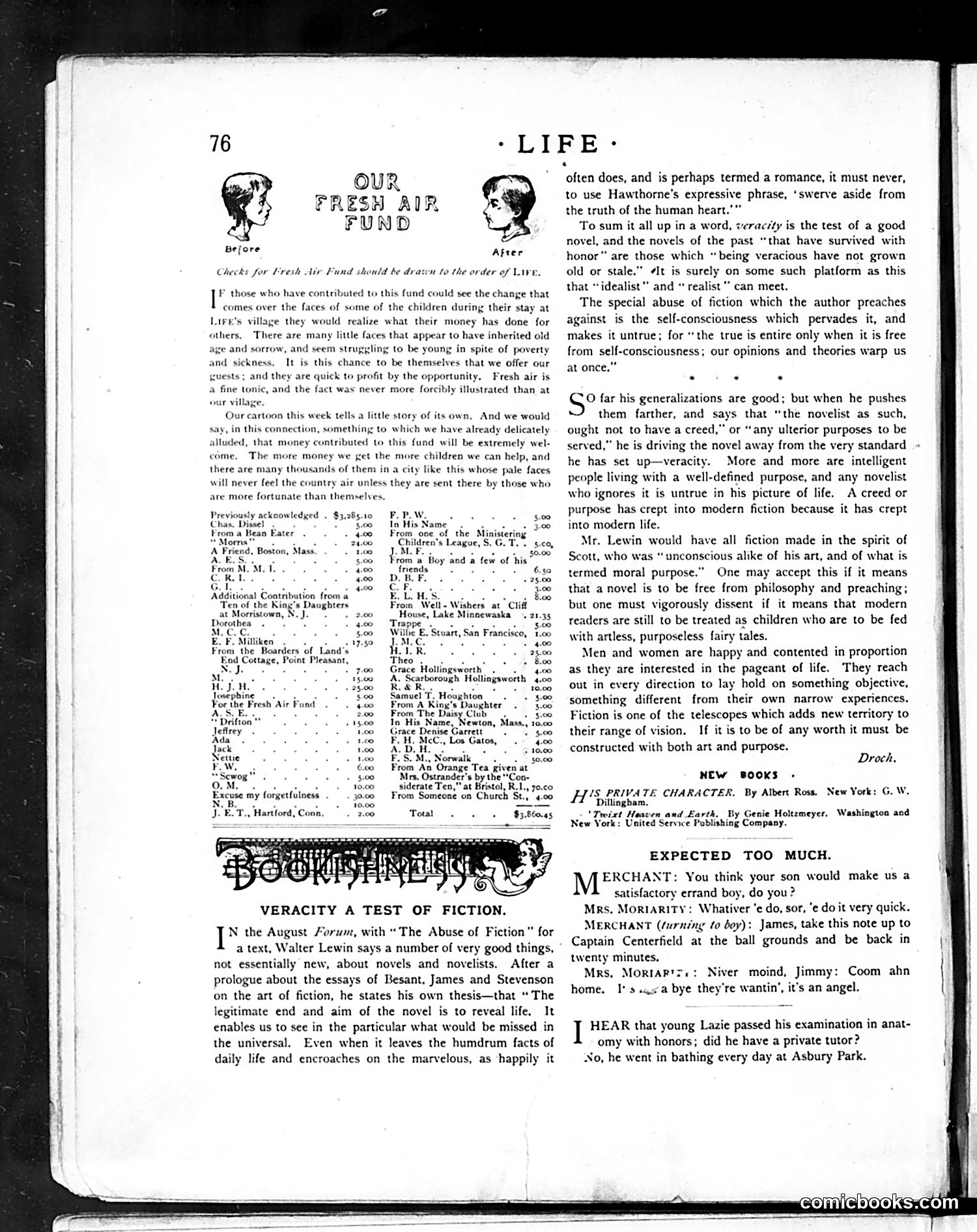
This page contains two distinct sections: **"Our Fresh Air Fund"** (top left): A fundraising list for a children's charity providing outdoor relief to impoverished urban youth. The accompanying illustration shows "Before" and "After" profile sketches of a child, presumably demonstrating the health benefits of fresh air exposure—a Progressive Era concern about city poverty and public health. **"Veracity a Test of Fiction"** (bottom): A literary criticism piece discussing novelist William Lewin's views on fiction's moral purpose. The author argues against didactic fiction that preaches morality, contending novels should depict life truthfully rather than serve as vehicles for philosophy. The **"Expected Too Much"** humor sketch depicts a merchant sending a boy on an errand, with comedic family dialogue about the child's reluctance—typical period domestic humor.
📄 Transcribed text from this page (OCR, searchable)
Machine-transcribed from the original scan — historical spelling and the odd misread are preserved.
LIFE RESH AIR FUND Dejore After Checks for Fresh Air Fund should be drain to the order of Live. ] shore who have contributed to this fund could see the change that comes over the faces of some of the children during their stay at Lire’s village they would realize what their money has done for others. ‘There are many little faces that appear to have inherited old and sorrow, and seem struggling to be young in spite of poverty It is this chance to be themselves that we offer our are quick to profit by the opportunity, Fresh air is tonic, and the fact was never more forcibly illustrated than at our villag Our cartoon this week tells a little story of its own, say, in this connectio luded, and sickness, ; and the And we would something to which we have already delicately that money contributed to this fund will be extremely wel- The more money we get the more children we can help, and there are many thousands of them in a city like this whose pale faces will never feel the country air unless they are sent there by those who are more fortunate than themselves. Previously acknowledged . $3,285.10 Chas. Dissel 5.00 A From a Beaa 400 From ove of the M omns” «2400 Children's League, A Friend, Boston, Mass. . eo MF. . S: : sco From a Boy and a a few of his” - 400 | fnends 6.50 D.B.F. A + 25.00 oo a rn 29 ELHS. " . - 3.00 From Well~ Wishers at’ Cliff House, Lake Minnewaska 21.35 Trappe. ss 50 Wille E. Stuart, San Francisco, 1.00 Poe et een ER. ok ee eayegeo Theo : + Boo Grace Hollingsworth’. 4.00 A. Scarborough Hollingsworth 4.00 R&R, % 16.00 Samuel T. Houghton". ” . 5.00 From A King's Daughter." §.00 From The Daisy Club. $.co In His Name, Newton, Mass, 10.00 Grace Denise Garrett." $00 F.H. McC., Los Gatos, ©.” 4.00 ALDH. axe FI S.'M.. Norwalk From An Orange Tea given at ‘Mrs, Ostrander’s by the "Con- siderate Ten,” at Bristol, R. From Someone on Church St F.P.N 2 In His Name ion from a Daughters itional Coat Ten of the King at Morristown, N. J. Dorothea MC. E. F. Milliken Josephine |. For the Fresh Air Fond AS. E. * Drifton Jefirey Ada Jack VERACITY A TEST OF FICTION. N the August Forwm, with “The Abuse of Fiction" for a text, Walter Lewin says a number of very good things, not essentially new, about novels and novelists. After a prologue about the essays of Besant, James and Stevenson on the art of fiction, he states his own thesis—that “ The legitimate end and aim of the novel is to reveal life. It enables us to see in the particular what would be missed in the universal. Even when it leaves the humdrum facts of daily life and encroaches on the marvelous, as happily it often does, and is perhaps termed a romance, it must never, to use Hawthorne's expressive phrase, ‘swerve aside from the truth of the human heart.’” To sum it all up in a word, veracity is the test of a good novel, and the novels of the past “that have survived with honor" are those which “being veracious have not grown old or stale.” lt is surely on some such platform as this that “idealist and “ realist” can meet. The special abuse of fiction which the author preaches against is the self-consciousness which pervades it, and makes it untrue; for “the true is entire only when it is free from self-consciousness; our opinions and theories warp us at once.” . . . ~ O far his generalizations are good; but when he pushes them farther, and says that “the novelist as such, ought not to have a creed,” or “any ulterior purposes to be served,” he is driving the novel away from the very standard he has set up—veracity. More and more are intelligent people living with a well-defined purpose, and any novelist who ignores it is untrue in his picture of life. A creed or purpose has crept into modern fiction because it has crept into modern life. Mr. Lewin would have all fiction made in the spirit of Scott, who was “unconscious alike of his art, and of what is termed moral purpose.” One may accept this if it means that a novel is to be free from philosophy and preaching; but one must vigorously dissent if it means that modern readers are still to be treated as children who are to be fed with artless, purposeless fairy tales. Men and women are happy and contented in proportion as they are interested in the pageant of life. They reach out in every direction to lay hold on something objective, something different from their own narrow experiences. Fiction is one of the telescopes which adds new territory to their range of vision. If it is to be of any worth it must be constructed with both art and purpose. Droch. NEW B800KS - HLS, PRIVATE CHARACTER. By Albert Ross. New York: G. W. Dillingham. ‘Twist Heaven and Earth, By Genie Holtzmeyer. Washington and New Vork: United Service Publishing Company. EXPECTED TOO MUCH. ERCHANT: You think your son would make us a satisfactory errand boy, do you ? Mrs. MortariTy: Whativer ‘e do, sor, 'e do it very quick. MERCHANT (furning fo boy): James, take this note up to Captain Centerfield at the ball grounds and be back in twenty minutes, Mrs, Moriartze: } home. It's awa bye th er moind, Jimmy: Coom ahn ‘re wantin’, it's an angel. HEAR that young Lazie passed his examination in anat- omy with honors; did he have a private tutor? No, he went in bathing every day at Asbury Park.