
Life, 1889-08-08 · page 4 of 16
Life — August 8, 1889 — page 4: what you’re looking at
What you’re looking at
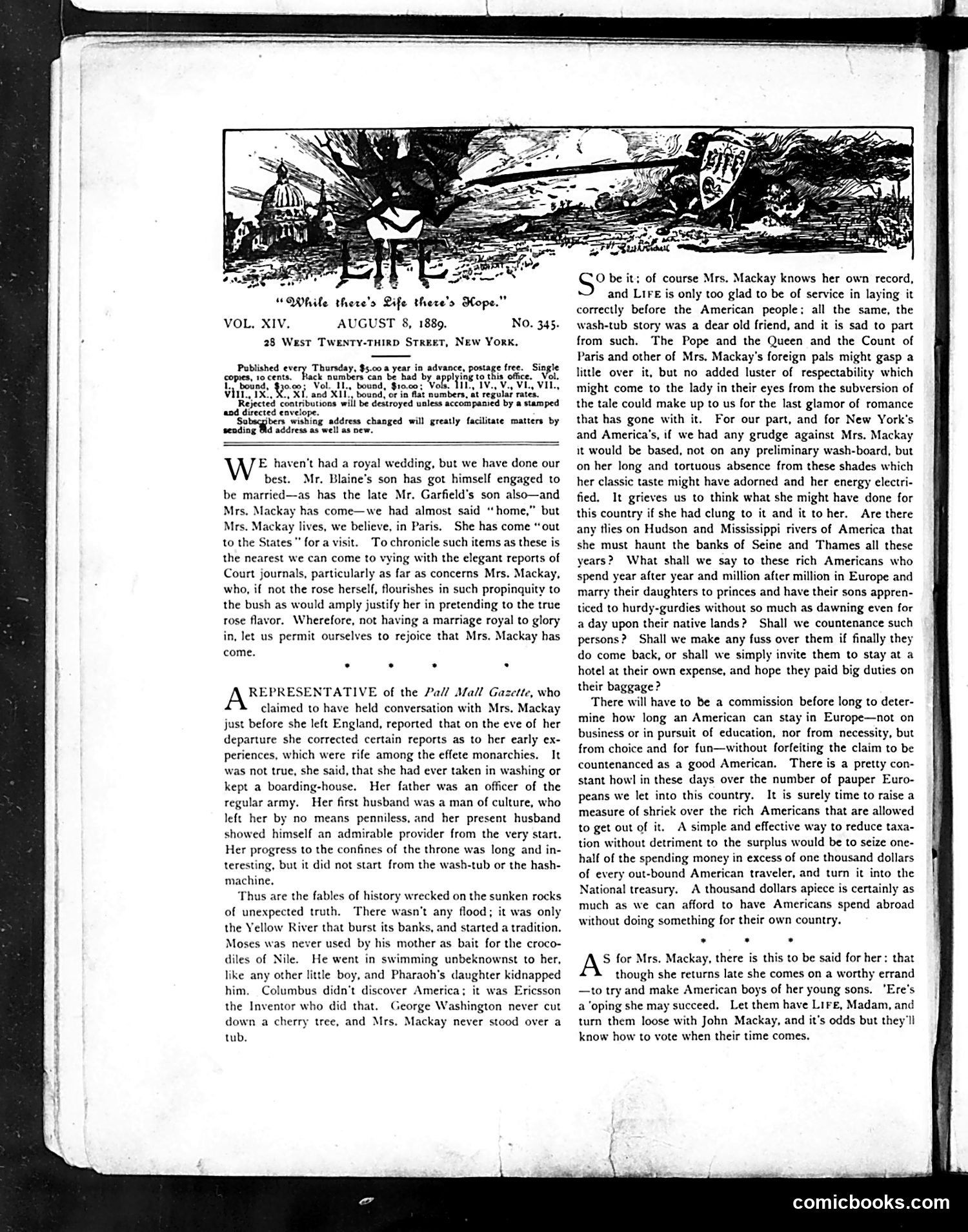
The masthead image appears to be a decorative header rather than a political cartoon. The page's main content is editorial commentary about Mrs. Mackay, a wealthy American socialite. The text satirizes Mrs. Mackay's social ambitions in Europe—she has apparently been making false claims about her family's aristocratic connections and history. The editors mock her pretensions, referencing invented stories about papal and royal connections. The satire criticizes wealthy Americans generally for spending lavishly abroad while remaining culturally insecure. The editors advocate for redirecting this wealth toward American institutions and question whether such wealthy travelers truly understand American civic values, humorously suggesting they don't know how to vote. The piece is social criticism disguised as gossip about one prominent family's European aspirations.
📄 Transcribed text from this page (OCR, searchable)
Machine-transcribed from the original scan — historical spelling and the odd misread are preserved.
“OMile there's Life there's Hope.” VOL, XIV. AUGUST 8, 1889. No. 345. 28 West TWENTY-THIRD STREET, New York, Published every Thursday, $5.00 a year in advance, postage free. Single copies, 1o cents. Rack aumbers can be had by applying to this office. Vol. Is boved, Gyo.ge; Vol. I. bound, Sroco: Vols: TI. 1V.. Vi VI vhtt., 1X., X., Xi. and X11, bound, of in flat numbers, Rejected contributions will be destroyed unless accom; and directed envelope. . Sabsqpbers wishing address changed will greatly facilitate matters by sending Old address as well as new. E haven't had a royal wedding, but we have done our best. Mr. Blaine’s son has got himself engaged to be married—as has the late Mr. Garfield's son also—and Mrs, Mackay has come—we had almost said “home,” but Mrs. Mackay lives, we believe, in Paris. She has come “out to the States" fora visit. To chronicle such items as these is the nearest we can come to vying with the elegant reports of Court journals, particularly as far as concerns Mrs, Mackay, who, if not the rose herself, flourishes in such propinquity to the bush as would amply justify her in pretending to the true rose flavor. Wherefore, not having a marriage royal to glory in, let us permit ourselves to rejoice that Mrs. Mackay has come. . . . . REPRESENTATIVE of the Pal? Mall Gazette, who claimed to have held conversation with Mrs. Mackay just before she left England, reported that on the eve of her departure she corrected certain reports as to her early ex- periences, which were rife among the effete monarchies. It was not true, she said, that she had ever taken in washing or kept a boarding-house. Her father was an officer of the regular army. Her first husband was a man of culture, who left her by no means penniless, and her present husband showed himself an admirable provider from the very start. Her progress to the confines of the throne was long and in- teresting, but it did not start from the wash-tub or the hash- machine. Thus are the fables of history wrecked on the sunken rocks of unexpected truth. There wasn’t any flood; it was only the Yellow River that burst its banks, and started a tradition. Moses was never used by his mother as bait for the croco- diles of Nile. He went in swimming unbeknownst to her, like any other little boy, and Pharaoh's daughter kidnapped him. Columbus didn’t discover America; it was Ericsson the Inventor who did that. George Washington never cut down a cherry tree, and Mrs. Mackay never stood over a tub. O be it; of course Mrs. Mackay knows her own record, and Lire is only too glad to be of service in laying it correctly before the American people; all the same, the wash-tub story was a dear old friend, and it is sad to part from such. The Pope and the Queen and the Count of Paris and other of Mrs. Mackay’s foreign pals might gasp a little over it, but no added luster of respectability which might come to the lady in their eyes from the subversion of the tale could make up to us for the last glamor of romance that has gone with it. For our part, and for New York's and America’s, if we had any grudge against Mrs. Mackay it would be based, not on any preliminary wash-board, but on her long and tortuous absence from these shades which her classic taste might have adorned and her energy electri- fied. It grieves us to think what she might have done for this country if she had clung to it and it to her. Are there any flies on Hudson and Mississippi rivers of America that she must haunt the banks of Seine and Thames all these years? What shall we say to these rich Americans who spend year after year and million after million in Europe and marry their daughters to princes and have their sons appren- ticed to hurdy-gurdies without so much as dawning even for a day upon their native lands? Shall we countenance such persons? Shall we make any fuss over them if finally they do come back, or shall we simply invite them to stay at a hotel at their own expense, and hope they paid big duties on their baggage? There will have to be a commission before long to deter- mine how long an American can stay in Europe—not on business or in pursuit of education, nor from necessity, but from choice and for fun—without forfeiting the claim to be countenanced as a good American. There is a pretty con- stant howl in these days over the number of pauper Euro- peans we let into this country. It is surely time to raise a measure of shrick over the rich Americans that are allowed to get out of it. A simple and effective way to reduce taxa- tion without detriment to the surplus would be to seize one- half of the spending money in excess of one thousand dollars of every out-bound American traveler, and turn it into the National treasury. A thousand dollars apiece is certainly as much as we can afford to have Americans spend abroad without doing something for their own country. . . . S for Mrs. Mackay, there is this to be said for her: that though she returns late she comes on a worthy errand —to try and make American boys of her young sons. ‘Ere's a ‘oping she may succeed. Let them have Lire, Madam, and turn them loose with John Mackay, and it’s odds but they'll know how to vote when their time comes. comicbooks.com