
A complete issue · 20 pages · 1889
Life — July 4, 1889
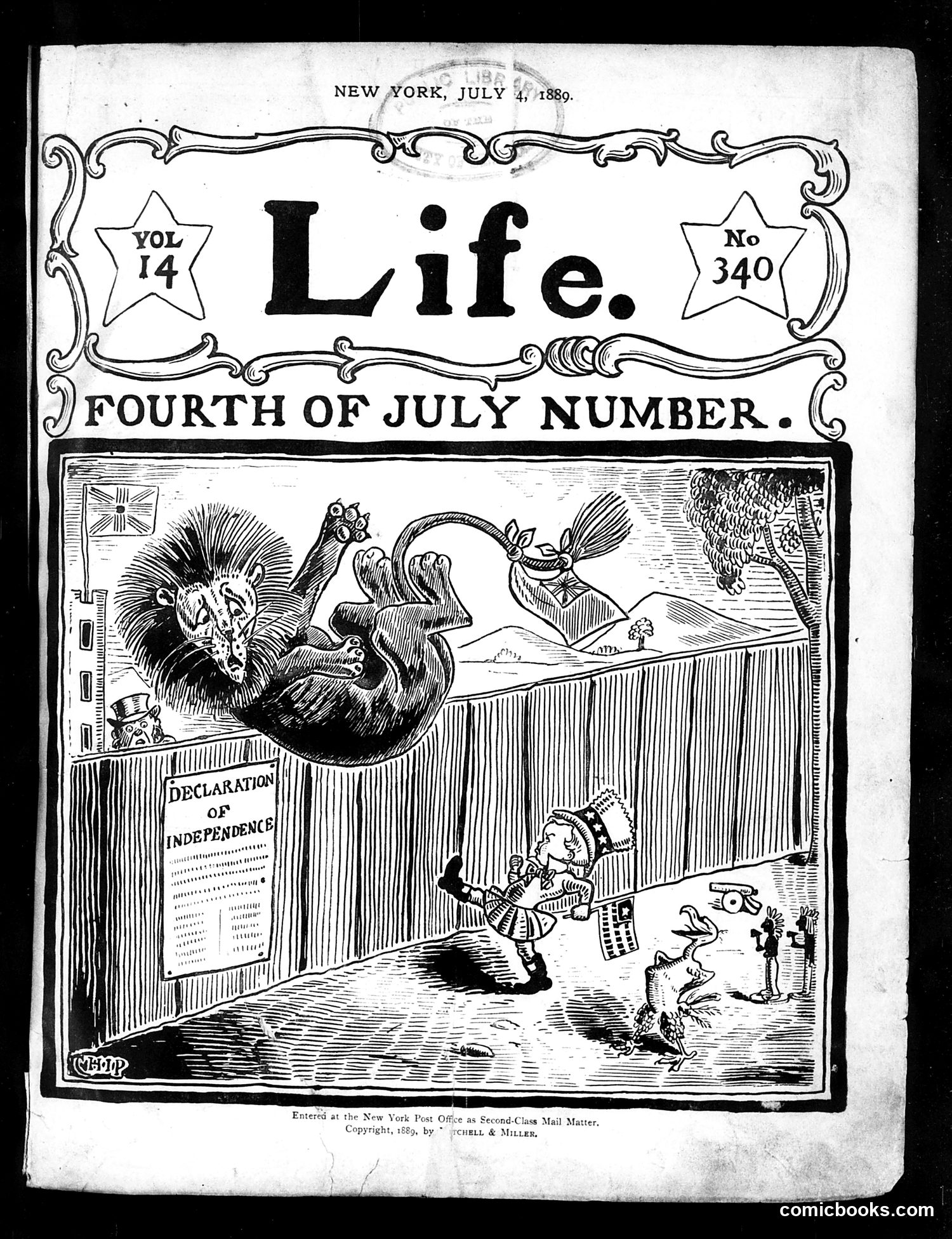
This Fourth of July satirical cover depicts Uncle Sam (identifiable by his characteristic tall hat and starred clothing) lying on his back in a precarious position, appearing to juggle or struggle with the Declaration of Independence document visible on the wall behind him. A small figure in patriotic dress stands nearby with what appears to be fireworks or celebratory items. The cartoon likely satirizes American political instability or governance challenges of 1889—suggesting the nation is metaphorically "juggling" its founding principles precariously rather than maintaining them steadily. The exaggerated, unstable pose suggests concerns about the country's direction during this Gilded Age period, though the specific political issue requires additional historical context to identify with certainty.
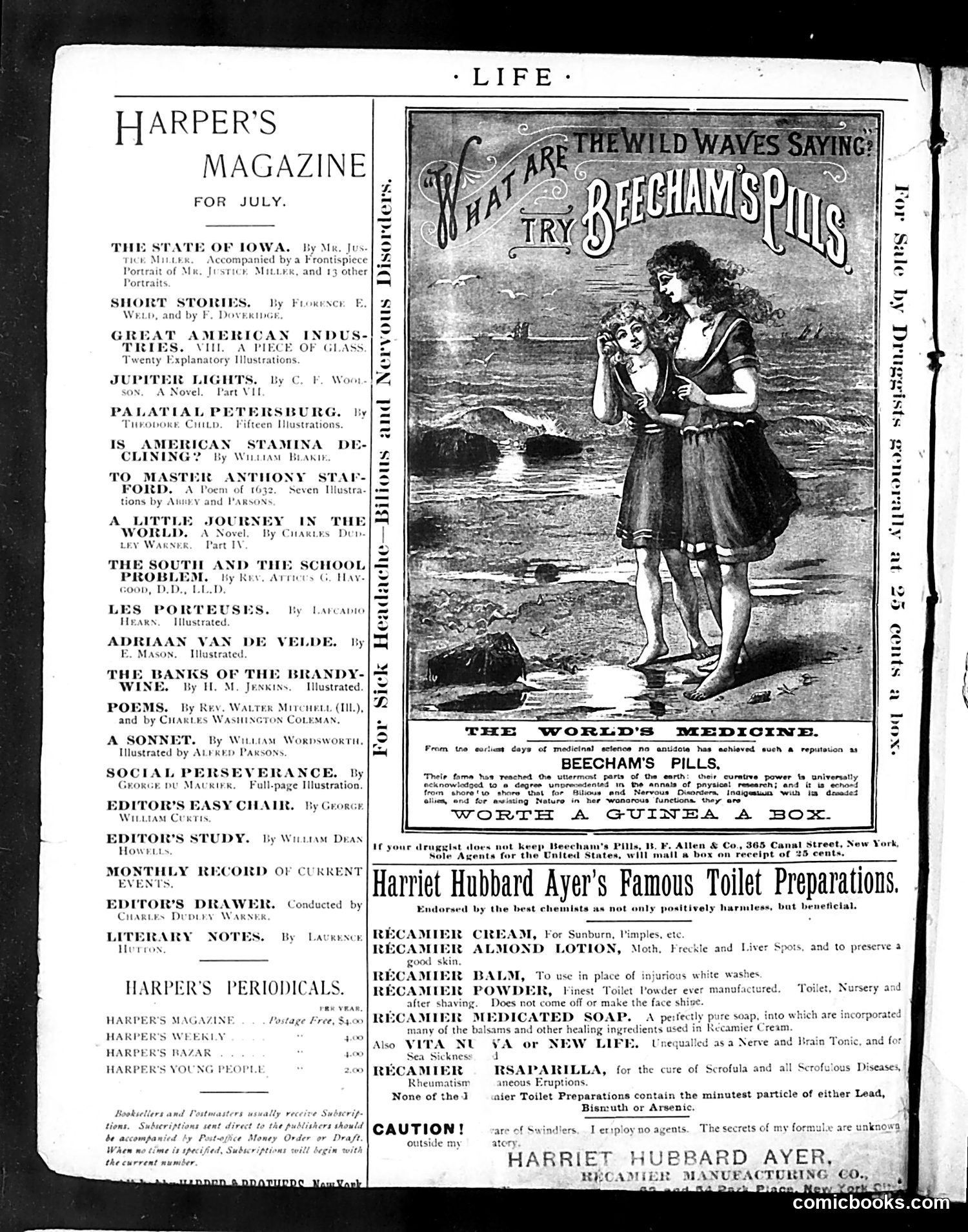
This page is **primarily advertising**, not political satire. The dominant content features two large commercial advertisements: 1. **Beecham's Pills** (top right): A Victorian-era patent medicine ad showing two women by the seaside, promoting pills as "The World's Medicine." The text claims universal efficacy for various ailments. 2. **Harriet Hubbard Ayer's Toilet Preparations** (bottom): Advertisement for cosmetic and medicinal products including creams, lotions, powders, and soaps, with a cautionary note about counterfeits. The left side lists Harper's Magazine's July contents—literary works, stories, and essays—typical of the publication's editorial offerings. **No political cartoon or satire is present.** This appears to be a standard magazine contents/advertising page from the era, reflecting period attitudes toward patent medicines and beauty products marketed with exaggerated health claims.
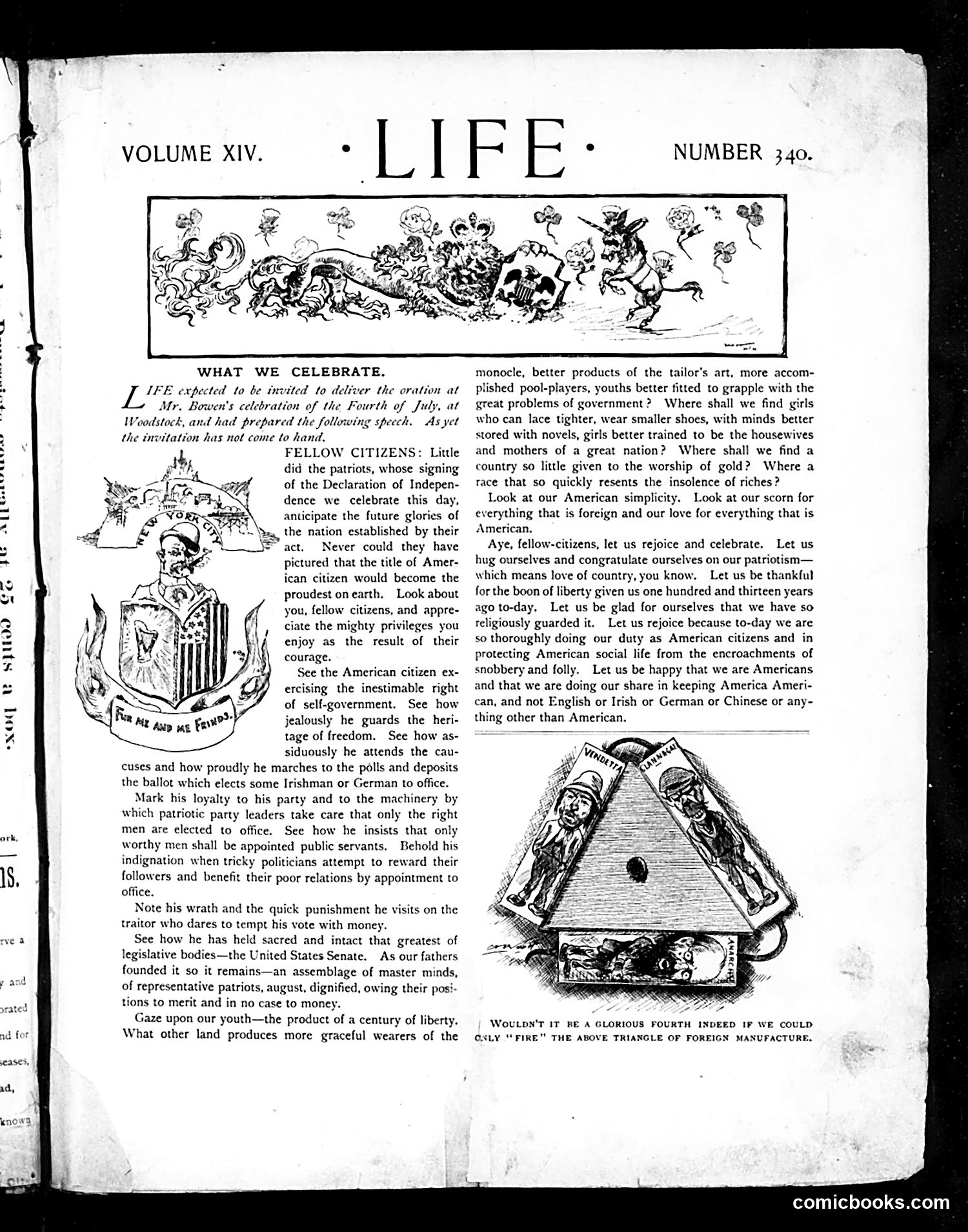
This patriotic Fourth of July editorial celebrates American citizenship and democratic ideals. The main text, titled "What We Celebrate," praises the Declaration of Independence and critiques political corruption—specifically mocking the tendency of political machines to reward Irish and German immigrant voters with government appointments in exchange for votes. The top cartoon depicts allegorical figures representing patriotic virtues. The lower illustration shows a shield or emblem labeled "Street Cleaning" with hands clasping it, captioned with text about "firing" foreign manufacturing influences. The satire targets machine politics and immigrant political influence while ironically celebrating American meritocratic ideals. It reflects nativist anxieties of the era about non-Anglo immigrants' political power, presenting this as contrary to founding principles of worthy, merit-based leadership.
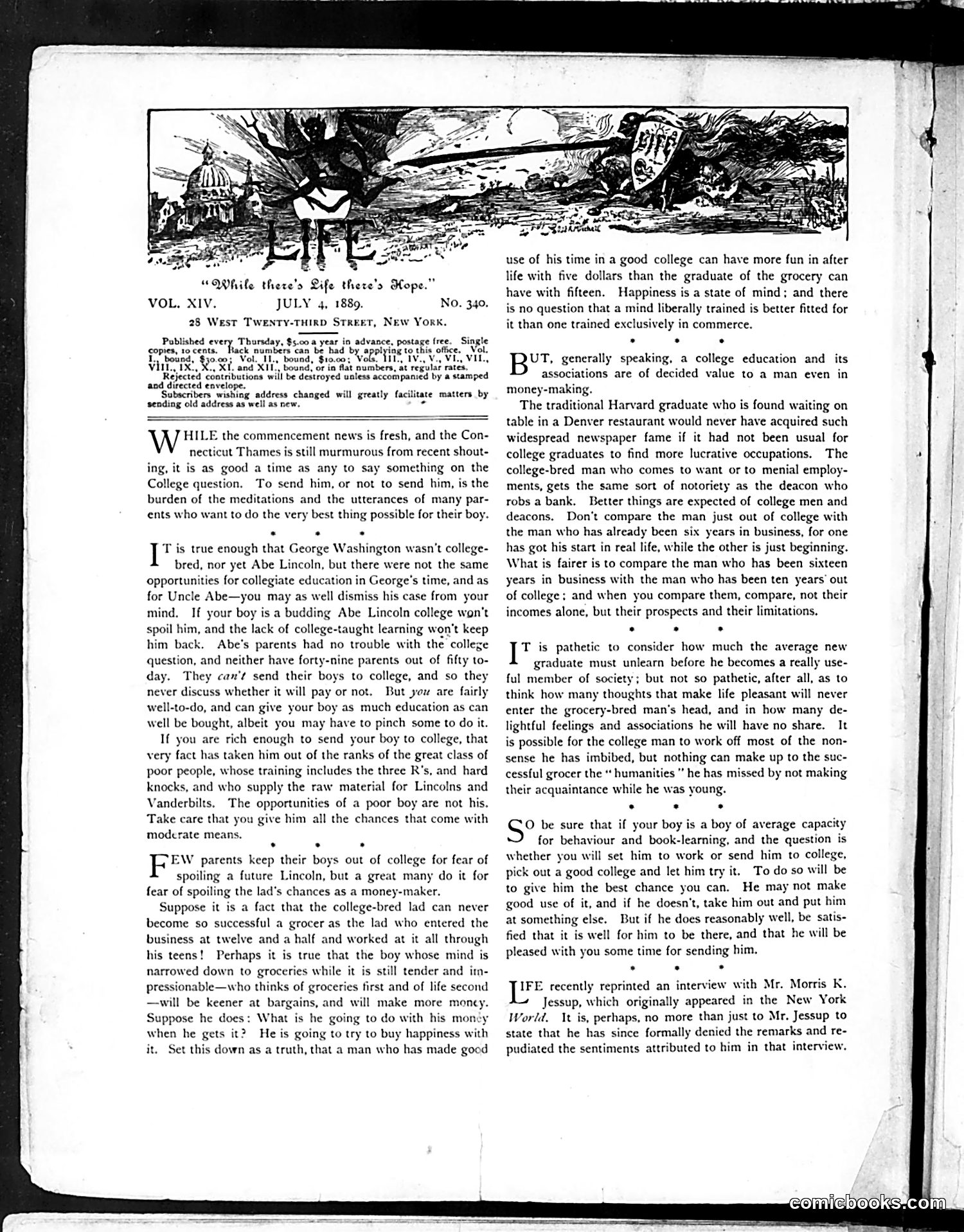
The masthead cartoon depicts a chaotic landscape with classical architecture (a domed building) juxtaposed against violent destruction—explosions, debris, and what appears to be warfare or catastrophe. The quote "'While there's Life there's Hope'" suggests ironic commentary on optimism amid crisis. The article below debates whether parents should send sons to college. It references historical figures (George Washington, Abraham Lincoln) who succeeded without formal education, questioning whether college truly ensures success. The satire targets middle-class anxieties about education's value and cost. The cartoon likely comments on contemporary social upheaval or instability (the date is 1880), while the article's debate reflects Gilded Age concerns about education's role in social mobility and economic success.
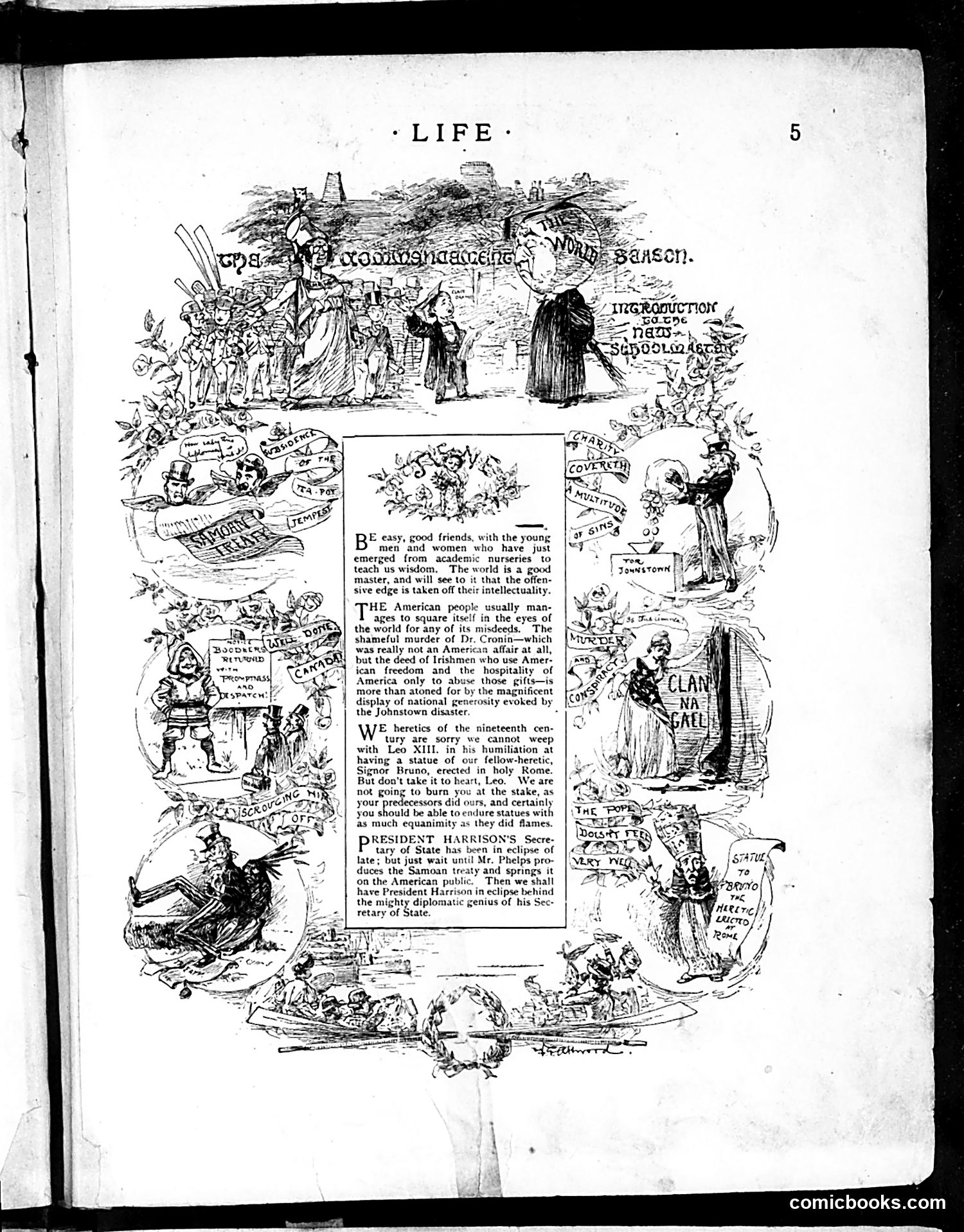
This satirical page lampoons Irish-American political influence and the **Johnstown Flood** (appears to reference the 1889 disaster). The text mocks how Irish-Americans "manage to square itself in the eyes of the world" while pursuing their own interests, suggesting their charitable response to the disaster was performative nationalism rather than genuine American concern. The cartoon criticizes Irish-American political networks (references to "Clan na Gael" visible) and accuses them of using the tragedy for political advantage. The piece sarcastically praises their "national generosity" while implying their real motivation was advancing Irish nationalist causes in America. The ornate border illustrations appear to depict various Irish-American figures and stereotypes, reinforcing the satire's focus on Irish-American political culture and perceived dual loyalties.
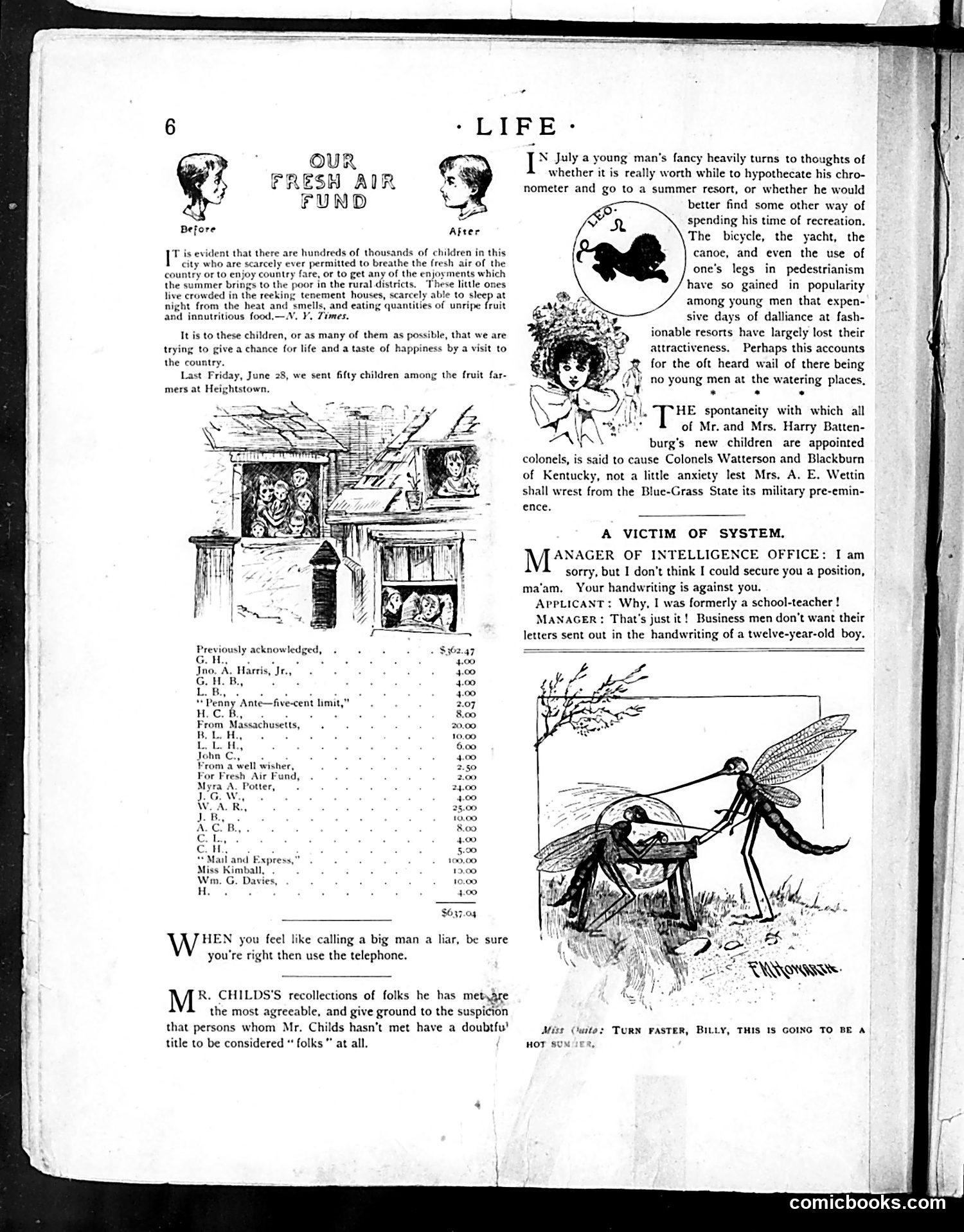
This page contains several distinct items: **"Our Fresh Air Fund"** (left): A charitable initiative sending poor urban children to the countryside. The "before/after" images show a malnourished child transformed by fresh air—a progressive-era social welfare program satirized here as genuinely beneficial. **"A Victim of System"** (center): A brief satirical dialogue mocking rigid business hiring practices. A school-teacher applicant is rejected because their handwriting resembles a child's—absurd bureaucratic inflexibility presented as comedy. **Dragonfly cartoon** (right): Illustrates a humorous domestic scene where one insect tells another "Turn faster, Billy, this is going to be a hot summer"—likely weather-related humor unrelated to politics. The page reflects early 20th-century American concerns: child welfare, employment discrimination, and seasonal anticipation.
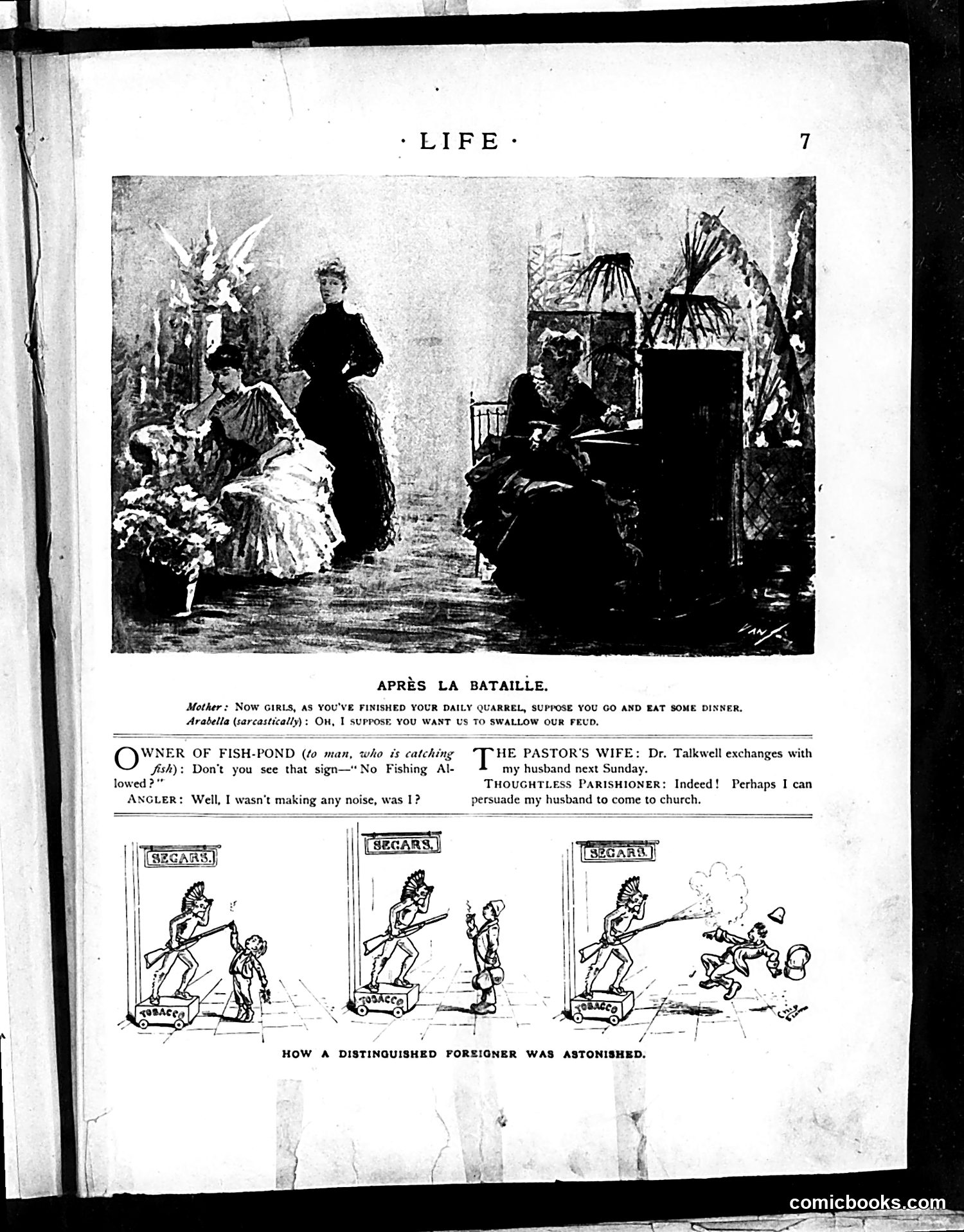
**Upper Section ("Après la Bataille"):** A domestic scene showing women in an interior with potted plants. The dialogue suggests post-conflict conversation between upper-class women, with one mother instructing girls to eat dinner and another sarcastically noting they should "swallow our feud"—implying resolution of a dispute. **Lower Comic Strip ("How a Distinguished Foreigner Was Astonished"):** Three sequential panels labeled "Segars" show a military or uniformed figure repeatedly striking a small civilian with what appears to be a sword or stick, escalating in violence across the panels. The title suggests ironic commentary on foreign military conduct or colonial violence, presenting "astonishment" at brutal behavior treated as entertainment. The page overall satirizes social conflict and military aggression as routine matters among the privileged classes.
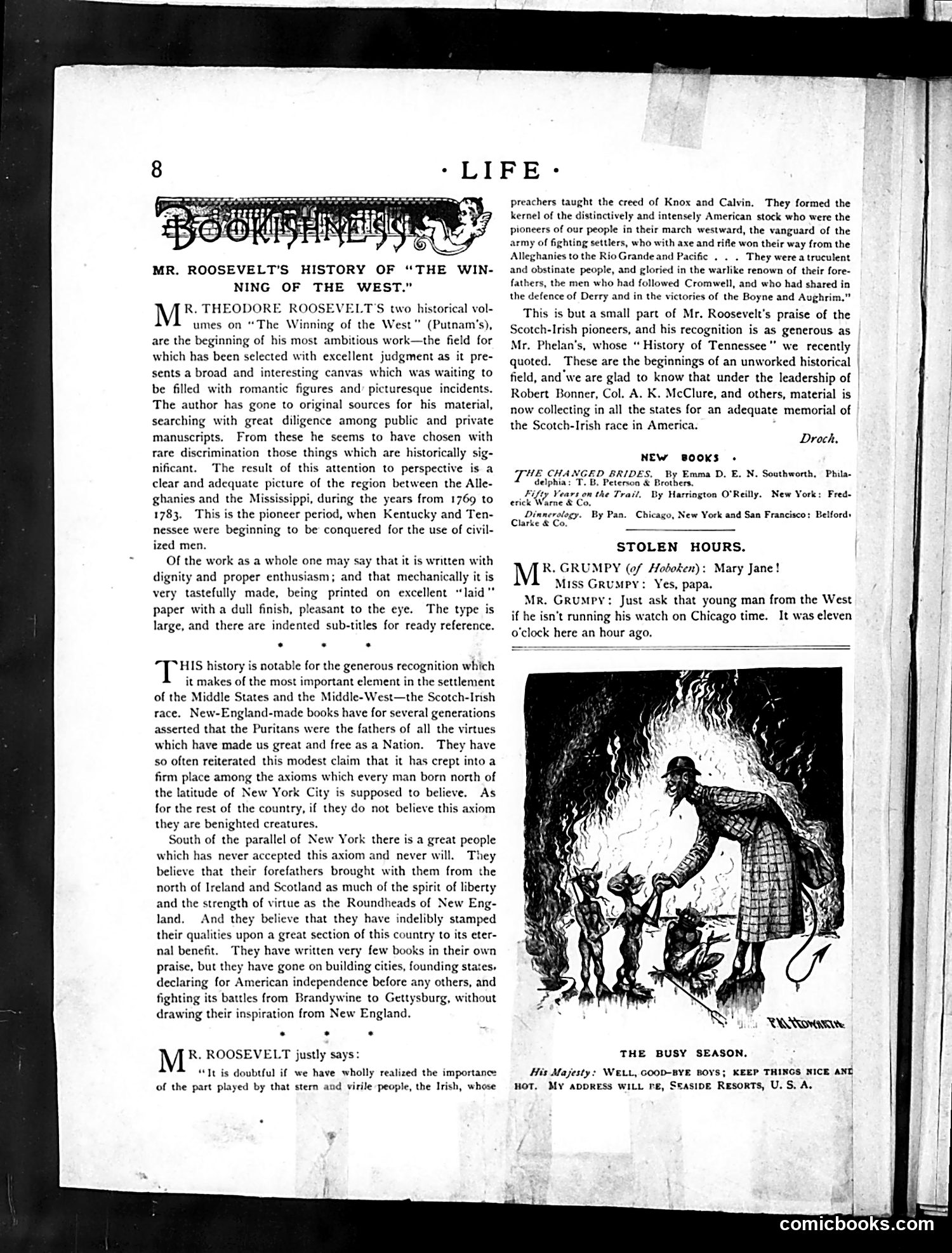
This cartoon illustrates a domestic scene where a woman in a plaid dress tends a fireplace while a child plays nearby. The illustration is captioned "THE BUSY SEASON" with a subtitle referencing "His Majesty" and addressing "SEASIDE RESORTS, U.S.A." The joke appears to mock the contrast between leisurely vacation life and domestic labor: while wealthy Americans escape to seaside resorts for relaxation, working-class women remain home managing household fires and childcare—their "busy season" never ends. The satire highlights class disparities in access to leisure during the early 20th century, suggesting that servants and working women cannot enjoy the same vacation privileges as their employers.
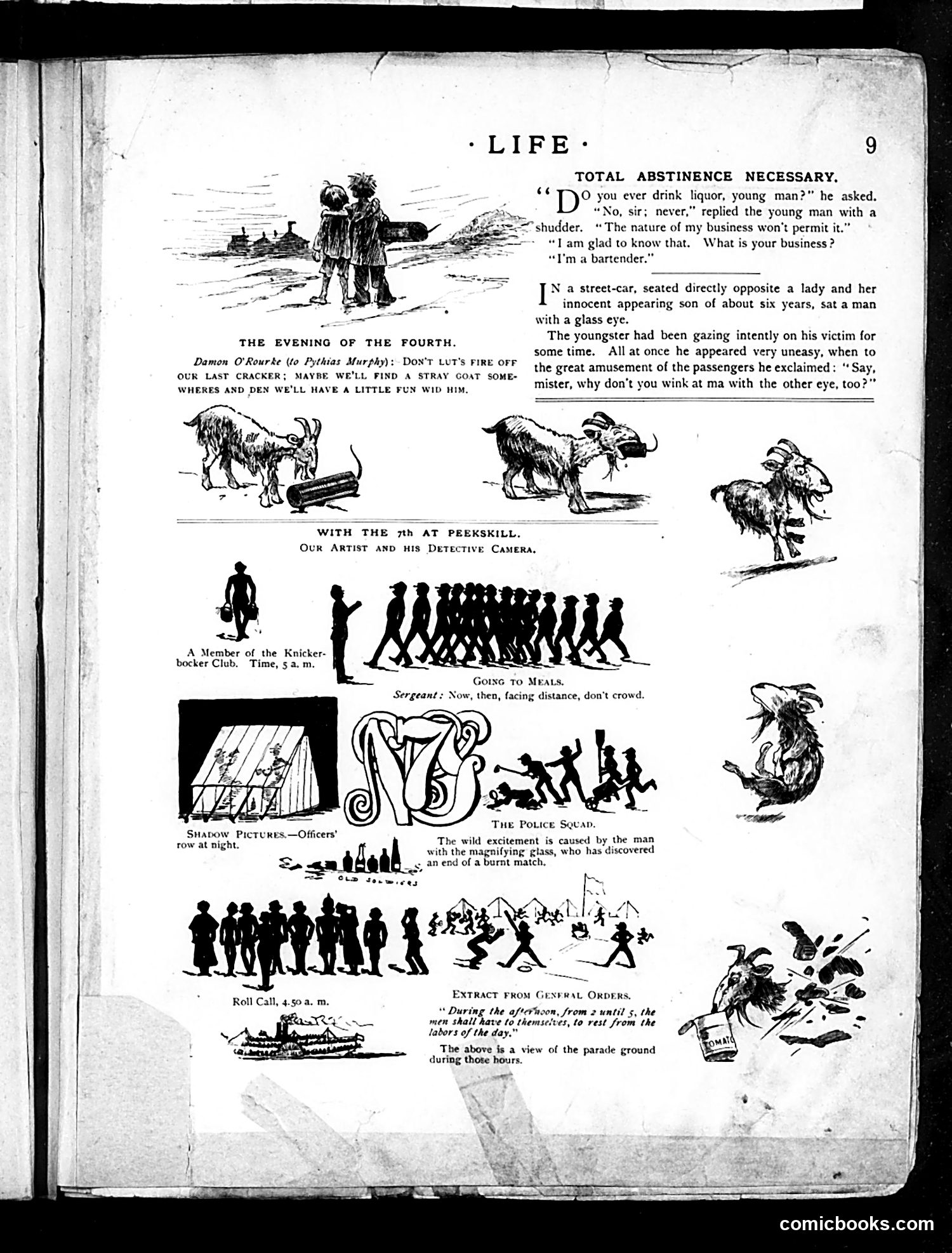
This page satirizes Fourth of July celebrations and military life circa early 1900s. The top section mocks a bartender's claimed abstinence through a street-car anecdote about a child noticing his "other eye" — implying the bartender drinks secretly despite denying it. The lower illustrations humorously document Independence Day activities: dogs with firecrackers, a "Knickerbocker Club" member, soldiers marching "Going to Meals," officers viewing "Shadow Pictures," and a police squad responding to a man with a "magnifying glass" discovering an "end of a burnt match" — mocking both military bureaucracy and the trivial disturbances that consume official attention on the holiday. The satire targets pretension, hidden vice, and the absurdity of military protocol.
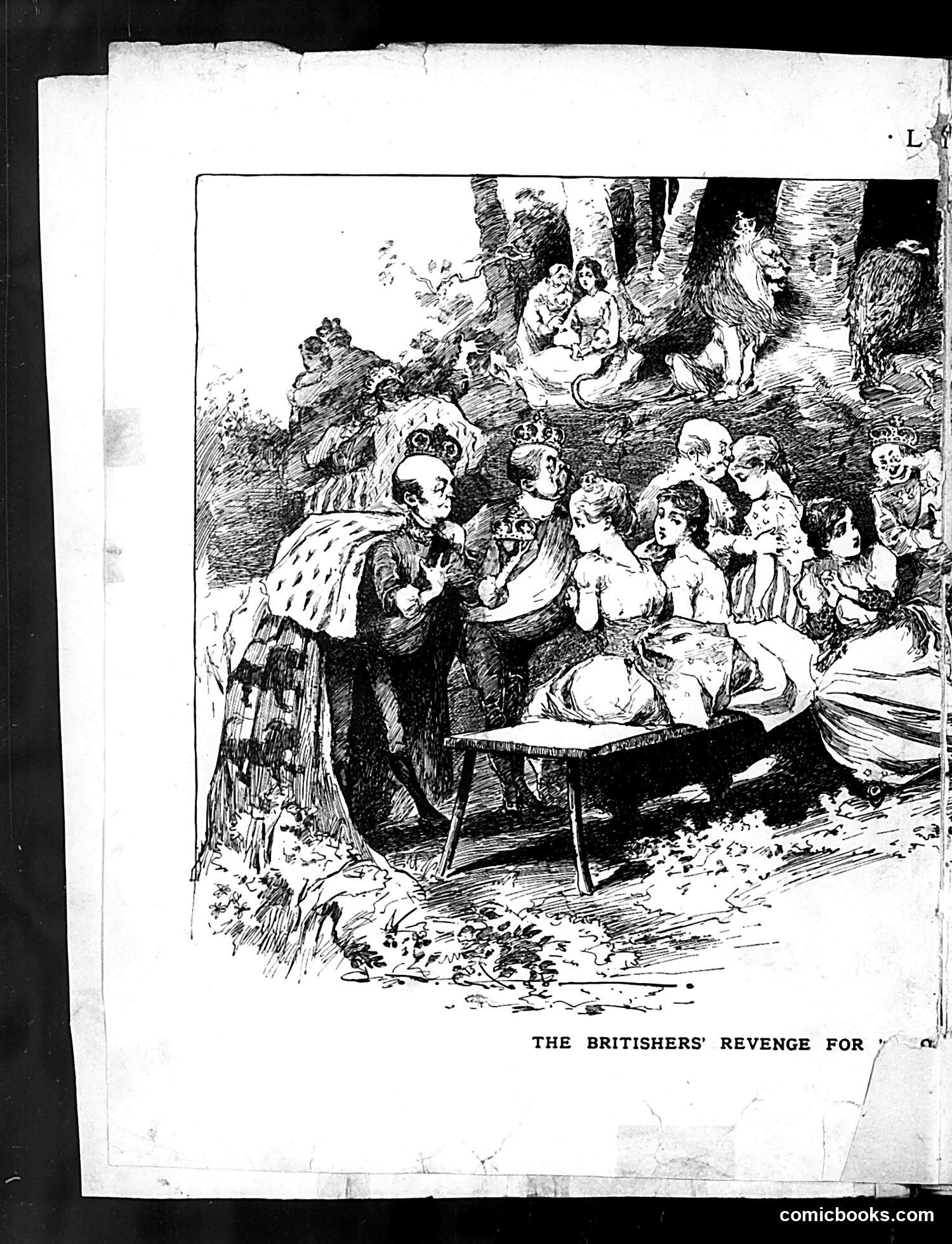
This political cartoon depicts what appears to be a royal or aristocratic British figure (left, wearing ermine-trimmed robes and crown) surrounded by women and children in a forest or wooded setting. The title suggests British retaliation for some unspecified offense. Without the complete caption or date, the specific historical event referenced is unclear. However, the imagery—a figure of authority among civilians, particularly women and children—suggests satire about British colonial conduct or military actions. The intimate, domestic scene contrasts with the formal dress and royal bearing, likely mocking either British pretensions or their treatment of civilian populations. The cartoon's incomplete title prevents definitive interpretation of its satirical target.
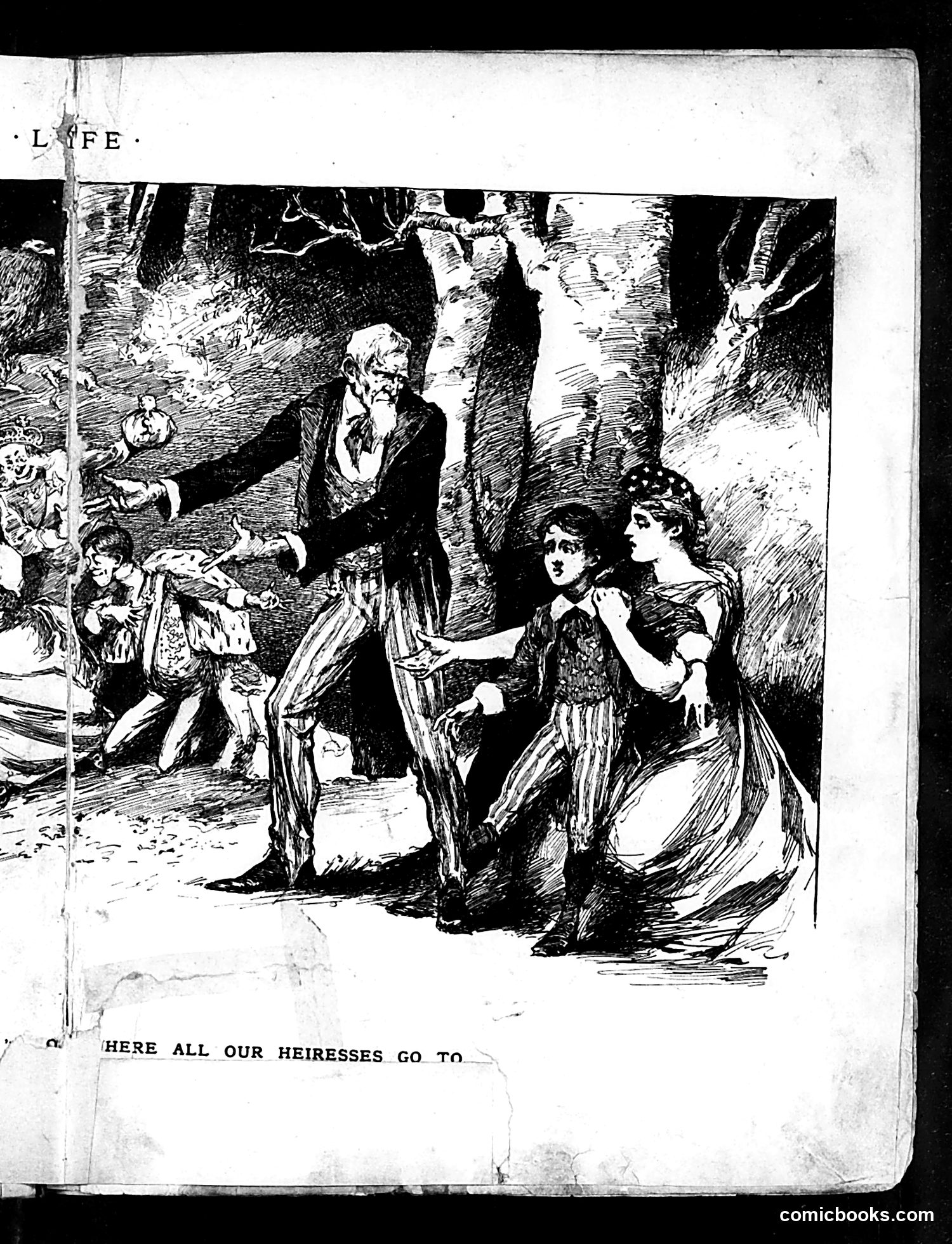
This illustration from *Life* magazine depicts a scene titled "Here All Our Heiresses Go To," showing an elderly gentleman (appearing to be a wealthy patriarch or matchmaker) presenting young women to potential suitors in a forest setting. The satire targets the practice of wealthy families arranging marriages for their daughters, treating heiresses as commodities to be displayed and traded. The caption's incomplete phrase suggests ironic commentary on the marriage market—implying wealthy families parade their daughters for advantageous matches in private, secluded settings away from public scrutiny. The formal dress and woodland location create an absurdist contrast, mocking the ritualistic nature of aristocratic matrimonial arrangements. This reflects *Life*'s satirical criticism of Gilded Age wealth concentration and marriage practices among the elite.
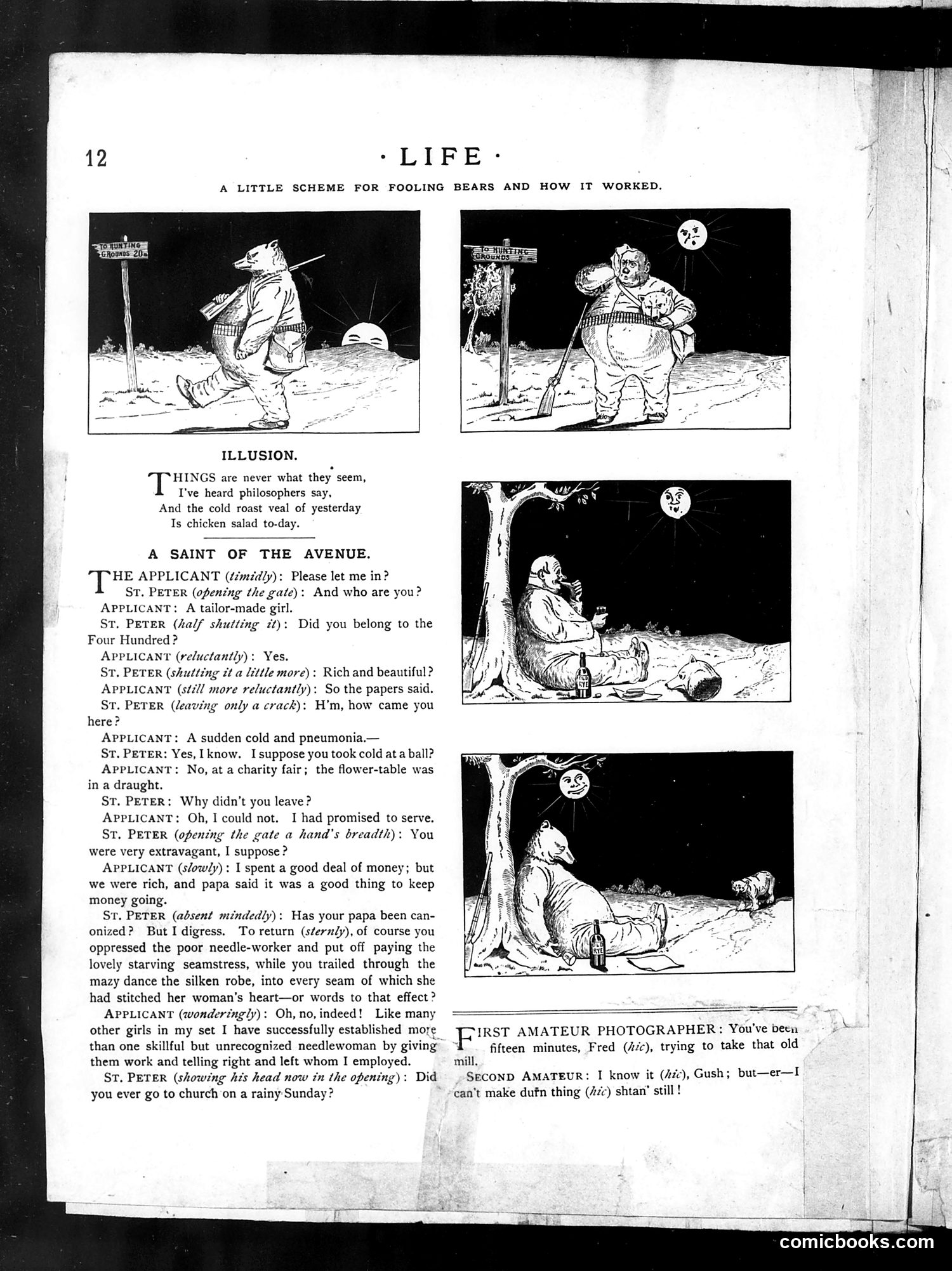
This page contains two satirical pieces: **"A Little Scheme for Fooling Bears"** (top cartoons): The text references an old saying about illusion—things aren't what they seem. The phrase "cold roast veal of yesterday is chicken salad to-day" suggests deception and repackaging, likely a general commentary on fraud or misrepresentation rather than a specific political reference. **"A Saint of the Avenue"** (main dialogue): St. Peter interrogates a wealthy woman ("tailor-made girl," member of the "Four Hundred"—high society) applying for heaven entry. The satire mocks how she gains admission by claiming charitable work despite her extravagant lifestyle. St. Peter suggests she typically exploited seamstresses, but she counters that she actually employed and supported poor needlewomen—a sardonic commentary on wealthy women's selective charity and self-justification. The piece satirizes both class privilege and how the wealthy rationalize their behavior through modest philanthropic acts. **Bottom joke**: Two amateur photographers struggle to photograph an old mill that won't stay still—a simple visual gag about persistence and frustration.
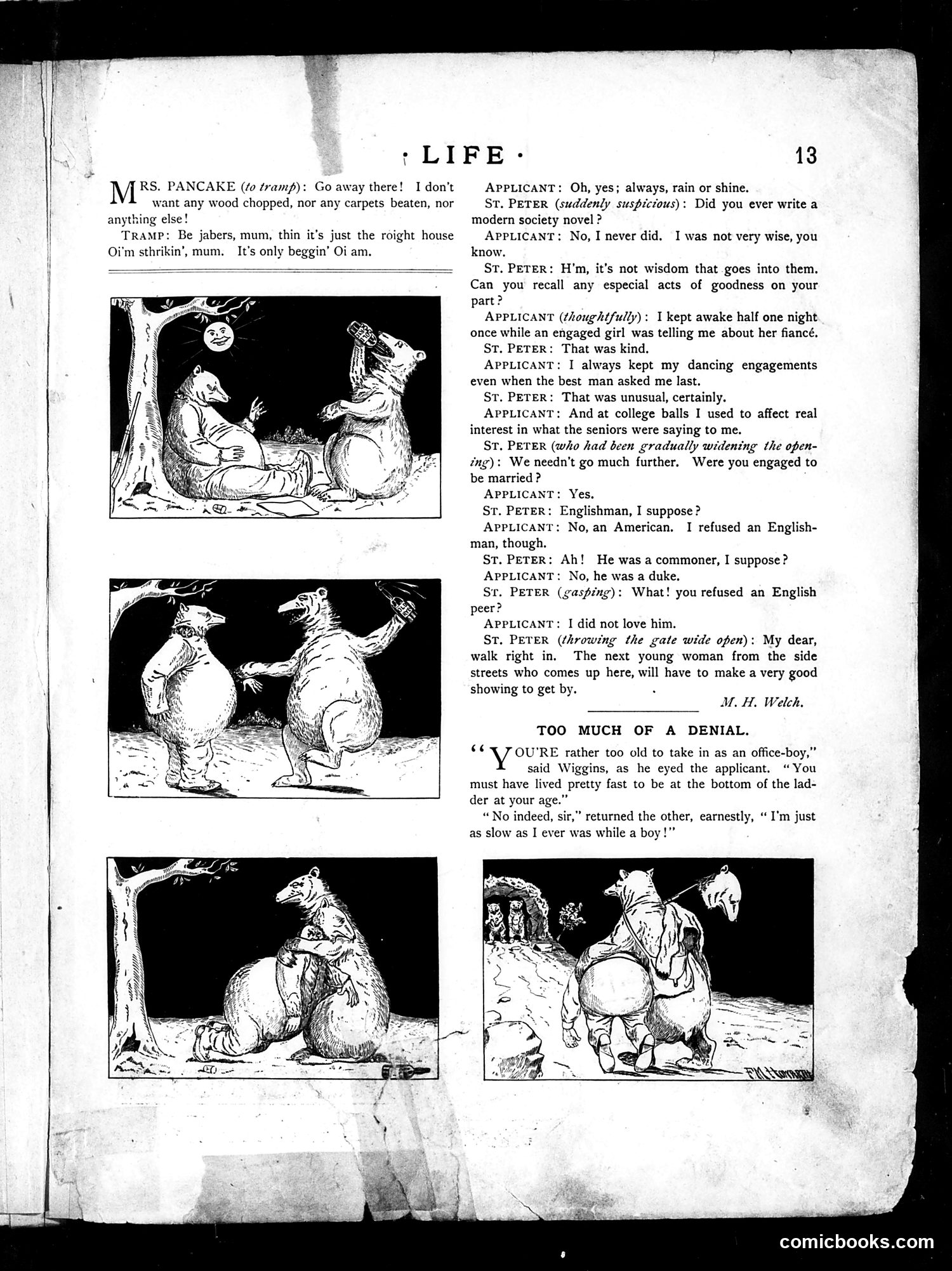
This page contains two distinct satirical pieces: **"Too Much of a Denial"** (bottom): A brief joke about a job applicant claiming he's always been slow, even as a boy—the humor lies in his inadvertent admission that he's been a failure his entire life. **"St. Peter at the Gate"** (right column): A longer dialogue satirizing modern society, particularly women's values. An applicant seeks heavenly entry by citing trivial "good deeds" (staying awake listening to gossip, keeping dance dates). St. Peter grows suspicious about modern novels—implying they promote questionable morality. The punchline: the woman is admitted to heaven specifically because she *refused* to marry an English duke solely for his title/wealth. This inverts contemporary expectations, suggesting most women would accept such a match. The satire critiques both materialism and the "modern" literature allegedly encouraging it. **Four animal illustrations** (left): Appear to show a separate comic strip featuring anthropomorphic animals in conversation, though context is unclear without captions. The page reflects early 20th-century American anxieties about women's changing values and "modern" literature's influence.
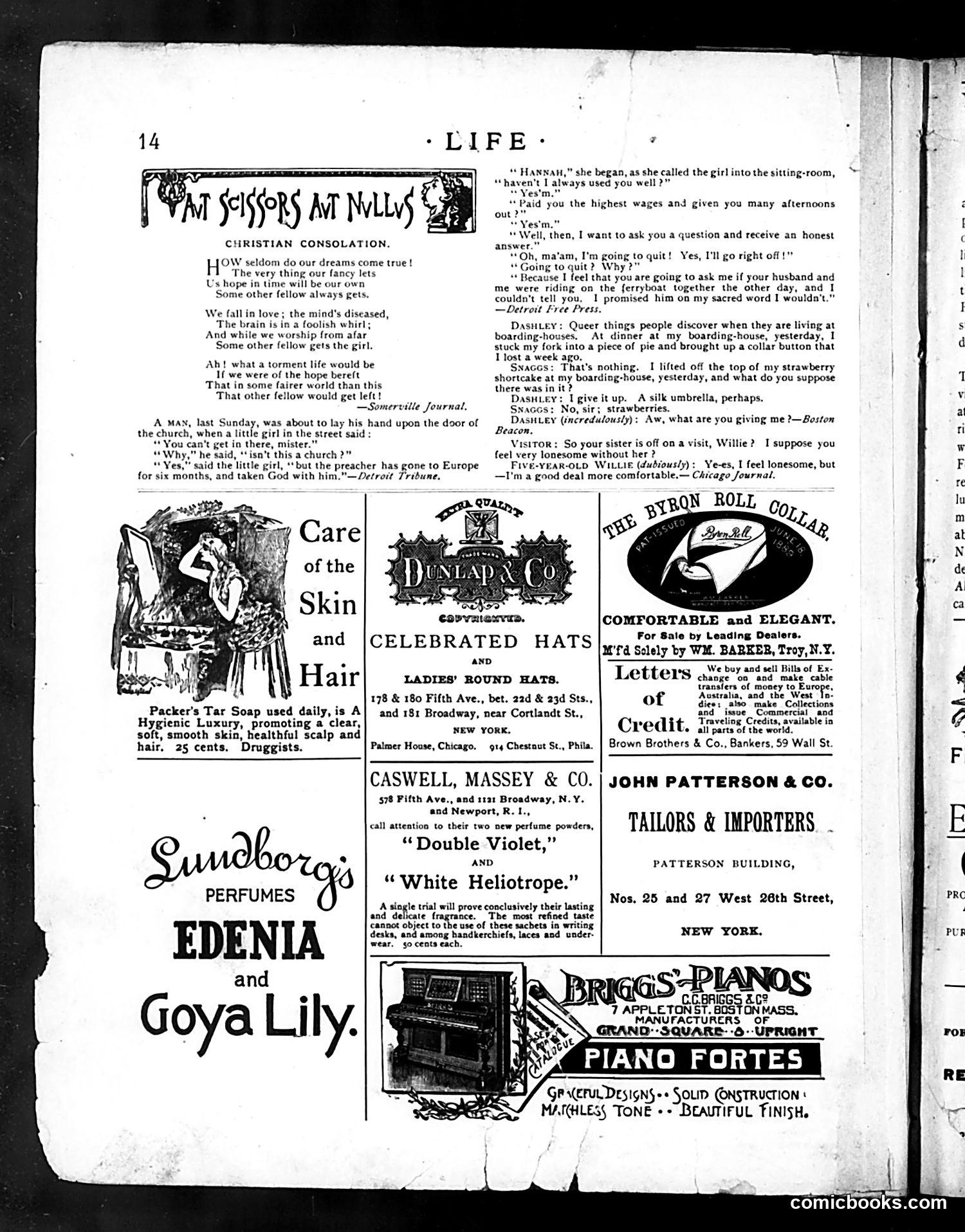
This page from *Life* magazine contains **humorous anecdotes and advertisements** rather than political cartoons. The content reflects turn-of-the-century American domestic humor: **The humor pieces** use ironic situations common to daily life: a church visitor discovers the preacher has gone to Europe; an employer's servant anticipates an awkward question about a ferry encounter and quits preemptively; boarding-house residents find unexpected objects in their food; a five-year-old boy admits he's more comfortable than lonely without his visiting sister. **The satire** targets small social hypocrisies and the absurdities of boarding-house life, servant-employer dynamics, and family relationships—gentle, domestic comedy rather than political critique. **The advertisements** promote contemporary consumer goods (soap, perfumes, hats, pianos, tailoring services, banking) typical of the era, occupying roughly half the page. This advertising-heavy format was standard for *Life* at this time. The page contains no identifiable political figures or references, focusing instead on relatable, everyday comedic scenarios for middle-class readers.
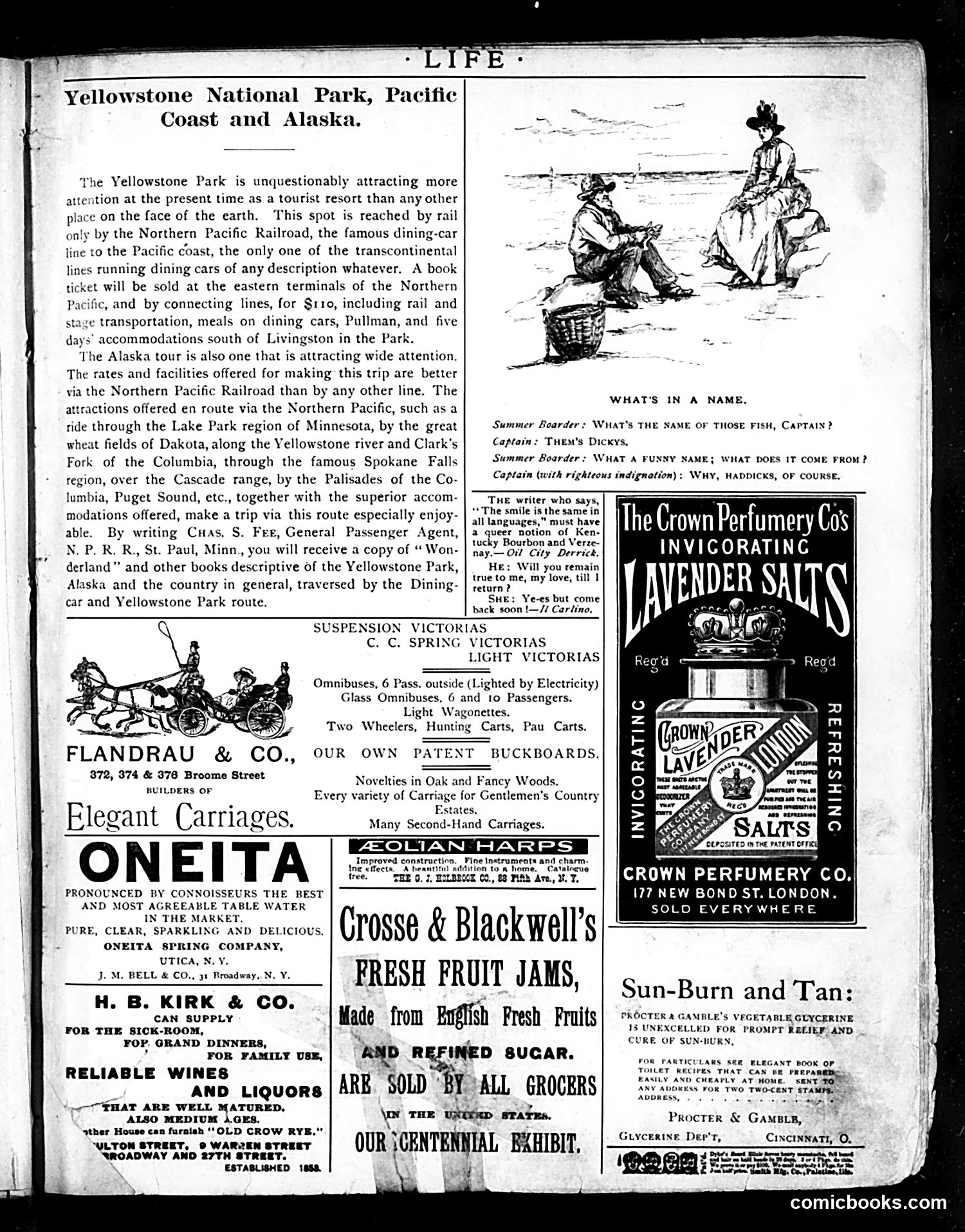
This page is primarily **advertisements** with a small humorous dialogue section titled "What's in a Name." The joke plays on **homophonic confusion**: A summer boarder asks a captain about fish names. The captain replies they're "diddies" (likely "diddies" or similar-sounding word). When asked the origin, the captain responds indignantly with "WHY, HADDICKS, OF COURSE"—a made-up or obscure term played for comedic effect through the captain's mock-indignant tone, suggesting the boarder should obviously know this. Below are two shorter romantic quips exploiting similar wordplay and misunderstanding between lovers. The page is otherwise filled with late 19th-century advertisements for luxury goods: carriages, spring water, wines, jams, perfume, and harps—typical of *Life* magazine's commercial content. The small illustration shows two figures in period dress, likely the "summer boarder" and "captain" from the main joke.
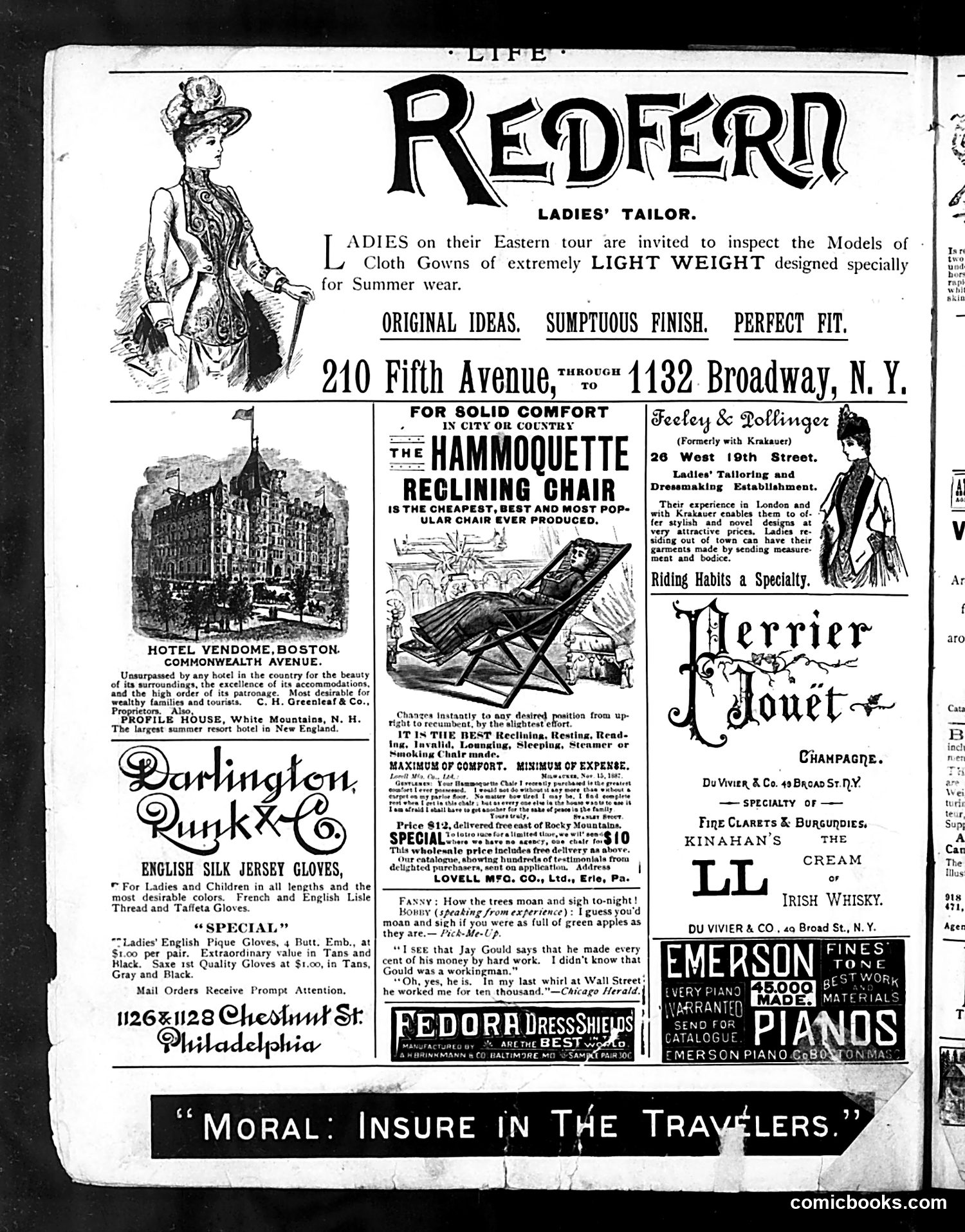
This page is primarily **advertising**, not political satire. It's from Life magazine's commercial section featuring luxury goods and services circa early 1900s. The ads showcase upper-class consumer culture: high-end tailoring (Redfern), summer resort hotels (Hotel Vendome), fine gloves, and furniture. One small comic relief appears—two brief jokes about trees sighing (bottom left) and Jay Gould's wealth, reflecting contemporary public skepticism about robber baron fortunes. The page's moral tagline—"Insure in the Travelers"—is purely commercial promotion. **What's notable to modern readers:** The abundance of ads for imported luxuries (French gloves, Irish whisky, champagne) targeting wealthy women on "Eastern tours" reveals Gilded Age materialism and gender-specific marketing. Women's fashion and leisure dominate, reflecting both women's purchasing power and their social confinement to consumption and appearance.
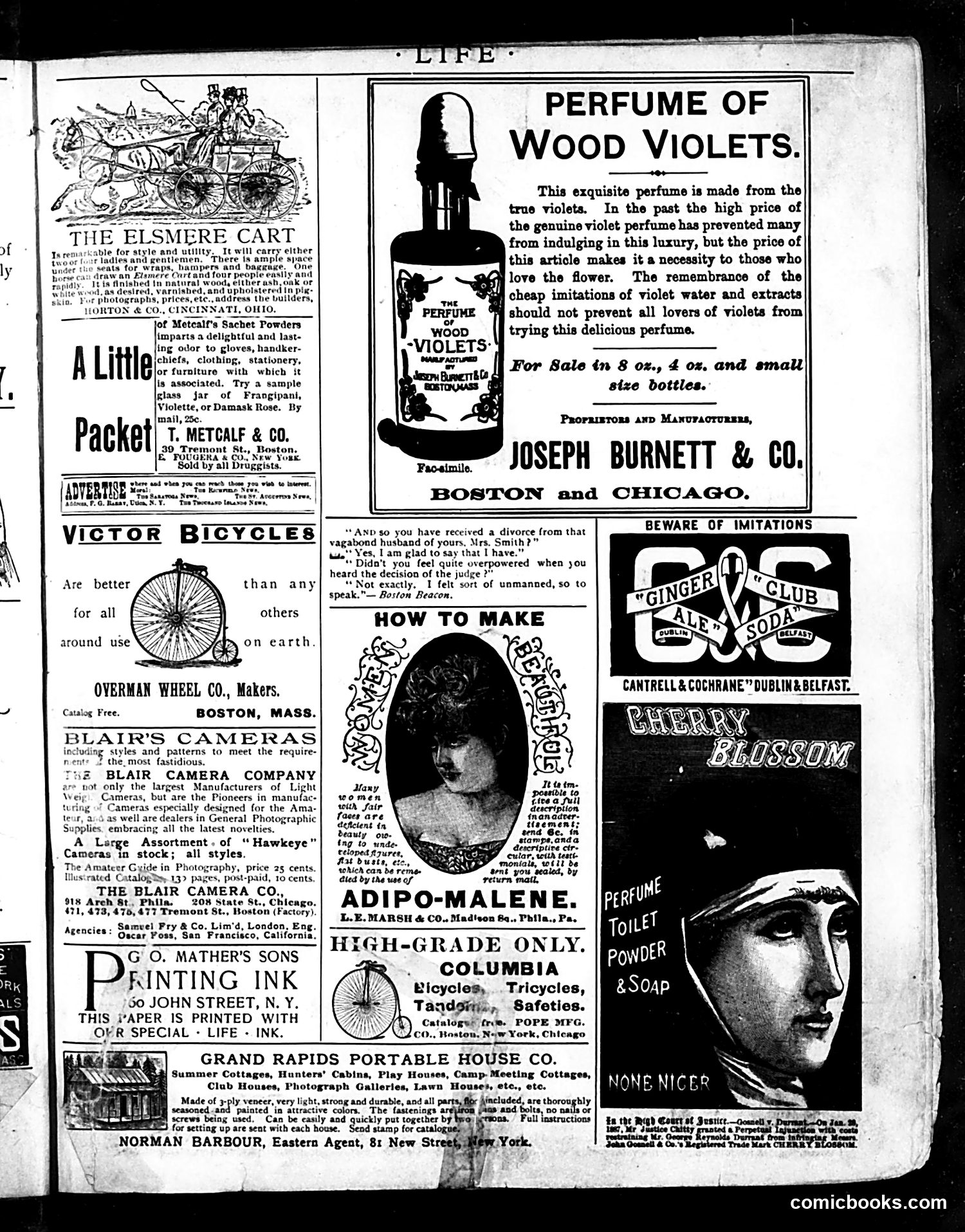
This page is primarily **advertising**, not satirical content. It showcases late 19th-century consumer products and services. The main items advertised include: - **The Elsmere Cart** (carriages for families) - **Victor Bicycles** and **Columbia Bicycles** (competing bicycle manufacturers) - **Blair's Cameras** (photography equipment) - **Perfume of Wood Violets** by Joseph Burnett & Co. - **Adipo-Malene** (a product for women concerned with body shape) - **Ginger Ale and Cherry Blossom** beverages - Printing ink, sachets, and portable houses The only **satirical element** is a small joke about divorce: a woman says receiving her divorce made her feel "unmanned"—a pun playing on the word's double meaning (both emasculated and deprived of a husband). This brief humor is characteristic of Life's satirical style but is buried among commercial advertisements. The page reflects turn-of-the-century consumer culture, technological innovation (bicycles, cameras), and emerging beauty/wellness products marketed to middle-class readers.
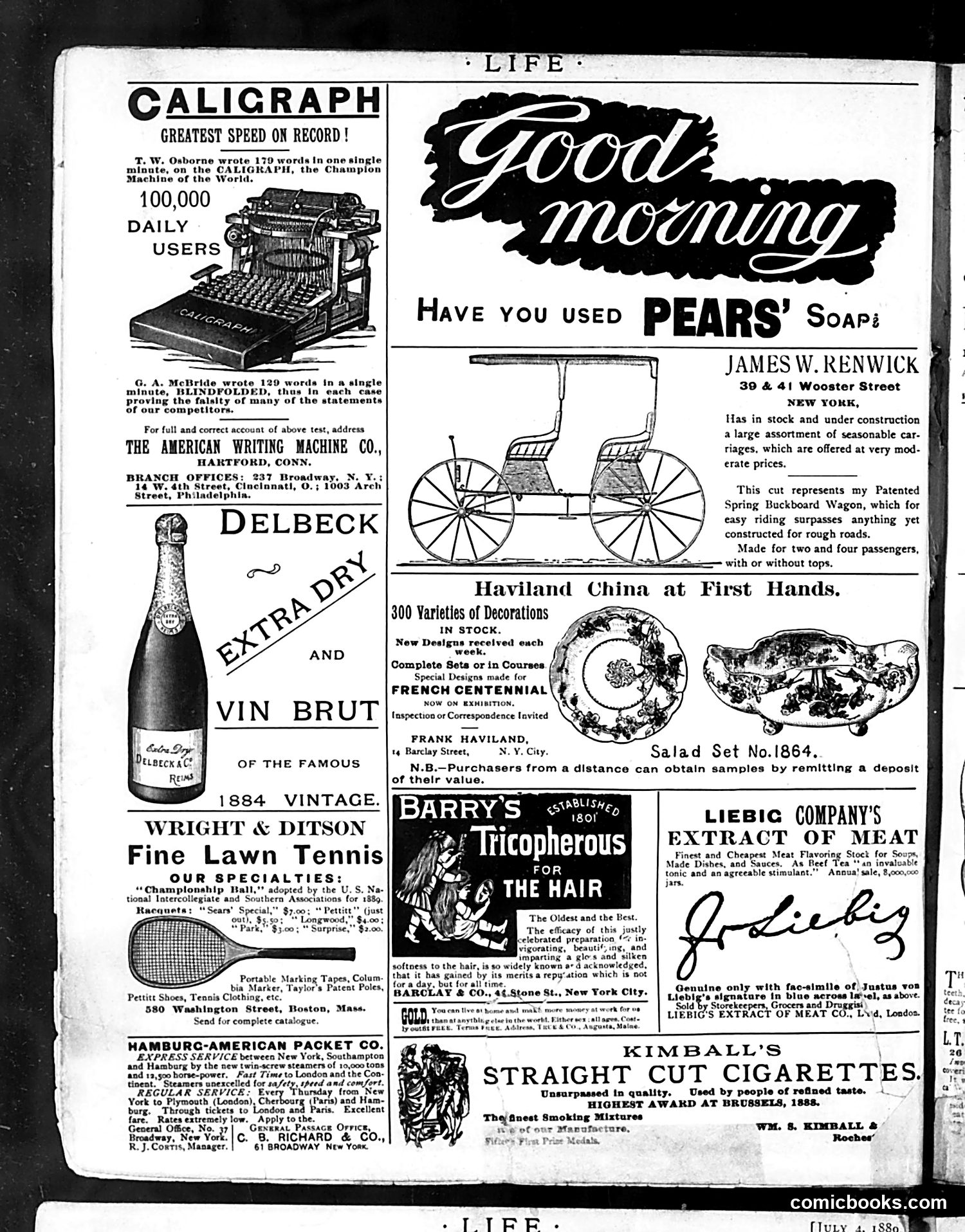
This is primarily an **advertising page** from Life magazine, circa 1880s, containing no political cartoons or satirical commentary. Instead, it features period product advertisements typical of the era. The ads showcase late-19th-century consumer goods and services: typewriters (Caligraph), champagne (Delbeck), carriages (Renwick's spring wagons), fine lawn tennis equipment (Wright & Ditson), steamship passage (Hamburg-American Line), decorative china (Haviland), meat extract (Liebig's—a precursor to modern bouillon), hair tonic (Barry's Tricopherous), and cigarettes (Kimball's). The "Greatest Speed on Record" claim for the typewriter reflects the era's fascination with mechanical innovation and productivity. Liebig's meat extract represents 19th-century nutritional science marketed as a health tonic. This page reflects consumer culture of the Gilded Age, targeting affluent readers with imported luxuries, new technologies, and genteel pursuits.
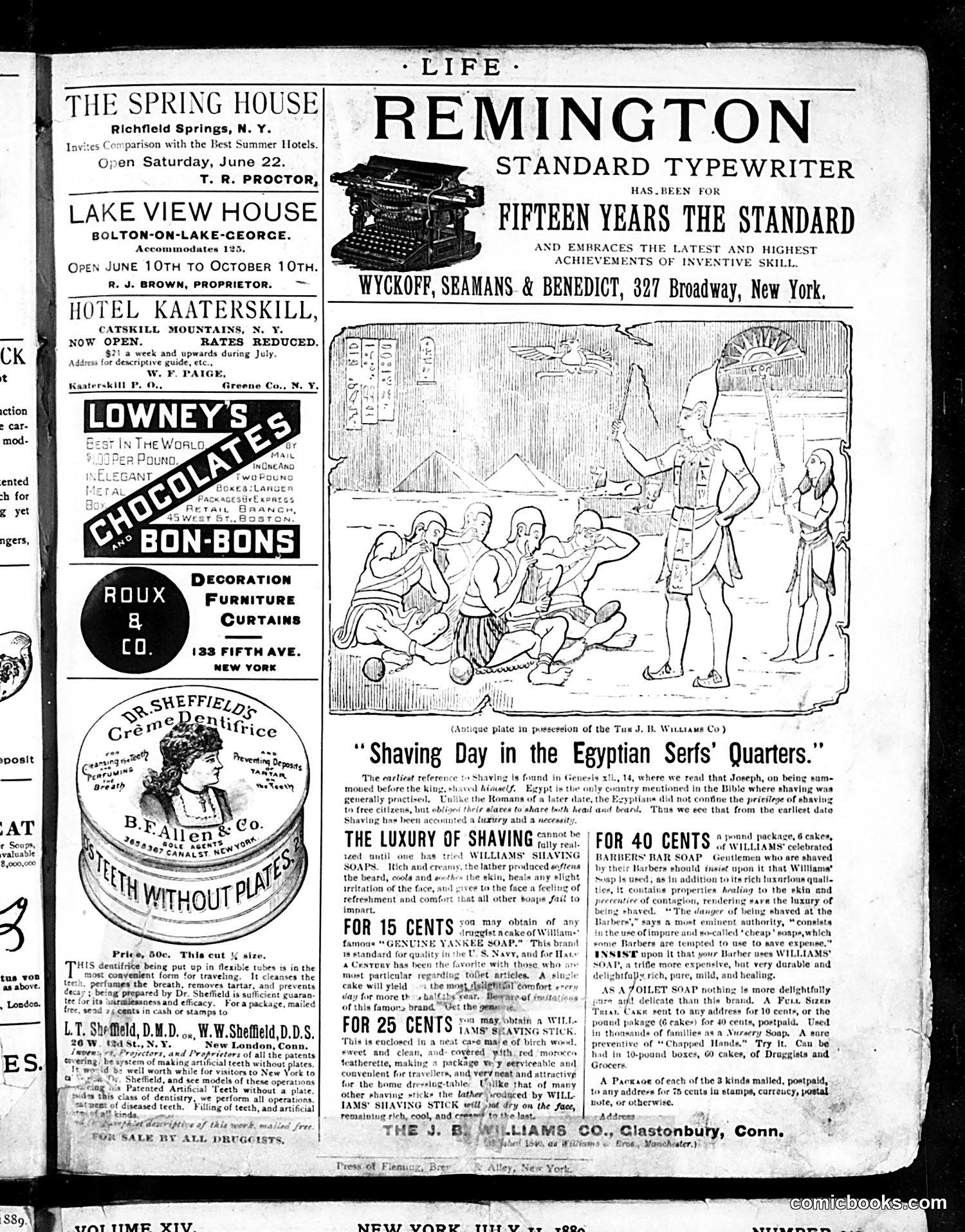
This page is primarily **advertising**, dominated by hotel promotions and product ads (typewriters, furniture, dental work, and soaps). The main cartoon depicts an ancient Egyptian scene where enslaved workers are being shaved. The caption references Biblical history—specifically Joseph in Egypt—to establish that shaving is an ancient practice. The cartoon illustrates servants or slaves undergoing forced grooming, likely depicting a historical or biblical moment. The satire's point appears subtle: the surrounding advertisements for **Williams' Shaving Soap** use this "exotic" historical image to market shaving as a luxury practice ("The Luxury of Shaving"), suggesting that even ancient Egyptian slaves received this civilized treatment. The irony is that what was once imposed on enslaved people is now being sold to modern consumers as an optional, desirable comfort—a clever marketing strategy that romanticizes the past while selling contemporary grooming products.
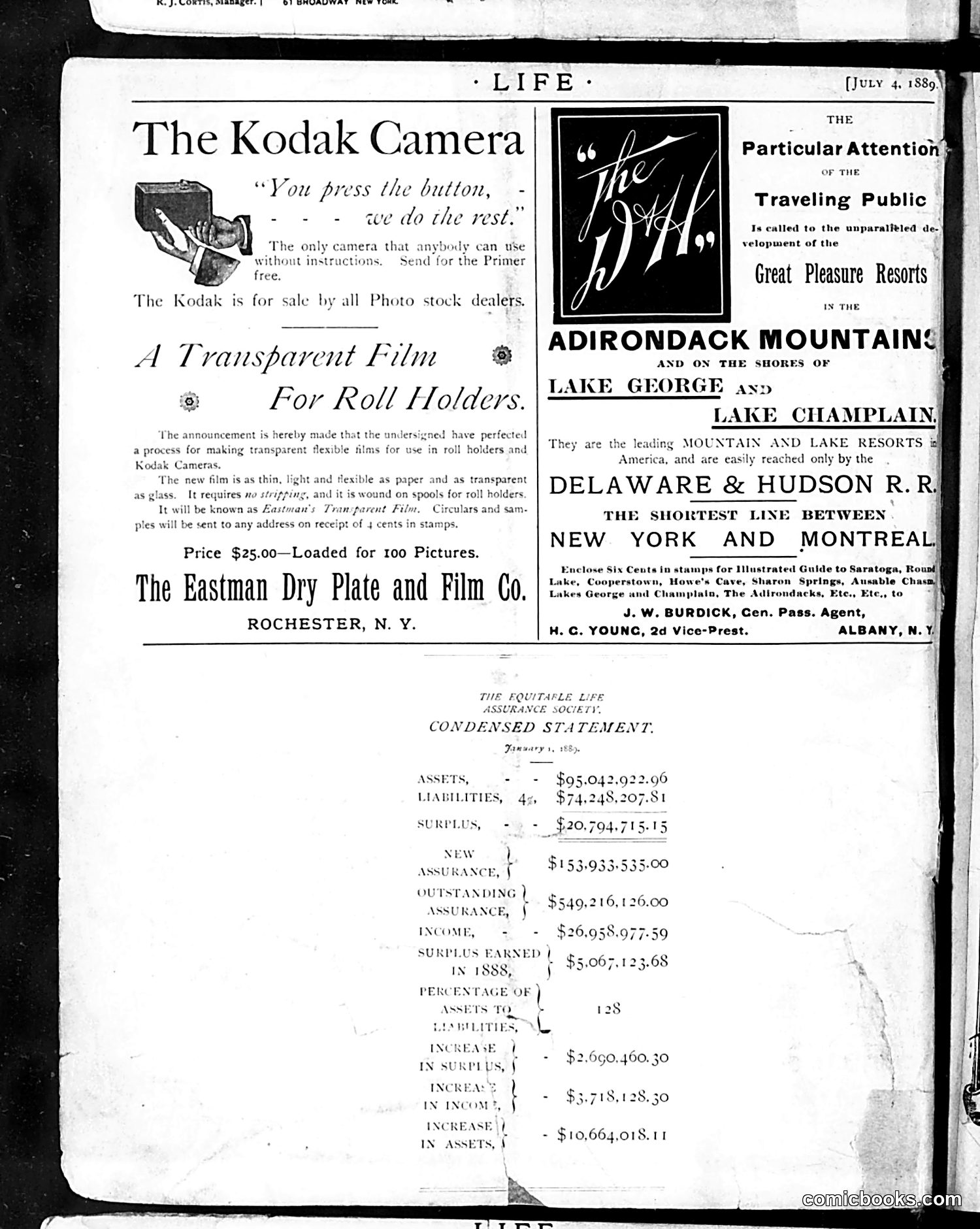
This page is primarily **advertising and financial reporting**, not satirical content. It contains: **Advertisements:** - **Kodak Camera**: promoting the revolutionary concept of user-friendly photography ("You press the button, we do the rest") - **Eastman Dry Plate and Film Co.**: selling transparent film for roll holders - **Delaware & Hudson Railroad**: advertising resort destinations (Adirondacks, Lake George, Lake Champlain) accessible via their line to New York and Montreal **Financial Statement:** The lower half displays a "Condensed Statement" from the Equitable Life Assurance Society (dated January 1, 1889), detailing assets, liabilities, surplus, new assurance written, and income figures—standard corporate reporting. **Historical context**: This reflects the Gilded Age boom in consumer technology (photography), tourism infrastructure (railroads), and institutional finance. There is **no visible political satire or cartoon** on this page—it represents typical late-19th-century magazine content mixing advertisements with financial news.