
Life, 1889-07-04 · page 8 of 20
Life — July 4, 1889 — page 8: what you’re looking at
What you’re looking at
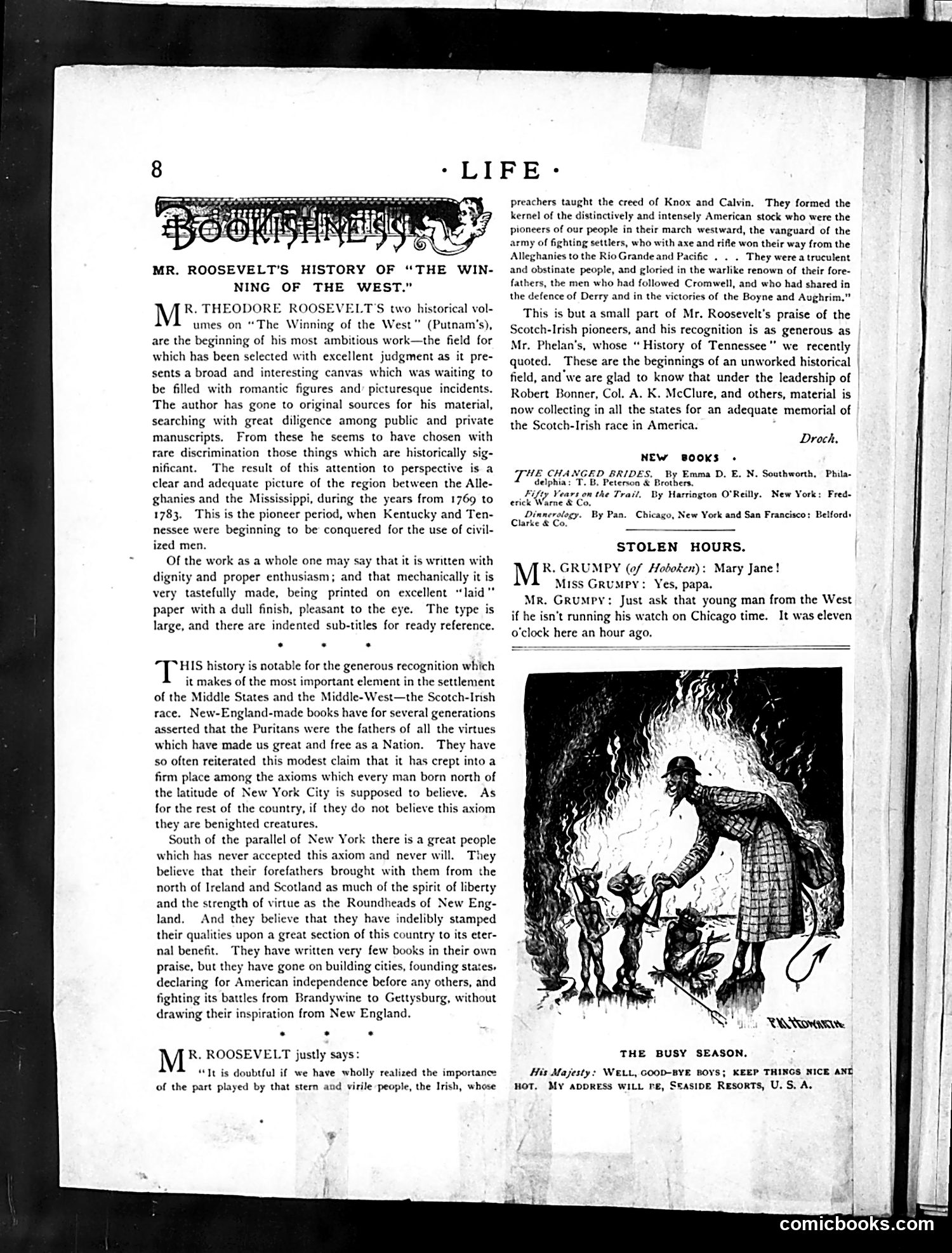
This cartoon illustrates a domestic scene where a woman in a plaid dress tends a fireplace while a child plays nearby. The illustration is captioned "THE BUSY SEASON" with a subtitle referencing "His Majesty" and addressing "SEASIDE RESORTS, U.S.A." The joke appears to mock the contrast between leisurely vacation life and domestic labor: while wealthy Americans escape to seaside resorts for relaxation, working-class women remain home managing household fires and childcare—their "busy season" never ends. The satire highlights class disparities in access to leisure during the early 20th century, suggesting that servants and working women cannot enjoy the same vacation privileges as their employers.
📄 Transcribed text from this page (OCR, searchable)
Machine-transcribed from the original scan — historical spelling and the odd misread are preserved.
- LIFE: MR. ROOSEVELT’S HISTORY OF “THE WIN- NING OF THE WEST.” R. THEODORE ROOSEVELT'S two historical vol- umes on “The Winning of the West” (Putnam's), are the beginning of his most ambitious work—the field for which has been selected with excellent judgment as it pre- sents a broad and interesting canvas which was waiting to be filled with romantic figures and: picturesque incidents. The author has gone to original sources for his material, searching with great diligence among public and private manuscripts. From these he seems to have chosen with rare discrimination those things which are historically sig- nificant. The result of this attention to perspective is a clear and adequate picture of the region between the Alle- ghanies and the Mississippi, during the years from 1769 to 1783. This is the pioneer period, when Kentucky and Ten- nessee were beginning to be conquered for the use of civil- ized men. Of the work as a whole one may say that it is written with dignity and proper enthusiasm; and that mechanically it is very tastefully made, being printed on excellent “laid" paper with a dull finish, pleasant to the eye. The type is large, and there are indented sub-titles for ready reference. . . . THs history is notable for the generous recognition which it makes of the most important element in the settlement of the Middle States and the Middle-West—the Scotch-Irish race. New-England-made books have for several generations asserted that the Puritans were the fathers of all the virtues which have made us great and free as a Nation. They have so often reiterated this modest claim that it has crept into a firm place among the axioms which every man born north of the latitude of New York City is supposed to believe. As for the rest of the country, if they do not believe this axiom they are benighted creatures. South of the parallel of New York there is a great people which has never accepted this axiom and never will. They believe that their forefathers brought with them from the north of Ireland and Scotland as much of the spirit of liberty and the strength of virtue as the Roundheads of New Eng- land. And they believe that they have indelibly stamped their qualities upon a great section of this country to its eter- nal benefit. They have written very few books in their own praise, but they have gone on building cities, founding states. declaring for American independence before any others, and fighting its battles from Brandywine to Gettysburg, without drawing their inspiration from New England. . . . R. ROOSEVELT justly says: “It is doubtful if we have wholly realized the importance of the part played by that stern and virile people, the Irish, whose preachers taught the creed of Knox and Calvin. They formed the kernel of the distinctively and intensely American stock who were the pioneers of our people in their march westward, the vanguard of the army of fighting settlers, who with axe and rifle won their way from the Alleghanies to the Rio Grande and Pacific . . . They were a truculent and obstinate people, and gloried in the warlike renown of their fore- fathers, the men who had followed Cromwell, and who had shared in the defence of Derry and in the victories of the Boyne and Aughrim.” This is but a small part of Mr. Roosevelt's praise of the Scotch-Irish pioneers, and his recognition is as generous as Mr. Phelan’s, whose “History of Tennessee” we recently quoted. These are the beginnings of an unworked historical field, and'we are glad to know that under the leadership of Robert Bonner, Col. A. K. McClure, and others, material is now collecting in all the states for an adequate memorial of the Scotch-Irish race in America. Droch, NEW B0OKS - By Emma D, E, N. Southworth, Phila- delphia: T. B. Peterson & Brothers, Fifty Years on the Trait, By Harrington O'Reilly. New York: Fred- erick Warne & Co. Dinnerology. By Pan. Chicago, New York and San Francisco: Belford+ Clarke & Co, STOLEN HOURS. R. GRUMPY (ef Hoboken): Mary Jane! Miss Grumpy: Yes, papa. Mr. Grumpy: Just ask that young man from the West if he isn’t running his watch on Chicago time. It was eleven o'clock here an hour ago. TWKonam THE BUSY SEASON, His Majesty: WELL, GOOD-BYE BOYS; KEEP THINGS NICE AND HoT. My appRESS WILL re, Seasipe Resorts, U.S. A. comicbooks.co = m