
Life, 1889-07-04 · page 4 of 20
Life — July 4, 1889 — page 4: what you’re looking at
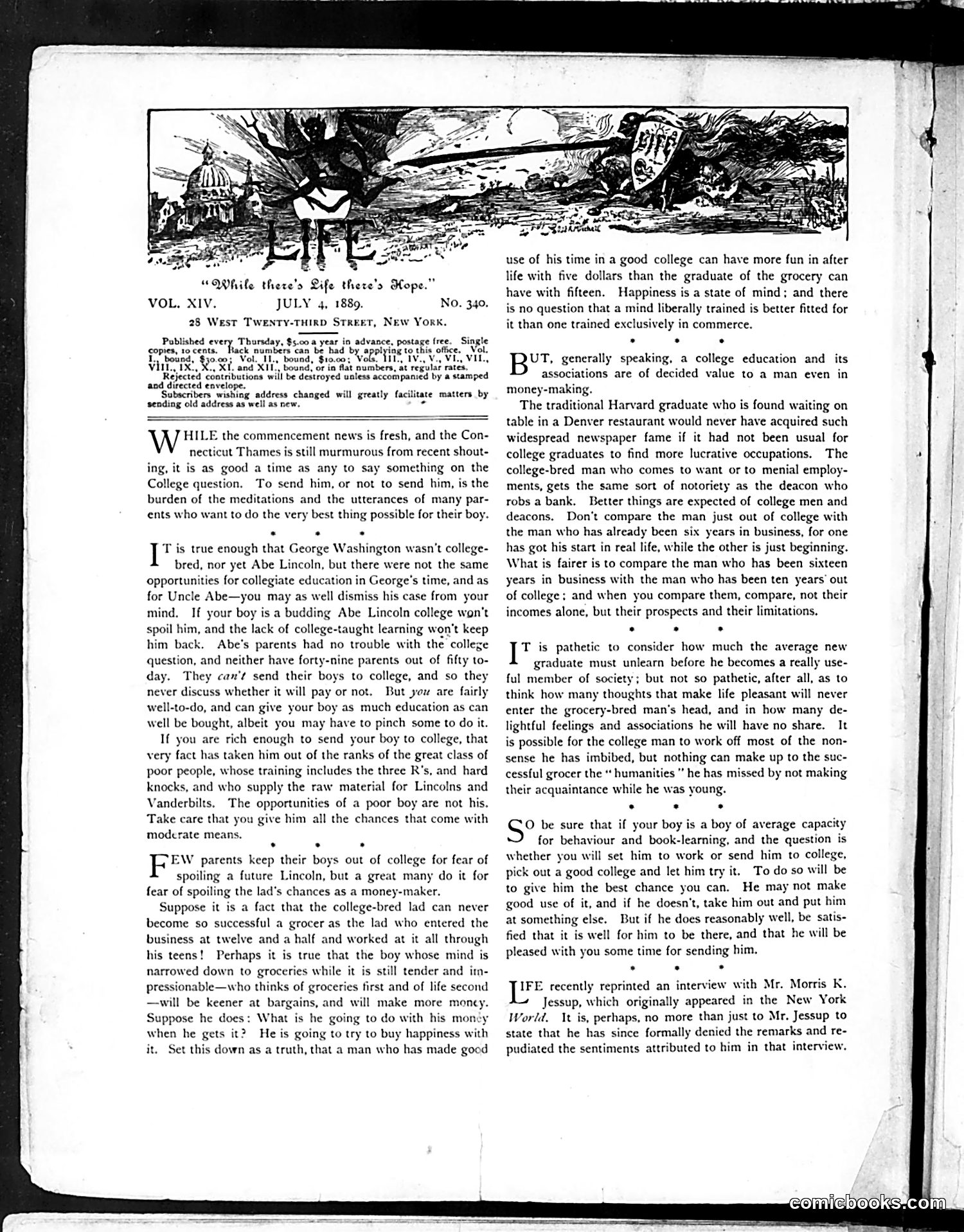
What you’re looking at
The masthead cartoon depicts a chaotic landscape with classical architecture (a domed building) juxtaposed against violent destruction—explosions, debris, and what appears to be warfare or catastrophe. The quote "'While there's Life there's Hope'" suggests ironic commentary on optimism amid crisis. The article below debates whether parents should send sons to college. It references historical figures (George Washington, Abraham Lincoln) who succeeded without formal education, questioning whether college truly ensures success. The satire targets middle-class anxieties about education's value and cost. The cartoon likely comments on contemporary social upheaval or instability (the date is 1880), while the article's debate reflects Gilded Age concerns about education's role in social mobility and economic success.
📄 Transcribed text from this page (OCR, searchable)
Machine-transcribed from the original scan — historical spelling and the odd misread are preserved.
VOL. XIV. 28 West TWENTY-THIRD STREE: JULY 4, 1889. No. 340. New York. Poblished every: Tharsday. $5.0 a year in advance, postage free. Single copies, ro cents. Hack numbers can be had by applying to this office, 4 1, 1, $30.00; Vol. I1., bound, $10.00; Vols. III, 1V., V., VIL, VIL, VIL, 1X), X, XI. and X11", bound! of in lat numbers, at regular rates, Rejected contributions will be destroyed unless accompanied by a stamped and directed envelope. Subscribers wishing address changed will greatly facilitate matters by sending old address as well as new. - HILE the commencement news is fresh, and the Con- necticut Thames is still murmurous from recent shout- ing, it is as good a time as any to say something on the College question. To send him, or not to send him, is the burden of the meditations and the utterances of many par- ents who want to do the very best thing possible for their boy. . . . T is true enough that George Washington wasn't college- bred, nor yet Abe Lincoln, but there were not the same opportunities for collegiate education in George’s time, and as for Uncle Abe—you may as well dismiss his case from your mind. If your boy is a budding Abe Lincoln college won't spoil him, and the lack of college-taught learning won't keep him back. Abe's parents had no trouble with the college question, and neither have forty-nine parents out of fifty to- day. They can’t send their boys to college, and so they never discuss whether it will pay or not. But yow are fairly well-to-do, and can give your boy as much education as can well be bought, albeit you may have to pinch some to do it. If you are rich enough to send your boy to college, that very fact has taken him out of the ranks of the great class of poor people, whose training includes the three R’s, and hard knocks, and who supply the raw material for Lincolns and Vanderbilts. The opportunities of a poor boy are not his. Take care that you give him all the chances that come with moderate mean: . . . EW parents keep their boys out of college for fear of spoiling a future Lincoln, but a great many do it for fear of spoiling the lad’s chances as a money-maker. Suppose it is a fact that the college-bred lad can never become so successful a grocer as the lad who entered the business at twelve and a half and worked at it all through his teens! Perhaps it is true that the boy whose mind is narrowed down to groceries while it is still tender and itm- pressionable—who thinks of groceries first and of life second —will be keener at bargains, and will make more moncy. Suppose he does: What is he going to do with his moncy when he gets it? He is going to try to buy happiness with it, Set this down as a truth, that a man who has made good use of his time in a good college can have more fun in after life with five dollars than the graduate of the grocery can have with fifteen. Happiness is a state of mind; and there is no question that a mind liberally trained is better fitted for it than one trained exclusively in commerce. . . . Bu: generally speaking, a college education and its associations are of decided value to a man even in money-making. The traditional Harvard graduate who is found waiting on table in a Denver restaurant would never have acquired such widespread newspaper fame if it had not been usual for college graduates to find more lucrative occupations. The college-bred man who comes to want or to menial employ- ments, gets the same sort of notoriety as the deacon who robs a bank. Better things are expected of college men and deacons. Don’t compare the man just out of college with the man who has already been six years in business, for one has got his start in real life, while the other is just beginning. What is fairer is to compare the man who has been sixteen years in business with the man who has been ten years’ out of college; and when you compare them, compare, not their incomes alone, but their prospects and their limitations, . . . T is pathetic to consider how much the average new graduate must unlearn before he becomes a really use- ful member of society; but not so pathetic, after all, as to think how many thoughts that make life pleasant will never enter the grocery-bred man’s head, and in how many de- lightful feelings and associations he will have no share. It is possible for the college man to work off most of the non- sense he has imbibed, but nothing can make up to the suc- cessful grocer the “ humanities " he has missed by not making their acquaintance while he was young. . . . O be sure that if your boy is a boy of average capacity for behaviour and book-learning, and the question is whether you will set him to work or send him to college, pick out a good college and let him try it. To do so will be to give him the best chance you can. He may not make good use of it, and if he doesn’t, take him out and put him at something else. But if he does reasonably well, be satis- fied that it is well for him to be there, and that he will be pleased with you some time for sending him. LF recently reprinted an interview with Mr. Morris K. Jessup, which originally appeared in the New York World. \t is, perhaps, no more than just to Mr. Jessup to state that he has since formally denied the remarks and re- pudiated the sentiments attributed to him in that interview. COMmMebooks*c om