
A complete issue · 17 pages · 1889
Life — June 27, 1889
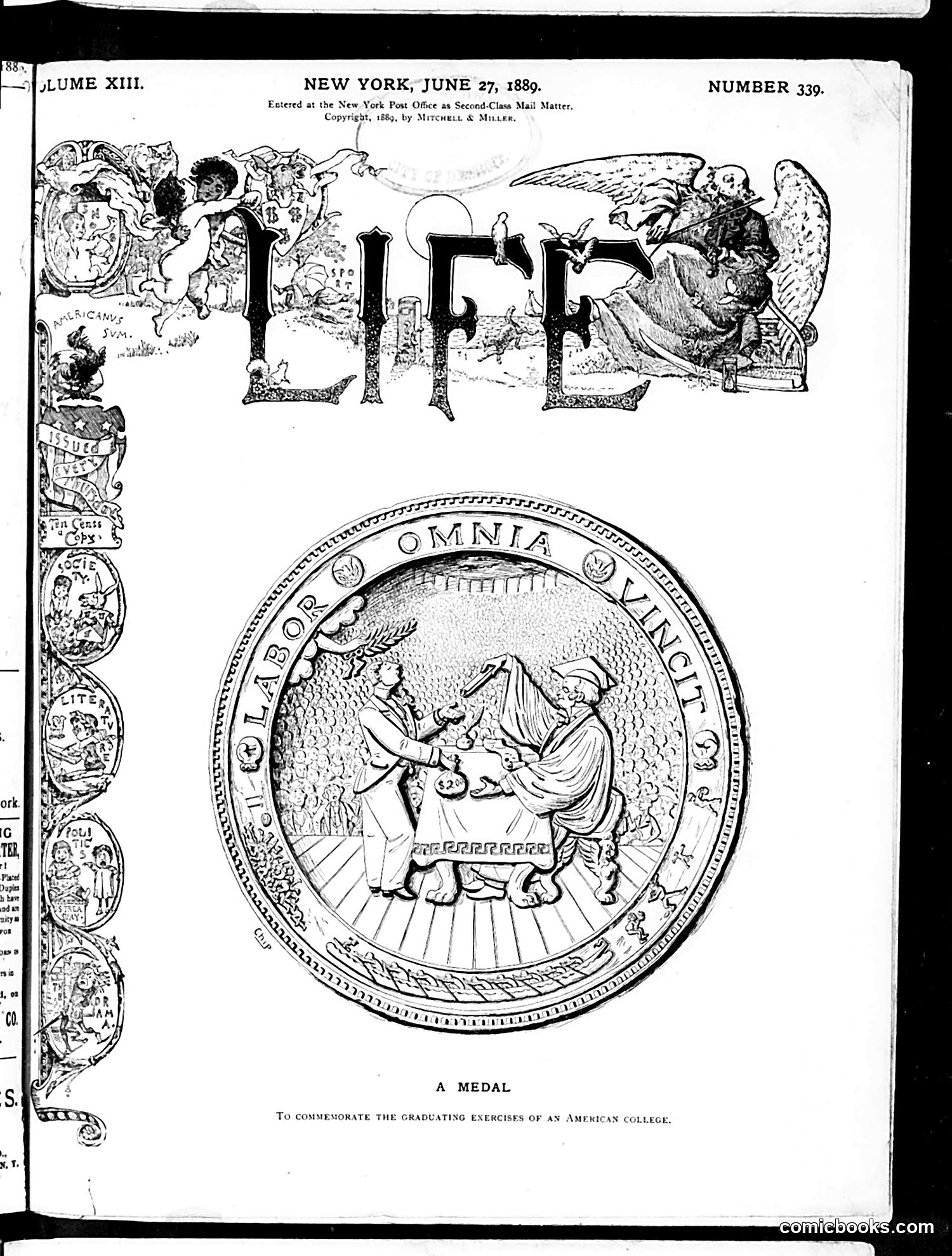
This page features two distinct elements: **Top:** An ornamental title page header reading "LIFE" with elaborate decorative illustrations incorporating classical and allegorical figures. **Bottom:** A circular medal design labeled "A MEDAL" with Latin text reading "LABOR OMNIA VINCIT" (Labor conquers all things). The medal depicts two classical figures in robes appearing to exchange or present something, set against a background with radiating lines and a Greek key pattern border. **Caption:** "To commemorate the graduating exercises of an American college." The satire likely mocks ceremonial academic traditions or graduation practices of American colleges in 1889, using classical imagery ironically to comment on contemporary educational institutions. Without additional context about specific college events from this period, the exact target remains unclear, though the tone suggests gentle mockery of academic formality.
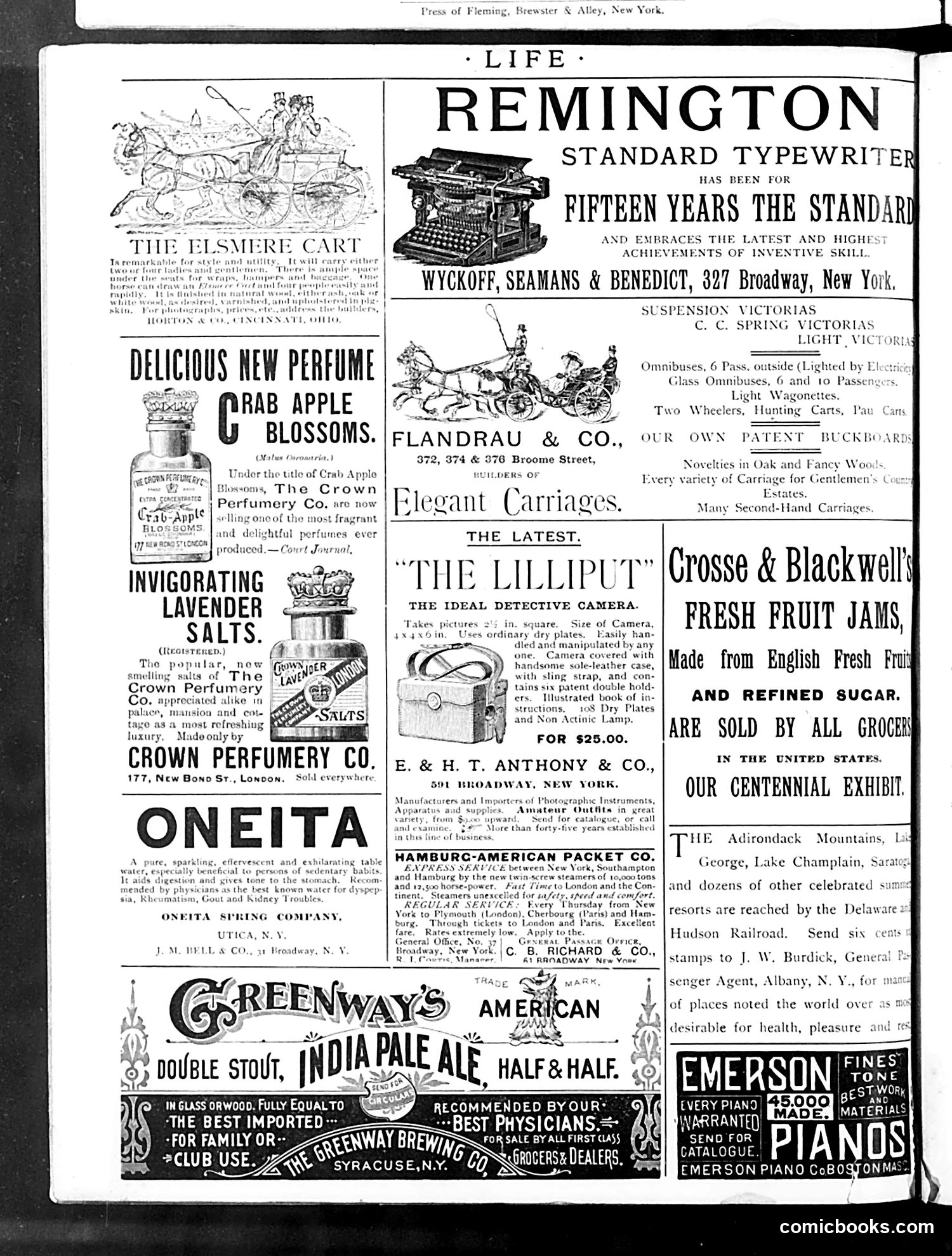
This page is **primarily advertising** rather than satirical content. It contains numerous late-19th-century product advertisements including: - Remington Standard Typewriter (claiming 15 years as "the standard") - Crab Apple Blossom perfume by Crown Perfumery Co. - Invigorating Lavender Salts - Oneita sparkling water - Greenway's Double Stout and India Pale Ale beer - Various carriages, cameras, jams, and pianos The only notable illustration is "The Elsmiere Cart" at top left—a decorative drawing of a horse-drawn carriage described as "remarkable for style and utility." There is **no apparent political cartoon or satire** on this page. It represents standard commercial advertising from the period, targeted at affluent readers of *Life* magazine.
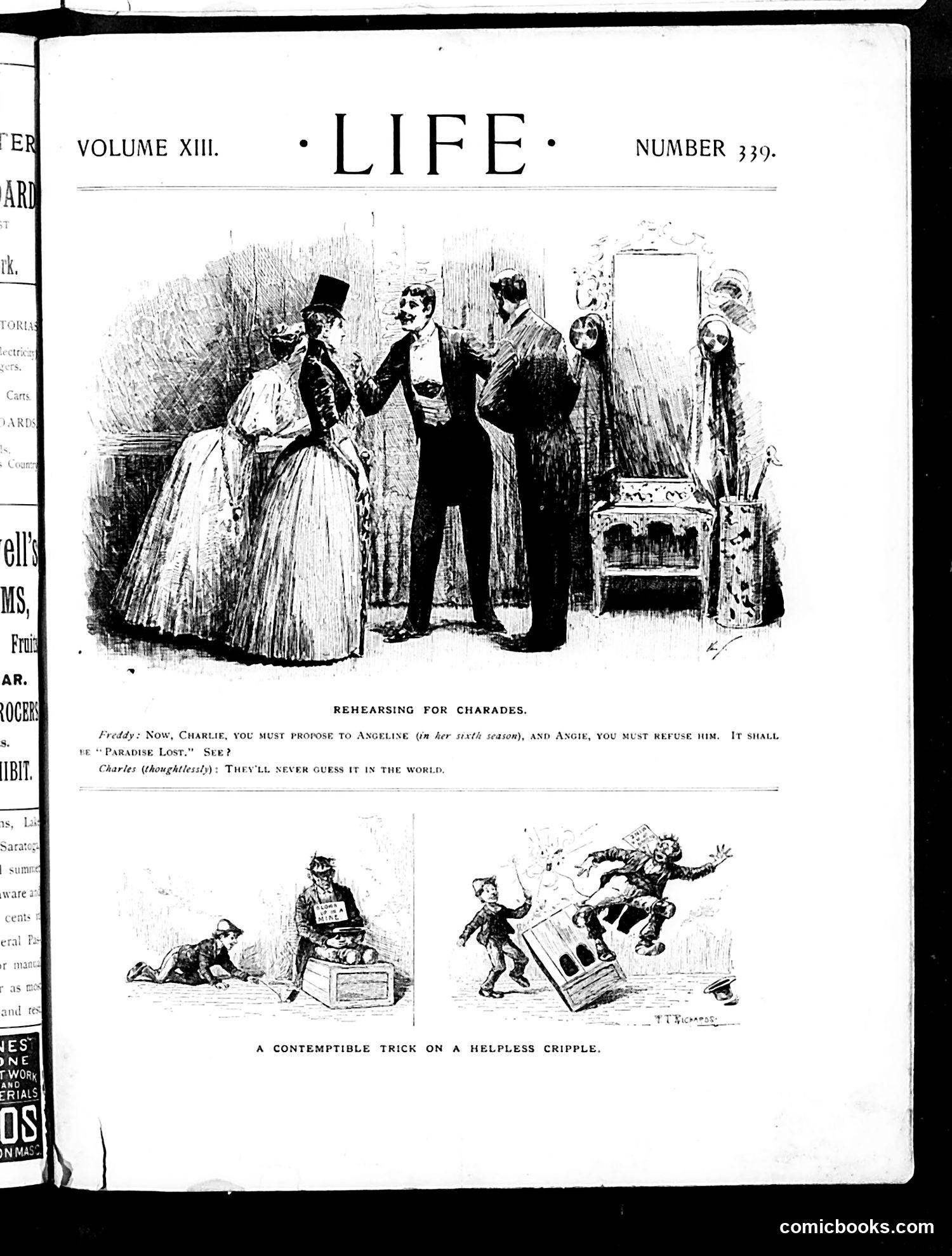
This page from *Life* magazine (Volume XIII, Number 339) contains two unrelated comic sketches: **Top: "Rehearsing for Charades"** A social scene showing well-dressed Victorian figures preparing parlor games. The dialogue indicates they're planning to act out "Paradise Lost," with a character named Charles confidently asserting the performers will never be guessed. This is gentle domestic satire about amateur theatricals and the pretentiousness of Victorian parlor entertainment. **Bottom: "A Contemptible Trick on a Helpless Cripple"** Two sketches showing someone playing a prank on a disabled person using a wheeled device or crutch. The satire appears to mock the cruelty of such pranks, though the exact point remains unclear without fuller context. Both reflect *Life*'s satirical approach to Victorian social customs and moral behaviors.
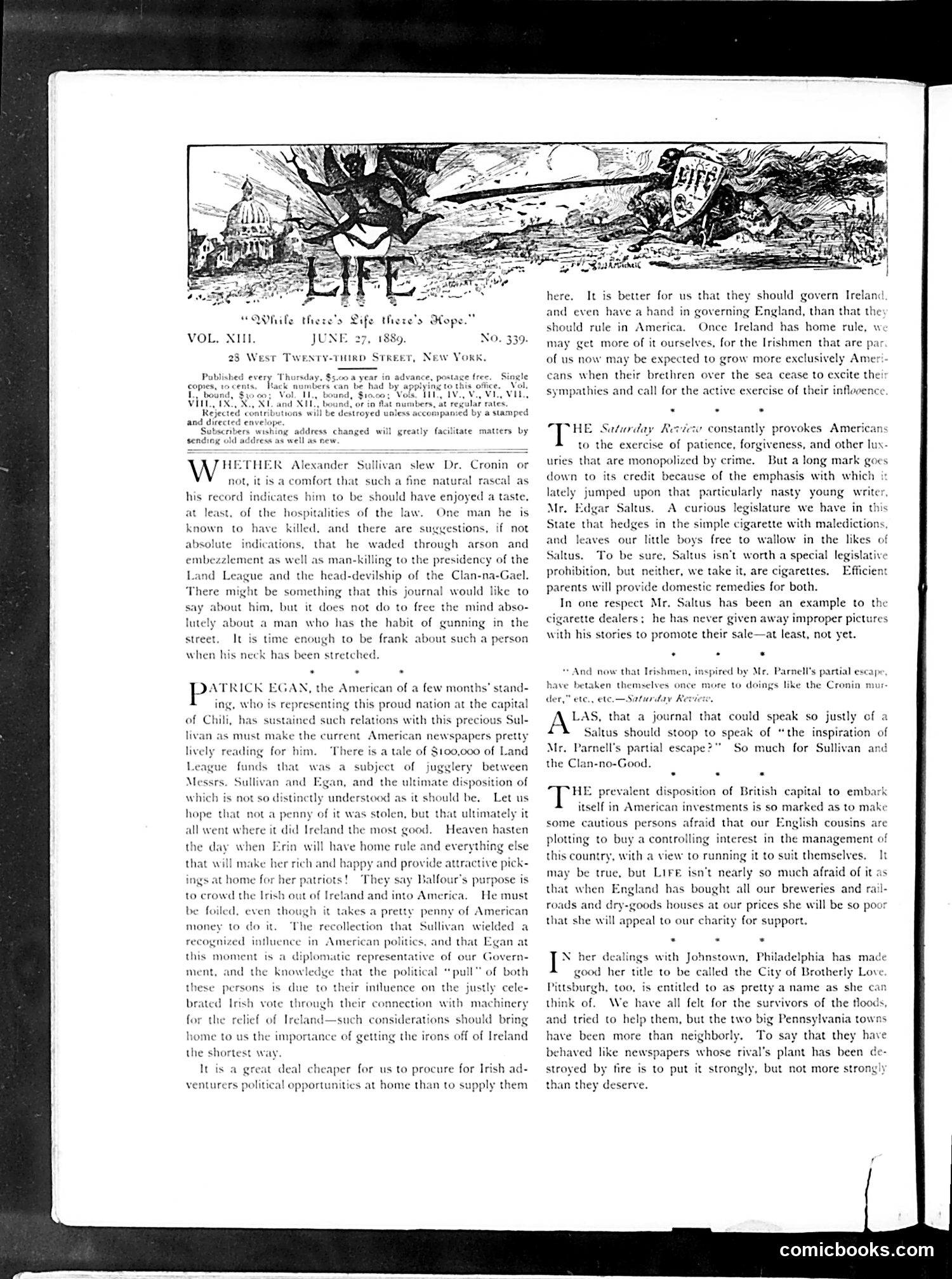
The masthead illustration shows allegorical figures representing "Life" with classical imagery. The main editorial discusses Irish-American political influence, specifically mentioning **Alexander Sullivan** and **Dr. Cronin**—an apparent reference to a murder case involving Irish nationalist figures in Chicago. The text critiques how Irish-American leaders like **Patrick Egan** leverage political connections between the U.S. and Ireland. It expresses concern about British interference in American affairs and debates whether Irish immigrants should focus on Ireland's independence or American interests. The satire mocks the competing political loyalties and financial schemes among Irish-American activists, suggesting they exploit American political opportunities while claiming to advance Irish causes—a commentary on ethnic political patronage networks of the Gilded Age.
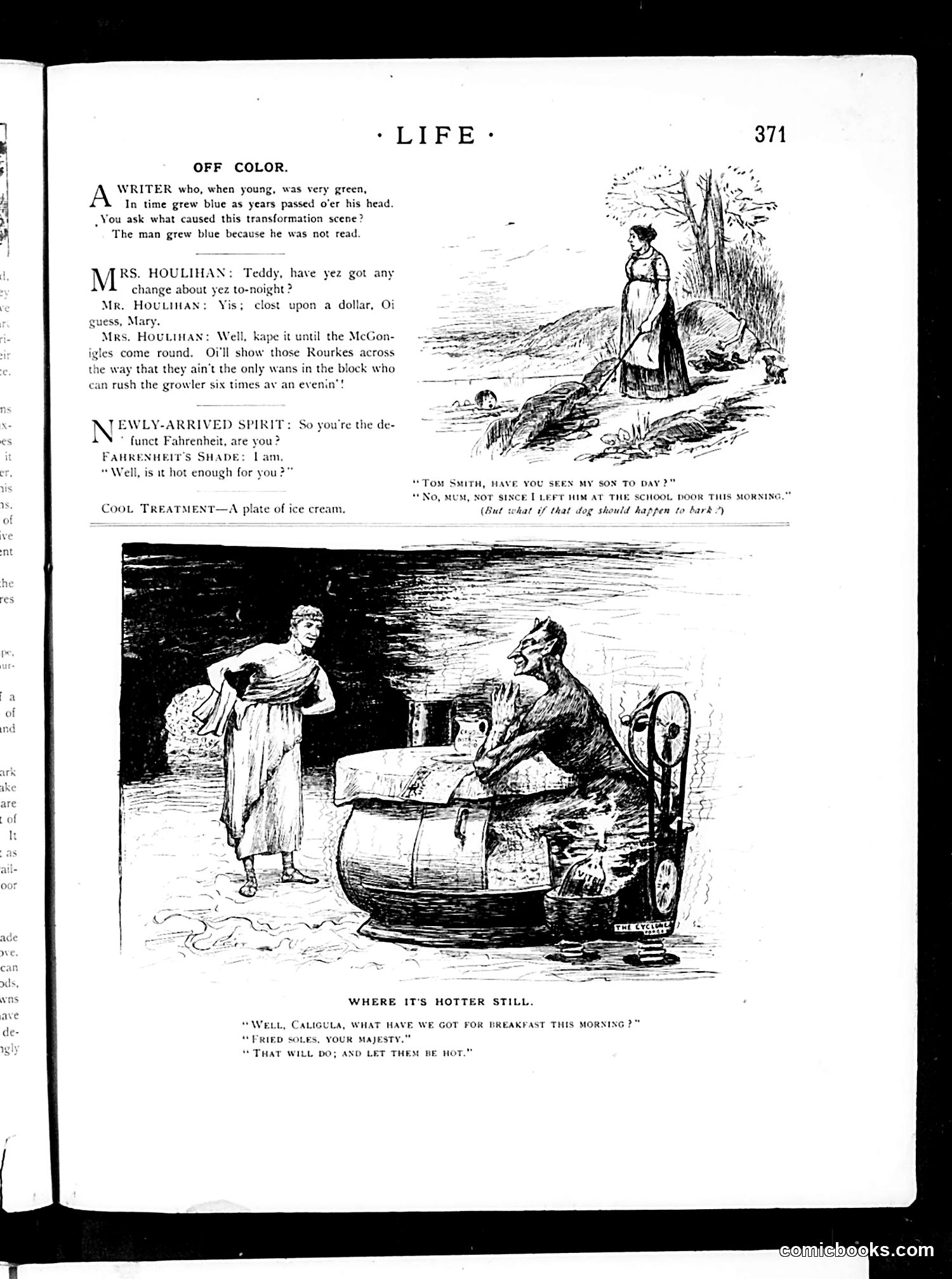
This page contains three separate satirical pieces: **"Off Color"**: A poem about a writer who turned blue (mentally depressed) from lack of reading—social commentary on intellectual decline. **"Newly-Arrived Spirit"**: A brief quip about a deceased Fahrenheit (unclear which historical figure) asking if suffering in the afterlife isn't enough. **"Cool Treatment"**: A one-line joke about ice cream as remedy. **"Where It's Hotter Still"**: The main cartoon depicts a woman and a man with a donkey-powered cart. The dialogue suggests domestic tension—she's asking about breakfast while he threatens to make things "hotter" through punishment (fried soles/feet). This satirizes marital discord and male authority, presenting domestic conflict as humorous. The donkey-powered transport suggests rural or working-class setting.
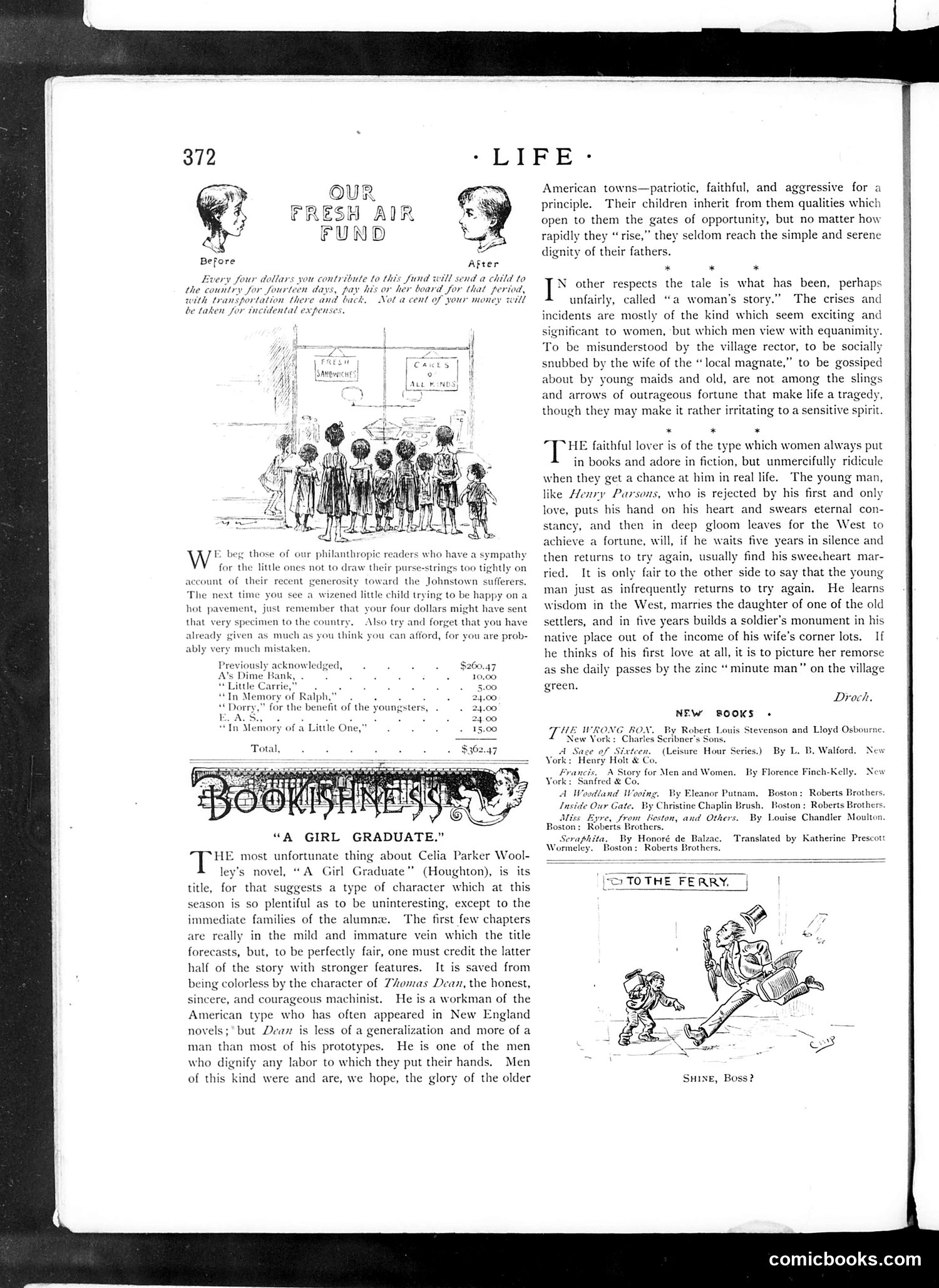
**The "Fresh Air Fund" Section:** This depicts a charitable program sending poor urban children to the countryside for health and moral improvement—a common Progressive Era initiative. The "before" and "after" illustrations show children's supposed transformation through rural exposure, reflecting period beliefs that fresh air and rural virtue could reform city children. **"A Girl Graduate" Review:** The text critiques Celia Parker Woolley's novel about an unconventional female character. The reviewer praises the honest working-class character Thomas Dean as embodying authentic American values—suggesting contemporary debates about class, gender roles, and what constituted "proper" American character. The discussion reflects turn-of-century tensions between traditional and progressive social values.
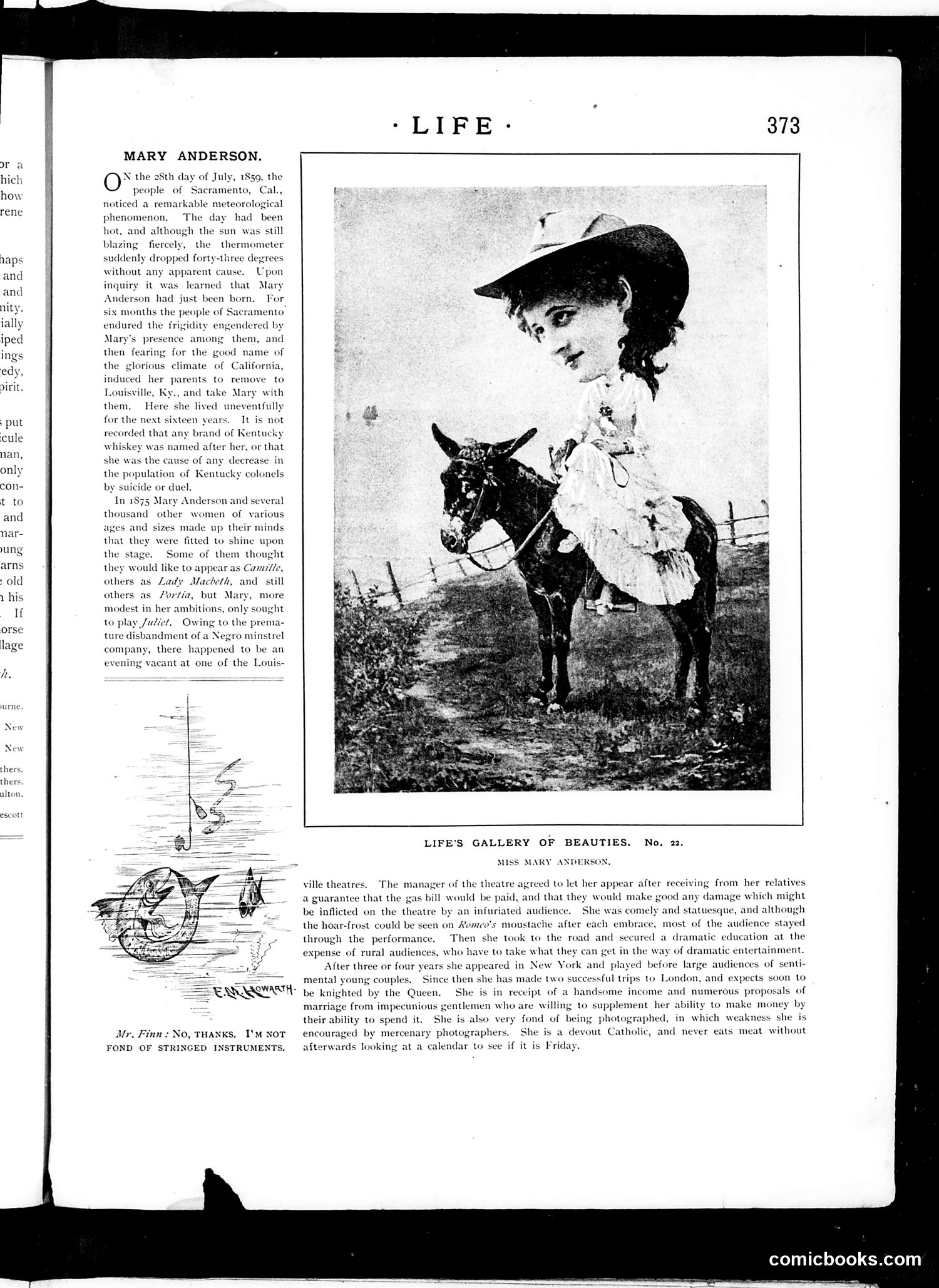
This page presents a biographical profile of actress Mary Anderson rather than political satire. The main photograph shows Anderson posing with a donkey, illustrating her versatility as a performer—the accompanying text notes she appeared in various theatrical roles including *Camille*, *Lady Macbeth*, and *Fioretti*. The article chronicles Anderson's career trajectory: born in Sacramento in 1850, she moved to Kentucky, eventually performing in theatrical companies. She's noted as having made successful London tours and receiving marriage proposals from "impecunious suitors" seeking her money. The piece emphasizes her devoutness (she's "a devout Catholic") and her superstitious nature regarding calendar days for work. There's no apparent political commentary—this is straightforward entertainment journalism profiling a notable Victorian-era actress.
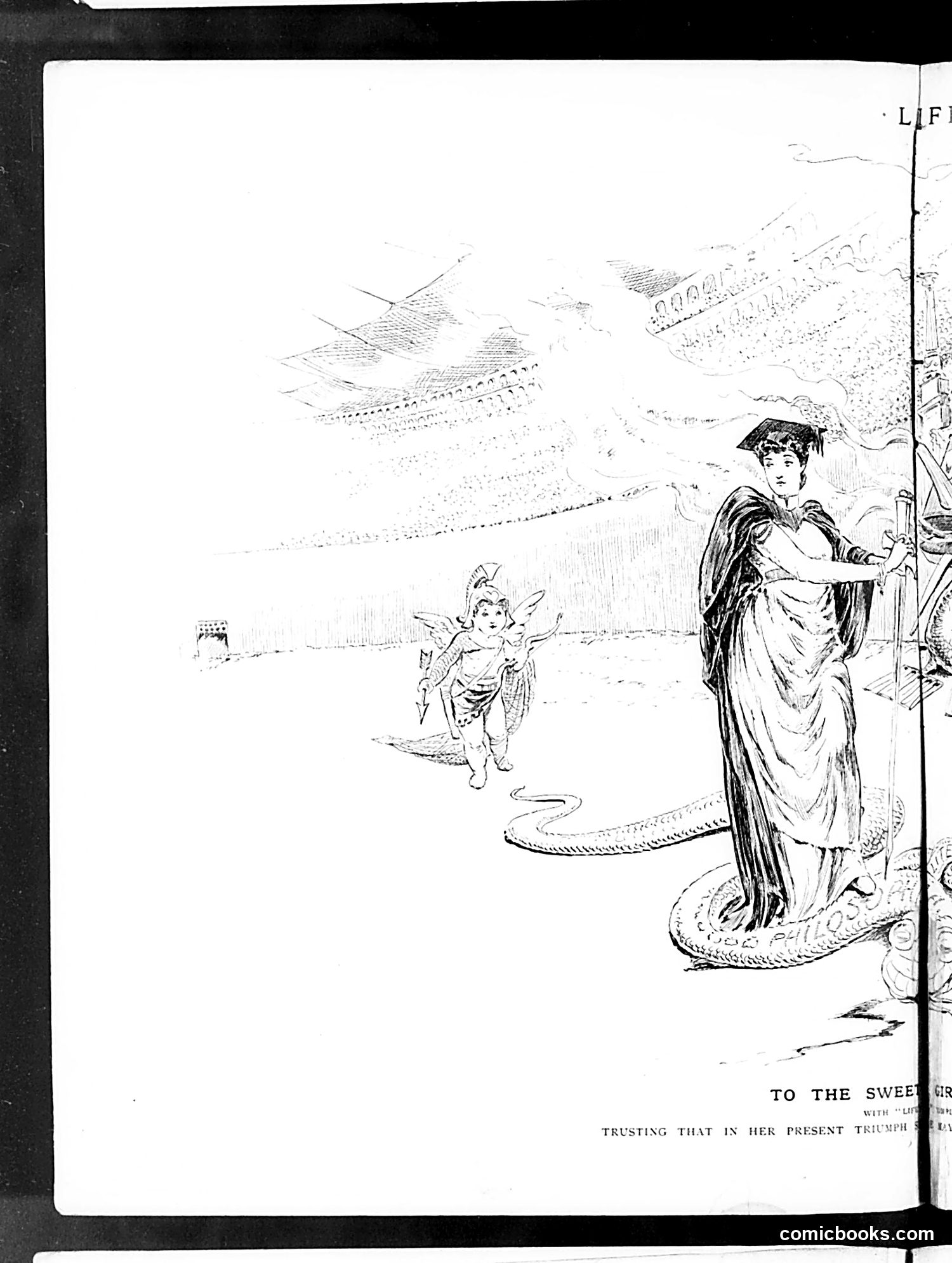
This appears to be a dedicatory or title page from *Life* magazine. The illustration shows an allegorical scene: a classical female figure (likely representing a virtue or ideal—possibly Liberty, Justice, or similar) stands on the right, gesturing toward a small winged cherub or cupid figure in an open landscape. Mountains appear in the background. The partial text at bottom reads "TO THE SWEET..." and mentions "TRUSTING THAT IN HER PRESENT TRIUMPH..." The incomplete inscription suggests this page dedicates the following content to a female subject or ideal, with optimism about her current success or victory. Without the complete text or surrounding context, I cannot identify the specific person, event, or political issue being referenced. The classical artistic style was typical of *Life's* allegorical cover designs from the early 20th century.
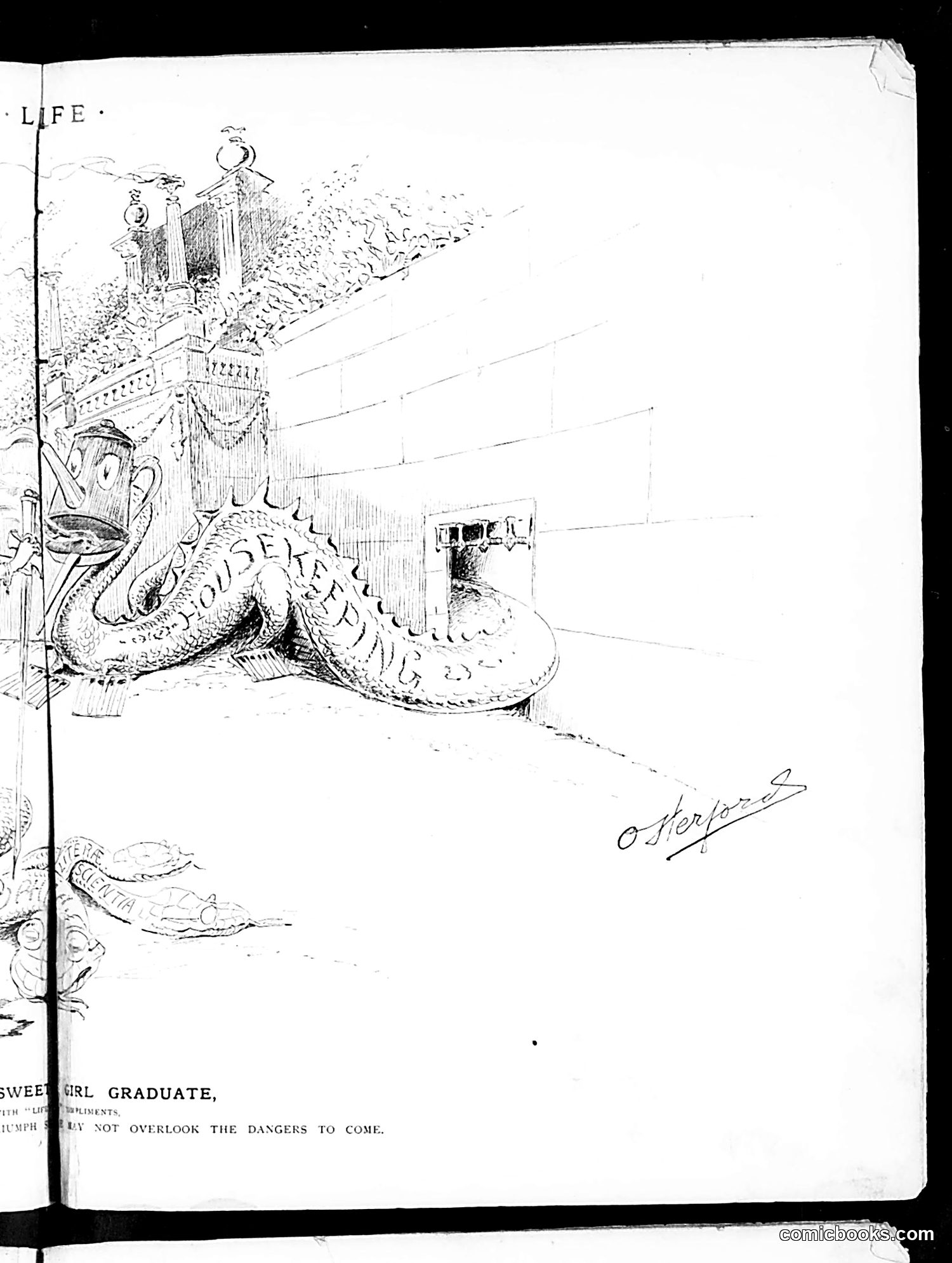
This political cartoon depicts a large dragon coiled around an ornate gate or fortification, with classical architectural elements visible. The dragon appears to represent a threat or danger—likely symbolizing war, tyranny, or another menace of the period. The visible text fragment reads "SWEET GIRL GRADUATE" and warns to "NOT OVERLOOK THE DANGERS TO COME," suggesting this cartoon addresses threats facing young women entering adult life after graduation. The artist's signature appears to be "O. Herford." The cartoon uses the dragon as classical symbolism for peril or evil forces. Without the full page context or publication date, the specific historical threat referenced remains unclear, though the cautionary tone suggests commentary on societal dangers of the era.
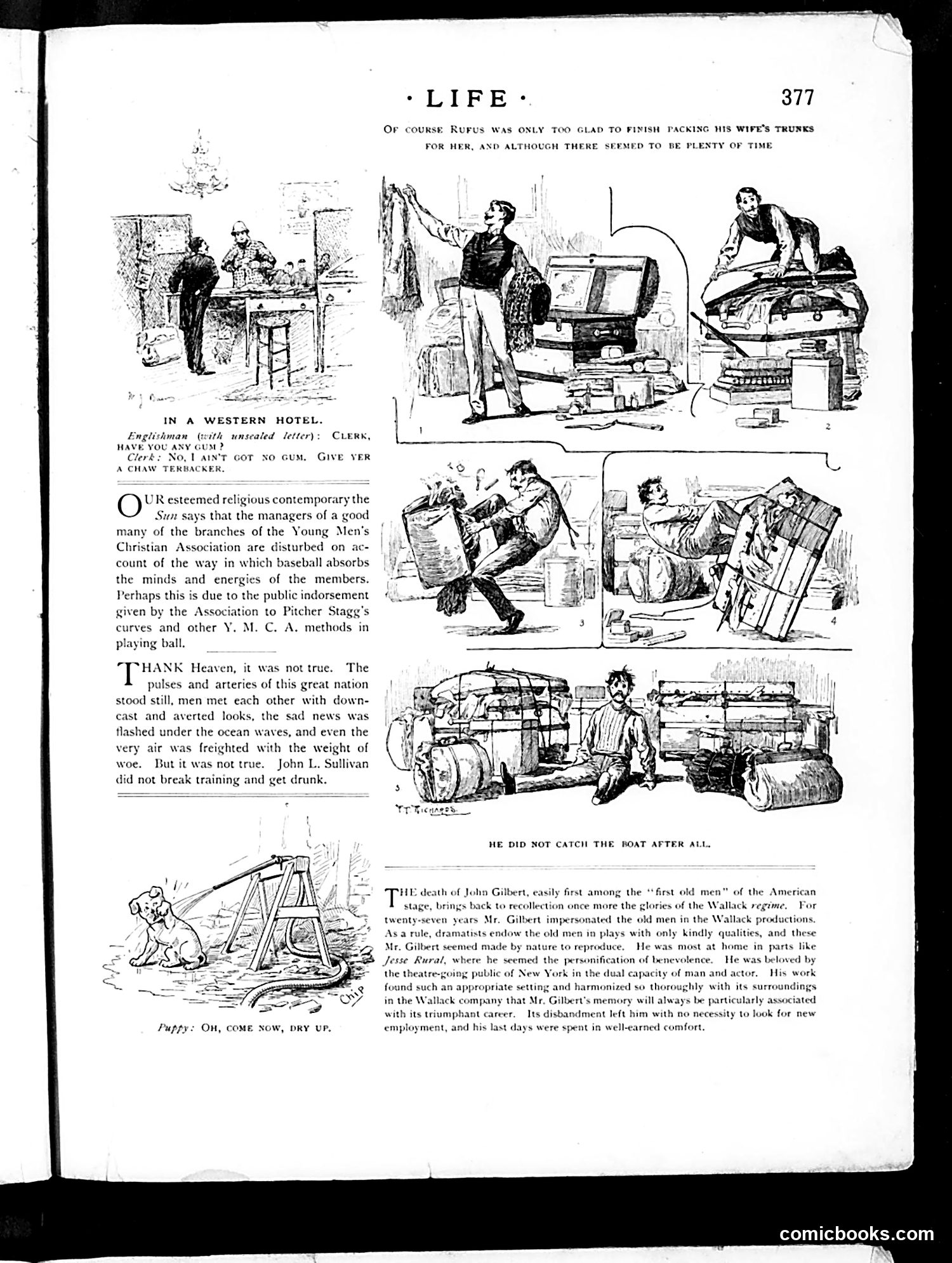
This page contains a humorous narrative sequence about packing for travel, likely depicting a married couple preparing for a journey. The illustrations show the escalating chaos of Wife's packing efforts—trunks overflowing, clothing strewn about, and increasingly frantic activity. The satire targets the stereotype of wives' excessive luggage and the time-consuming nature of packing, contrasted with the husband's (Rufus's) impatience. The final panel shows a boat departing without them, suggesting the packing took so long they missed their departure entirely. The accompanying text discusses John L. Sullivan and the Wallack theatrical company, appearing to be an unrelated tribute to deceased actor John Gilbert. The page mixes satirical domestic humor with theatrical commentary, typical of Life's format during this period.
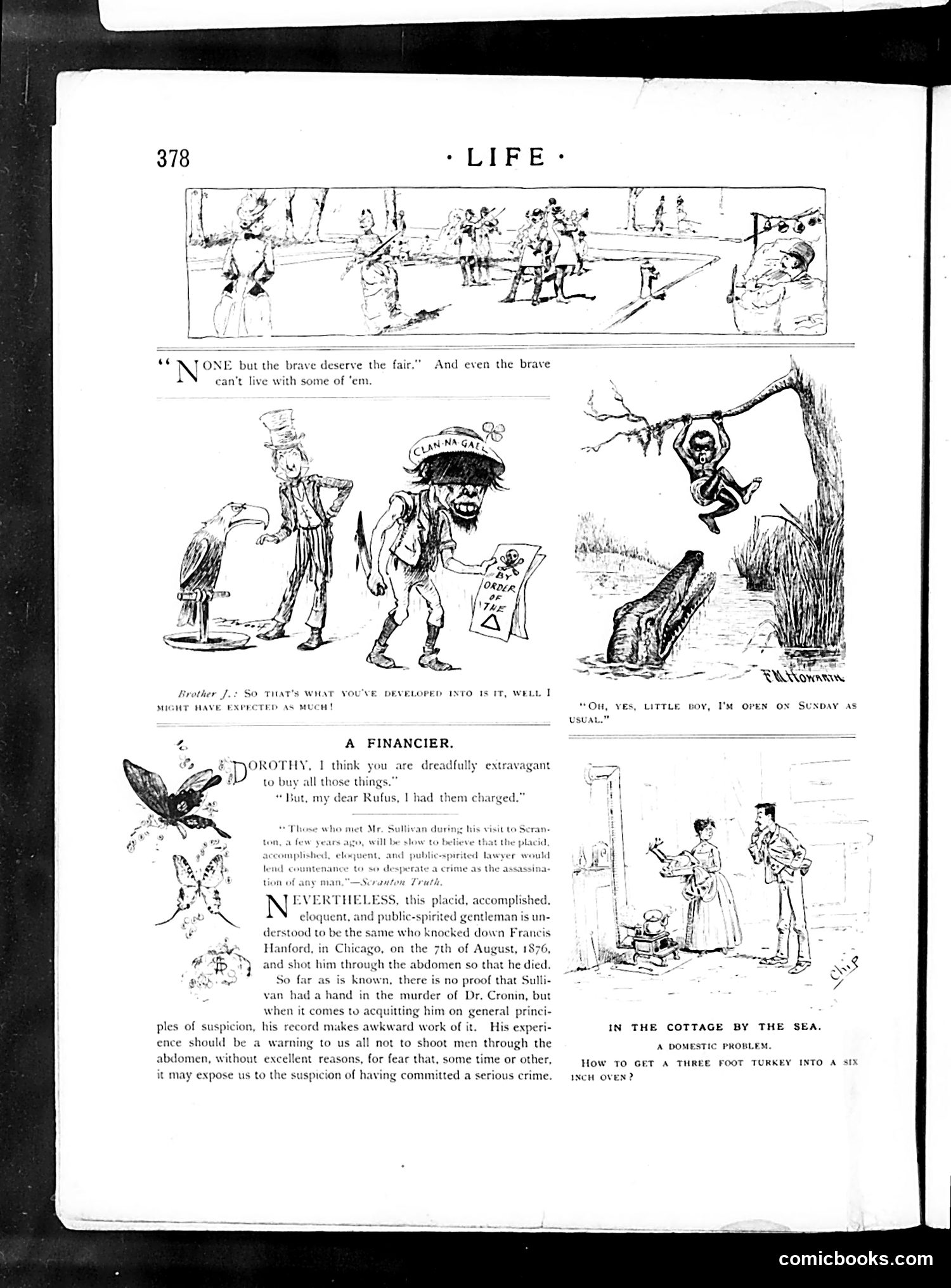
This page contains three satirical pieces from *Life* magazine: **Top cartoon**: A beach scene satirizing class differences—wealthy people enjoying leisure while workers labor nearby, with the caption about "the brave" and fairness suggesting ironic commentary on social inequality. **"A Financier"**: A dialogue mocking extravagant spending and debt. A woman (Dorothy) buys expensive items; her husband (Rufus) objects, but she replies she had them "charged"—a joke about purchasing on credit without immediate payment consequences. **The Sullivan passage**: References a real historical figure (appears to be John "The Shaughraun" Sullivan or similar), noting he violently assaulted Francis Hanford in Chicago (1876) and killed him. The text sardonically warns against shooting people through the abdomen without "excellent reasons," as such violence creates suspicion of other crimes—likely alluding to unsolved murders he may have committed. **Bottom cartoon**: A domestic humor piece about fitting a three-foot turkey into a six-inch oven—a simple joke about practical impossibility, relatable to holiday cooking.
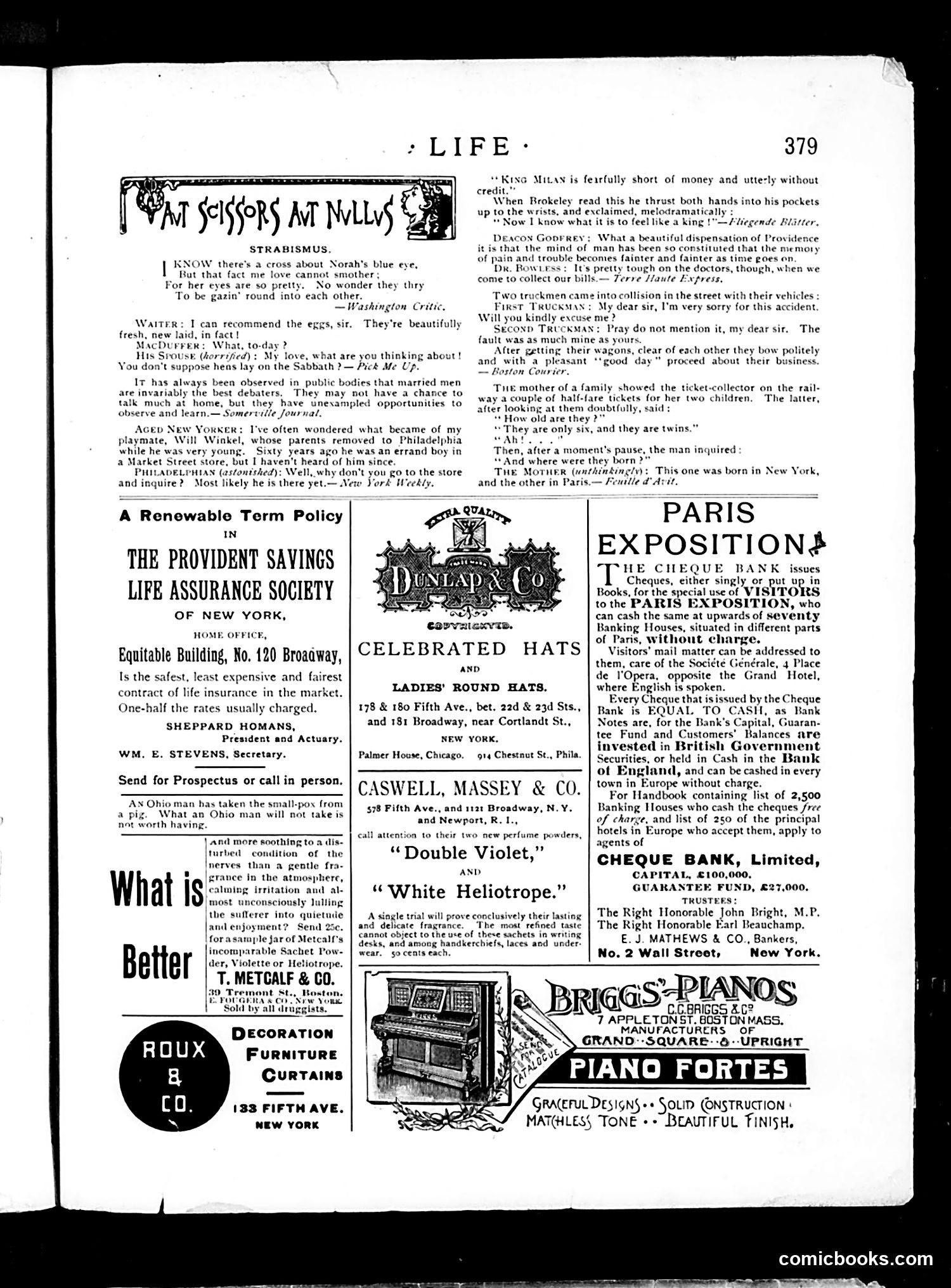
This page is **primarily advertisements** with brief satirical humor pieces interspersed. The main content consists of short jokes typical of *Life* magazine's humor section: - **"Strabismus"**: A quip about a cross-eyed woman named Norah whose eyes look in different directions - **King Milan anecdote**: A joke about a poor king; when someone reads he has no money, the reader feels rich by comparison - **Various one-liners** about eggs, clergymen, married men's debating skills, and other domestic observations The satirical tone is gentle and observational rather than political. These are **brief, pun-driven gags** typical of late-19th/early-20th century American humor magazines. The **advertisements** dominate the page: life insurance, celebrated hats, perfume powders, pianos, and furniture. The ads use period typography and elaborate Victorian styling. No clear political cartoons or caricatures appear. The page reflects *Life*'s format as a humor and satire publication mixing jokes with commercial advertisements.
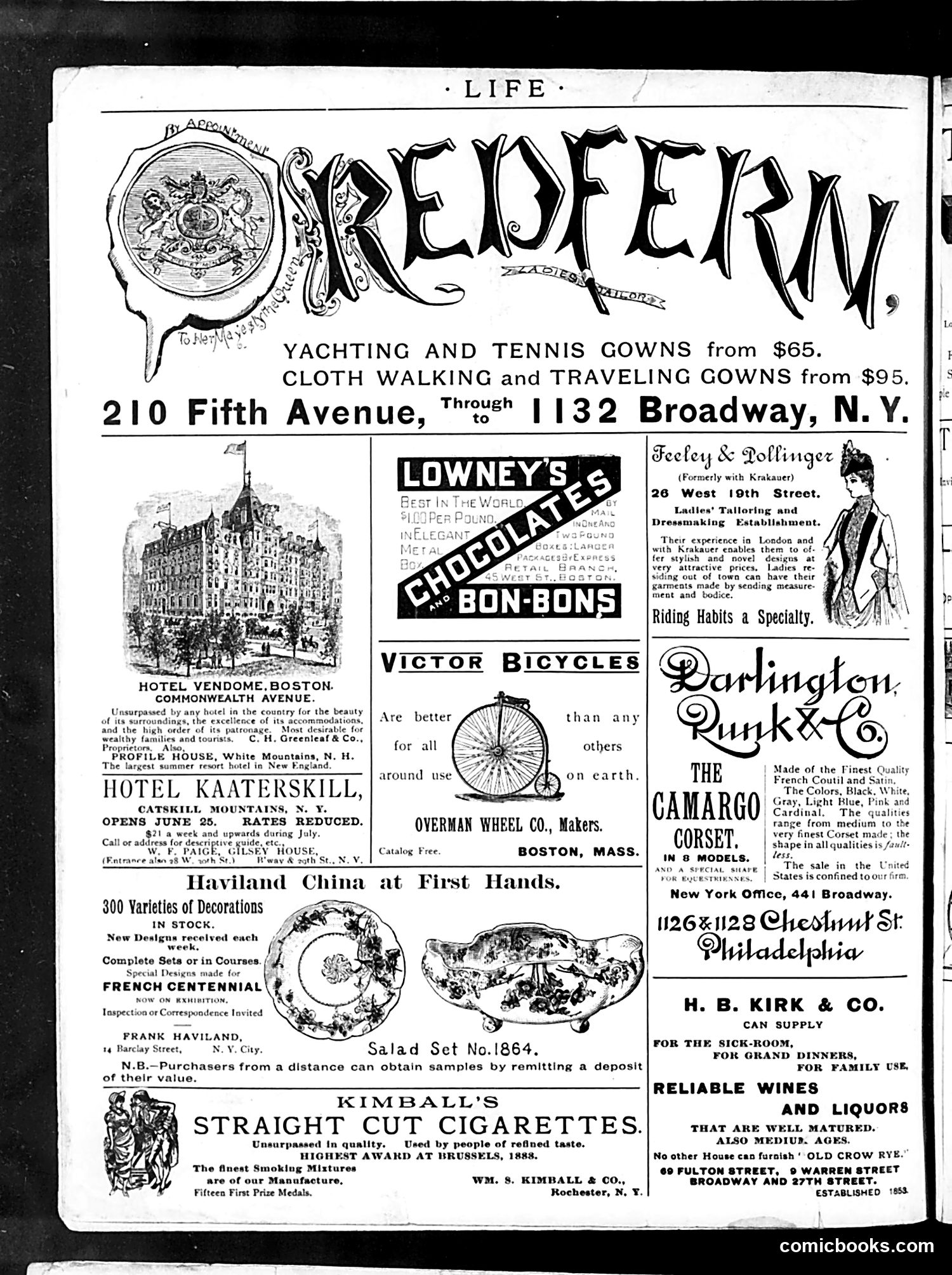
This is **not a cartoon page** but rather a full-page advertisement section from *Life* magazine. The page contains no political satire or editorial content. The ads showcase luxury goods targeting wealthy Americans of the era: women's fashions (yachting gowns, riding habits), upscale hotels in fashionable destinations (Boston, Catskill Mountains), fine china and tableware, bicycles, corsets, cigarettes, and liquor. The "O'Redfern" header advertises high-end women's clothing, while other advertisers emphasize quality ("finest," "unsurpassed") and prestigious credentials (Brussels awards, London experience). **Historical context**: This reflects Gilded Age consumerism—the page targets an affluent audience with leisure time and disposable income for travel, fashion, and entertainment. The prominence of women's clothing and corset ads reflects the era's focus on female fashion and social roles. No satire or political content appears on this page.
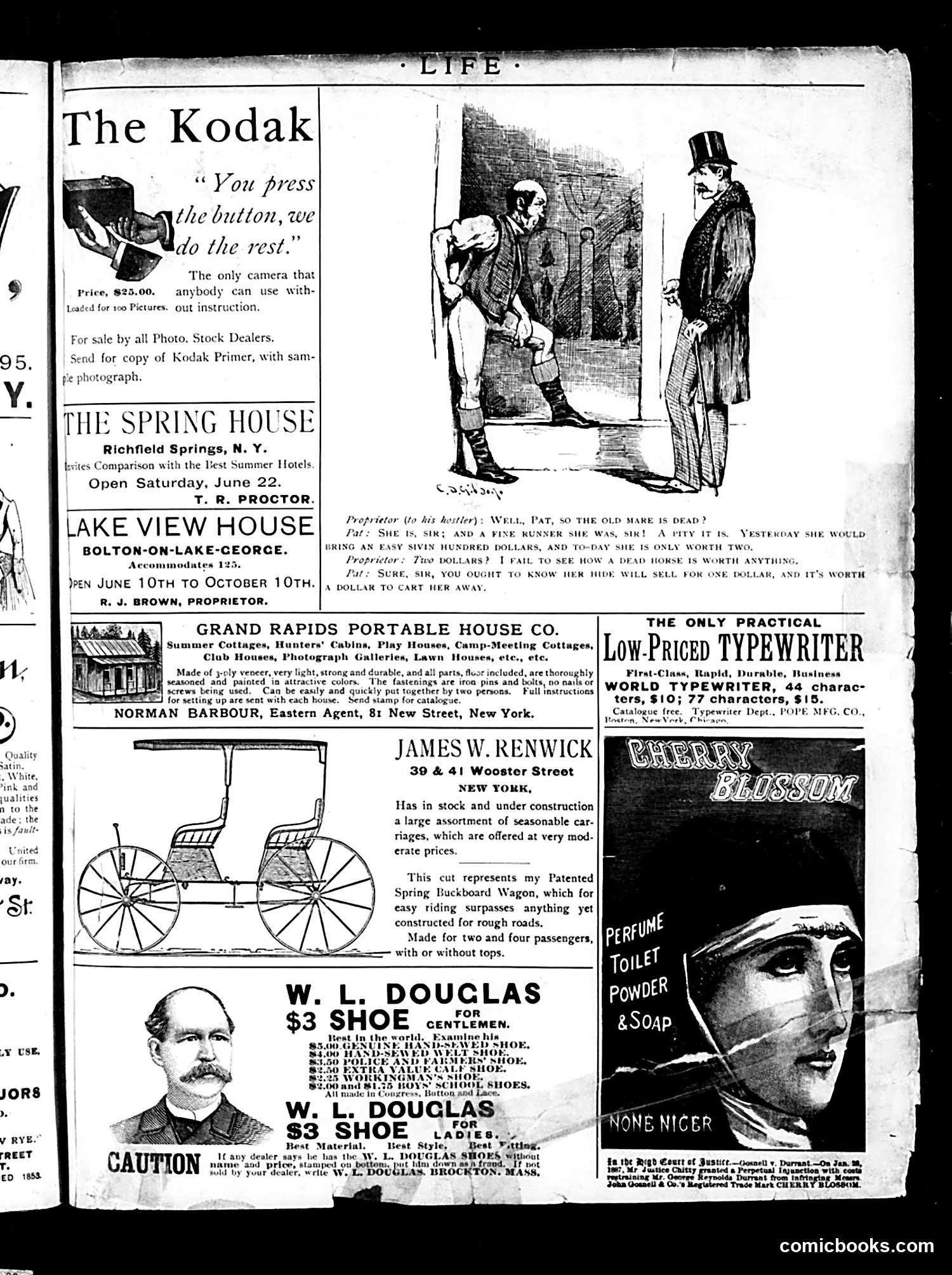
This page is primarily **advertisements** with one small cartoon. The main satirical content is a brief comic dialogue between a hotel proprietor and his stableman "Pat" about a dead horse. **The Cartoon's Joke:** The proprietor is shocked that a dead horse has any value, but Pat explains the hide can be sold for $1 and the carcass can be hauled away for another $1—totaling $2. It's a darkly humorous Irish-servant stereotype joke playing on unexpected practicality: even a worthless dead animal has salvage value if you think creatively about its parts. The humor relies on Pat's working-class resourcefulness outwitting his educated employer's assumptions. **The Advertisements** showcase late-19th-century products: Kodak cameras (emphasizing ease-of-use for amateurs), hotel resorts, portable houses, carriages, typewriters, shoes, and beauty products—typical consumer goods of the period.
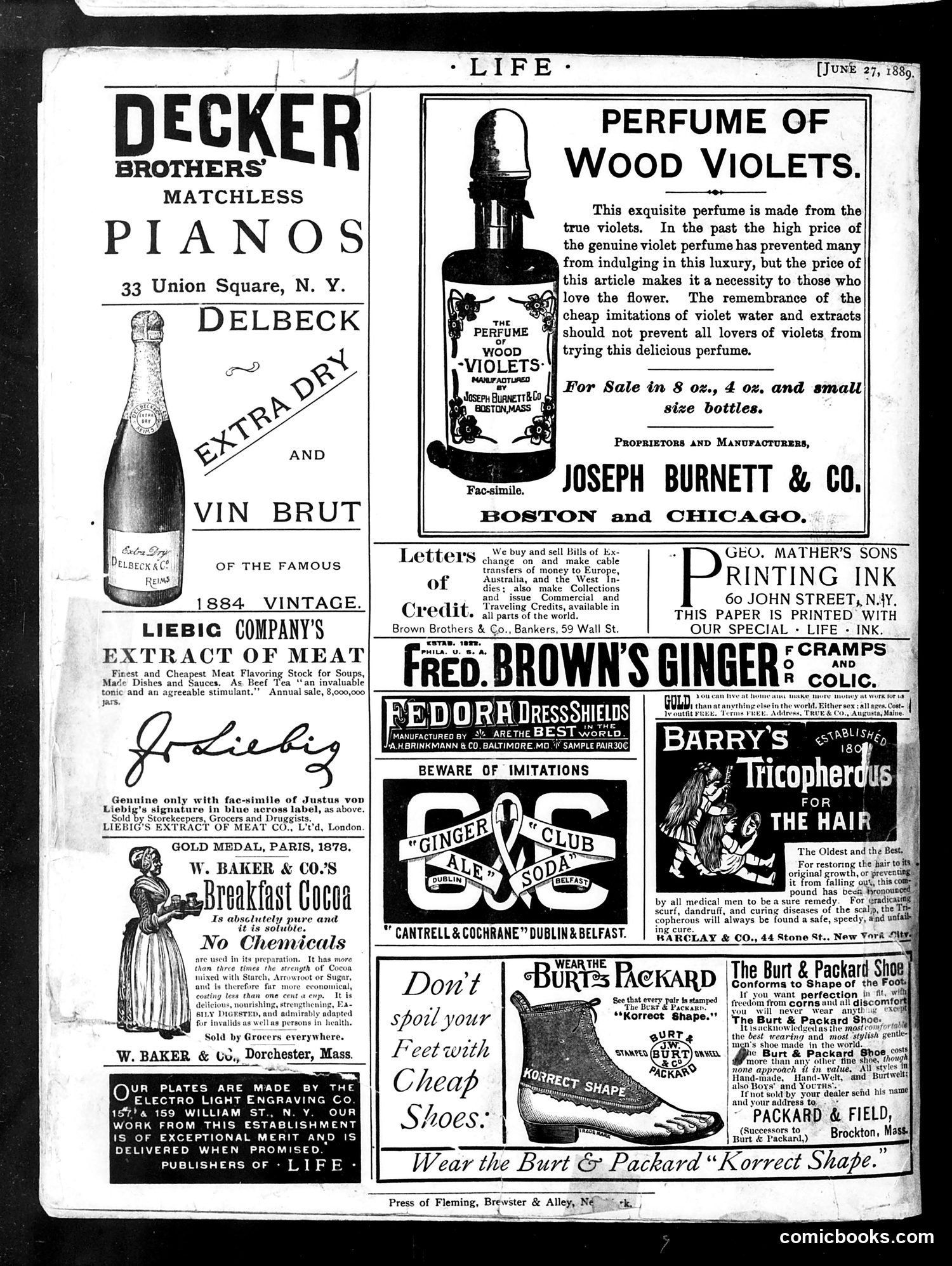
This is primarily an **advertising page** rather than a satirical cartoon page. The content consists of various product advertisements typical of the late 1880s. Notable ads include: - **Decker Brothers Pianos** and **Delbreck champagne** (luxury goods) - **Liebig's Extract of Meat** and **W. Baker & Co. Breakfast Cocoa** (food products emphasizing purity and health benefits) - **Perfume of Wood Violets** (marketed as now affordable to the masses, previously a luxury item) - **Brown's Ginger Ale**, **Barry's Tricopherous hair product**, and **Burt & Packard shoes** (consumer goods) - A **"Beware of Imitations"** warning for Ginger Ale, reflecting period concerns about counterfeit products The ads collectively reflect **Gilded Age consumer culture**—marketed convenience, aspirational luxury goods becoming democratized through lower pricing, and emphasis on authenticity against cheap imitations. There are no visible political cartoons or satire on this particular page.
I can see this is a page from Life magazine (dated 1889 based on the marking in the upper left), but the image is almost entirely black with only fragments of text visible along the left margin. The legible portions appear to be advertisement text mentioning "Shoe," "Comfort," and a location ending in "Mass," but there's insufficient visible content to identify any specific cartoons, figures, or satirical commentary. To properly analyze the political or social satire, I would need a clearer image where the actual cartoon illustrations and accompanying text are readable. As presented, I cannot responsibly identify specific caricatures or explain the intended jokes without being able to see the substantive content.